
Life, 1915-02-18 · page 25 of 44
Life — February 18, 1915 — page 25: what you’re looking at
What you’re looking at
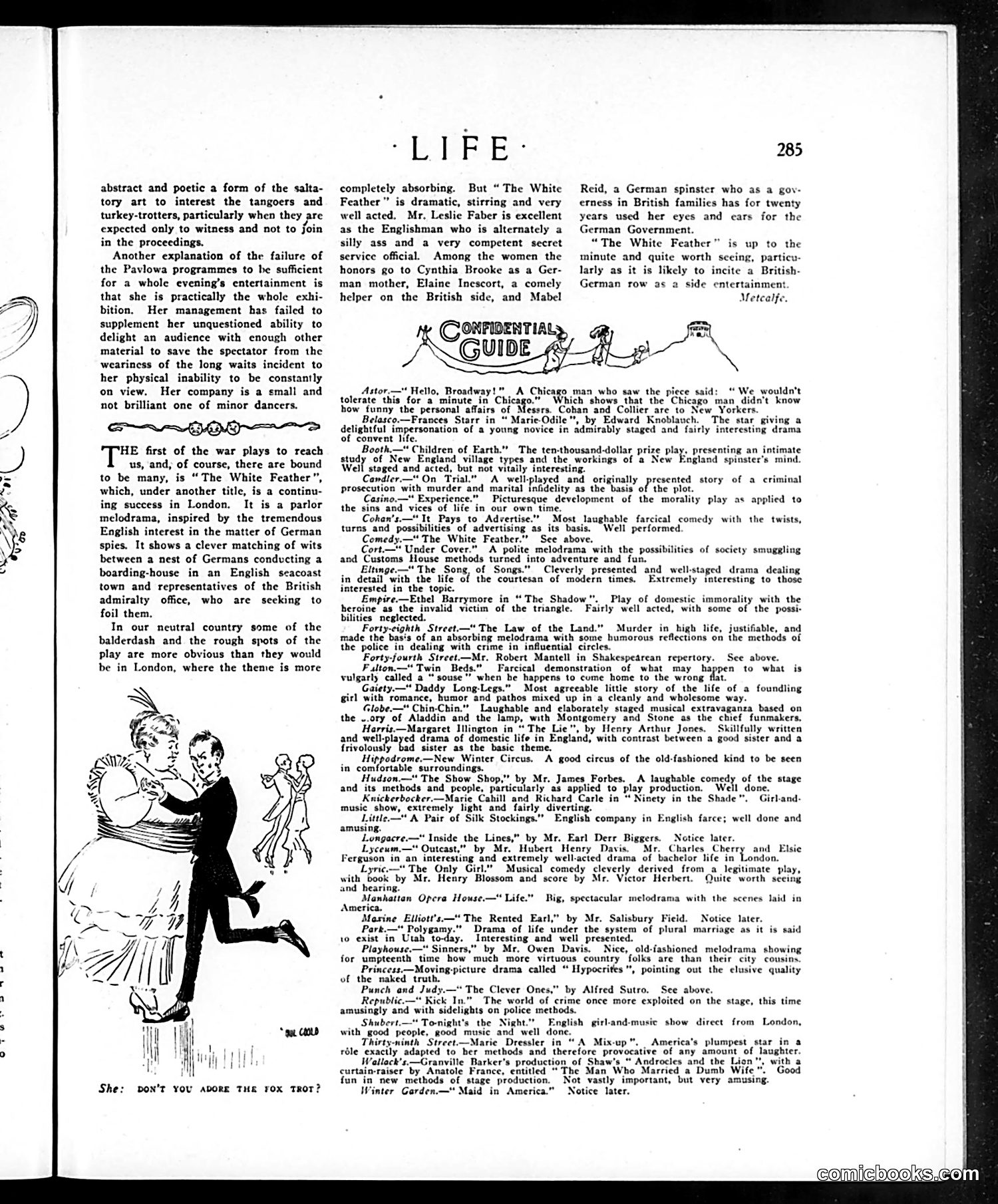
This page reviews theatrical productions, primarily focusing on "The White Feather," a war play about German spies operating from a boarding house in an English coastal town during WWI. The review praises it as dramatic and well-acted, noting British audiences find it more absorbing than American spectators. The cartoon shows a man dancing the fox trot with a large woman, captioned "She: DON'T YOU ADORE THE FOX TROT?" The joke satirizes the fox trot's popularity—the man appears to be struggling under the woman's weight, suggesting the dance craze, while fashionable, may be physically taxing or ridiculous. The page also briefly criticizes the Pavlova ballet program for being insufficient evening entertainment, claiming the famous dancer's small supporting cast creates tedious waits between performances. Other theater reviews follow in condensed form.
📄 Transcribed text from this page (OCR, searchable)
Machine-transcribed from the original scan — historical spelling and the odd misread are preserved.
abstract and poetic a form of the salta- tory art to interest the tangoers and turkey-trotters, particularly when they pre expected only to witness and not to join in the proceedings. Another explanation of the failure of the Pavlowa programmes to be sufficient for a whole evening’s entertainment is that she is practically the whole exhi- bition, Her management has failed to supplement her unquestioned ability to delight an audience with enough other material to save the spectator from the weariness of the long waits incident to her physical inability to be constantly on view. Her company is a small and not brilliant one of minor dancers. PHA 'HE first of the war plays to reach us, and, of course, there are bound to be many, is “The White Feather”, which, under another title, is a continu- ing success in London. It is a parlor melodrama, inspired by the tremendous English interest in the matter of German spies. It shows a clever matching of wits between a nest of Germans conducting a boarding-house in an English seacoast town and representatives of the British admiralty office, who are seeking to foil them. In our neutral country some of the balderdash and the rough spots of the play are more obvious than they would be in London, where the theme is more YOU ADORE THE FOX TROT? -LIFE-: completely absorbing. But “The White Feather” is dramatic, stirring and very well acted. Mr, Leslie Faber is excellent as the Englishman who is alternately a silly ass and a very competent secret service official. Among the women the honors go to Cynthia Brooke as a Ger- man mother, Elaine Inescort, a comely 285 Reid, a German spinster who as a gov- erness in British families has for twenty years used her eyes and ears for the German Government. “The White Feather” is up to the minute and quite worth seeing, particy- larly as it is likely to incite a British- German row as a side entertainmen’ helper on the British side, and Mabel KGa oe Astor. —“ Hello, Broadway!" A Chicago man who saw the piece said: “ We wouldn't tolerate this for a minute in Chicago.” Which shows that the Chicago man didn't know how funny the personal affairs of Messrs. Cohan and Collier are to New Yorkers Belasco.—Frances Starr in “ Marie-Odile", by Edward Knoblauch. The star giving a delightful impersonation of a young novice in admirably staged and fairly interesting drama of convent life. Booth.—" Children of Earth.” study of New England village ty Well staged and acted, but not vit Candler—" On Trial prosecution with murder Casin Experi the sins and Cohan’s.—"' It Pays to Ade: turns and possibilities of advertising as its basis, Well performed. The White Feather." See above. Under Cover.” A polite melodrama with the possibilities of society smuggling and Customs House methods turned into adventure and fun. Eltinge.—"" The Song, of Songs." Cleverly presented and well-staged drama dealing in detail with the life of the courtesan of modern times, Extremely interesting to those interested in the topic. Empire.—Ethel Barrymore in “The Shadow". Play of domestic immorality with the ine as the invalid victim of the triangle. Fairly well acted, with some of the possi- bilities neglected. Forty-cighth Street—" The Law of the Land.” Murder in high life, justifiable, and made the bas's of an absorbing melodrama with some humorous reflections on the methods of the police in dealing with crime in influential circles. Forty-jourth Street.—Mr. Robert Mantell in Shakespearean repertory. See above. Falton.—" Twin Beds." Farcical demonstration of what may happen to what is vulgarly called a“ when be happens to cume home to the wrong flat. Gaiety.—" Daddy Long-Legs.” Most agreeable little story of the life of a foundling girl with romance, humor and pathos mixed up in a cleanly and wholesome way. Globe.—* Chin-Chin.” Laughable and elaborately staged musical extravaganza based on the ..ory of Aladdin and the lamp, with Montgomery and Stone as the chief funmakers, Harris.—Margaret Ilington in “The Lie”, by Henry Arthur Jones, Skillfully written and well-played drama of domestic life in England, with contrast between a good sister and a frivolously bad sister as the basic theme. Hippodrome.—New Winter Circus. A good circus of the old-fashioned kind to be seen in comfortable surroundings. Hudson.— The Show Shop," by Mr. James Forbes. A laughable comedy of the stage and its methods and people, particularly a3 applied to play production, Well done. Knickerbocker.—Marie Cahill and Richard Carle in “Ninety in the Shade”. Girl-and- music show, extremely light and fairly diverting. Little.—" A Pair of Silk Stockings.” English company in English farce; well done and amusing. Longacre.—" Inside the Lines," by Mr. Earl Derr Biggers. Notice later. Lyceum.—" Outcast,” by Mr. Hubert Henry Davis, Mr. Charles Cherry Elsie Ferguson in an interesting and extremely wellacted drama of bachelor life in London. Lyric.—" The Only Girl." Musical comedy cleverly derived from a legitimate play, with ‘book by Mr. Henry Blossom and score by Mr. Victor Herbert. Quite worth sceing and hearing. Manhattan Opera House.—" Life.” America, The Rented Earl,” by Mr. Salisbury Field. Notice later. Drama of life under the system of plural marriage as it is said to exist Interesting and well presented. Playhouse.—" Sinners," by Mr. Owen Davis. Nice, old-fashioned melodrama showing for umpteenth time how’ much more virtuous country ‘folks are than their city cousins, Princess.—Moving-picture drama called “ Hypocrites", pointing out the elusive quality of the naked truth. Punch and Judy.—* The Clever Ones,” by Alfred Sutro. See above. Republic.— Kick In." The world of crime once more exploited on the stage, this time amusingly and with sidelights on police methods. Shubdcrt.—" Tonight's the Night.” English girland-musie show direct with! good people, good music and well done. Thirty-ninth Street—Marie Dressler in “A Mix-up". America’s plumpest star in a réle exactly adapted to ber methods and therefore provocative of any amount of laughter. Wallack's.—Granville Barker's production of Shaw's “ Androcies and the Lion", with a curtain-raiser by Anatole France, entitled “The Man Who Married a Dumb Wife". Good fun in new methods of stage production. Not vastly important, but very amusing. Winter Garden." Maid in America.” Notice later. The ten-thousand-dollar prize play. presenting an intimate 1 the workings of a New England spinster’s mind. ly interesting. A Meltplayed and originally presented story marital infidelity as the basis of the plot. of a criminal Most laughable farcical comedy with the twists, Rig, spectacular melodrama with the scenes laid in from London,