
Life, 1915-02-18 · page 10 of 44
Life — February 18, 1915 — page 10: what you’re looking at
What you’re looking at
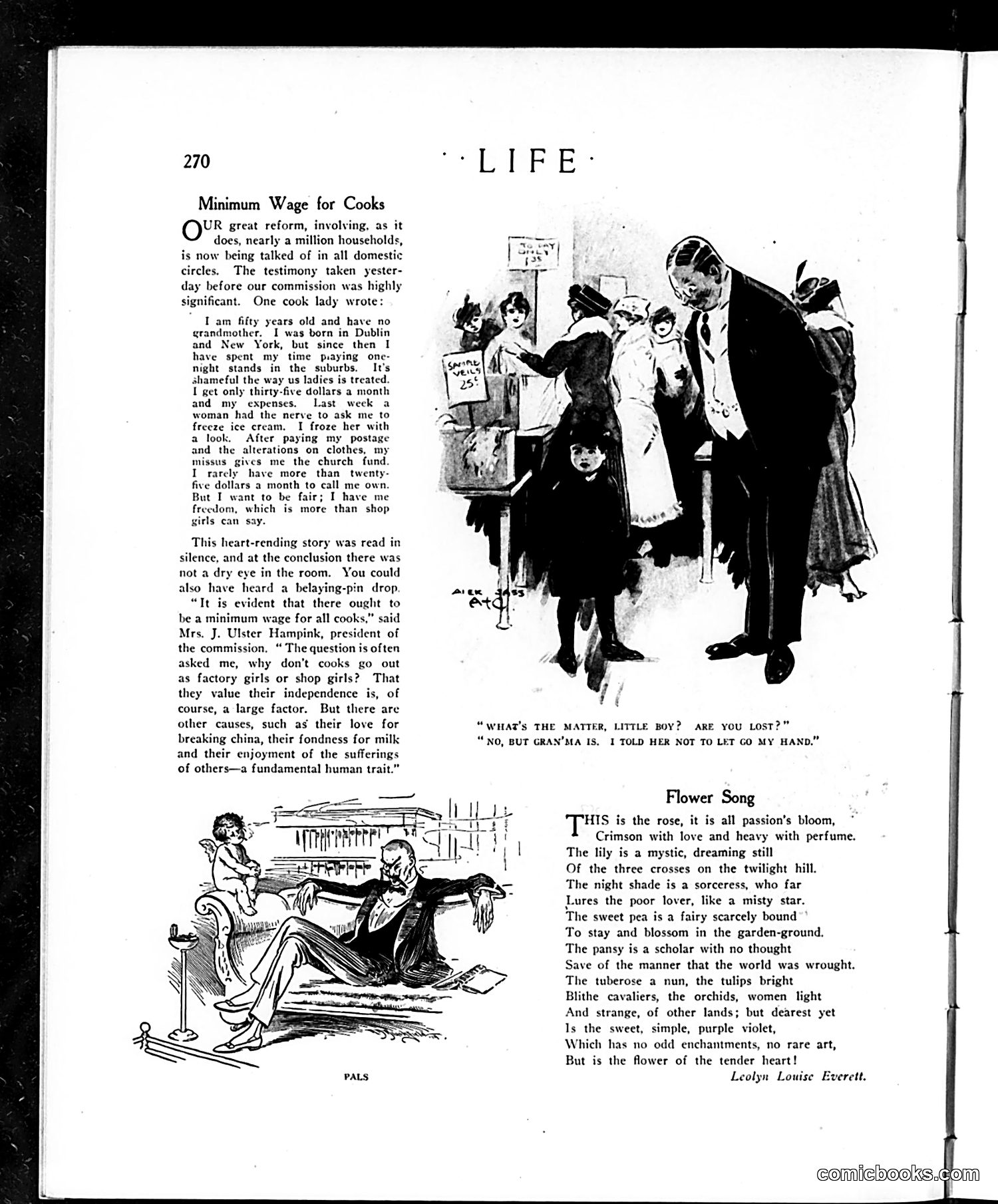
**Main Article & Cartoon:** This section presents testimony from a 50-year-old cook describing exploitative working conditions—earning only $35/month with additional unpaid domestic duties (laundry, church work). The accompanying illustration shows a woman cook with children gathered around her, apparently discussing wages or employment. The article advocates for minimum wage legislation for domestic workers, with Mrs. J. Ulster Hampkin (commission president) arguing that cooks deserve better pay and independence comparable to factory workers. The satire critiques society's undervaluation of domestic labor and the physical/emotional toll on working women. **"Flower Song" Poem:** Below is an unrelated romantic poem by Leolyn Louise Everett celebrating various flowers. The "PALS" sketch at bottom left appears to be a separate humorous illustration.
📄 Transcribed text from this page (OCR, searchable)
Machine-transcribed from the original scan — historical spelling and the odd misread are preserved.
270 Minimum Wage for Cooks UR great reform, involving, as it does, nearly a million households, is now being talked of in all domestic circles. The testimony taken yester- day before our commission was highly significant. One cook lady wrote: T am fifty years old and have no grandmother, I was born in Dublin and New York, but since then I have spent my time p.aying one- night stands in the suburbs. It’s shameful the way us ladies is treated. I get only thirty-five dollars a month and my expenses. Last week a woman had the nerve to ask me to freeze ice cream, I froze her with a look. After paying my postag: and the alterations on clothes, my missus gives me the church fund. I rarely have more than twenty- five dollars a month to call me own. But I want to be fair; I have me freedom, which is more than shop girls can say. This heart-rending story was read in silence, and at the conclusion there was not a dry eye in the room. You could also have heard a belaying-pin drop. “Tt is evident that there ought to be a minimum wage for all cooks,” said Mrs. J. Ulster Hampink, president of the commission. “ The question is often asked me, why don’t cooks go out as factory girls or shop girls? That they value their independence is, of course, a large factor. But there are other causes, such as their love for “WHAT’s THE MATTER, LITTLE BOY? ARE YOU LOST?” breaking china, their fondness for milk “NO, BUT GRAN’MA IS, I TOLD HER NOT TO LET GO MY HAND.” and their enjoyment of the sufferings of others—a fundamental human trait.” Flower Song 'HIS is the rose, it is all passion’s bloom, Crimson with love and heavy with perfume. The lily is a mystic, dreaming still Of the three crosses on the twilight hill. The night shade is a sorceress, who far Lures the poor lover, like a misty star. The sweet pea is a fairy scarcely bound To stay and blossom in the garden-ground. The pansy is a scholar with no thought Save of the manner that the world was wrought. The tuberose a nun, the tulips bright Blithe cavaliers, the orchids, women light And strange, of other lands; but dearest yet Is the sweet, simple, purple violet, Which has no odd enchantments, no rare art, But is the flower of the tender heart! Leolyn Louise Everett. comichooks.