
Life, 1915-02-18 · page 30 of 44
Life — February 18, 1915 — page 30: what you’re looking at
What you’re looking at
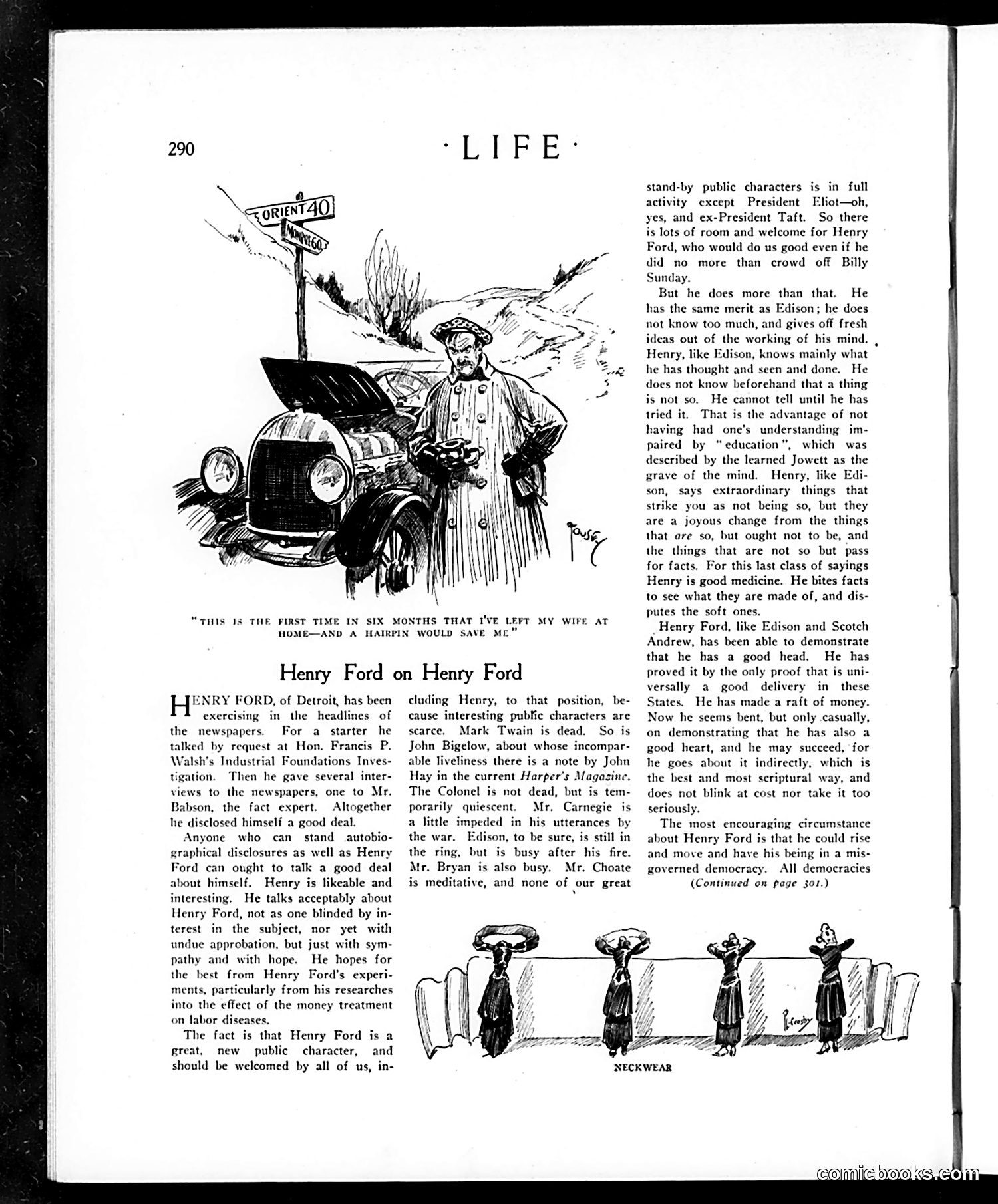
This article praises Henry Ford as a refreshing public figure during a period when other prominent Americans—Mark Twain (deceased), Carnegie, Edison, Bryan, and even ex-President Taft—are either dead or occupied elsewhere. The author argues Ford fills a genuine gap in American public discourse. The cartoon caption jokes that Ford's frequent absences from home for public appearances mean a hairpin would be more useful to his wife than his presence—a contemporary domestic jab. The article's central argument: Ford, like Edison, possesses practical intelligence unburdened by formal education, allowing him to think freshly rather than being constrained by established assumptions. This makes him valuable social medicine—he "bites facts" and challenges soft thinking. The author also credits Ford's business success and growing charitable interests as proof of both competence and character, noting approvingly that his philanthropy operates indirectly, avoiding self-promotion.
📄 Transcribed text from this page (OCR, searchable)
Machine-transcribed from the original scan — historical spelling and the odd misread are preserved.
“THIS 18 THE FIRST TIME IN SIX MONTHS THAT I'VE LEFT MY WIFE AT HOME—AND A HAIRPID WOULD SAVE ME” Henry Ford on Henry Ford RY FORD, of Detroit, has been exercising in the headlines of newspapers. For a starter he H the talked by request at Hon. Francis P. Walsh's Industrial Foundations Inves- tigation. Then he gave several inter- views to the newspapers, one to Mr. Babson, the fact expert. Altogether he disclosed himself a good deal. Anyone who can stand autobio- graphical disclosures as well as Henry Ford can ought to talk a good deal about himself. Henry is likeable and interesting. He talks acceptably about Henry Ford, not as one blinded by terest in the subject, nor yet ith undue approbation, but just with sym- pathy and with hope. He hopes for the best from Henry Ford’s experi- ments, particularly from his researches into the effect of the money treatment on labor diseases. The fact is that Henry Ford is a great, new public character, and should be welcomed by all of us, in- cluding Henry, to that position, be- cause interesting public characters are scarce. Mark Twain is dead. So is John Bigelow, about whose incompar- able liveliness there is a note by John Hay in the current Harper’s Magazine. The Colonel is not dead, but is tem- porarily quiescent. Mr, Carnegie is a little impeded in his utterances by the war. Edison, to be sure, is still in the ring, but is busy after his fire. Mr. Bryan is also busy. Mr. Choate is meditative, and none of our great stand-by public characters is in full activity except President Eliot—oh, yes, and ex-President Taft. So there is lots of room and welcome for Henry Ford, who would do us good even if he did no more than crowd off Billy Sunday. But he does more than that. He has the same merit as Edison; he does not know too much, and gives off fresh ideas out of the working of his mind. , Henry, like Edison, knows mainly what he has thought and seen and done. He does not know beforehand that a thing is not so, He cannot tell until he has That is the advantage of not ing had one’s understanding im- paired by “education”, which was described by the learned Jowett as the grave of the mind. Henry, like Edi- son, says extraordinary things that strike you as not being so, but they are a joyous change from the things that are so, but ought not to be, and the things that are not so but pass for facts. For this last class of sayings Henry is good medicine. He bites facts to see what they are made of, and dis- putes the soft ones. Henry Ford, like Edison and Scotch Andrew, has been able to demonstrate that he has a good head. He has proved it by the only proof that is uni- versally a good delivery in these States. He has made a raft of money. Now he seems bent, but only casually, on demonstrating that he has also a good heart, and he may succeed, for he goes about it indirectly, which is the best and most scriptural way, and does not blink at cost nor take it too seriously. The most encouraging circumstance about Henry Ford is that he could rise and move and have his being in a mis- governed democracy. All democracies (Continued on page 301.)