
Life, 1915-02-18 · page 8 of 44
Life — February 18, 1915 — page 8: what you’re looking at
What you’re looking at
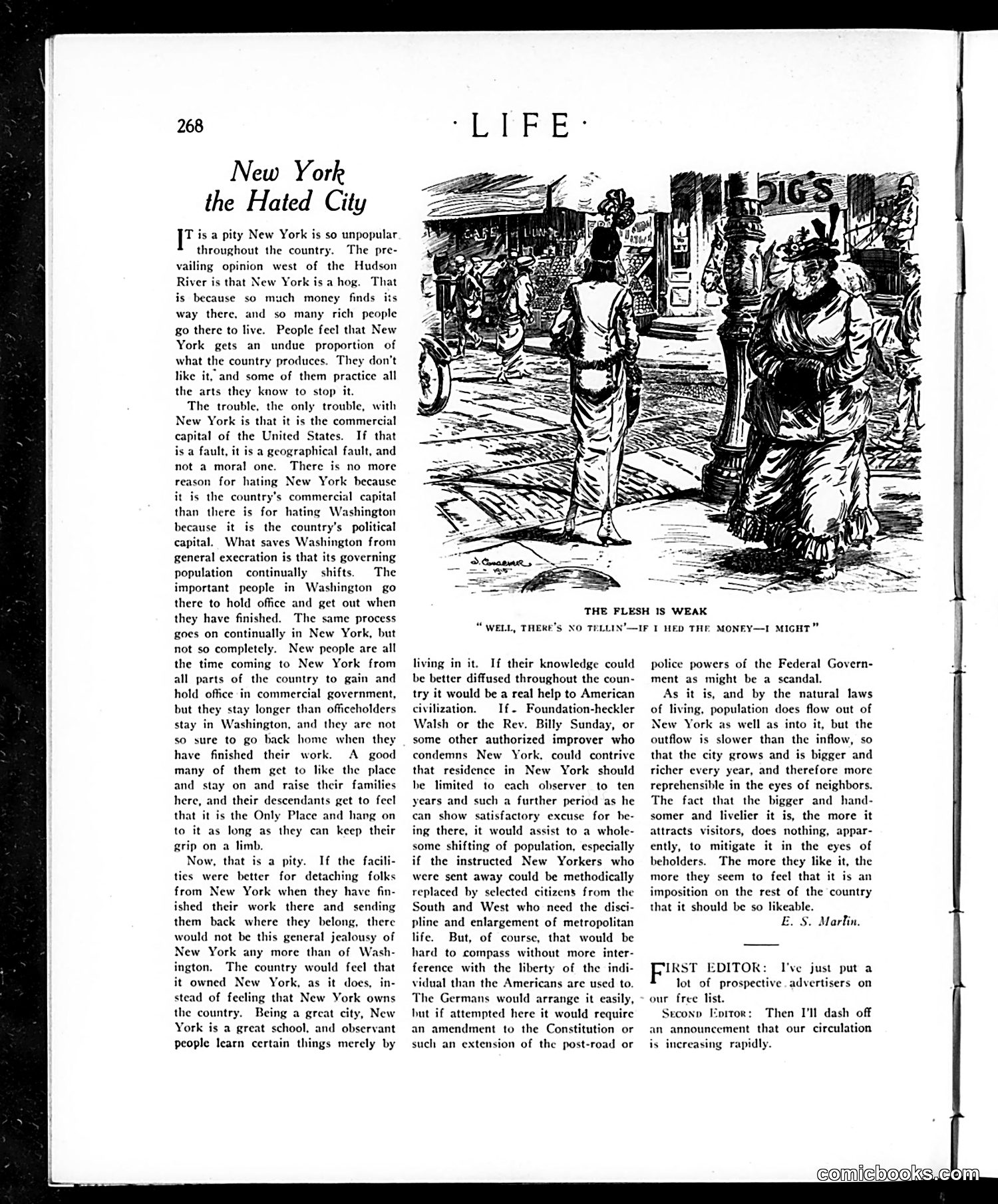
This satirical piece critiques New York's unpopular reputation nationwide. The accompanying sketch, titled "The Flesh Is Weak" with the caption "Well, there's no tellin'—if I had the money, I might," depicts a street scene where figures appear to be soliciting or engaging in vice—likely referencing prostitution or urban moral decay. The text argues New York's unpopularity stems from it being the commercial capital rather than moral failings, and that dispersing New York's population (like Washington's rotating government officials) would benefit the country. The cartoon illustrates the very urban vices that fuel anti-New York sentiment: poverty, vice, and moral corruption visibly present on city streets—the stereotypical "hated city" behavior that provincial Americans feared and resented.
📄 Transcribed text from this page (OCR, searchable)
Machine-transcribed from the original scan — historical spelling and the odd misread are preserved.
the Hated City T is a pity New York is so unpopular throughout the country. The pre- vailing opinion west of the Hudson River is that New York is a hog. That is because so much money finds way there, and so many rich people go there to live. People feel that York gets an undue proportion of what the country produces. They don’t like it, and some of them practice all the arts they know to stop it. The trouble, the only trouble, with New York is that it is the commercial capital of the United States. If that is a fault, it is a geographical fault, and not a moral one. There is no more reason for hating New York because it is the country’s commercial capital than there is for hating Washington because it is the country’s political capital. What saves Washington from general execration is that its governing population continually shifts. The important people in Washington go there to hold office and get out when they have finished. The same process goes on continually in New York, but not so completely. New people are all the time coming to New York from all parts of the country to gain and hold office in commercial government, but they stay longer than officeholders stay in Washington, and they are not so sure to go back home when they have finished their work. A good many of them get to like the place and stay on and raise their families here, and their descendants get to feel that it is the Only Place and hang on to it as long as they can keep their grip on a limb. Now, that is a pity. If the facili- ties were better for detaching folks from New York when they have fin- ished their work there and sending them back where they belong, there would not be this general jealousy of New York any more than of Wash- ington. The country would feel that it owned New York, as it does, in- stead of feeling that New York owns the country. Being a great city, New York is a great school, and observant people learn certain things merely by THE FLESH IS WEAK “WELL, THERE’S NO TELL living in it. If their knowledge could be better diffused throughout the coun- try it would be a real help to American civilization. If- Foundation-heckler Walsh or the Rev. Billy Sunday, or some other authorized improver who condemns New York. could contrive that residence in New York should he limited to cach observer to ten years and such a further period as he can show satisfactory excuse for be- ing there, it would assist to a whole- some shifting of population, especially if the instructed New Yorkers who were sent away could be methodically replaced by selected citizens from the South and West who need the disci- pline and enlargement of metropolitan life. But, of course, that would be hard to compass without more inter- ference with the liberty of the indi- vidual than the Americans are used to. The Germans would arrange it easily, but if attempted here it would require an amendment to the Constitution or such an extension of the post-road or '"—IF I HED THE MONEY—I MIGHT” police powers of the Federal Govern- ment as might be a scandal. As it is, and by the natural laws of living, population does flow out of New York as well as into it, but the outflow is slower than the inflow, so that the city grows and is bigger and richer every year, and therefore more reprehensible in the eyes of neighbors. The fact that the bigger and hand- somer and livelier it is, the more it attracts visitors, does nothing, appar- ently, to mitigate it in the eyes of beholders. The more they like more they seem to feel that it is an imposition on the rest of the country that it should be so likeable. E. S. Marlin. IRST EDITOR: I've just put a lot of prospective. advertisers on our free list. Seconp Eprtor: Then I'll dash off an announcement that our circulation is increasing rapidly.