
A complete issue · 44 pages · 1915
Life — January 21, 1915
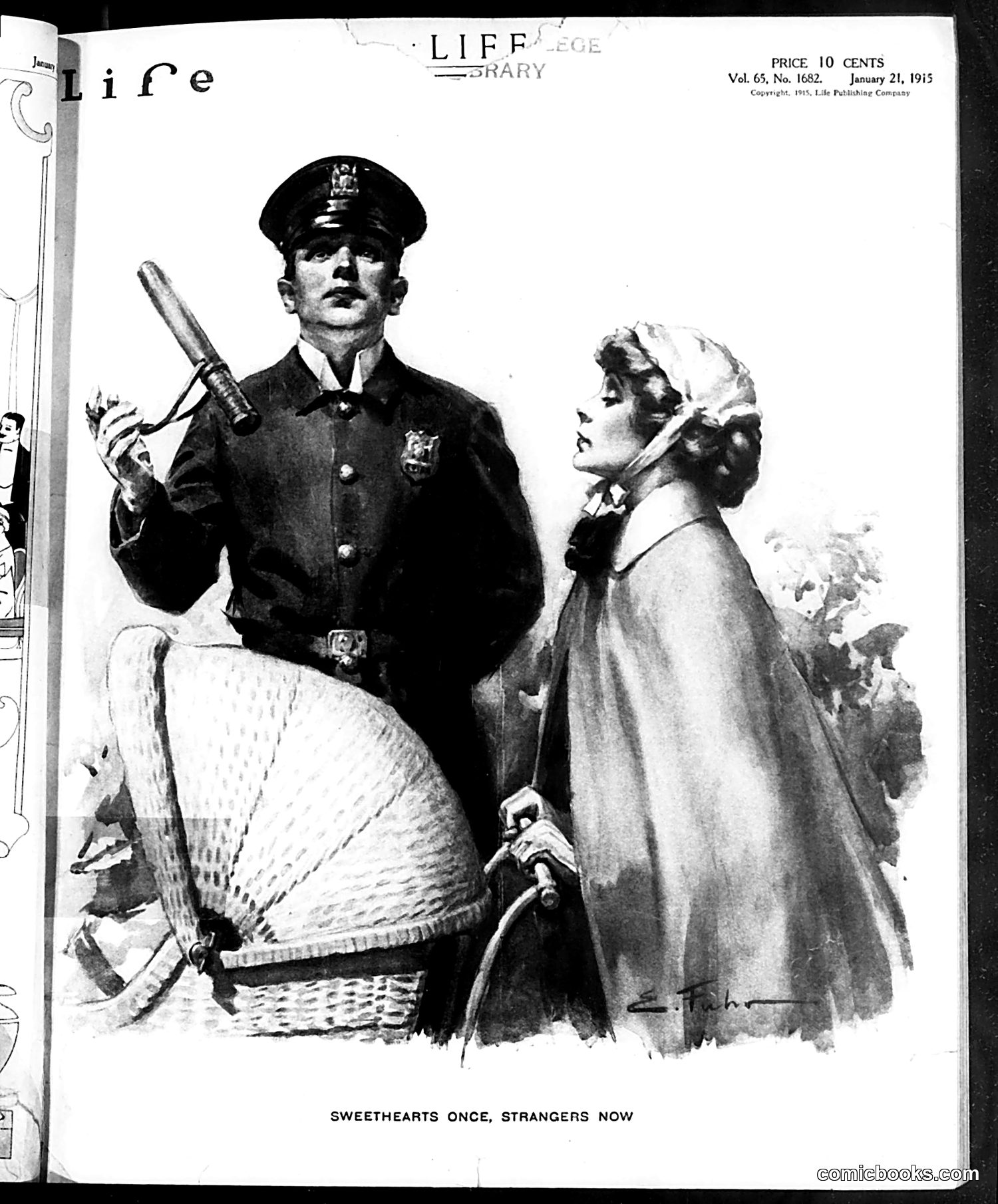
This Life magazine cover from January 21, 1915, depicts a uniformed soldier (appearing to be a police officer or military figure based on his cap and formal dark jacket) holding a telescope or viewing instrument, facing away from a woman in a light-colored coat and bonnet. The caption suggests a romantic separation—likely commentary on wartime partings or the emotional distance created by military service. Given the 1915 date (during World War I), this probably reflects contemporary anxieties about soldiers departing for war and the resulting estrangement from civilian life and romantic relationships. The soldier's turned-away posture and the woman's isolated stance visually emphasize their emotional disconnection and physical separation.
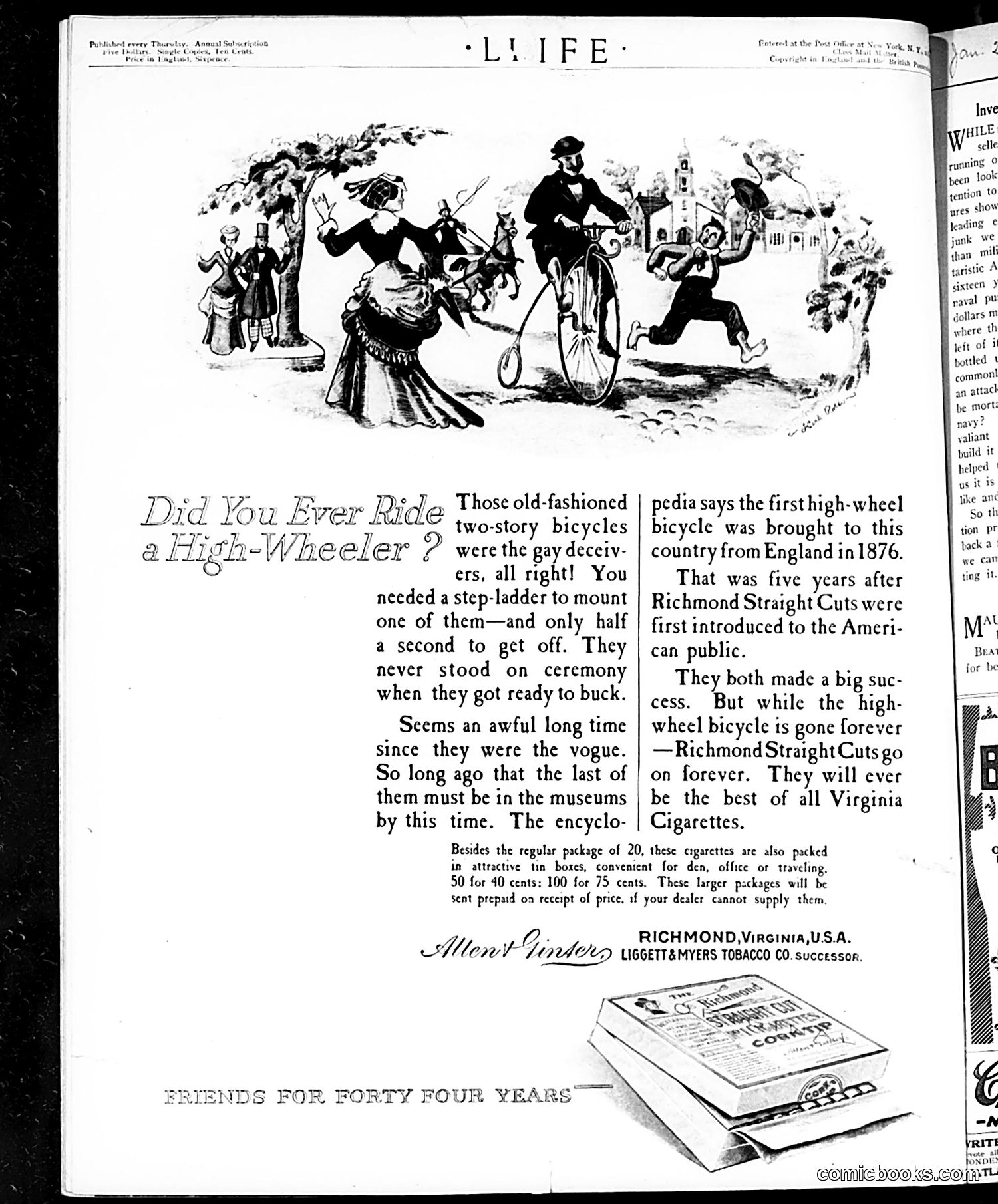
This is primarily **advertising copy** for Richmond Straight Cuts cigarettes, disguised as nostalgic humor. The illustration depicts Victorian-era people with a high-wheel bicycle ("high-wheeler"), referencing an outdated technology. The ad's joke: just as high-wheel bicycles were once fashionable but are now museum pieces, Richmond Straight Cuts cigarettes will endure forever. The text humorously notes that high-wheelers required a step-ladder to mount and were awkward to ride—contrasting this obsolescence with the cigarettes' permanent appeal. The phrase "Friends for Forty Four Years" (at bottom) emphasizes brand loyalty and longevity. This represents early 20th-century advertising strategy: using self-aware humor about consumer culture to sell products by positioning the brand as a timeless classic, unlike passing fads.
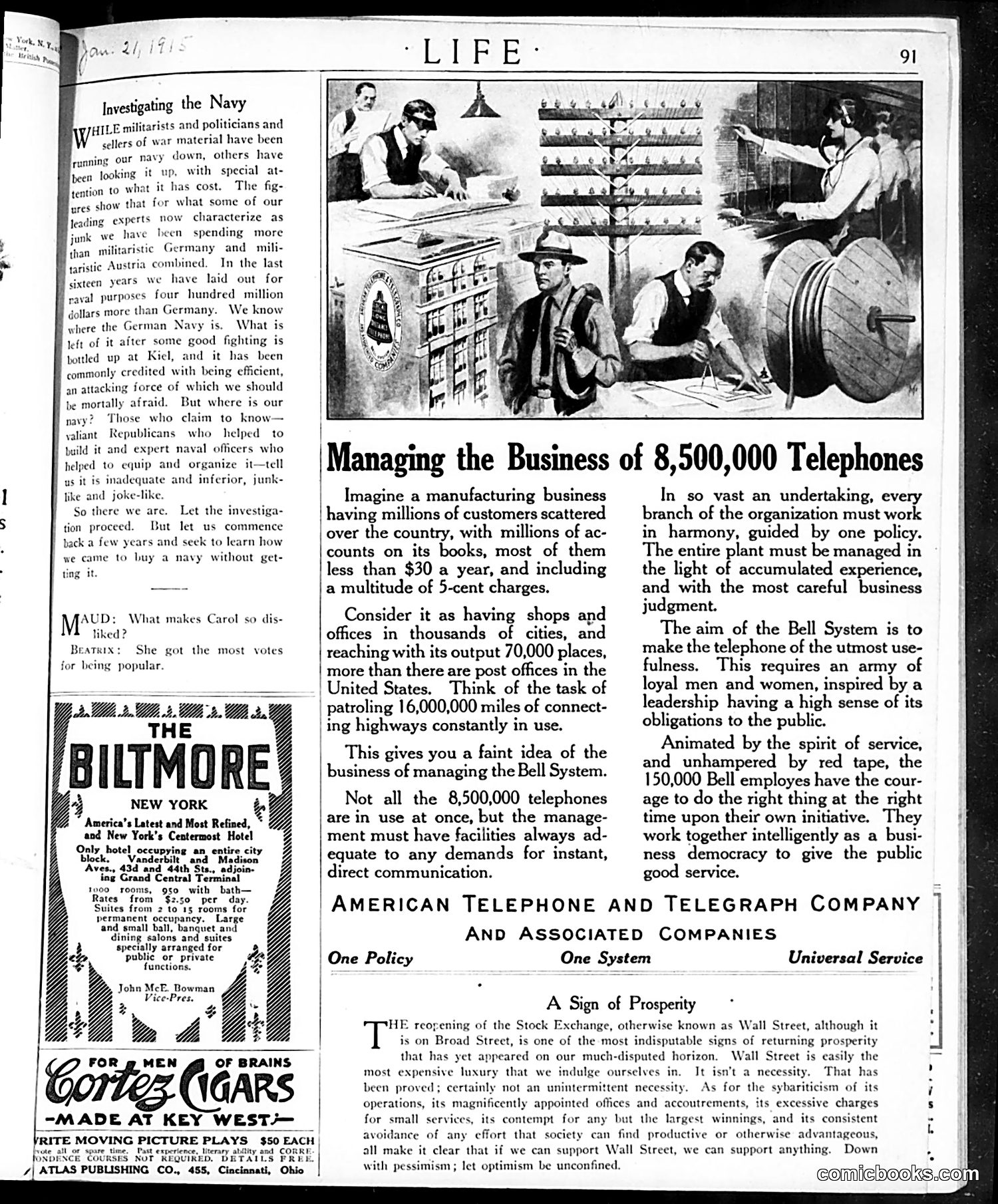
This Life magazine page (p. 91) contains no political cartoon. Instead, it features: 1. **Left column**: A brief political commentary titled "Investigating the Navy," criticizing Republicans for claiming credit for building the U.S. Navy while allegedly mismanaging its spending relative to Germany's. The author questions where the Navy actually is and suggests Republicans are "junk" and "jobless." 2. **Main content**: A lengthy advertisement for the American Telephone and Telegraph Company, celebrating the Bell System's management of 8.5 million telephones across the country. It emphasizes organizational efficiency and public service. 3. **Bottom section**: Additional advertisements for The Biltmore hotel in New York and Cortez cigars. The page is primarily commercial advertising, not satirical content.
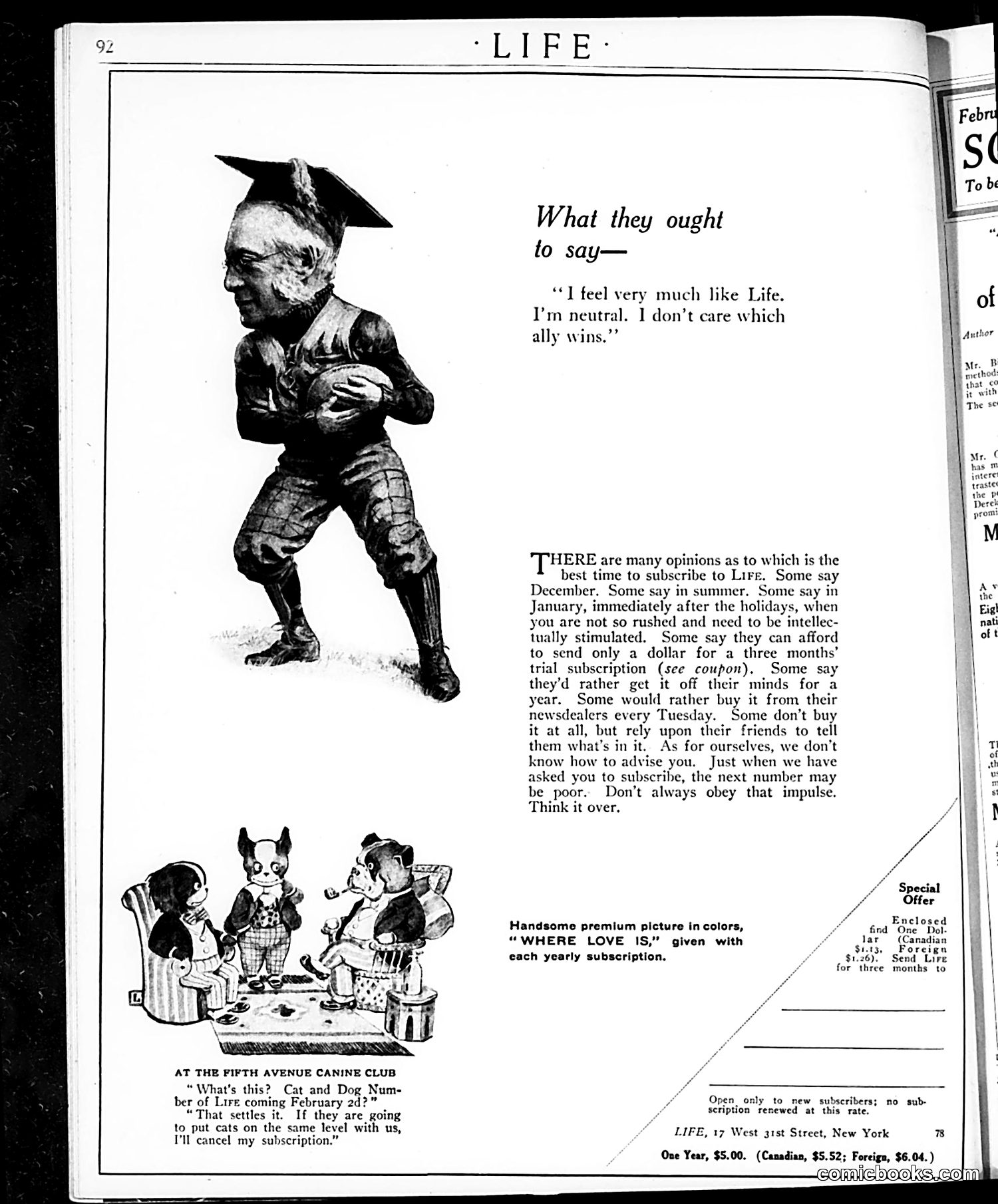
This page satirizes subscription decisions for *Life* magazine itself. The top caricature depicts a scholarly graduate figure representing "Life" magazine personified as neutral and indifferent to competition—a tongue-in-cheek self-advertisement. The main text humorously addresses when readers should subscribe, acknowledging practical concerns: holiday rush, cost (offering a three-month trial for one dollar), and whether to buy individually or via newsstand. The tone is deliberately self-aware and sardonic about subscription timing. The bottom cartoon shows animals at "The Fifth Avenue Canine Club" debating a subscription cancellation, with one character threatening to cancel if dogs are "put on the same level" as humans in upcoming content—a joke about editorial standards and anthropomorphization in the magazine. Overall, this is *Life* magazine's humorous advertisement for itself.
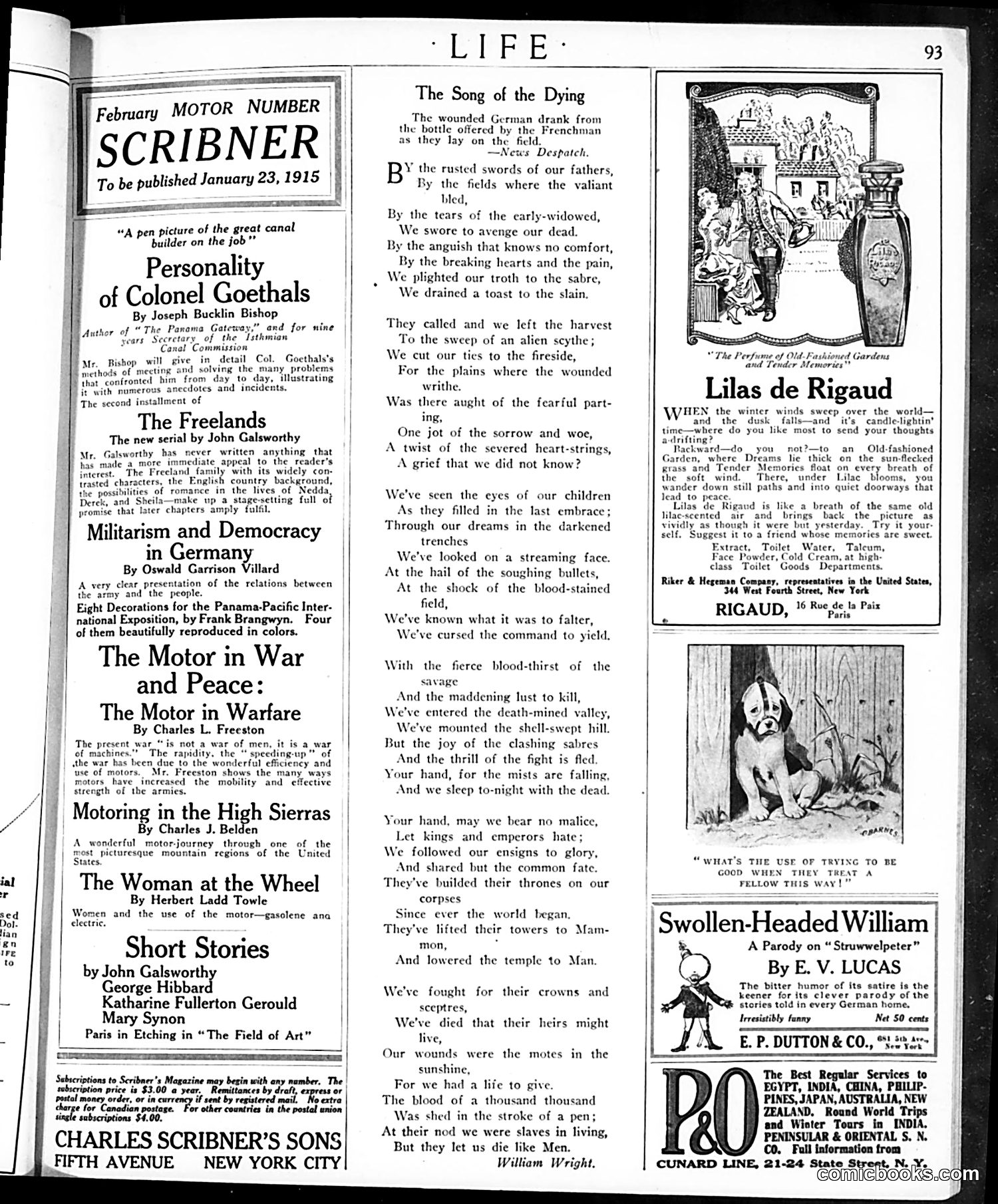
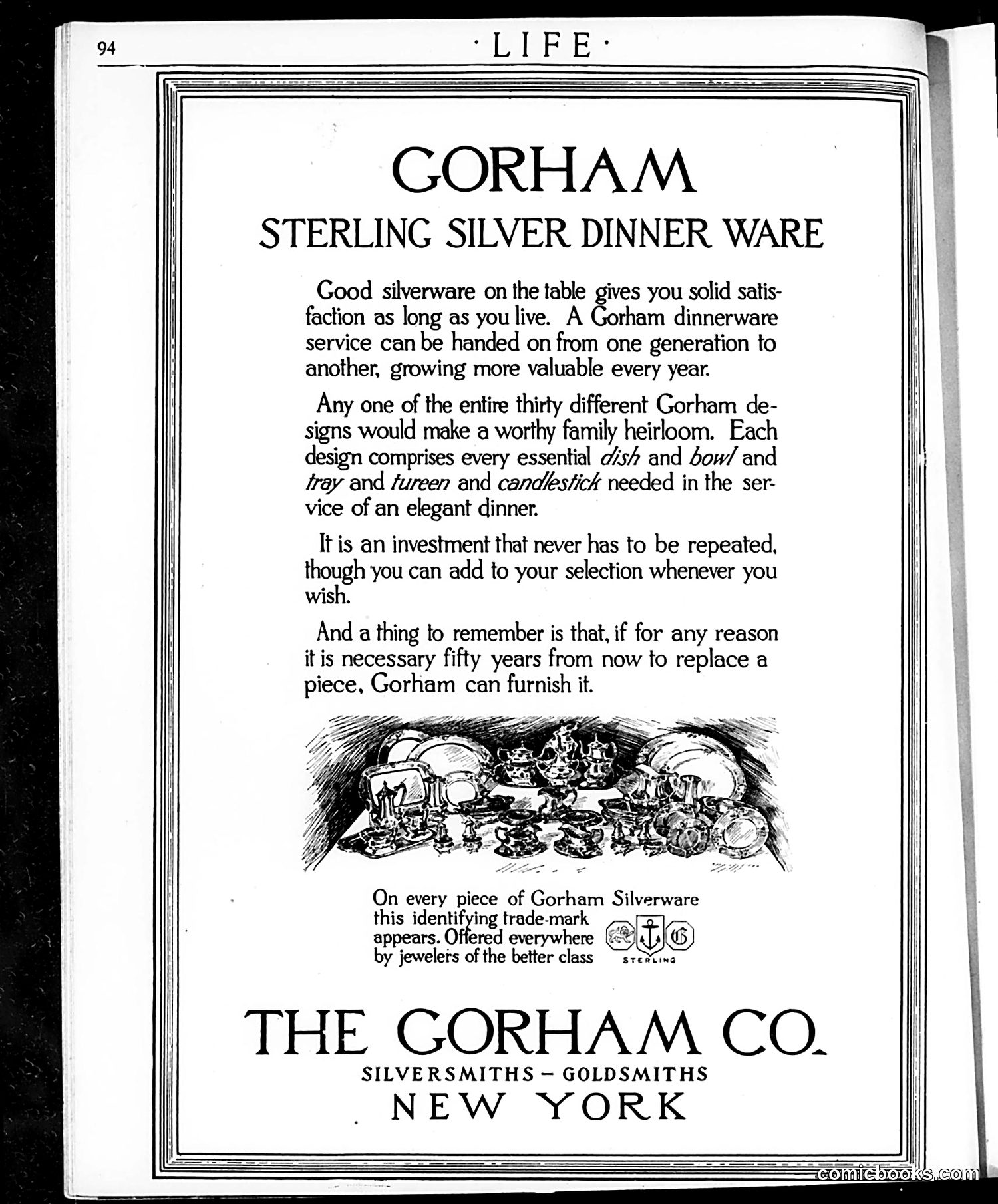
This is a **straightforward advertisement**, not satirical content. It's a full-page ad for Gorham Sterling Silver Dinnerware from The Gorham Company (silversmiths and goldsmiths based in New York). The ad emphasizes that Gorham silverware is a lasting investment—durable enough to pass between generations and increase in value over time. It highlights that their thirty different design options constitute complete dinner services with all necessary pieces (dishes, bowls, trays, tureens, candlesticks). A notable feature: Gorham promises that even fifty years later, they can replace individual pieces if needed—positioning this as a long-term commitment to customers. The illustration shows an elegant table setting with their silver pieces displayed. There is no political or social satire present on this page.
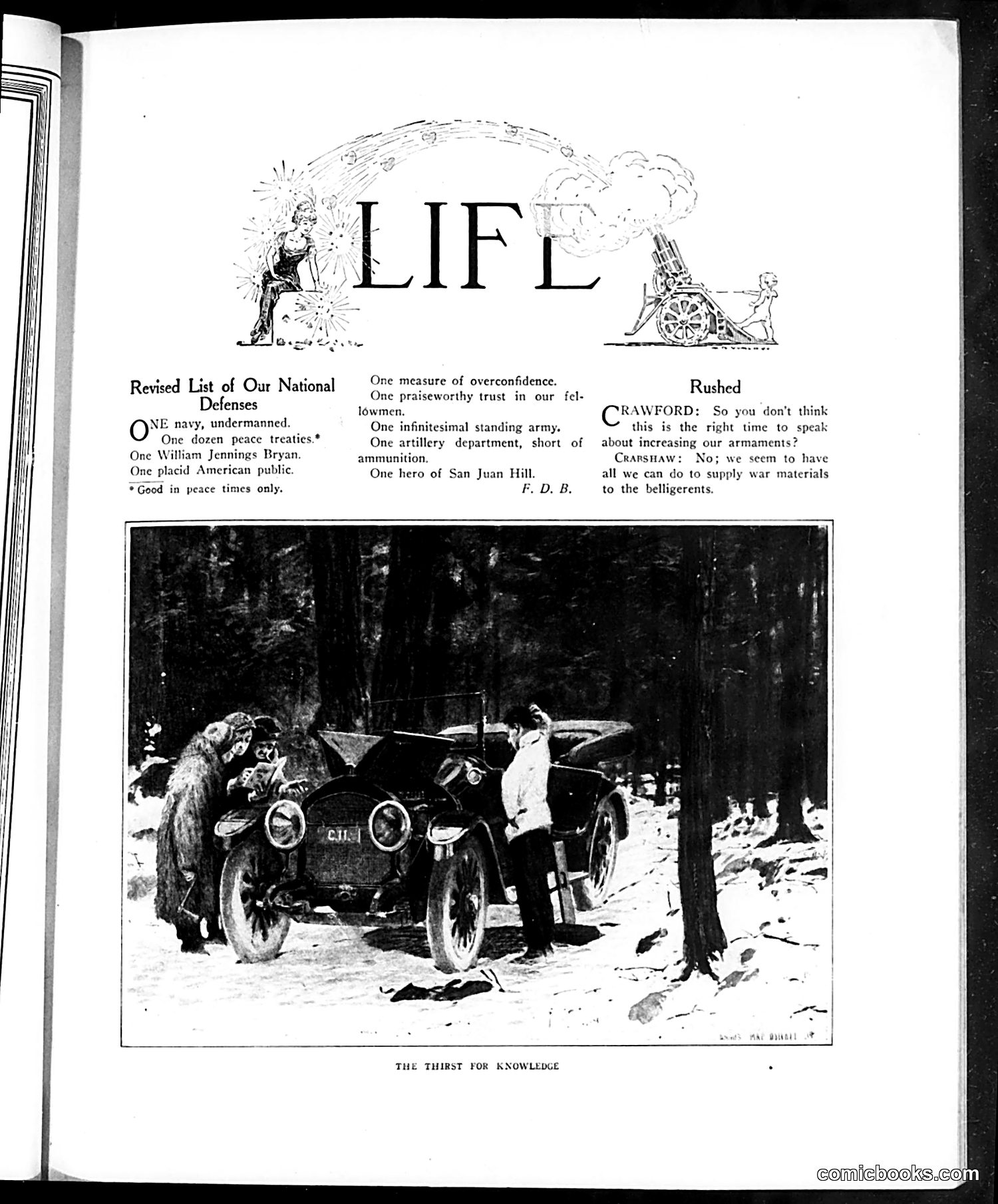
This *Life* magazine page satirizes American military preparedness during what appears to be the pre-WWI era. **"Revised List of Our National Defenses"** mockingly catalogs America's actual weak military assets—an undermanned navy, outdated peace treaties, and a few notable individuals like William Jennings Bryan (a pacifist politician). The asterisk notes these items are "*Good in peace times only*," sarcastically suggesting they're useless for actual defense. **"Rushed"** shows a conversation between Crawford and Crapshaw debating whether to increase military spending. Crapshaw dismisses the urgency, claiming they can only supply war materials to "belligerents" (warring nations), implying America lacks domestic preparedness. **The main illustration**, captioned "The Thirst for Knowledge," depicts bears and a man examining an automobile in a forest—likely satirizing American naïveté about military threats, portrayed as primitive curiosity facing modern dangers.
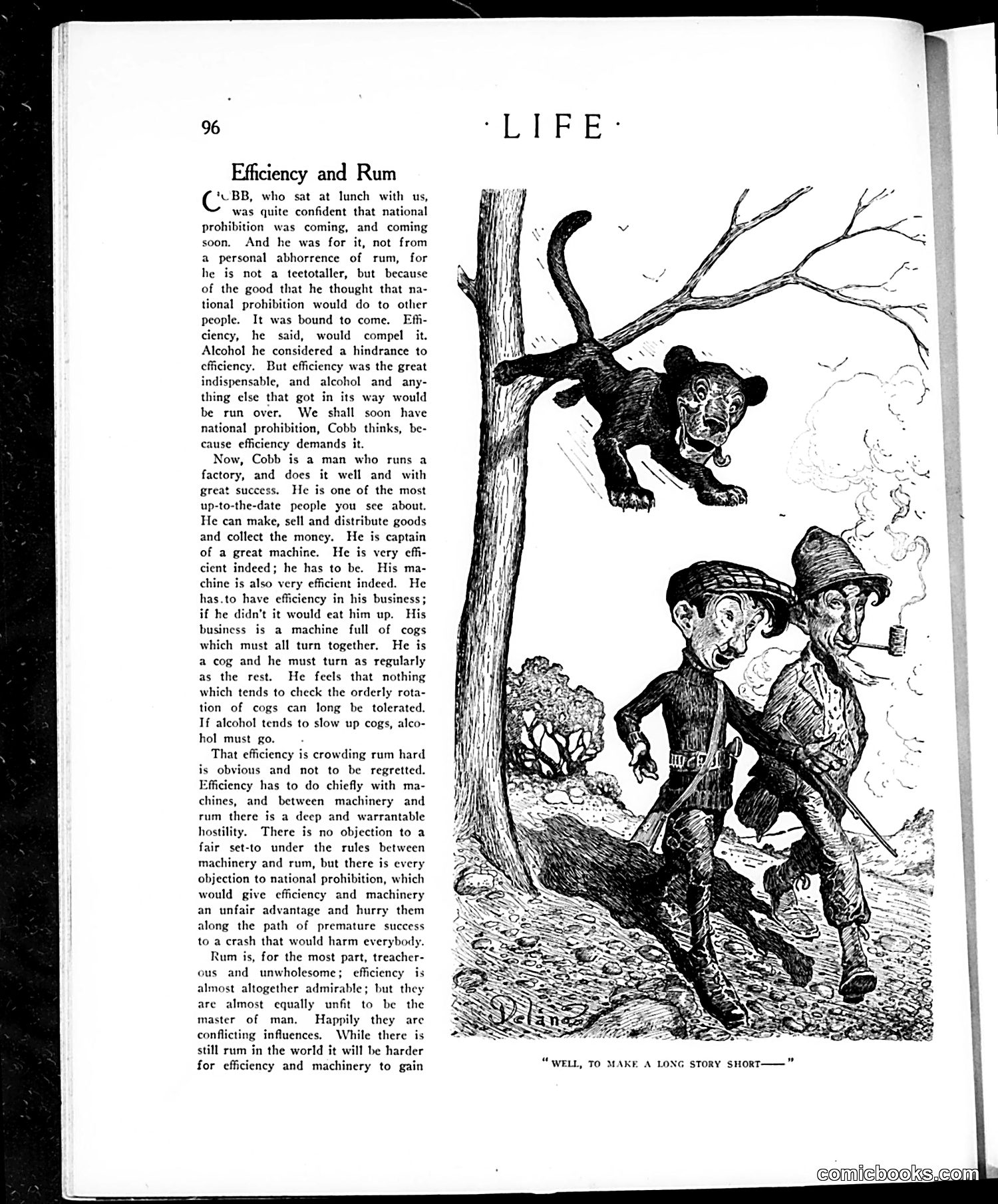
This satirical piece critiques the tension between industrial efficiency and alcohol prohibition. The text describes "Cobb," a factory manager who embodies mechanical efficiency but argues that national prohibition will harm business because alcohol and industrial machinery are incompatible—efficiency demands alcohol be eliminated. The illustration shows two caricatured men at a tree with a small demon/imp figure above. The caption reads "Well, to make a long story short—" suggesting these characters are debating prohibition. The satire mocks prohibition advocates by presenting the absurd argument that efficiency itself demands alcohol's removal, while simultaneously attacking those who prioritize industrial productivity over moral concerns. The piece appears to question whether purely mechanical "efficiency" should govern public policy.
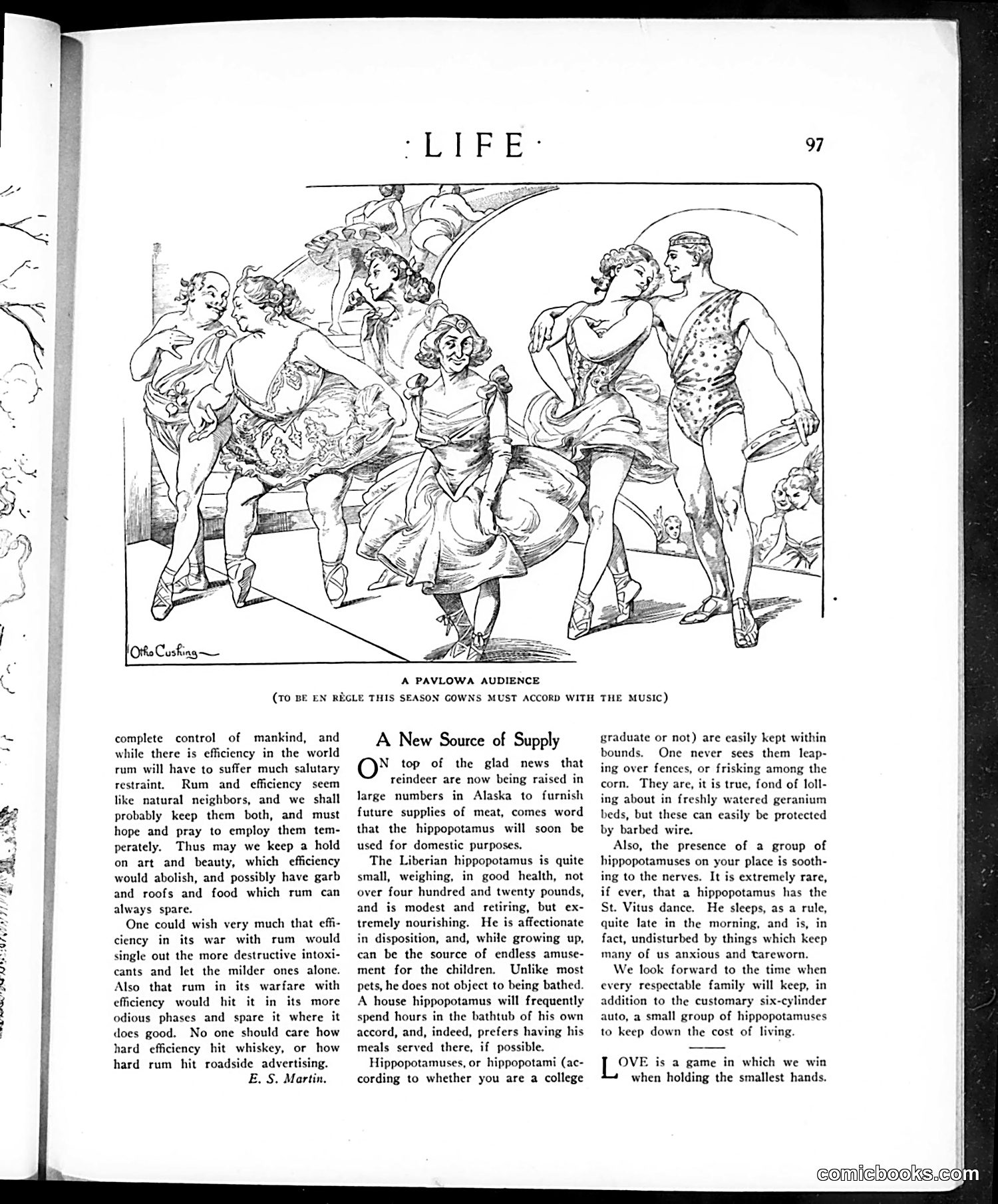
This cartoon satirizes high-society theater attendance during the early 20th century. The drawing depicts elegantly dressed men and women in fashionable attire at what the caption describes as "A Pavlowa Audience," likely referencing the famous Russian prima ballerina Anna Pavlova's tours in America. The satire appears to mock the pretension and frivolity of wealthy patrons who attend such performances. The caption's instruction "(to be en règle this season gowns must accord with the music)" humorously suggests that fashionable attendees are more concerned with wearing the correct gowns than actually appreciating the artistic performance—they're treating the ballet as a fashion show rather than a cultural event. The illustration is signed "Otto Cushing," a cartoonist of that era.
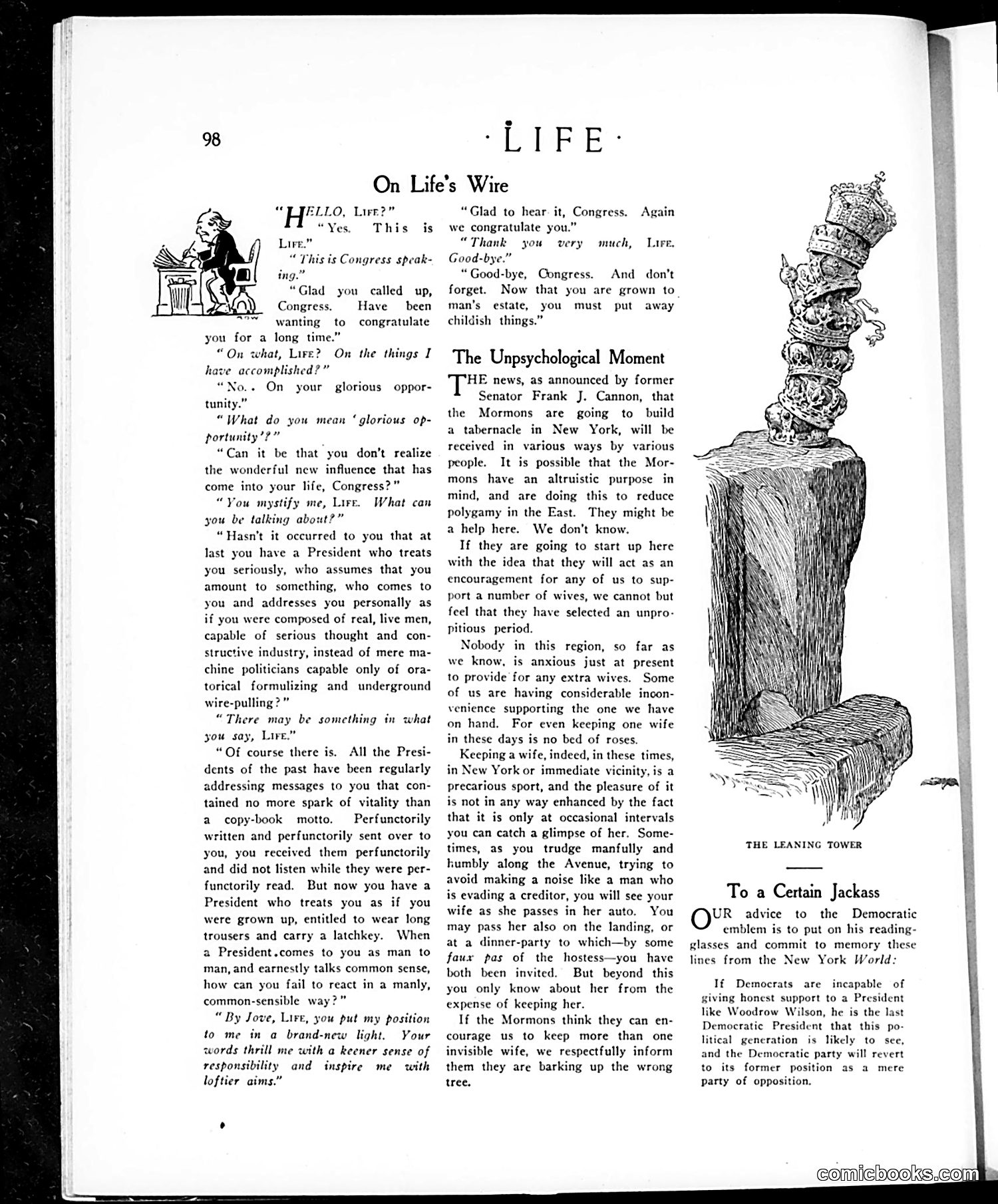
**"On Life's Wire"** (left column): A dialogue between "Congress" and "Life" (the magazine's personified voice). Congress has just been called to session after a long absence. Life congratulates Congress on their new influence, sarcastically suggesting they've become a "real" governing body rather than mere "machine politicians" and "wire-pullers." The satire implies Congress was previously ineffective or corrupt—a common criticism of the era. **"The Unpsychological Moment"** (center): Commentary on Mormons planning to build a tabernacle in New York. The piece mockingly suggests this might reduce polygamy in the East, but skeptically notes local resistance to supporting "extra wives." The satire ridicules both Mormon practices and contemporary attitudes toward them. **"To a Certain Jackass"** (right): A brief editorial criticizing Democratic opposition to President Woodrow Wilson, calling it ineffectual partisanship.
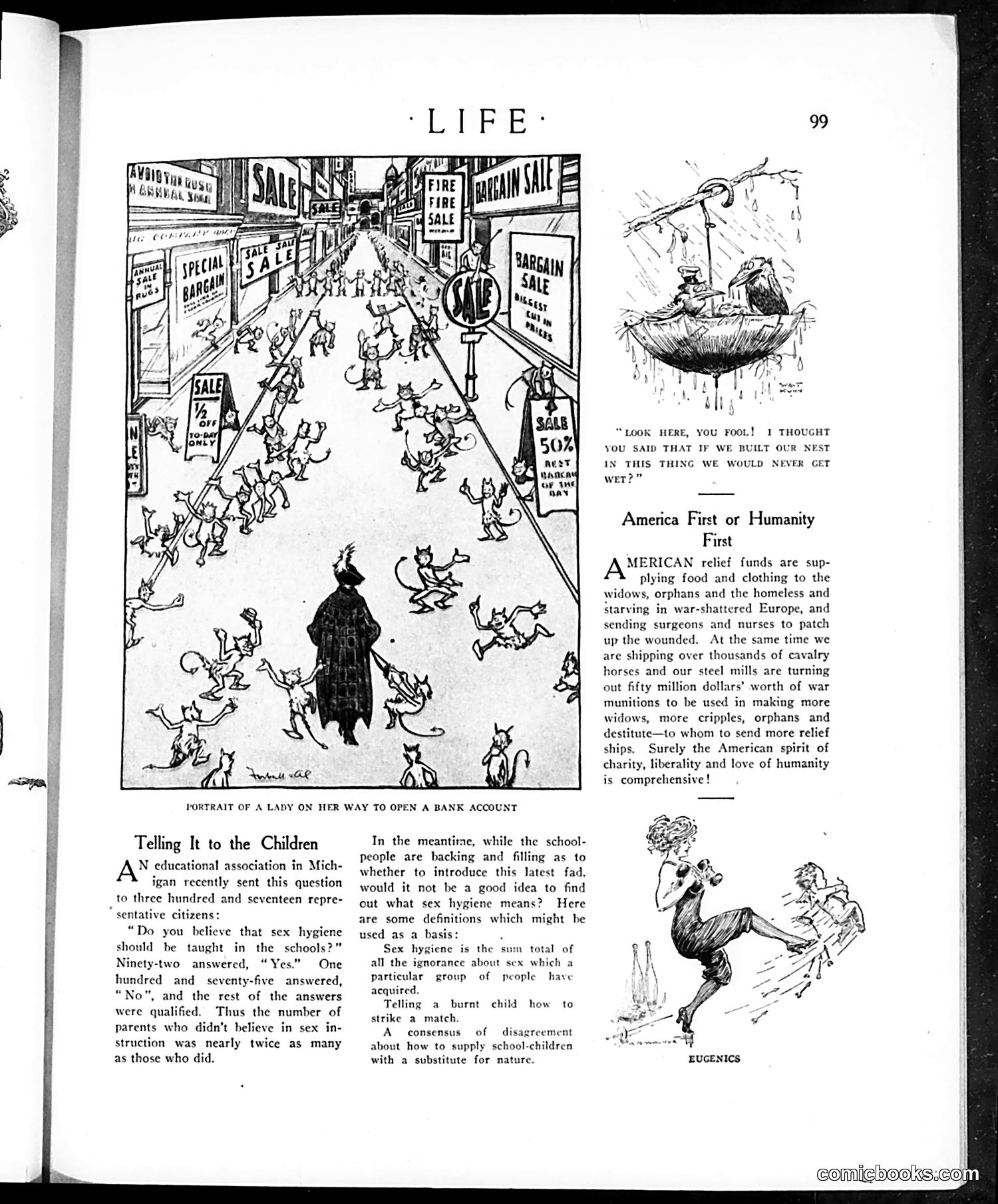
**Left cartoon:** Depicts a well-dressed woman (likely representing American consumers or the wealthy) surrounded by a chaotic street scene filled with people and "SALE" signs. The caption reads "PORTRAIT OF A LADY ON HER WAY TO OPEN A BANK ACCOUNT," satirizing materialism and consumerism during what appears to be a post-WWI period. **Right section:** Contains social commentary criticizing American priorities. While sending relief aid and military resources to war-torn Europe, the text argues Americans should prioritize domestic needs. The cartoon "EUGENICS" (bottom right) appears to critique pseudoscientific eugenic theories popular in that era. **"Telling It to the Children":** Discusses a Michigan educational debate about teaching sex hygiene in schools—a controversial topic then. The page overall critiques American consumer culture and questions national priorities.
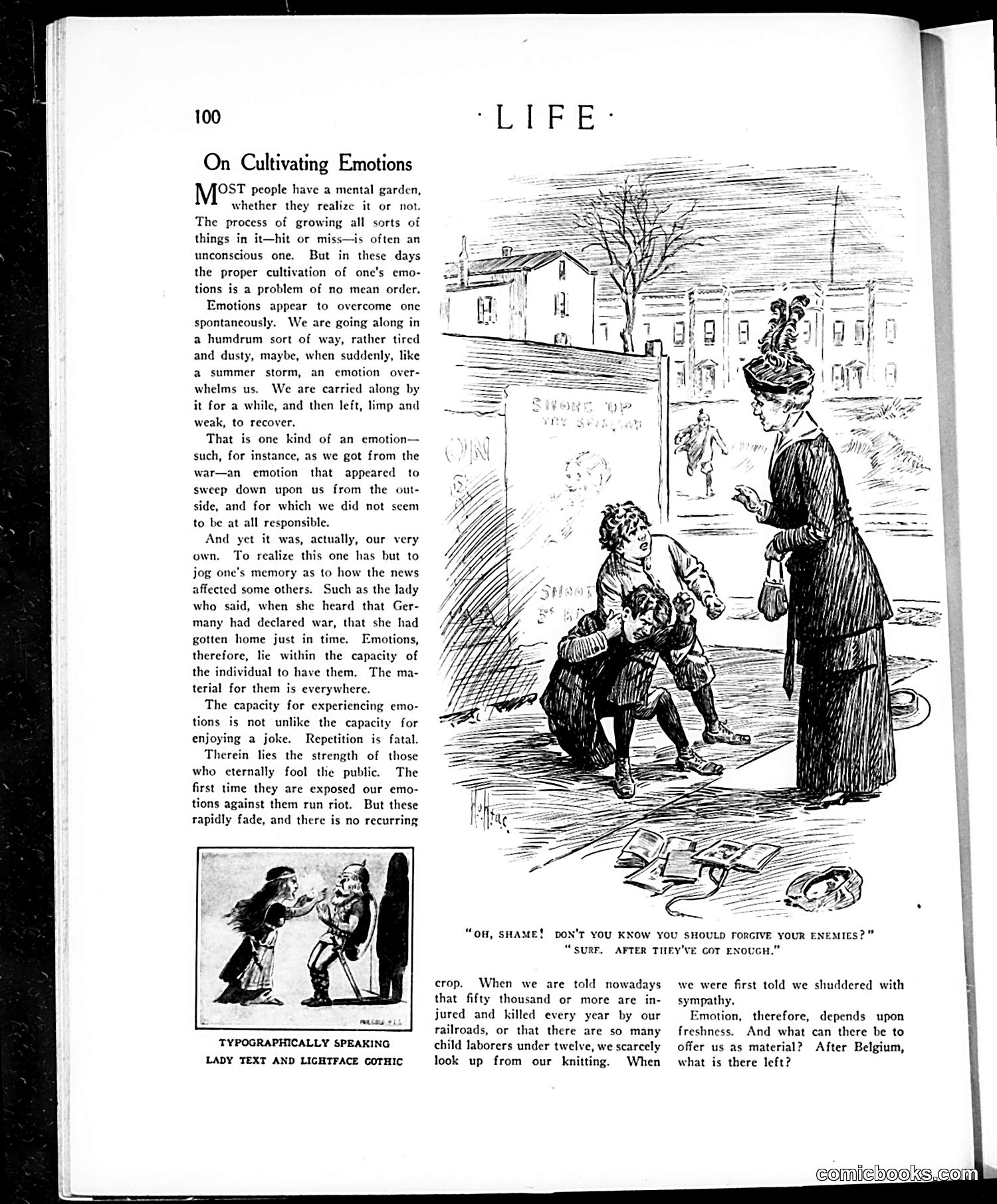
This page discusses how emotions are cultivated and become dulled through repetition. The main illustration shows a well-dressed woman with a child in what appears to be a public square, with the caption addressing forgiveness of enemies—likely satirizing sentimental moral lessons. The smaller cartoon below, labeled "Typographically Speaking: Lady Text and Lightface Gothic," appears to be a visual pun about typography using human figures, though the specific joke is unclear. The text references wartime emotional responses and the numbness that follows repeated exposure to tragedy—mentioning Belgium specifically, suggesting this was written during or shortly after WWI, when reports of Belgian atrocities circulated widely. The piece argues that constant exposure to suffering dulls our emotional capacity to respond.
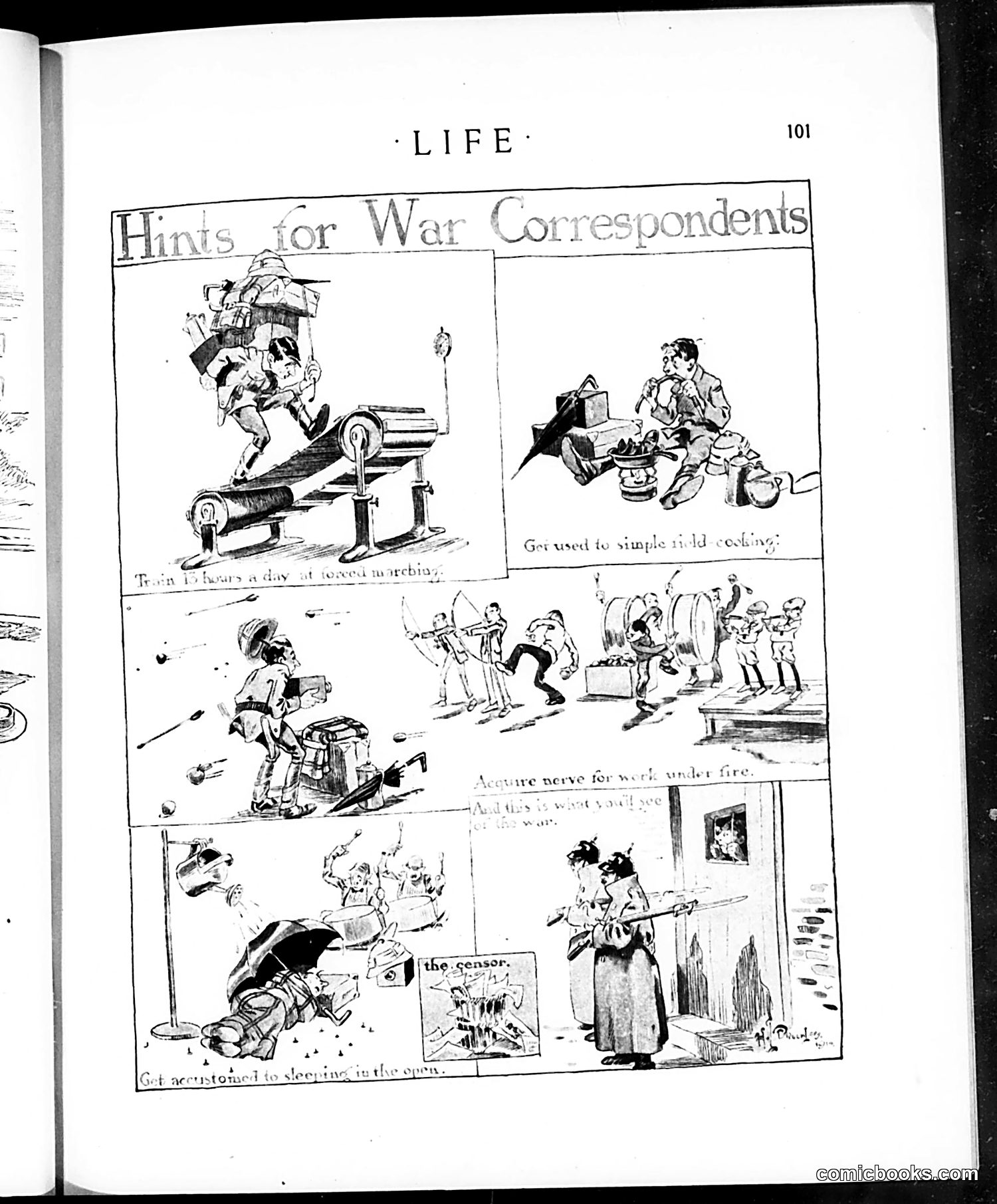
This satirical comic strip mocks the challenges faced by journalists covering World War I combat. Each panel illustrates a humorous "lesson" for war reporters: - Top left: A correspondent must endure constant bombardment and chaos - Top right: Simple field cooking is necessary - Middle: Reporters need nerve to work under fire and manage dangerous situations - Bottom left: Correspondents must learn to sleep amid the chaos of war - Bottom right: A reporter works despite censorship of their dispatches The overall satire presents war correspondence as an absurdly difficult profession requiring physical toughness, resourcefulness, and the ability to function under impossible conditions while dealing with military censorship. It's humorous commentary on the actual hazards and constraints journalists faced covering the front lines.
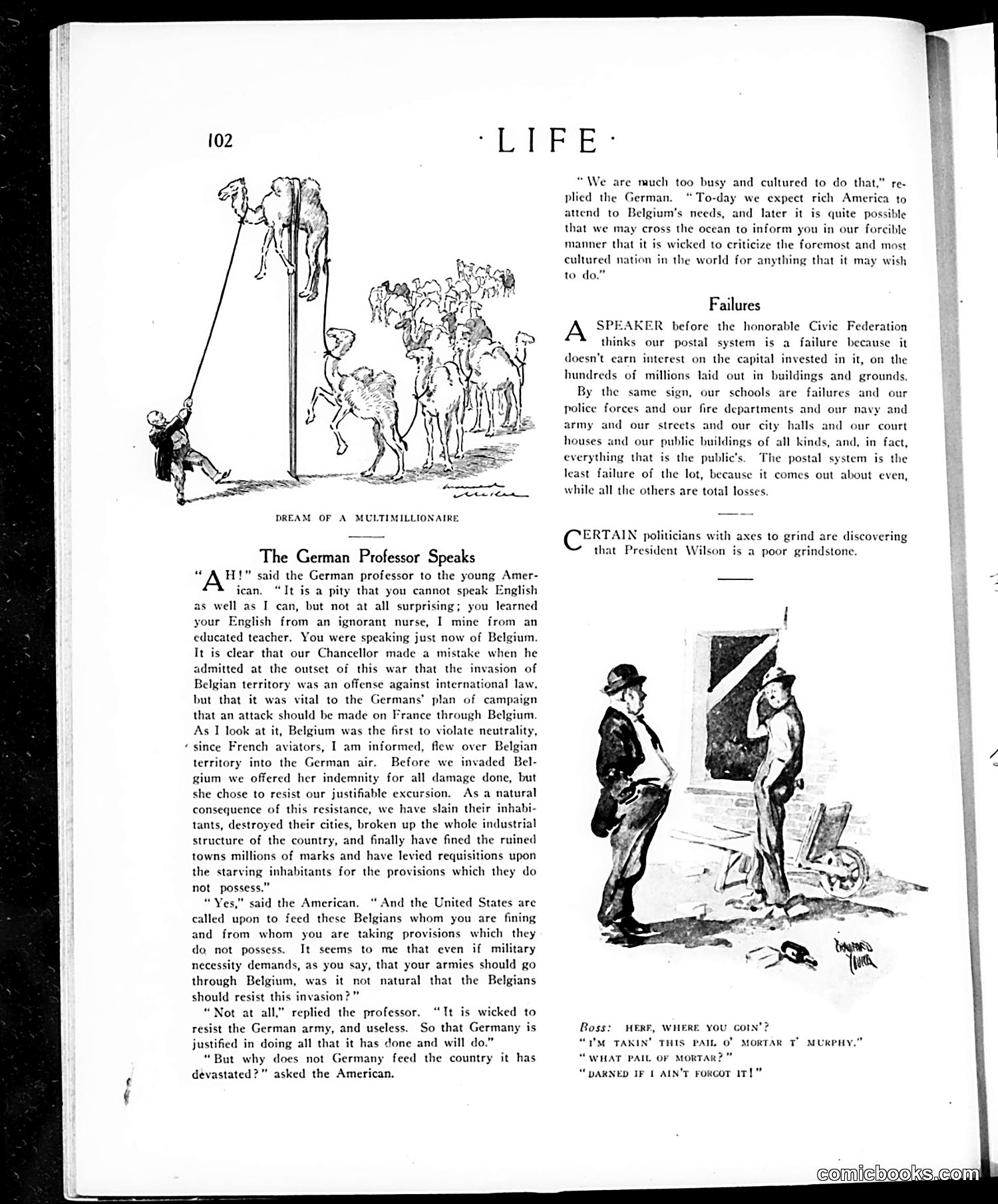
**"Dream of a Multimillionaire"** (top cartoon): Shows a wealthy figure on a tall pedestal being worshipped by a crowd below—satirizing the excessive reverence for the ultra-rich in American society. **"The German Professor Speaks"** (main article): Features a dialogue between a German academic and an American, debating Germany's invasion of Belgium during World War I. The German defends the invasion as militarily necessary; the American counters that it violates neutrality and international law. **"Roses" (bottom cartoon)**: Two soldiers discuss obtaining provisions, with wordplay on "Mortar Murphy"—likely satirizing military logistics or supply chain absurdities during wartime. The page overall critiques German justifications for Belgian invasion while skewering American attitudes toward wealth and war.
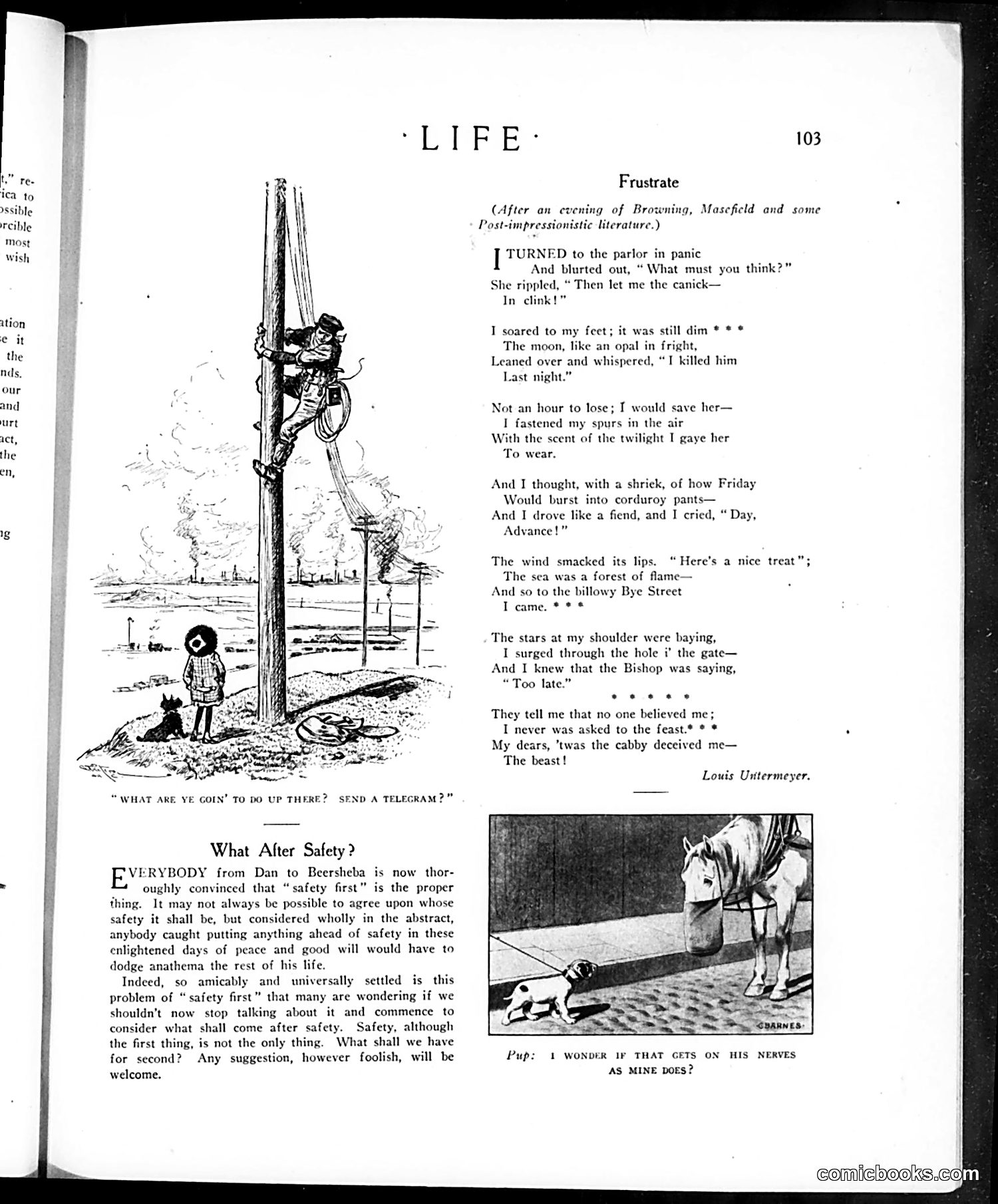
**The Poetry ("Frustrate"):** Louis Untermeyer's poem parodies overwrought Romantic literature (referencing Browning and Post-Impressionist work). It mocks dramatic melodrama—a woman confesses to murder, the narrator rushes to save her through increasingly absurd poetic imagery (stars "baying," winds with "lips"). The punchline: she deceived him; the "cabby" (taxi driver) was the actual problem. It satirizes pretentious literary overstatement and the gap between dramatic posturing and mundane reality. **The Cartoons:** - Top left: A soldier climbing a pole while a child below asks if he'll "send a telegram"—likely mocking military inefficiency or absurd wartime procedures. - Bottom right: Shows a dog under a horse, captioned about getting "on his nerves"—gentle visual humor about discomfort. **"What After Safety?":** The essay questions whether society, having obsessed over "safety first," has neglected asking what comes *after* safety is achieved. It's post-WWI social commentary on whether prioritizing safety has made people forget larger purposes.
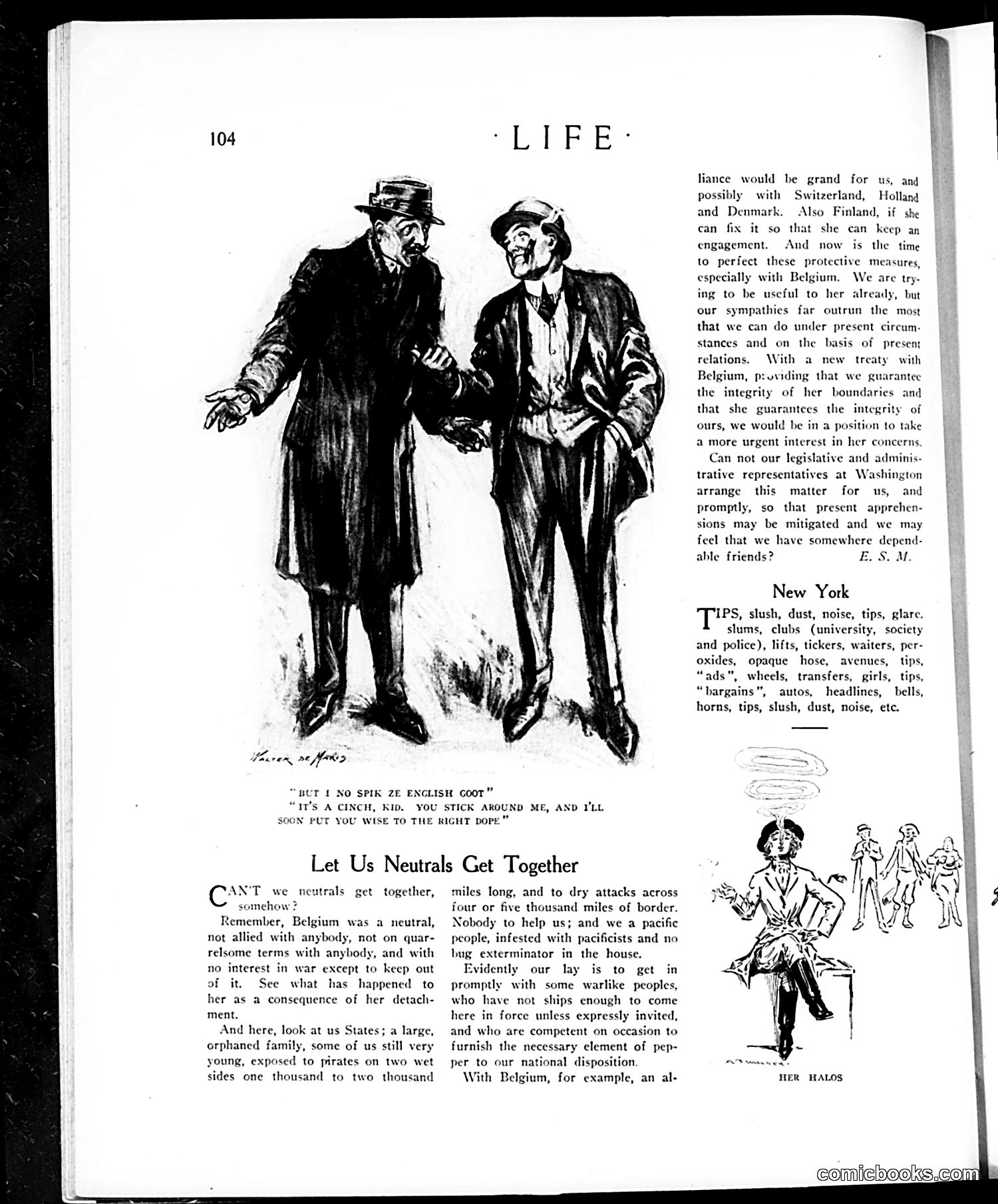
This page contains political satire from the World War I era (likely 1914-1917, before U.S. entry). The main cartoon depicts two men in working-class dress with exaggerated immigrant features, speaking broken English about con artistry—a commentary on urban crime and immigrant communities. The accompanying editorial "Let Us Neutrals Get Together" argues that the United States should form military alliances with neutral nations like Belgium, Switzerland, and Denmark for mutual protection. It references Belgium's fate as a cautionary tale: despite being neutral, Belgium was invaded and devastated during WWI. The author contends that American neutrality is insufficient; the nation needs "warlike" allies to deter aggression across its ocean and land borders. The piece advocates abandoning strict neutrality in favor of strategic partnerships with militarily competent nations—a hawkish position urging preparedness and collective security before America's formal 1917 entry into the war.
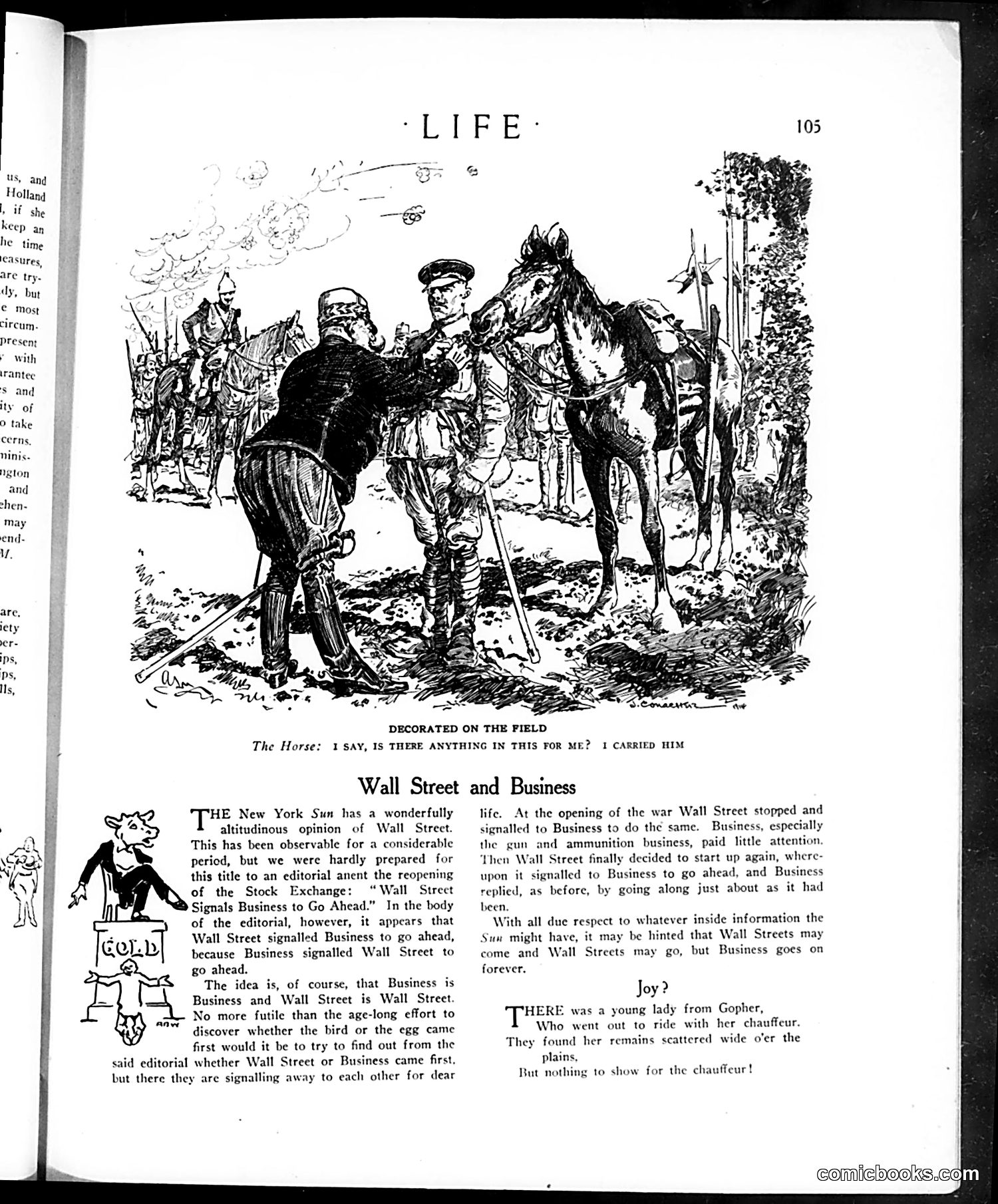
**Top Cartoon**: "Decorated on the Field" depicts a wounded soldier on horseback asking officers, "I say, is there anything in this for me? I carried him." The satire mocks the gap between military sacrifice and personal reward—the soldier expects compensation for his service but receives none. **Main Article**: "Wall Street and Business" satirizes circular reasoning in financial reporting. The *New York Sun* claimed "Wall Street signals Business to go ahead" during the 1914 stock exchange reopening. Life's editorial ridicules this as meaningless—both institutions are merely copying each other's moves, yet newspapers present it as meaningful economic leadership. The satire suggests Wall Street and Business have no independent authority; they're mutually dependent and both ultimately irrelevant to actual commerce. **"Joy?" Poem**: A dark joke about an automobile accident. A young woman riding with her chauffeur dies in a crash, leaving "nothing to show for the chauffeur"—meaning no survivor, no witness to what happened, and implicitly no one to blame or compensate. It's early-1910s dark humor about automobile dangers.
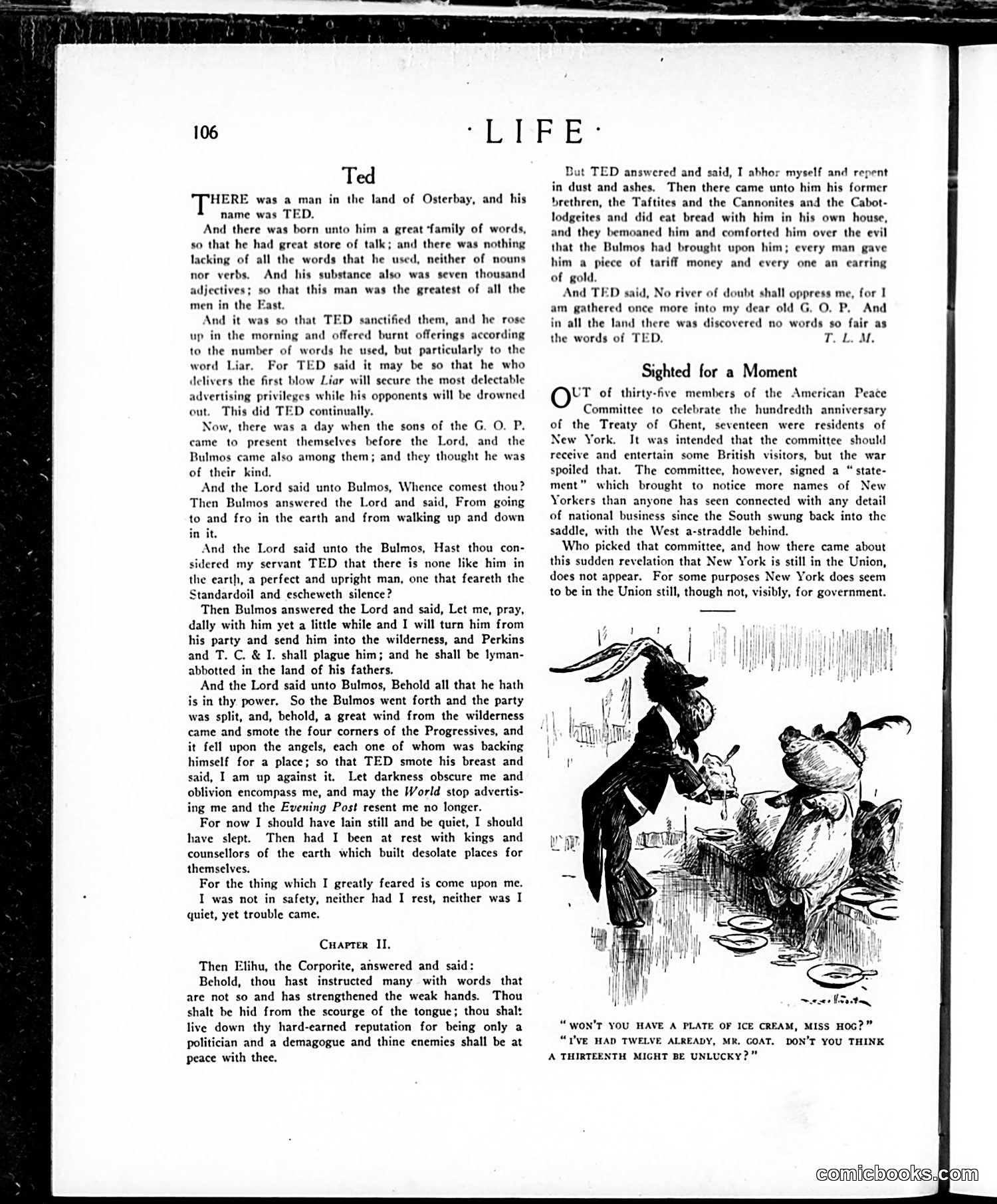
This page contains a biblical parody mocking Theodore Roosevelt's political rhetorical style. "Ted" is portrayed as a man of excessive words who worships "the word Liar," suggesting Roosevelt deployed hyperbolic language and accusations against opponents. The story parodies the Book of Job, with "Bulmos" (likely referring to conservative Republican establishment figures) testing Ted's loyalty to the GOP. When the "Progressives" split from the Republican party—a reference to Roosevelt's 1912 Bull Moose Party run—Ted laments his troubles. The accompanying cartoon shows a goat refusing ice cream from a man, with caption about unlucky numbers. This appears unrelated satirical content, possibly mocking someone's superstitions or bad luck. The "Sighted for a Moment" section shifts to discussing American Peace Committee members, suggesting multiple satirical pieces per page in Life's format.
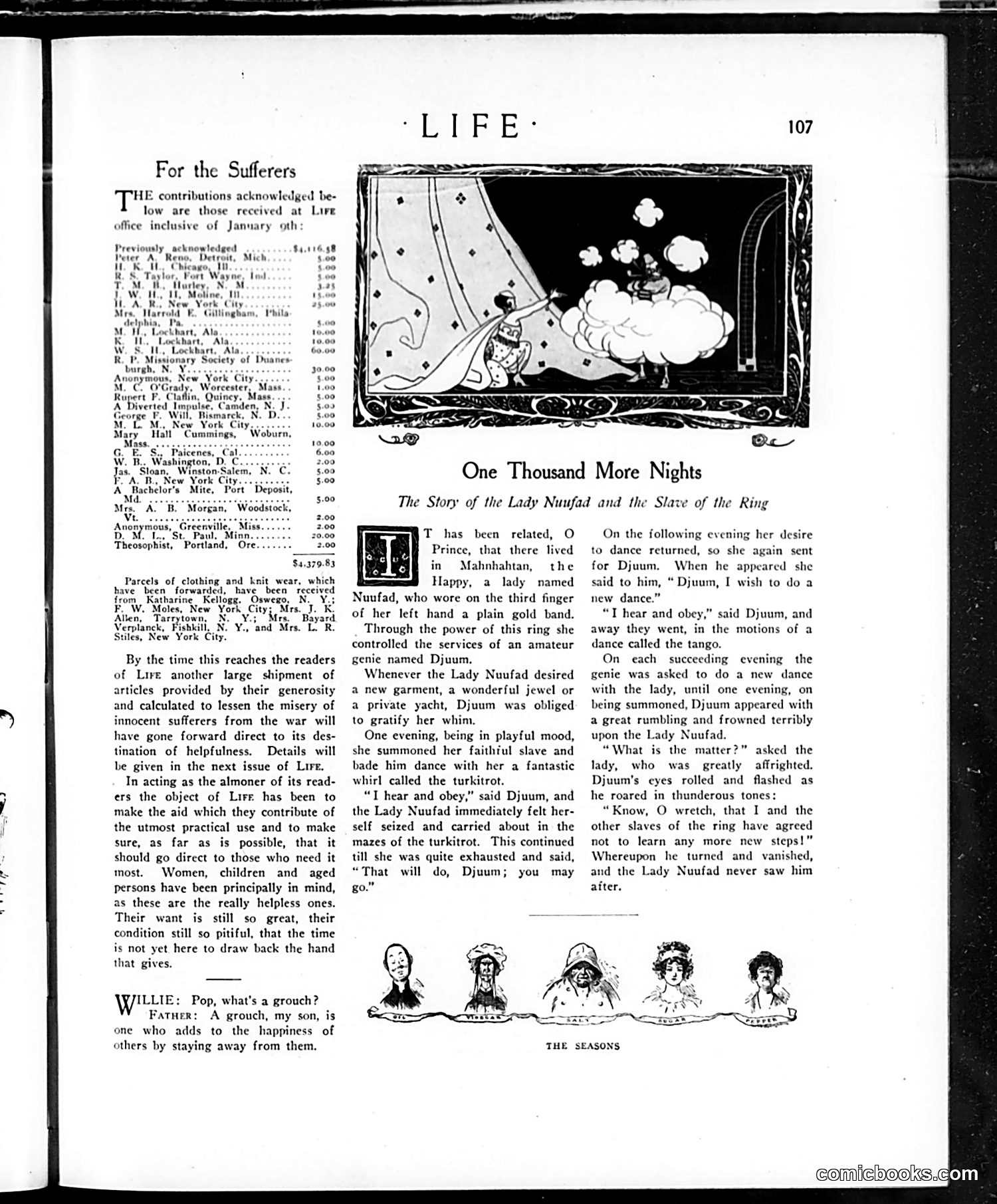
This page contains two distinct sections: **"For the Sufferers"** (left): A charitable fundraising notice listing donations received by *Life* magazine for war relief—likely WWI-related based on the language about "innocent sufferers from the war." The contributions range from small amounts to larger gifts, with donations sent to help women, children, and elderly persons affected by conflict. **"One Thousand More Nights"** (right): A satirical fairy tale parody mocking the "dance craze" phenomenon of the 1910s-20s. It mimics *Arabian Nights* style, telling of Lady Nuufad (New York + "happy" combined) who commands a genie named Djuum to perform new dances nightly. The joke: after she demands the tango, turkey trot, and other fashionable dances night after night, the genie and his fellow slaves unionize—refusing to learn more new steps. **The satire's point**: Americans' obsession with constantly adopting the latest dance fads is ridiculed as frivolous and exhausting, even comically enslaving entertainers to keep pace.
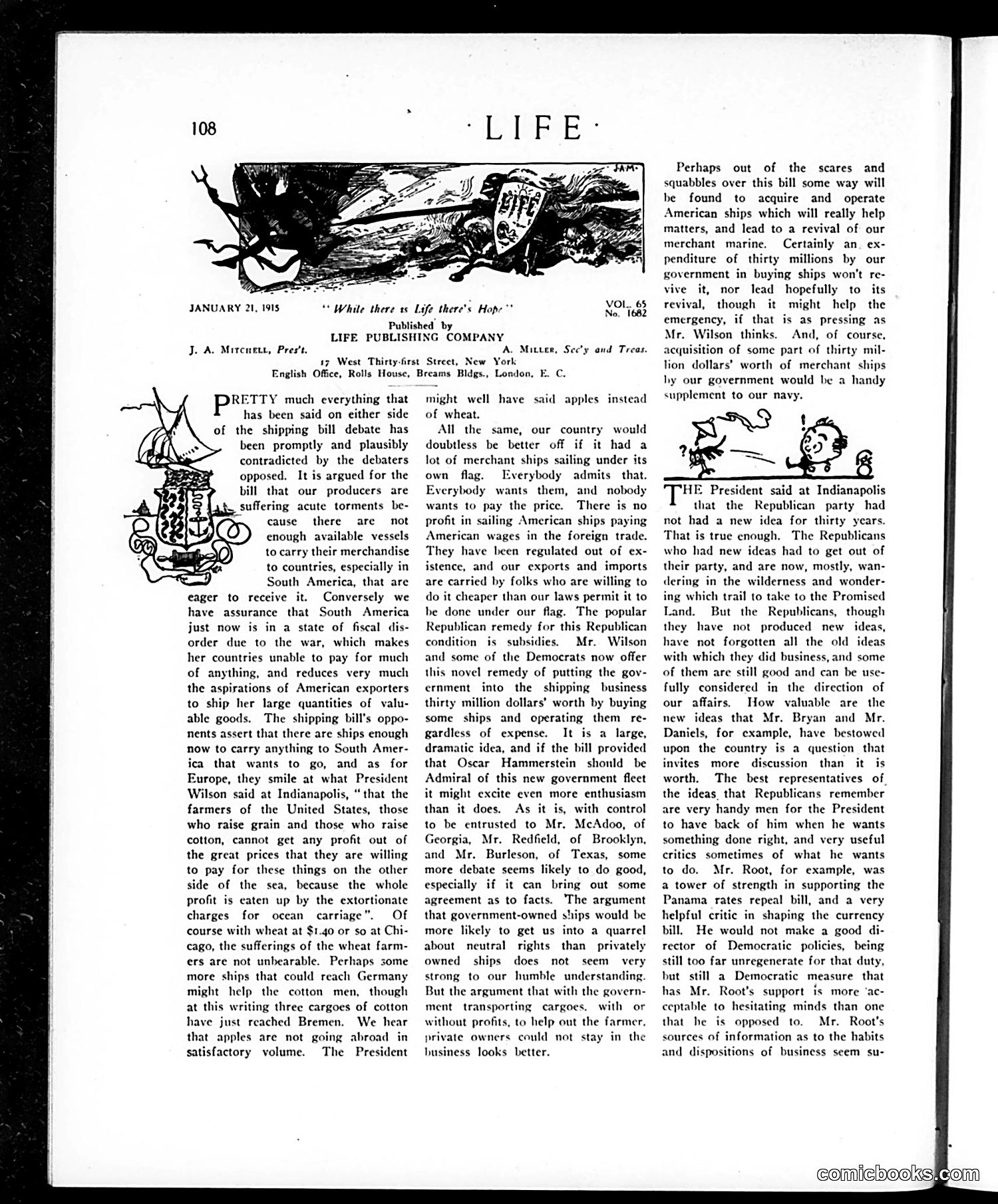
This editorial page discusses the debate over President Wilson's proposed Shipping Bill, which would have the government purchase and operate merchant ships to support American exporters. **The Cartoons:** The decorative illustrations appear to be generic maritime/nautical imagery (ships, sea creatures) rather than specific political caricature—common ornamental elements for a shipping-themed article. **The Debate:** The article satirizes how both sides of the shipping bill dispute contradict each other plausibly. Opponents claim American farmers/exporters suffer from lack of vessels; supporters counter that South America cannot afford purchases anyway due to war-related financial chaos. The text notes absurdities: wheat prices are actually high, yet farmers allegedly profit nothing due to shipping costs. **Wilson's Government Solution:** Rather than Republican subsidies to private shipowners, Wilson's Democrats propose federal ownership. The author expresses skepticism about placing such control under Secretary McAdoo and cabinet members, though admits government ships might avoid quarrels over neutral shipping rights during wartime. The overall tone is sardonic resignation—acknowledging America needs merchant ships while doubting either solution will work properly.
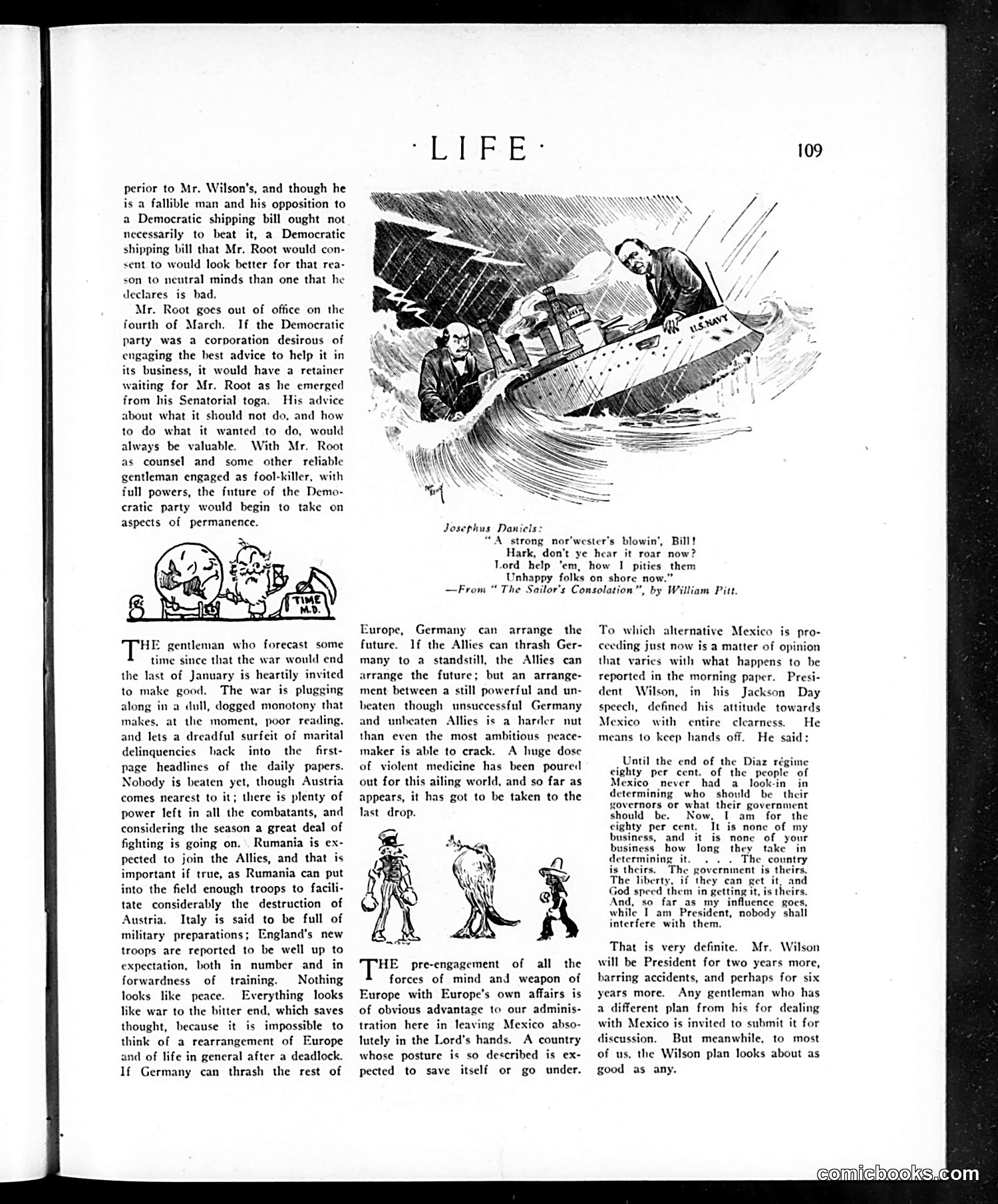
This page contains political commentary on World War I and President Wilson's Mexico policy (circa 1916). **The Naval Cartoon:** The top illustration depicts Josephus Daniels (Secretary of the Navy) as a sailor quoting William Pitt's poem about a storm. This satirizes Daniels' helplessness regarding European naval warfare—he can only observe the conflict passively, like a sailor watching a distant tempest. **Main Text Satire:** The author mocks predictions that WWI would end by January, noting instead the war grinds on with "dull, dogged monotony." The piece suggests Germany, the Allies, or neither could ultimately control post-war Europe—creating an unsolvable diplomatic puzzle. **Mexico Policy Critique:** The final section quotes Wilson's Jackson Day speech defending non-intervention in Mexico, allowing Mexicans self-determination. The satire's tone suggests this "hands-off" approach, while Europe convulses in war, conveniently removes Mexico from American political consideration rather than representing genuine principle.
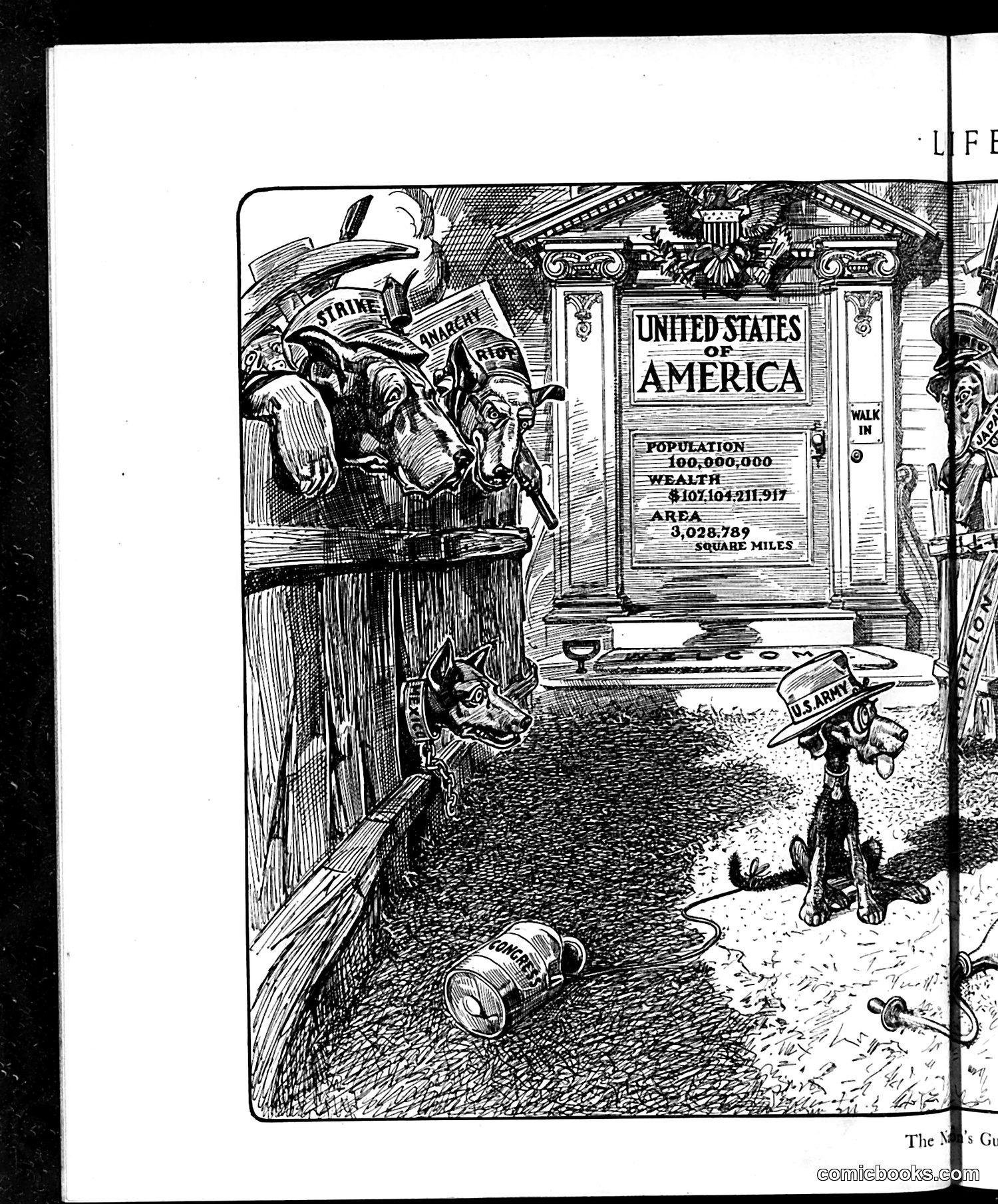
This satirical illustration critiques labor unrest in America. On the left, workers with signs reading "STRIKE," "ANARCHY," and "RIOT" are shown as violent, destructive forces—depicted as shadowy, aggressive figures attacking the entrance to a formal building. The right side presents the "United States of America" as an elegant, classical structure with statistics (population 100,000,000; wealth $107,104,211,917; area 3,028,789 square miles). A small, cartoonish dog wearing a U.S. Army hat sits guard below. The satire suggests that labor strikes and anarchist movements pose a threat to American prosperity and stability. The contrast between the chaotic mob and the dignified nation-building implies the cartoon's creator views strikes as barbaric threats to civilized order—a common anti-labor perspective of the early twentieth century.
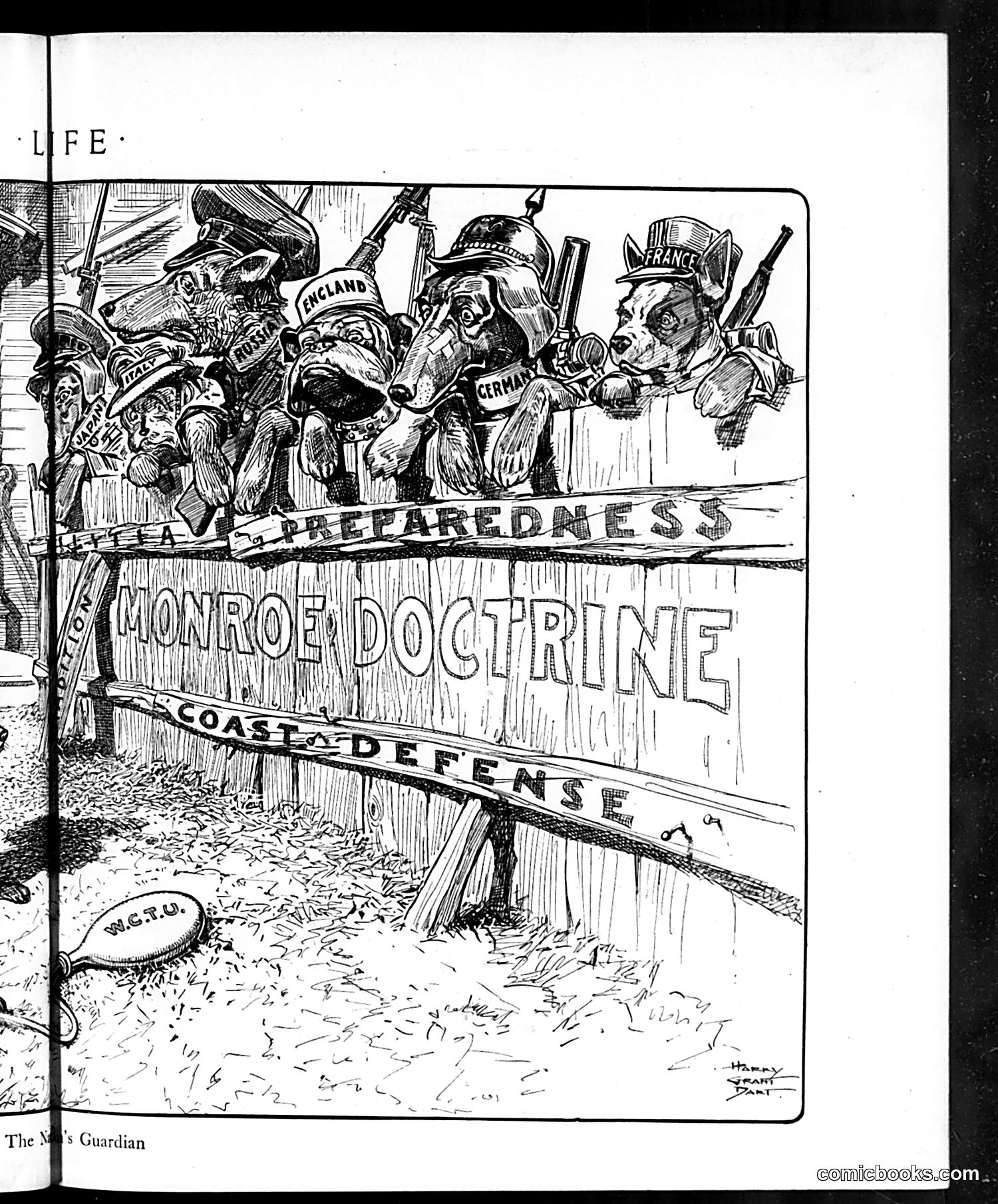
This cartoon satirizes American military preparedness during a period of international tension. Anthropomorphized animals representing different nations (labeled England, Germany, and France) stand armed on a platform labeled "Prepared Ness," while appearing defensive or aggressive. The "Monroe Doctrine" reference—printed prominently on the wooden structure—invokes America's historical policy opposing European intervention in the Western Hemisphere. The cartoon's title suggests nations are preparing for conflict. The "W.C.R.O." seal (unclear what this acronym represents) appears at the bottom. The overall message critiques either American isolationism or the arms race among world powers, likely dating from the pre-WWI or WWI era when European tensions ran high and America debated its military posture.
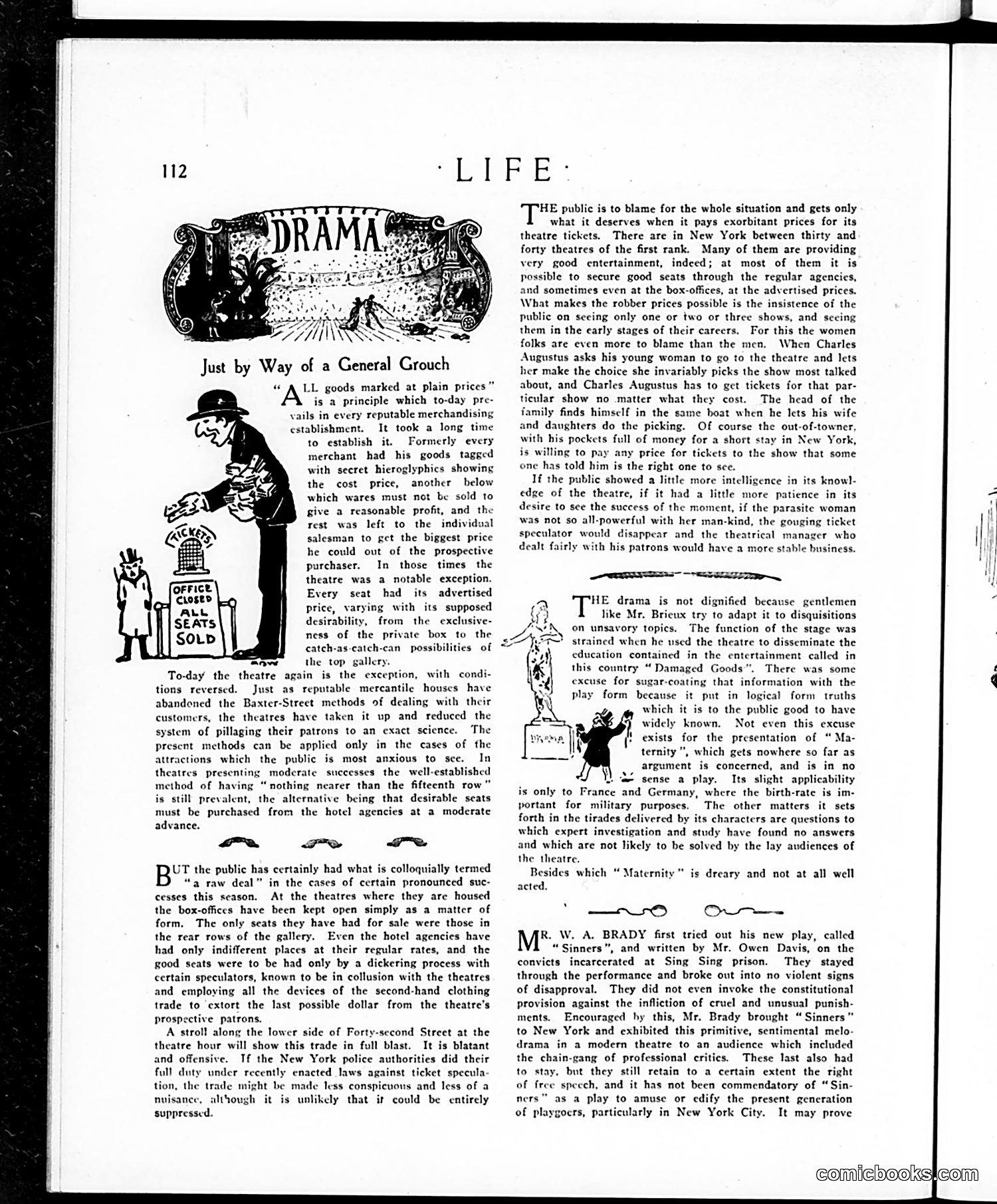
This 1910s-era *Life* article satirizes New York City's corrupt theater ticket market. The cartoon shows a street scalper ("OFFICE CASH FOR SEATS SOLD") profiteering from desperate theatergoers. **The Problem:** Popular Broadway shows charge inflated prices through collusion between box offices and speculators who operate like "second-hand clothing" dealers on 42nd Street, extracting maximum profit from patrons. **The Blame:** The author argues the public is complicit—particularly women who insist on seeing only the most talked-about shows rather than accepting good entertainment at reasonable prices. Out-of-town visitors and wealthy patrons willing to pay any price further encourage scalping. **The Irony:** While legitimate retail businesses abandoned such exploitative practices, theaters maintained them. The article advocates police enforcement of recent anti-scalping laws to combat this "blatant and offensive" trade. The satire targets both theatrical greed and consumer status-seeking.
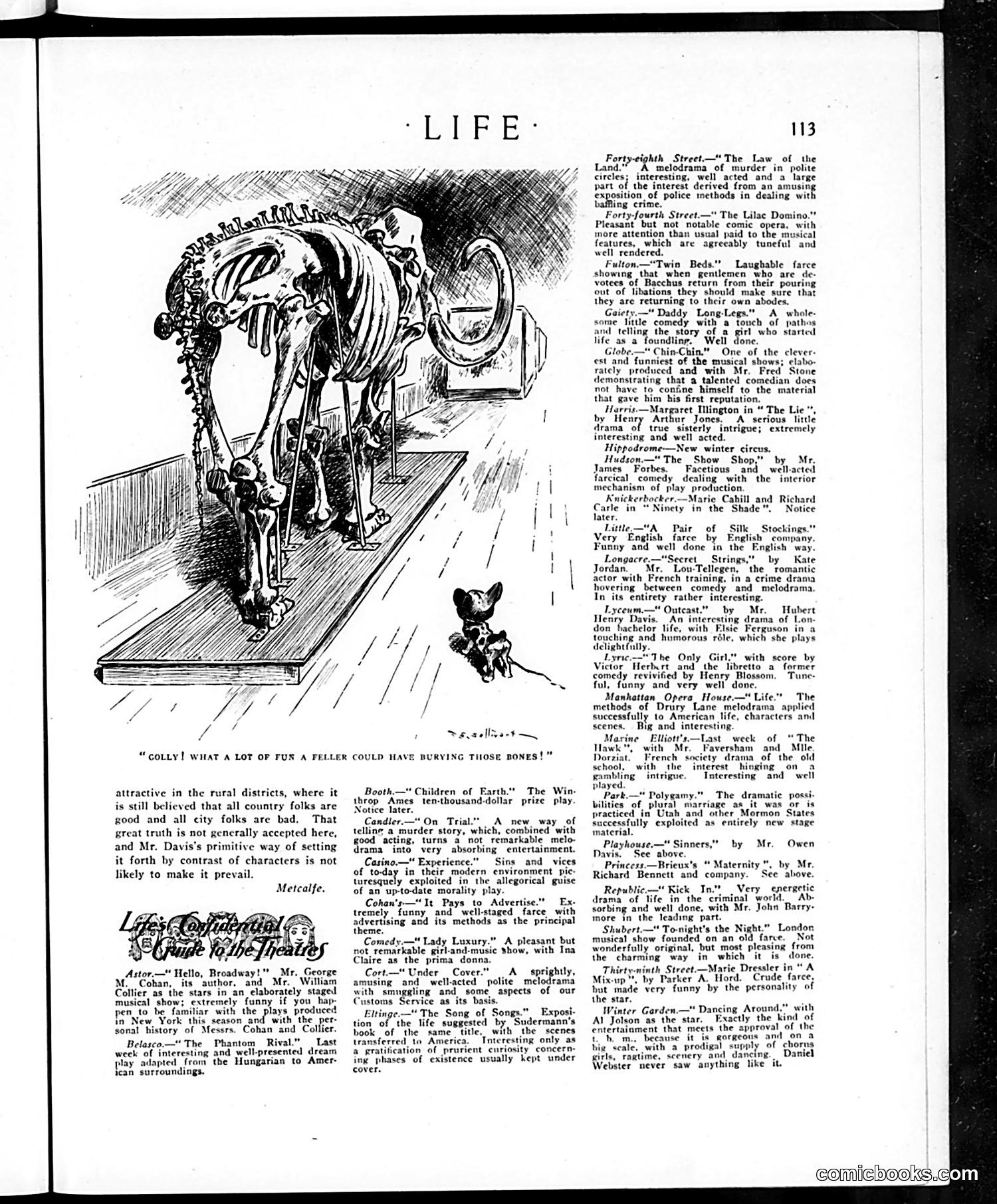
This page features a single cartoon titled "Golly! What a Lot of Fun a Feller Could Have Burying Those Bones!" The image shows a skeletal horse standing on a platform, with a small dog beside it looking up. The joke appears to satirize rural life and attitudes. The accompanying text critique suggests the cartoon illustrates a story by Mr. Davis that contrasts rural and urban morality—asserting that country people are inherently good while city dwellers are bad. The critic (Metcalfe) finds this "primitive" contrast unconvincing and doubts it will gain acceptance. The cartoon likely mocks naive rural sentimentality or simplistic moral contrasts. The dog's fascination with the horse bones represents unsophisticated, basic pleasures, humorously illustrating the story's stereotyping of rural simplicity versus urban complexity. The remainder of the page contains theater reviews typical of Life's entertainment coverage from this era.
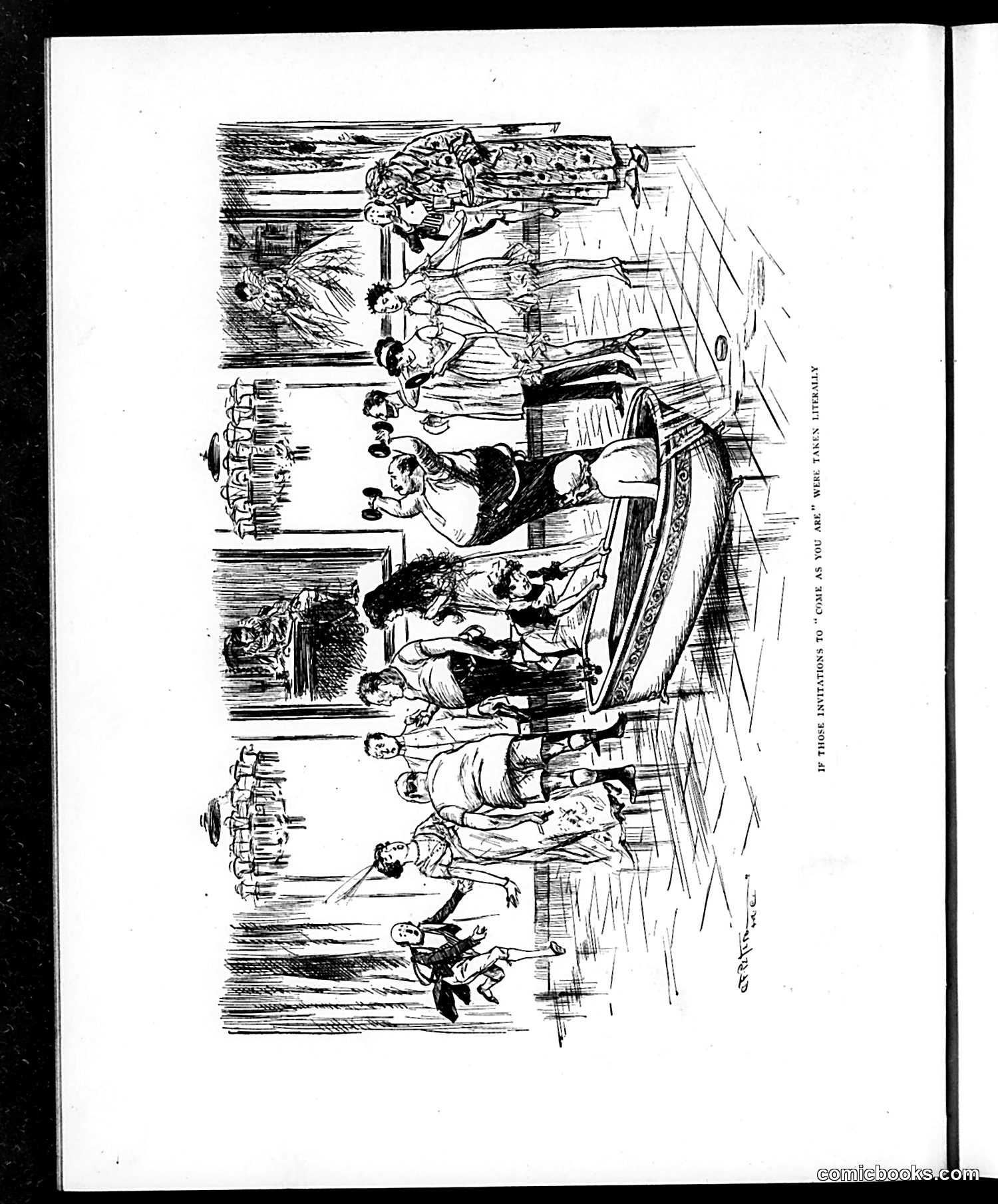
The OCR text appears to be corrupted or reversed and is illegible, making it impossible to read the caption or title. However, examining the sketch itself: This appears to be a satirical scene depicting multiple figures in what looks like a chaotic interior setting. The drawing style is characteristic of late 19th or early 20th-century satirical illustration. Without a legible caption, I cannot definitively identify the specific figures, political references, or satirical intent. The composition suggests social commentary—possibly about politics, society, or daily life—but the specific subject remains unclear. To accurately explain this cartoon's meaning to a modern reader, the legible original caption or additional context would be necessary.
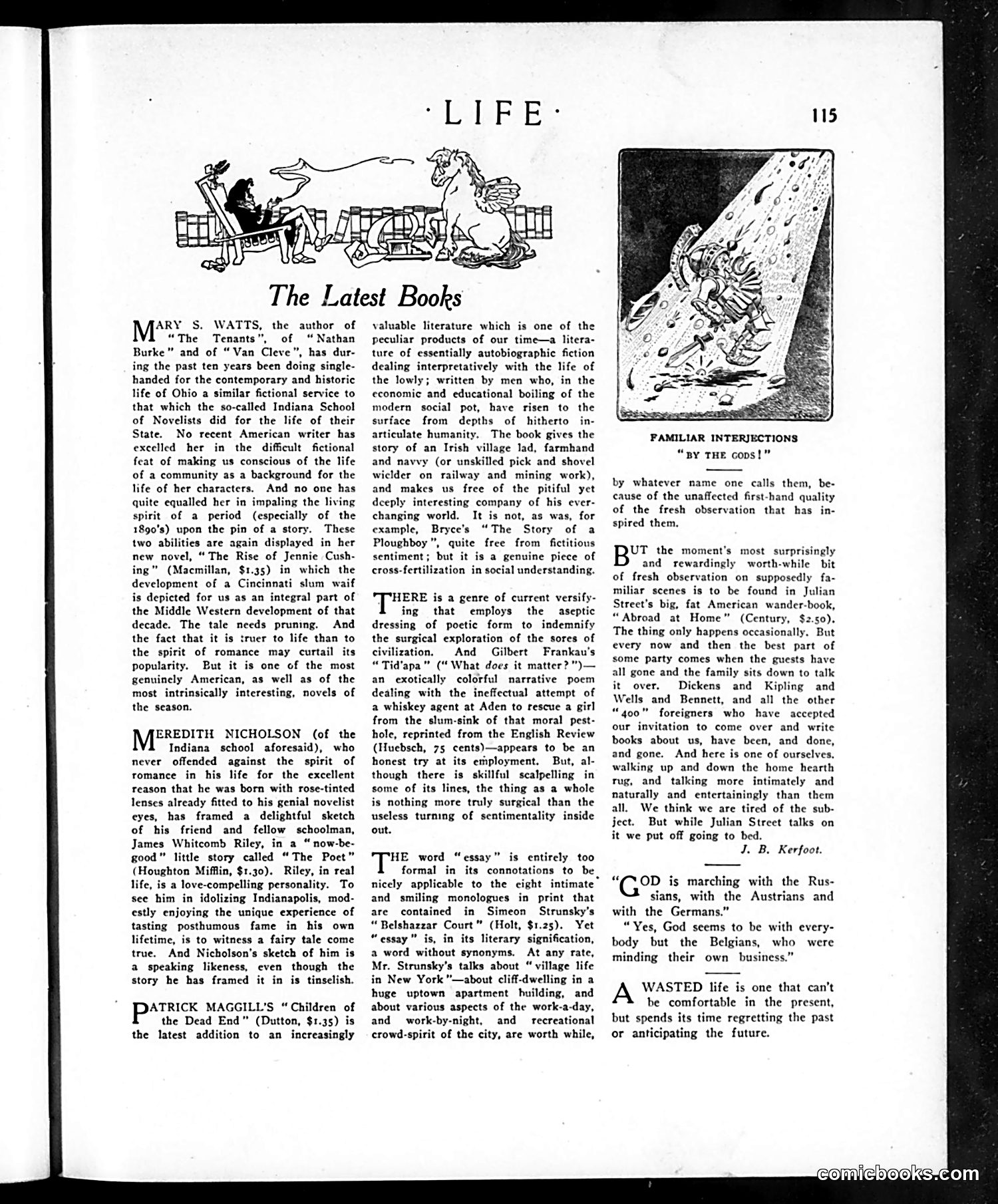
This is a book review column from *Life* magazine. The left side reviews several contemporary novels, including works by Mary S. Watts (about Ohio life), Meredith Nicholson (a biographical sketch of poet James Whitcomb Riley), and Patrick Magill (an autobiographical novel about an Irish laborer). The right side features a small cartoon titled "Familiar Interjections: 'By the Gods!'" showing what appears to be a figure on a slope or incline—likely illustrating some everyday human folly or observation. Below the cartoon are brief witty observations about modern life, including quotes about God's alignment with various nations during wartime, and a maxim about wasted lives. This represents *Life* as a literary and cultural journal mixing serious book criticism with humorous social commentary—typical of early 20th-century American magazine culture before *Life* became primarily photojournalistic.
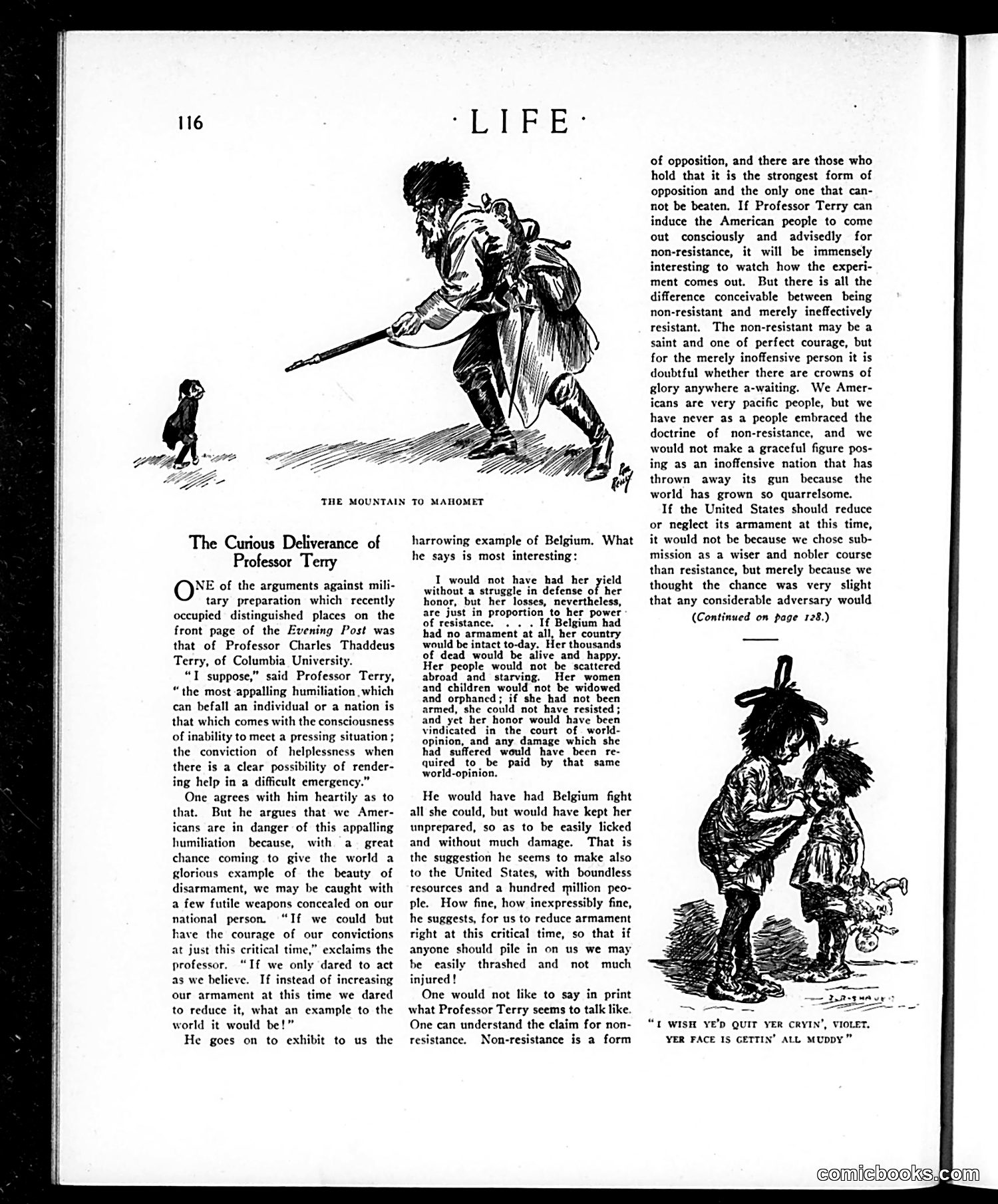
This page satirizes Professor Charles Thaddeus Terry of Columbia University, who publicly argued against American military preparedness. The top cartoon ("The Mountain to Mahomet") depicts Terry as a tiny figure dwarfed by a larger force—visualizing his impotence. The article attacks Terry's logic, which used Belgium as an example: he argued Belgium's losses were proportional to its military resistance, implying that disarmament would have preserved the nation and its honor through "world-opinion." The author finds this reasoning absurd and dangerous, especially for America. The satire's point: Terry conflates principled non-resistance (a coherent moral stance) with mere military weakness disguised as pacifism. The article argues Americans are naturally peaceful but have never embraced non-resistance doctrine—attempting it now would appear cowardly rather than noble, and leave America vulnerable to aggressors. The author suggests Terry's proposal is naive idealism masquerading as moral courage.
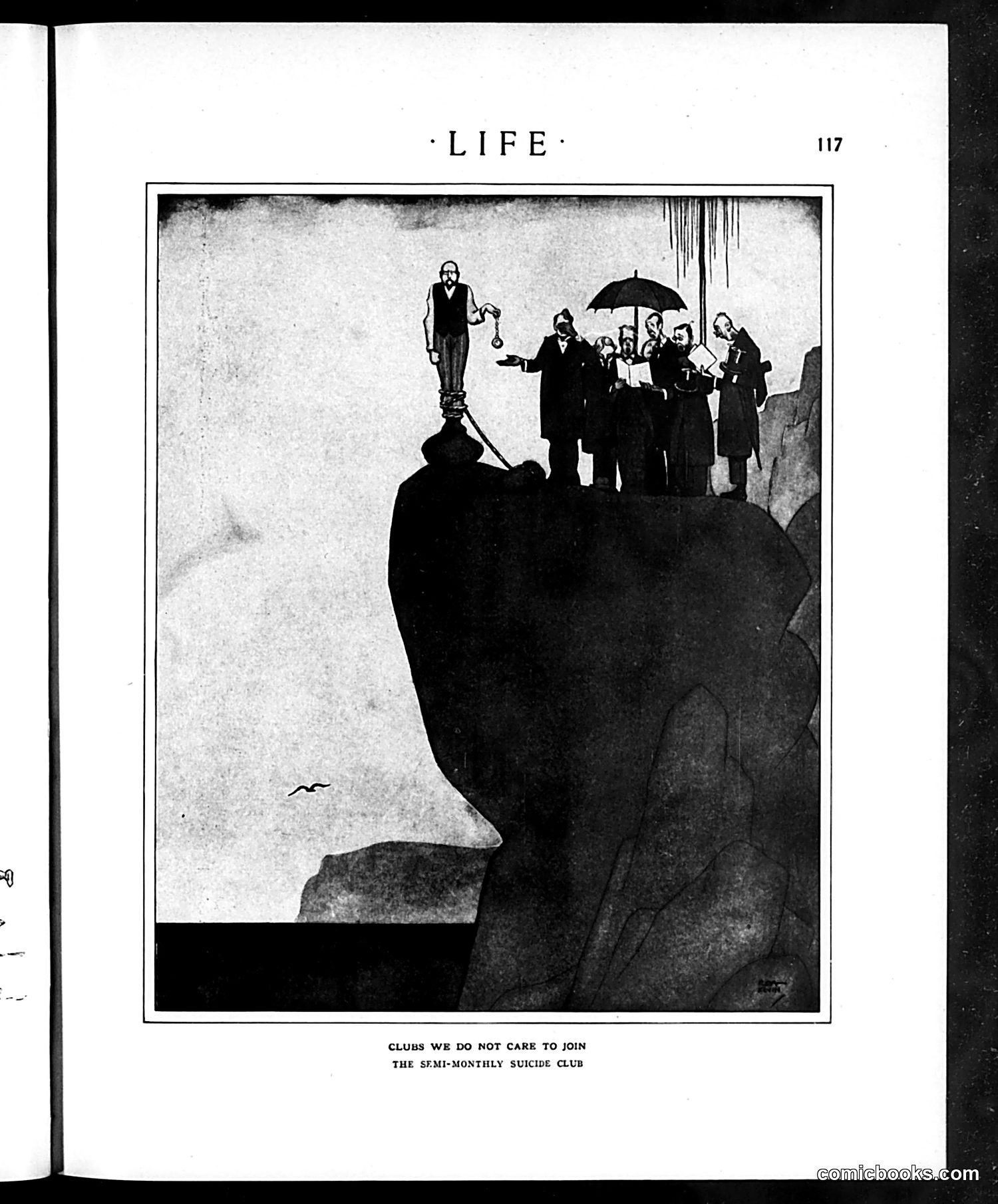
This satirical cartoon depicts a dark commentary on exclusive club membership. A man stands precariously atop a jagged cliff edge, holding a noose, while a well-dressed group below shelters under an umbrella—deliberately excluding him from their circle. The caption reads "Clubs We Do Not Care to Join: The Semi-Monthly Suicide Club," using sardonic humor to critique social exclusion and class divisions. The cartoon suggests that those in elite circles would rather watch someone in dire circumstances perish than extend membership or assistance. The image satirizes both the arbitrary nature of club membership and the indifference of the privileged toward those struggling. The "semi-monthly" detail adds dark comedy, implying suicide club membership occurs with routine regularity—a biting commentary on social callousness.
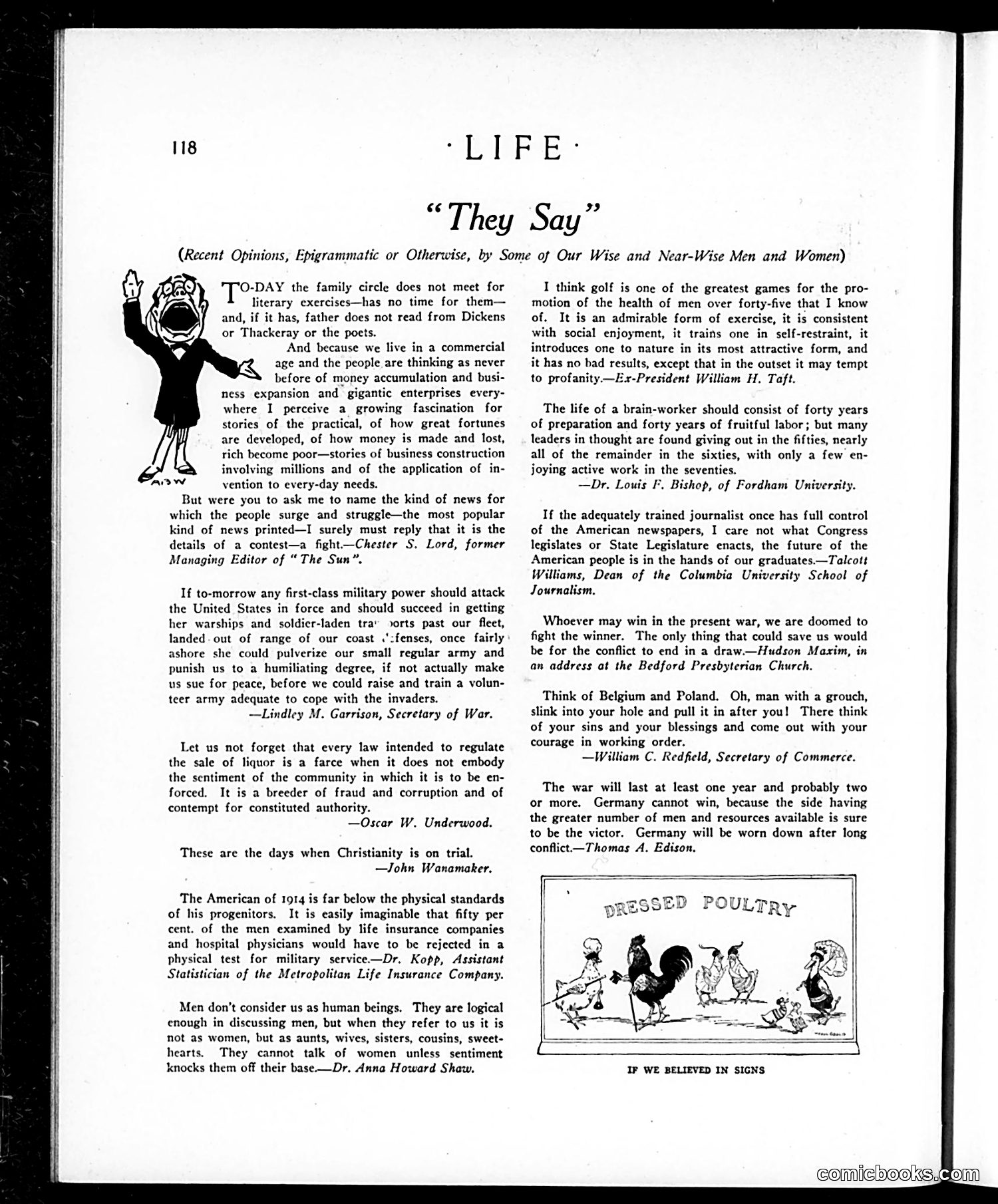
This page collects brief opinions from prominent figures (early 1914, based on references). The content reflects pre-WWI American anxieties: **Key figures quoted include:** - Secretary of War Lindley Garrison warns of U.S. military vulnerability to invasion - Ex-President William H. Taft endorses golf for middle-aged men - Dr. Anna Howard Shaw (women's rights advocate) critiques how men discuss women only through domestic relationships - Oscar Underwood and others comment on liquor prohibition and national character **The satire's point:** The page mocks how the nation's "wise men" offer contradictory, self-serving advice during uncertain times. Garrison fears military weakness while others debate golf and prohibition—suggesting leadership lacks unified vision. The cartoon below ("Dressed Poultry") appears to mock superstitious belief, titled "If We Believed in Signs." The overall effect satirizes 1914 America's anxieties about military preparedness, morality, and national decline.
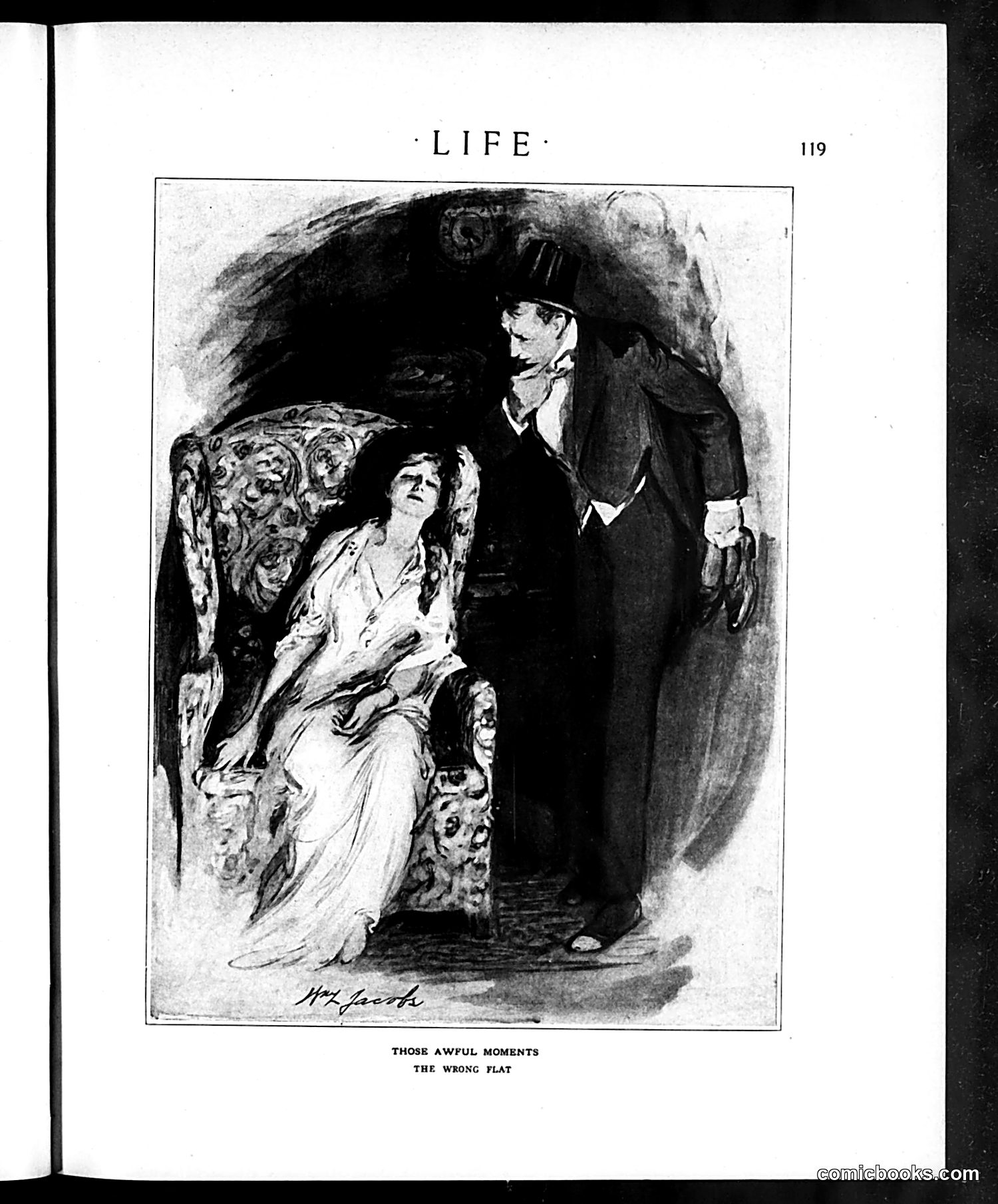
This illustration titled "Those Awful Moments: The Wrong Flat" depicts a common comedic scenario from early 20th-century urban life. A formally dressed man in a top hat stands in a doorway, appearing to have entered an apartment uninvited or unannounced. A woman seated in an ornate chair looks up in surprise or alarm at his presence. The humor derives from the social awkwardness of mistakenly entering the wrong residential flat—a scenario made more mortifying by the formal attire and the intimate domestic setting. The joke plays on Victorian-era social propriety and embarrassment, likely resonating with Life magazine's urban, middle-class readership who would recognize such situations in apartment buildings. The illustration is by artist Hal Jacobs, as signed at bottom.
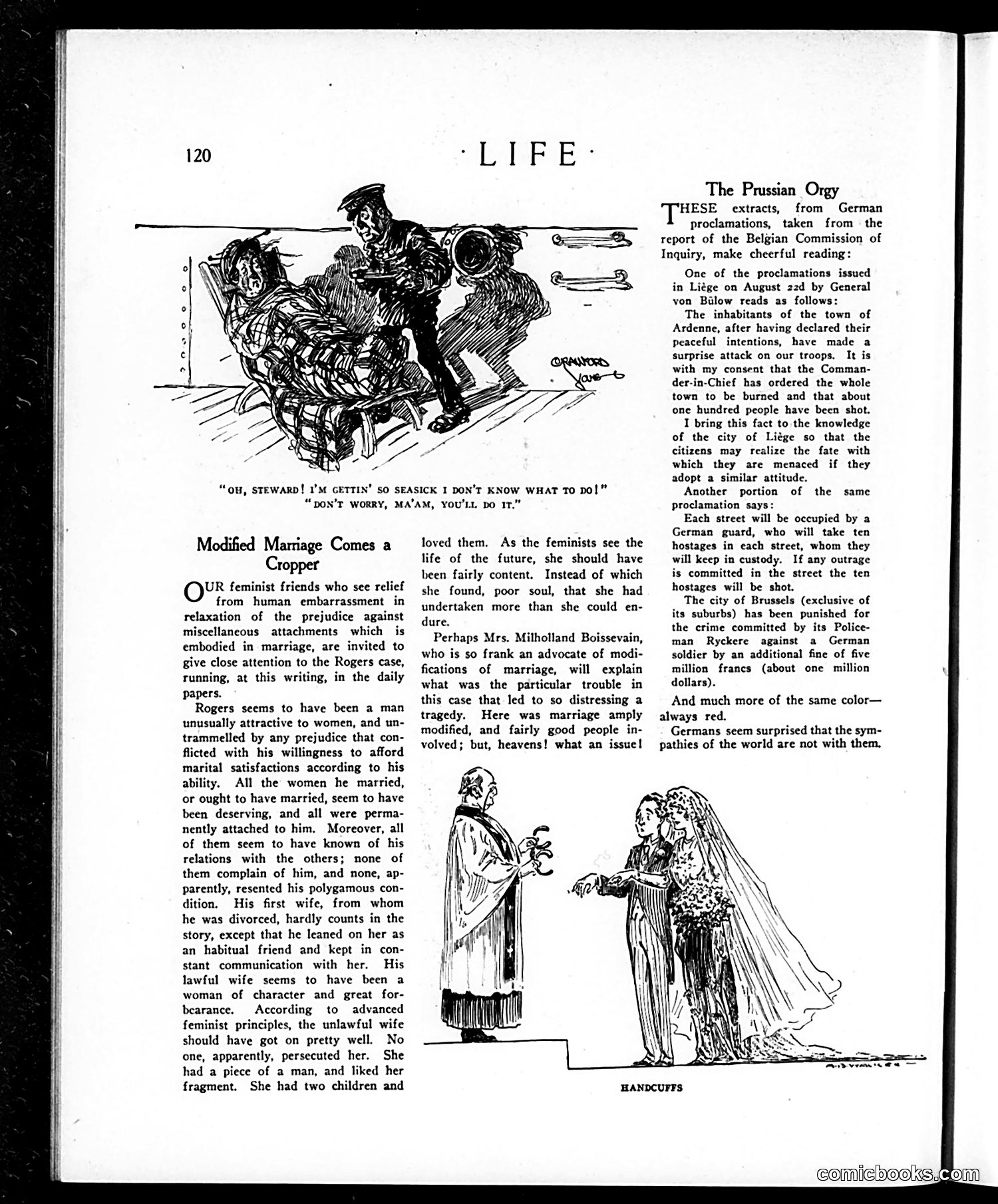
This page contains two distinct satirical pieces from an American publication critical of both feminist social reforms and German military conduct during World War I. **Top cartoon** ("Oh, Steward!"): A seasick woman passenger receives casual reassurance from a ship's steward—mild humor about maritime discomfort. **"Modified Marriage Comes a Cropper"**: This article satirizes feminist advocates of relaxed marriage restrictions by citing the "Rogers case"—apparently a real scandal involving a man who maintained multiple relationships. The author argues that even with willing participants and "modified" marriage arrangements, the situation ended tragically, undermining feminist arguments that such arrangements could work harmoniously. **"The Prussian Orgy"**: This section reproduces German military proclamations (allegedly from the 1914 Belgian invasion) describing the burning of towns, executions of civilians, and hostage-taking as collective punishment. The final line—"Germans seem surprised that the sympathies of the world are not with them"—is devastating satire, implying Germany's actions were self-evidently monstrous yet they expected international sympathy.
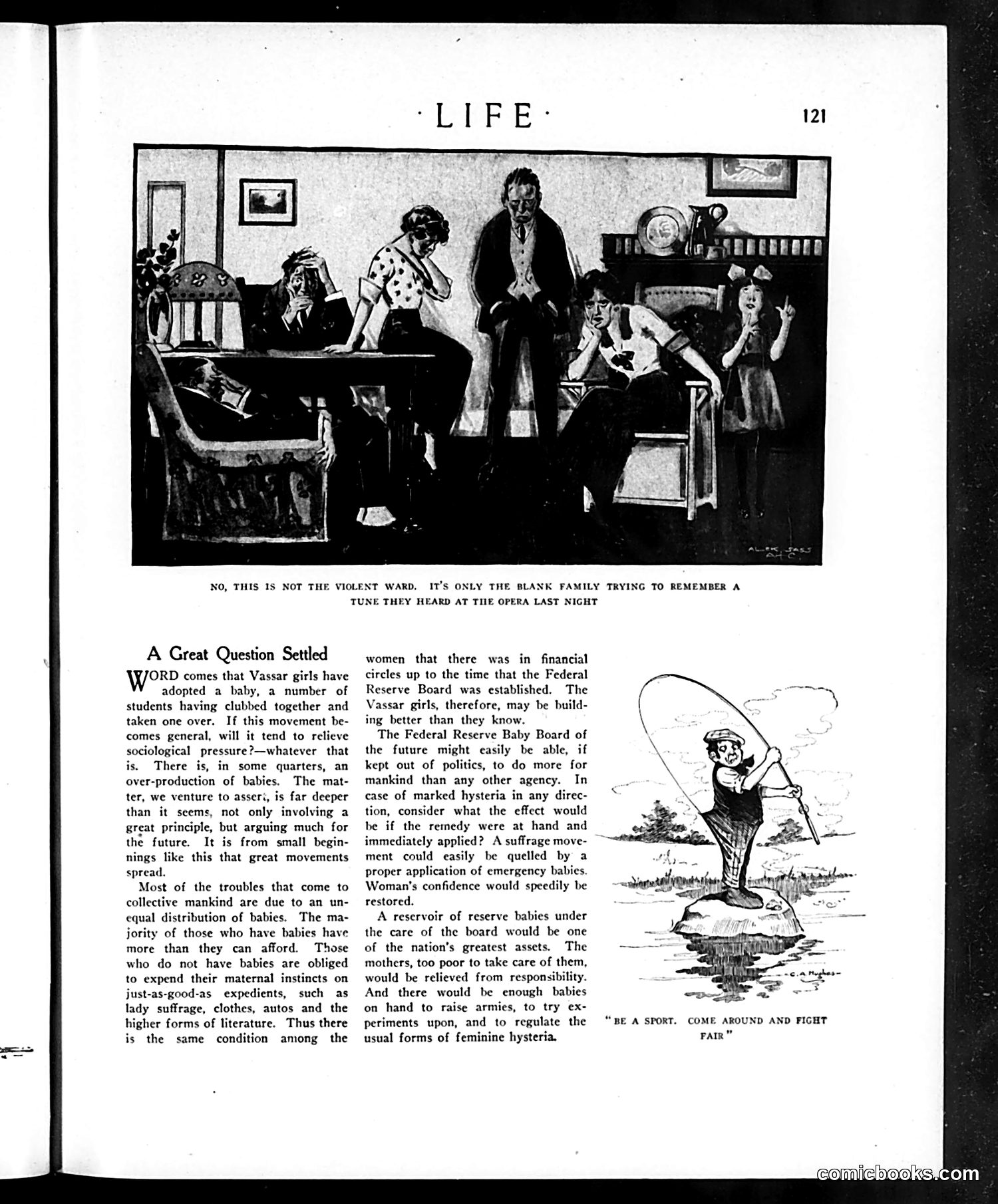
**The Cartoon (top):** A domestic scene where a family appears rowdy or chaotic indoors. The caption jokes they're not in a "violent ward" but rather the "blank family" trying to recall an opera tune—satirizing how people's attempts to recreate music at home can sound discordant or mad. **The Article:** A satirical piece responding to news that Vassar College students collectively adopted a baby. The author sardonically proposes establishing a "Federal Reserve Baby Board"—mocking the recent creation of the Federal Reserve (1913) by applying its logic to infant management. The satire targets early 20th-century anxieties about overpopulation among the poor and underpopulation among the wealthy. It absurdly suggests babies could be distributed as a solution to social problems, including "quelling" women's suffrage movements and controlling "feminine hysteria" through strategic baby deployment. **Context:** This reflects period attitudes viewing women's rights activism as emotional instability requiring paternalistic management, while simultaneously exposing the absurdity of such thinking through exaggeration.
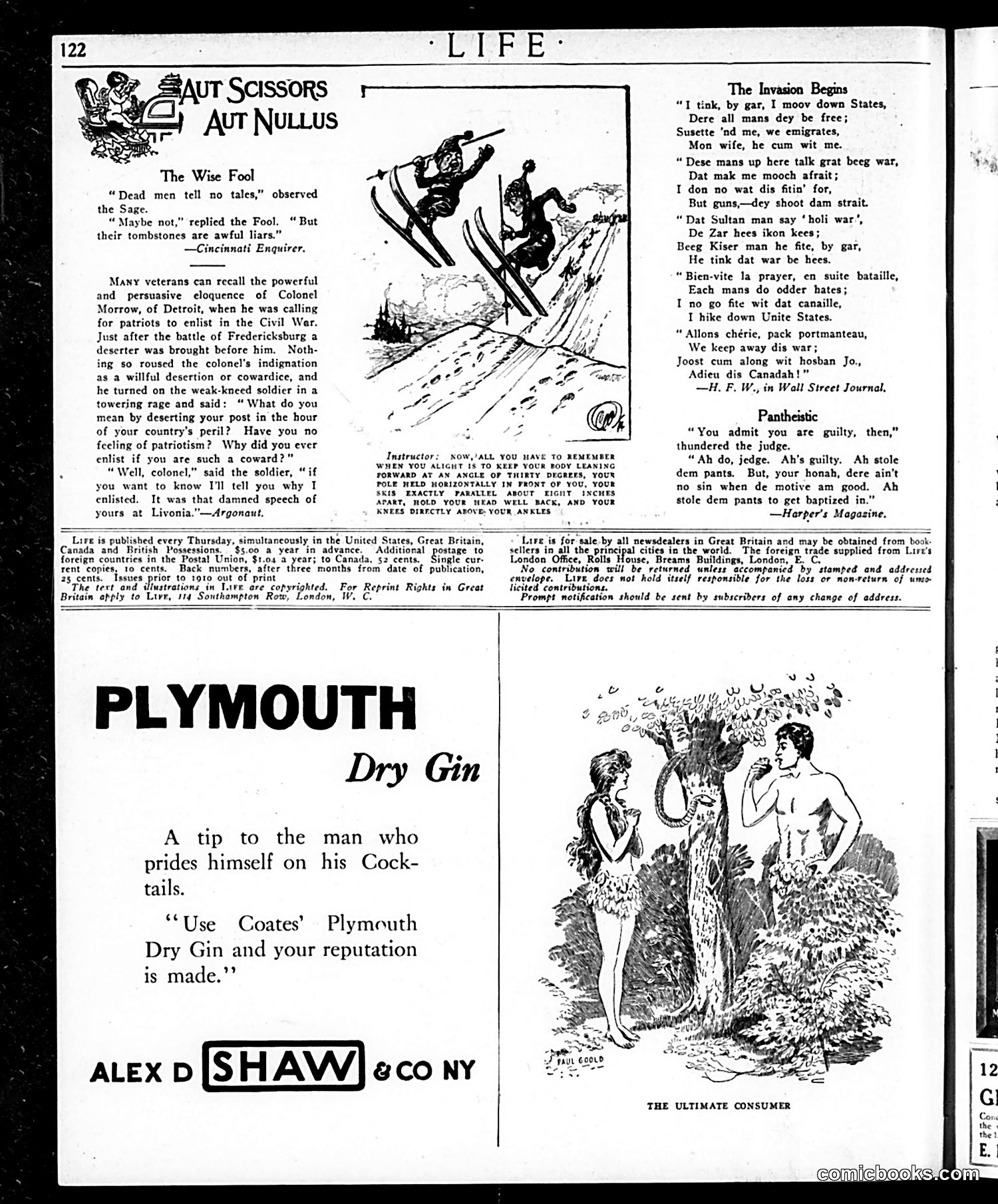
This page contains multiple distinct pieces: **"The Wise Fool" and Civil War anecdote**: Short humorous pieces satirizing human nature and military recruitment. The Colonel Morrow story mocks the gap between patriotic rhetoric and soldiers' actual motivations—the soldier enlisted because Morrow's speech frightened him, not inspired him. **"The Invasion Begins"**: A dialect-heavy cartoon satirizing European immigrants' fears of Old World conflicts. The character (appears to be French-Canadian) speaks broken English with a heavy accent, expressing alarm at European wars ("Sultan man," "Zar," "Kiser") and deciding to flee to "Unite States" for peace. This reflects early-20th-century American attitudes toward immigration and European instability. **Skiing instruction cartoon**: A humorous visual gag showing an instructor providing overly complex, contradictory skiing instructions while students tumble down a slope. **"Pantheistic"**: A brief joke playing on dialect humor and religious rationalization—a man justifies stealing pants because he'll use them to get baptized. The page also contains advertising for Plymouth Dry Gin. The overall tone is lighthearted satire with period-typical use of ethnic dialect humor.
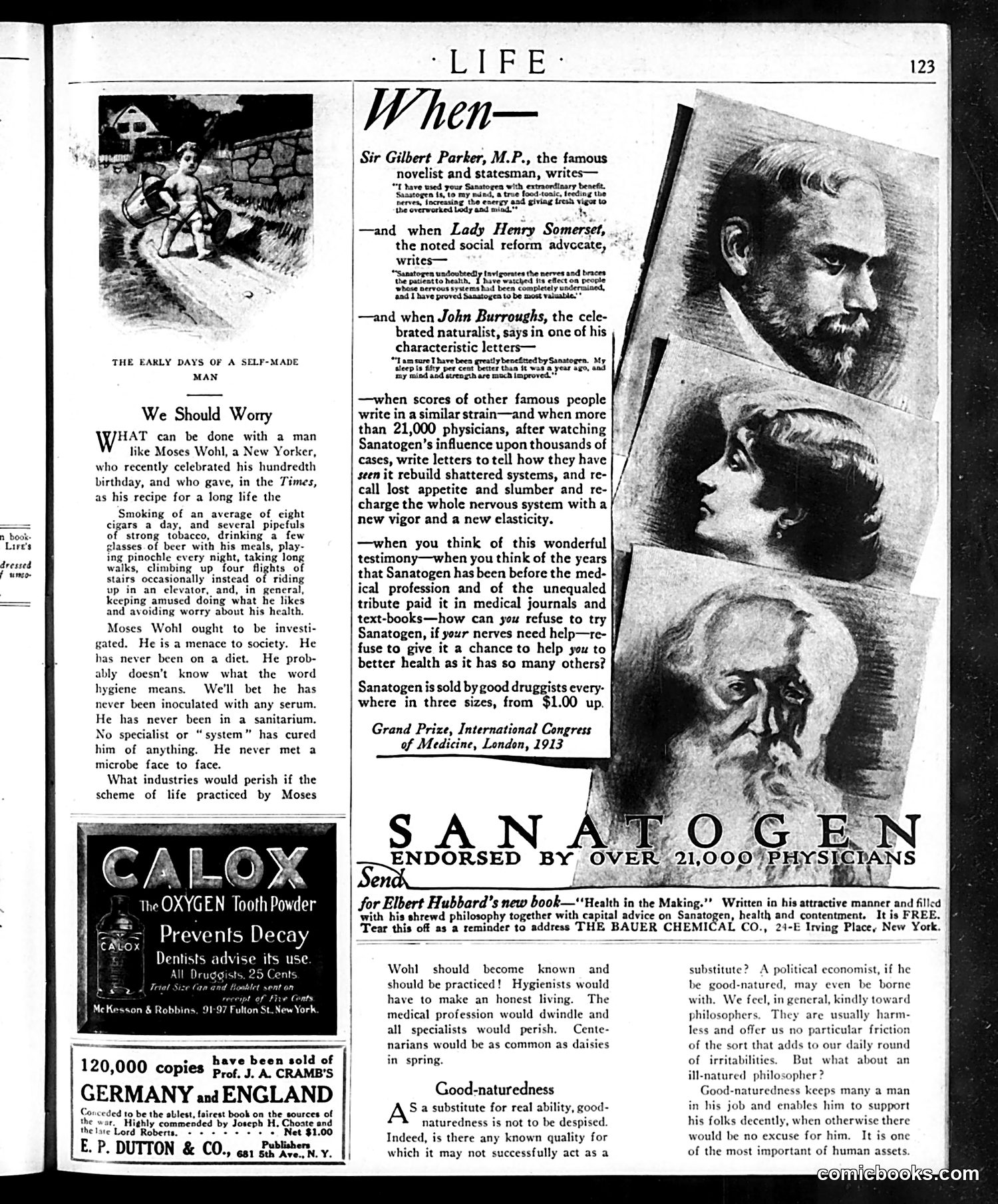
This page combines satire with pharmaceutical advertising. The left column mocks Moses Wohl, a real New York centenarian who attributed his longevity to cigars, beer, and avoiding medical advice—practices that directly contradicted early 20th-century health orthodoxy. Life magazine's satirical point: Wohl's existence threatens entire industries built on medical interventions, diets, and sanitariums. The humor lies in imagining the economic catastrophe if his lifestyle actually worked. The right side ironically undercuts this satire through a massive Sanatogen advertisement featuring endorsements from celebrities (novelist Gilbert Parker, reformer Lady Henry Somerset, naturalist John Burroughs) and claims of 21,000 physician endorsements. The advertisement essentially sells the opposite lifestyle—a commercial health product promising vigor. The page's irony is unintentional: Life satirizes medical-industrial fearmongering while being surrounded by the very marketing that exemplifies it, demonstrating how advertising shaped health narratives in this era.
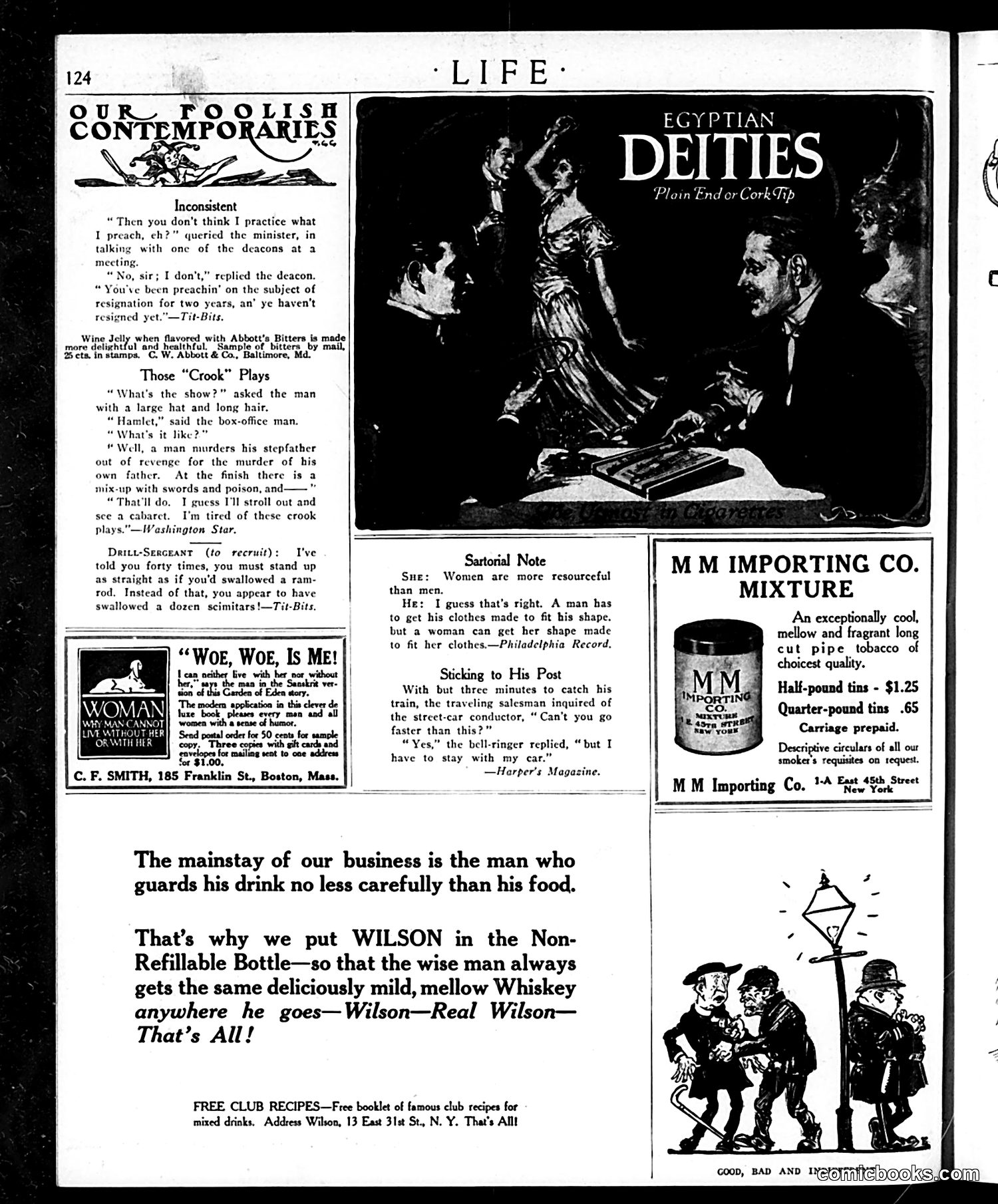
This page combines humor columns with advertisements, typical of Life's satirical format. **Content Summary:** The page features several short joke segments ("Our Foolish Contemporaries," "Those 'Crook' Plays," etc.) mocking everyday social hypocrisy and absurdity. The opening joke satirizes a minister preaching about resignation while refusing to resign himself—a jab at clerical inconsistency. The "Crook Plays" section criticizes contemporary theater's obsession with crime drama, with a theatergoer tired of murder plots preferring cabaret entertainment instead. This reflects early 20th-century anxiety about sensationalist entertainment. **Visual Elements:** The "Egyptian Deities" illustration (top right) appears decorative rather than satirical—depicting classical figures in period style. **Advertisements:** The page heavily features period product ads (Abbott's Bitters, Wilson Whiskey, MM Importing tobacco), reflecting Life's revenue model of combining editorial content with advertising. These were standard luxury goods marketed to educated, affluent readers. The overall tone reflects Life's characteristic blend of social commentary and commercial interests.
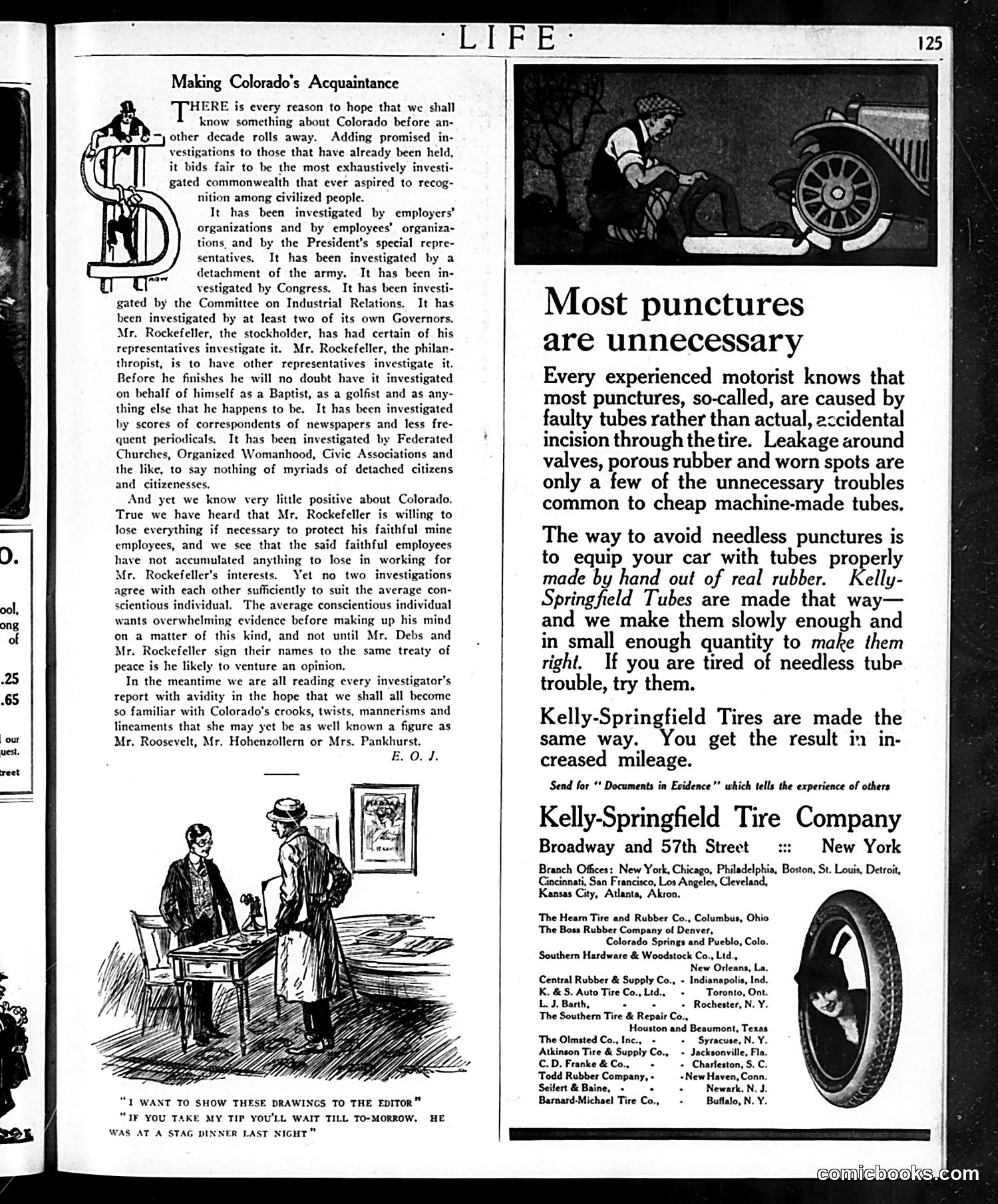
**Left Column - Political Satire:** The essay "Making Colorado's Acquaintance" mocks the endless investigations into Colorado labor disputes (likely the 1914 Ludlow Massacre coal miners' strike). It satirizes how Rockefeller—identified as both "stockholder" and "philanthropist"—launches separate investigations while nothing gets resolved. The piece ridicules the absurdity: multiple organizations (Congress, the Army, churches, newspapers) investigate repeatedly yet reach no consensus, and the author suggests that until labor radical Eugene Debs and capitalist Rockefeller sign a "treaty of peace," no real understanding emerges. The accompanying cartoon shows two men at a desk; one wants to show drawings to the editor, but the other advises waiting because the editor is "at a stag dinner"—a cynical joke about editorial priorities during serious crises. **Right Column - Advertisement:** Kelly-Springfield Tire Company advertisement claiming superior quality through hand-manufacturing, unrelated to the political content above.
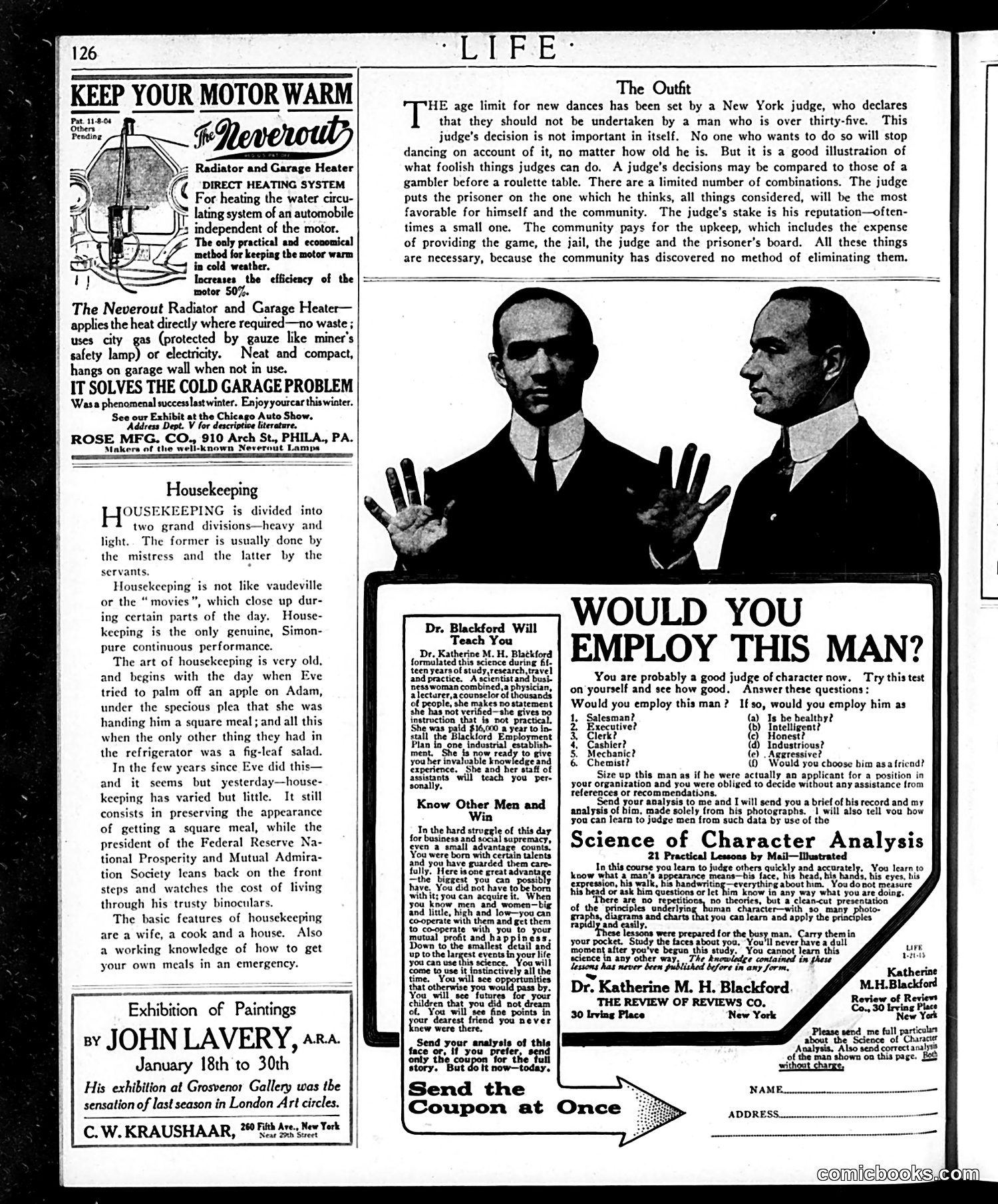
This page from *Life* magazine contains satirical commentary on social attitudes and judicial overreach, combined with period advertisements. **"The Outfit" (main article):** The editorial mocks a New York judge's decision setting age 35 as the limit for new dances. The satirist argues judges often make arbitrary, unenforceable decisions—comparing them to gamblers—while the public funds the entire legal system (jails, judges, prisoners). The point: judicial pronouncements about personal behavior are foolish and ineffective. **"Would You Employ This Man?" advertisement:** This promotes Dr. Katherine M.H. Blackford's character analysis service. The accompanying illustration shows two men in silhouette, and users are asked personality questions to determine if someone is suitable employment material. This reflects early 20th-century pseudoscientific personality assessment—a precursor to modern job screening but lacking scientific validity. The page also includes practical advertisements (motor heaters, exhibitions) and an article on housekeeping using period humor (references to cost-of-living inflation).
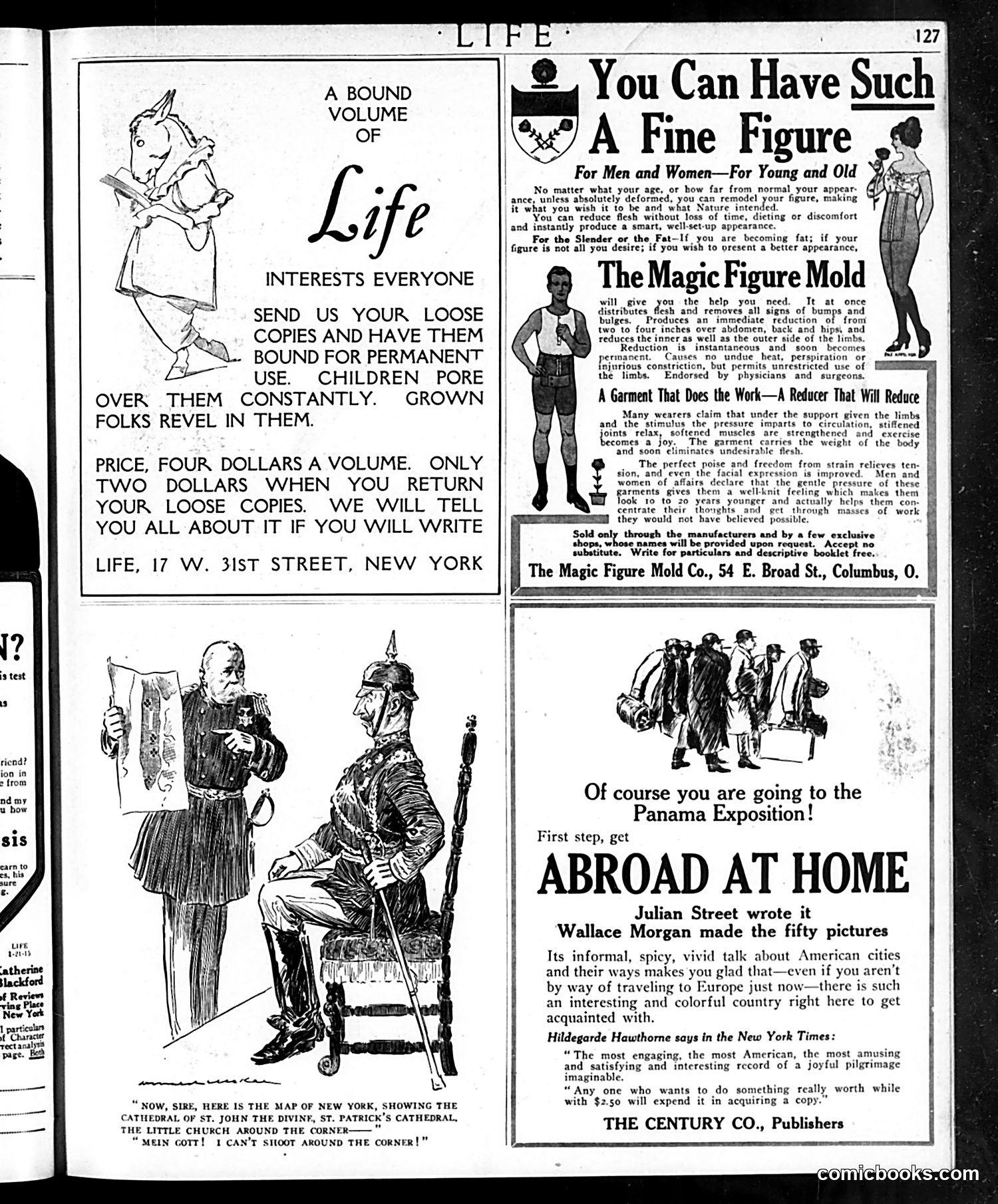
The main cartoon (lower left) depicts a German military officer being given a map of New York City by an American guide. The officer's exasperated response—"Mein Gott! I can't shoot around the corner!"—is a satirical jab at German militarism, likely referencing tensions during World War I (the magazine was published around that era). The joke mocks German aggressive expansionism by suggesting even their military capabilities have limits in civilian urban landscapes. The remainder of the page consists entirely of period advertisements: Life magazine's binding service, "The Magic Figure Mold" (a body-shaping corset), and "Abroad at Home," a travel guidebook to American cities. These ads reflect early 1900s consumer culture and attitudes toward fashion and leisure.
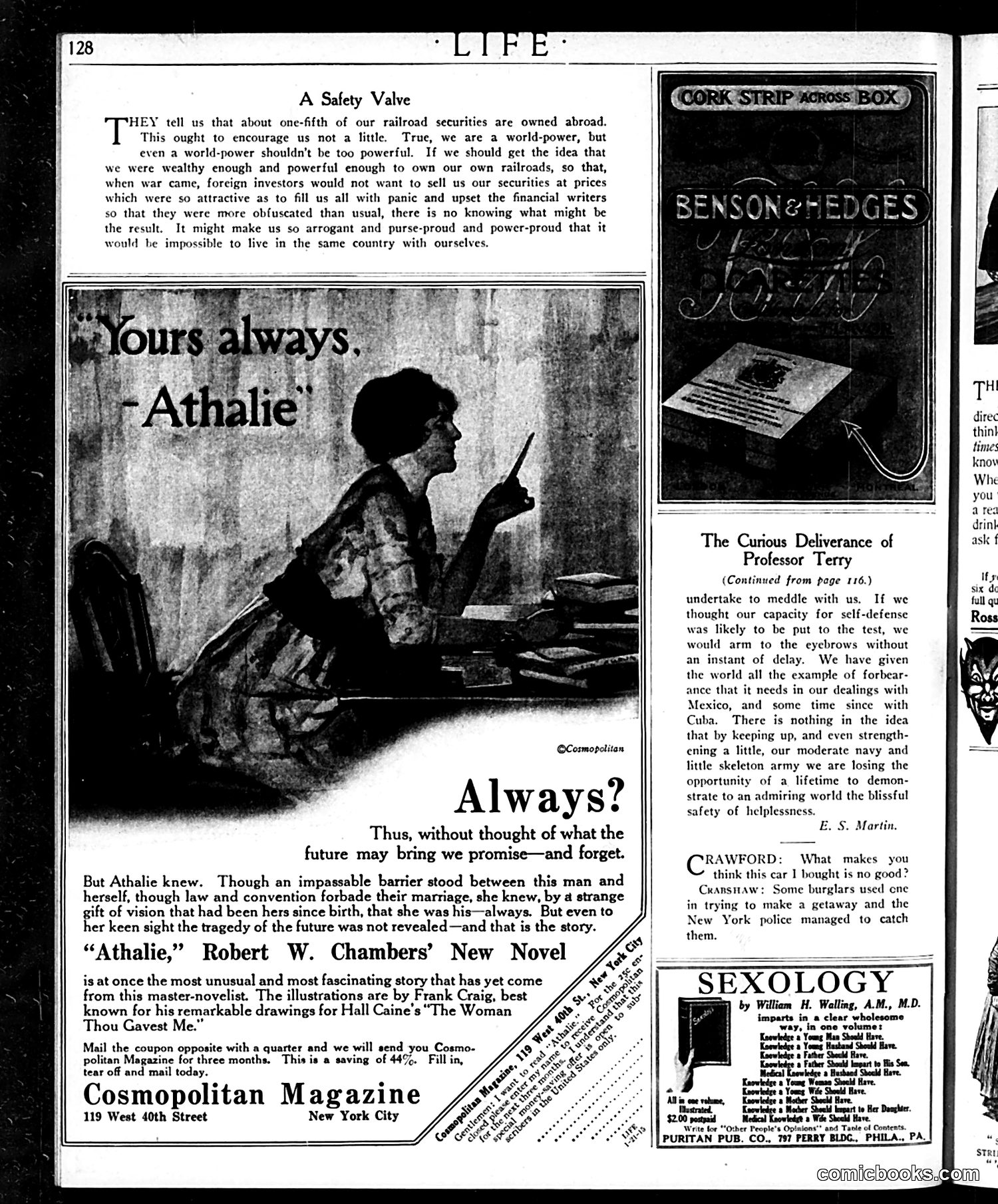
**"A Safety Valve" Editorial:** This is satirical commentary on American anxiety about foreign ownership of railroad securities. The piece mocks fears that foreign investment might somehow threaten American power and independence. The satirist argues that *allowing* foreign investors to profit from American railroads is actually prudent—it prevents America from becoming so wealthy and arrogant that it becomes insufferable to live with. The tone is ironic: the "safety valve" is deliberately keeping some economic power abroad to temper American self-importance. **"Always?" Illustration:** This appears to be an advertisement or story excerpt for Robert W. Chambers' novel "Athalie." The image shows a woman at a desk in profile, seemingly in thought or correspondence. The text suggests a romantic plot involving a man and woman separated by "law and convention"—likely a socially forbidden relationship. The illustration uses period melodramatic styling typical of early-20th-century serialized fiction. The page is primarily **advertising and serialized fiction content** rather than political satire, with the editorial serving as filler material between advertisements.
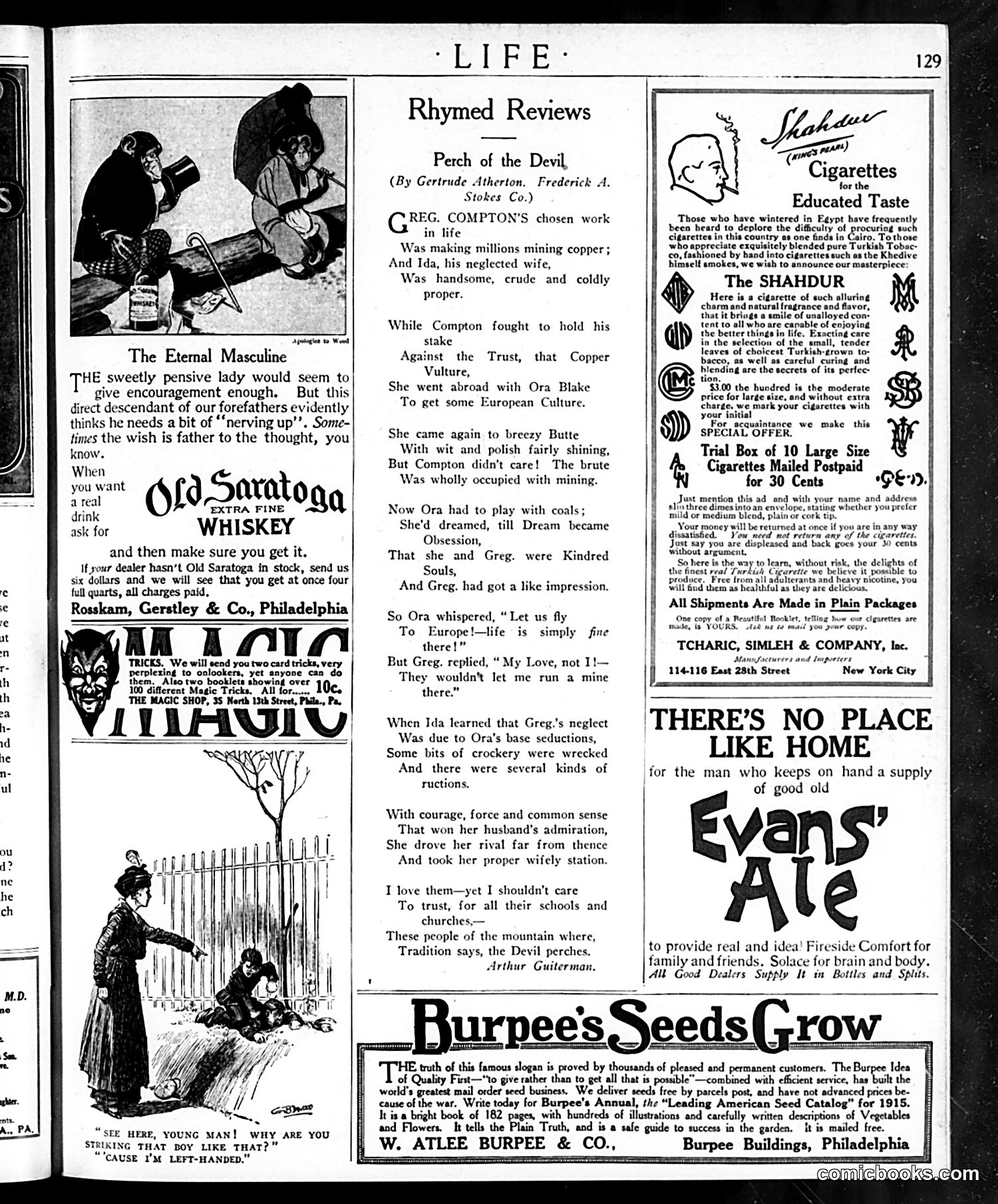
This satirical cartoon depicts a man nervously preparing himself with alcohol before approaching a woman. The woman sits composed and encouraging, while the man appears anxious and hesitant—hence the caption about needing to "nerve up." The joke targets male insecurity and the cultural expectation that men must be confident suitors. Despite the woman's clear interest, the man doubts himself and resorts to whiskey for courage. The satire mocks traditional masculine bravado: the supposedly "eternal masculine" is actually timid and dependent on alcohol to face courtship. The accompanying Old Saratoga whiskey advertisement ironically reinforces this point, suggesting liquor as solution to romantic anxiety—a common advertising trope of the era. Below, a separate joke about left-handedness (explaining why a boy was struck) uses physical awkwardness as minor comic relief.
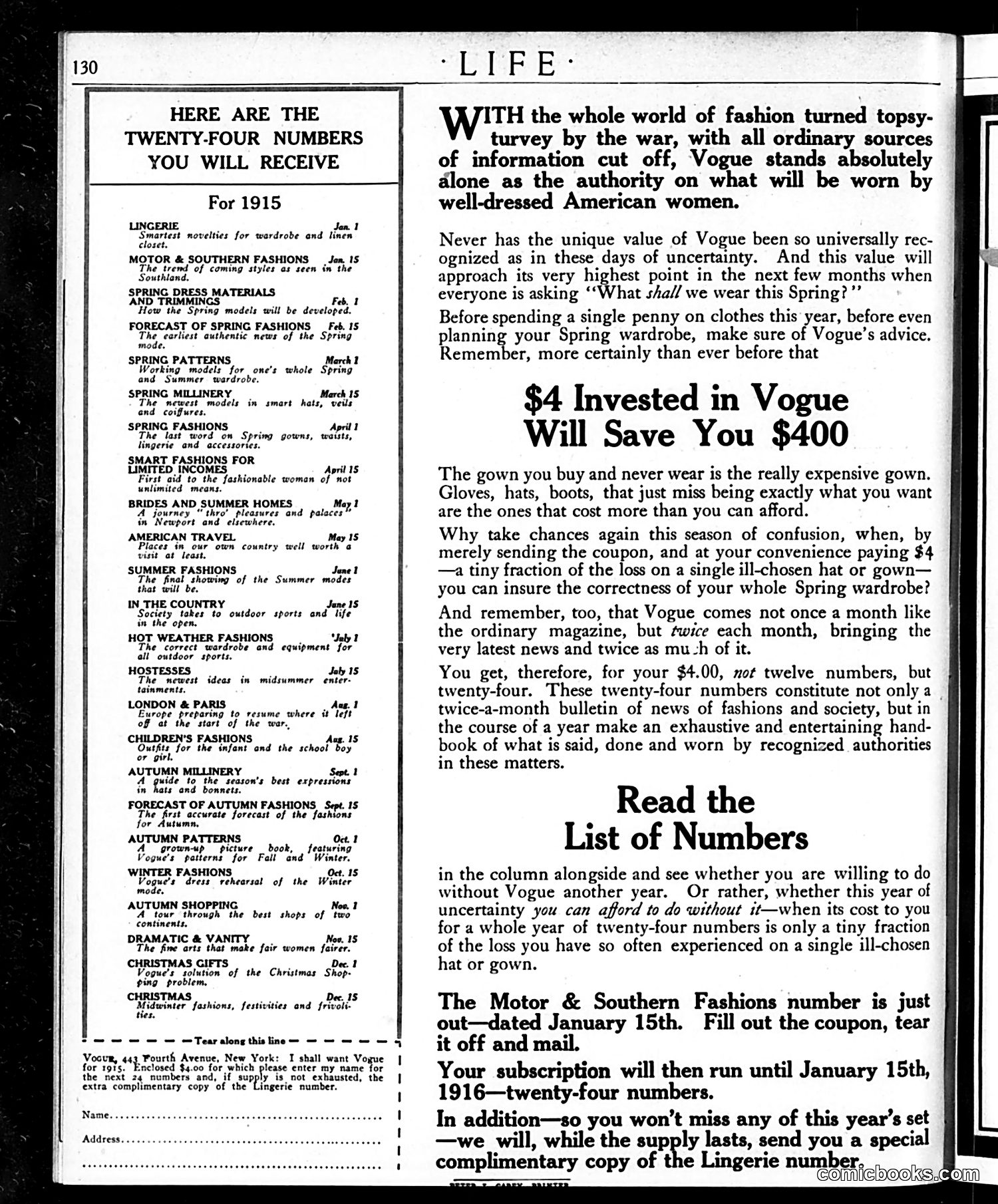
This is primarily a **subscription pitch**, not satire or political commentary. The page advertises Vogue magazine subscriptions to Life readers during World War I. The key claim—"$4 Invested in Vogue Will Save You $400"—represents the magazine's sales argument: wartime fashion confusion makes expert guidance essential. With European fashion centers disrupted by the war, Vogue positions itself as America's sole reliable fashion authority. The left column lists twenty-four promised issues covering seasonal fashion forecasts, patterns, and lifestyle content. The pitch emphasizes value: readers get twice-monthly issues (not monthly competitors) plus a "handbook" of fashion advice for a modest investment. For modern readers: this reflects pre-internet information scarcity, when specialized magazines were premium sources. The wartime context (Europe "preparing to resume where it left off at the start of the war") dates this to early WWI, when transatlantic fashion communication had collapsed. This is **marketing content**, not satirical commentary.
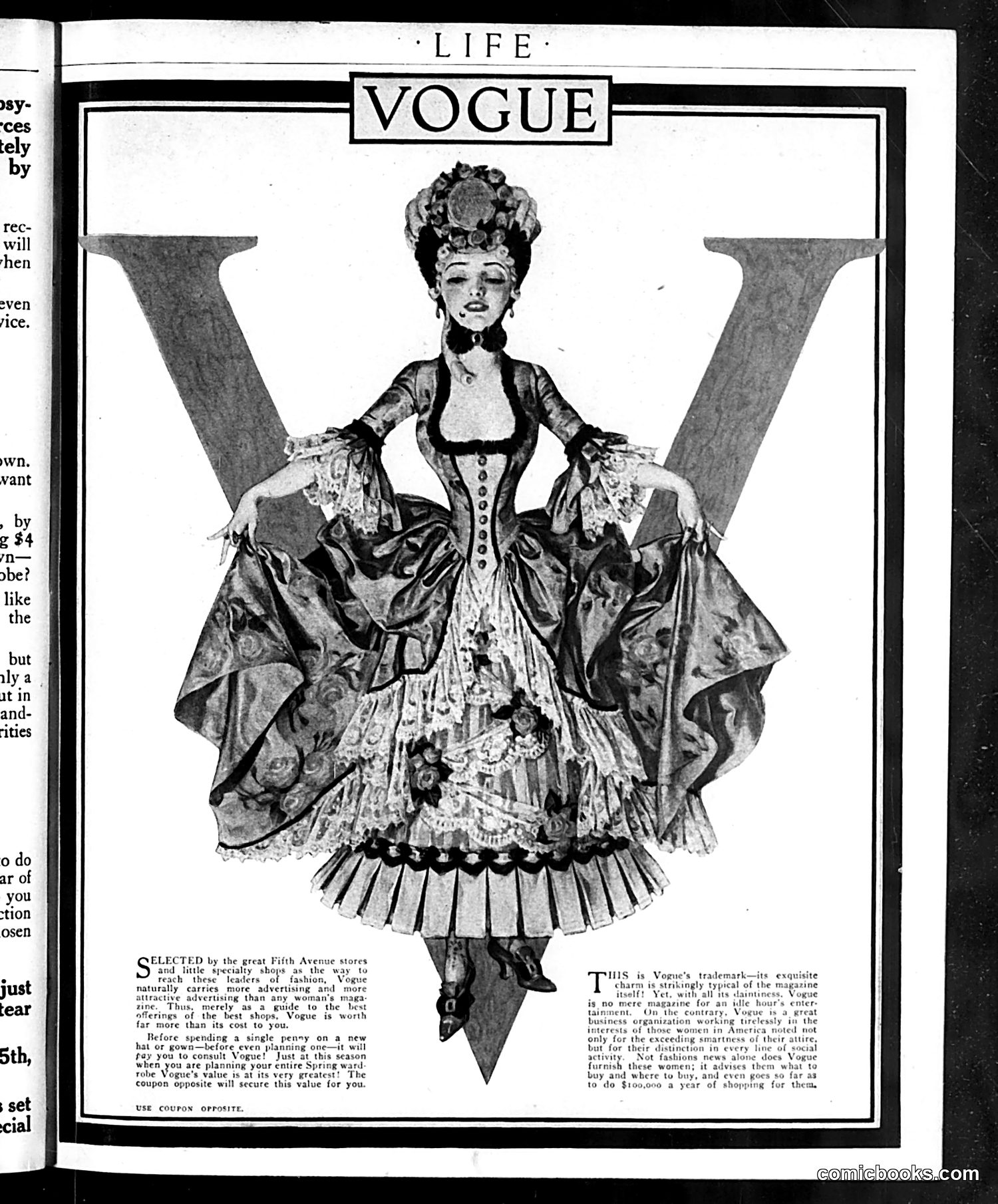
This is an **advertisement for Vogue magazine**, not political satire. The large illustration depicts an elegantly dressed woman in elaborate early-20th-century fashion—featuring an ornate upswept hairstyle, corseted waist, lace trim, and dramatic cape or wing-like sleeves—positioned within a giant letter "V" (Vogue's trademark). The accompanying text promotes Vogue as an essential shopping guide, emphasizing that it carries advertising from "great Fifth Avenue stores" and specialty shops. The ad argues that consulting Vogue before purchasing clothing for the spring wardrobe provides superior value and fashion guidance. A coupon is offered for subscription. This represents early **magazine advertising designed to position fashion periodicals as indispensable lifestyle guides** rather than mere entertainment—a marketing strategy still used today.
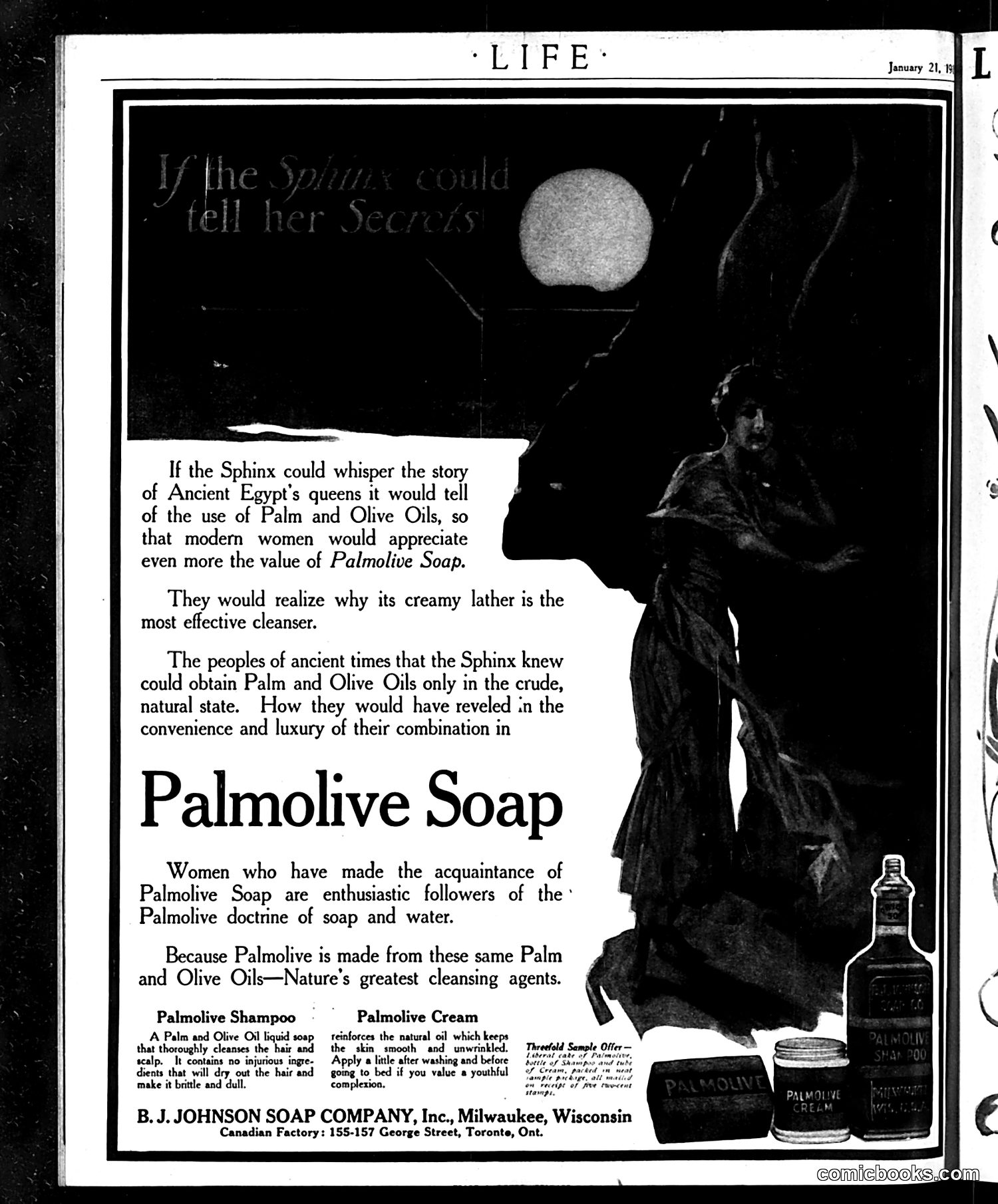
This is primarily a **product advertisement**, not political satire. The page uses the Egyptian Sphinx as a marketing device to suggest ancient pedigree and glamour for Palmolive Soap. The ad's central conceit: if the Sphinx could speak, it would reveal that Ancient Egyptian queens used palm and olive oils for beauty—therefore modern women should buy Palmolive products containing these same ingredients. The silhouetted figure gazing at the moon beside the Sphinx appears to be a romanticized woman, evoking exoticism and luxury. The copy emphasizes that ancient peoples had crude oils, but modern women enjoy their "convenience and luxury" in refined soap form. Multiple product variants (shampoo, cream) are advertised. **For modern readers**: This reflects early-20th-century advertising's heavy reliance on appeals to antiquity, femininity, and "natural" ingredients to market mass-produced toiletries—a strategy still common today, though the Egyptology framing now reads as dated cultural appropriation.