
Life, 1915-01-21 · page 12 of 44
Life — January 21, 1915 — page 12: what you’re looking at
What you’re looking at
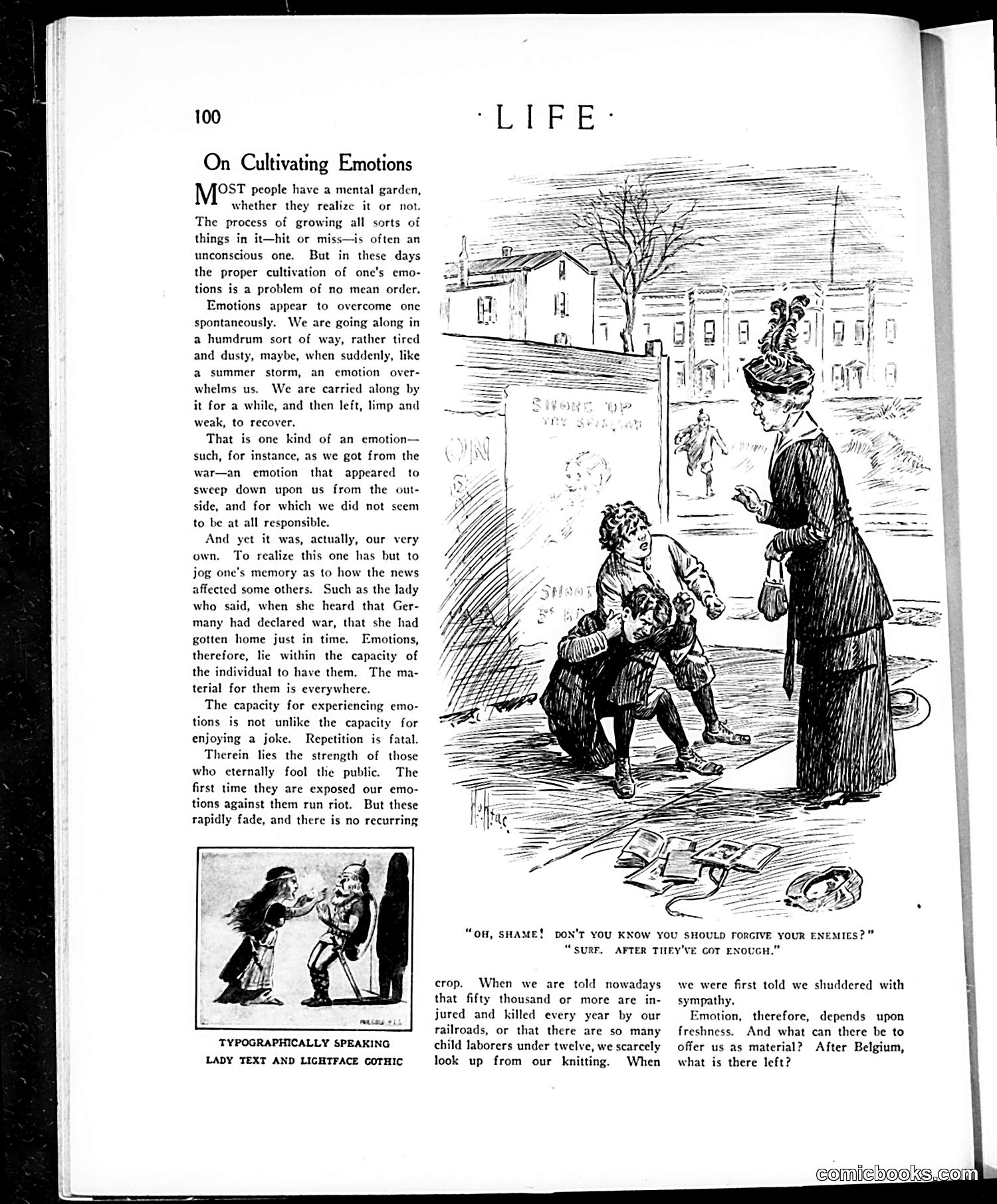
This page discusses how emotions are cultivated and become dulled through repetition. The main illustration shows a well-dressed woman with a child in what appears to be a public square, with the caption addressing forgiveness of enemies—likely satirizing sentimental moral lessons. The smaller cartoon below, labeled "Typographically Speaking: Lady Text and Lightface Gothic," appears to be a visual pun about typography using human figures, though the specific joke is unclear. The text references wartime emotional responses and the numbness that follows repeated exposure to tragedy—mentioning Belgium specifically, suggesting this was written during or shortly after WWI, when reports of Belgian atrocities circulated widely. The piece argues that constant exposure to suffering dulls our emotional capacity to respond.
📄 Transcribed text from this page (OCR, searchable)
Machine-transcribed from the original scan — historical spelling and the odd misread are preserved.
100 On Cultivating Emotions OST people have a mental garden, whether they realize it or not. The process of growing all sorts of things in it—hit or miss—is often an unconscious one. But in these days the proper cultivation of one’s emo- tions is a problem of no mean order. Emotions appear to overcome one spontaneously. We are going along in a humdrum sort of way, rather tired and dusty, maybe, when suddenly, like a summer storm, an emotion over- whelms us. We are carried along by it for a while, and then left, limp and weak, to recover. That is one kind of an emotion— such, for instance, as we got from the war—an emotion that appeared to sweep down upon us from the out- side, and for which we did not seem to be at all responsible. And yet it was, actually, our very own. To realize this one has but to jog one’s memory as to how the news affected some others. Such as the lady who said, when she heard that Ger- many had declared war, that she had gotten home just in time. Emotions, therefore, lie within the capacity of the individual to have them. The ma- terial for them is everywhere. The capacity for experiencing emo- tions is not unlike the capacity for enjoying a joke. Repetition is fatal. Therein lies the strength of those who eternally fool the public. The first time they are exposed our emo- tions against them run riot. But these rapidly fade, and there is no recurring TYPOGRAPHICALLY SPEAKING LADY TEXT AND LIGHTFACE GOTHIC “OH, SHAME! “SURF. crop. When we are told nowadays that fifty thousand or more are in- jured and killed every year by our railroads, or that there are so many child laborers under twelve, we scarcely look up from our knitting. When DON'T YOU KNOW YOU SHOULD rorGIVE YOUR ENEMIES?” AFTER THEY'VE GOT ENOUGH.” we were first told we shuddered with sympathy. Emotion, therefore, depends upon freshness. And what can there be to offer us as material? After Belgium, what is there left? comichooks,