
Life, 1915-01-21 · page 27 of 44
Life — January 21, 1915 — page 27: what you’re looking at
What you’re looking at
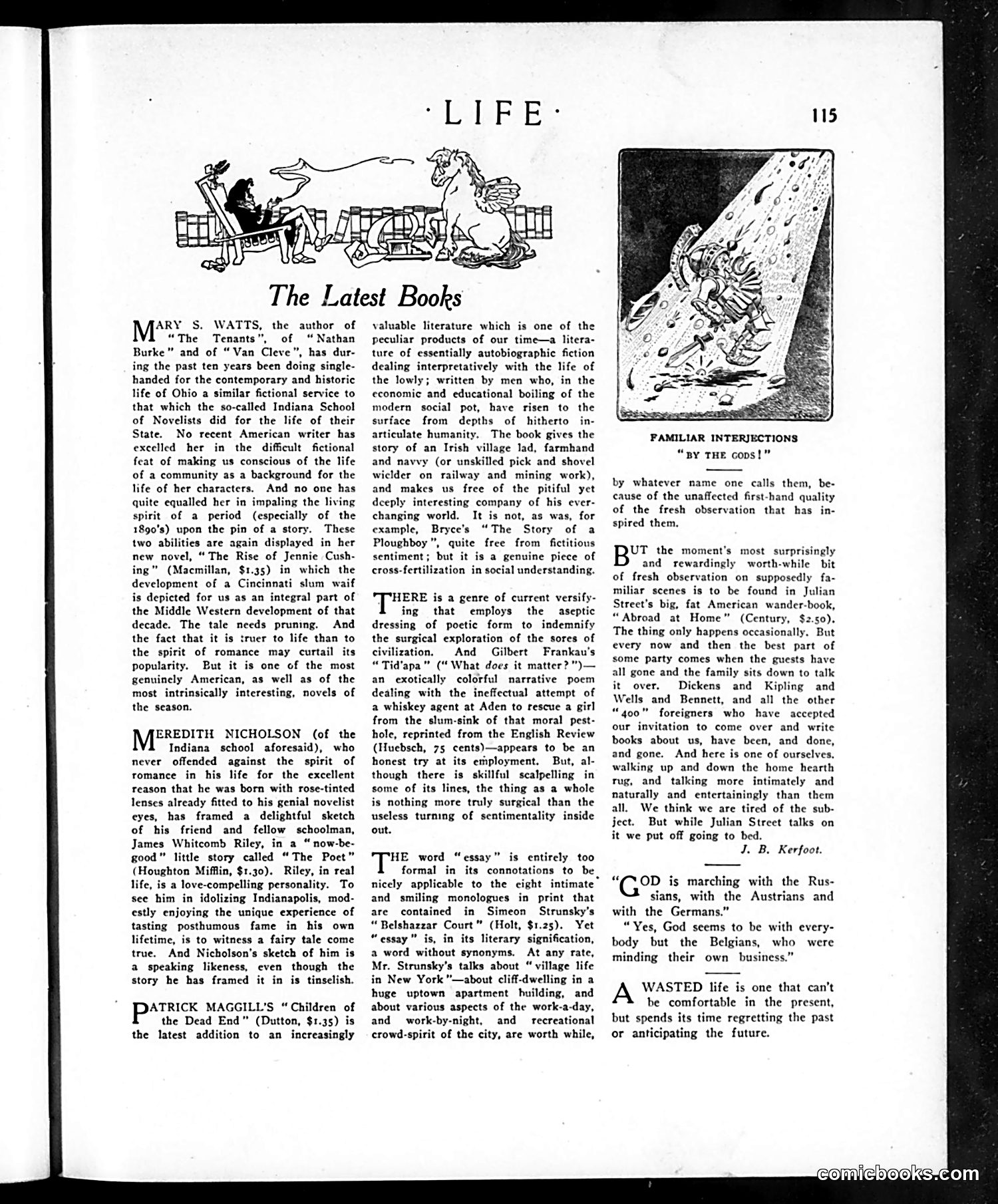
This is a book review column from *Life* magazine. The left side reviews several contemporary novels, including works by Mary S. Watts (about Ohio life), Meredith Nicholson (a biographical sketch of poet James Whitcomb Riley), and Patrick Magill (an autobiographical novel about an Irish laborer). The right side features a small cartoon titled "Familiar Interjections: 'By the Gods!'" showing what appears to be a figure on a slope or incline—likely illustrating some everyday human folly or observation. Below the cartoon are brief witty observations about modern life, including quotes about God's alignment with various nations during wartime, and a maxim about wasted lives. This represents *Life* as a literary and cultural journal mixing serious book criticism with humorous social commentary—typical of early 20th-century American magazine culture before *Life* became primarily photojournalistic.
📄 Transcribed text from this page (OCR, searchable)
Machine-transcribed from the original scan — historical spelling and the odd misread are preserved.
The Latest Books ARY S. WATTS, the author of “The Tenants”, of “ Nathan Burke” and of “Van Cleve”, has dur- ing the past ten years been doing single- handed for the contemporary and historic life of Ohio a similar fictional service to that which the so-called Indiana School of Novelists did for the life of their State. No recent American writer has excelled her in the difficult fictional feat of making us conscious of the life of a community as a background for the life of her characters. And no one has quite equalled her in impaling the living spirit of a period (especially of the 1890's) upon the pin of a story. These two abilities are again displayed in her new novel, “The Rise of Jennie Cush- ing” (Macmillan, $1.35) in which the development of a Cincinnati slum waif is depicted for us as an integral part of the Middle Western development of that decade. The tale needs pruning. And the fact that it is truer to life than to the spirit of romance may curtail its popularity. But it is one of the most genuinely American, as well as of the most intrinsically interesting, novels of the season. EREDITH NICHOLSON (of the Indiana school aforesaid), who never offended against the spirit of romance in his life for the excellent reason that he was born with rose-tinted lenses already fitted to his genial novelist eyes, has framed a delightful sketch of his friend and fellow schoolman, James Whitcomb Riley, in a “ now-be- good” little story called “The Poet” (Houghton Mifflin, $1.30). Riley, in real life, is a love-compelling personality. To see him in idolizing Indianapolis, mod- estly enjoying the unique experience of tasting posthumous fame in his own lifetime, is to witness a fairy tale come true. And Nicholson's sketch of him is a speaking likeness, even though the story he has framed it in is tinselish. ATRICK MAGGILL’S “ Children of the Dead End" (Dutton, $1.35) is the latest addition to an increasingly valuable literature which is one of the peculiar products of our time—a litera- ture of essentially autobiographic fiction dealing interpretatively with the life of the lowly; written by men who, in the economic and educational boiling of the modern social pot, have risen to the surface from depths of hitherto in- articulate humanity. The book gives the story of an Irish village lad, farmhand and navvy (or unskilled pick and shovel wiclder on railway and mining work), and makes us free of the pitiful yet deeply interesting company of his ever- changing world. It is not, as was, for example, Bryce’s “The Story of a Ploughboy ", quite free from fictitious sentiment; but it is a genuine piece of cross-fertilization in social understanding. 'HERE is a genre of current versify- ing that employs the aseptic dressing of poetic form to indemnify the surgical exploration of the sores of civilization, And Gilbert Frankau’s “Tid'apa” (“ What does it matter? '")— an exotically colorful narrative poem dealing the ineffectual attempt of a whiskey agent at Aden to rescue a girl from the slum-sink of that moral pest- hole, reprinted from the English Review (Huebsch, 75 cents)—appears to be an honest try at its employment. But, al- though there is skillful scalpelling in some of its lines, the thing as a whole is nothing more truly surgical than the useless turning of sentimentality inside out. HE word “essay” is entirely too formal in its connotations to be, nicely applicable to the cight intimate and smiling monologues in print that are contained in Simeon Strunsky’s “ Belshazzar Court” (Holt, $1.25). Yet “essay” is, in its literary signification, a word without synonyms. At any rate, Mr. Strunsky’s talks about “ village life in New York "—about cliff-dwelling in a huge uptown apartment building, and about various aspects of the work-a-day, and work-by-night, and recreational crowd-spirit of the city, are worth while, FAMILIAR INTERJECTIONS “BY THE cops!” by whatever name one calls them, be- cause of the unaffected first-hand quality of the fresh observation that has in- spired them. UT the moment's most surprisingly and rewardingly worth-while bit of fresh observation on supposedly fa- miliar scenes is to be found in Julian Street's big, fat American wander-book, “Abroad at Home” (Century, $2.50). The thing only happens occasionally, But every now and then the best part of some party comes when the guests have all gone and the family sits down to talk it over. Dickens and Kipling and Wells and Bennett, and all the other “ 400" foreigners who have accepted our invitation to come over and write books about us, have been, and done, and gone. And here is one of ourselves, walking up and down the home hearth rug, and talking more intimately and naturally and entertainingly than them all. We think we are tired of the sub- ject. But while Julian Street talks on it we put off going to bed. J. B. Kerfoot. "GoP is marching with the Rus- sians, with the Austrians and with the Germans.” “Yes, God seems to be with every- body but the Belgians, who minding their own business.” were WASTED life is one that can’t be comfortable in the present, but spends its time regretting the past or anticipating the future.