
Life, 1915-01-21 · page 24 of 44
Life — January 21, 1915 — page 24: what you’re looking at
What you’re looking at
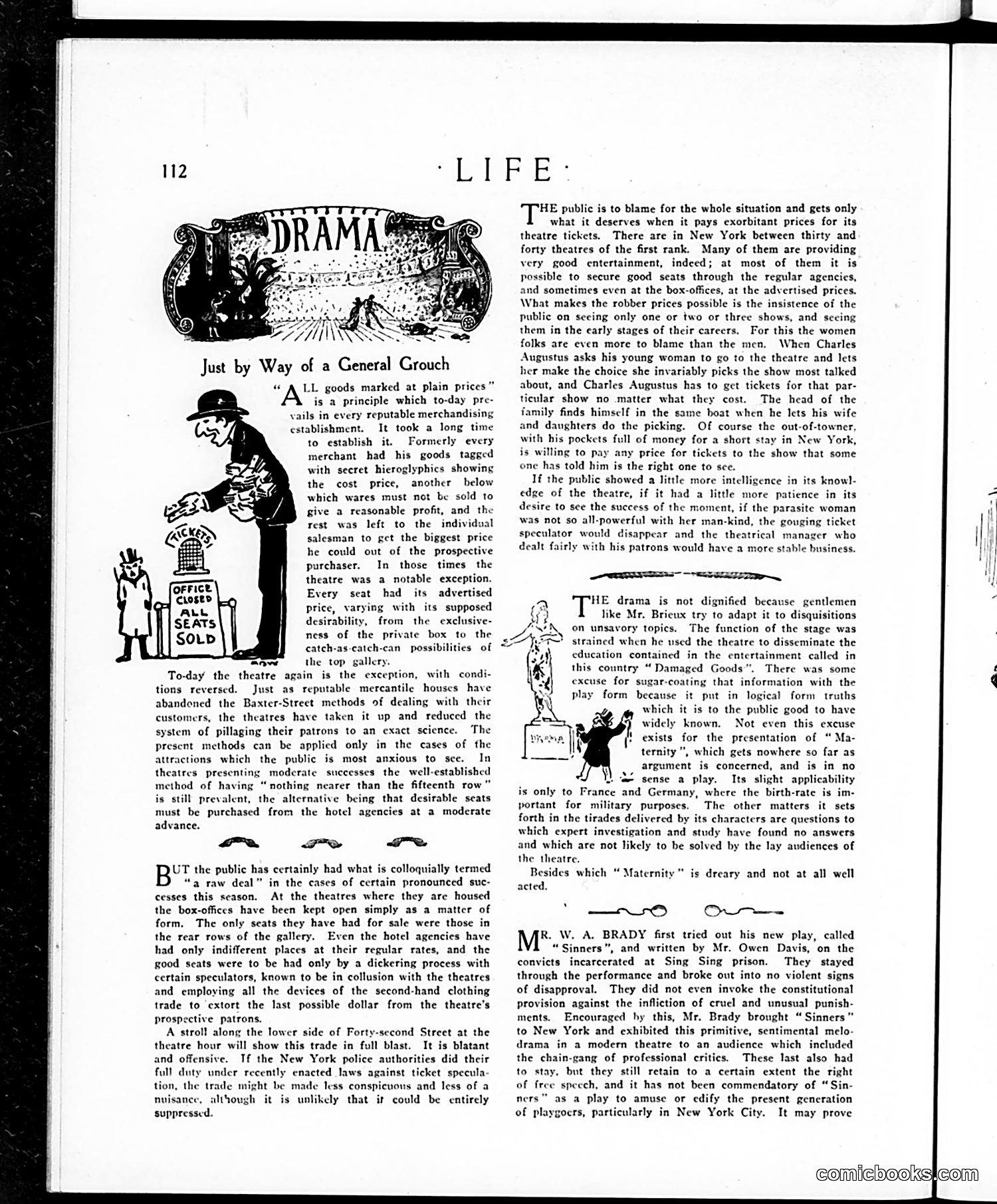
This 1910s-era *Life* article satirizes New York City's corrupt theater ticket market. The cartoon shows a street scalper ("OFFICE CASH FOR SEATS SOLD") profiteering from desperate theatergoers. **The Problem:** Popular Broadway shows charge inflated prices through collusion between box offices and speculators who operate like "second-hand clothing" dealers on 42nd Street, extracting maximum profit from patrons. **The Blame:** The author argues the public is complicit—particularly women who insist on seeing only the most talked-about shows rather than accepting good entertainment at reasonable prices. Out-of-town visitors and wealthy patrons willing to pay any price further encourage scalping. **The Irony:** While legitimate retail businesses abandoned such exploitative practices, theaters maintained them. The article advocates police enforcement of recent anti-scalping laws to combat this "blatant and offensive" trade. The satire targets both theatrical greed and consumer status-seeking.
📄 Transcribed text from this page (OCR, searchable)
Machine-transcribed from the original scan — historical spelling and the odd misread are preserved.
ESE Just by Way of a General Grouch « A LL goods marked at plain prices” is a principle which to-day pre- vails in every reputable merchandising establishment. It took a long time to establish it. Formerly every merchant had his goods tagged with secret hieroglyphics showing the cost price, another below which wares must not be sold to give a reasonable profit, and the rest was left to the individual salesman to get the biggest price he could out of the prospective purchaser. In those times the theatre was a notable exception. Every seat had its advertised ice, varying with its supposed y, from the exclusive- ness of the private box to the catch-as-catch-can possibilities of the top gallery. To-day the theatre again is the exception, with condi- tions reversed. Just as reputable mercantile houses have abandoned the Baxter-Street methods of dealing with their customers, the theatres have taken it up and reduced the system of pillaging their patrons to an exact science. The present methods can be applied only in the cases of the attractions which the public is most anxious to sce. In theatres presenting moderate successes the well-established method of having “nothing nearer than the fifteenth row” is still prevalent, the alternative being that desirable scats must be purchased from the hotel agencies at a moderate advance, rr fw UT the public has certainly had what is colloquially termed “a raw deal” in the cases of certain pronounced suc- cesses this season. At the theatres where they are housed the box-offices have been kept open simply as a matter of form. The only seats they have had for sale were those in the rear rows of the gallery. Even the hotel agencies have had only indifferent places at their regular rates, and the good seats were to be had only by a dickering process with certain speculators, known to be in collusion with the theatres and employing all the devices of the second-hand clothing trade to extort the last possible dollar from the theatre's Prospective patrons, A stroll along the lower side of Forty-second Street at the theatre hour will show this trade in full blast. It is blatant and offensive. If the New York police authorities did their full duty under recently enacted laws against ticket specula tion, the trade might be made less conspicuous and less of a nuisance, although it is unlikely that it could be entirely suppressed. Fou HE public is to blame for the whole situation and gets only what it deserves when it pays exorbitant prices for its theatre tickets, There are in New York between thirty and forty theatres of the first rank. Many of them are providing very good entertainment, indeed; at most of them it is possible to secure good seats through the regular agencies, and sometimes even at the box-offices, at the advertised prices. What makes the robber prices possible is the insistence of the public on seeing only one or two or three shows, and seeing them in the early stages of their careers. For this the women folks are even more to blame than the men. When Charles Augustus asks his young woman to go to the theatre and lets her make the choice she invariably picks the show most talked about, and Charles Augustus has to get tickets for that par- ticular show no matter what they cost. The head of the iamily finds himself in the same boat when he lets his wife and daughters do the picking. Of course the out-of-towner, with his pockets full of money for a short stay in New York, is willing to pay any price for tickets to the show that some one has told him is the right one to sce. If the public showed a little more intelligence in its knowl- edge of the theatre, if it had a little more patience in its ire to see the success of the ment, if the parasite woman not so all-powerful with her man-kind, the gouging ticket speculator would disappear and the theatrical dealt fairly with his patrons would have a more stable business. ees ee ol fate drama is not dignified because gentlemen like Mr. Brieux try to adapt it to disquisitions on unsavory topics. The function of the stage was strained when he used the theatre to disseminate the education contained in the entertainment called in this country “Damaged Goods There was some excuse for sugar-coating that information with the play form because it put in logical form truths which it is to the public good to have widely known. Not even this excuse ig exists for the presentation of “ Ma- ternity”, which gets nowhere so far as argument is concerned, and is in no | 2 sense a play. Its slight applicability is only to France and Germany, where the birth-rate is im- portant for military purposes. The other matters it sets forth in the tirades delivered by its characters are questions to which expert investigation and study have found no answers and which are not likely to be solved by the lay audiences of the theatre. Besides which “ Maternity acted, dreary and not at all well —_STd Own R. W. A. BRADY first tried out his new play, called Sinners”, and written by Mr. Owen Da on the convicts incarcerated at Sing Sing prison. They stayed through the performance and broke out into no violent signs of disapproval. They did not even invoke the constitutional provision against the infliction of cruel and unusual punish- ments. Encouraged hy this, Mr. Brady brought “Sinners” to New York and exhibited this primitive, sentimental melo: drama a modern theatre to an audience which included the chain-gang of professional critics. These last also had to stay, but they still retain to a certain extent the right of free speech, and it has not been commendatory of “Sin- ners” as a play to amuse or edify the present generation of playgocrs, particularly in New York City. It may prove