
Life, 1915-01-21 · page 30 of 44
Life — January 21, 1915 — page 30: what you’re looking at
What you’re looking at
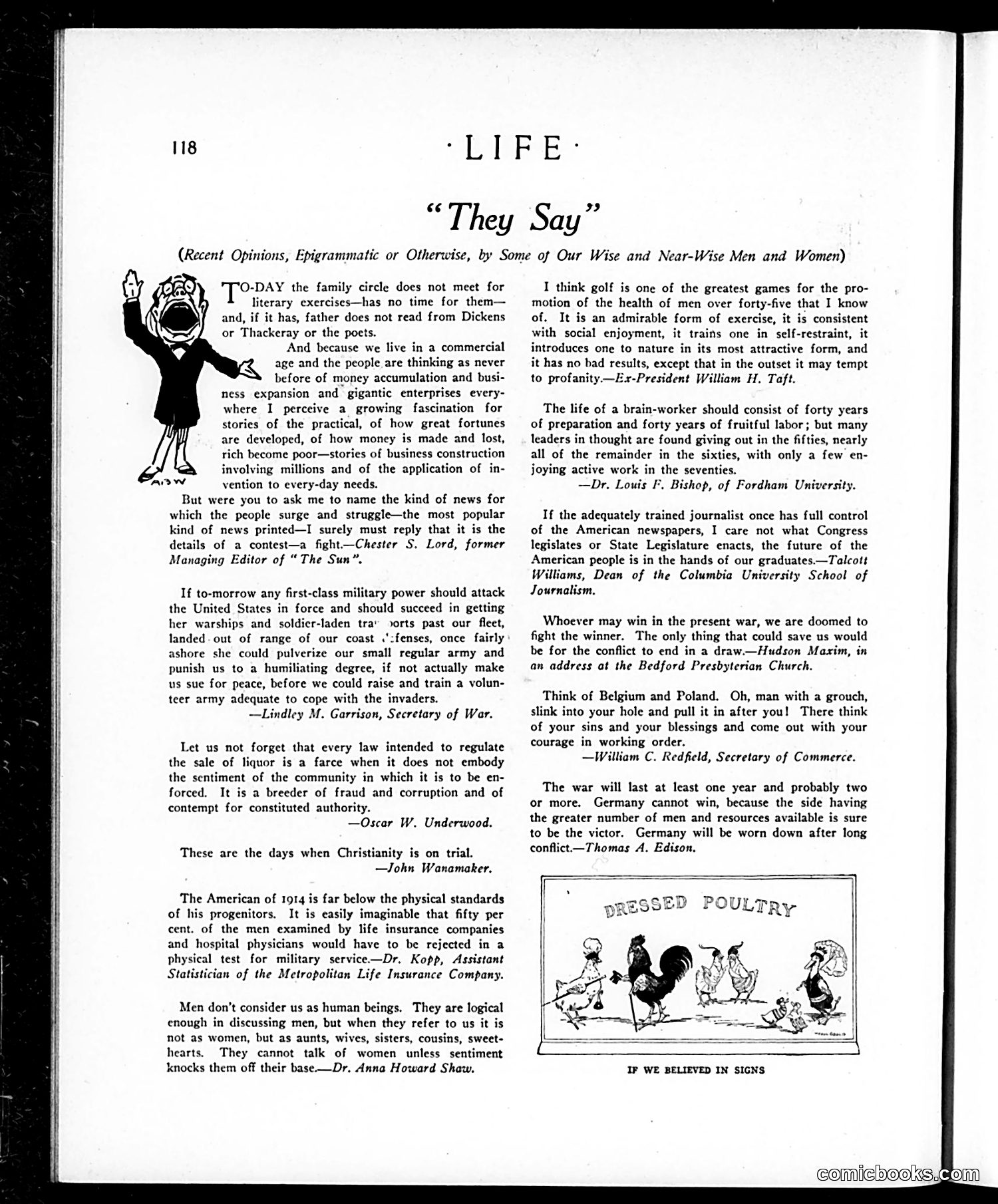
This page collects brief opinions from prominent figures (early 1914, based on references). The content reflects pre-WWI American anxieties: **Key figures quoted include:** - Secretary of War Lindley Garrison warns of U.S. military vulnerability to invasion - Ex-President William H. Taft endorses golf for middle-aged men - Dr. Anna Howard Shaw (women's rights advocate) critiques how men discuss women only through domestic relationships - Oscar Underwood and others comment on liquor prohibition and national character **The satire's point:** The page mocks how the nation's "wise men" offer contradictory, self-serving advice during uncertain times. Garrison fears military weakness while others debate golf and prohibition—suggesting leadership lacks unified vision. The cartoon below ("Dressed Poultry") appears to mock superstitious belief, titled "If We Believed in Signs." The overall effect satirizes 1914 America's anxieties about military preparedness, morality, and national decline.
📄 Transcribed text from this page (OCR, searchable)
Machine-transcribed from the original scan — historical spelling and the odd misread are preserved.
US) bala “They Say” (Recent Opinions, Epigrammatic or Otherwise, by Some of Our Wise and Near-Wise Men and Women) ‘0-DAY the family circle does not meet for literary exercises—has no time for them— and, if it has, father does not read from Dickens or Thackeray or the poets. And because we live in a commercial age and the people are thinking as never before of money accumulation and busi- ness expansion and gigantic enterprises every- where I perceive a growing fascination for stories of the practical, of how great fortunes are developed, of how money is made and lost, rich become poor—stories of business construction involving millions and of the application of in- vention to every-day needs. But were you to ask me to name the kind of news for which the people surge and struggle—the most popular kind of news printed—I surely must reply that it is the details of a contest—a fight—Chester S. Lord, former Managing Editor of “The Sun”. If to-morrow any first-class military power should attack the United States in force and should succeed in getting her warships and soldicr-laden tra" >orts past our fleet, landed. out of range of our coast .':fenses, once fairly ashore she could pulverize our small regular army and punish us to a humiliating degree, if not actually make us sue for peace, before we could raise and train a volun- teer army adequate to cope with the invaders. —Lindley M. Garrison, Secretary of War. Let us not forget that every law intended to regulate the sale of liquor is a farce when it does not embody the sentiment of the community in which it is to be en- forced. It is a breeder of fraud and corruption and of contempt for constituted authority. —Oscar W. Underwood. These are the days when Christianity is on trial. —John Wanamaker, The American of 1914 is far below the physical standards of his progenitors. It is easily imaginable that fifty per cent. of the men examined by life insurance companies and hospital physicians would have to be rejected in a physical test for military service—Dr. Kopp, Assistant Statistician of the Metropolitan Life Insurance Company. Men don’t consider us as human beings. They are logical enough in discussing men, but when they refer to us it is not as women, but as aunts, wives, sisters, cousins, sweet- hearts. They cannot talk of women unless sentiment knocks them off their base—Dr. Anna Howard Shaw. I think golf is one of the greatest games for the pro- motion of the health of men over forty-five that I know of. It is an admirable form of exercise, it is consistent with social enjoyment, it trains one in self-restraint, it introduces one to nature in its most attractive form, and it has no bad results, except that in the outset it may tempt to profanity—Ex-President William H. Taft. The life of a brain-worker should consist of forty years of preparation and forty years of fruitful labor; but many leaders in thought are found giving out in the fifties, nearly all of the remainder in the sixties, with only a few en- joying active work in the seventies. —Dr. Louis F. Bishop, of Fordham University. If the adequately trained journalist once has full control of the American newspapers, I care not what Congress legislates or State Legislature enacts, the future of the American people is in the hands of our graduates.—Talcott Williams, Dean of the Columbia University School of Journalism. Whoever may win in the present war, we are doomed to fight the winner. The only thing that could save us would be for the conflict to end in a draw.—Hudson Maxim, in an address at the Bedford Presbyterian Church. Think of Belgium and Poland. Oh, man with a grouch, slink into your hole and pull it in after you! There think of your sins and your blessings and come out with your courage in working order. —William C. Redfield, Secretary of Commerce. The war will last at least one year and probably two or more. Germany cannot win, because the side having the greater number of men and resources available is sure to be the victor. Germany will be worn down after long conflict—Thomas A. Edison. IF WE BELIEVED IN SIGNS comichooks.com