
Life, 1915-01-21 · page 28 of 44
Life — January 21, 1915 — page 28: what you’re looking at
What you’re looking at
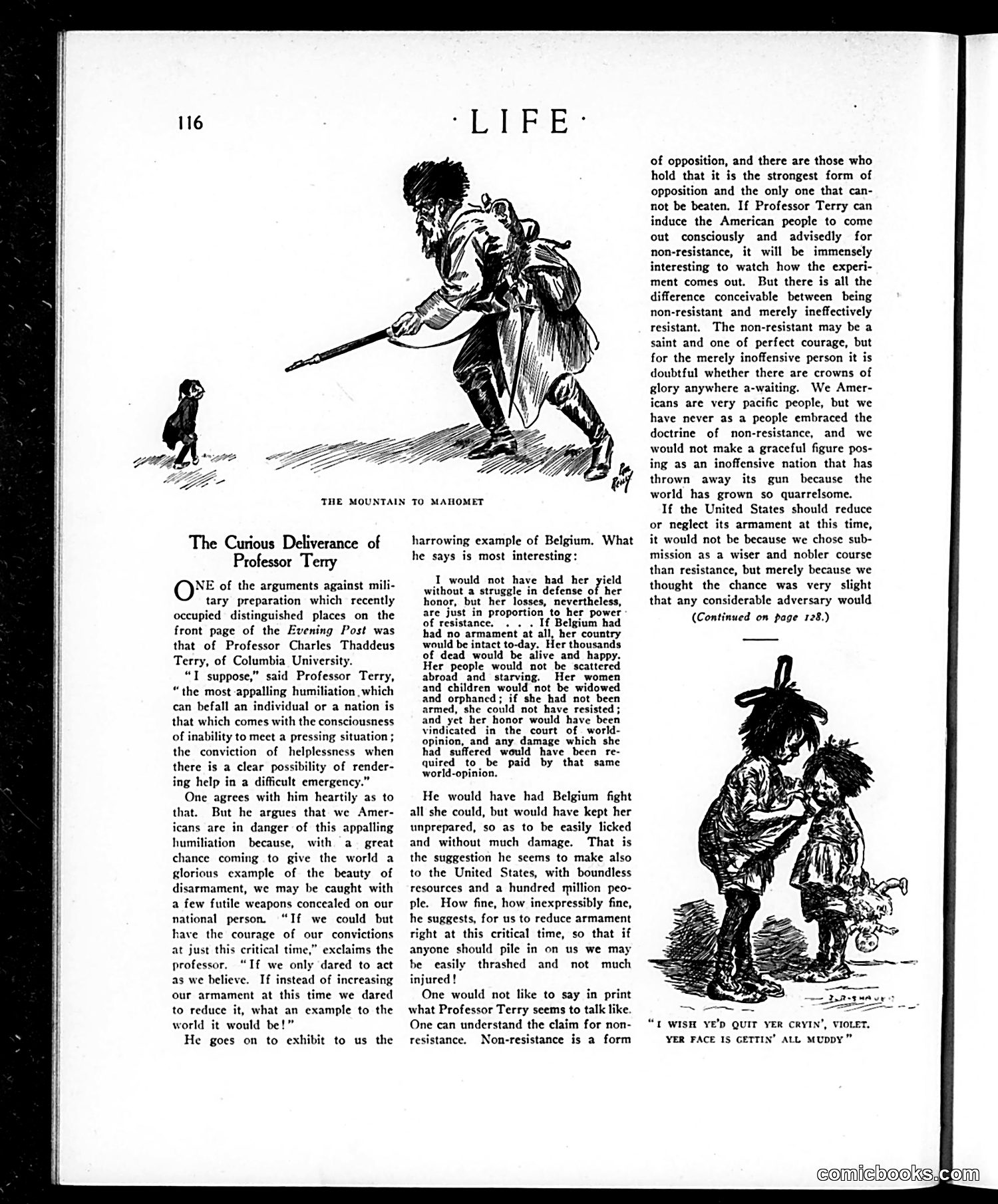
This page satirizes Professor Charles Thaddeus Terry of Columbia University, who publicly argued against American military preparedness. The top cartoon ("The Mountain to Mahomet") depicts Terry as a tiny figure dwarfed by a larger force—visualizing his impotence. The article attacks Terry's logic, which used Belgium as an example: he argued Belgium's losses were proportional to its military resistance, implying that disarmament would have preserved the nation and its honor through "world-opinion." The author finds this reasoning absurd and dangerous, especially for America. The satire's point: Terry conflates principled non-resistance (a coherent moral stance) with mere military weakness disguised as pacifism. The article argues Americans are naturally peaceful but have never embraced non-resistance doctrine—attempting it now would appear cowardly rather than noble, and leave America vulnerable to aggressors. The author suggests Terry's proposal is naive idealism masquerading as moral courage.
📄 Transcribed text from this page (OCR, searchable)
Machine-transcribed from the original scan — historical spelling and the odd misread are preserved.
THE MOUNTAIN TO MAHOMET The Curious Deliverance of Professor Terry ONE of the arguments against mili- tary preparation which recently occupied distinguished places on the front page of the Evening Post was that of Professor Charles Thaddeus Terry, of Columbia University. “TI suppose,” said Professor Terry, “the most appalling humiliation which can befall an individual or a nation is that which comes with the consciousness of inability to meet a pressing situation ; the conviction of helplessness when there is a clear possibility of render- ing help in a difficult emergen: One agrees with him heartily as to that. But he argues that we Amer- icans are in danger of this appalling humiliation because, with a great chance coming to give the world a glorious example of the beauty of disarmament, we may be caught with a few futile weapons concealed on our national person. “If we could but have the courage of our convictions at just this critical time,” exclaims the professor. “If we only dared to act as we believe. If instead of increasing our armament at this time we dared to reduce it, what an example to the world it would be!” He goes on to exhibit to us the harrowing example of Belgium. What he says is most interesting: I would not have had her yield without a struggle in defense of her honor, but her losses, nevertheless, are just in proportion to her power of resistance. . . . If Belgium had had no armament at all, her country would be intact to-day. Her thousands of dead would be alive and happy. Her people would not be scattered abroad and starving. Her women and children would not be widowed and orphaned; if she had not been armed, she could not have resisted ; and yet her honor would have been vindicated in the court of world- opinion, and any damage which she had suffered would have been re- quired to be paid by that same world-opinion. He would have had Belgium fight all she could, but would have kept her unprepared, so as to be easily licked and without much damage. That is the suggestion he seems to make also to the United States, with boundless resources and a hundred million peo- ple. How fine, how inexpressibly fine, he suggests, for us to reduce armament right at this critical time, so that if anyone should pile in on us we may be easily thrashed and not much injured! One would not like to say in print what Professor Terry seems to talk like. One can understand the claim for non- resistance. Non-resistance is a form of opposition, and there are those who hold that it is the strongest form of opposition and the only one that can- not be beaten. If Professor Terry can induce the American people to come out consciously and advisedly for non-resistance, it will be immensely interesting to watch how the experi- ment comes out. But there is all the difference conceivable between being non-resistant and merely ineffectively resistant. The non-resistant may be a saint and one of perfect courage, but for the merely inoffensive person it is doubtful whether there are crowns of glory anywhere a-waiting. We Amer- icans are very pacific people, but we have never as a people embraced the doctrine of non-resistance, and we would not make a graceful figure pos- ing as an inoffensive nation that has thrown away its gun because the world has grown so quarrelsome. If the United States should reduce or neglect its armament at this time, it would not be because we chose sub- mission as a wiser and nobler course than resistance, but merely because we thought the chance was very slight that any considerable adversary would (Continued on page 128.) “T WISH YE'D QUIT YER CRYIN’, VIOLET. YER FACE IS GETTIN’ ALL MUDDY” comichooks, com)