
Life, 1915-01-21 · page 21 of 44
Life — January 21, 1915 — page 21: what you’re looking at
What you’re looking at
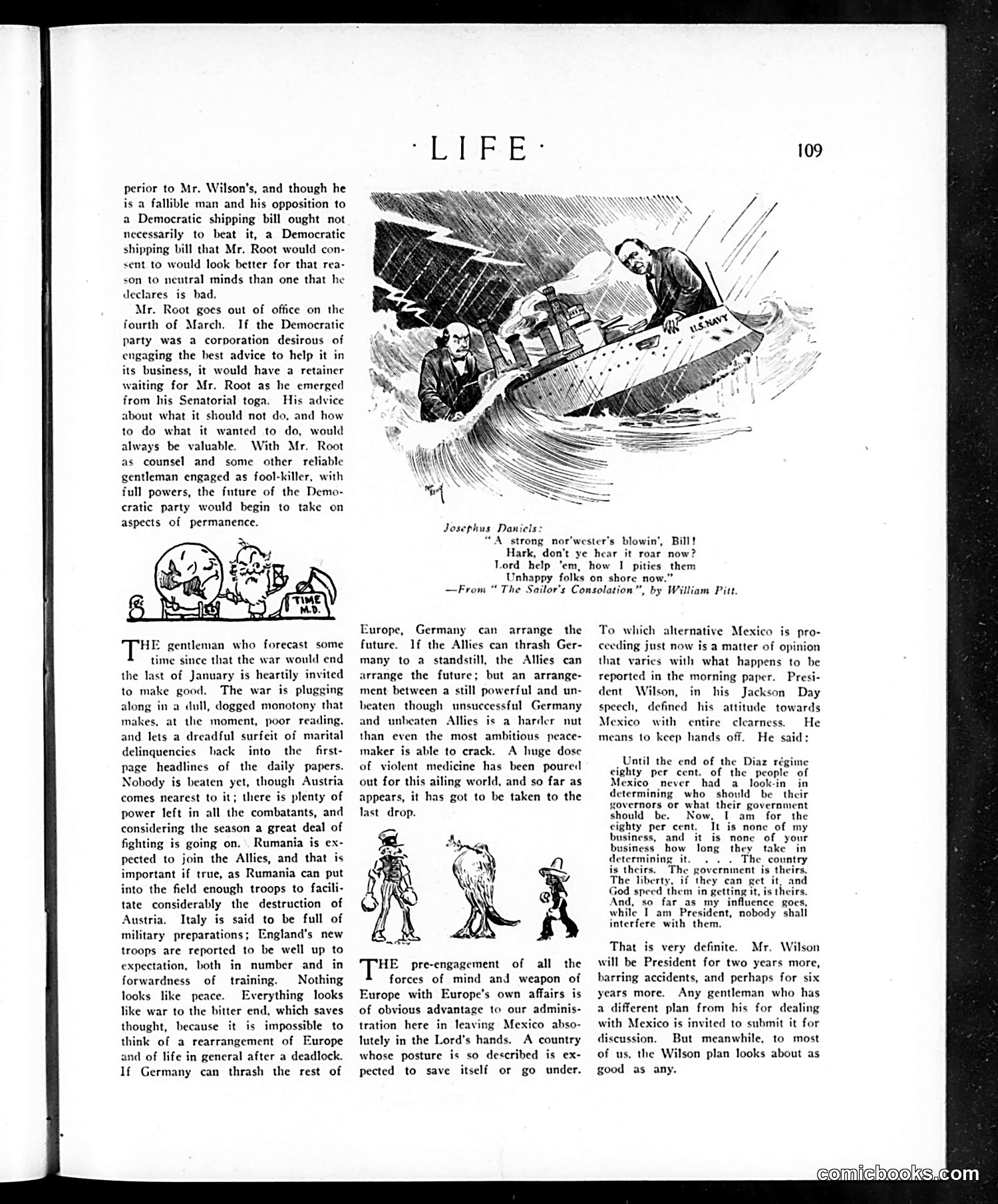
This page contains political commentary on World War I and President Wilson's Mexico policy (circa 1916). **The Naval Cartoon:** The top illustration depicts Josephus Daniels (Secretary of the Navy) as a sailor quoting William Pitt's poem about a storm. This satirizes Daniels' helplessness regarding European naval warfare—he can only observe the conflict passively, like a sailor watching a distant tempest. **Main Text Satire:** The author mocks predictions that WWI would end by January, noting instead the war grinds on with "dull, dogged monotony." The piece suggests Germany, the Allies, or neither could ultimately control post-war Europe—creating an unsolvable diplomatic puzzle. **Mexico Policy Critique:** The final section quotes Wilson's Jackson Day speech defending non-intervention in Mexico, allowing Mexicans self-determination. The satire's tone suggests this "hands-off" approach, while Europe convulses in war, conveniently removes Mexico from American political consideration rather than representing genuine principle.
📄 Transcribed text from this page (OCR, searchable)
Machine-transcribed from the original scan — historical spelling and the odd misread are preserved.
perior to Mr. Wilson's, and though he is a fallible man and his opposition to a Democratic shipping bill ought not necessarily to beat it, a Democratic shipping bill that Mr. Root would con- sent to would look better for that rea- son to neutral minds than one that he declares is bad. Mr. Root goes out of office on the fourth of March. If the Democratic party was a corporation desirous of engaging the best advice to help it in its business, it would have a retainer waiting for Mr. Root as he emerged from his Senatorial toga. His advice about what it should not do, and how to do what it wanted to do, would always be valuable. With Mr. Root as counsel and some other reliable gentleman engaged as fool-killer, with full powers, the future of the Demo- cratic party would begin to take on aspects of permanence. T! gentleman who forecast some time since that the war would end the last of January is heartily invited to make good. The war is plugging along in a dull, dogged monotony that makes, at the moment, poor reading, and lets a dreadful surfeit of marital delinquencies back into the first- page headlines of the daily papers. Nobody is beaten yet, though Austria comes nearest to it; there is plenty of power left in all the combatants, and considering the season a great deal of fighting is going on. Rumania is ex- pected to join the Allies, and that is important if true, as Rumania can put into the field enough troops to facili- tate considerably the destruction of Austria. Italy is said to be full of military preparations; England’s new troops are reported to be well up to expectation, both in number and in forwardness of training. Nothing looks like peace. Everything looks like war to the bitter end, which saves thought, because it is impossible to think of a rearrangement of Europe and of life in general after a deadlock. If Germany can thrash the rest of N \ aN Josephus Daniels: “A strong nor'wester’s blowin’, SS Bill! Hark, don't ye hear it roar now? Lord help ‘em, how I pities them Unhappy folks on shore now.” —From “ The Sailor's Consolation”, by William Pitt. Europe, Germany can arrange the future. 1f the Allies can thrash Ger- many to a standstill, the Allies can arrange the future; but an arrange- ment between a still powerful and un- beaten though unsuccessful Germany and unbeaten Allies is a harder nut than even the most ambitious peace- maker is able to crack. A huge dose of violent medicine has been poured out for this ailing world, and so far as appears, it has got to be taken to the last. drop. HE pre-engagement of all the forces of mind and weapon of Europe with Europe's own affairs is of obvious advantage to our admit tration here in leaving Mexico abso- lutely in the Lord’s hands. A country whose posture is so described is ex- pected to save itself or go under. To which alternative Mexico is pro- ceeding just now is a matter of opinion that varies with what happens to be reported in the morning paper. Presi- dent Wilson, in his Jackson Day speech, defined his attitude towards Mexico with entire clearness. He means to keep hands off. He said: _ Until the end of the Diaz régime eighty per cent. of the people of Mexico never had a look-in in lctermining who should be their governors or what their government should be. Now, I am for the eighty per cent, It is none of my i and it is none of your how long they take in ing it. + The country The government is theirs. they can get it, and d them in getting it, is theirs. And, so far as my influence goes, while I am_ President, nobody shall interfere with them. That is very definite. Mr. Wilson will be President for two years more, barring accidents, and perhaps for six years more. Any gentleman who has a different plan from his for dealing h Mexico is invited to submit it for discussion. But meanwhile, to most of us, the Wilson plan looks about as good as any.