
Life, 1915-01-21 · page 20 of 44
Life — January 21, 1915 — page 20: what you’re looking at
What you’re looking at
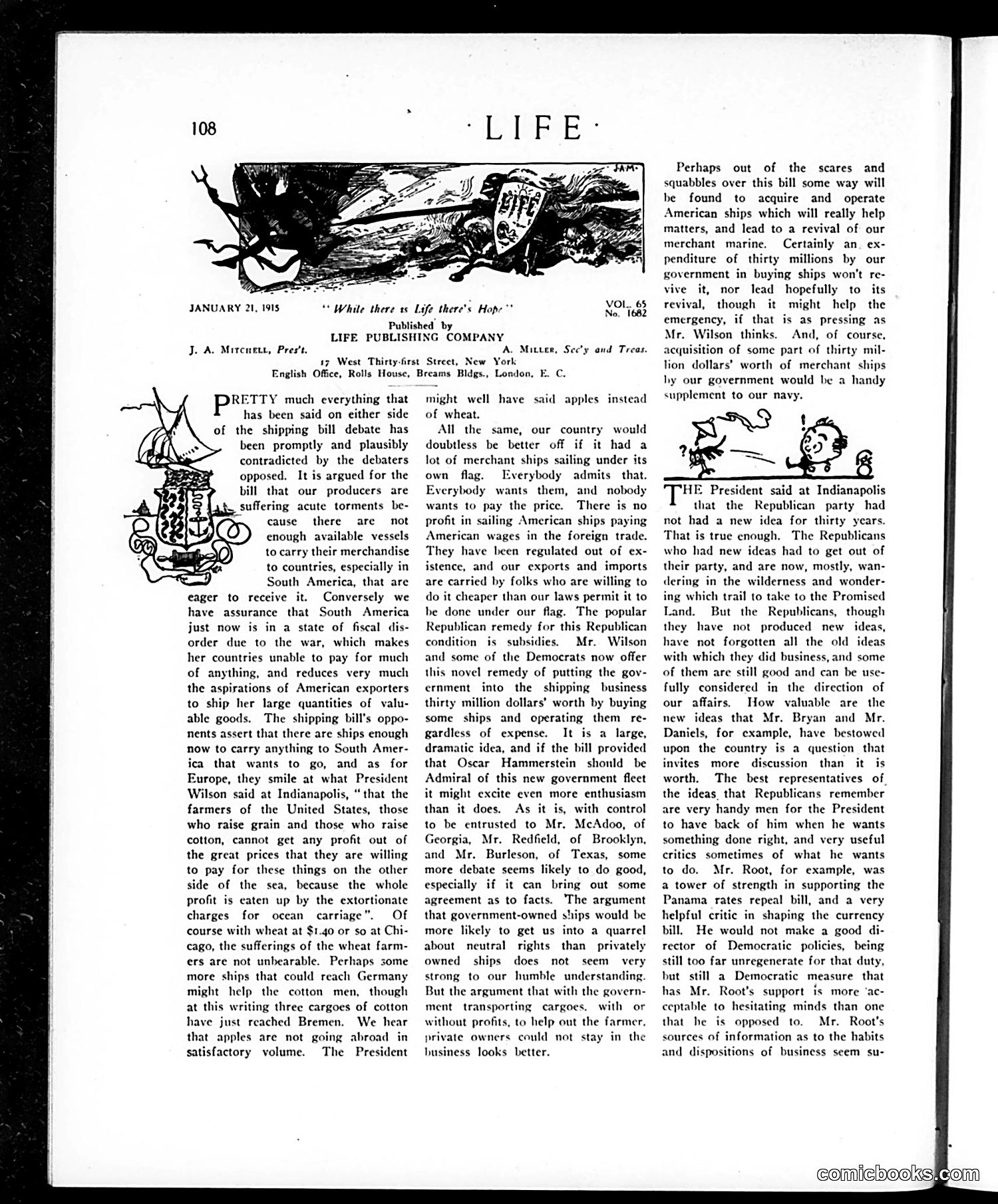
This editorial page discusses the debate over President Wilson's proposed Shipping Bill, which would have the government purchase and operate merchant ships to support American exporters. **The Cartoons:** The decorative illustrations appear to be generic maritime/nautical imagery (ships, sea creatures) rather than specific political caricature—common ornamental elements for a shipping-themed article. **The Debate:** The article satirizes how both sides of the shipping bill dispute contradict each other plausibly. Opponents claim American farmers/exporters suffer from lack of vessels; supporters counter that South America cannot afford purchases anyway due to war-related financial chaos. The text notes absurdities: wheat prices are actually high, yet farmers allegedly profit nothing due to shipping costs. **Wilson's Government Solution:** Rather than Republican subsidies to private shipowners, Wilson's Democrats propose federal ownership. The author expresses skepticism about placing such control under Secretary McAdoo and cabinet members, though admits government ships might avoid quarrels over neutral shipping rights during wartime. The overall tone is sardonic resignation—acknowledging America needs merchant ships while doubting either solution will work properly.
📄 Transcribed text from this page (OCR, searchable)
Machine-transcribed from the original scan — historical spelling and the odd misread are preserved.
JANUARY 21, 1915 J. A. Mircuett, Pres’t, English Office, Rolls House, RETTY much everything that has been said on either side of the shipping bill debate has been promptly and plausibly contradicted by the debaters opposed. It is argued for the bill that our producers are suffering acute torments be- cause there are not enough available vessels to carry their merchandise to countries, especially in South America, that are eager to receive it. Conversely we have assurance that South America just now is in a state of fiscal dis- order due to the war, which makes her countries unable to pay for much of anything, and reduces very much the aspirations of American exporters to ship her large quantities of valu- able goods. The shipping bill's oppo- nents assert that there are ships enough now to carry anything to South Amer- ica that wants to go, and as for Europe, they smile at what President Wilson said at Indianapolis, “that the farmers of the United States, those who raise grain and those who raise cotton, cannot get any profit out of the great prices that they are willing to pay for these things on the other side of the sea, because the whole profit is eaten up by the extortionate charges for ocean carriage”. Of course with wheat at $1.40 or so at Chi- cago, the sufferings of the wheat farm- ers are not unbearable. Perhaps some more ships that could reach Germany might help the cotton men, though at this writing three cargoes of cotton have just reached Bremen. We hear that apples are not going abroad in satisfactory volume. The President “* While there 1s Life there's: Hope” Published by LIFE PUBLISHING COMPANY A. Mutter, See’y and Treas. 17 West Thirty-first Street, New York Breams Bldgs., London, E. VOL. 65 No, 1682 might well have said apples instead of wheat. All the same, our country would doubtless be better off if it had a lot of merchant ships sailing under its own flag. Everybody admits that. Everybody wants them, and nobody wants to pay the price. There is no profit in sailing American ships paying American wages in the foreign trade. They have been regulated out of ex- istence, and our exports and imports are carried by folks who are willing to do it cheaper than our laws permit it to be done under our flag. The popular Republican remedy for this Republican condition is subsidies. Mr. Wilson and some of the Democrats now offer this novel remedy of putting the gov- ernment into the shipping business thirty million dollars’ worth by buying some ships and operating them re- gardless of expense. It is a large, dramatic idea, and if the bill provided that Oscar Hammerstein should be Admiral of this new government fleet it might excite even more enthusiasm than it does. As it is, with control to be entrusted to Mr. McAdoo, of Georgia, Mr. Redfield, of Brooklyn, and Mr. Burleson, of Texas, some more debate seems likely to do good, especially if it can bring out some agreement as to facts. The argument that government-owned ships would be more likely to get us into a quarrel about neutral rights than privately owned ships does not seem very strong to our humble understanding. But the argument that with the govern- ment transporting cargoes. with or without profits, to help out the farmer, private owners could not stay in the husiness looks better. Perhaps out of the scares and squabbles over this bill some way will be found to acquire and operate American ships which will really help matters, and lead to a revival of our merchant marine. Certainly an. ex- penditure of thirty millions by our government in buying ships won't re- vive it, nor lead hopefully to its revival, though it might help the emergency, if that is as pressing as Mr. Wilson thinks. And, of course, acquisition of some part of thirty mil- lion dollars’ worth of merchant ships hy our government would be a handy supplement to our navy. HE President said at Indianapolis that the Republican party had not had a new idea for thirty years. That is true enough. The Republicans who had new ideas had to get out of their party, and are now, mostly, wan- dering in the wilderness and wonder- ing which trail to take to the Promised Land. But the Republicans, though they have not produced new ideas, have not forgotten all the old ideas with which they did business, and some of them are still good and can be use- fully considered in the direction of our affairs. How valuable are the new ideas that Mr. Bryan and Mr. Daniels, for example, have bestowed upon the country is a question that invites more discussion than it is worth. The best representatives of the ideas that Republicans remember are very handy men for the President to have back of him when he wants something done right, and very useful critics sometimes of what he wants to do. Mr. Root, for example, was a tower of strength in supporting the Panama rates repeal bill, and a very helpful critic in shaping the currency bill. He would not make a good di- rector of Democratic policies, being still too far unregenerate for that duty, but still a Democratic measure that has Mr. Root’s support is more ‘ac- ceptable to hesitating minds than one that he is opposed to. Mr. Root’s sources of information as to the habits and dispositions of bu $$ seem Su-