
Life, 1915-01-21 · page 33 of 44
Life — January 21, 1915 — page 33: what you’re looking at
What you’re looking at
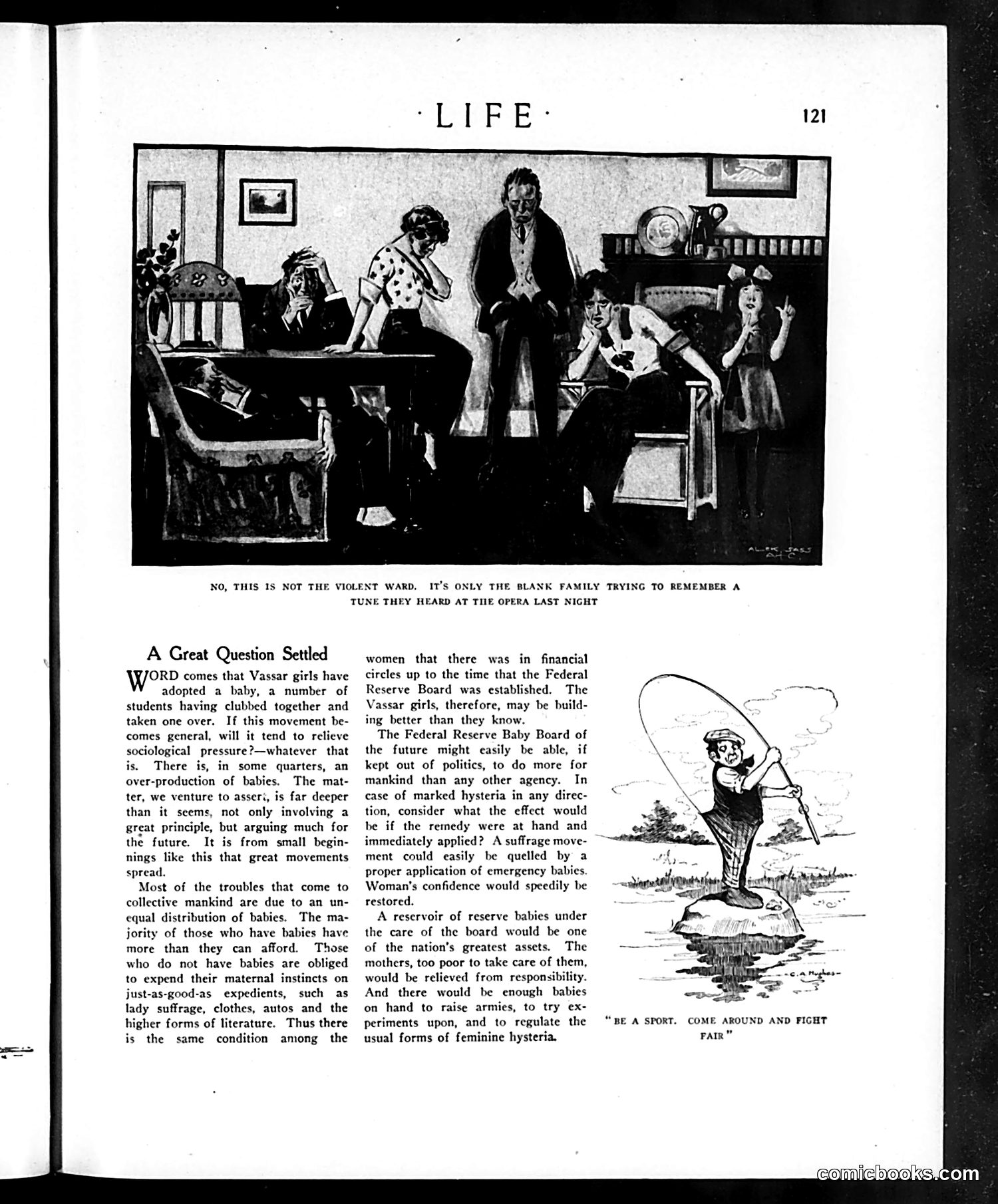
**The Cartoon (top):** A domestic scene where a family appears rowdy or chaotic indoors. The caption jokes they're not in a "violent ward" but rather the "blank family" trying to recall an opera tune—satirizing how people's attempts to recreate music at home can sound discordant or mad. **The Article:** A satirical piece responding to news that Vassar College students collectively adopted a baby. The author sardonically proposes establishing a "Federal Reserve Baby Board"—mocking the recent creation of the Federal Reserve (1913) by applying its logic to infant management. The satire targets early 20th-century anxieties about overpopulation among the poor and underpopulation among the wealthy. It absurdly suggests babies could be distributed as a solution to social problems, including "quelling" women's suffrage movements and controlling "feminine hysteria" through strategic baby deployment. **Context:** This reflects period attitudes viewing women's rights activism as emotional instability requiring paternalistic management, while simultaneously exposing the absurdity of such thinking through exaggeration.
📄 Transcribed text from this page (OCR, searchable)
Machine-transcribed from the original scan — historical spelling and the odd misread are preserved.
NO, THIS IS NOT THE VIOLENT WARD, A Great Question Settled ORD comes that Vassar girls have adopted a baby, a number of students having clubbed together and taken one over. If this movement be- comes general, will it tend to relieve sociological pressure ?—whatever that is. There is, in some quarters, an over-production of babies. The mat- ter, we venture to asseri, is far deeper than it seems, not only involving a great principle, but arguing much for the future. It is from small begin- nings like this that great movements spread. Most of the troubles that come to collective mankind are due to an un- equal distribution of babies. The ma- jority of those who have babies have more than they can afford. Those who do not have babies are obliged to expend their maternal instincts on just-as-good-as expedients, such as lady suffrage, clothes, autos and the higher forms of literature. Thus there is the same condition among the women that there was in financial circles up to the time that the Federal Reserve Board was established. The Vassar girls, therefore, may be build- ing better than they know. The Federal Reserve Baby Board of the future might easily be able, if kept out of politics, to do more for mankind than any other agency. In case of marked hysteria in any direc- tion, consider what the effect would be if the remedy were at hand and immediately applied? A suffrage move- ment could easily be quelled by a proper application of emergency babies. Woman's confidence would speedily be restored. A reservoir of reserve babies under the care of the board would be one of the nation’s greatest assets. The mothers, too poor to take care of them, would be relieved from responsibility. And there would be enough babies on hand to raise armies, to try ex- periments upon, and to regulate the usual forms of feminine hysteria. “BE A SPORT. IT’S ONLY THE BLANK FAMILY TRYING TO REMEMBER A TUNE THEY HEARD AT TIE OPERA LAST NIGHT worse COME AROUND AND FIGHT FAIR”