
A complete issue · 45 pages · 1914
Life — September 24, 1914
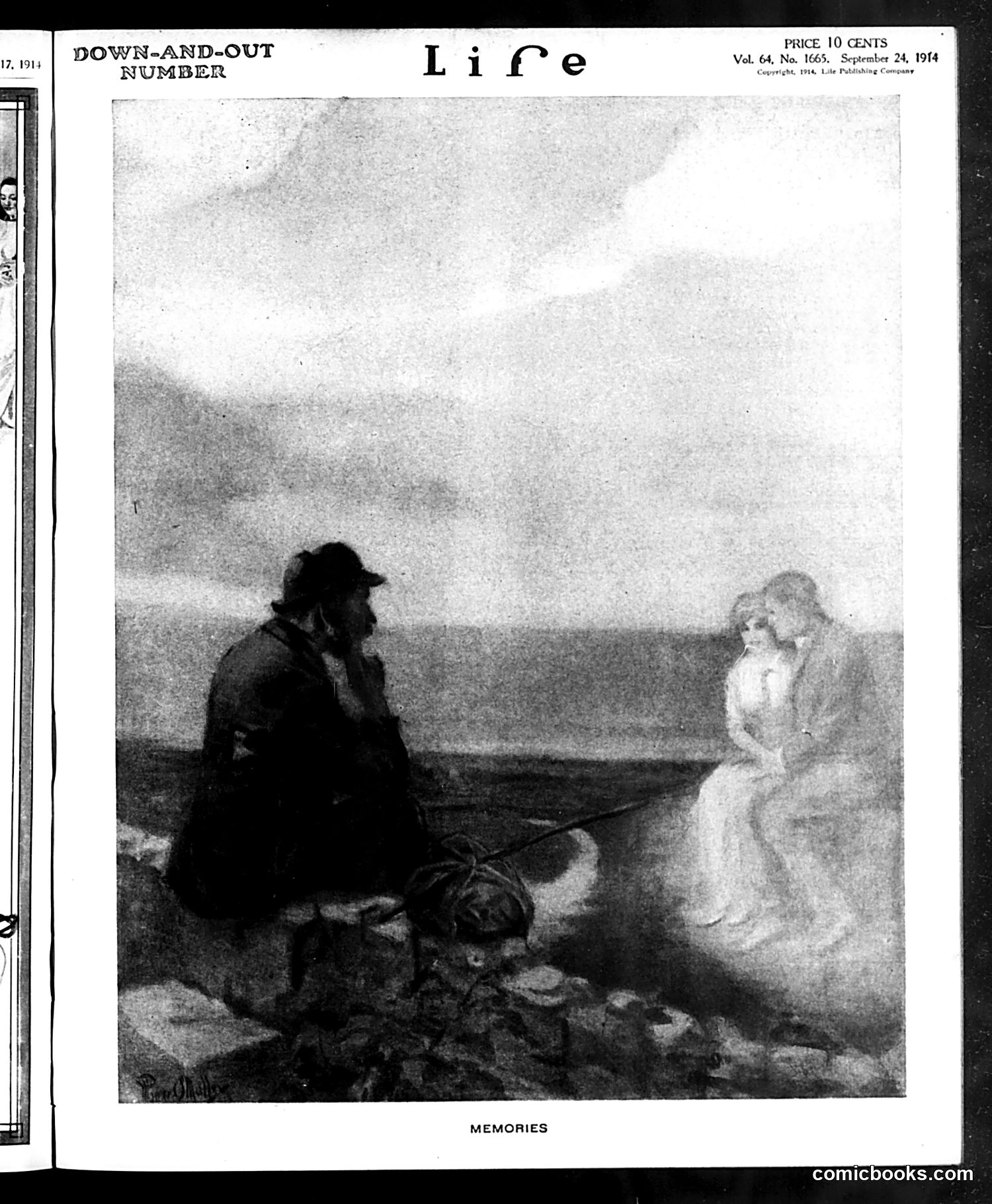
This illustration is titled "Memories" and depicts two figures by a seaside or beach setting. On the left sits an elderly man in dark clothing, appearing contemplative or melancholic. On the right are two younger figures in lighter dress, seemingly engaged together. The romantic or sentimental scene likely illustrates the common Victorian/Edwardian theme of reflecting on past love or youth—contrasting an aging person's solitary present with memories of romantic companionship. Given Life magazine's satirical nature, this could mock sentimentality or the gap between youthful romance and later-life loneliness. The specific historical or political reference remains unclear without additional context from the magazine's surrounding content.
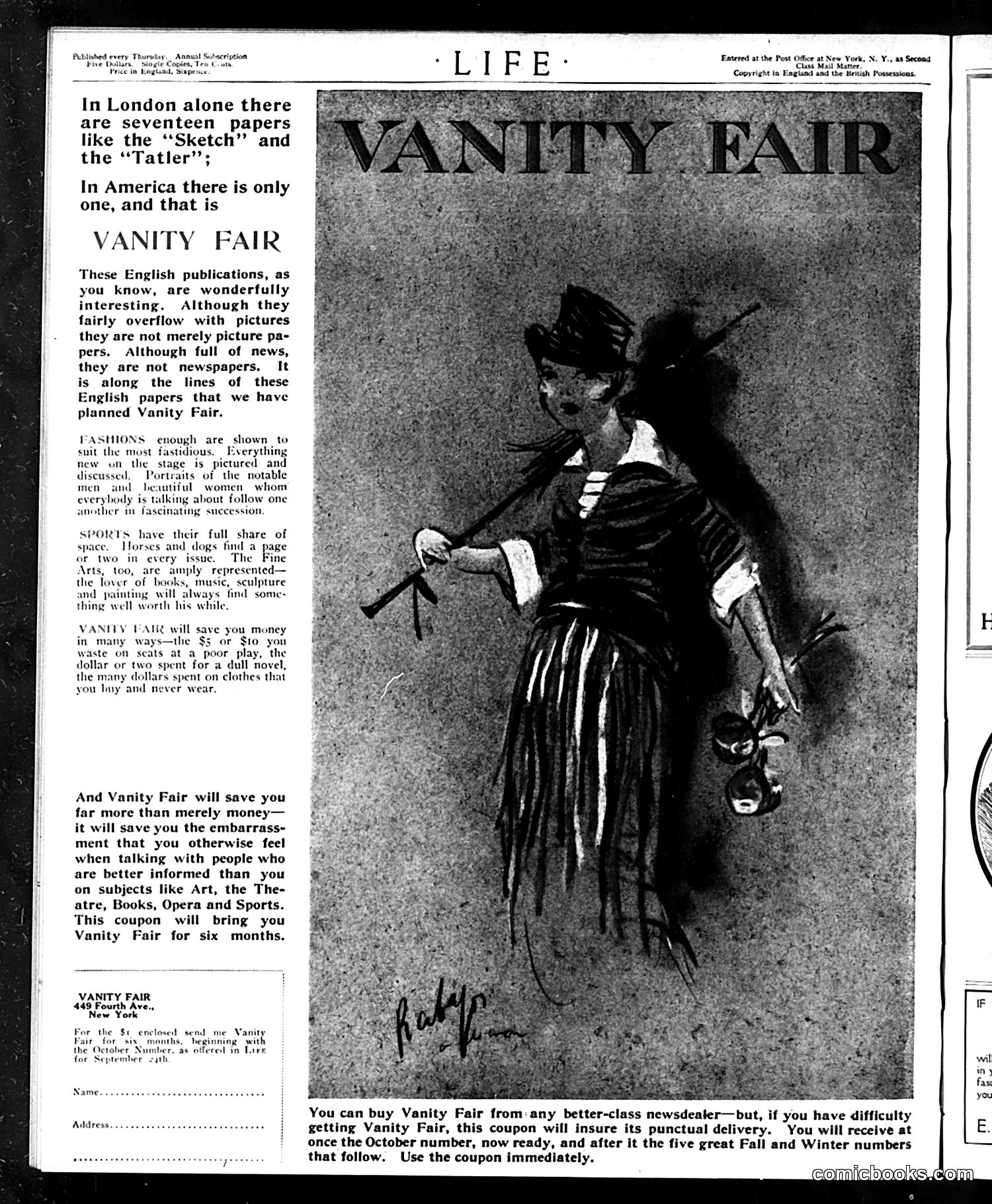
This page is primarily **advertising for Vanity Fair magazine**, not political satire. The left column promotes Vanity Fair as America's equivalent to English publications like the "Sketch" and "Tatter," emphasizing its coverage of fashions, sports, arts, theater, books, opera, and society news. The central illustration appears to be a **fashion or society figure**—likely a woman in elegant dress with a hat—though the specific identity is unclear from the image alone. The illustration serves as aspirational content typical of the magazine's marketing. The coupon at bottom invites six-month subscriptions. This is essentially a **lifestyle magazine advertisement** rather than political commentary, targeting affluent readers interested in culture and high society.
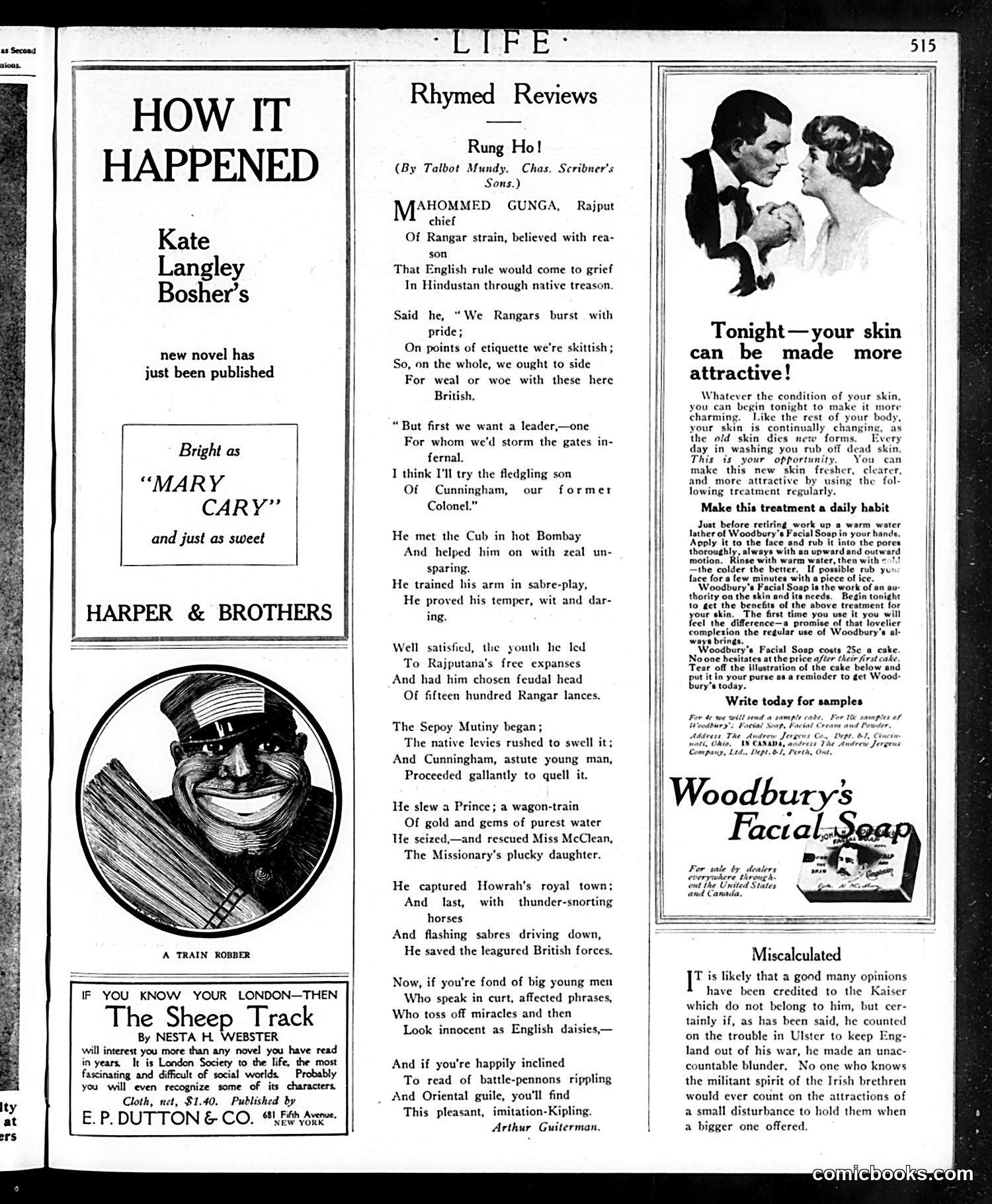
This page is primarily **advertising and book promotion** rather than political satire. The left side advertises Kate Langley Bosher's novel "How It Happened," compared to "Mary Carey." A circular illustration shows "A Train Robber"—a criminal caricature with exaggerated features, likely reflecting early 20th-century attitudes toward crime and lawlessness. The center features a poem titled "Rung Ho!" about Mahommed Gunga, a Rajput chief, depicting British colonial India. The verse celebrates a native leader helping Britain suppress rebellion, reflecting contemporary imperial attitudes. The right side advertises Woodbury's Facial Soap with standard beauty-industry messaging about skin improvement—typical period advertising. The overall page reflects Life magazine's mixed content: literature promotion, colonial-era poetry, and consumer advertising targeting educated readers.
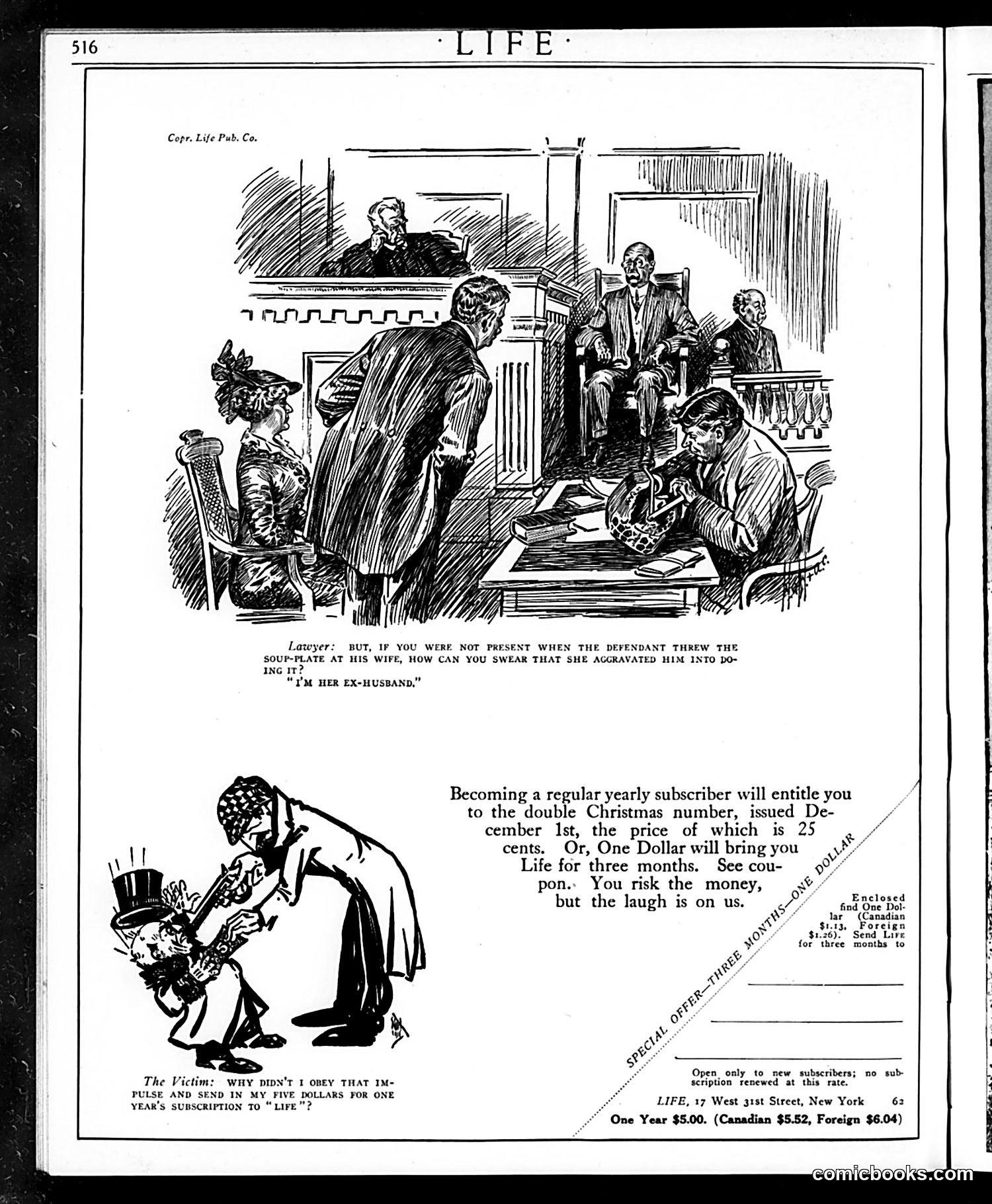
**Top Cartoon:** A courtroom scene depicting legal testimony. A lawyer questions a witness about events she couldn't have witnessed directly, challenging her credibility regarding a defendant's alleged aggravation of his wife. The caption reads: "BUT, IF YOU WERE NOT PRESENT WHEN THE DEFENDANT THREW THE SOUP-PLATE AT HIS WIFE, HOW CAN YOU SWEAR THAT SHE AGGRAVATED HIM INTO DOING IT? I'M HER EX-HUSBAND." The satire mocks both the absurdity of allowing biased testimony (an ex-husband vouching for a woman's character) and the legal system's acceptance of circumstantial claims about provocation. **Bottom Cartoon:** Shows a figure forcibly extracting money from another, captioning why they won't subscribe to Life magazine. The page is primarily **advertising** for Life subscriptions, offering promotional rates.
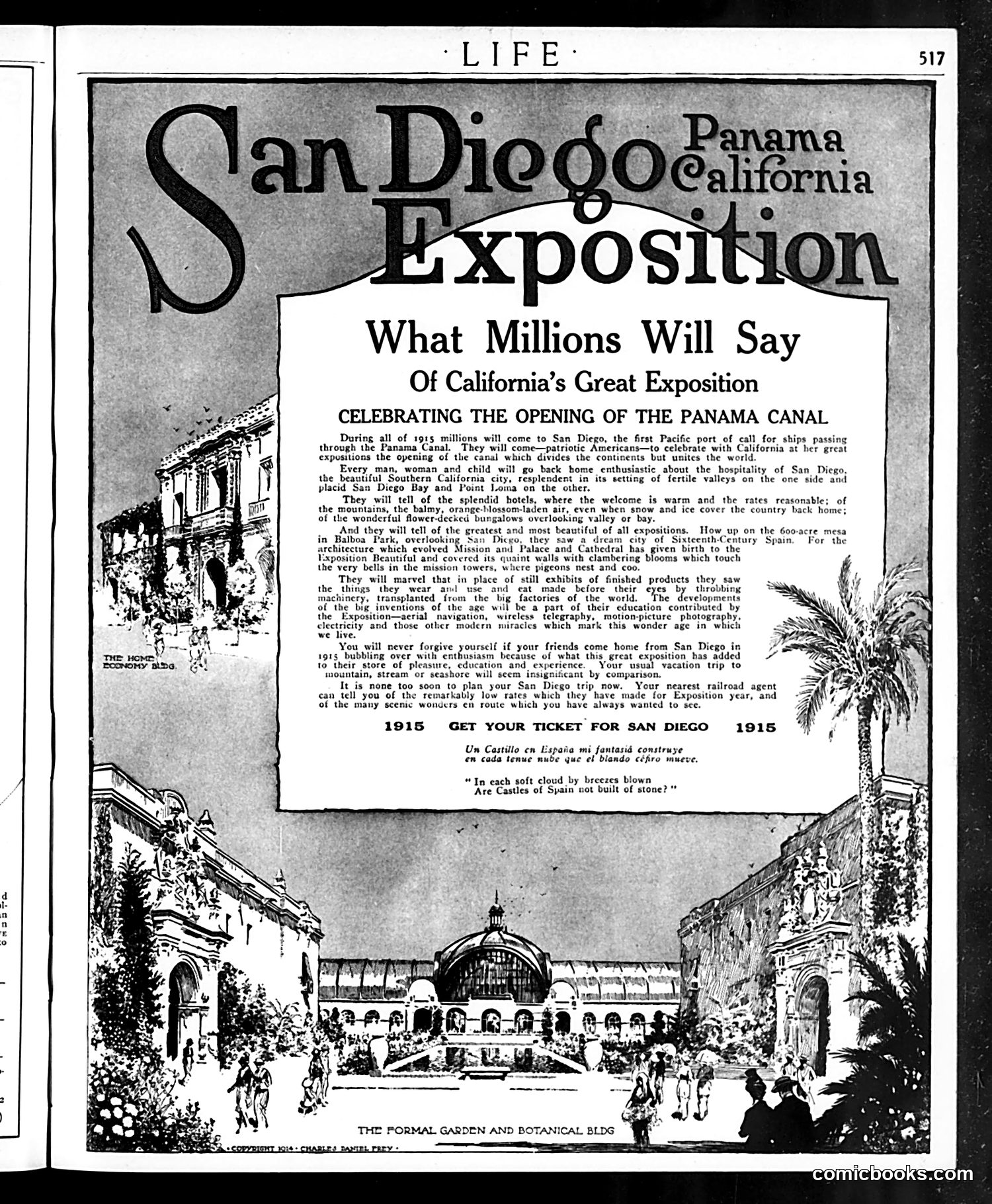
This is primarily **advertising content**, not satire or political commentary. It promotes the 1915 Panama-California Exposition in San Diego, celebrating the opening of the Panama Canal. The page features architectural illustrations of Spanish Colonial-style buildings with courtyards and botanical gardens—the exposition's actual design aesthetic. The text uses persuasive language ("What Millions Will Say") to encourage visitors, emphasizing the exposition as a celebration of modern achievements (wireless, aviation, electricity) alongside cultural attractions. The Spanish motto and architectural references evoke the region's Hispanic heritage, deliberately evoking "Sixteenth-Century Spain" to create an exotic, culturally distinctive fair experience. This was a genuine World's Fair, not satirical commentary—representative of early 20th-century American promotional journalism blended into *Life* magazine's pages.
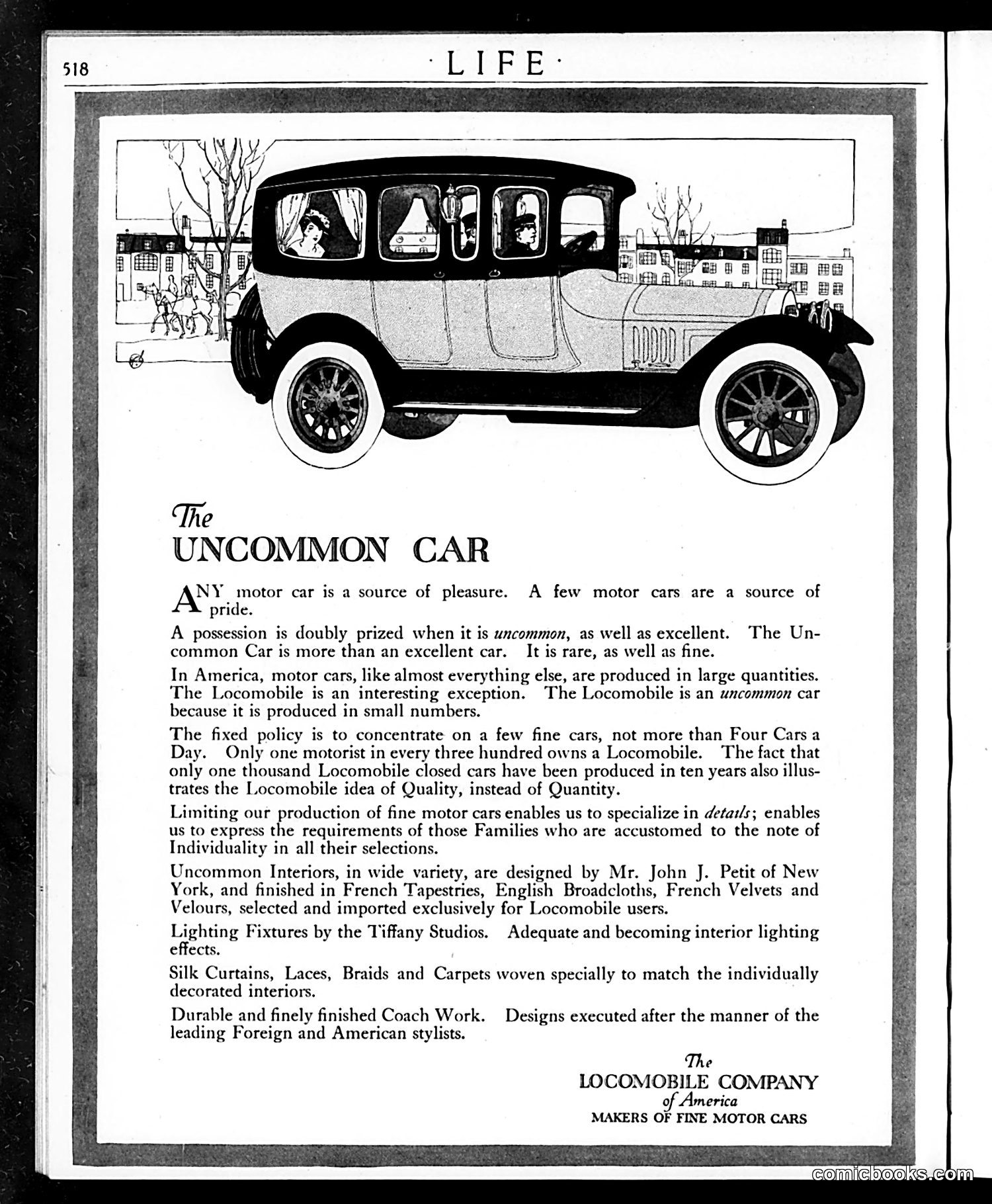
This is **not a cartoon or satire**—it's a straightforward automobile advertisement from *Life* magazine (page 518). The Locomobile Company markets their cars as luxury vehicles for wealthy buyers who value **exclusivity over mass production**. The ad emphasizes that Locomobiles are "uncommon" because production is deliberately limited to "Four Cars a Day," contrasting with mass-produced American automobiles. The pitch emphasizes quality, individualization, and fine craftsmanship: custom interiors designed by John J. Petit, Tiffany Studios lighting fixtures, imported French fabrics and velvets, and handcrafted coachwork. The message targets affluent consumers seeking distinction and refined taste rather than affordable transportation. This reflects early 20th-century luxury marketing to America's wealthy elite.
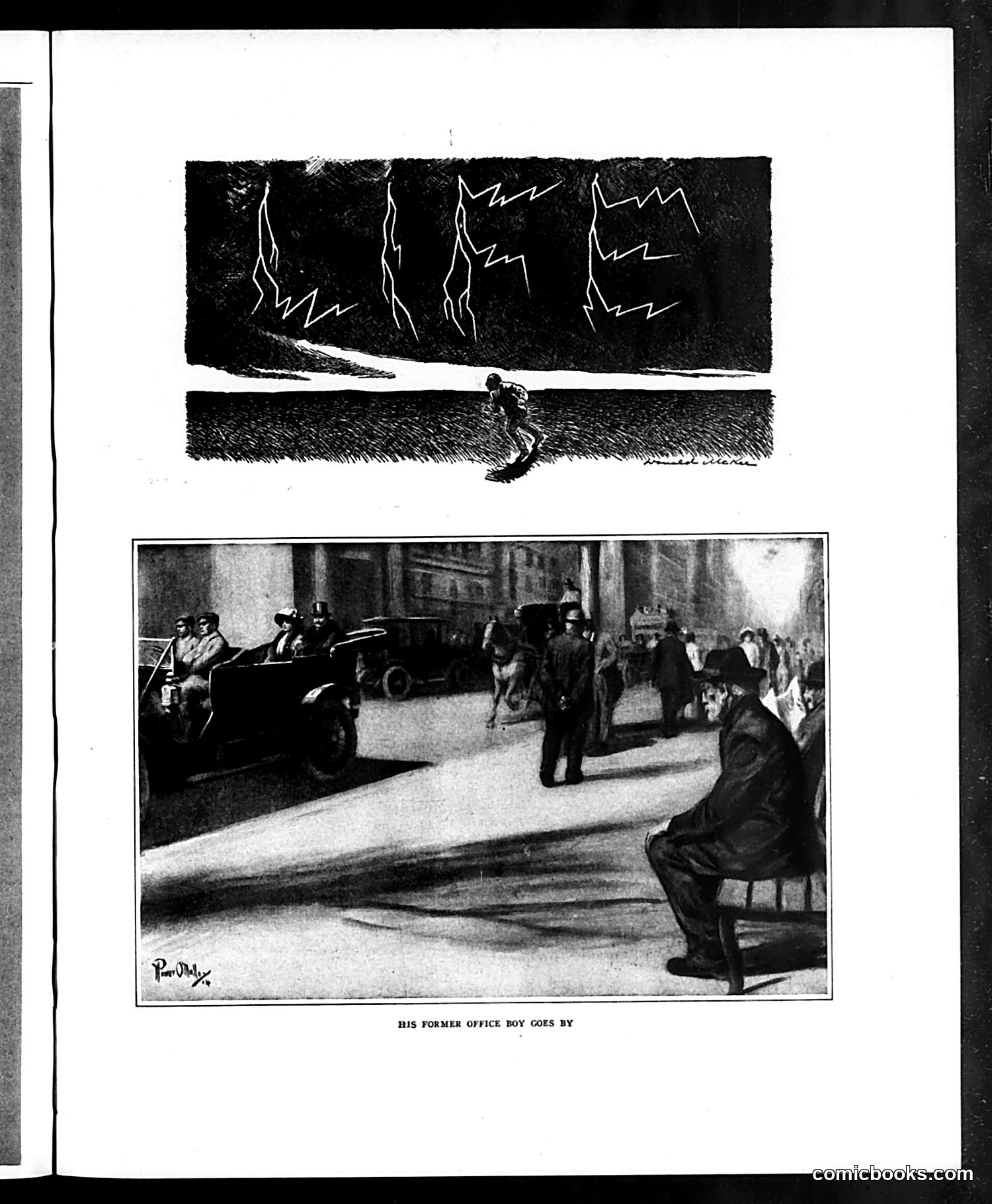
The page contains two distinct images: **Top image**: A sketch-style comic strip showing a figure running away from lightning bolts in a dark sky, suggesting flight or escape from danger. **Bottom image**: A signed cartoon titled "HIS FORMER OFFICE BOY GOES BY" depicting a street scene where a man sits on a bench watching expensive automobiles pass by. The scene appears to reference class contrast—likely showing a former office boy (a low-ranking worker) observing his former employer or someone of higher status driving past in fancy cars. The satire suggests ironic commentary on social mobility, economic disparity, or perhaps the bittersweet experience of watching others' success while remaining in a lower station. Without additional context about the specific Life magazine issue, the precise political or social event referenced remains unclear, though the themes address early 20th-century American class consciousness.
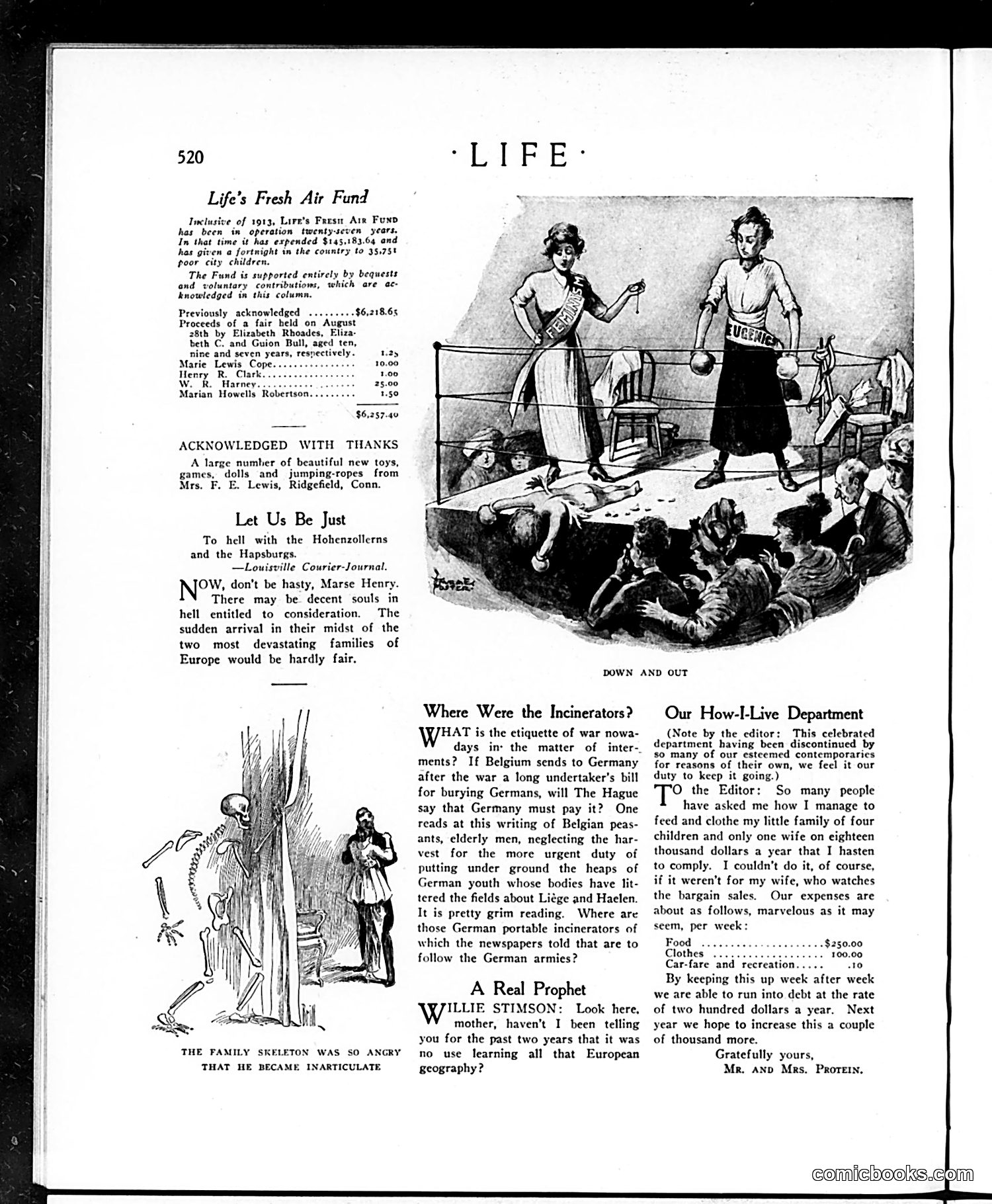
This page contains three distinct sections: 1. **"Down and Out"** - A large illustration showing two women conducting what appears to be a physical exercise or punishment session with children watching. The caption suggests mockery of harsh discipline methods. 2. **"Where Were the Incinerators?"** - A satirical piece questioning German war practices, specifically the disposal of bodies after WWI. It references Belgium and Germany in a grimly humorous tone about post-war obligations. 3. **"A Real Prophet"** and **"How-I-Live Department"** - A advice column excerpt where Willie Stimson questions the practicality of European geography education, followed by a family budget breakdown showing financial strain ($250/month for food alone). The page reflects post-WWI American attitudes: skepticism toward European conflicts, criticism of German conduct, and domestic economic concerns during the interwar period.
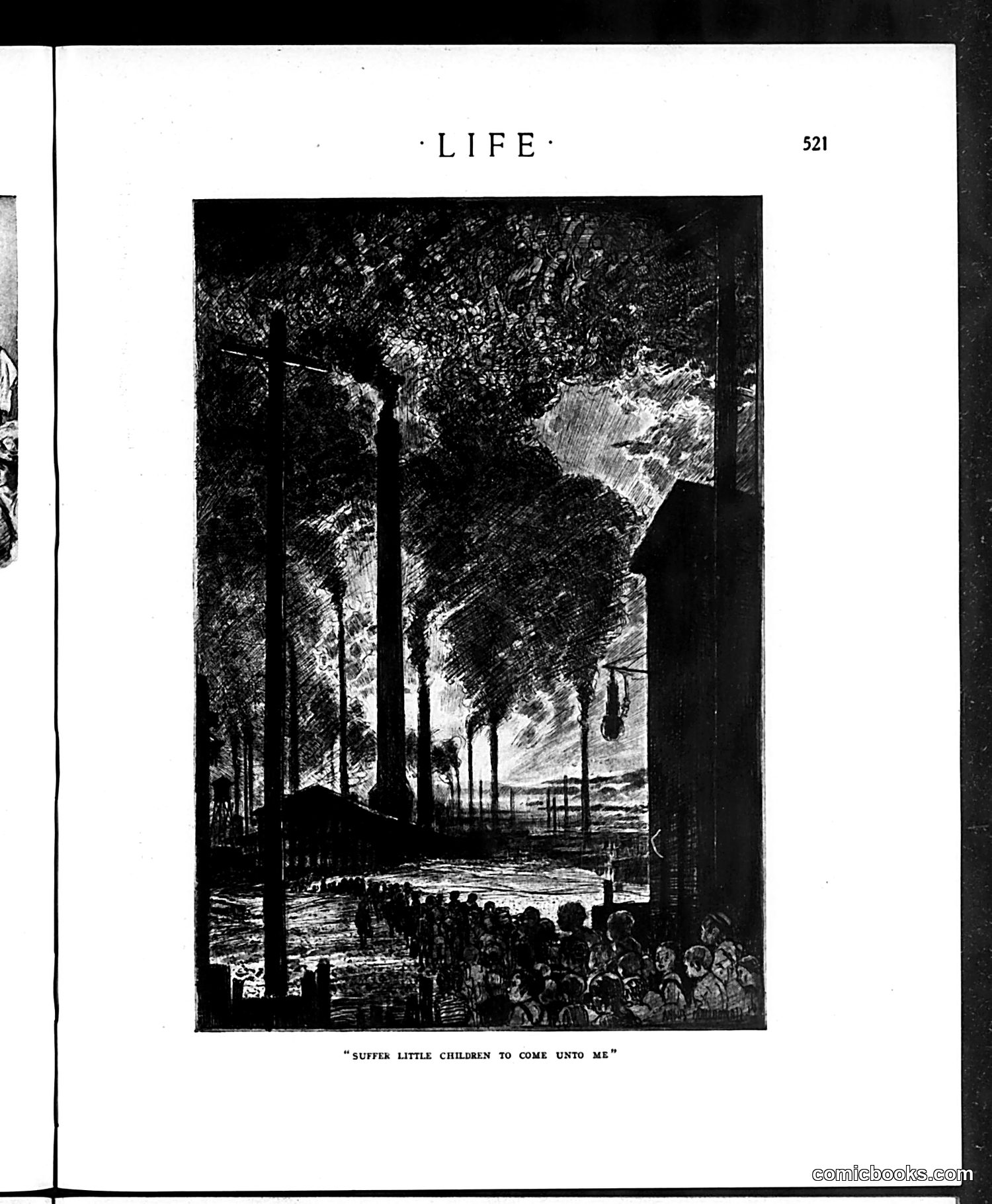
This page from *Life* magazine (page 521) contains a single illustration with the caption "SUFFER LITTLE CHILDREN TO COME UNTO ME." The image depicts a religious scene—likely an outdoor gathering or revival meeting—viewed through tall trees. A figure (presumably representing Jesus or a religious leader) stands elevated before a large crowd of people gathered below. The composition uses dramatic lighting and perspective to emphasize the scene's spiritual or theatrical nature. The caption directly references Matthew 19:14 from the Bible. Without additional context about the publication date, I cannot identify specific political or social satire this may target. The image could be commenting on religious gatherings, mass movements, or institutional religion, but the exact satirical intent remains unclear from the visual information alone.
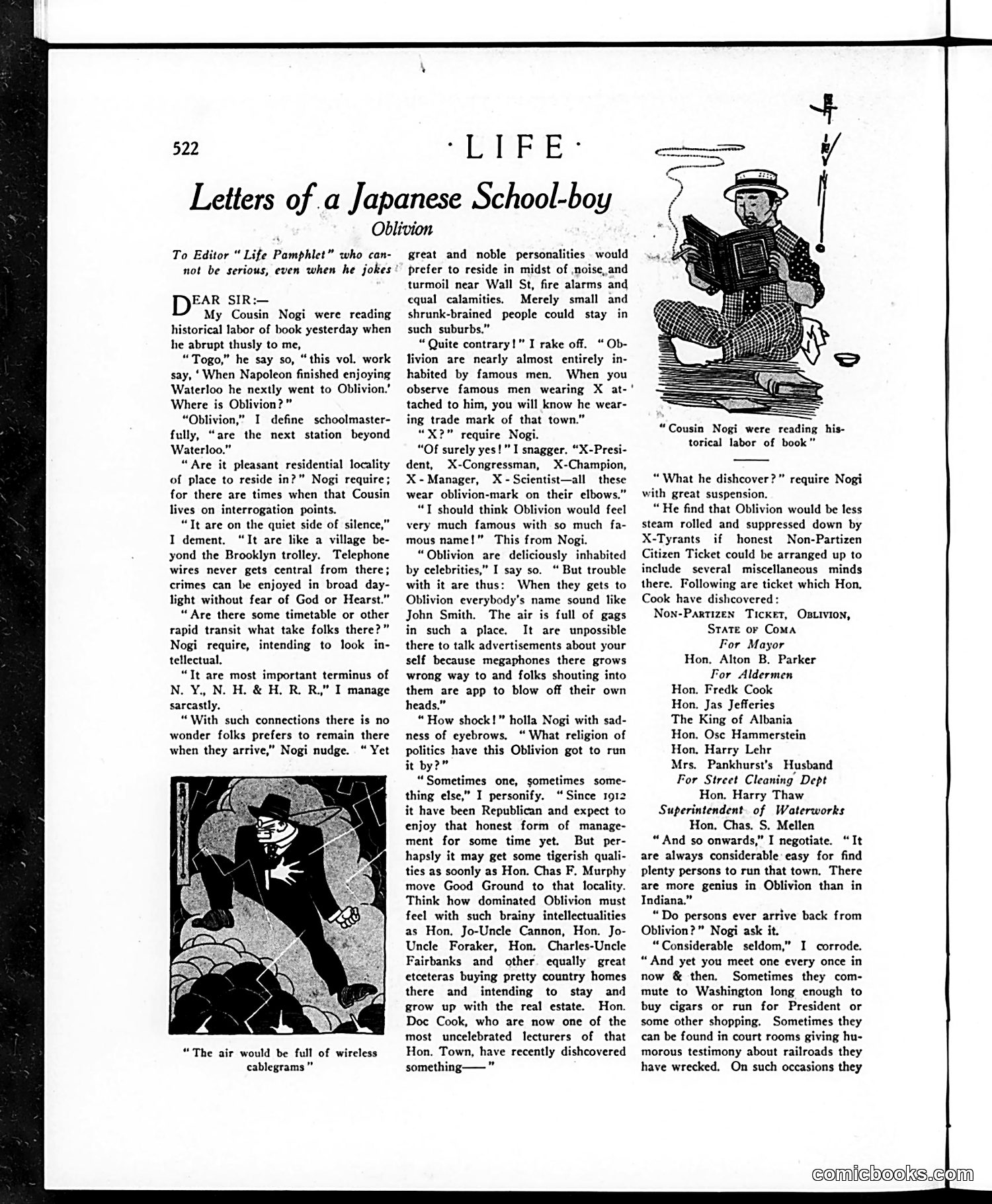
This page features satirical letters supposedly from a Japanese visitor named Nogi, commenting on American life and naming prominent local figures. The main cartoon depicts Nogi reading "historical labor of book" with a Japanese man in traditional dress. The satire mocks both the Japanese character's observations and American pretensions. Nogi ridicules "Oblivion" (likely a fictional/code name for a town) as inhabited by famous men all wearing "X-marks"—suggesting these prominent citizens are interchangeable or fraudulent. The humor plays on cultural misunderstanding: Nogi treats American status symbols naively, while the text implies American provincialism and pride are equally absurd. The list of "Mayor," "Aldermen," and local officials appears to mock small-town self-importance.
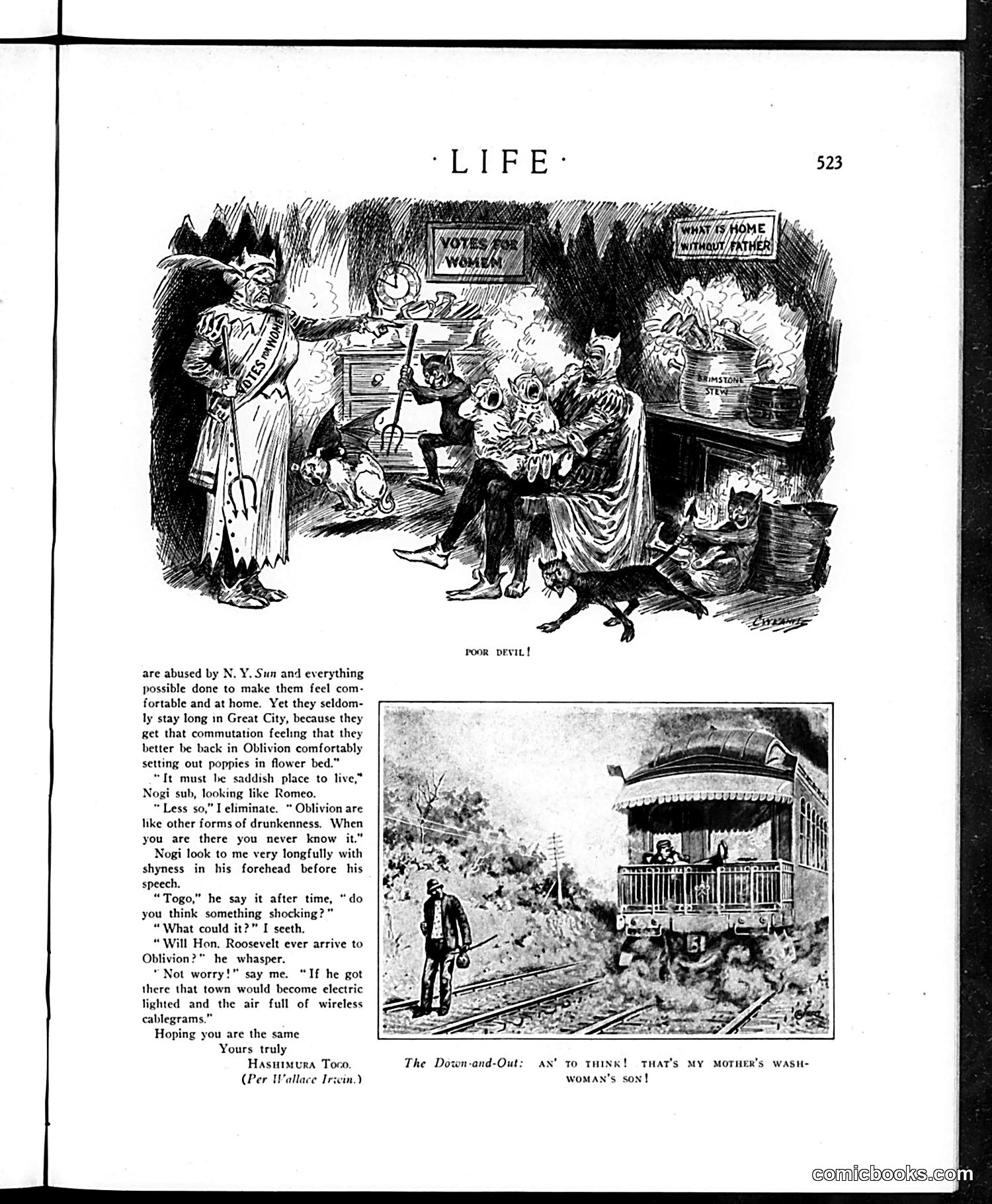
This cartoon satirizes debates about Japanese immigration to America and the desirability of life in Oblivion (likely a reference to a small, undesirable town). The main cartoon shows demon-like figures in what appears to be Hell or a hellish space, with signs reading "Notes for Women" and "What is Home Without Mother?" The accompanying text (attributed to Hashimura Todo) contains a Japanese character's reflections on Oblivion, wondering if even Theodore Roosevelt would visit such a place. The commentary mocks both the town's undesirability and contemporary anxieties about Japanese settlement in America. The photograph below depicts a rural railway shack, illustrating the kind of isolated, undesirable living conditions being referenced in the satire about Japanese immigrants' experiences and choices regarding where to settle.
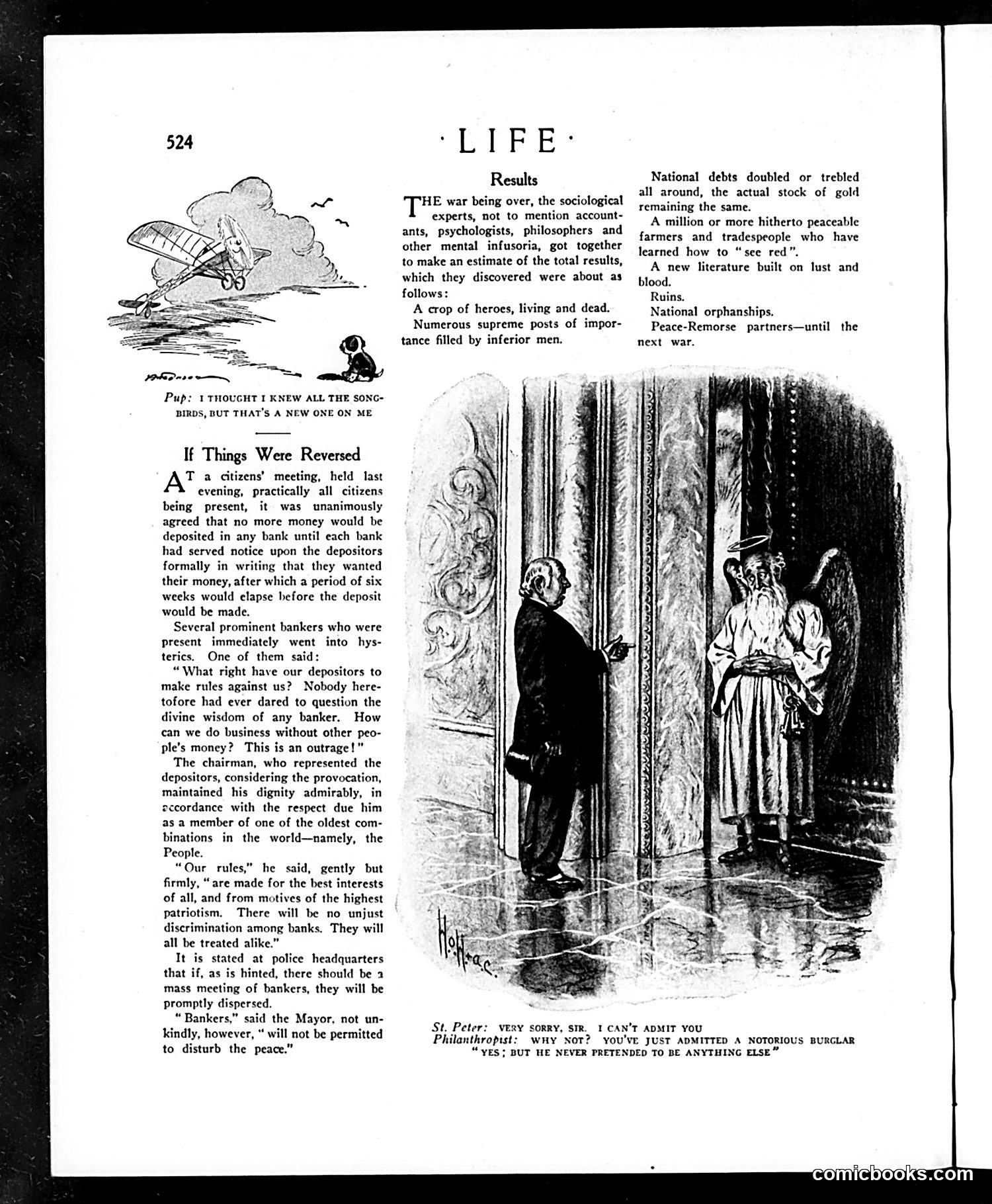
This page from *Life* magazine satirizes post-war tensions between depositors and banks. The top section, "Results," lists war's devastating social costs: dead heroes, national debt, orphanships, and ruined farmers. The main piece, "If Things Were Reversed," mocks bankers' resistance to depositor demands by imagining a hypothetical citizens' meeting where banks must serve notice before withdrawing deposits—reversing normal banking practice. Bankers react hysterically, claiming this violates "divine wisdom." The accompanying cartoon shows St. Peter denying entry to Heaven to a notorious burglar, who protests that the burglar "never pretended to be anything else"—implying bankers are hypocritical, fraudulently claiming respectability while behaving unethically. The satire suggests post-war financial institutions deserve public suspicion.
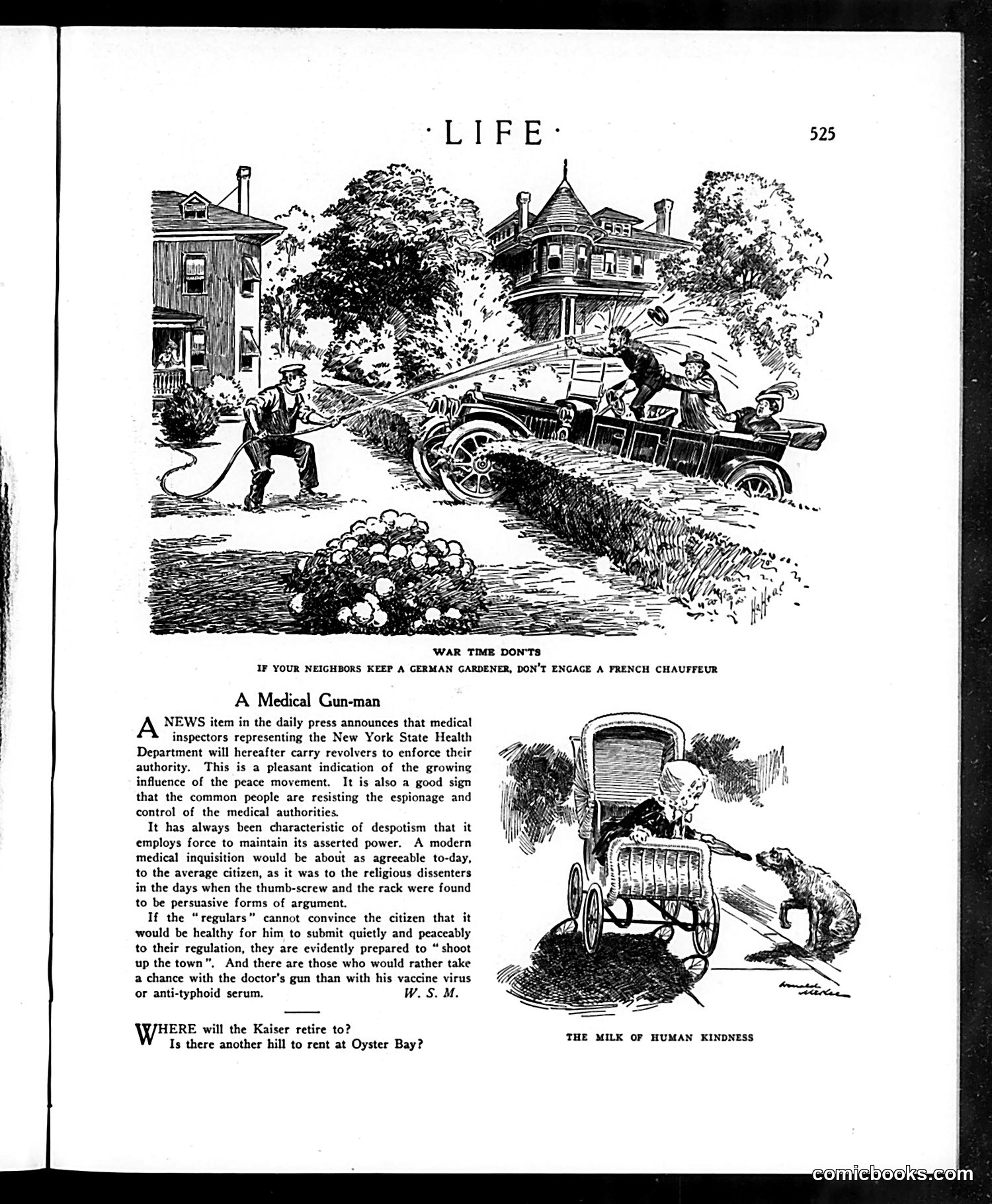
**Top Illustration:** A wartime domestic safety cartoon showing a man watering his garden while a car passes by. The caption warns against hiring a "French chauffeur" if neighbors employ a German gardener—likely satirizing wartime suspicions of foreign nationals and espionage paranoia during WWI. **"A Medical Gun-man":** This article criticizes medical inspectors enforcing public health authority through coercion. It compares their use of force to despotism, arguing citizens resent mandatory vaccines and medical procedures ("shoot up the town"). The piece suggests people distrust government medical mandates. **Bottom cartoon ("The Milk of Human Kindness"):** Shows a figure offering milk to a cat, illustrating kindness or charity. The page reflects WWI-era anxieties about foreign threats and governmental overreach.
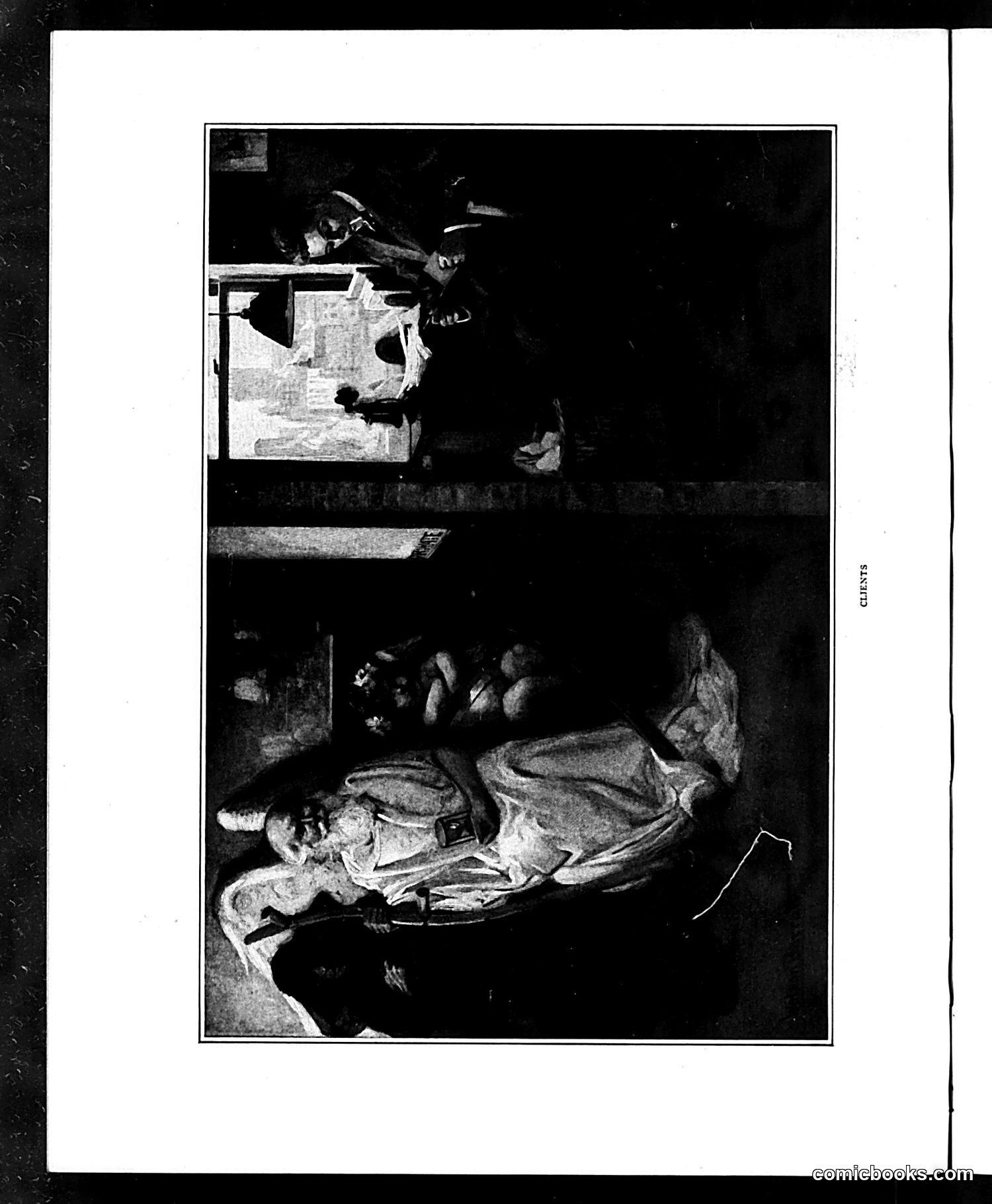
This appears to be a page from Life magazine showing what looks like a theatrical or film scene. The image is rotated 90 degrees, making it difficult to read clearly, but it depicts figures in what appears to be an interior setting with dramatic lighting typical of early cinema or stage production. Without being able to read the accompanying text clearly due to the image orientation and quality, I cannot definitively identify the specific political or social references, the figures depicted, or the satirical point being made. The page appears to reference "CHESS" (visible on the right margin), suggesting the content may relate to that game or a chess-themed production, but I cannot confidently explain the cartoon's meaning or context to a modern reader without more legible source material.
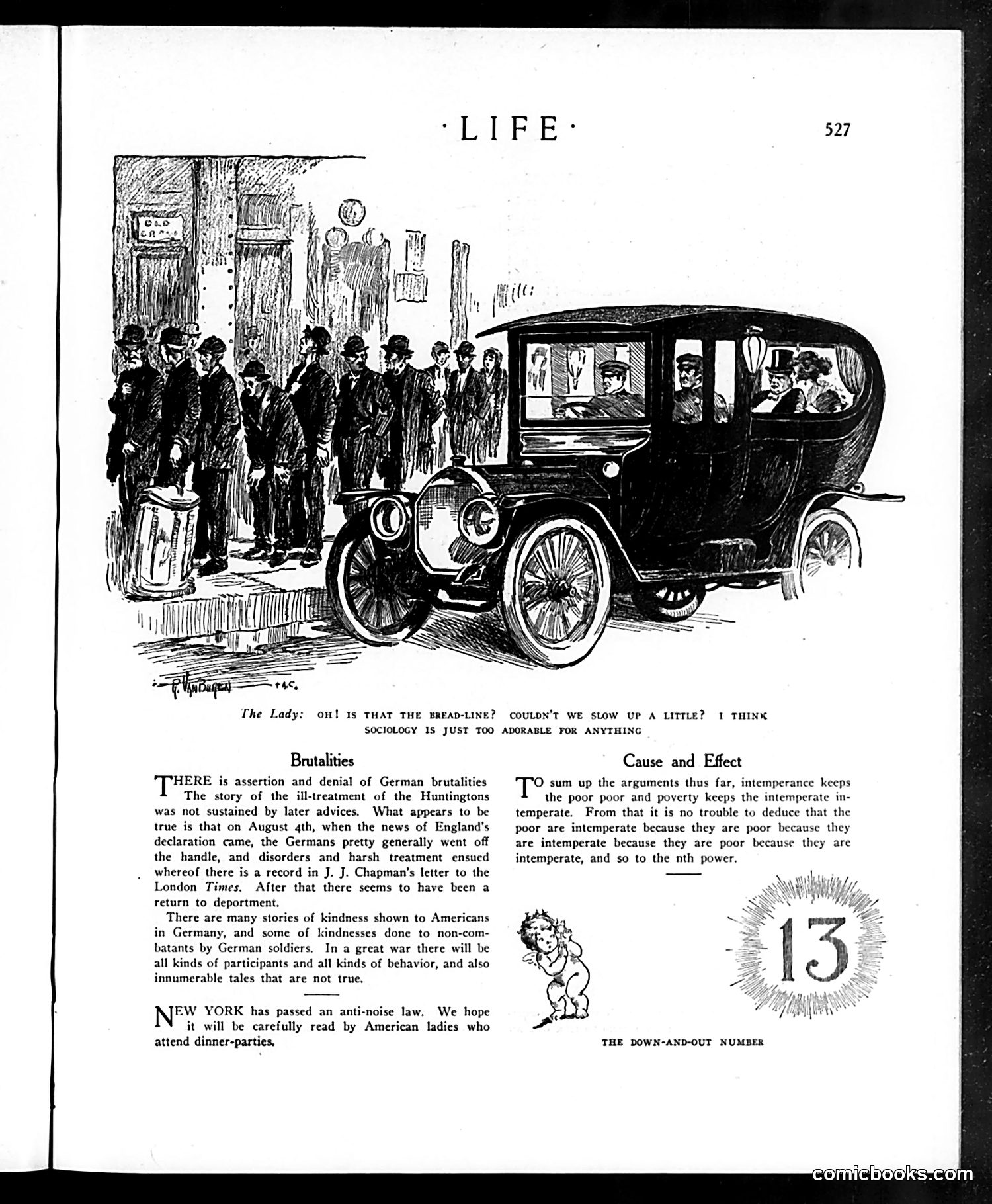
**The Main Cartoon:** Shows a wealthy woman in an automobile asking her chauffeur if a crowd of poor people waiting outside constitute a "bread-line" (unemployment queue). She dismisses poverty as mere "sociology" too "adorable" to take seriously—satirizing upper-class indifference to economic hardship. **The Text Sections** address two issues: 1. **"Brutalities"**: Discusses alleged German mistreatment of civilians during WWI (referencing the Huntingtons case), noting some reports were unverified but acknowledging documented incidents in J.J. Chapman's letter to the *London Times*. 2. **"Cause and Effect"**: Mocks circular reasoning about poverty and alcoholism—poor people drink *because* they're poor, which keeps them poor, which makes them drink, etc., in endless logical loops. **The Anti-Noise Law reference** jokes that wealthy dinner-party hostesses should read NYC's new noise ordinance. **Overall point**: The satire ridicules wealthy indifference to poverty and flawed social arguments used to justify inequality.
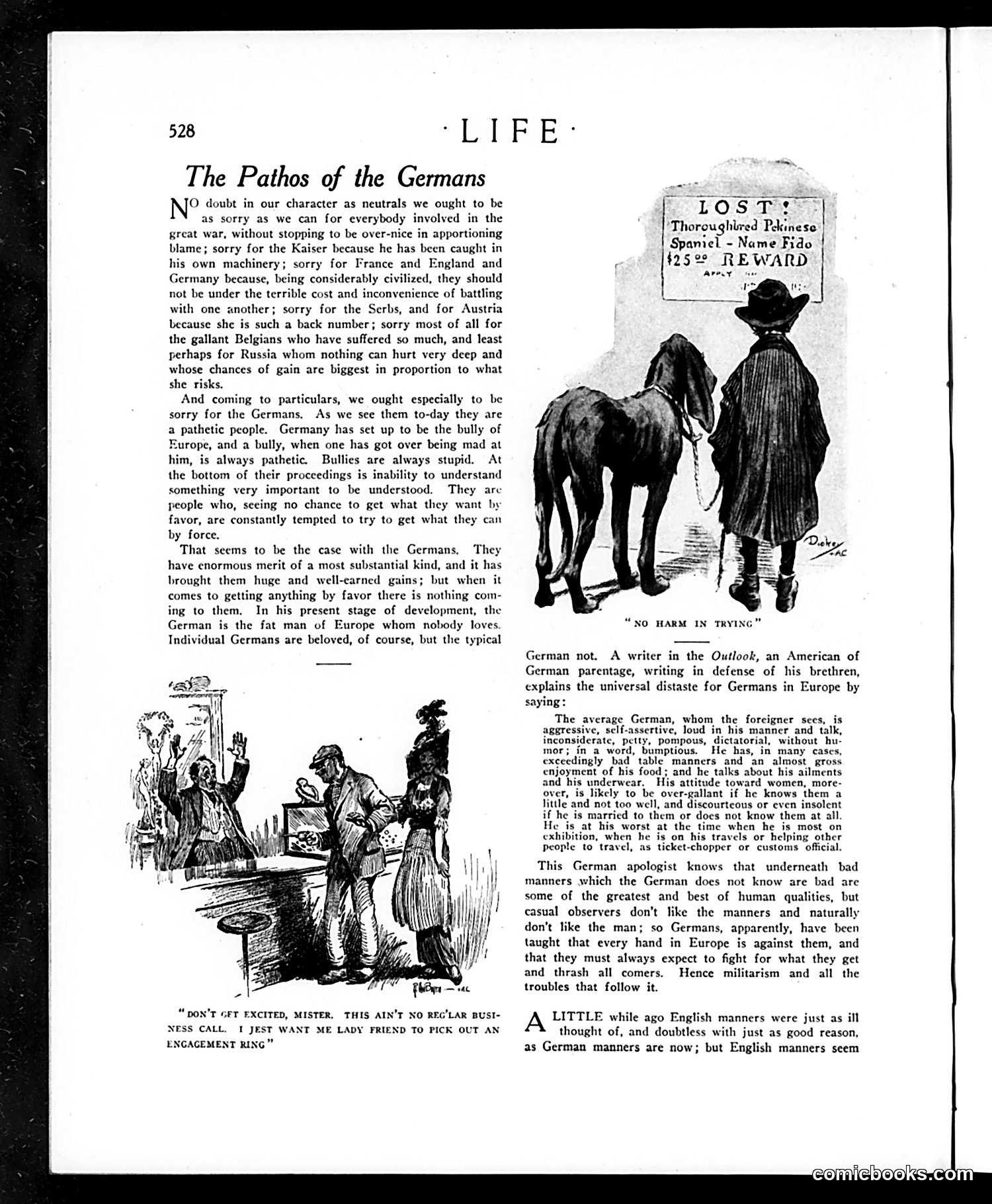
This World War I-era satirical article criticizes German national character as seen by outsiders. The text presents a backhanded "defense" of Germans: acknowledging their substantial qualities while explaining why Europeans dislike them. The key argument: Germans appear aggressive, loud, inconsiderate, and bumptious—with poor table manners and inappropriate behavior toward women. A German-American writer quoted here argues these *manners* cause the distaste, not inherent badness. However, Life suggests Germans have been taught that Europe opposes them, leading to their militarism. The two cartoons illustrate German social clumsiness: the upper sketch shows someone rudely demanding a lady friend help pick an engagement ring; the lower depicts a customs official's inappropriate behavior. The satire mocks both German behavior and the defensive apology for it—suggesting Germany's international isolation stems from poor deportment rather than innocence.
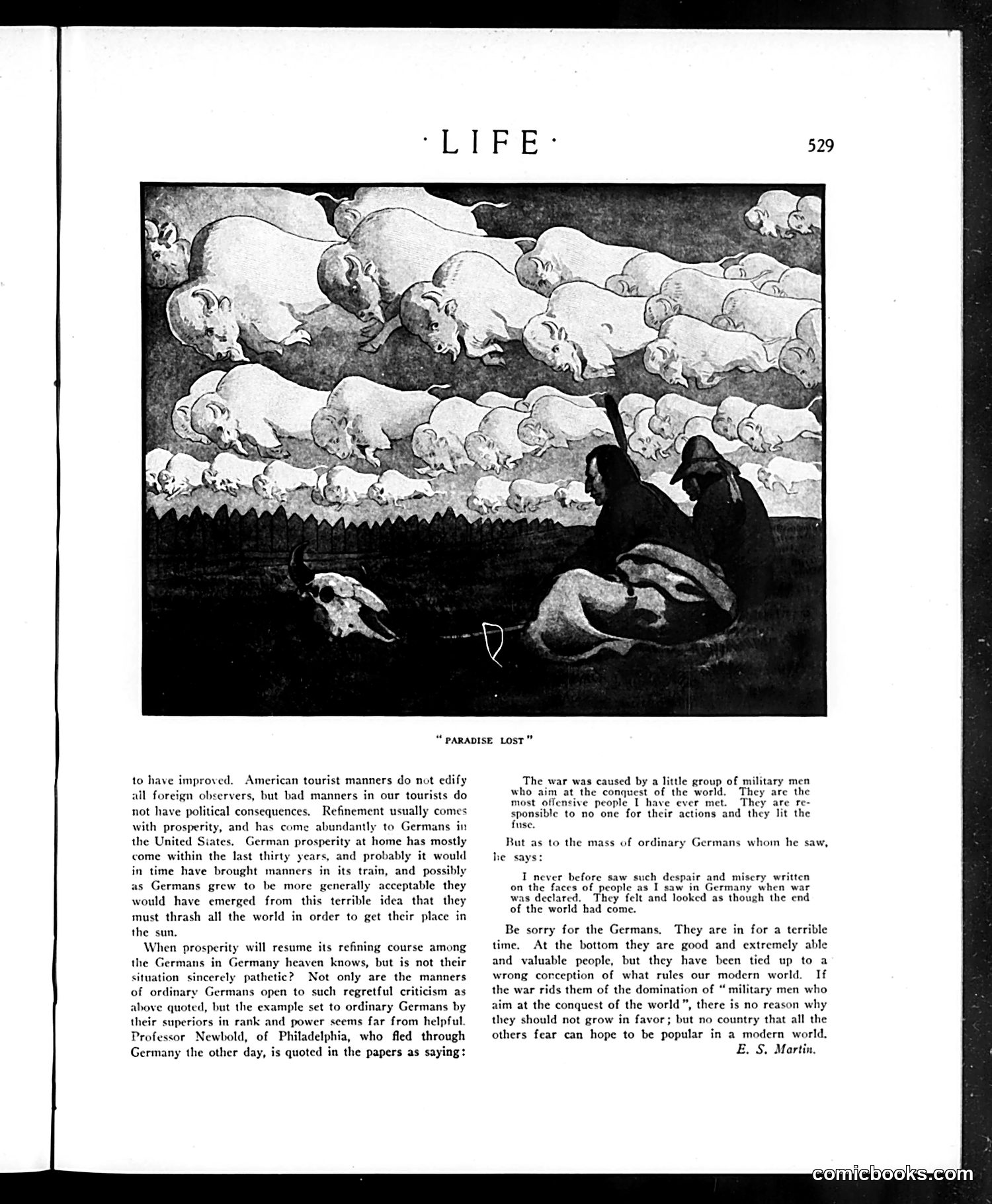
This cartoon illustrates post-World War I commentary on Germany's collapse. The image shows two figures in dark silhouette observing a nightmarish vision of sleeping, cherubic babies arranged in rows—a surreal, grotesque inversion of innocence that suggests ruined dreams or lost hope. The accompanying text by E.S. Martin discusses German culpability for the war while expressing sympathy for ordinary German citizens. Martin argues that a small military elite ("military men who aim at the conquest of the world") dragged Germany into catastrophic war, leaving the general population devastated. He quotes Professor Newbold's firsthand observations of German despair immediately after war's declaration. The cartoon's title "Paradise Lost" reinforces this message: Germany's former prosperity and potential for civilized development has been destroyed by militarist ambitions. The satire suggests that Germany's militaristic leadership has condemned an entire nation to suffering, transforming what might have been a peaceful, prosperous future into nightmare.
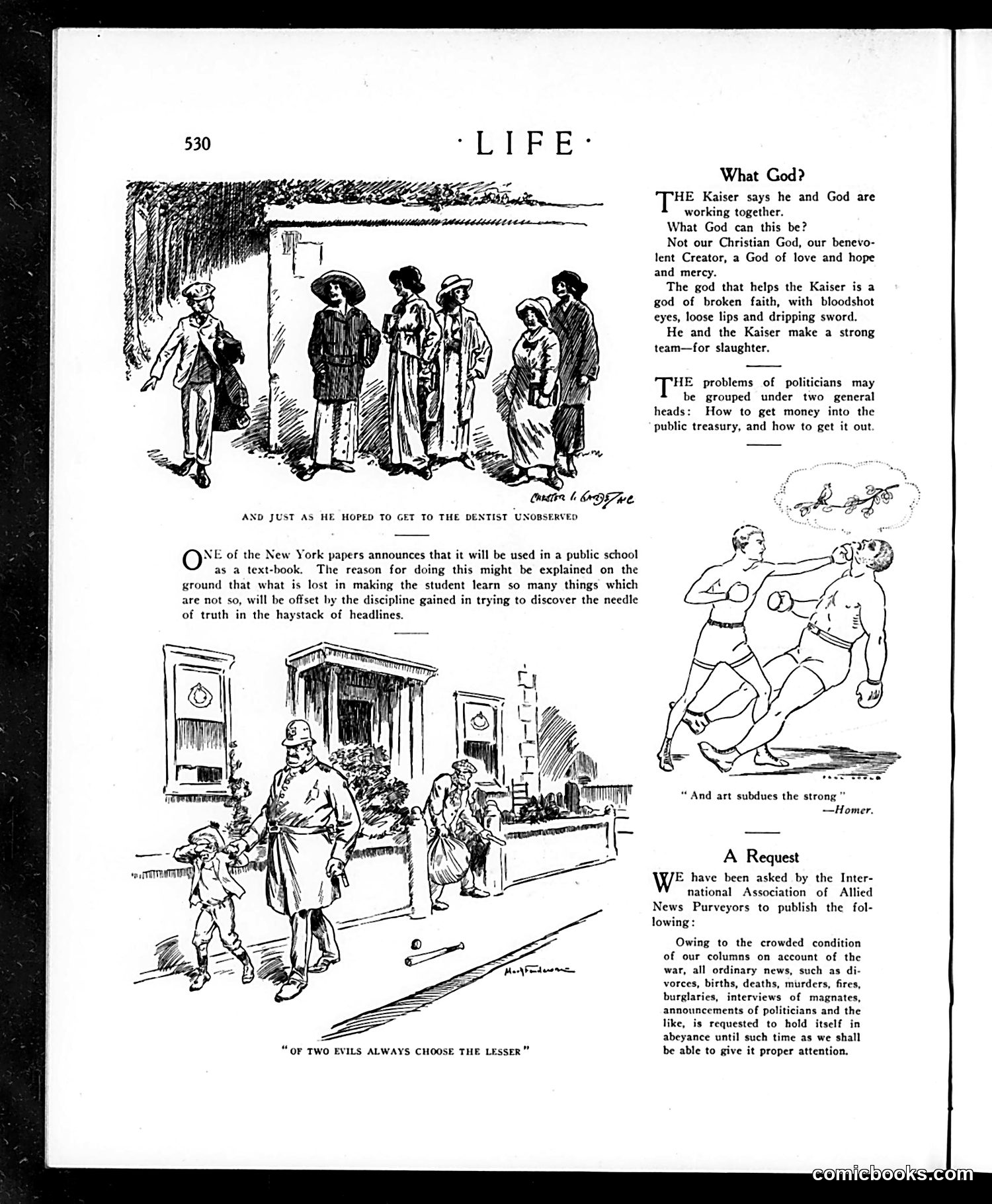
This page contains WWI-era American political satire, likely from 1914-1918. **Top Cartoon**: Shows a man attempting to slip past a group unnoticed to reach a dentist. The humor is straightforward—dental visits were universally dreaded. **"What God?" Section**: Directly attacks Kaiser Wilhelm II's claim that he and God work together. Life contrasts the Christian God of mercy with the "god" supposedly aiding the Kaiser—depicted as bloodthirsty and violent. This reflects American opposition to Germany during WWI. **"Of Two Evils" Cartoon**: Illustrates people choosing between two undesirable options, likely referencing wartime hardships or political compromises. **"A Request"**: Life ironically announces it's suspending ordinary news coverage due to war-related material overload. This satirizes how completely WWI dominated American newspapers and public discourse, crowding out routine reporting. The page reflects Life's anti-German editorial stance and critiques how the war consumed public attention and media space.
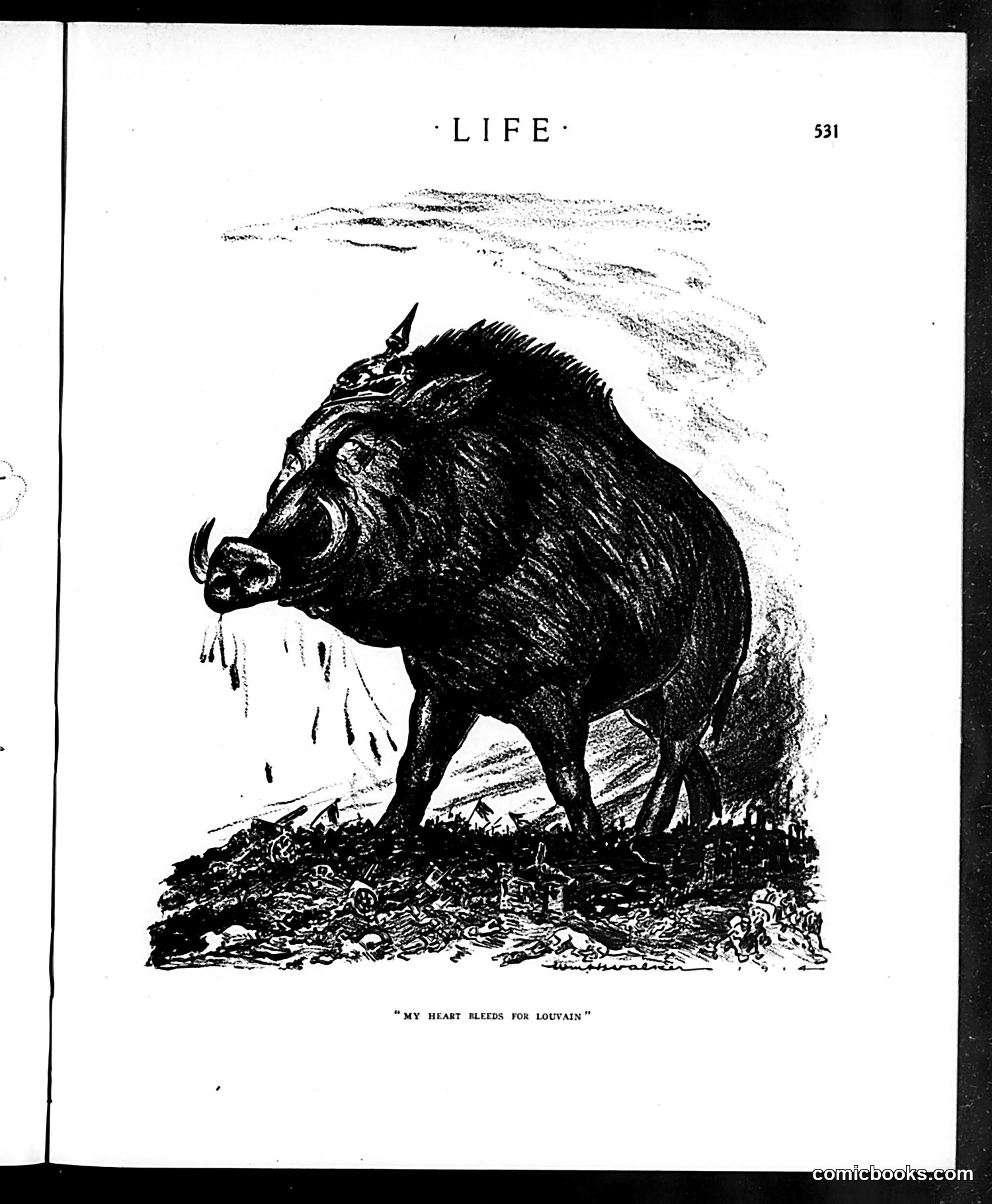
This is a political cartoon from *Life* magazine (page 531) depicting a menacing boar or wild pig with a spiked helmet—a recognizable symbol of German militarism from World War I era. The animal stands over devastated ground littered with ruins and debris. The caption "My Heart Bleeds for Louvain" references the German destruction of the Belgian city of Louvain in 1914, which shocked international opinion and became a symbol of German aggression and atrocities against civilians during WWI. The cartoon's satire is mordant: the German militarist claims sympathy for Louvain's destruction while literally standing triumphant atop the wreckage, suggesting German hypocrisy or mockery. The brutish animal form emphasizes dehumanization of the enemy in wartime propaganda.
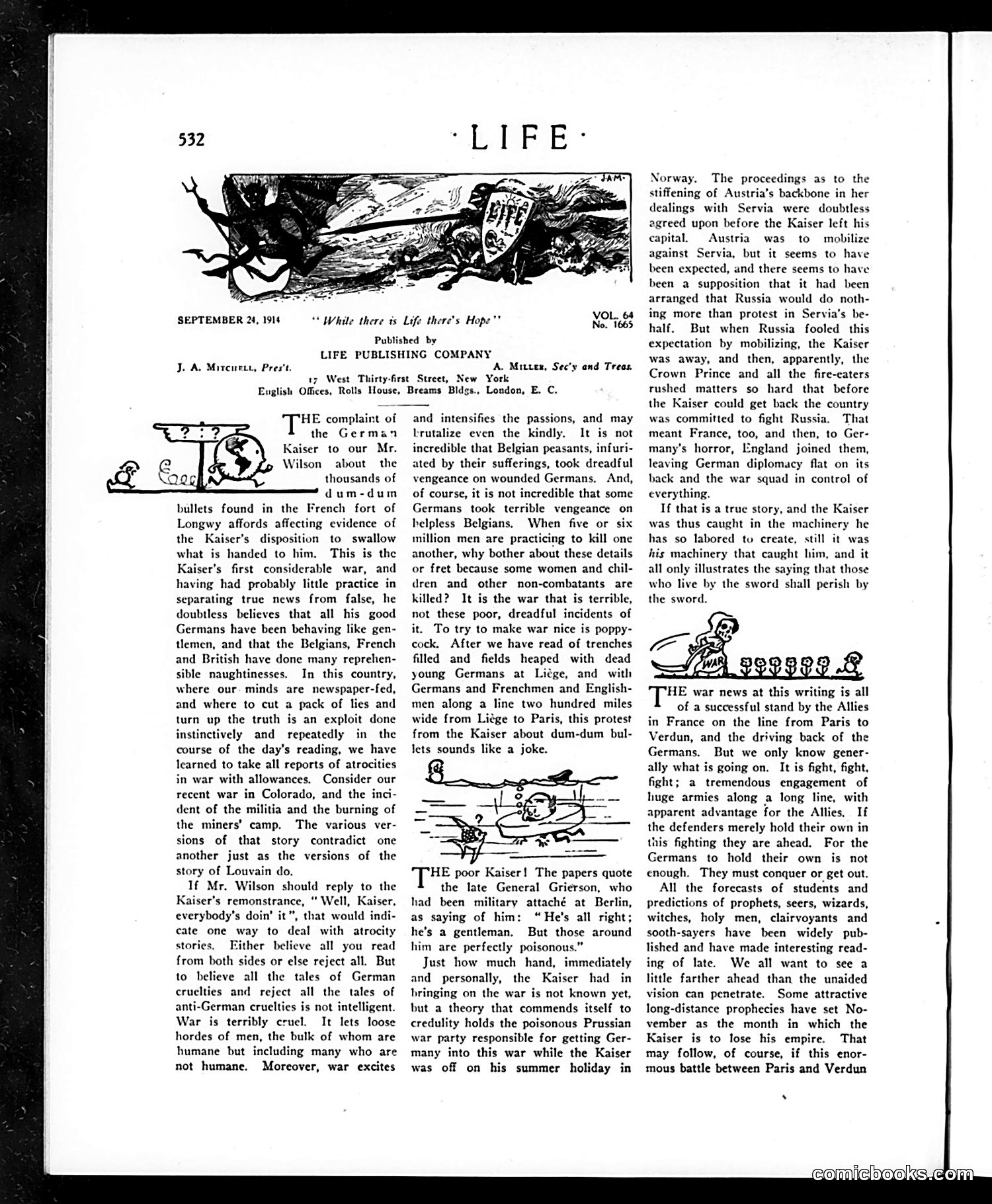
This editorial page mocks Kaiser Wilhelm II's complaint to President Wilson about French use of dum-dum bullets at the Fort of Longwy. The satire argues the Kaiser, inexperienced in major warfare, naively believes German soldiers behave honorably while enemies commit atrocities—a credulous position. The cartoons (appearing to show a suffering Kaiser figure) accompany text asserting that war inherently involves cruelty on all sides. The author argues that singling out German violations while ignoring Allied ones is intellectually dishonest. The piece also suggests the Kaiser may have been manipulated by hardline Prussian militarists into the war while away on summer holiday in Norway, implying he bears less personal responsibility than his advisors. The overall tone is cynical about wartime propaganda from any belligerent.
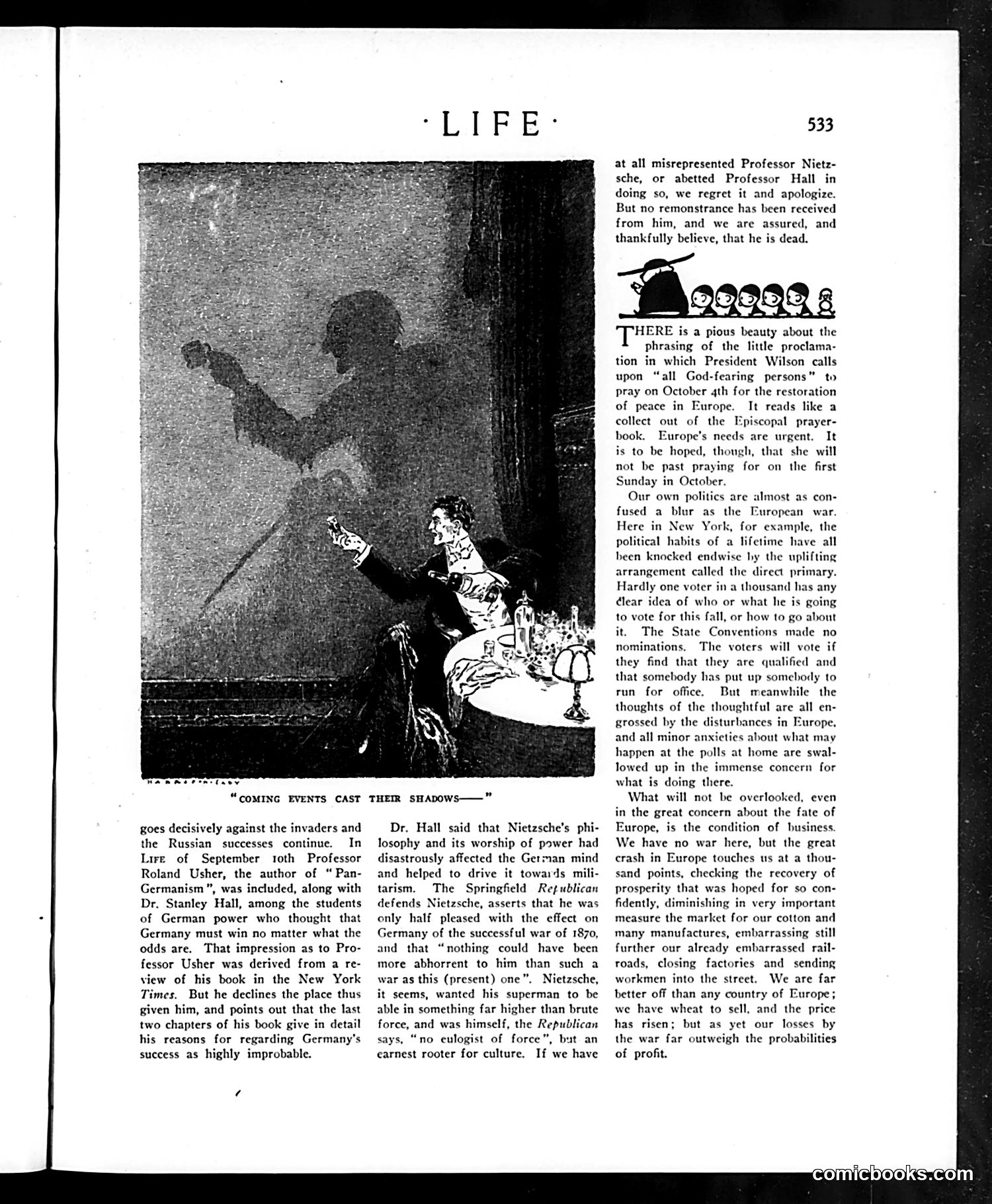
## The Cartoon The illustration titled "Coming Events Cast Their Shadows" depicts two well-dressed diners at a table with ominous shadowy figures looming behind them—appearing to be soldiers or military figures. This visual metaphor suggests that coming warfare or conflict casts its dark influence over present civilian life. ## Context and References The page discusses German philosophy and World War I's impact on America. It references Professor Roland Usher's book "Pan-Germanism" and debates whether Nietzsche's philosophy of power corrupted German militarism. The editors defend Nietzsche against charges of promoting brutality, noting he actually valued culture over "brute force." ## The Satire's Point The cartoon illustrates the article's broader concern: even as Americans dine peacefully, the European war's consequences—economic collapse, factory closures, unemployment—loom inevitable. American prosperity appears fragile, threatened by distant conflict. The juxtaposition mocks the pretense of normalcy while catastrophe approaches. The page reflects early WWI American anxiety about the war's unavoidable economic and social consequences, despite initial American neutrality.
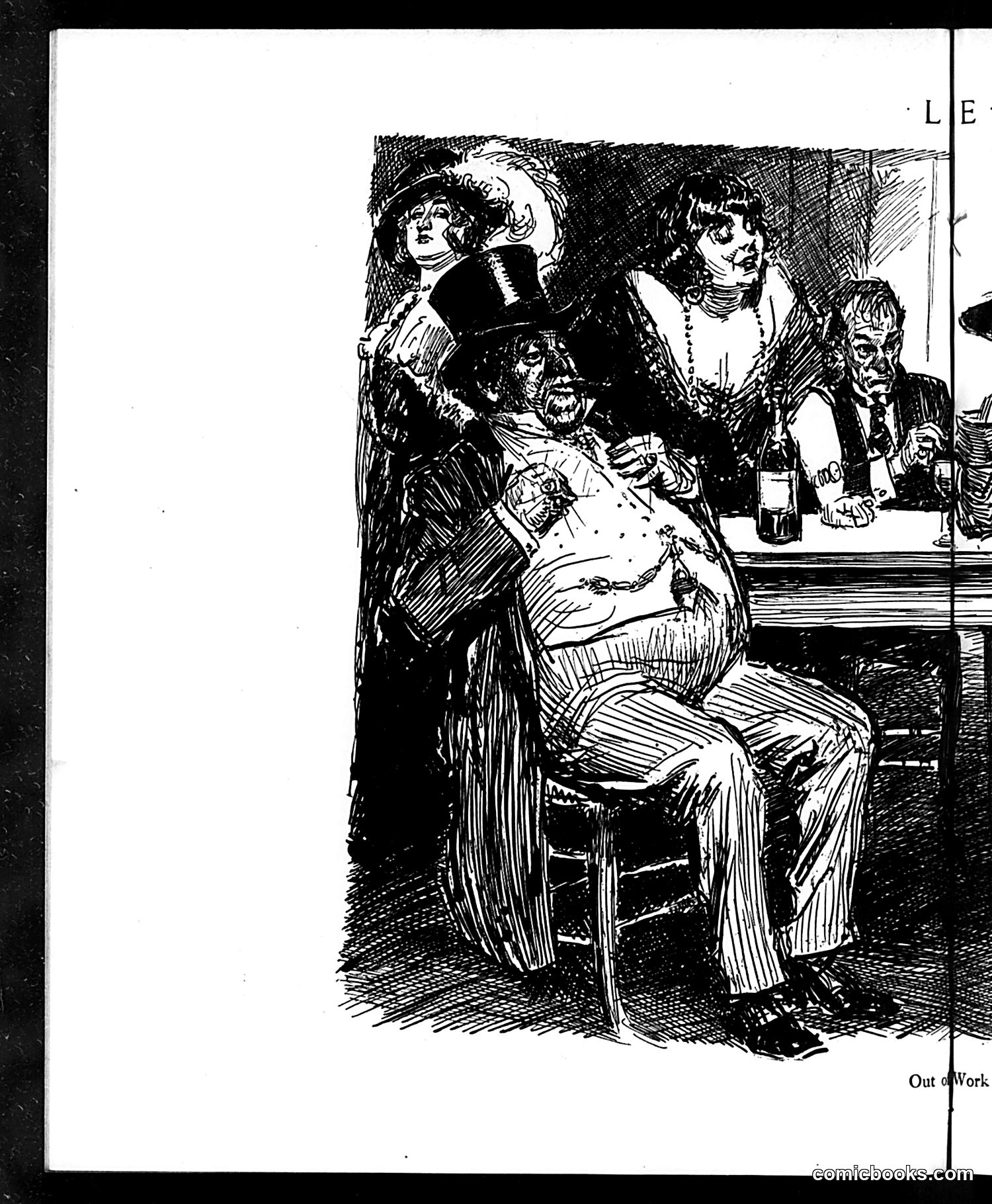
This satirical illustration depicts a scene of social commentary, likely from the early 20th century. A portly, well-dressed man sits prominently in the foreground, appearing intoxicated or distressed, while fashionably dressed women and other figures gather behind him in what appears to be a bar or social establishment. The title "Out of Work" suggests commentary on unemployment or economic hardship. The contrast between the central figure's apparent prosperity (fine clothing, access to alcohol and social venues) and the caption's implication of joblessness creates ironic satire—possibly mocking either the idle wealthy or hypocritical attitudes toward unemployment during economic difficulty. The caricatured style and exaggerated features were typical of Life magazine's satirical approach to social issues of its era.
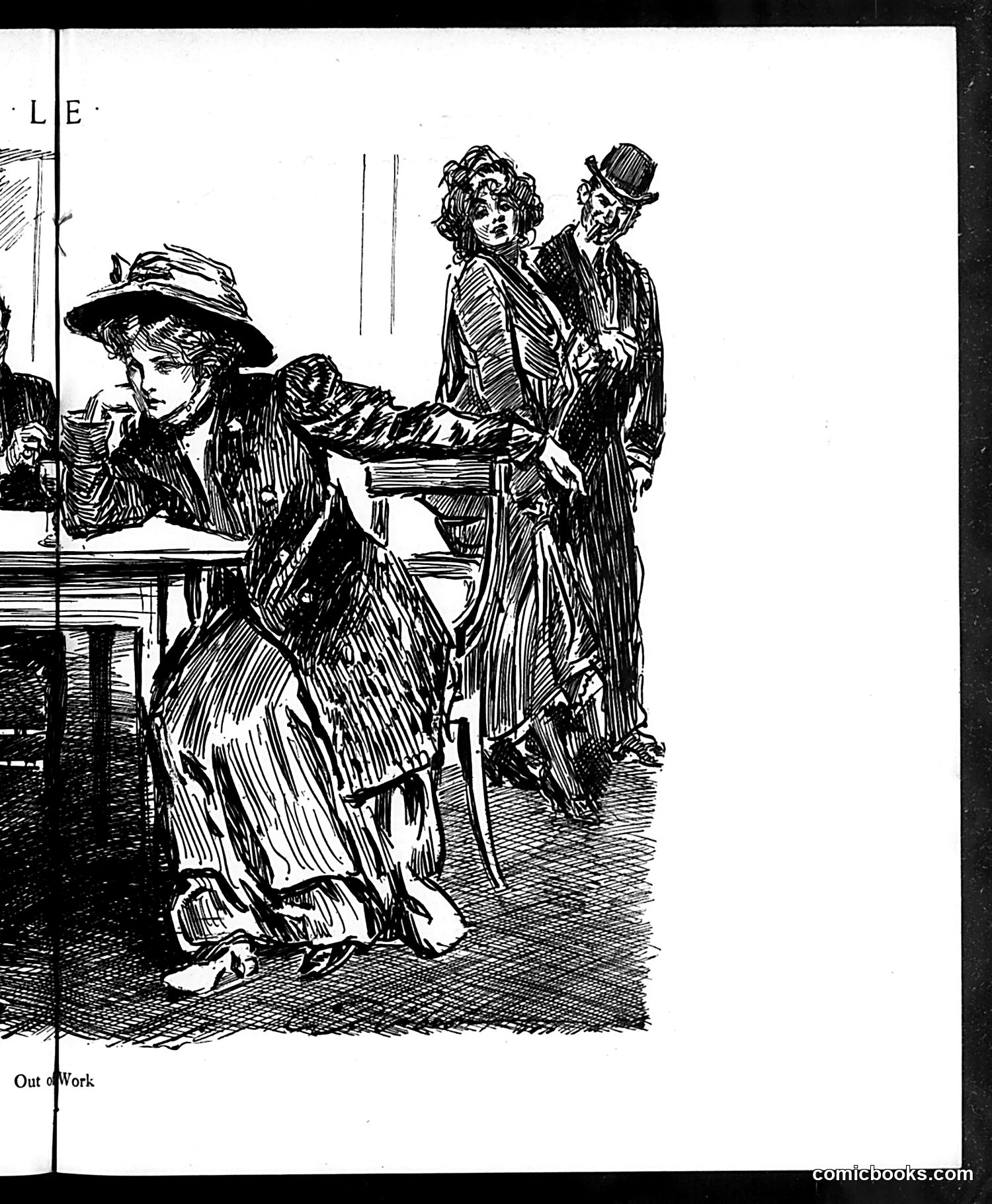
This sketch depicts three fashionably dressed figures in what appears to be an early 20th-century interior setting. The title "Out of Work" suggests social commentary on unemployment or labor issues. The woman in the foreground, wearing a long coat and hat, appears to be the central subject. Two men stand behind her—one in formal attire with a top hat. Their body language and positioning suggest a scene of desperation or difficult circumstances. The sketch's style and composition suggest this is satirical commentary on economic hardship, possibly targeting the wealthy or idle classes. Without additional context from the magazine issue, the specific identities of these figures and the precise social situation being lampooned remain unclear, though the title indicates commentary on joblessness or financial distress.
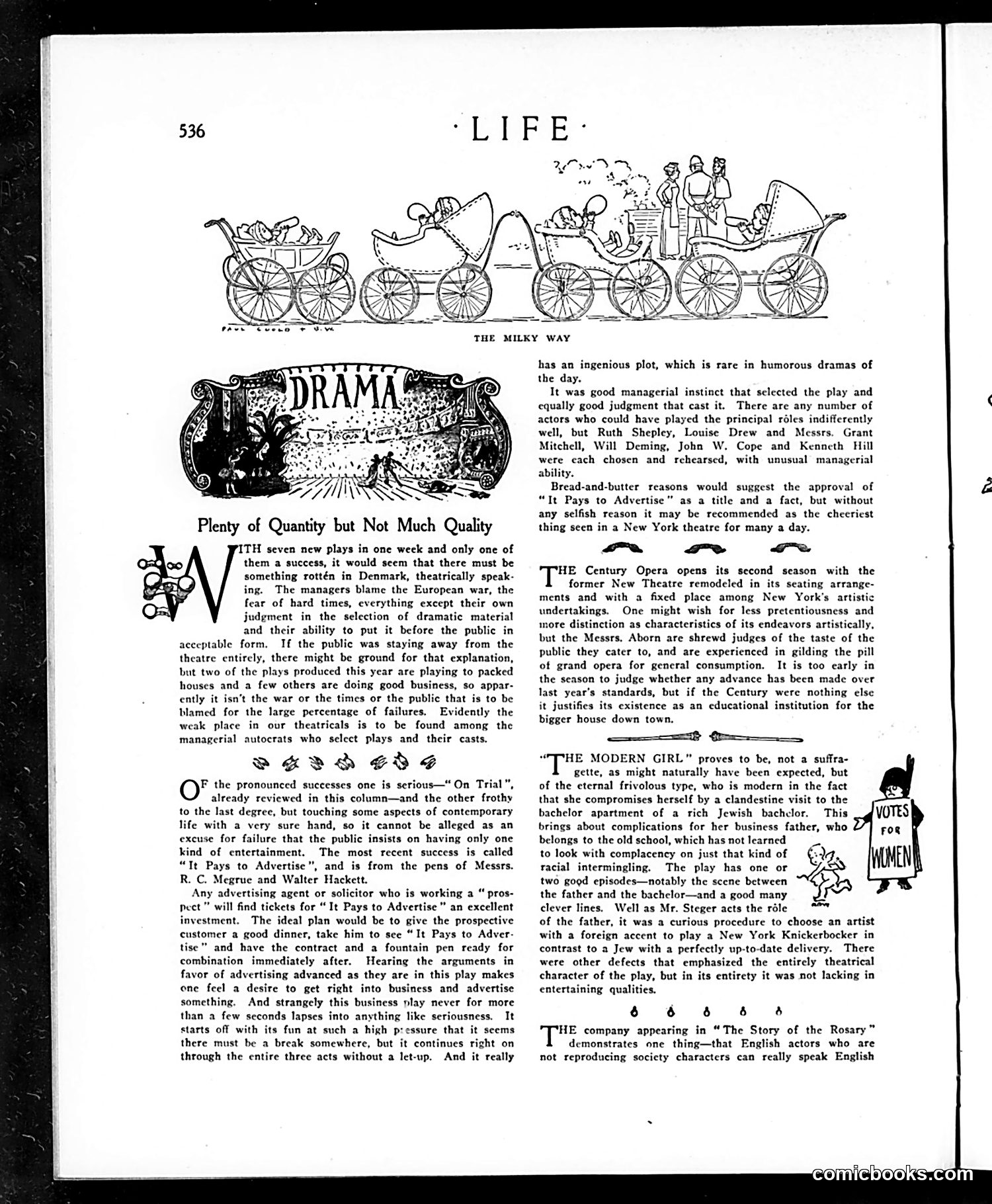
This page reviews seven new theatrical productions, using the illustration "The Milky Way"—a procession of baby carriages of varying quality—as visual metaphor for Broadway's mixed output. The critic argues that managers, not war or economic hardship, bear responsibility for theatrical failures. Most plays are mediocre ("quantity but not quality"). The reviews praise two successes: the serious drama "On Trial" and the comedic farce "It Pays to Advertise," which the critic enthusiastically endorses as entertaining and cleverly plotted. He notes the cast (including Ruth Shepley and Grant Mitchell) was well-selected. Brief mentions follow of Century Opera's new season and "The Modern Girl." The underlying satire critiques managerial incompetence in play selection and casting as the real problem plaguing theater—not external circumstances. The carriage illustration cleverly visualizes this theme: many productions exist, but few are worthwhile.
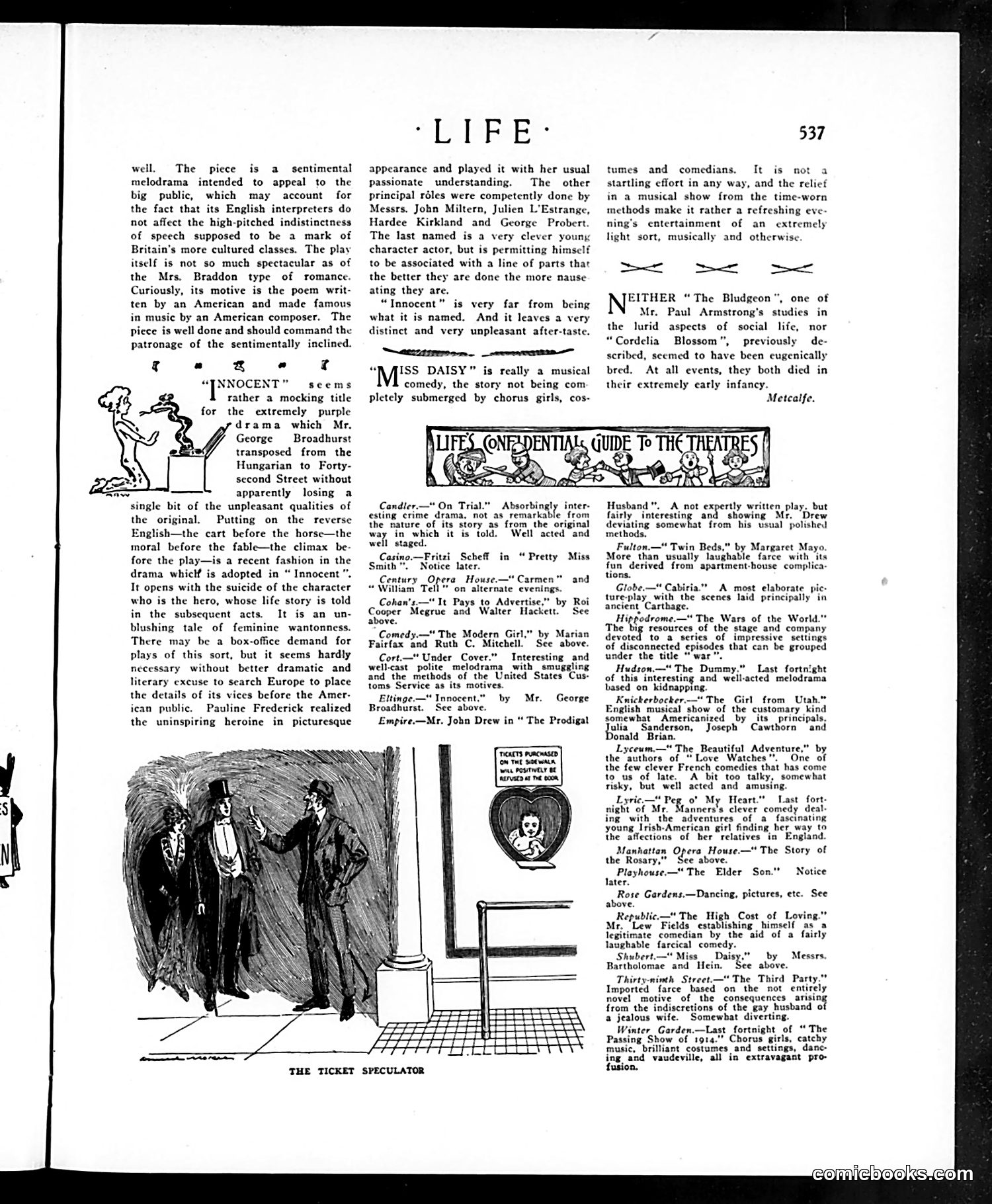
The cartoon depicts a scene of theatrical commerce in the early 20th century. Two men in formal attire appear to be conducting a transaction—likely a ticket broker ("speculator") selling theater tickets to a patron at an inflated price. The sketch shows the parasitic practice of ticket scalping, where middlemen would purchase tickets and resell them for profit, a practice that exploited both theaters and eager theatergoers. This satirizes the widespread problem of ticket speculation during this era of popular theater. The surrounding text reviews various Broadway productions, establishing the context: theater was highly sought-after entertainment, making tickets valuable commodities. The cartoon mocks those who profited from artificially inflating ticket prices, a practice Life magazine apparently viewed as morally questionable profiteering from public demand.
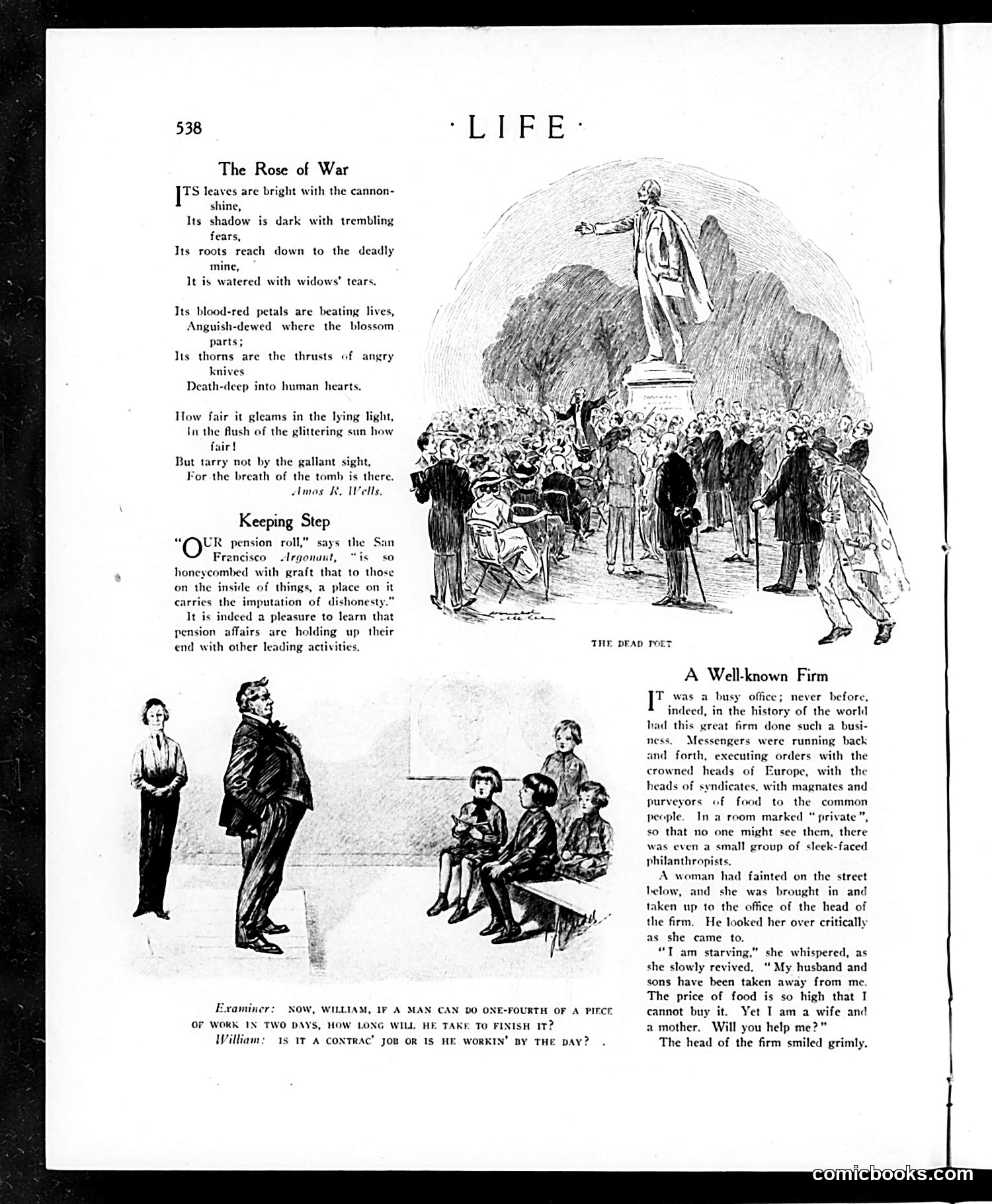
This Life magazine page contains three satirical pieces about wartime profiteering and social inequality: **"The Rose of War"** is a poem criticizing warfare's romanticization. It uses flower imagery to describe war's reality: death, widows' grief, and destroyed lives disguised by patriotic "gleaming" language—a direct critique of propaganda. **"Keeping Step"** mocks San Francisco's pension system as corrupt ("honeycomb[ed] with graft"), sarcastically noting that dishonesty is so normalized in pensions that it rivals other major activities. **"A Well-known Firm"** is a short story satirizing war profiteers. A desperate, starving widow—whose husband and sons were conscripted—appeals to a wealthy businessman making fortunes from wartime contracts with European powers and food suppliers. His "grim smile" suggests he'll exploit her further rather than help. The accompanying cartoon shows an examiner testing a worker's productivity with absurdly contradictory hiring terms—mocking employers' exploitation of laborers through confusing contract language. Overall, the page critiques wartime exploitation: both the glorification of combat and the enrichment of those profiting from others' suffering.
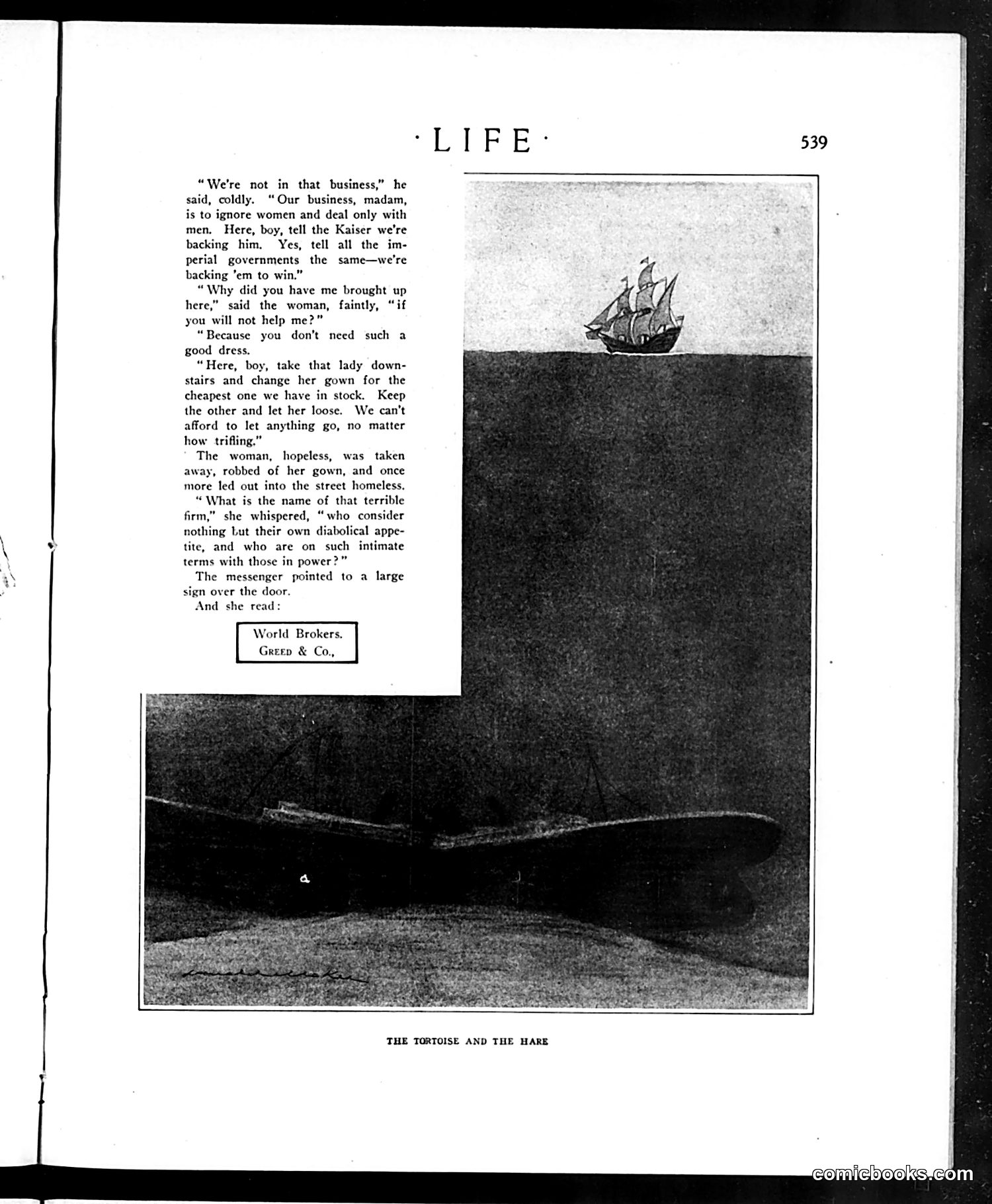
This satirical story criticizes munitions dealers and war profiteers during World War I. A desperate homeless woman seeks help from a firm called "World Brokers, Greed & Co.," but is coldly refused because they claim to deal only with men—specifically governments and military powers. The firm's representative openly boasts of backing the Kaiser and "imperial governments" to win, prioritizing profit over human suffering. The woman is stripped of her decent clothing and cast back onto the streets, her plight entirely ignored. The satire targets the amoral nexus of war industry and political power: these dealers profit enormously from global conflict while callously disregarding the civilian casualties and devastation. The title's reference to Aesop's fable suggests irony—greed's apparent "victory" will ultimately prove hollow. The cartoon condemns both war profiteers and their intimate complicity with governments waging war.
This is a satirical essay (not a cartoon) critiquing American class dynamics and service-industry behavior in the early 20th century. The author contrasts a courteous London hotel page—who served with dignity despite his lowly position—with the hostile, demanding behavior of American service workers (porters, cab drivers, elevator operators, waiters, cooks). The piece sarcastically calls these workers "the Boss" and "Under-Dog," arguing that middle-class Americans have become so fearful of being labeled "cranks" that they kowtow to rude service staff, reversing normal social hierarchy. The author criticizes this dynamic as uniquely American: wealthy Europeans simply *demand* service and pay for it, while anxious middle-class Americans grovel to avoid confrontation. The essay suggests this servile behavior reflects broader national anxieties about labor relations ("the 'help' question is one of our national horrors"). The "Woof—woof—woof!" represents service workers' aggressive, animalistic demeanor toward customers.
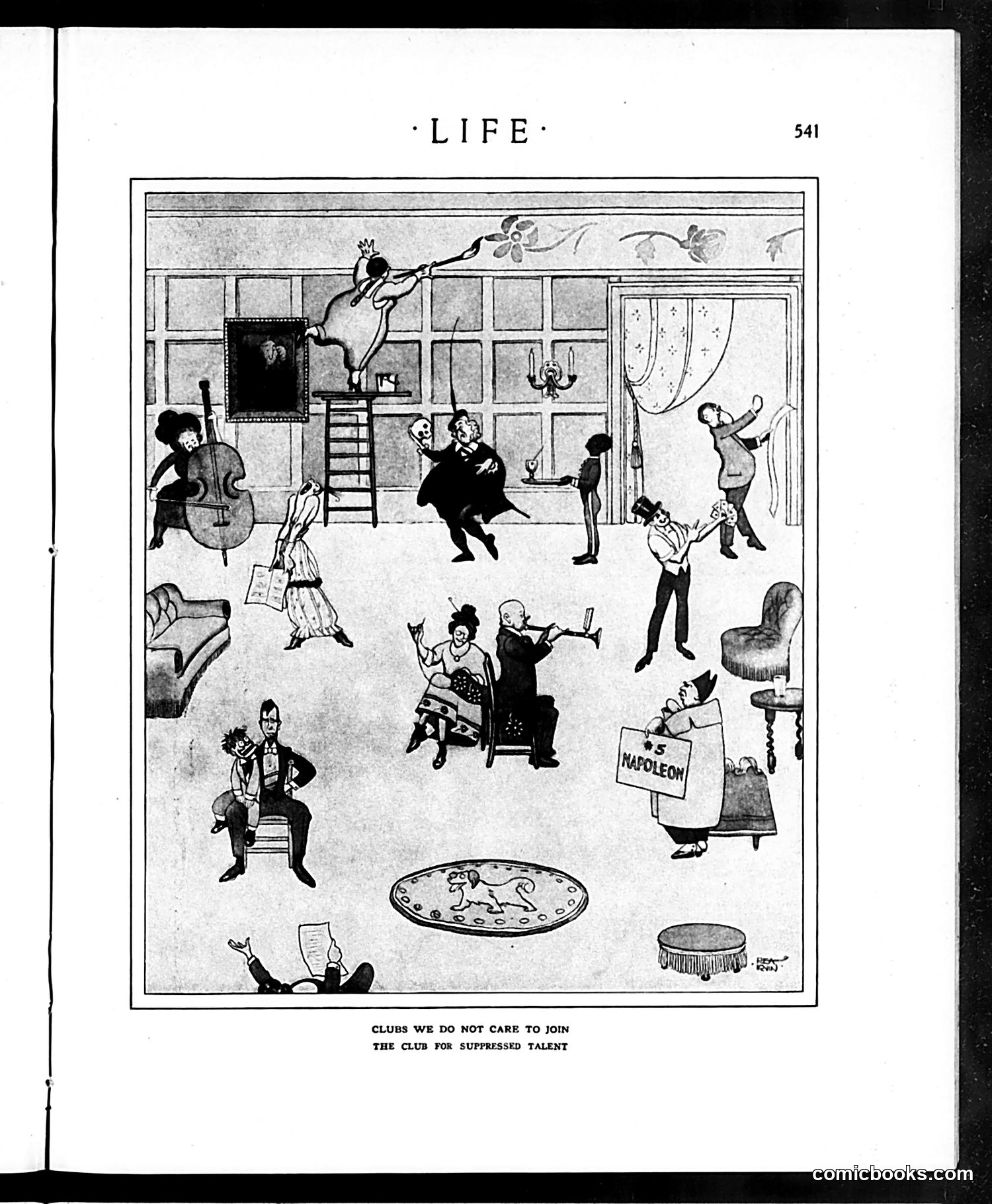
This satirical cartoon depicts a chaotic indoor scene labeled "The Club for Suppressed Talent," showing various performers engaged in amateur entertainments—musicians, acrobats, dancers, and comedians—apparently doing circus-like acts in a living room. The joke targets people with unrealized artistic ambitions who gather to practice their untrained talents among like-minded individuals. The caption "Clubs we do not care to join" suggests that *Life* magazine's readers would disdain membership in such a club, implying mockery of both the performers' lack of professional skill and the pretentiousness of amateur talent clubs that proliferated in early 20th-century America. The reference to "Napoleon" (visible on a sign) appears to reference amateur theatrical productions or historical reenactments common in such amateur clubs.
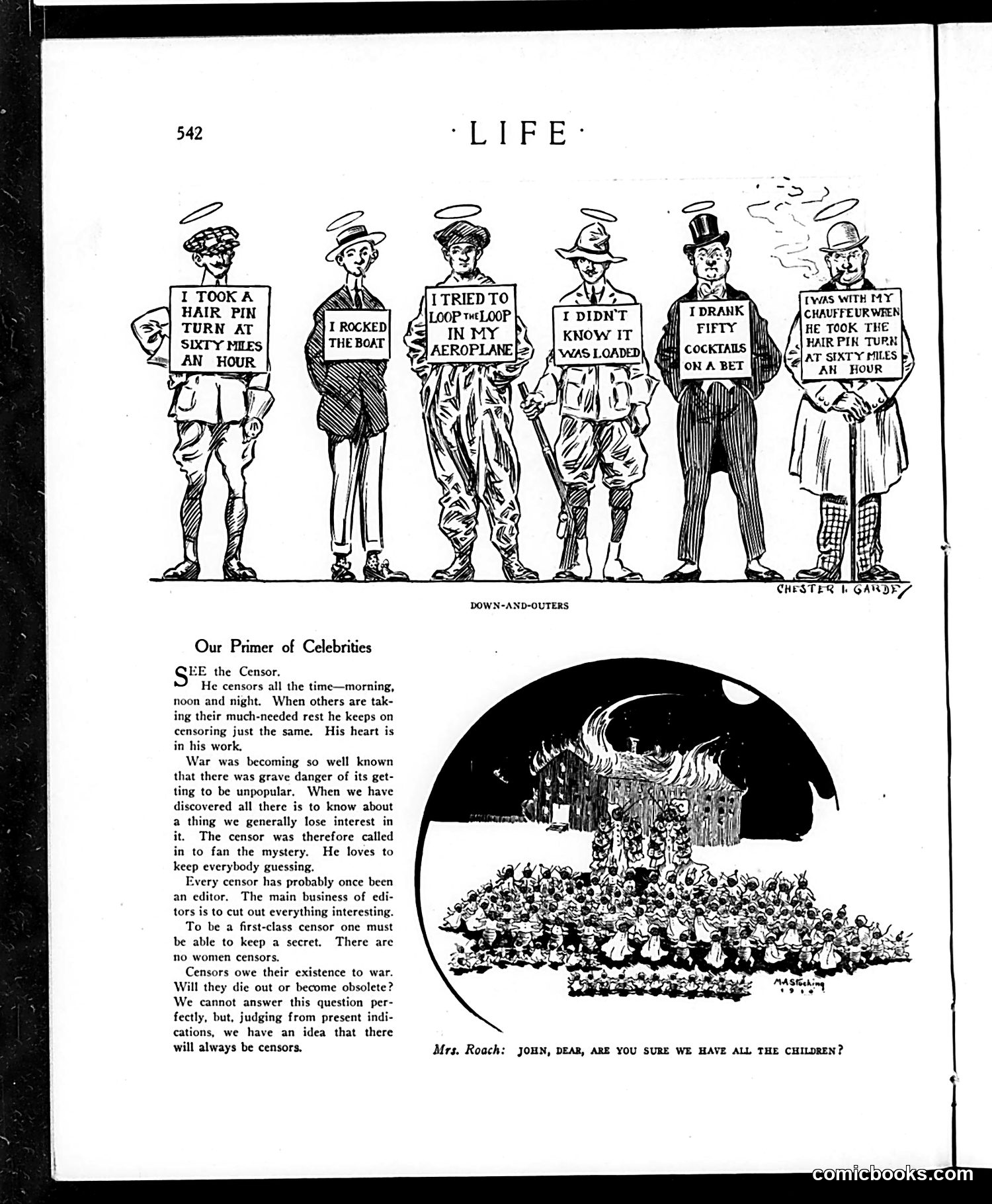
The top cartoon satirizes reckless wartime behavior among the wealthy. Six figures with halos (suggesting false virtue) boast of dangerous stunts: speeding at sixty miles per hour with a hairpin turn, loop-the-loops in airplanes, and drunk driving. The satire targets the hypocrisy of privileged people engaging in frivolous, dangerous activities while others sacrifice in wartime. Below, "Our Primer of Celebrities" mocks government censors during World War I. The text portrays censors as perpetually working to suppress information and maintain mystery around the war effort—keeping the public "guessing." It suggests censorship exists to artificially sustain interest in an otherwise unpopular war. The final cartoon shows a crowded air-raid shelter with Mrs. Roach asking if all children are accounted for, highlighting civilian vulnerability to air attacks. Together, the page critiques wartime excess among elites, government information control, and civilian danger.
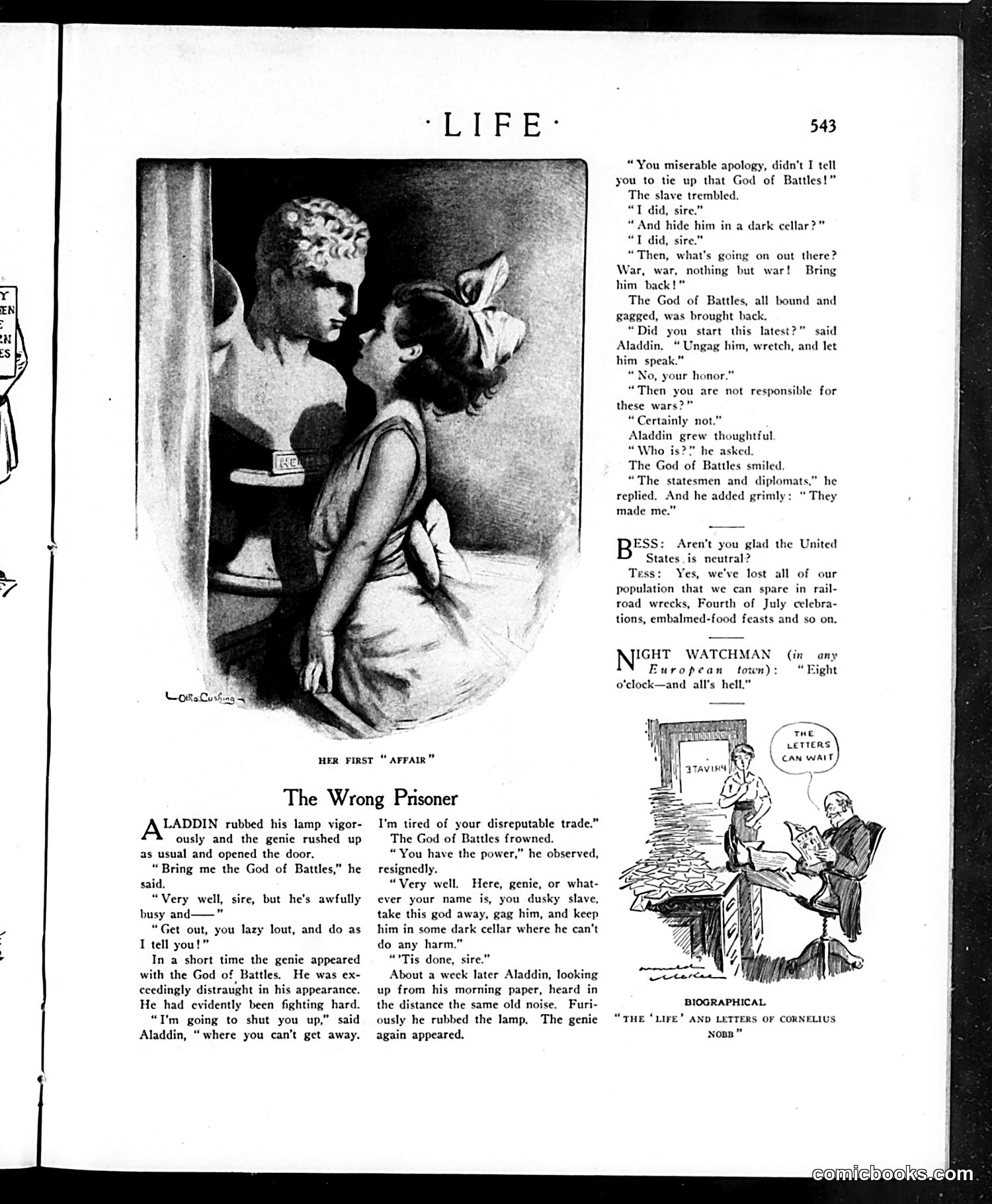
This page contains two distinct pieces of satire: **"The Wrong Prisoner"** (main story): A fable using Aladdin's lamp to critique war. Aladdin imprisons the "God of Battles" to stop warfare, but wars continue. When he retrieves the god, the god reveals he's not responsible—"The statesmen and diplomats" made him, implying political leaders, not military forces themselves, drive warfare. This critiques politicians' responsibility for war. **"Bess & Tess" dialogue**: A brief exchange mocking American neutrality during what appears to be WWI (referenced by "European town" and the context of the God of Battles story). The joke sarcastically equates America's civilian death toll from accidents and poor food safety with actual war casualties—suggesting Americans shouldn't feel smug about neutrality when domestic conditions kill people too. Both pieces target political hypocrisy and the disconnect between leaders' rhetoric and reality regarding warfare and national safety.
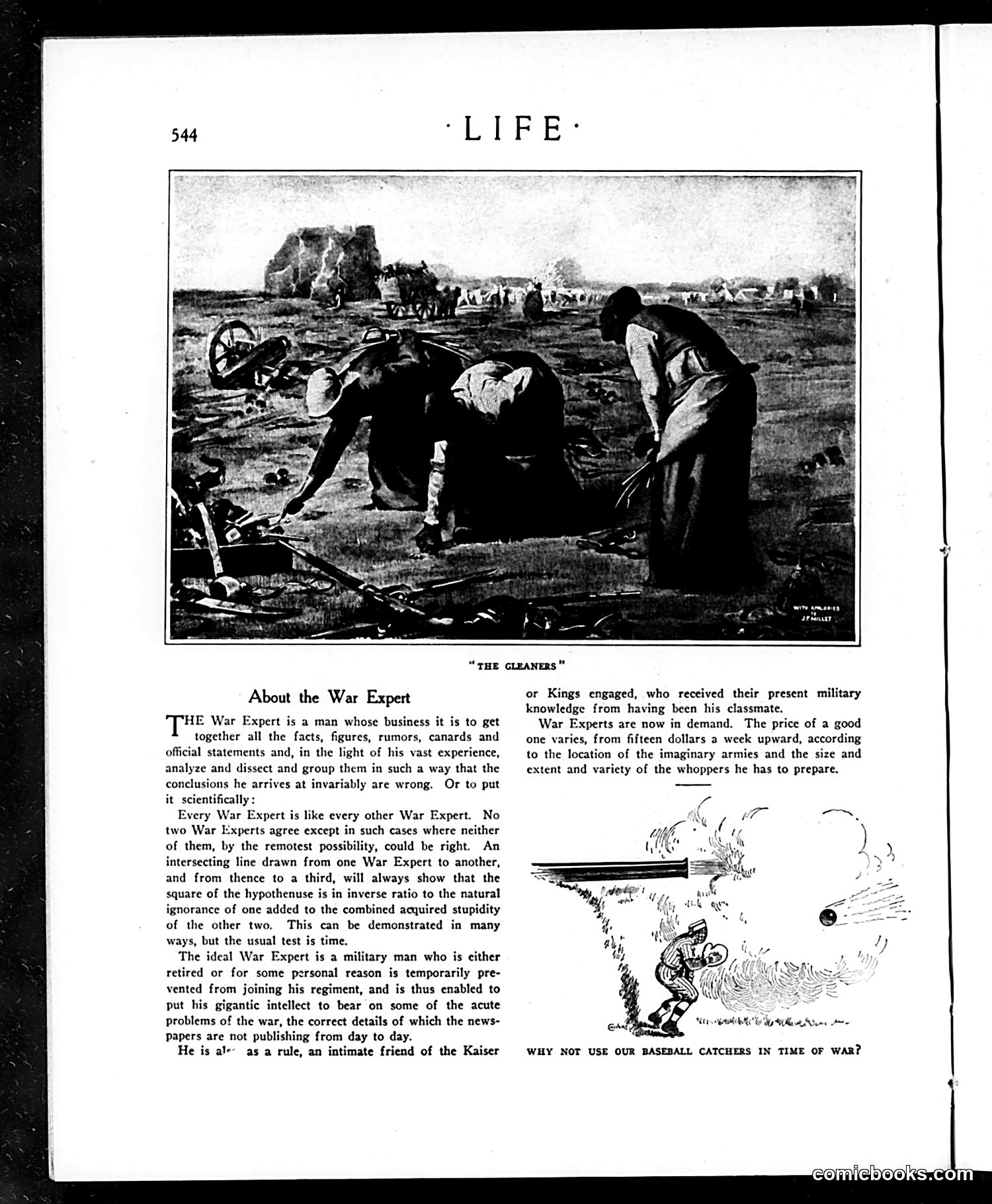
This Life magazine page satirizes "War Experts"—self-proclaimed military analysts who profitably peddle false predictions about WWI. The text mockingly defines them as consistently wrong analysts who charge $15+ weekly depending on their fabrications' scope. The top photograph titled "The Gleaners" shows workers in a field, likely illustrating ordinary people engaged in honest labor—a visual contrast to the parasitic "experts." The bottom cartoon depicts a soldier catching a baseball, accompanying the rhetorical question "Why not use our baseball catchers in time of war?" This likely critiques how military expertise was valued less than celebrity or athletic fame during wartime recruitment, or satirizes absurd military decision-making. The text particularly mocks retired officers advising the press while prevented from active duty, and those claiming friendship with the Kaiser or European royalty. The savage mathematical parody about "hypothenuses" emphasizes the absurdity of their pseudo-scientific approach to military analysis.
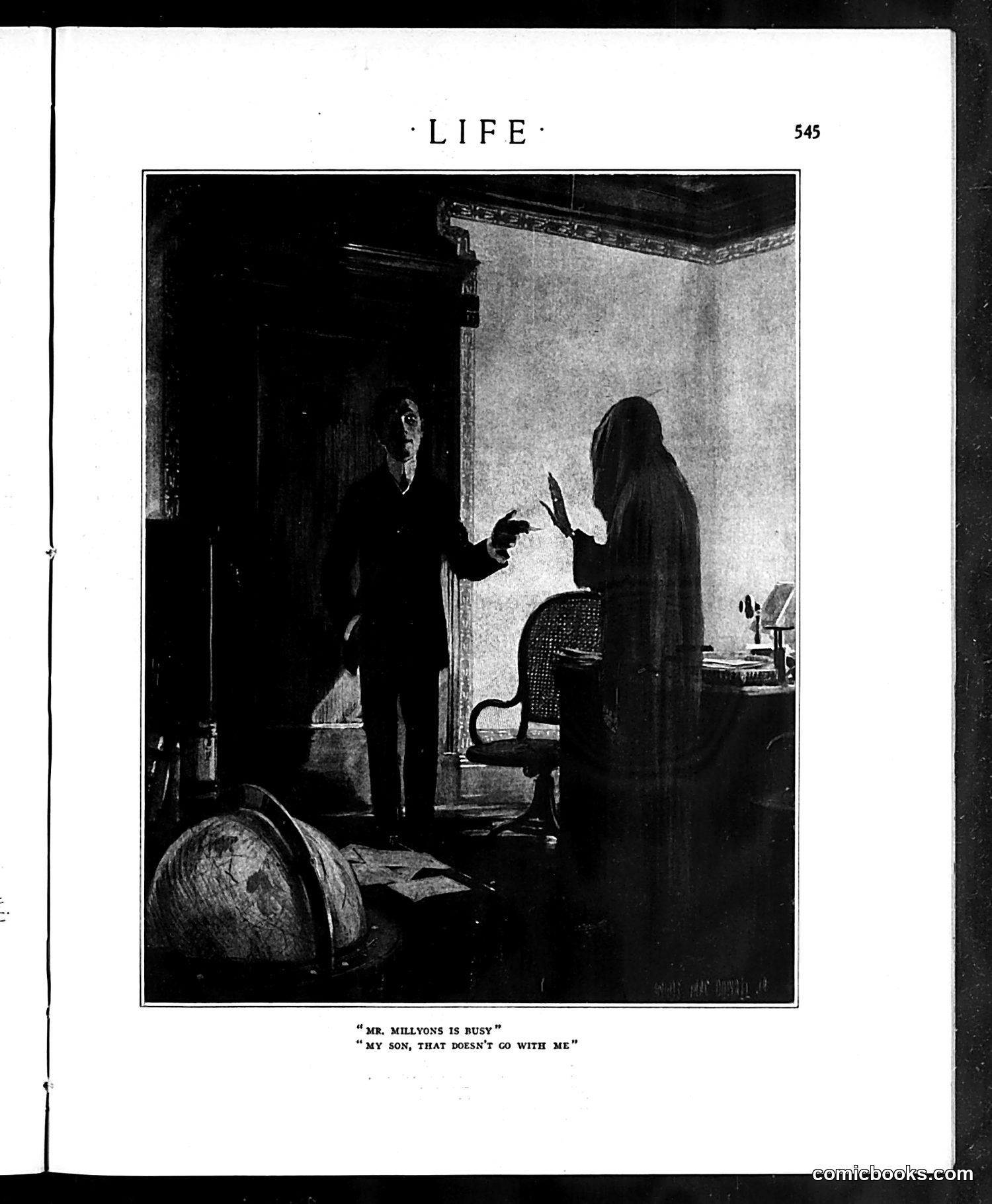
This appears to be a satirical illustration from *Life* magazine depicting a domestic scene. The dialogue suggests a conflict between a father figure (left, in dark clothing) and what appears to be his son or a younger male relative (seated, partially visible). A woman in long dress stands between them. The caption "Mr. Millyons is busy" / "My son, that doesn't go with me" implies a disagreement—likely the father refuses to allow his son to accompany "Mr. Millyons" (presumably a wealthy or important person) somewhere. The scene critiques class dynamics or parental authority, with the implication that the father won't permit his son to associate with or follow someone of higher social standing. A globe is visible, suggesting possible travel plans.
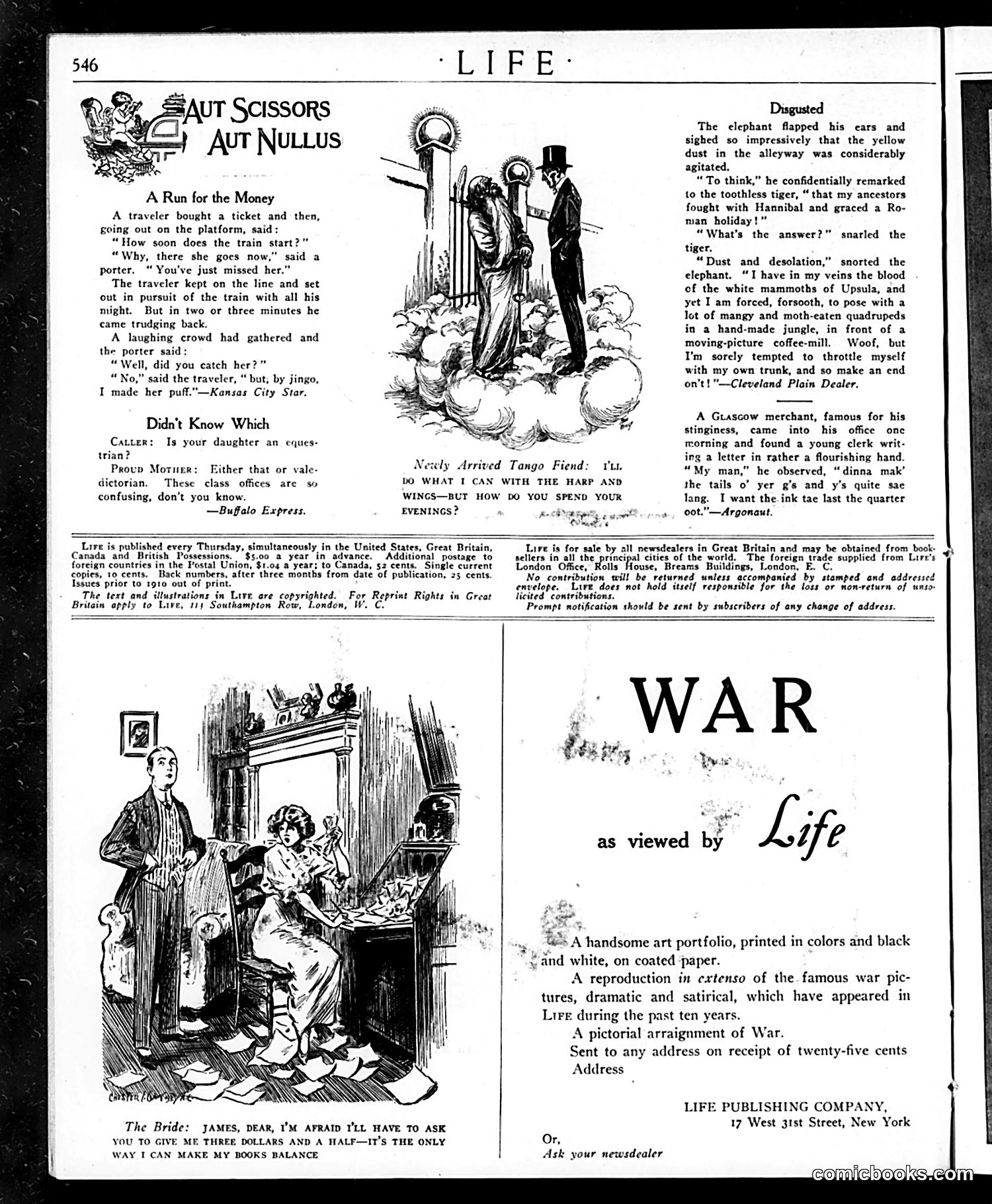
This page contains several brief humorous pieces typical of *Life* magazine's satirical style: **"A Run for the Money"** jokes about a porter tricking a traveler into chasing a departing train. **"Didn't Know Which"** is a short quip about a mother confusing "equestrian" with "valedictorian"—poking fun at class pretension and linguistic confusion. **"Disgusted"** features an anthropomorphized elephant lamenting its fallen status: once noble enough to serve Hannibal in ancient Rome, it now performs in a circus for a moving-picture company. The satire mocks both the elephant's snobbish nostalgia and the degradation of once-grand things reduced to cheap entertainment. **"The Bride"** cartoon depicts newlywed financial anxiety—a wife asking her husband for money to balance household accounts, a gentle jab at marital economics. The page concludes with an advertisement for a *Life* war portfolio, indicating the magazine covered WWI extensively during the preceding decade.
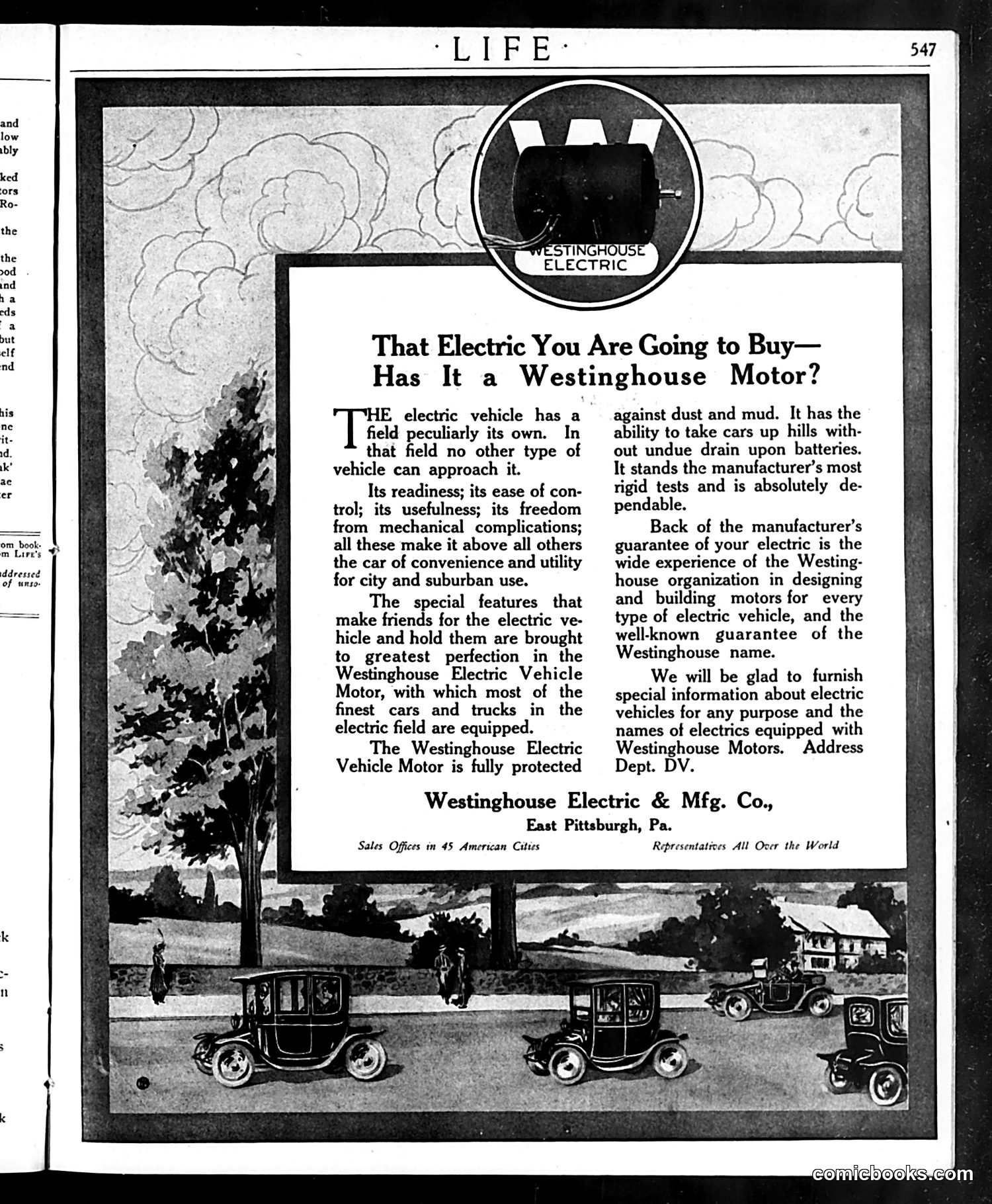
This is **not a cartoon or satire**—it's a straightforward advertisement for Westinghouse Electric motors used in electric vehicles. The page promotes electric cars as superior for city and suburban use, emphasizing their ease of control, convenience, and reliability compared to other vehicle types. The ad highlights that Westinghouse motors are standard equipment in "most of the finest cars and trucks in the electric field." It stresses the motor's durability, ability to climb hills without draining batteries, and protection against dust and mud. The imagery shows a pastoral landscape with three electric vehicles in the foreground. For modern readers: this represents the pre-1920s era when electric vehicles competed seriously with gasoline cars before internal combustion engines eventually dominated the market. The ad reflects genuine commercial confidence in electric vehicle technology before that industry largely disappeared.
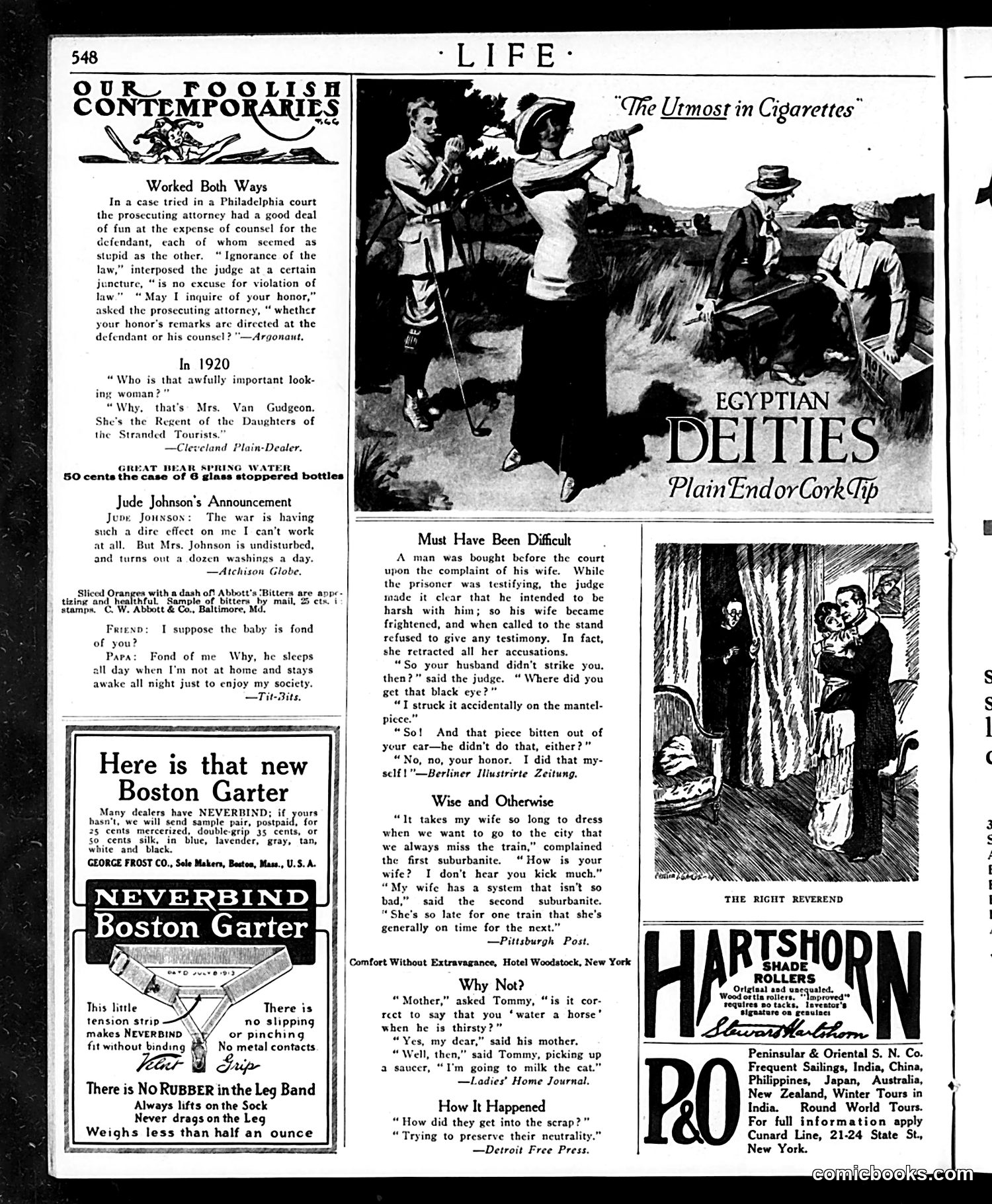
This page contains brief humorous anecdotes rather than political cartoons. The jokes satirize early 20th-century social conventions and human behavior: **Key humor themes:** - **Legal absurdity**: A prosecutor's insult backfires when the judge notes it applies equally to both attorneys - **Wartime gender roles**: A judge's announcement that WWI affects his work while his wife handles domestic labor unaffected—satirizing men's dramatic self-importance - **Marriage dynamics**: Multiple jokes about wives' behavior (slow dressing, defensive testimony, system-gaming) reflect period assumptions about spousal relationships - **Child logic**: A boy's innocent misunderstanding of "watering" animals versus "milking" them The advertisements (Boston Garters, Egyptian cigarettes, P&O shipping) show contemporary commercial products. **Social context**: These jokes reflect 1920s attitudes toward marriage, gender roles, and courtroom procedures. The humor targets male vanity and marital friction—standard vaudeville-style material of the era. No specific political figures or events are referenced.
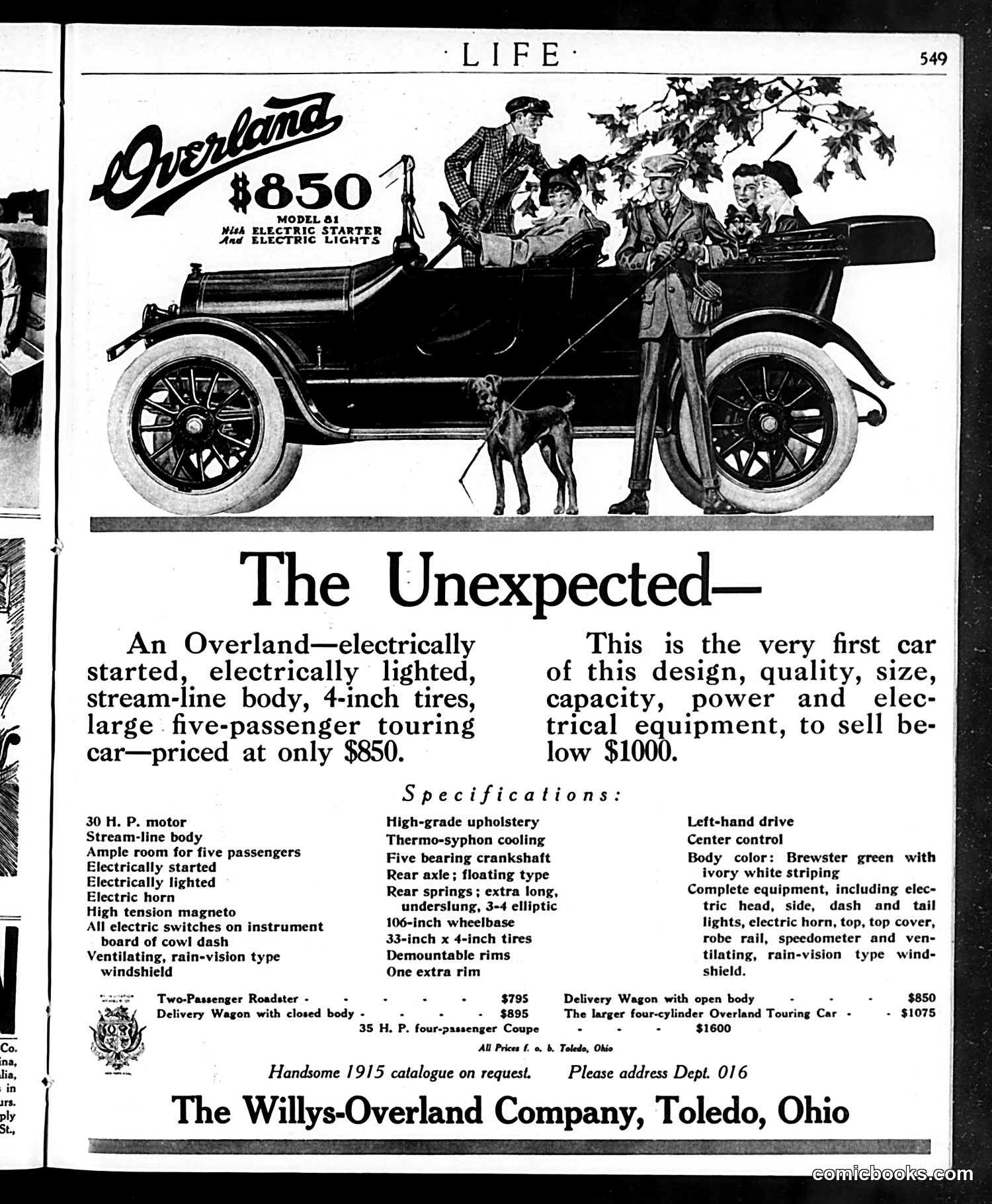
This is a **car advertisement**, not political satire. It promotes the Overland automobile by the Willys-Overland Company (Toledo, Ohio), priced at $850—positioned as unexpectedly affordable for its features. The illustration shows a well-dressed family and gentleman with a dog admiring the vehicle, emphasizing it as a desirable product for respectable middle-class consumers. The "unexpected" angle is the value proposition: a five-passenger touring car with electric starter, electric lights, and quality construction selling below $1,000—remarkable for 1915. Key selling points include modern conveniences (electric starting/lighting), comfort features (high-grade upholstery, ventilation), and specifications (30 H.P. motor, stream-line body). This reflects early automotive marketing targeting consumers transitioning from horses to motorized transport. The page includes variant models and pricing, suggesting broad market appeal across income levels.
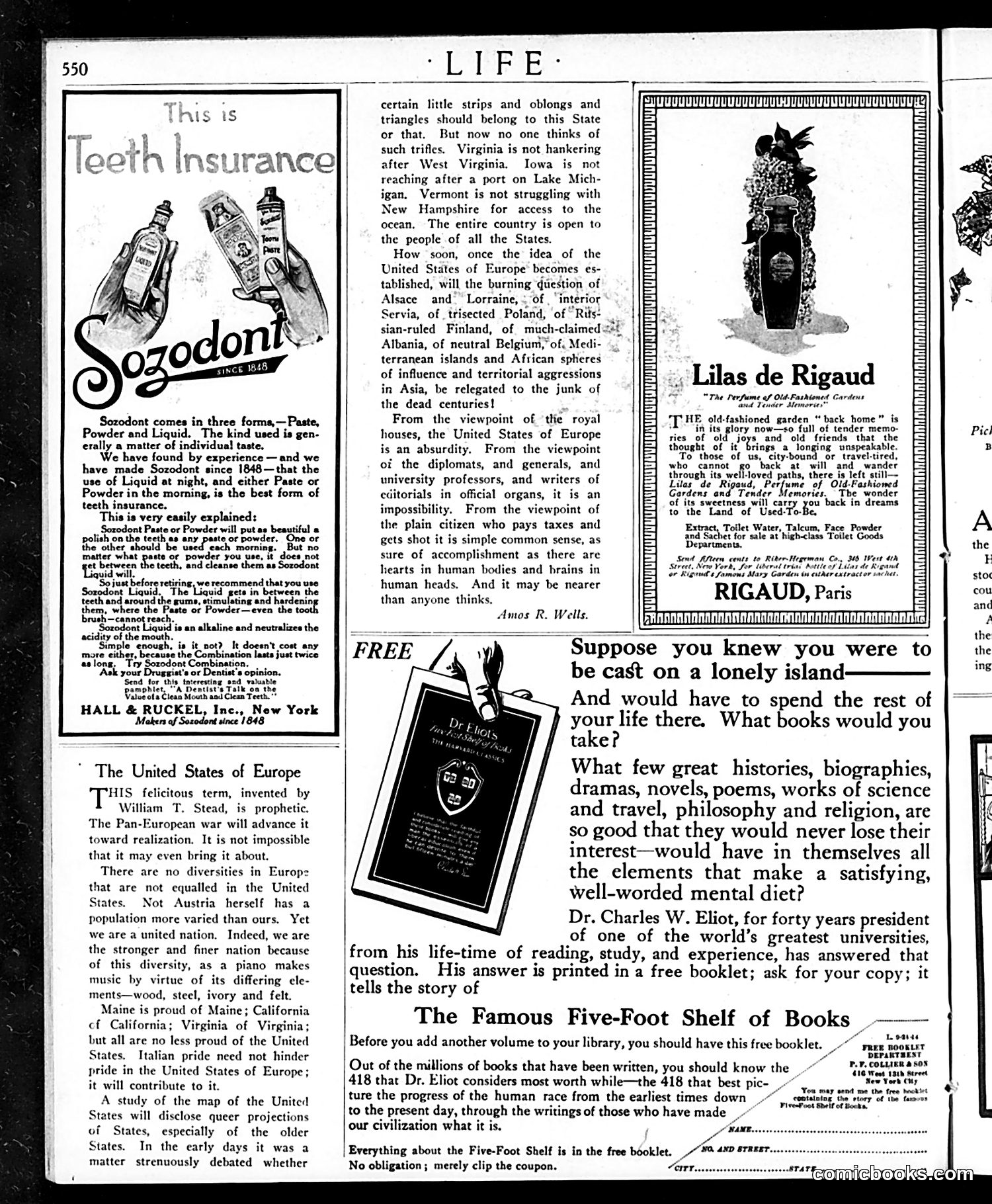
This page is primarily **advertising and editorial content** rather than political cartoons. The main editorial piece, "The United States of Europe" by Amos R. Wells, argues that a unified European federation (similar to the American union) would resolve territorial disputes that currently plague Europe—Alsace-Lorraine, Poland, Albania, Belgium, etc. The author suggests that from a practical standpoint, such unity makes "common sense," though he acknowledges it appears impossible to royalty, diplomats, and academics. The advertisements include: - **Sozodont toothpaste** (promoting dental care) - **Lilas de Rigaud perfume** (nostalgic "old-fashioned garden" branding) - A book promotion for "The Famous Five-Foot Shelf of Books" by Dr. Charles W. Eliot The editorial's context appears pre-WWI, advocating for continental unity as a solution to European nationalism. The tone is optimistic yet realistic about political obstacles.
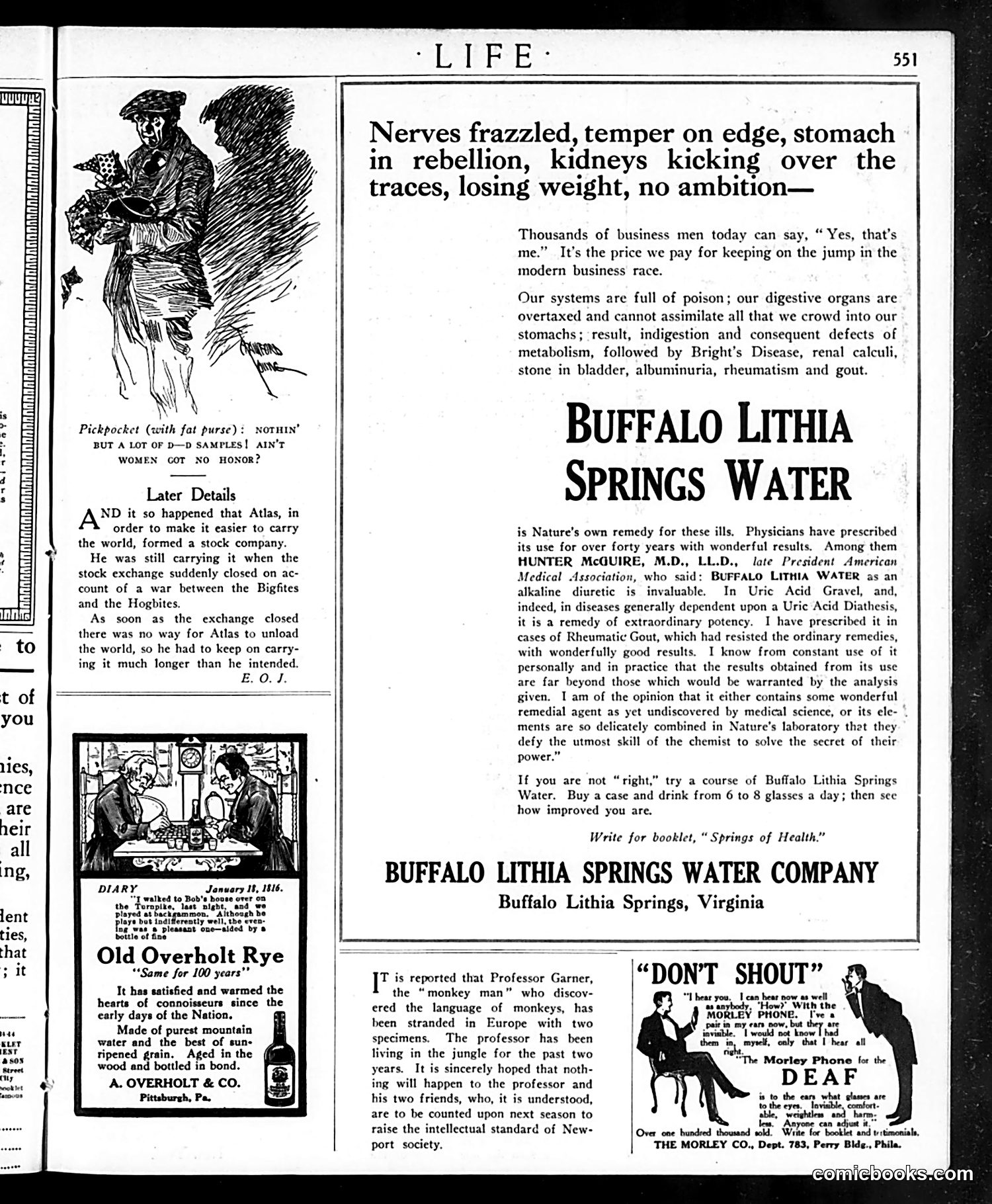
This page contains two main elements: **The "Pickpocket" cartoon** (upper left) depicts a woman pickpocket complaining that her victim's purse contains only "samples"—cheap promotional goods rather than real money. The caption sarcastically questions women's honor, playing on contemporary anxieties about women's changing social roles and behavior in the early 20th century. **The "Atlas" story** (center left) is a satirical financial allegory: Atlas (representing businessmen) formed a stock company to help carry "the world" (financial burden), but when the stock exchange suddenly closed due to conflict, he became trapped carrying it indefinitely. This likely references the 1907 financial panic or similar market disruptions. **The remaining content is primarily advertising**—for Buffalo Lithia Springs Water (a patent medicine claiming to cure digestive ailments and various diseases) and Old Overholt Rye whiskey, alongside a notice about Professor Garner (the "monkey man") and an ad for a telephone device for deaf users.
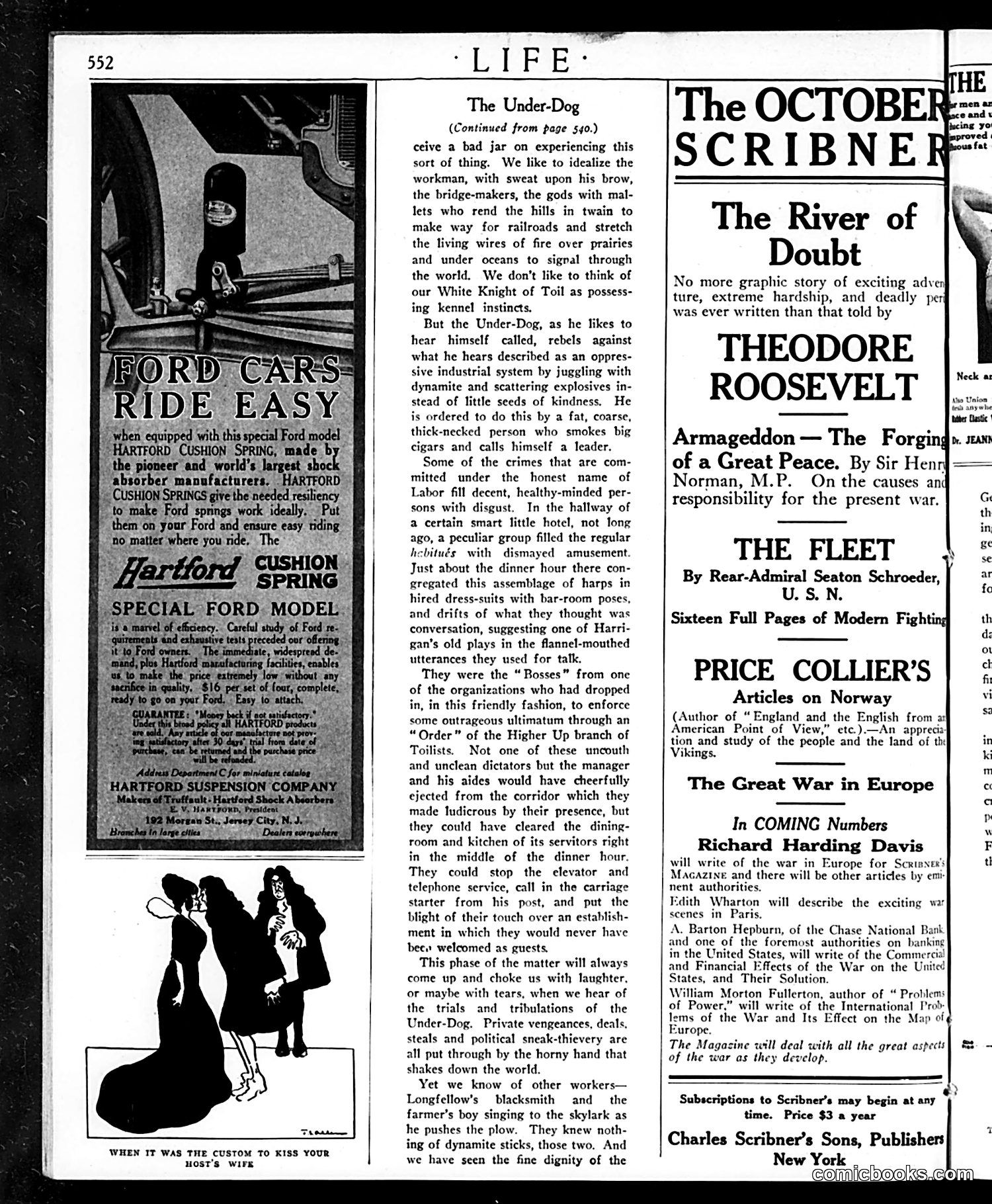
**The Cartoon:** The silhouetted illustration titled "When It Was the Custom to Kiss Your Host's Wife" depicts a social scene from an earlier era—likely Victorian or Edwardian times. The joke is historical/nostalgic: it references an obsolete social custom where men would greet their host's wife with a kiss, treating it as normal etiquette. For modern readers, this humorously highlights how much social conventions have changed. **The Article:** "The Under-Dog" is a lengthy essay critiquing labor radicalism. The author distinguishes between noble working men (invoked through idealized figures like Longfellow's blacksmith) and corrupt labor "bosses"—uncouth, cigar-smoking thugs who manipulate workers into using dynamite and violence while exploiting their power to paralyze services in hotels and establishments. The piece satirizes the hypocrisy and thuggishness of labor leadership, portraying them as worse offenders than the workers they claim to represent. **Context:** This reflects early 20th-century anxieties about labor unions, strikes, and industrial sabotage.
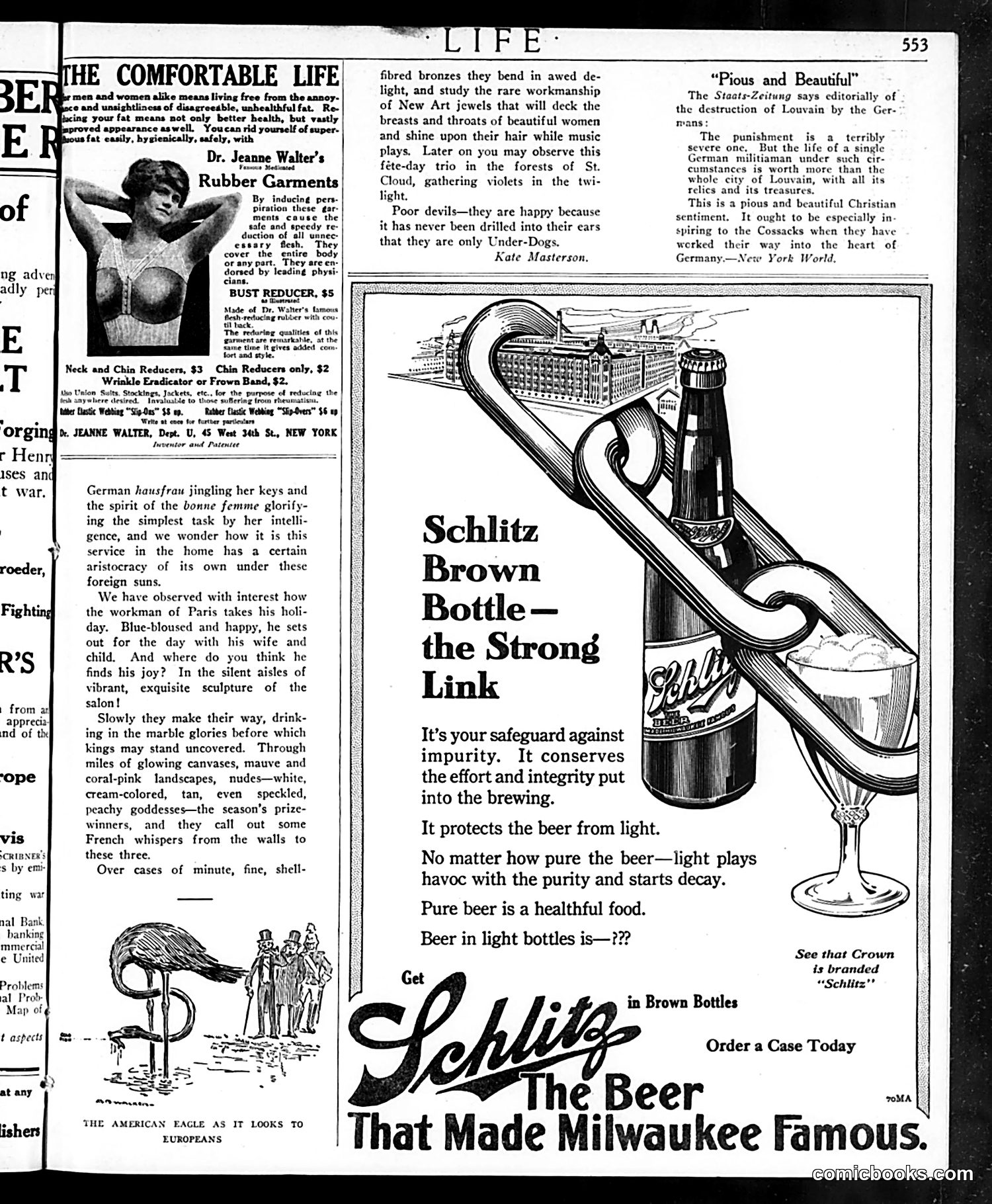
This page contains **two distinct sections**: social commentary/advertising on the left, and a major beer advertisement on the right. **Left side:** Features Dr. Jeanne Walter's rubber garment advertisements (bust reducers, chin reducers) promising to eliminate fat. Below this sits a satirical piece mocking German and European culture, praising French workers and German housewives for finding joy in art and domestic life—presenting a romanticized view of continental society. **Right side:** A **Schlitz beer advertisement** emphasizing that brown bottles protect beer from light damage, which causes decay. The ad claims "pure beer is a healthful food" and warns against buying beer in light bottles (likely targeting competitors). The phrase "The Beer That Made Milwaukee Famous" was Schlitz's actual slogan. **Historical context:** This appears to be from WWI era (references to "Germans," "Cossacks," Louvain destruction suggest 1914-1918). The Staats-Zeitung quote defending German militarism is presented as commentary on propaganda. The beer ad's emphasis on brown bottles reflects genuine brewing science but also competitive marketing during Prohibition's approach.
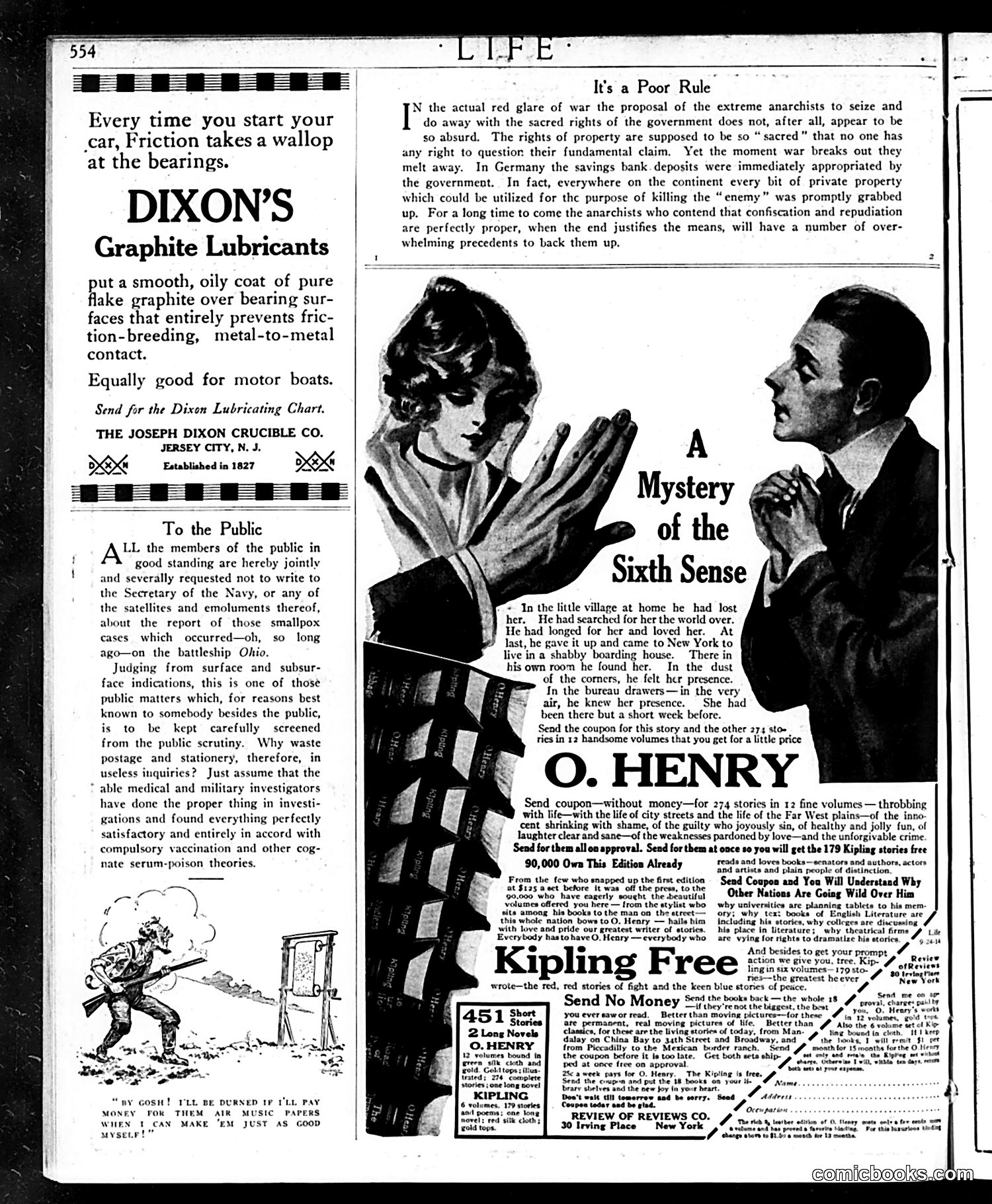
This page combines advertisements with political commentary and literary promotions typical of early 20th-century Life magazine. **The Political Cartoon/Editorial ("It's a Poor Rule"):** The text argues that wartime government seizure of private property (confiscation) undermines anarchist arguments against private property rights. During WWI, governments across Europe—particularly Germany—appropriated savings deposits and civilian resources for military purposes. Life's satire points out the hypocrisy: governments claim property rights are "sacred" in peacetime, yet abandon this principle entirely during war, thus paradoxically validating anarchist critiques about property's conditional nature. **Other Content:** The page also features advertisements for Dixon's graphite lubricants and a prominent promotion for O. Henry's collected stories (274 tales in 12 volumes), capitalizing on the writer's popularity. The small cartoon at bottom-left appears unrelated social commentary, likely satirizing frivolous spending. This reflects Life's role as a venue for satirical social and political criticism alongside commercial advertising.
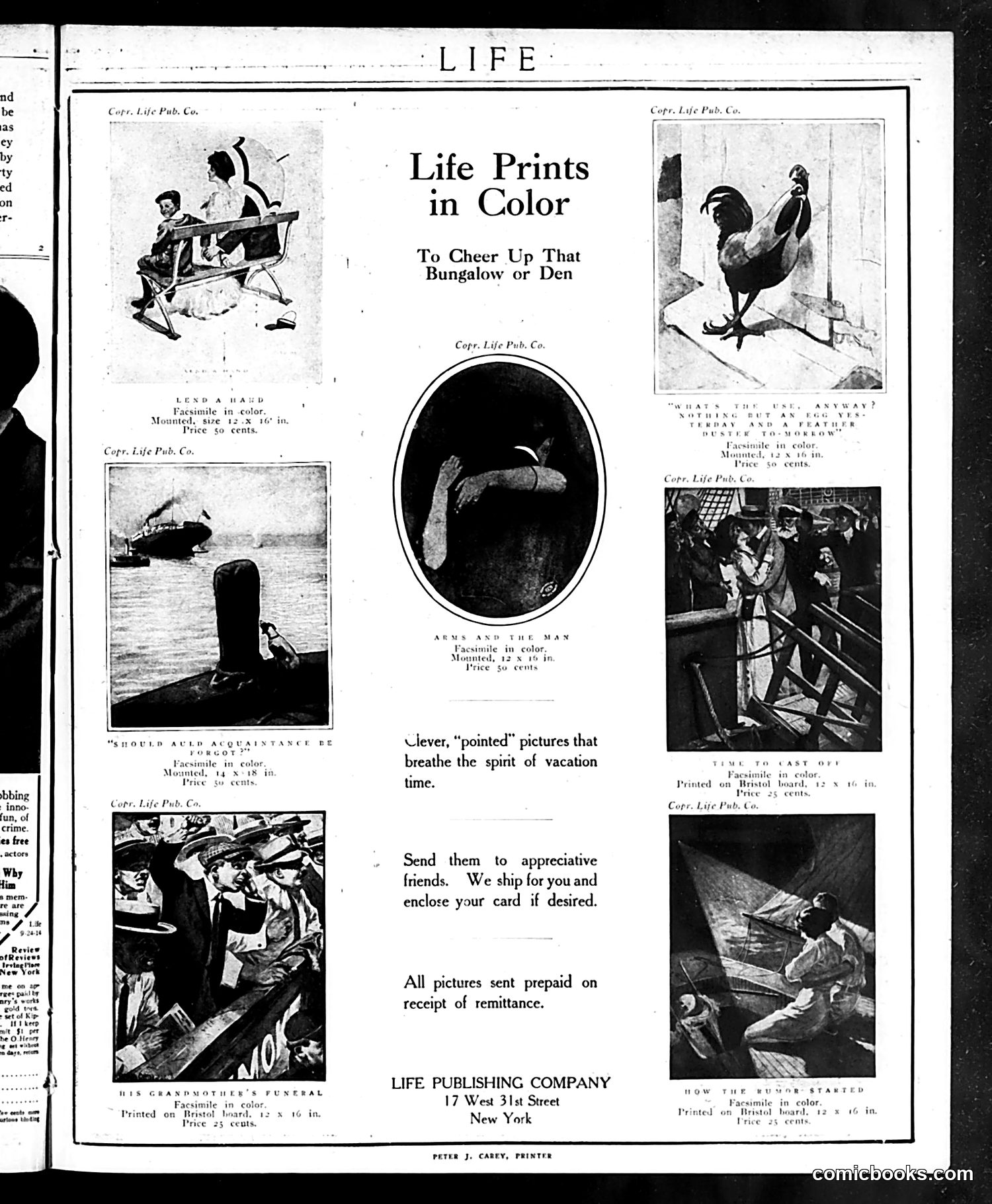
This is primarily **advertising content**, not political satire. Life Publishing Company is promoting colored prints for home decoration, marketed as cheerful vacation-themed artwork suitable for "bungalow or den" settings. The six sample prints shown depict leisure activities: a woman in a hammock, a rooster, a ship at sea, people boarding a vessel, a crowded dock scene, and a person fishing. These represent "vacation time" imagery—relaxing, travel, and outdoor recreation. The advertisement emphasizes convenience: Life will ship prints directly to friends with an enclosed card, prepaid on remittance. The target market appears to be middle-class homeowners seeking affordable, ready-made wall decoration reflecting the leisure culture of the era (likely early 20th century, based on styling and clothing). No political figures or specific satire are evident—this is commercial messaging disguised within Life's editorial pages.
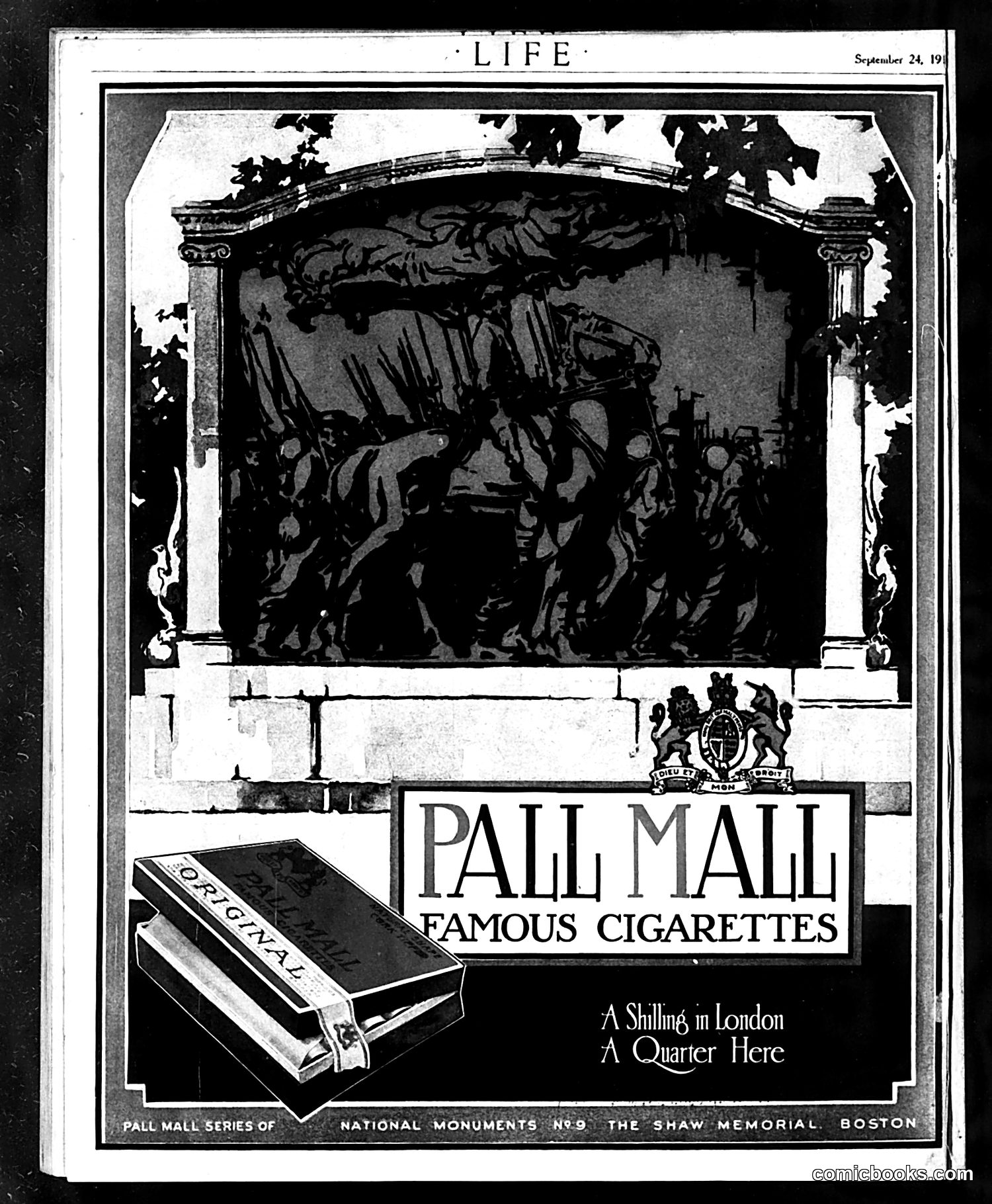
This is primarily a **Pall Mall cigarette advertisement** rather than political satire. The ad features a classical theatrical scene framed like a stage proscenium, depicting what appears to be a historical or mythological dramatic moment with multiple figures and a horse. The tagline "A Shilling in London / A Quarter Here" compares cigarette prices between Britain and America, suggesting Pall Mall offers better value for American consumers (a quarter being roughly equivalent to a shilling). The bottom references the "Pall Mall Series of National Monuments No. 9—The Shaw Memorial, Boston," likely associating the product with American cultural institutions to build brand prestige. The theatrical imagery serves as decorative branding rather than satirical commentary.
I can see this is a page from Life magazine with a date visible in the upper left corner (appearing to show "24, 19[__]"), but the image is almost entirely dark and illegible. The content is too obscured to make out any cartoon figures, caricatures, text, or satirical elements with confidence. To properly explain the political or social references, identify the figures depicted, or describe the joke or satire involved, I would need a clearer or higher-contrast version of this image. As it stands, I cannot reliably read the OCR text or discern the visual content well enough to provide accurate historical context for a modern reader. I'd recommend checking the original source or a better-quality scan of this page.