
Life, 1914-09-24 · page 40 of 45
Life — September 24, 1914 — page 40: what you’re looking at
What you’re looking at
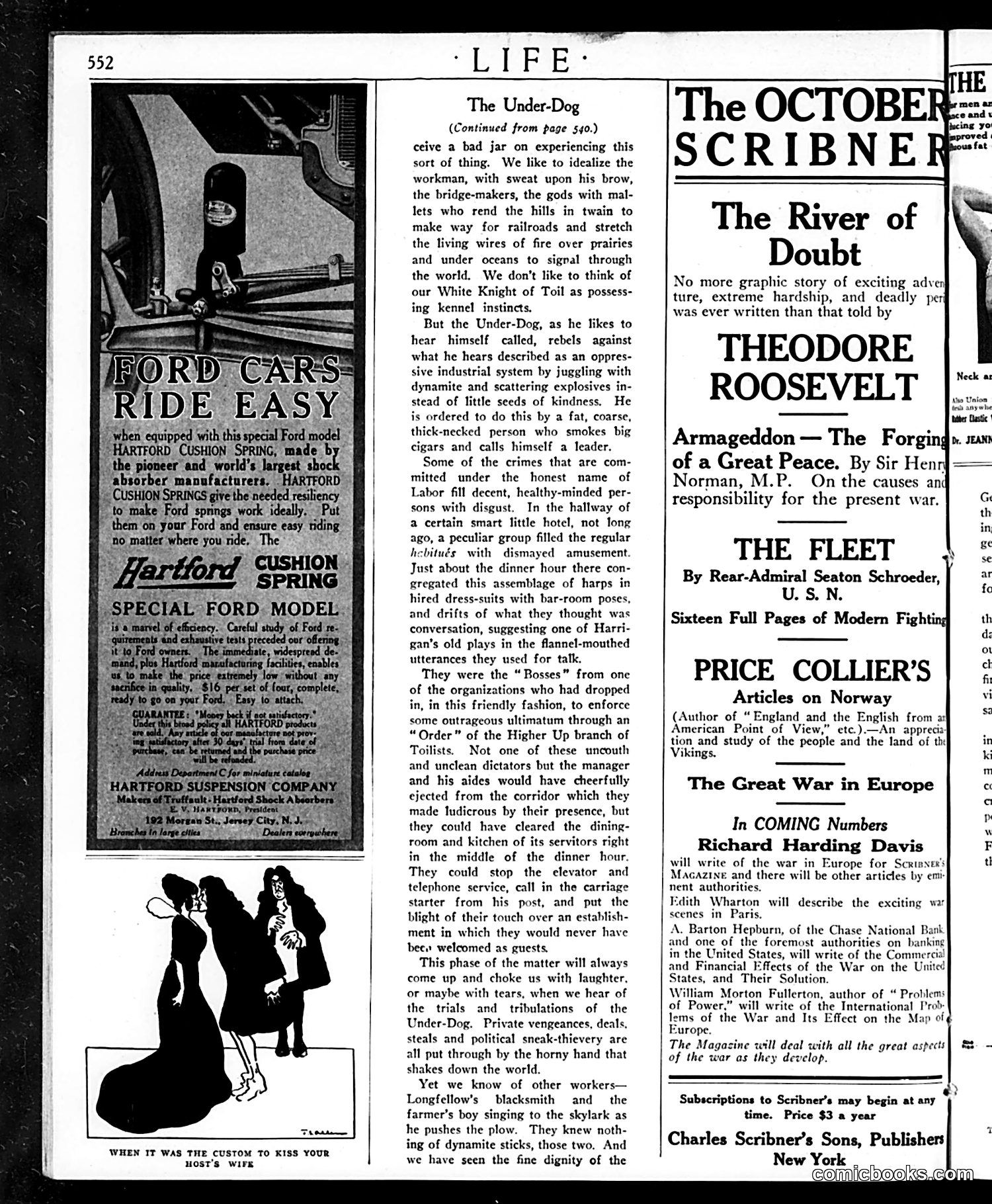
**The Cartoon:** The silhouetted illustration titled "When It Was the Custom to Kiss Your Host's Wife" depicts a social scene from an earlier era—likely Victorian or Edwardian times. The joke is historical/nostalgic: it references an obsolete social custom where men would greet their host's wife with a kiss, treating it as normal etiquette. For modern readers, this humorously highlights how much social conventions have changed. **The Article:** "The Under-Dog" is a lengthy essay critiquing labor radicalism. The author distinguishes between noble working men (invoked through idealized figures like Longfellow's blacksmith) and corrupt labor "bosses"—uncouth, cigar-smoking thugs who manipulate workers into using dynamite and violence while exploiting their power to paralyze services in hotels and establishments. The piece satirizes the hypocrisy and thuggishness of labor leadership, portraying them as worse offenders than the workers they claim to represent. **Context:** This reflects early 20th-century anxieties about labor unions, strikes, and industrial sabotage.
📄 Transcribed text from this page (OCR, searchable)
Machine-transcribed from the original scan — historical spelling and the odd misread are preserved.
WHEN IT WAS THE CUSTOM TO KISS YOUR uost’s WIFE PRE The Under-Dog (Continued from page 540.) ceive a bad jar on experiencing this sort of thing. We like to idealize the workman, with sweat upon his brow, the bridge-makers, the gods with mal- lets who rend the hills in twain to make way for railroads and stretch the living wires of fire over prairies and under oceans to signal through the world. We don’t like to think of our White Knight of Toil as possess- ing kennel instincts. But the Under-Dog, as he likes to hear himself called, rebels against what he hears described as an oppres- sive industrial system by juggling with dynamite and scattering explosives in- stead of little seeds of kindness. He is ordered to do this by a fat, coarse, thick-necked person who smokes big cigars and calls himself a leader. Some of the crimes that are com- mitted under the honest name of Labor fill decent, healthy-minded per- sons with disgust. In the hallway of a certain smart little hotel, not long ago, a peculiar group filled the regular hebitués with dismayed amusement. Just about the dinner hour there con- gregated this assemblage of harps in hired dress-suits with bar-room poses, and drifts of what they thought was conversation, suggesting one of Harri- gan’s old plays in the flannel-mouthed utterances they used for talk. They were the “Bosses” from one of the organizations who had dropped in, in this friendly fashion, to enforce some outrageous ultimatum through an “Order” of the Higher Up branch of Toilists. Not one of these uncouth and unclean dictators but the manager and his aides would have cheerfully ejected from the corridor which they made ludicrous by their presence, but they could have cleared the dining- room and kitchen of its servitors right in the middle of the dinner hour. They could stop the elevator and telephone service, call in the carriage starter from his post, and put the blight of their touch over an establish- ment in which they would never have bees welcomed as guests. This phase of the matter will always come up and choke us with laughter, or maybe with tears, when we hear of the trials and tribulations of the Under-Dog. Private vengeances, deals, steals and political sneak-thievery are all put through by the horny hand that shakes down the world. Yet we know of other workers— Longfellow’s blacksmith and the farmer’s boy singing to the skylark as he pushes the plow. They knew noth- ing of dynamite sticks, those two. And we have seen the fine dignity of the The OCTOBER::: acing yo SCRIBNEF* The River of Doubt No more graphic story of exciting adven ture, extreme hardship, and deadly perj was ever written than that told by THEODORE ROOSEVELT Armageddon — The Forg of a Great Peace. By Sir Henn Norman, M.P. On the causes an responsibility for the present war. THE FLEET By Rear-Admiral Seaton Schroeder, U.S.N. Sixteen Full Pages of Modern Figh PRICE COLLIER’S Articles on Norway (Author of “England and the English from American Point of View,” ete.).—An appreca tion and study of the people and the land of th: Vikings. The Great War in Europe In COMING Numbers Richard Harding Davis will write of the war in Europe for Scripxe Macazine and there will be other articles by ¢ nent authorities. Edith Wharton will describe the exciting war scenes in Paris, A. Barton Hepburn, of the Chase National Bank and one of the foremost authorities on banking in the United States, will write of the Commer and Financial Effects of the War on the Unit States, and Their Solution. William Morton Fullerton, author of “ Pro! of Power,” will write of the International [’ro’- lems of the War and Its Effect on the Map of Europe. The Magazine will deal with all the great aspects of the war as they develop. Subscriptions to Scribner’s may begin at any time. Price $3 a year Charles Scribner’s Sons, Publishers New York . comichooks com