
Life, 1914-09-24 · page 21 of 45
Life — September 24, 1914 — page 21: what you’re looking at
What you’re looking at
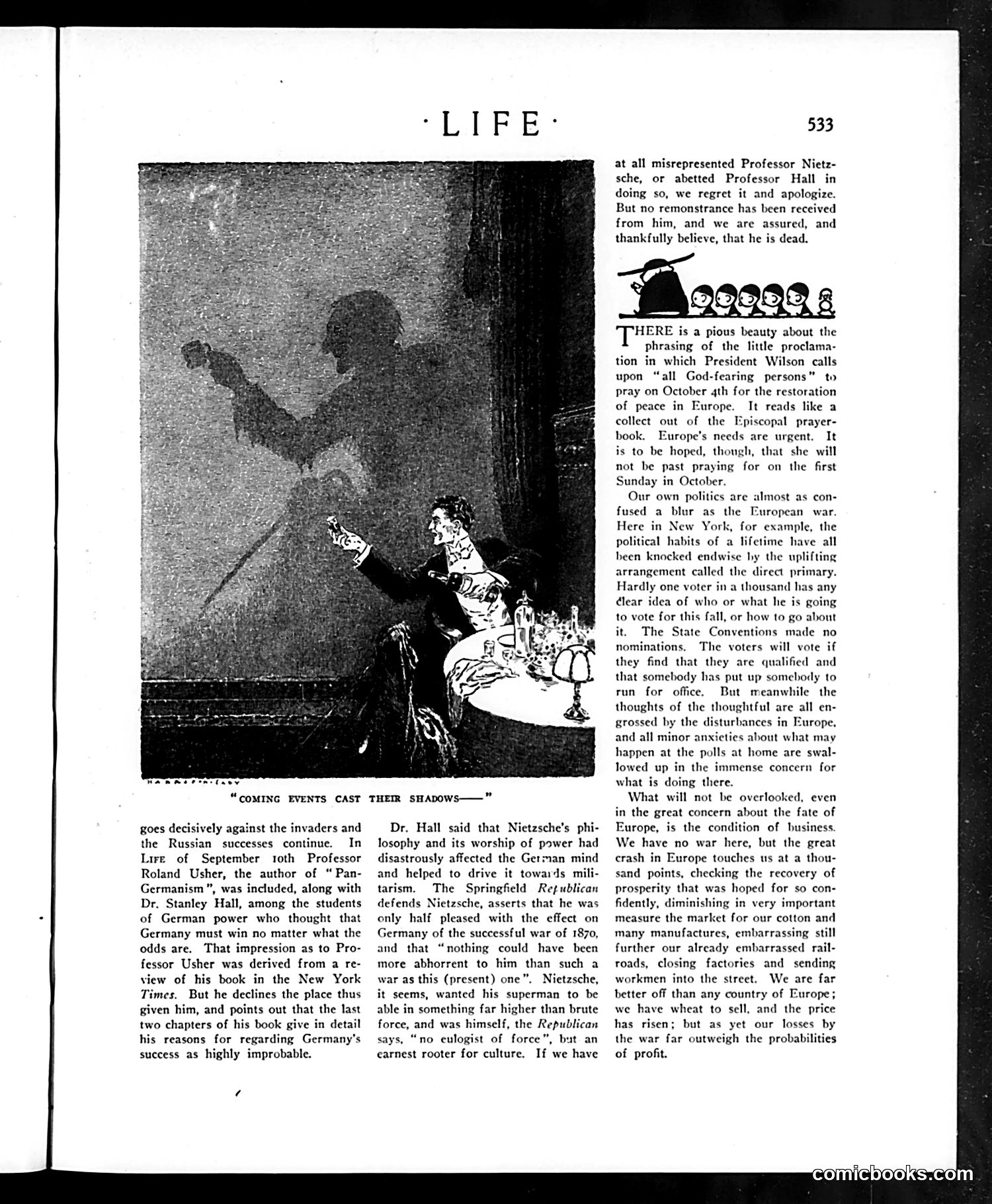
## The Cartoon The illustration titled "Coming Events Cast Their Shadows" depicts two well-dressed diners at a table with ominous shadowy figures looming behind them—appearing to be soldiers or military figures. This visual metaphor suggests that coming warfare or conflict casts its dark influence over present civilian life. ## Context and References The page discusses German philosophy and World War I's impact on America. It references Professor Roland Usher's book "Pan-Germanism" and debates whether Nietzsche's philosophy of power corrupted German militarism. The editors defend Nietzsche against charges of promoting brutality, noting he actually valued culture over "brute force." ## The Satire's Point The cartoon illustrates the article's broader concern: even as Americans dine peacefully, the European war's consequences—economic collapse, factory closures, unemployment—loom inevitable. American prosperity appears fragile, threatened by distant conflict. The juxtaposition mocks the pretense of normalcy while catastrophe approaches. The page reflects early WWI American anxiety about the war's unavoidable economic and social consequences, despite initial American neutrality.
📄 Transcribed text from this page (OCR, searchable)
Machine-transcribed from the original scan — historical spelling and the odd misread are preserved.
aN Re Pent iaey “COMING EVENTS CAST goes decisively against the invaders and the Russian successes continue. In Lire of September toth Professor Roland Usher, the author of “ Pan- Germanism”, was included, along with Dr. Stanley Hall, among the students of German power who thought that Germany must win no matter what the odds are. That impression as to Pro- fessor Usher was derived from a re- iew of his book in the New York Times. But he declines the place thus given him, and points out that the last two chapters of his book give in detail his reasons for regarding Germany's success as highly improbable. THEIR SHADOWS——” Dr. Hall said that Nietzsche’s phi- losophy and its worship of power had disastrously affected the German mind and helped to drive it towards tarism. The Springfield Republican defends Nietzsche, asserts that he was only half pleased with the effect on Germany of the successful war of 1870, and that “nothing could have been more abhorrent to him than such a war as this (present) one”. Nietzsche, it seems, wanted his superman to be able in something far higher than brute force, and was himself, the Republican says, “no eulogist of force”, but an earnest rooter for culture. If we have 533 at all misrepresented Professor Nietz- sche, or abetted Professor Hall in doing so, we regret it and apologize. But no remonstrance has been received from him, and we are assured, and thankfully believe, that he is dead. SP RERE is a pious beauty about the phrasing of the little proclama- tion in which President Wilson calls upon “all God-fearing persons” to pray on October 4th for the restoration of peace in Europe. It reads like a collect out of the Episcopal prayer- book. Europe's needs are urgent. It is to be hoped, though, that she will not be past praying for on the first Sunday in October. Our own politics are almost as con- fused a blur as the European war. Here in New York, for example, the political habits of a lifetime have all been knocked endwise hy the uplifting arrangement called the direct primary. Hardly one voter in a thousand has any lear idea of who or what he is going to vote for this fall, or how to go about it. The State Conventions made no nominations. The voters will vote if they find that they are qualified and that somebody has put up somebody to run for office. But meanwhile the thoughts of the thoughtful are all en- grossed by the disturbances in Europe, and all minor anxieties about what may happen at the polls at home are swal- lowed up in the immense concern for what is doing there. What will not be overlooked, even in the great concern about the fate of Europe, is the condition of business. We have no war here, but the great crash in Europe touches us at a thou- sand points, checking the recovery of Prosperity that was hoped for so con- fidently, diminishing in very important measure the market for our cotton and many manufactures, embarrassing still further our already embarrassed rail- roads, closing factories and sending workmen into the street. We are far better off than any country of Europe; we have wheat to sell, and the price has risen; but as yet our losses by the war far outweigh the probabilities of profit.