
Life, 1914-09-24 · page 20 of 45
Life — September 24, 1914 — page 20: what you’re looking at
What you’re looking at
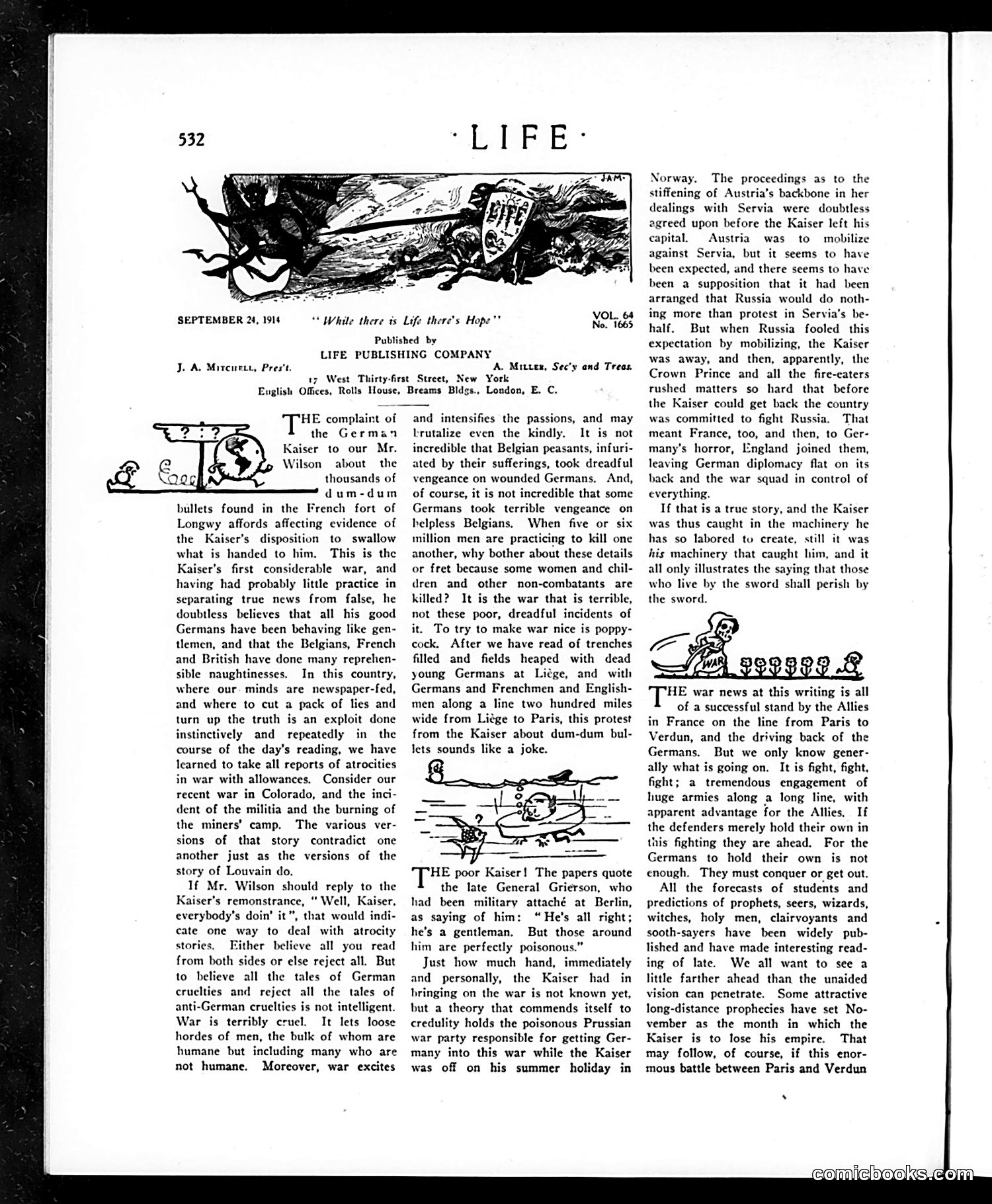
This editorial page mocks Kaiser Wilhelm II's complaint to President Wilson about French use of dum-dum bullets at the Fort of Longwy. The satire argues the Kaiser, inexperienced in major warfare, naively believes German soldiers behave honorably while enemies commit atrocities—a credulous position. The cartoons (appearing to show a suffering Kaiser figure) accompany text asserting that war inherently involves cruelty on all sides. The author argues that singling out German violations while ignoring Allied ones is intellectually dishonest. The piece also suggests the Kaiser may have been manipulated by hardline Prussian militarists into the war while away on summer holiday in Norway, implying he bears less personal responsibility than his advisors. The overall tone is cynical about wartime propaganda from any belligerent.
📄 Transcribed text from this page (OCR, searchable)
Machine-transcribed from the original scan — historical spelling and the odd misread are preserved.
SEPTEMBER 24, 1914 ‘* While there ts Life there's Hope"* Published by LIFE PUBLISHING COMPANY J. A. Mitcuett, Pres’t. A. Mitten, Sec’y ond Treas. tz West Thirty-first Street, New York English Offices, Rolls House, Breams Bldgs., London, E. C. HE complaint of the German Kaiser to our Mr. Wilson about the thousands of dum-dum bullets found in the French fort of Longwy affords affecting evidence of the Kaiser’s disposition to swallow what is handed to him, This is the Kaiser's first considerable war, and having had probably little practice in separating true news from false, he doubtless believes that all his good Germans have been behaving like gen- tlemen, and that the Belgians, French and British have done many reprehen- sible naughtinesses. In this country, where our. minds are newspaper-fed, and where to cut a pack of lies and turn up the truth is an exploit done instinctively and repeatedly in the course of the day’s reading, we have learned to take all reports of atrocities in war with allowances. Consider our recent war in Colorado, and the inci- dent of the militia and the burning of the miners’ camp. The various ver- sions of that story contradict one another just as the versions of the story of Louvain do. If Mr. Wilson should reply to the Kaiser's remonstrance, “ Well, Kaiser, everybody's doin’ it”, that would indi- cate one way to deal with atrocity stories, Either believe all you read from both sides or else reject all. But to believe all the tales of German cruelties and reject all the tales of anti-German cruelties is not intelligent. War is terribly cruel. It lets loose hordes of men, the bulk of whom are humane but including many who are not humane. Moreover, war excites and intensifies the passions, and may Lrutalize even the kindly. It is not incredible that Belgian peasants, infuri- ated by their sufferings, took dreadful vengeance on wounded Germans. And, of course, it is not incredible that some Germans took terrible vengeance on helpless Belgians. When five or six million men are practicing to kill one another, why bother about these details or fret because some women and chil- dren and other non-combatants are killed? It is the war that is terrible, not these poor, dreadful incidents of it. To try to make war nice is poppy- cock. After we have read of trenches filled and fields heaped with dead young Germans at Liége, and with Germans and Frenchmen and English- men along a line two hundred miles wide from Liége to Paris, this protest from the Kaiser about dum-dum bul- lets sounds like a joke. TR poor Kaiser! The papers quote the late General Grierson, who had been military attaché at Berlin, as saying of him: “He's all right; he’s a gentleman. But those around him are perfectly poisonous.” Just how much hand, immediately and personally, the Kaiser had in bringing on the war is not known yet, but a theory that commends itself to credulity holds the poisonous Prussian war party responsible for getting Ger- many into this war while the Kaiser was off on his summer holiday in Norway. The proceedings as to the stiffening of Austria’s backbone in her dealings with Servia were doubtless agreed upon before the Kaiser left his capital. Austria was to mobilize against Servia, but it seems to have been expected, and there seems to have been a supposition that it had been arranged that Russia would do noth- ing more than protest in Servia’s be- half. But when Russia fooled this expectation by mobilizing, the Kaiser was away, and then, apparently, the Crown Prince and all the fire-caters rushed matters so hard that before the Kaiser could get back the country was committed to fight Russia. That meant France, too, and then, to Ger- many’s horror, England joined them, leaving German diplomacy flat on its back and the war squad in control of everything. If that is a true story, and the Kaiser was thus caught in the machinery he has so labored to create, still it was his machinery that caught him, and it all only illustrates the saying that those who live by the sword shall perish by the sword. of a successful stand by the Allies in France on the line from Paris to Verdun, and the driving back of the Germans. But we only know gener- ally what is going on. It is fight, fight, fight; a tremendous engagement of luge armies along a long line, with apparent advantage for the Allies, If the defenders merely hold their own in this fighting they are ahead. For the Germans to hold their own is not enough. They must conquer or get out. All the forecasts of students and predictions of prophets, seers, wizards, witches, holy men, clairvoyants and sooth-sayers have been widely pub- lished and have made interesting read- ing of late. We all want to see a little farther ahead than the unaided vision can penetrate. Some attractive long-distance prophecies have set No- vember as the month in which the Kaiser is to lose his empire. That may follow, of course, if this enor- mous battle between Paris and Verdun