
Life, 1914-09-24 · page 28 of 45
Life — September 24, 1914 — page 28: what you’re looking at
What you’re looking at
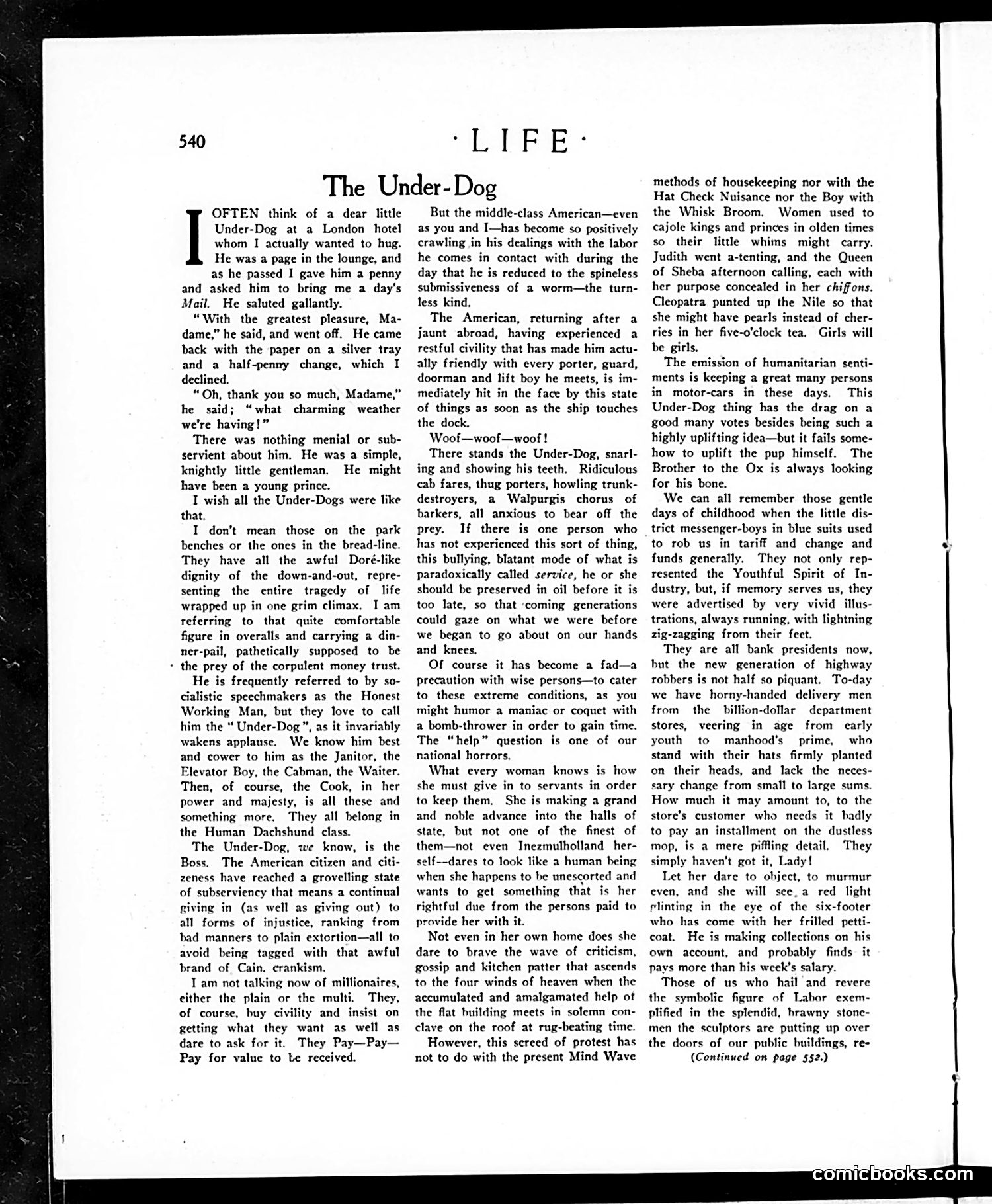
This is a satirical essay (not a cartoon) critiquing American class dynamics and service-industry behavior in the early 20th century. The author contrasts a courteous London hotel page—who served with dignity despite his lowly position—with the hostile, demanding behavior of American service workers (porters, cab drivers, elevator operators, waiters, cooks). The piece sarcastically calls these workers "the Boss" and "Under-Dog," arguing that middle-class Americans have become so fearful of being labeled "cranks" that they kowtow to rude service staff, reversing normal social hierarchy. The author criticizes this dynamic as uniquely American: wealthy Europeans simply *demand* service and pay for it, while anxious middle-class Americans grovel to avoid confrontation. The essay suggests this servile behavior reflects broader national anxieties about labor relations ("the 'help' question is one of our national horrors"). The "Woof—woof—woof!" represents service workers' aggressive, animalistic demeanor toward customers.
📄 Transcribed text from this page (OCR, searchable)
Machine-transcribed from the original scan — historical spelling and the odd misread are preserved.
ERA ? The Under-Dog OFTEN think of a dear little Under-Dog at a London hotel whom I actually wanted to hug. He was a page in the lounge, and as he passed I gave him a penny and asked him to bring me a day’s Mail. He saluted gallantly. “With the greatest pleasure, Ma- dame,” he said, and went off. He came back with the paper on a silver tray and a half-penny change, which I declined. “Oh, thank you so much, Madame,” he said; “what charming weather we're having!” There was nothing menial or sub- servient about him. He was a simple, knightly little gentleman. He might have been a young prince. I wish all the Under-Dogs were like that. I don’t mean those on the park benches or the ones in the bread-line. They have all the awful Doré-like dignity of the down-and-out, repre- senting the entire tragedy of life wrapped up in one grim climax. I am referring to that quite comfortable figure in overalls and carrying a din- ner-pail, pathetically supposed to be the prey of the corpulent money trust. He is frequently referred to by so- cialistic speechmakers as the Honest Working Man, but they love to call him the “ Under-Dog”, as it invariably wakens applause. We know him best and cower to him as the Janitor, the Elevator Boy, the Cabman, the Waiter. Then, of course, the Cook, in her power and majesty, is all these and something more. They all belong in the Human Dachshund class. The Under-Dog, we know, is the Boss. The American citizen and citi- zeness have reached a grovelling state of subserviency that means a continual giving in (as well as giving out) to all forms of injustice, ranking from bad manners to plain extortion—all to avoid being tagged with that awful brand of Cain. crankism. Tam not talking now of millionaires, either the plain or the multi. They, of course, buy civility and insist on getting what they want as well as dare to ask for it. They Pay—Pay— Pay for value to te received. But the middle-class American—even as you and I—has become so positively crawling in his dealings with the labor he comes in contact with during the day that he is reduced to the spineless submissiveness of a worm—the turn- less kind. The American, returning after a jaunt abroad, having experienced a restful civility that has made him actu- ally friendly with every porter, guard, doorman and lift boy he meets, is im- mediately hit in the face by this state of things as soon as the ship touches the dock. Woof—woof—woof ! There stands the Under-Dog, snarl- ing and showing his teeth. Ridiculous cab fares, thug porters, howling trunk- destroyers, a Walpurgis chorus of barkers, all anxious to bear off the prey. If there is one person who has not experienced this sort of thing, this bullying, blatant mode of what is paradoxically called service, he or she should be preserved in oil before it is too late, so that ‘coming generations could gaze on what we were before we began to go about on our hands and knees. Of course it has become a fad—a precaution with wise persons—to cater to these extreme conditions, as you might humor a maniac or coquet with a bomb-thrower in order to gain time. The “help” question is one of our national horrors. What every woman knows is how she must give in to servants in order to keep them. She is making a grand and noble advance into the halls of state, but not one of the finest of them—not even Inezmulholland her- self--dares to look like a human being when she happens to be unescorted and wants to get something that is her rightful due from the persons paid to provide her with it. Not even in her own home does she dare to brave the wave of criticism, gossip and kitchen patter that ascends to the four winds of heaven when the accumulated and amalgamated help of the flat building meets in solemn con- clave on the roof at rug-beating time. However, this screed of protest has not to do with the present Mind Wave methods of housekeeping nor with the Hat Check Nuisance nor the Boy with the Whisk Broom. Women used to cajole kings and princes in olden times so their little whims might carry. Judith went a-tenting, and the Queen of Sheba afternoon calling, each with her purpose concealed in her chiffons. Cleopatra punted up the Nile so that she might have pearls instead of cher- ries in her five-o’clock tea. Girls will be girls. The emission of humanitarian senti- ments is keeping a great many persons in motor-cars in these days. This Under-Dog thing has the drag on a good many votes besides being such a highly uplifting idea—but it fails some- how to uplift the pup himself. The Brother to the Ox is always looking for his bone. We can all remember those gentle days of childhood when the little dis- trict messenger-boys in blue suits used to rob us in tariff and change and funds generally. They not only rep- resented the Youthful Spirit of In- dustry, but, if memory serves us, they were advertised by very vivid illus- trations, always running, with lightning zig-zagging from their feet. They are all bank presidents now, but the new generation of highway robbers is not half so piquant. To-day we have horny-handed delivery men from the billion-dollar department stores, veering in age from early youth to manhood's prime, who stand with their hats firmly planted on their heads, and lack the neces- sary change from small to large sums. How much it may amount to, to the store’s customer who needs it badly to pay an installment on the dustless mop, is a mere piffling detail. They simply haven't got it, Lady! Let her dare to object, to murmur even, and she will see. a red light rlinting in the eye of the six-footer who has come with her frilled petti- coat. He is making collections on his own account, and probably finds it pays more than his week’s salary. Those of us who hail and revere the symbolic figure of Labor exem- plified in the splendid, brawny stone- men the sculptors are putting up over the doors of our public buildings, re- (Continued om page 552.)