
Life, 1914-09-24 · page 24 of 45
Life — September 24, 1914 — page 24: what you’re looking at
What you’re looking at
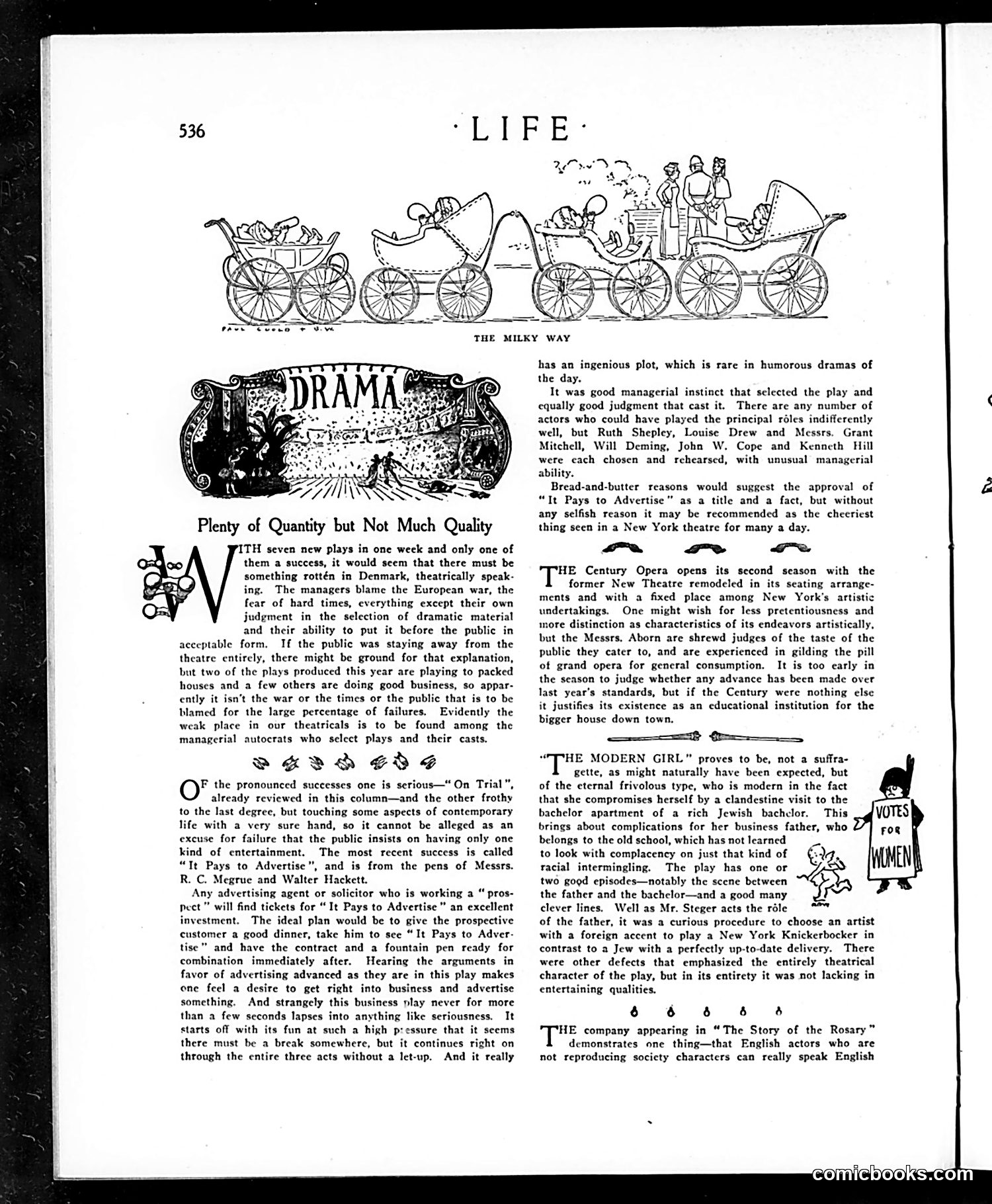
This page reviews seven new theatrical productions, using the illustration "The Milky Way"—a procession of baby carriages of varying quality—as visual metaphor for Broadway's mixed output. The critic argues that managers, not war or economic hardship, bear responsibility for theatrical failures. Most plays are mediocre ("quantity but not quality"). The reviews praise two successes: the serious drama "On Trial" and the comedic farce "It Pays to Advertise," which the critic enthusiastically endorses as entertaining and cleverly plotted. He notes the cast (including Ruth Shepley and Grant Mitchell) was well-selected. Brief mentions follow of Century Opera's new season and "The Modern Girl." The underlying satire critiques managerial incompetence in play selection and casting as the real problem plaguing theater—not external circumstances. The carriage illustration cleverly visualizes this theme: many productions exist, but few are worthwhile.
📄 Transcribed text from this page (OCR, searchable)
Machine-transcribed from the original scan — historical spelling and the odd misread are preserved.
THE MILKY WAY Plenty of Quantity but Not Much Quality TH seven new plays in one week and only one of them a success, it would seem that there must be something rottén in Denmark, theatrically speak- ing. The managers blame the European war, the fear of hard times, everything except their own judgment in the selection of dramatic material and their ability to put it before the public in acceptable form. If the public was staying away from the theatre entirely, there might be ground for that explanation, but two of the plays produced this year are playing to packed houses and a few others are doing good business, so appar- ently it isn’t the war or the times or the public that is to be Wamed for the large percentage of failures. Evidently the weak place in our theatricals is to be found among the managerial autocrats who select plays and their casts. SARA EG F the pronounced successes one is serious— On Trial”, already reviewed in this column—and the other frothy to the last degree, but touching some aspects of contemporary life with a very sure hand, so it cannot be alleged as an excuse for failure that the public insists on having only one kind of entertainment. The most recent success is called “Tt Pays to Advertise”, and is from the pens of Messrs. R. C. Megrue and Walter Hackett. Any advertising agent or solicitor who is working a “ pros- pect ” will find tickets for “It Pays to Advertise” an excellent investment. The ideal plan would be to give the prospective customer a good dinner, take him to see “It Pays to Adver- tise" and have the contract and a fountain pen ready for combination immediately after. Hearing the arguments in favor of advertising advanced as they are in this play makes one feel a desire to get right into business and advertise something. And strangely this business play never for more than a few seconds lapses into anything like seriousness. It starts off with its fun at such a high pcessure that it seems there must be a break somewhere, but it continues right on through the entire three acts without a let-up. And it really has an ingenious plot, which is rare in humorous dramas of the day. It was good managerial instinct that selected the play and equally good judgment that cast it. There are any number of actors who could have played the principal réles indifferently well, but Ruth Shepley, Louise Drew and Messrs. Grant Mitchell, Will Deming, John W. Cope and Kenneth Hill were cach chosen and rehearsed, with unusual managerial ability. Bread-and-butter reasons would suggest the approval of “It Pays to Advertise” as a title and a fact, but without any selfish reason it may be recommended as the checriest thing seen in a New York theatre for many a day. n~ Foe ‘HE Century Opera opens its second season with the former New Theatre remodeled in its seating arrange- ments and with a fixed place among New York's artistic undertakings. One might wish for less pretentiousness and more distinction as characteristics of its endeavors artistically, but the Messrs. Aborn are shrewd judges of the taste of the public they cater to, and are experienced in gilding the pill of grand opera for general consumption. It is too early in the season to judge whether any advance has been made over last year’s standards, but if the Century were nothing else it justifies its existence as an educational institution for the bigger house down town, 'HE MODERN GIRL” proves to be, not a suffra- gette, as might naturally have been expected, but of the eternal frivolous type, who is modern in the fact that she compromises herself by a clandestine visit to the bachelor apartment of a rich Jewish bachelor. This brings about complications for her business father, who belongs to the old school, which has not learned an to look with complacency on just that kind of 24, racial intermingling. The play has one or y two good episodes—notably the scene between the father and the bachelor—and a good many JJ clever lines. Well as Mr. Steger acts the réle gee of the father, it was a curious procedure to choose an artist with a foreign accent to play a New York Knickerbocker in contrast to a Jew with a perfectly up-to-date delivery. There were other defects that emphasized the entirely theatrical character of the play, but in its entirety it was not lacking in entertaining qualities. 6 6 & 8 8 HE company appearing in “The Story of the Rosary” demonstrates one thing—that English actors who are not reproducing society characters can really speak English vores FOR WONEN