
A complete issue · 40 pages · 1914
Life — August 6, 1914
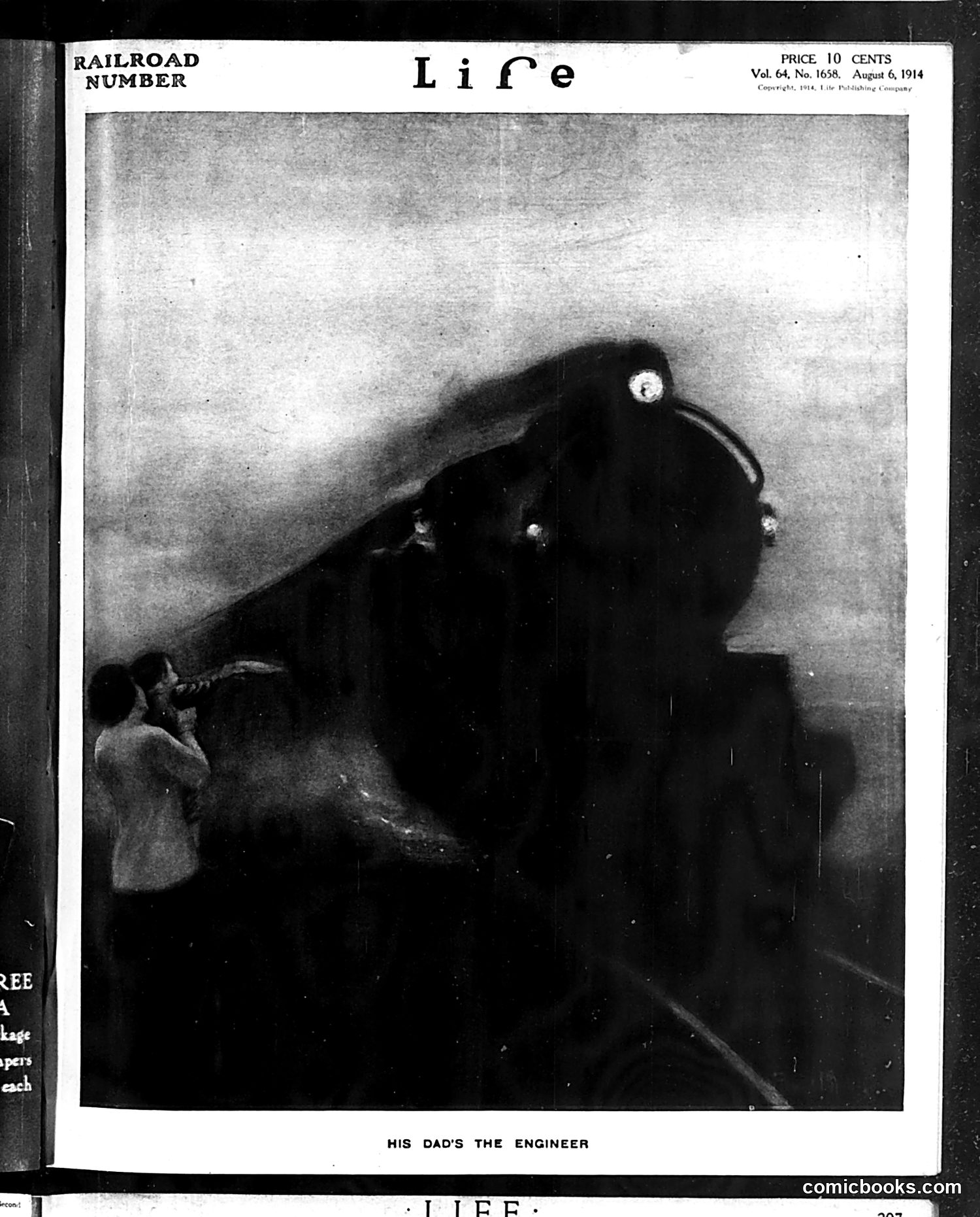
This Life magazine cover from August 6, 1914, depicts a silhouetted locomotive engine with a small child figure operating or inspecting it. The caption "His Dad's the Engineer" suggests a child following in his father's occupational footsteps. The image likely celebrates American industrial labor and the railroad industry, which was central to early 20th-century American identity and economy. The romanticized depiction of the locomotive reflects contemporary cultural reverence for engineers and technological progress. Published in August 1914—just as World War I began in Europe—this appears to be straightforward domestic content celebrating American industry rather than wartime satire, though the timing may invite ironic readings about industrial capacity and national power during global conflict.
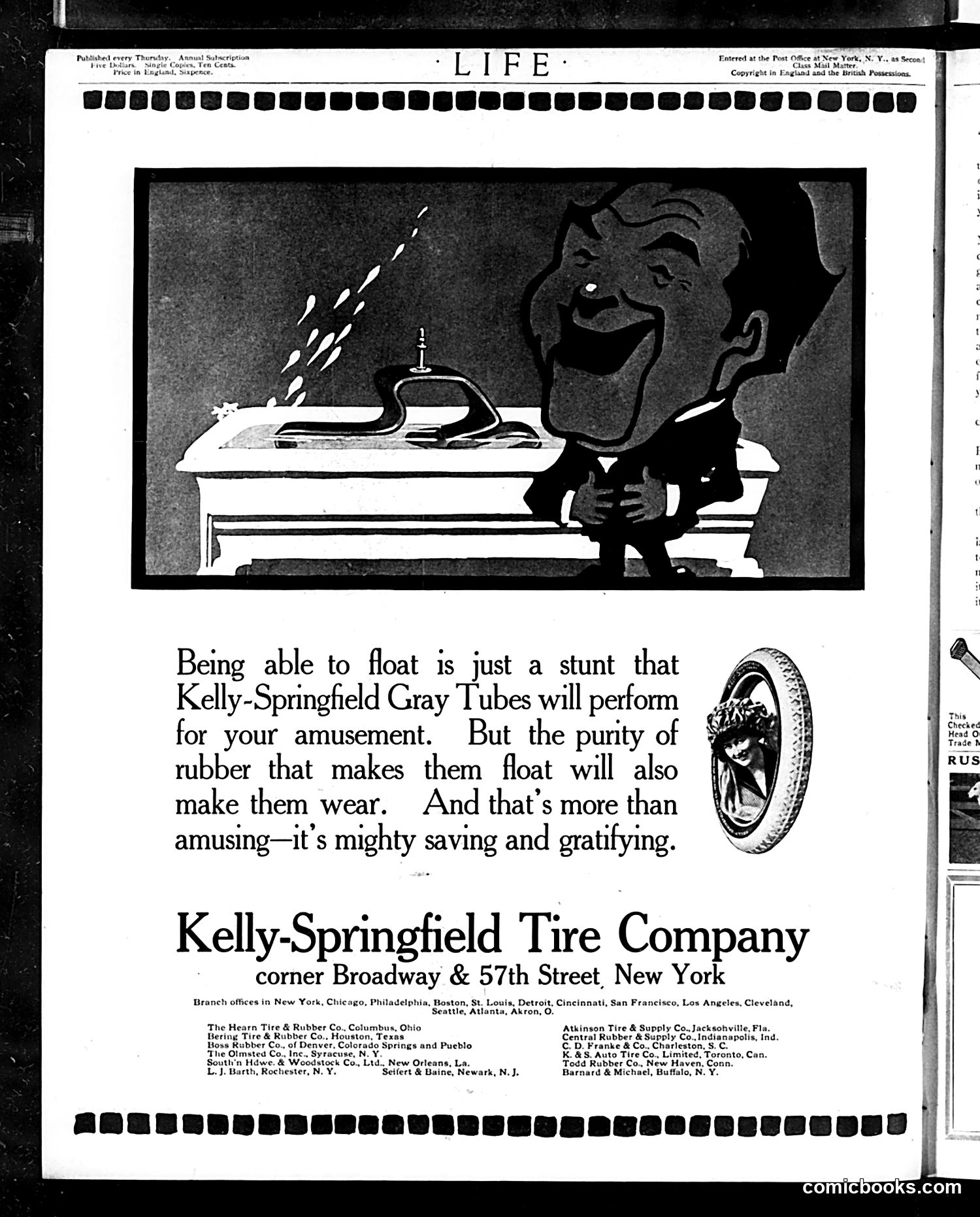
This is primarily a **tire company advertisement**, not political satire. The cartoon depicts a caricatured man at a desk with an exaggerated grinning face, appearing to demonstrate floating tires as entertainment. The ad's humor plays on the novelty of rubber tire technology: Kelly-Springfield tires can "float" (likely referring to buoyancy or tire design innovations), which the copywriter frames as simultaneously a "stunt" for amusement and a practical feature demonstrating rubber quality and durability. The caricatured figure appears to be a generic showman or entertainer type rather than a specific historical person. The joke relies on early-20th-century advertising's whimsical approach to promoting manufacturing innovations, treating industrial products as novelties worthy of public demonstration.
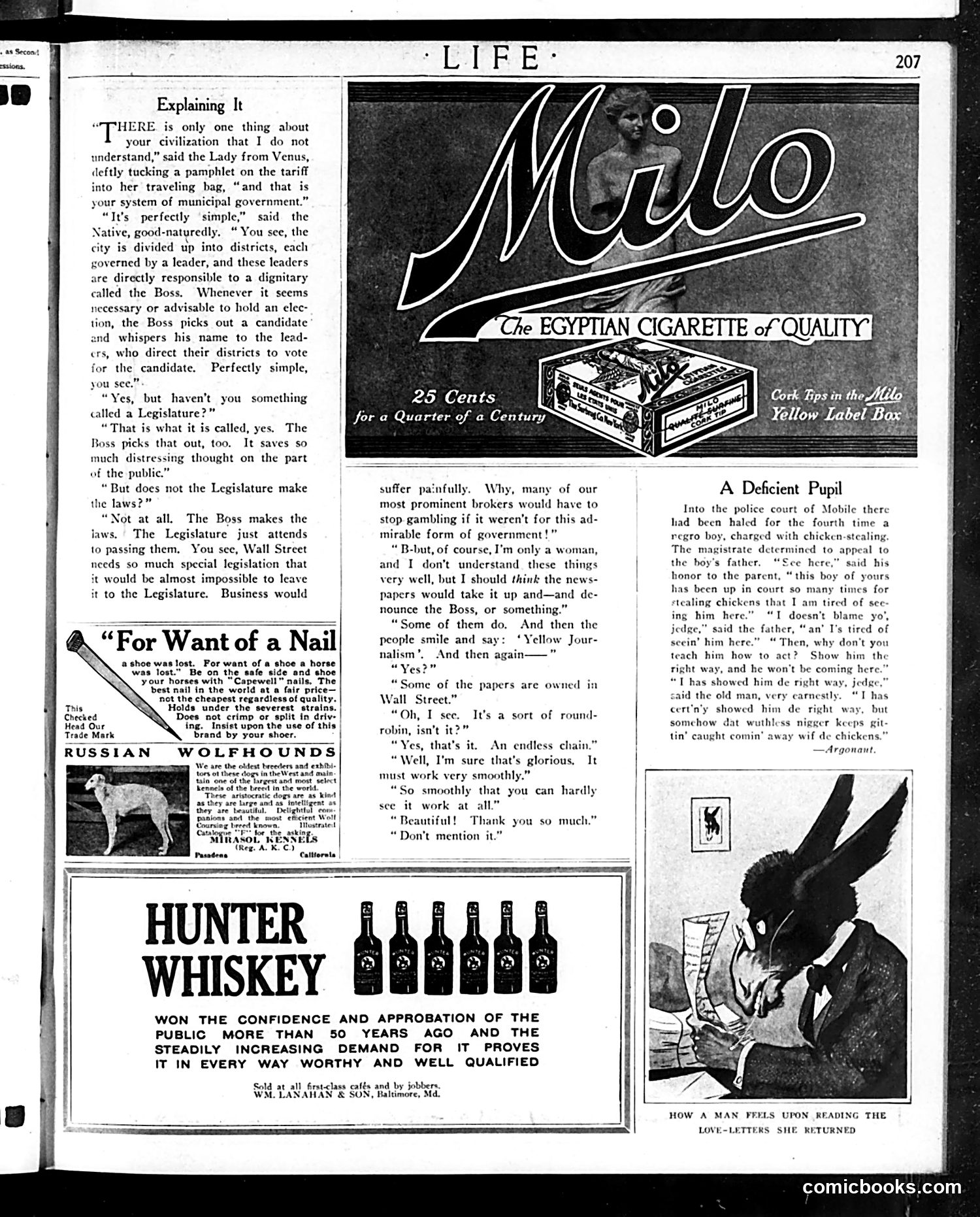
This page is primarily **advertising and narrative fiction** rather than political satire. The main content includes: - **"Explaining It"**: A dialogue satirizing municipal government corruption. A woman from Venus describes how a city "Boss" controls politics through a patronage system—picking candidates, directing votes, and holding elections to maintain public confidence while actually wielding power. The satire critiques how American municipal government operated through corrupt political machines. - **"A Deficient Pupil"**: A story about a boy brought to court for theft, featuring period-typical moral messaging. - **Advertisements** for Milo cigarettes, Hunter Whiskey, and Russian Wolfhounds. The "Boss" system described reflects real early-20th-century American urban political corruption—a common Life magazine target.
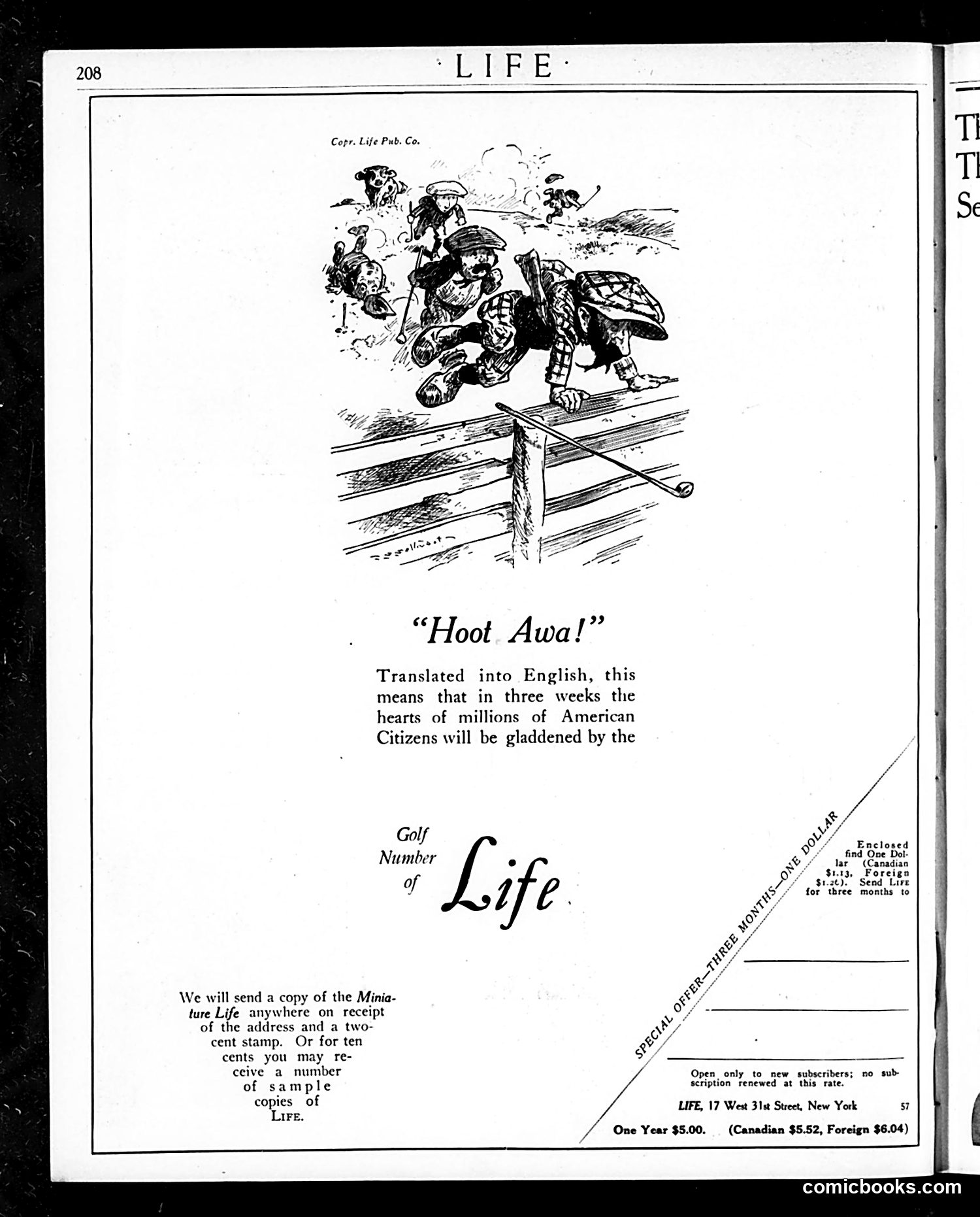
This is primarily a **subscription advertisement** for *Life* magazine rather than political commentary. The cartoon depicts figures (appearing to be caricatured characters) celebrating or cheering near a fence, captioned "Hoot Awa!" The text indicates this phrase "translated into English, this means that in three weeks the hearts of millions of American Citizens will be gladdened by the [Golf Number of Life]." The joke appears to be self-promotional: *Life* is humorously suggesting its upcoming Golf issue will be so popular that Americans will spontaneously celebrate. The "Hoot Awa!" is presented as jubilant exclamation, though the specific reference remains **unclear without additional context** about what event or cultural moment this references. The ad offers subscription options and miniature sample copies for minimal cost.
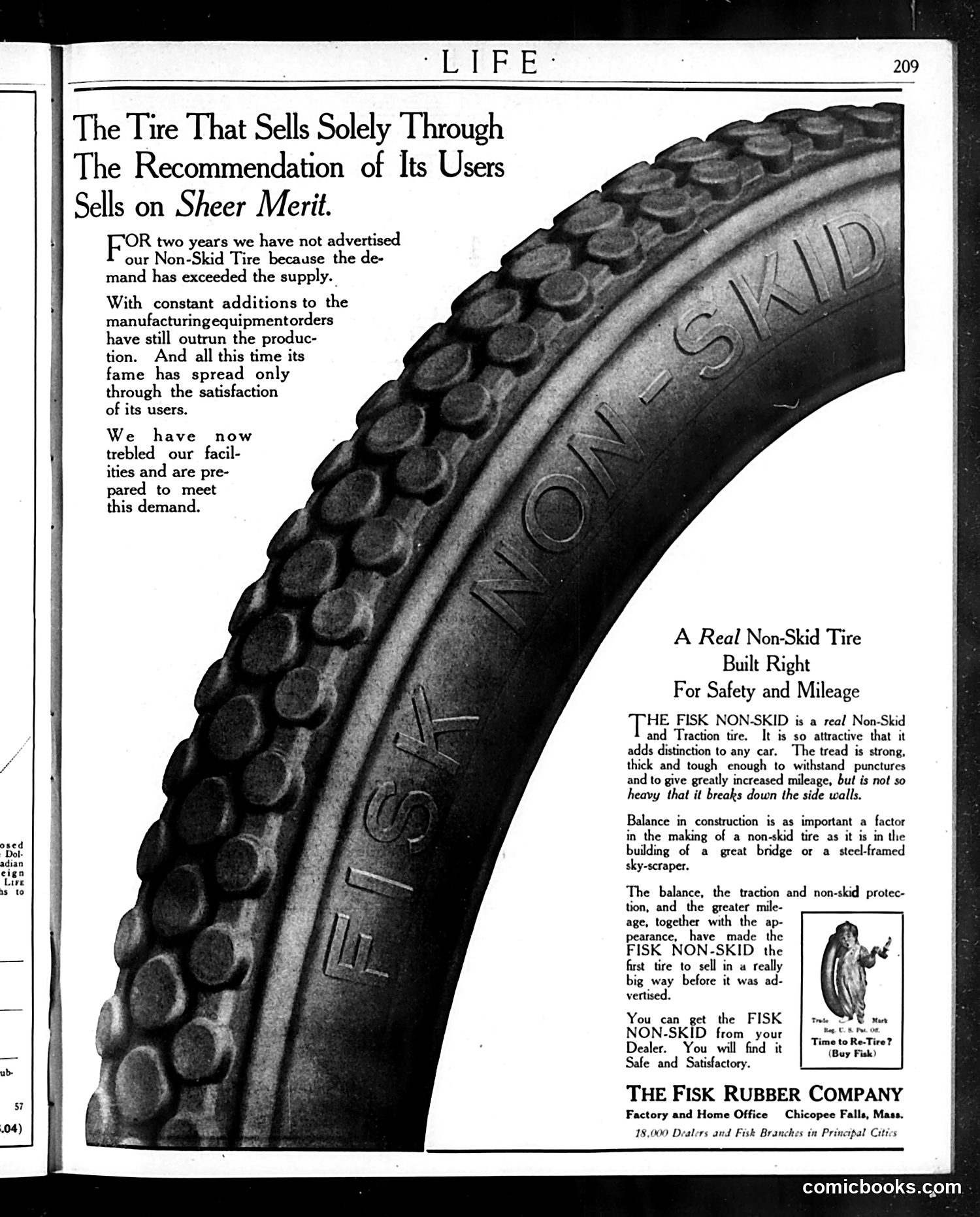
This page is primarily **advertising, not satire or political commentary**. It's a vintage advertisement for Fisk Non-Skid tires, published in *Life* magazine (page 209). The ad features a large photograph of a Fisk tire with prominent tread pattern and the "FISK" branding. The text emphasizes that the tire became popular solely through user recommendations—it sold on "sheer merit" without paid advertising for two years due to high demand. The small inset illustration shows the **Fisk Tire mascot**, a character frequently used in Fisk advertising campaigns of this era. The ad highlights safety, mileage, and balanced construction as selling points. This represents early 20th-century tire marketing strategy: leveraging word-of-mouth reputation and product quality as advertising appeals.
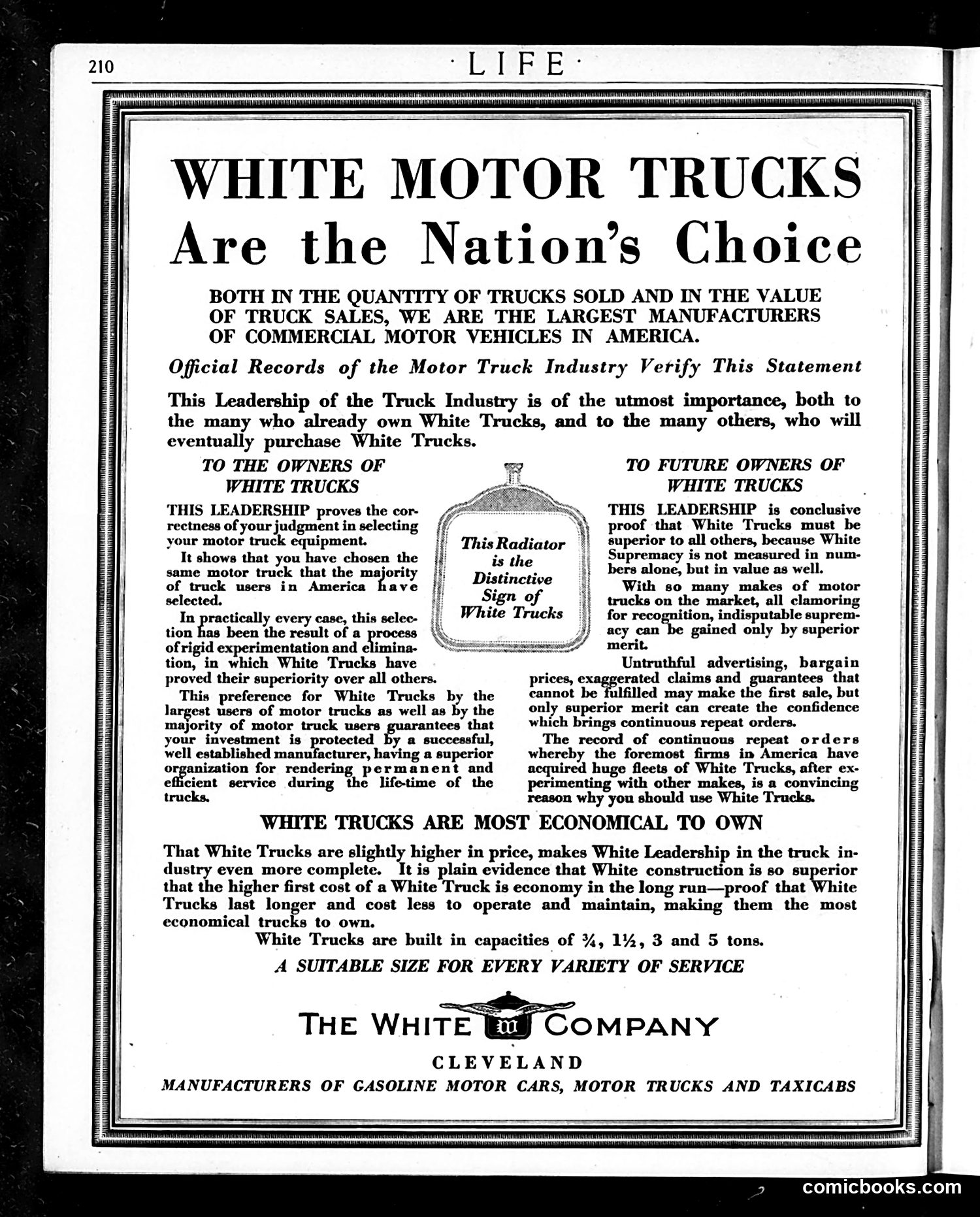
This page is **not a cartoon or satire** — it's a straightforward advertisement for White Motor Trucks, published in *Life* magazine (page 210). The ad makes marketing claims common to early automotive advertising: White trucks are "the Nation's Choice," the largest-selling commercial trucks, superior in construction, and most economical to own despite higher initial cost. The central image shows a radiator badge labeled "This Radiator is the Distinctive Sign of White Trucks." There is no political commentary, caricature, or satirical content here. *Life* magazine carried paid advertisements alongside its editorial content. This represents genuine period advertising rhetoric emphasizing durability, reliability, and value — appeals that remain standard in truck marketing today.
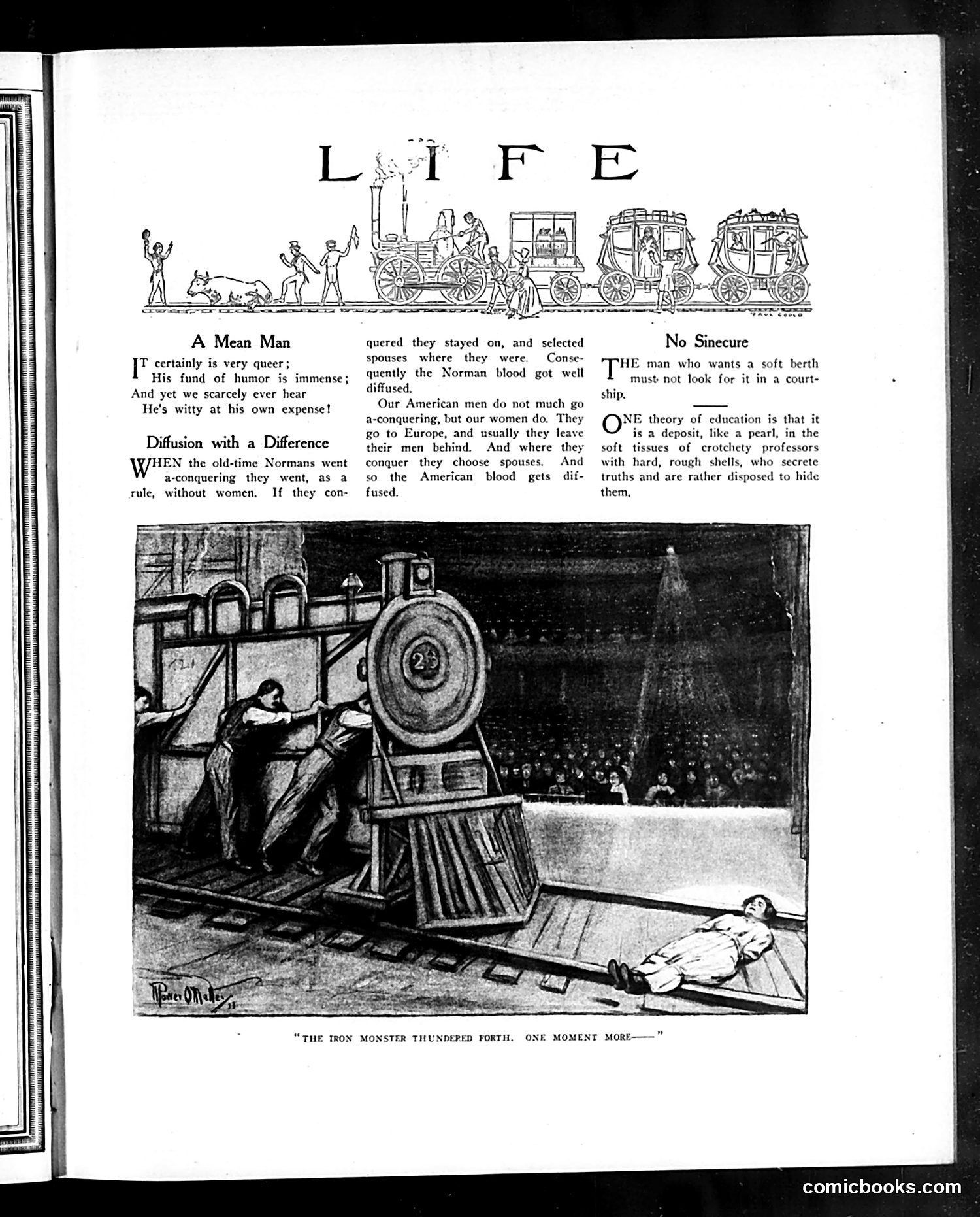
This page contains three brief satirical pieces about American society and gender differences. **"A Mean Man"** mocks a man with a poor sense of humor who experiences embarrassment at social gatherings. **"Diffusion with a Difference"** jokes that while old Normans conquered territories without women, modern Americans conquer Europe but leave their wives behind—reversing traditional gender roles. It suggests American women are more independent travelers than historical counterparts. **"No Sincere"** critiques education theory, comparing it unfavorably to a "crotchety professor" with harsh truths, versus soft, comfortable but dishonest instruction. The large cartoon below depicts **"The Iron Monster Thundered Forth"**—likely an early locomotive with passengers visible in windows, shown about to strike a person lying on the tracks, illustrating the dangers of rapid industrialization and modern transportation technology.
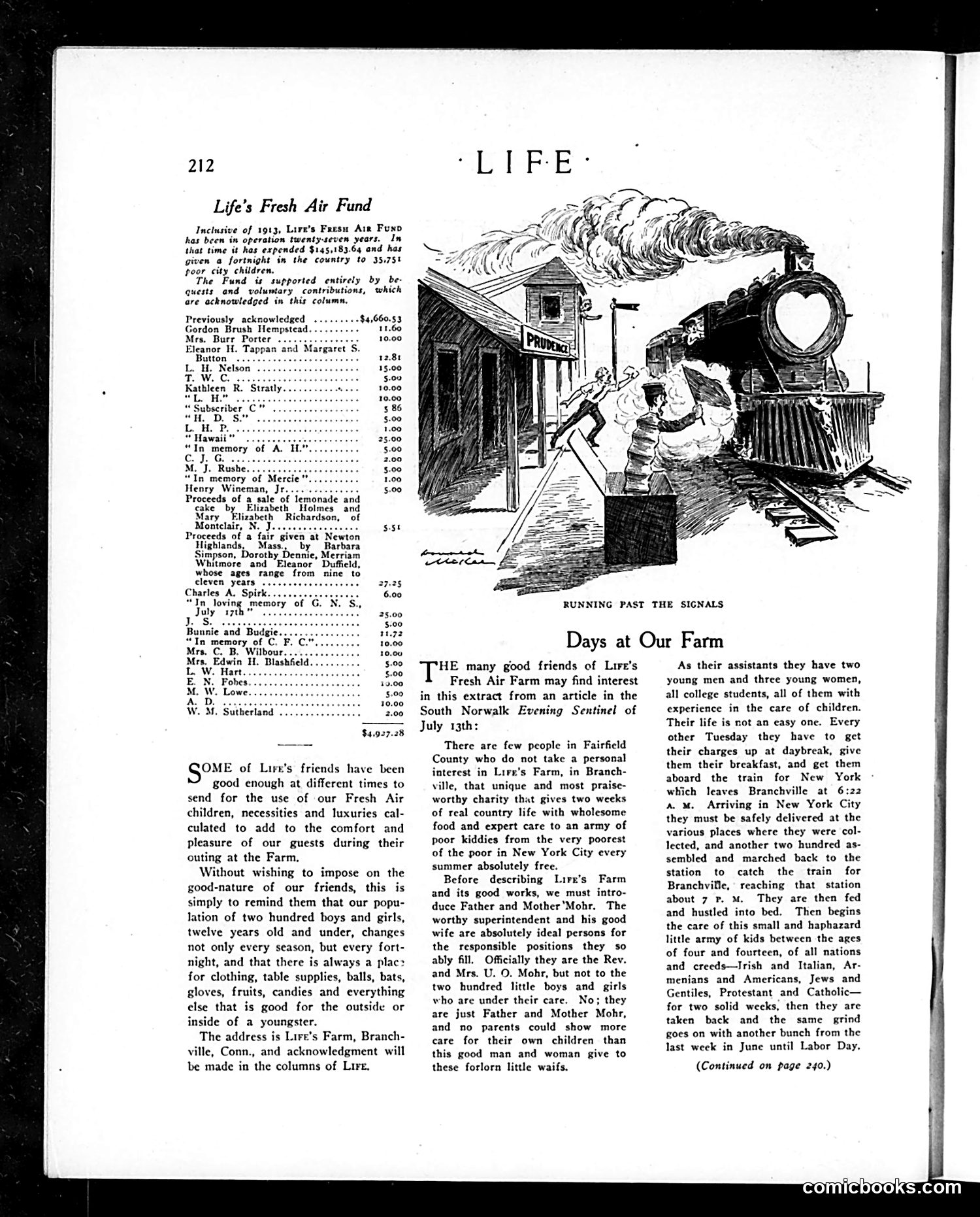
This page describes **Life's Fresh Air Fund**, a charitable initiative providing free summer vacations for poor children from New York City. The accompanying cartoon, titled "Running Past the Signals," depicts a steam locomotive with a figure appearing to signal or wave at it. The text explains that Life's Farm in Branchville, Connecticut hosts these children, supervised by Father and Mother Mohr. The farm accepts children of all nationalities and religions—"Americans and Jews and Gentiles—Protestant and Catholic"—for two-week stays. The cartoon likely illustrates the journey these city children take by train to reach the farm, capturing the excitement and movement of their escape from urban poverty to countryside fresh air and wholesome care. The "signals" reference suggests the organized, supervised nature of this charitable transport.
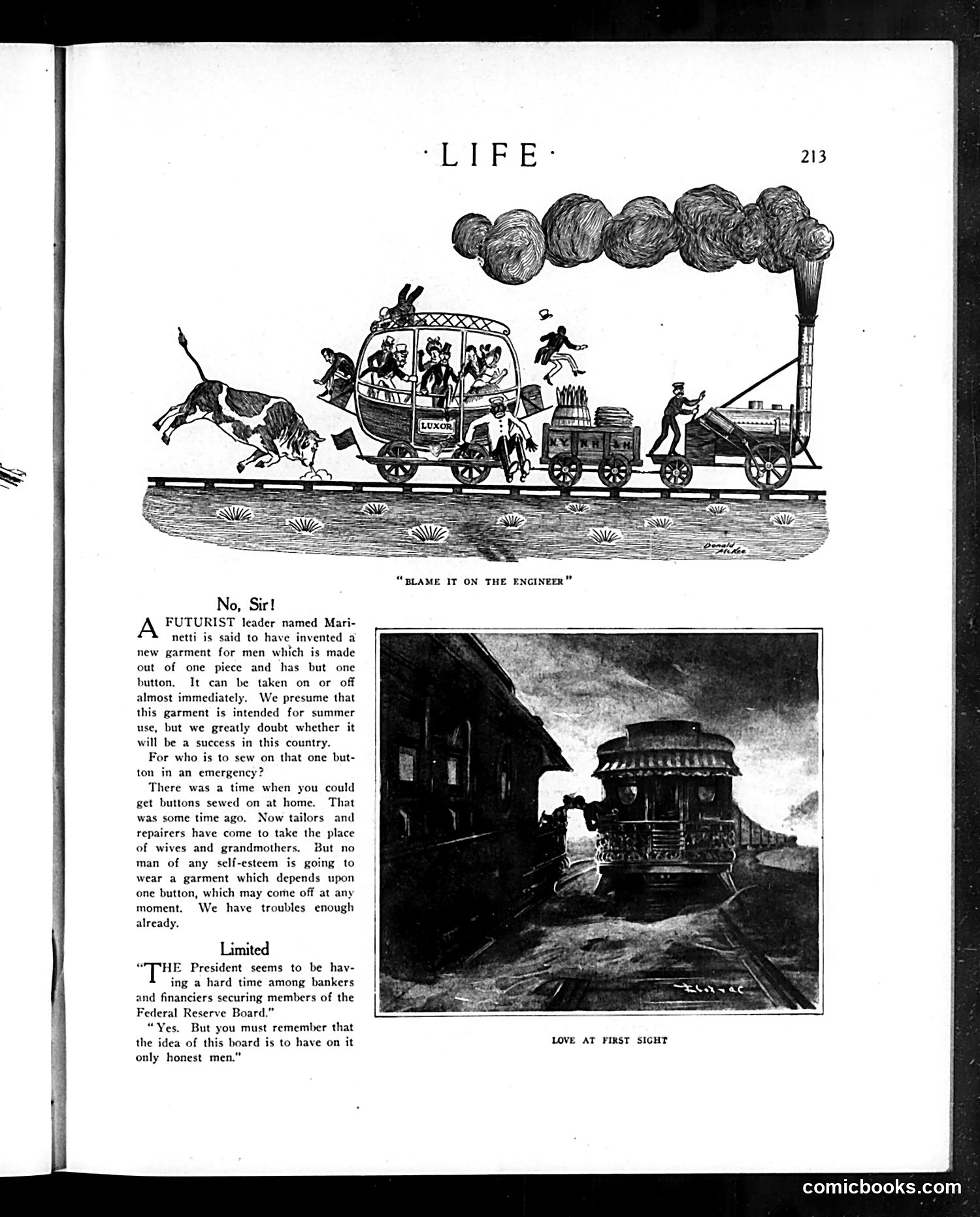
**Top Cartoon "Blame It on the Engineer":** This satirizes early 20th-century chaos and accident blame-shifting. A derailed train with smoke billowing features passengers, cargo, and chaos—with animals and people scattered about. The title suggests passengers or officials are deflecting responsibility onto the engineer, a common practice during the era of rapid industrialization and frequent railway accidents. **Text Articles:** Two brief satirical pieces mock contemporary absurdities: one ridicules a "futurist" designer's impractical one-button garment invention, questioning its practicality. The second jokes about Federal Reserve Board members' integrity, with dark humor about securing "honest men"—implying such men are rare among financiers. **"Love at First Sight" Image:** A romantic scene, likely providing tonal contrast to the page's humor.
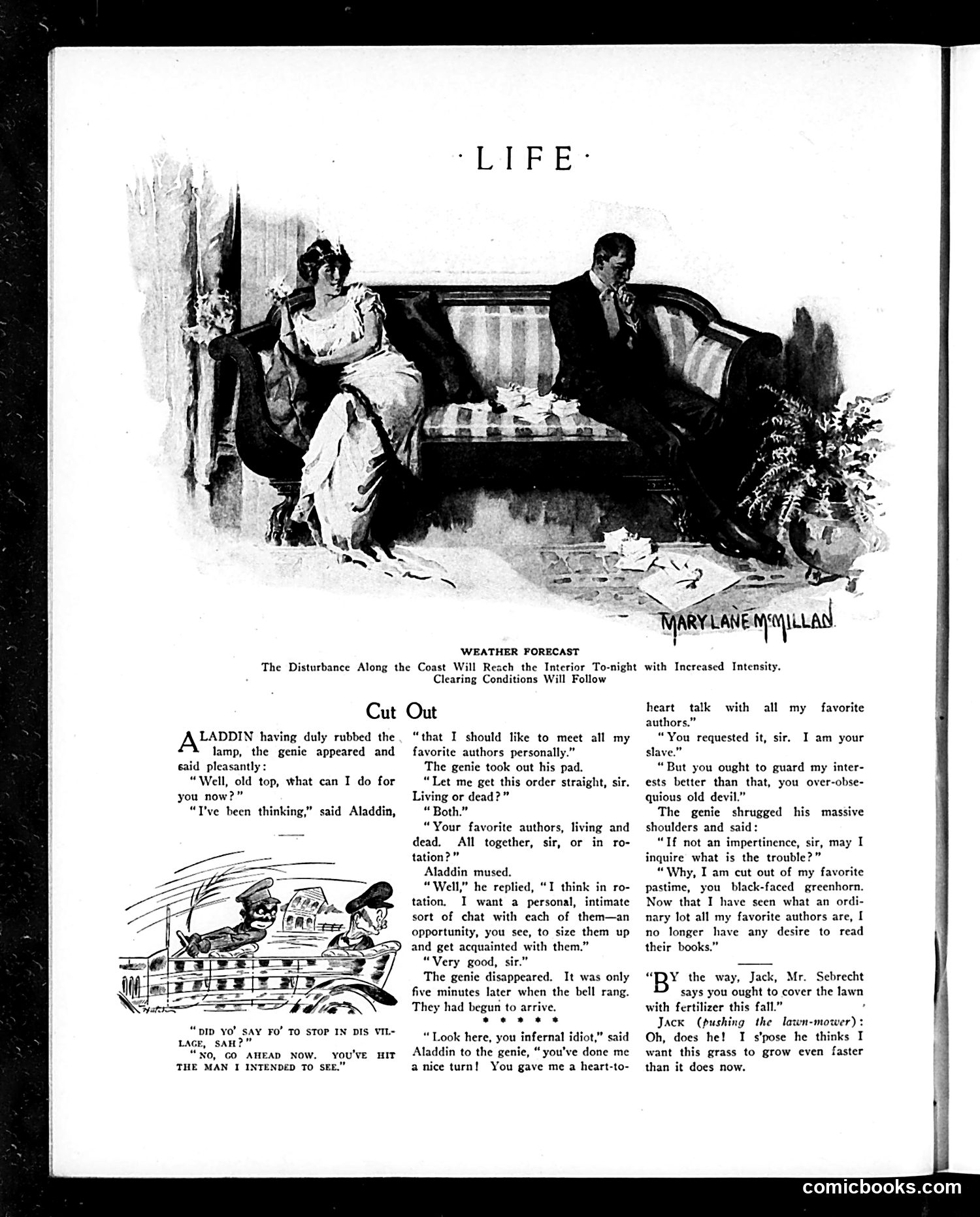
This page contains a fictional story illustrated by Mary Lane McMillan about Aladdin and a genie. The narrative satirizes literary fandom and author worship. **The Plot:** Aladdin rubs a lamp and requests personal, intimate conversations with all his favorite authors—both living and dead. The genie grants this wish but later returns, angry that Aladdin has made him a "heart-to-heart" confidant. Aladdin complains he's been "cut out" from his favorite authors' company because the genie has replaced him in their affections. **The Satire:** This mocks readers' unrealistic fantasies about meeting beloved authors personally. The twist—that obtaining this wish actually *alienates* the reader from the authors—suggests that personal relationships with writers destroy the idealized connection readers imagine through their books. The genie's role-reversal cleverly comments on fan delusion.
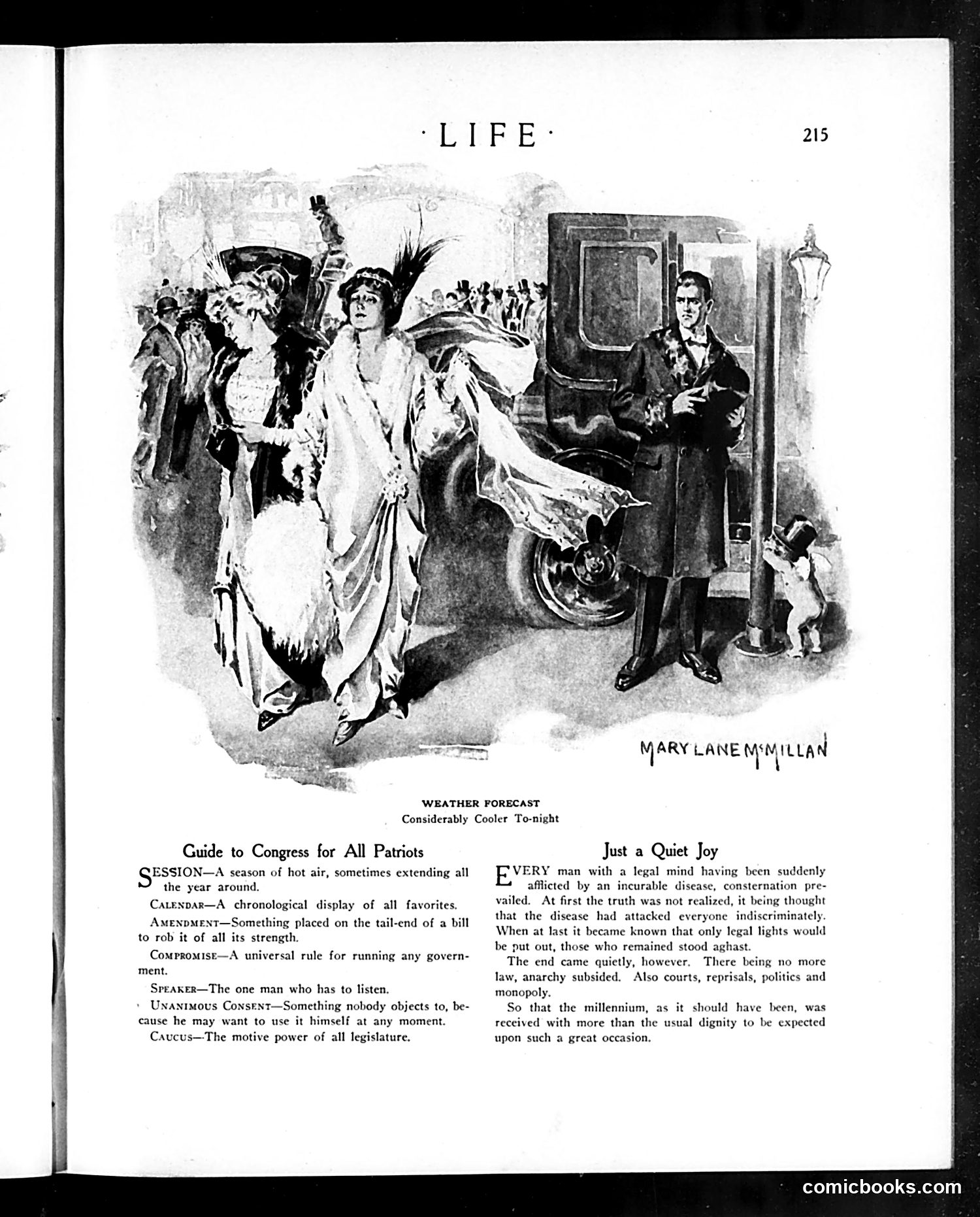
This page contains a satirical illustration by Mary Lane McMillan depicting fashionably dressed figures arriving at what appears to be a formal event or automobile. The cartoon illustrates "Weather Forecast: Considerably Cooler To-night"—likely a double entendre about both temperature and social climate. The left column, "Guide to Congress for All Patriots," humorously defines legislative terms (Session, Calendar, Amendment, Compromise, Speaker, Unanimous Consent, Caucus) in plain language, mocking congressional obscurity and procedure. The right column, "Just a Quiet Joy," describes relief following resolution of some unnamed legal crisis—possibly referencing labor unrest, trust-busting, or anarchist concerns common in early 20th-century America. The piece celebrates that law and order prevailed "quietly" without dramatic upheaval, suggesting the satirist found humor in the anticlimactic resolution.
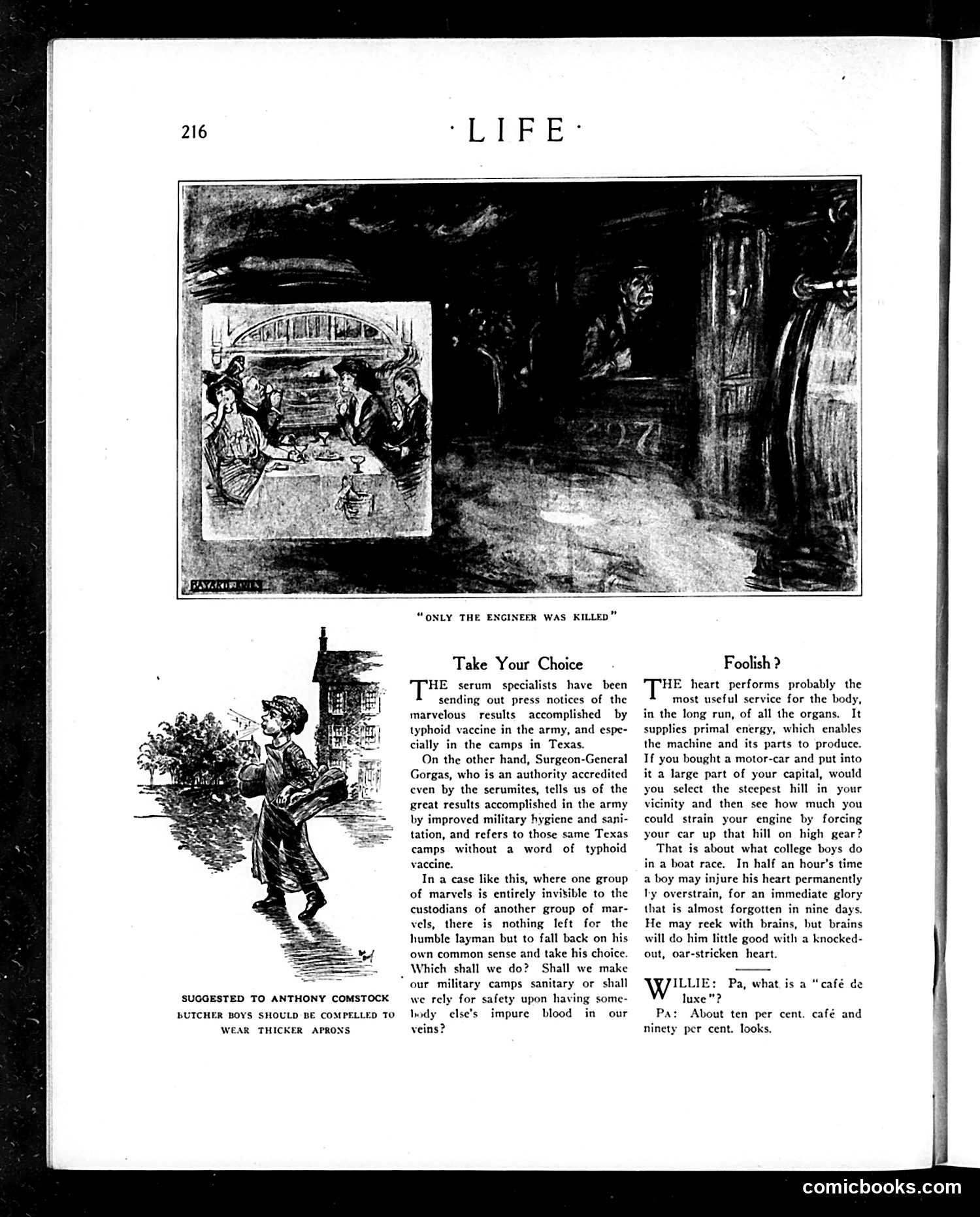
This page contains two distinct satirical pieces: **Top Image ("Only the Engineer Was Killed"):** A dark illustration showing what appears to be a train or vehicle accident scene, with an inset showing passengers dining. The caption's grim humor suggests irony about casualties. **"Take Your Choice":** A debate between medical authorities about typhoid vaccine effectiveness in Army camps, particularly Texas. The satire questions whether to trust Surgeon-General Gorgas's claims about sanitation improvements or rely on "common sense." **"Foolish?":** A humorous dialogue about motor-car engines and the human heart, using mechanical strain as metaphor for physical overexertion. **Bottom cartoon:** Suggests Anthony Comstock (implied moral censor) should require butchers wear thicker aprons—likely commentary on public decency standards versus practical workplace needs. The page reflects early-20th-century debates over public health, military administration, and social propriety.
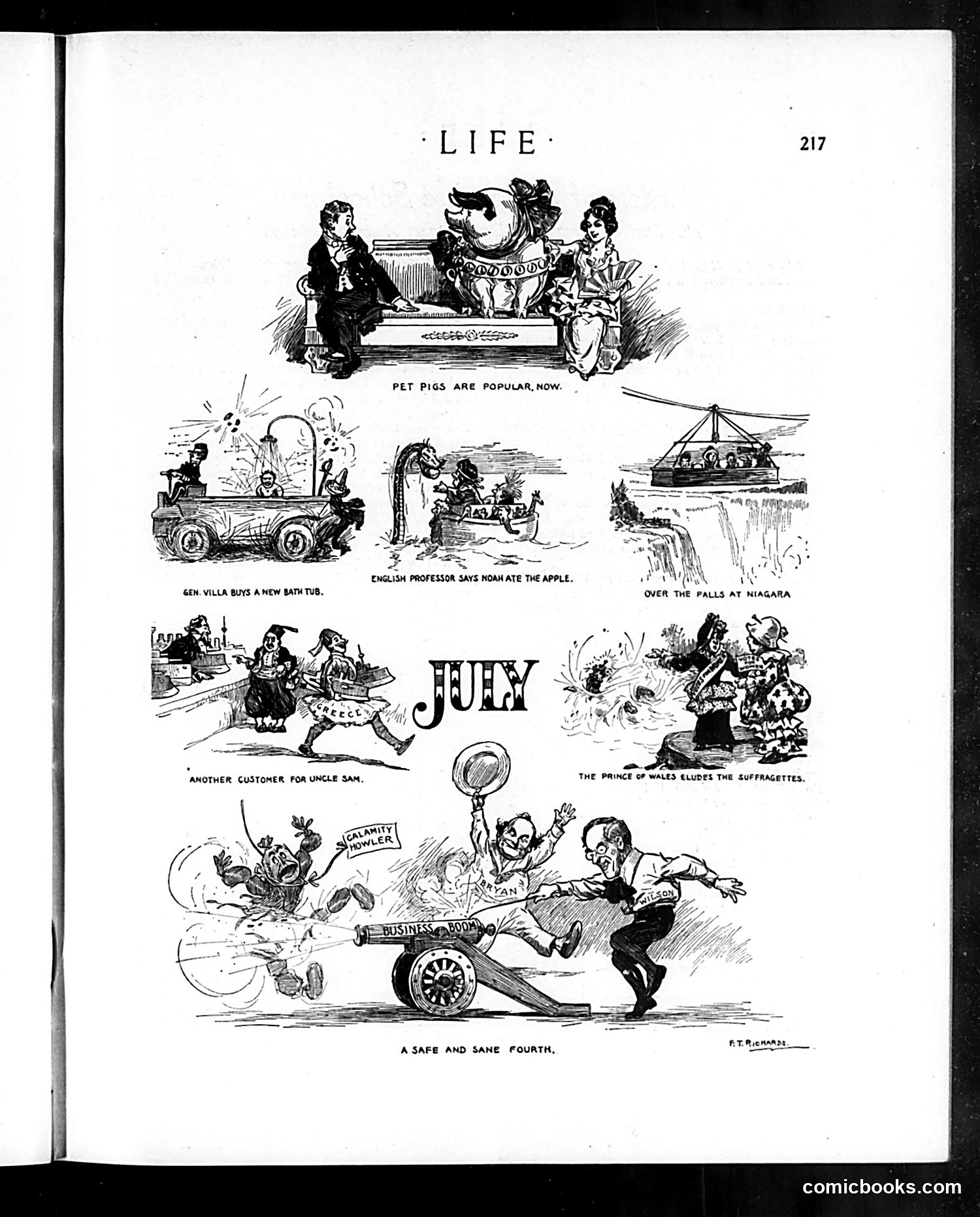
This page contains six political/social cartoons mocking contemporary events and figures: 1. **"Pet Pigs Are Popular Now"** - Satirizes fashionable society keeping pigs as pets, shown as elegantly dressed animals at a table. 2. **"Gen. Villa Buys a New Bath Tub"** - References Mexican General Pancho Villa (Mexican Revolution context), mocking his acquisition of modern luxuries. 3. **"English Professor Says Noah Ate the Apple"** - Religious/academic satire about biblical interpretation debates. 4. **"Over the Falls at Niagara"** - Depicts a dangerous stunt or accident. 5. **"Another Customer for Uncle Sam"** - Political commentary on American expansion or recruitment. 6. **"A Safe and Sane Fourth"** - July 4th safety satire, showing chaotic explosions despite promises of restraint. The cartoons employ exaggerated, crude caricature style typical of 1913 Life magazine's satirical approach to contemporary social and political absurdities.
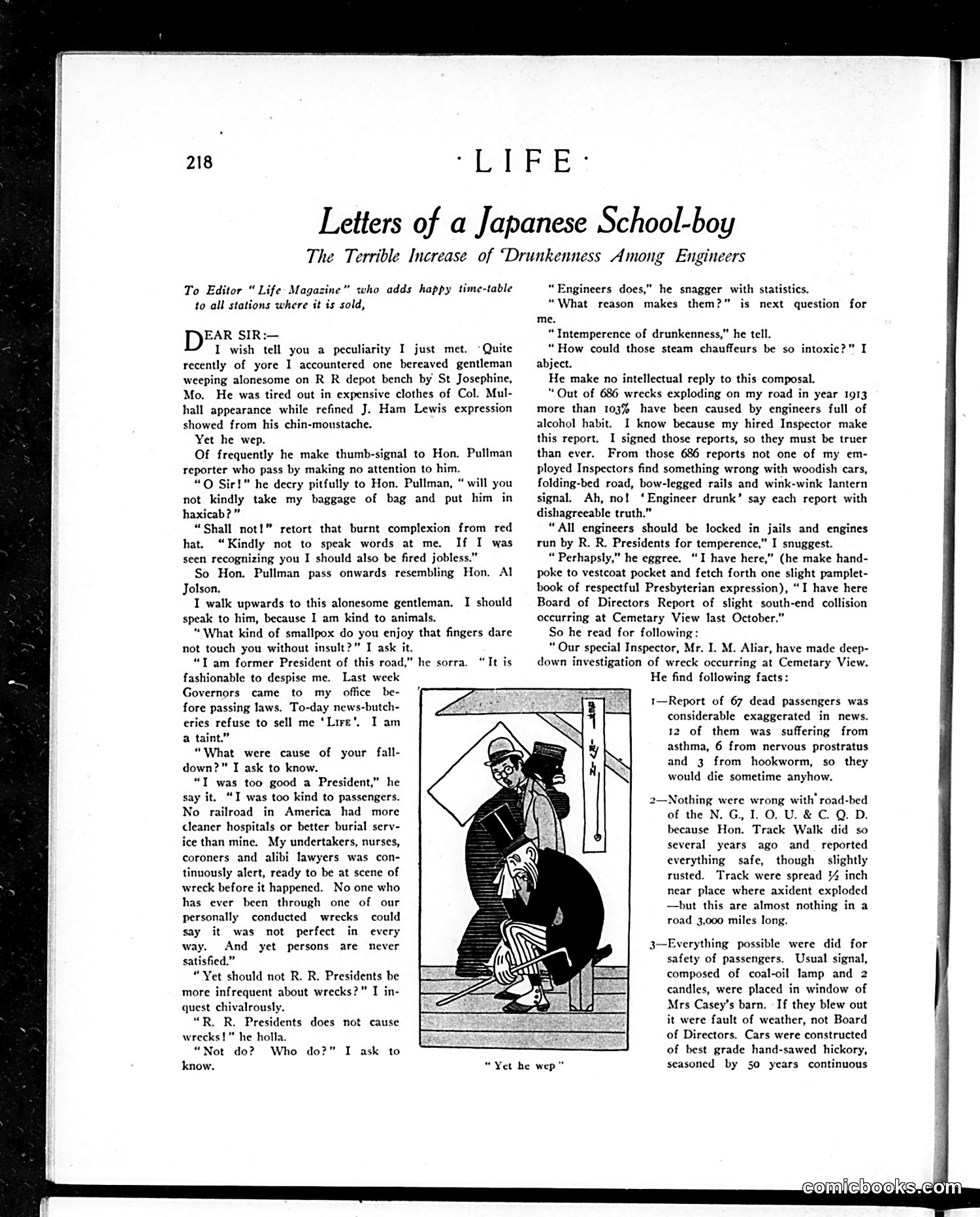
This satirical piece mocks railroad safety claims through a Japanese observer's perspective. The letter writer describes encountering a drunk railroad official who dismisses concerns about wrecks. The accompanying illustration shows a disheveled, intoxicated man in a train conductor's uniform. The satire targets railroad company executives' denial about safety problems—specifically, their deflection that engineer drunkenness doesn't cause wrecks. The Japanese correspondent's naive questions expose the absurdity of this position. By using a foreign perspective, the author emphasizes how ridiculous these claims sound to outside observers. The detailed statistics about wreck investigations serve to underscore that companies knew about the problem but refused accountability.
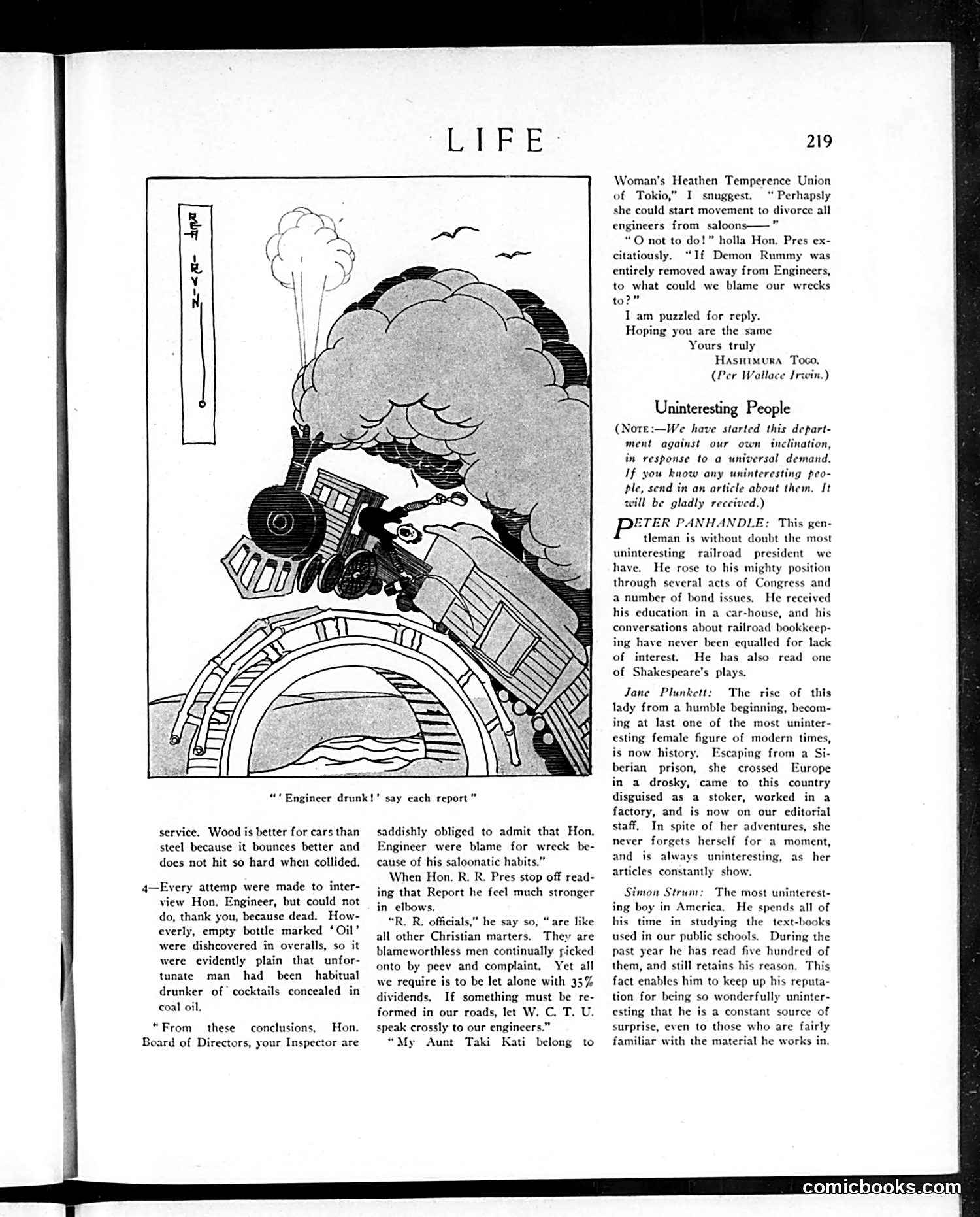
This *Life* magazine page contains two satirical pieces: **The Main Cartoon** depicts a train wreck caused by a drunk engineer. The accompanying letter (written in deliberately broken English by "Hasnimura Toco") mocks railroad executives who blame engineers' drinking for accidents while protecting their own 35% dividends. The railroad president absurdly argues that *removing* alcohol from engineers would eliminate their excuse for crashes—exposing corporate hypocrisy about safety versus profit. **"Uninteresting People"** is a humor column introducing three tediously dull individuals: a railroad president whose only qualification is congressional connections, a woman with an exotic past who paradoxically remains boring, and a boy who compulsively studies textbooks. The joke satirizes how some people remain utterly unremarkable despite their circumstances. Both pieces target corporate negligence, the temperance movement (via the Woman's Heathen Temperance Union reference), and American superficiality—common targets for *Life*'s satirical critique of early 20th-century society.
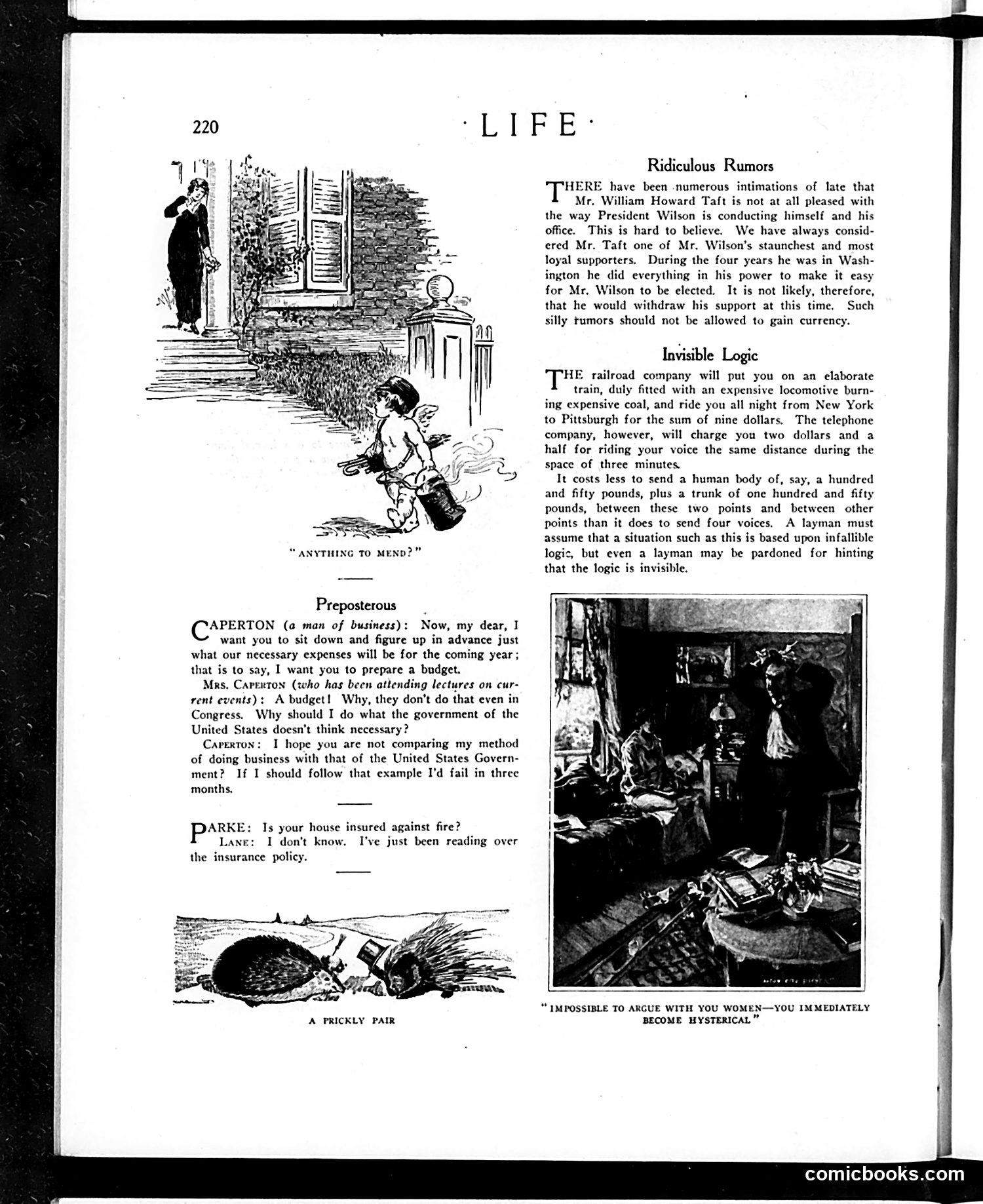
This page contains four separate satirical pieces from Life magazine: **"Ridiculous Rumors"** mocks gossip that former President William Howard Taft disapproves of President Wilson. Life sarcastically defends Taft's loyalty, implying the rumors are absurd—though the very fact that Life addresses them suggests tension between these political figures existed. **"Invisible Logic"** critiques the railroad and telephone industries' pricing inconsistencies: trains transport heavy bodies cheaply overnight, yet phones charge substantially more to transmit voices over the same distance. The satire highlights corporate pricing logic as irrational or deliberately exploitative. **"Preposterous"** satirizes a husband-wife dynamic where the wife, having attended lectures on current events, refuses to budget because Congress doesn't. The husband's exasperated retort—that his business would fail following government's example—mocks both governmental financial irresponsibility and women's newfound political awareness. **"A Prickly Pair"** (cartoon) and the final illustration address gender conflict, suggesting women become "hysterical" when arguing, reinforcing period stereotypes about female emotionality versus male rationality.
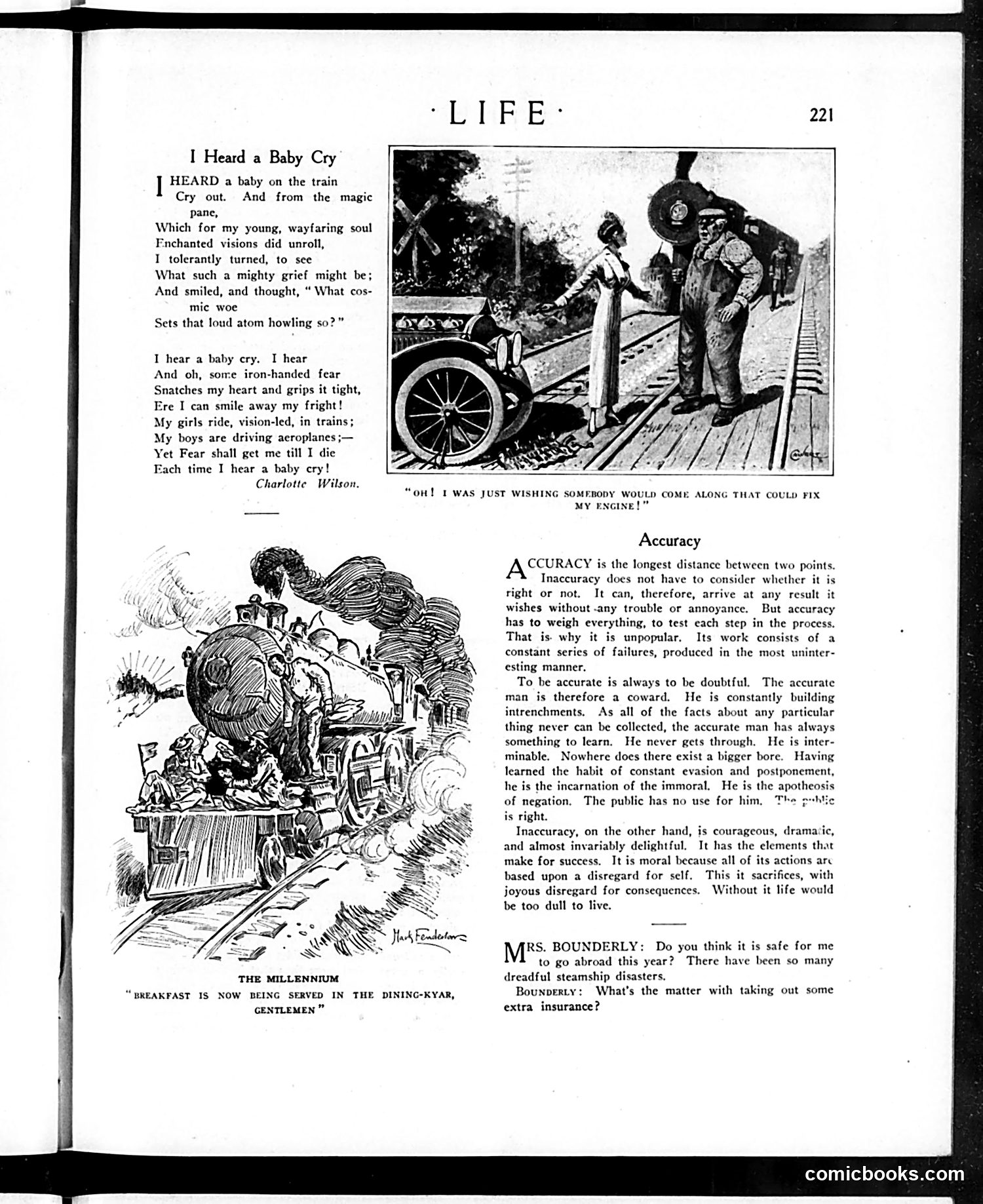
This page contains three distinct pieces: **"I Heard a Baby Cry"** (poem by Charlotte Wilson): A sentimental reflection on parenthood. The speaker once found a crying baby on a train merely amusing, philosophizing about it abstractly. Now, with children of their own traveling by train and airplane, that same cry triggers genuine terror—fear for their safety. The satire is gentle: it mocks the speaker's former detachment while validating modern parental anxiety about transportation dangers. **"The Millennium"** (cartoon): A crowded, chaotic train car labeled "breakfast in the dining-car"—appears to satirize the absurdity or chaos of modern railway dining service. **"Accuracy"** (essay/satire): A tongue-in-cheek inversion arguing accuracy is boring, cowardly, and unpopular, while inaccuracy is courageous and delightful. This is philosophical satire—likely mocking people who prioritize expedience or dramatic narrative over truth-telling. **"Mrs. Bounderly"** (brief dialogue): A woman worried about steamship disasters asks about insurance—appears to satirize anxious travelers and the insurance industry's response to transportation safety concerns.
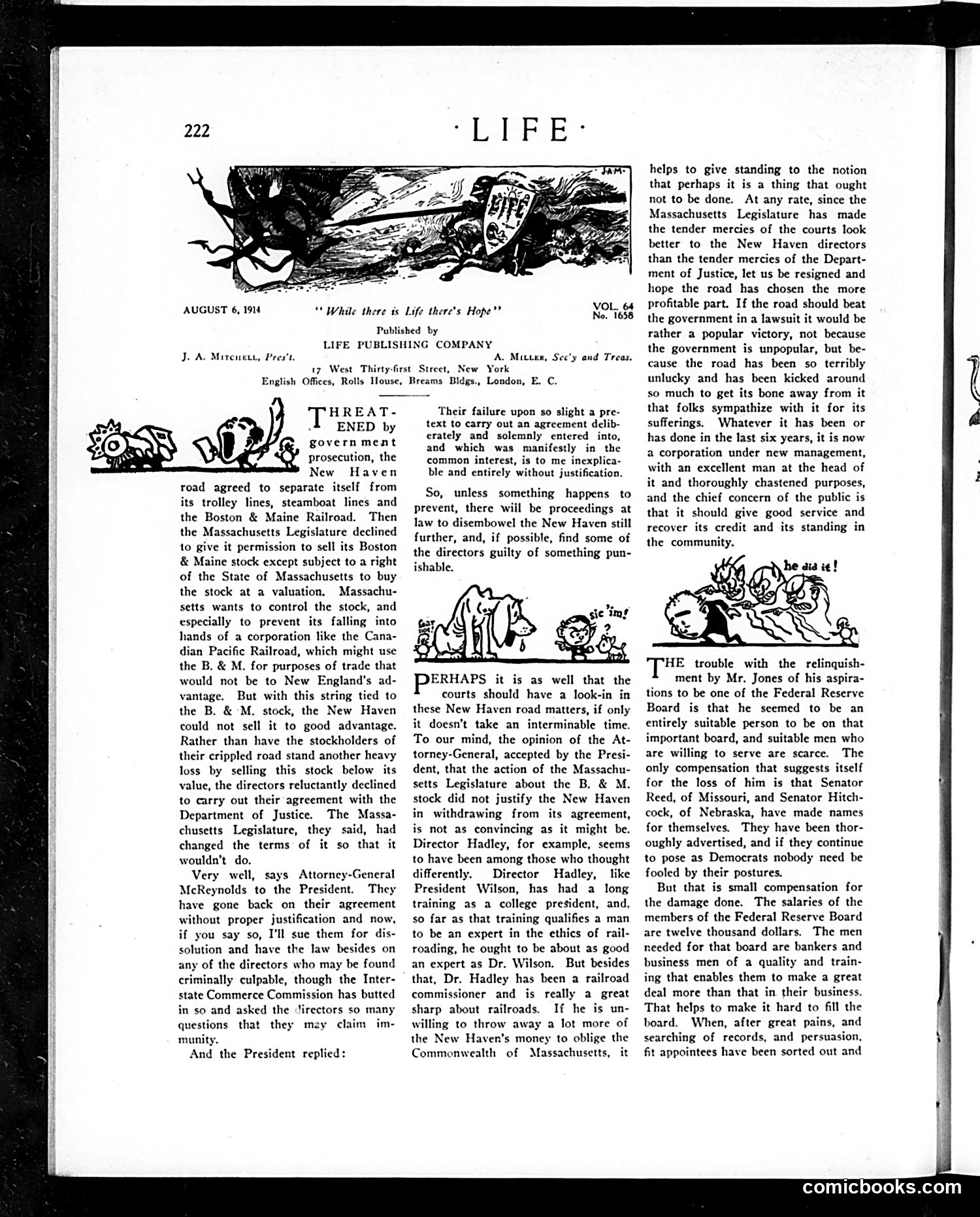
This page satirizes a dispute over the New Haven Railroad's corporate structure. The U.S. Department of Justice sued to force the New Haven to divest itself of subsidiary lines (trolleys, steamboats, the Boston & Maine Railroad) to prevent monopolistic control. The railroad initially agreed but then backed out when Massachusetts imposed conditions on selling the B&M stock that made the deal unprofitable. The article mocks this reversal, with President Wilson and Attorney-General McReynolds threatening dissolution proceedings. However, Life suggests the railroad director Hadley (a former college president and railroad commissioner with ethical training) may have a point—that Massachusetts's interference made the original agreement impossible to fulfill. The small cartoon (visible but unclear in detail) likely comments humorously on this bureaucratic tangle. The piece ultimately expresses resignation that courts rather than politicians will resolve the matter, hoping the railroad wins because popular opinion favors beating government overreach.
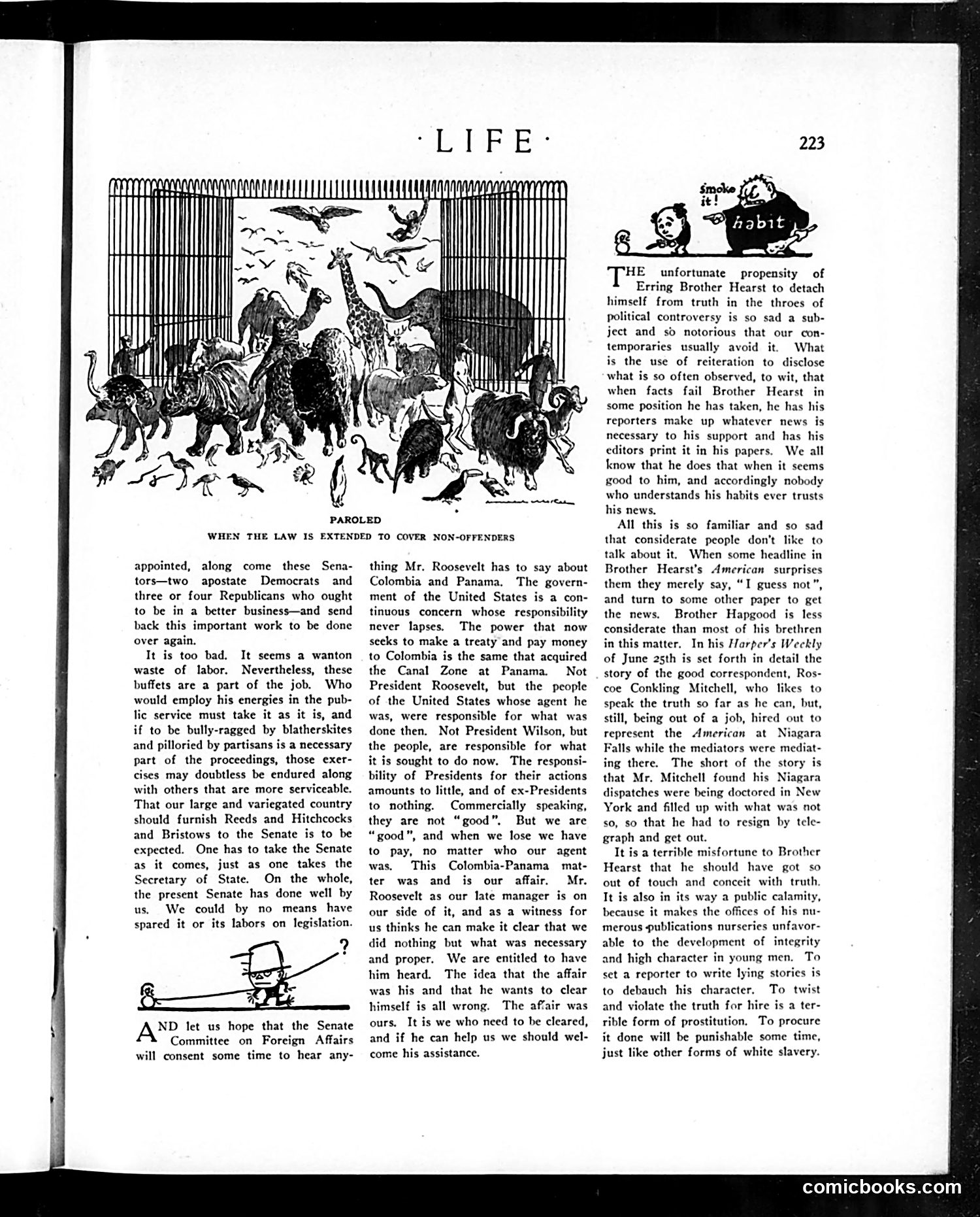
This page contains two satirical pieces critiquing American political figures and institutions circa early 1900s. **Left cartoon & text:** Attacks Senate obstructionists—specifically naming Senators Reed, Hitchcock, and Bristow—for repeatedly rejecting and returning legislation for revision. Life sarcastically defends tolerating these "buffets" as necessary to democratic process, though calling them "blatherskites" (loudmouths). **Right section:** Criticizes William Randolph Hearst's newspaper *The American* for fabricating news to support political positions. The piece references correspondent Roscoe Conkling Mitchell, whose dispatches from Niagara Falls mediation talks were allegedly doctored in New York. Life condemns Hearst for systematically manufacturing false news when facts don't support his agenda, suggesting readers know to distrust his papers and consult competitors instead. Both pieces target political manipulation through Senate obstruction and yellow journalism—key Progressive Era concerns.
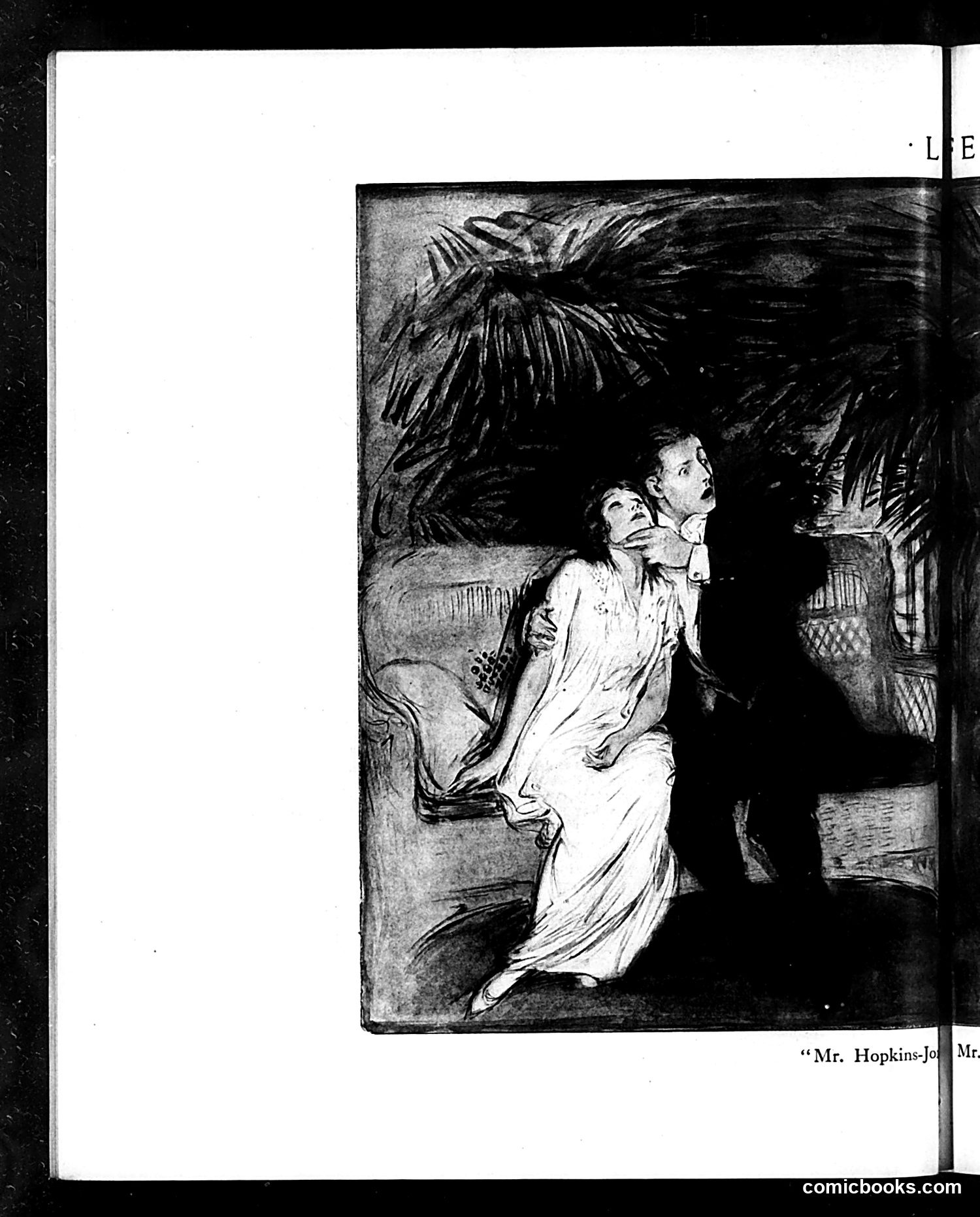
This appears to be a dramatic illustration from *Life* magazine showing two figures in what seems to be an intimate or tense domestic scene. A woman in a flowing white garment reclines on furniture while a man stands behind/above her in formal dress. The setting includes tropical plants and interior furnishings suggesting wealth or leisure. The partial caption "Mr. Hopkins-Jo" is cut off, making it impossible to identify the specific reference or context. Without the complete caption or article text, I cannot determine whether this illustrates a social commentary, a literary reference, a scandal, or satirical commentary on contemporary figures or behavior. The dramatic style suggests it depicts a morality tale or social critique typical of *Life* magazine's content.
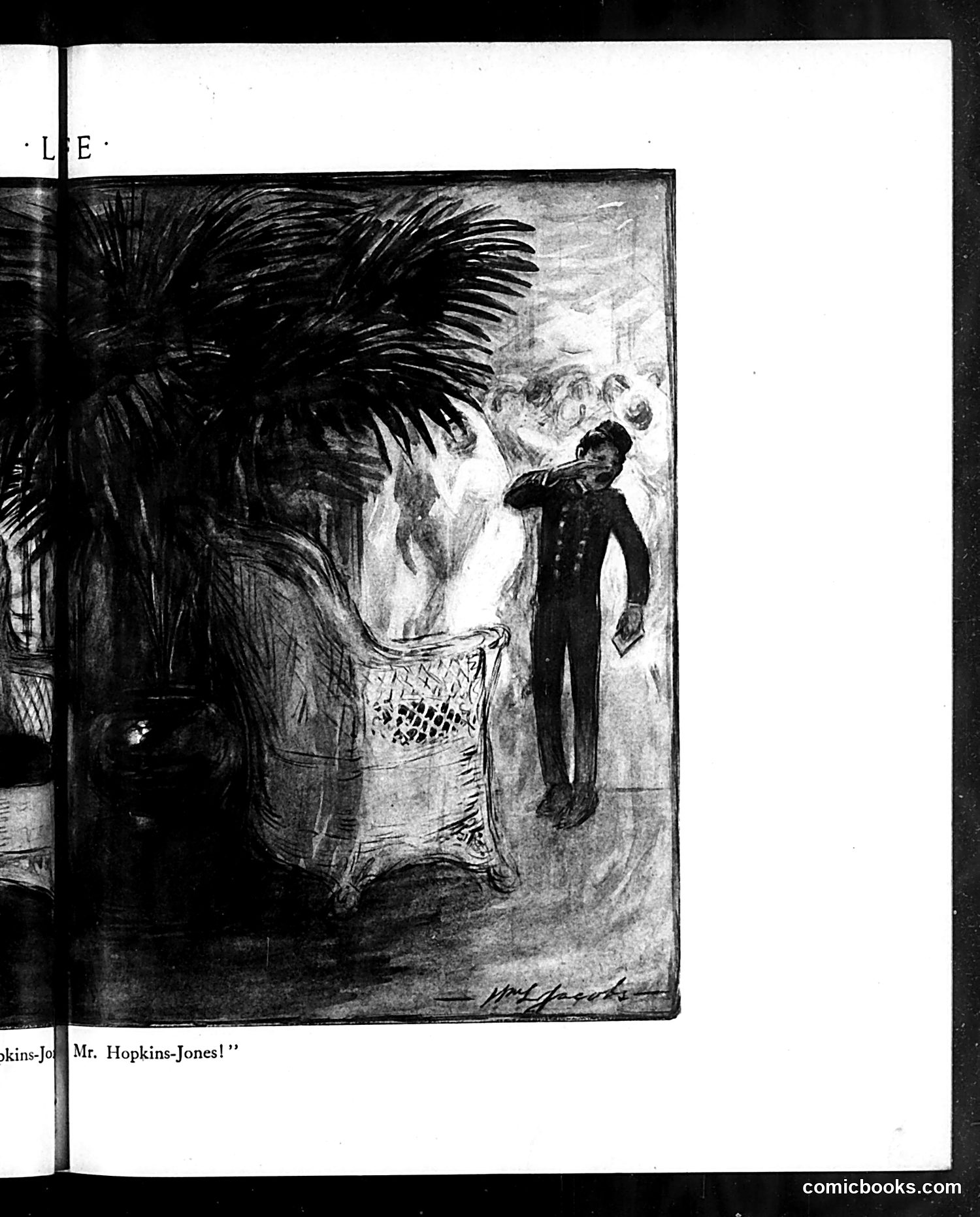
This appears to be a political cartoon from *Life* magazine featuring a dramatic scene. On the left is a large, dark, menacing figure (drawn with heavy black shading and fierce features) that appears to represent a threatening force or enemy. On the right stands a formally dressed man in dark clothing, depicted in a vulnerable pose - one hand raised defensively near his face. The caption reads "Mr. Hopkins-Jones!" suggesting this is commentary on a specific public figure. Without additional context about the date or historical circumstances, the exact political reference is unclear, but the composition suggests satire about a politician or public official confronting some form of threat or corruption. The artistic style and dramatic rendering emphasize danger or moral peril. The cartoon's point appears critical of the named figure's position or character.
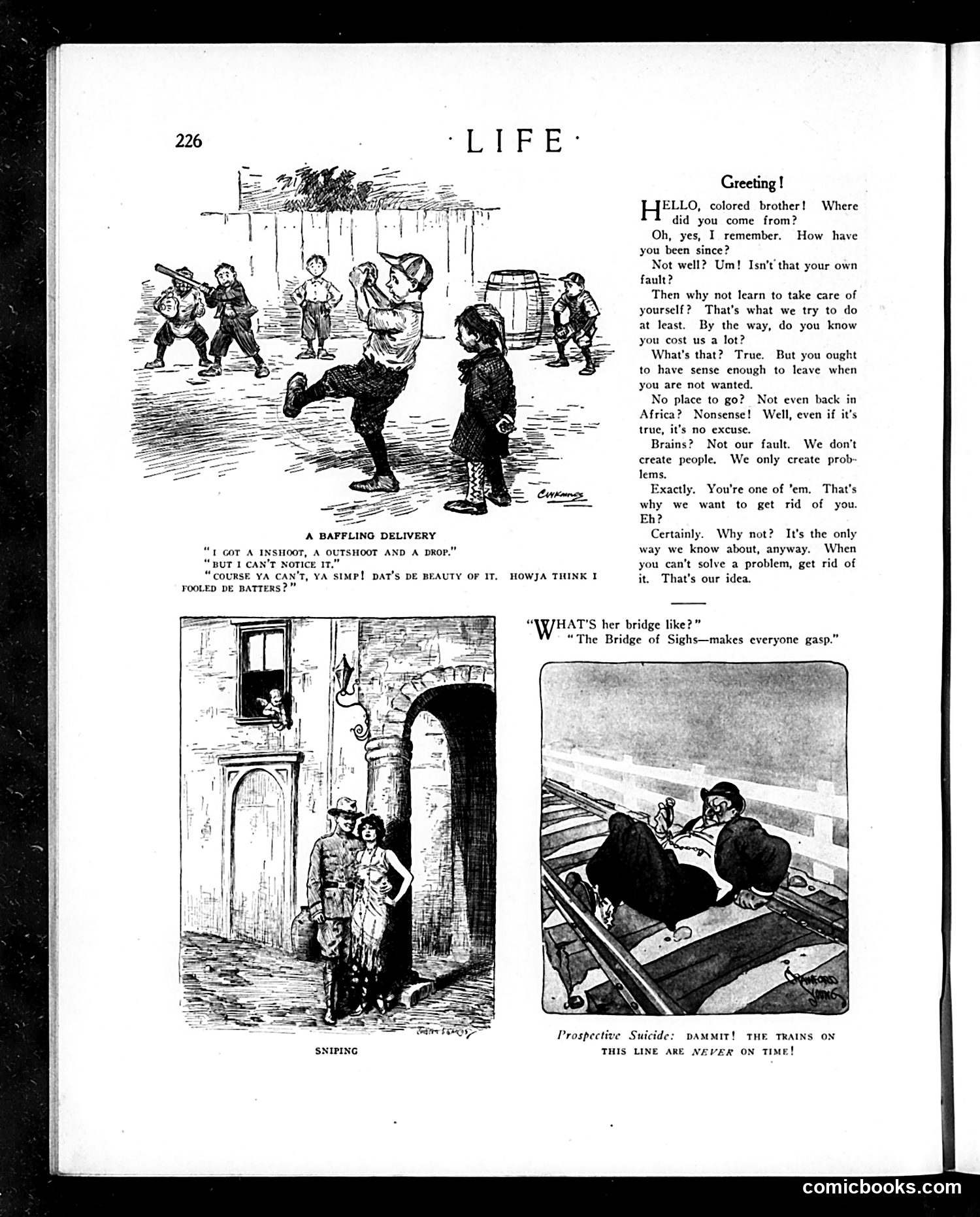
This page contains deeply racist content reflecting early 20th-century attitudes. The main "Greeting!" dialogue depicts a white person coldly dismissing a Black person, suggesting they're a burden ("you cost us a lot") and should leave the country or solve their own problems. The speaker callously concludes that when problems can't be solved, "get rid of it"—a chilling euphemism. The other cartoons appear unrelated: "A Baffling Delivery" depicts baseball players discussing a trick pitch; "Sniping" shows a figure at a doorway; and "Prospective Suicide" makes a dark joke about unreliable train schedules. The "Greeting" piece represents the magazine's satirical critique of white indifference and hostility toward Black Americans, though framed through the perpetrator's own callous voice—likely intending satirical exposure rather than endorsement, though the execution is deeply offensive by modern standards.
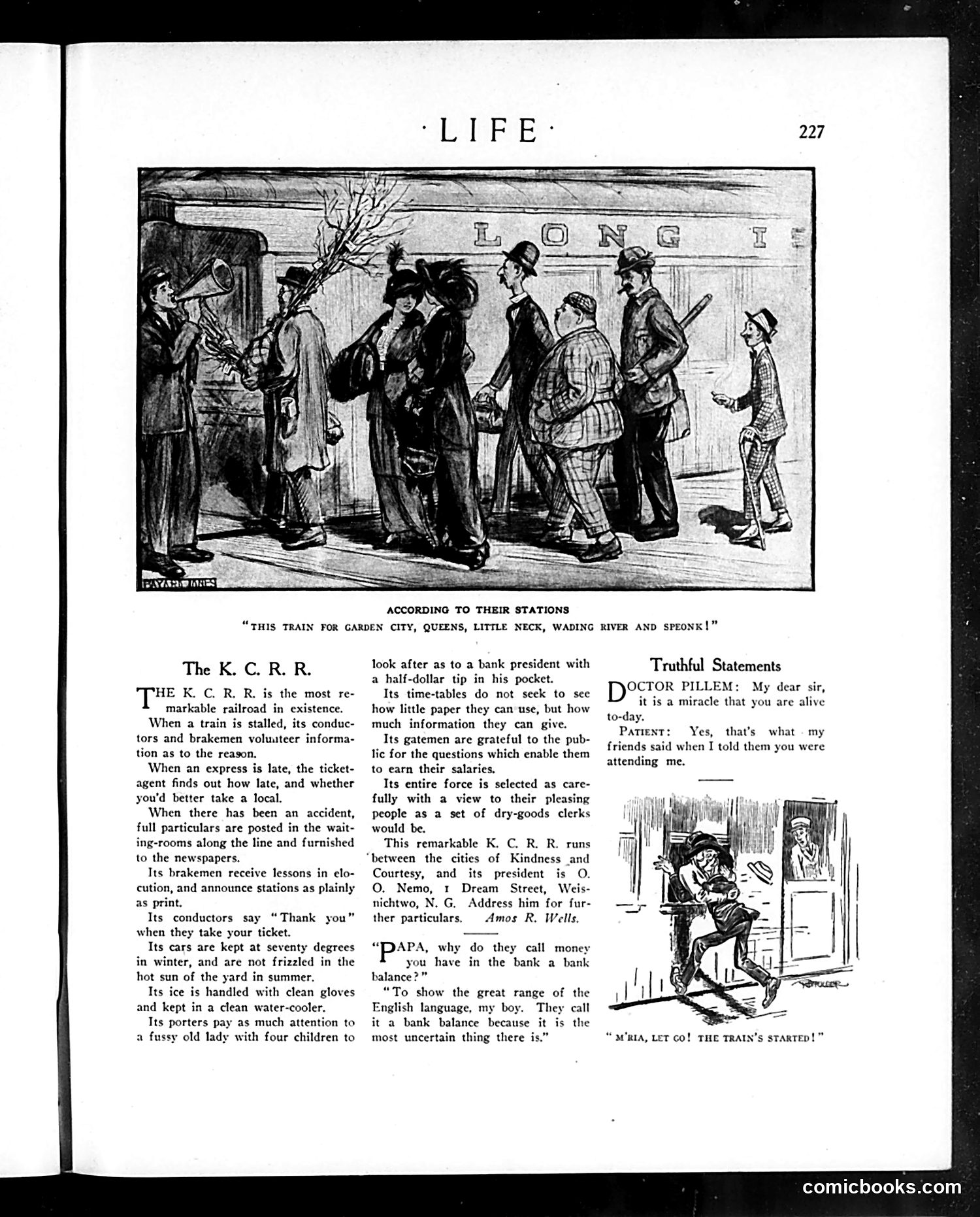
The top cartoon mocks an absurdly idealized railroad—the K.C.R.R.—by describing its impossibly courteous service: conductors who volunteer information, brakemen trained in elocution, porters treating elderly ladies and bank presidents equally, and gatemen grateful for customer questions. The satire works by contrast: this fictional railroad treats passengers with dignity and transparency—posting accident details, maintaining readable timetables, handling ice with clean gloves—practices that were apparently rare enough to warrant mockery. The fictional president "O.O. Nemo" (Nobody) from "Weisnichtwo" (German: "I-know-not-where") emphasizes the fantasy. This satirizes real railroads' notorious indifference to passenger comfort and safety during the early 20th century. The small "Truthful Statements" joke critiques pretentious doctors, while the bank-balance exchange mocks financial uncertainty.
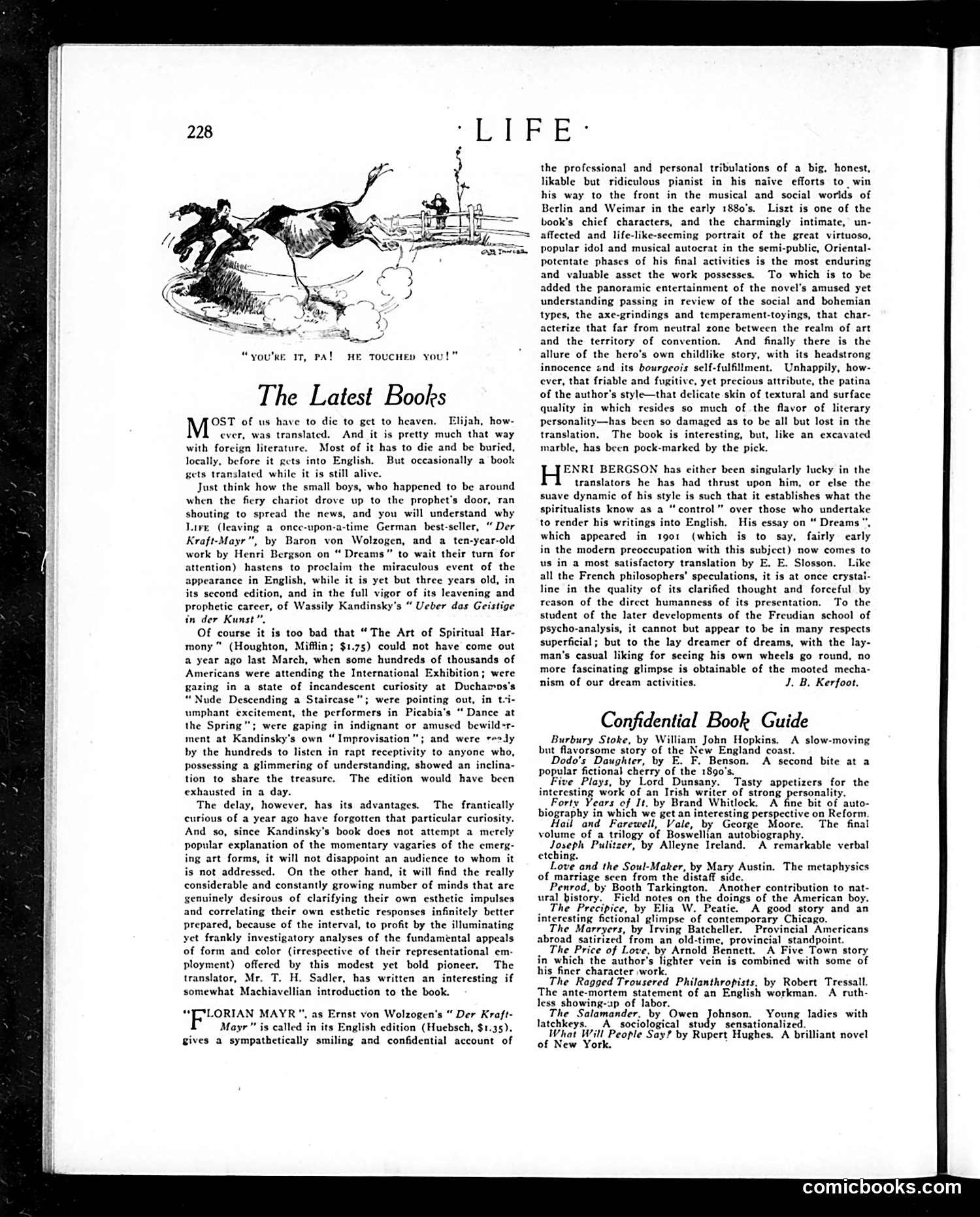
## The Cartoon The small illustration at top shows a figure being thrown or propelled violently, with the caption "YOU'RE IT, PA! HE TOUCHED YOU!" This appears to be a children's playground joke—a "tag" game reference—where the humor likely derives from the innocent physical contact between children, possibly with double-entendre implications given the era's sensibilities. ## The Content This page reviews newly translated books, primarily discussing Wassily Kandinsky's "The Art of Spiritual Harmony" and Ernst von Wolzogen's "Der Kraft-Mayr." The satire comments on the timing of literary translations: the Kandinsky book appears three years after the 1913 Armory Show (referenced through Duchamp's "Nude Descending a Staircase"), when American interest in modern art had cooled. The reviewer argues this delay is actually beneficial—the public is now intellectually prepared to appreciate Kandinsky's theoretical approach rather than merely gawking at avant-garde novelty. The tone is sophisticated and encouraging toward experimental art while gently mocking earlier sensationalism around modernism.
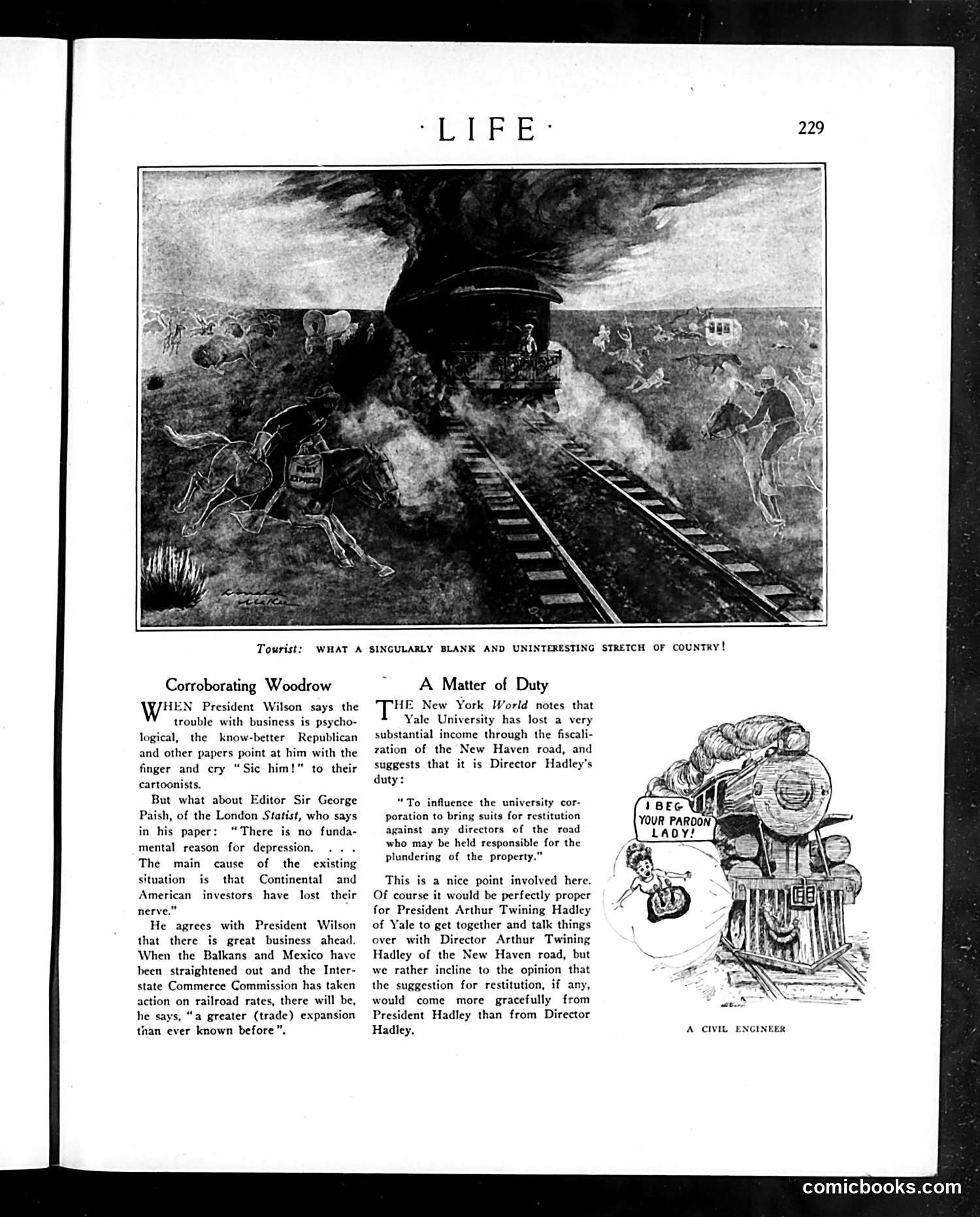
This *Life* magazine page contains satirical commentary on early 20th-century business and institutional conflicts. **"Corroborating Woodrow"** mocks President Wilson's claim that business depression is psychological. The article notes that Republican papers attack Wilson by citing British editor Sir George Paish, who agrees with Wilson's optimism about future growth—undermining the Republicans' criticism. **"A Matter of Duty"** highlights a conflict of interest involving Arthur Twining Hadley, who simultaneously served as Yale University's president AND as a director of the New Haven Railroad. Yale had lost substantial income when the railroad was "fiscalized" (placed under government control). The satire points out the absurdity: Hadley cannot ethically pressure himself (as railroad director) to compensate Yale (his university). The suggestion for restitution should come *from* President Hadley, not *to* him as Director Hadley—exposing the impossibility of his dual roles. The top cartoon satirizes tourists finding the railroad landscape uninteresting, contrasting with the serious institutional malfeasance discussed below.
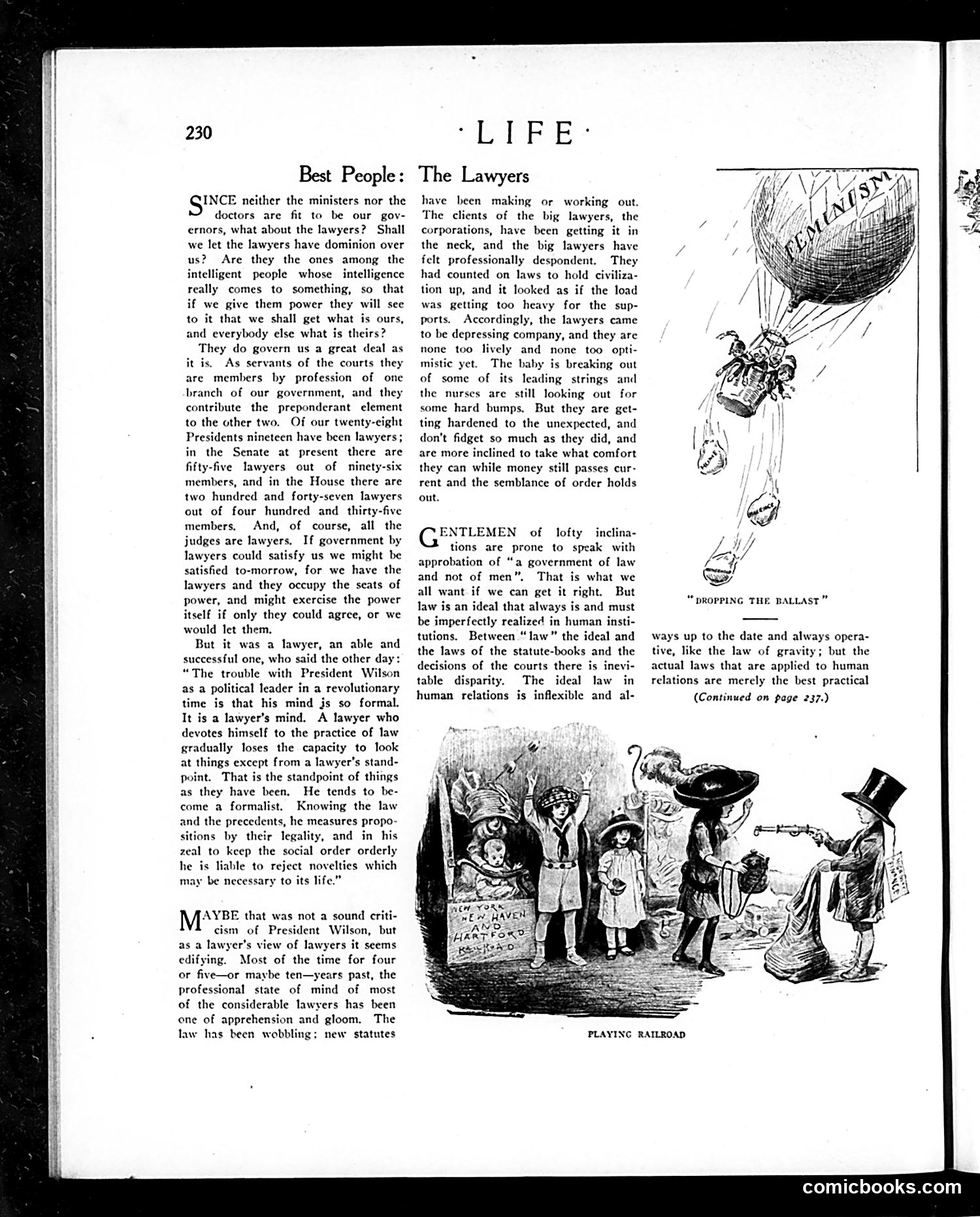
This satirical article critiques lawyer-dominated government in America. The text notes that 19 of 28 U.S. Presidents were lawyers, plus majorities in Congress and all judges—yet this hasn't solved societal problems. The article's key argument: lawyers think like formalists bound by precedent, making them poor leaders during revolutionary times. It specifically criticizes President Wilson as having "a lawyer's mind" too focused on legality rather than necessary change. The two cartoons illustrate this critique: - **"Dropping the Ballast"** shows a ship discarding cargo—symbolizing society shedding old legal constraints - **"Playing Railroad"** depicts children playing with toy trains, suggesting lawyers' outdated thinking is childish The satire suggests that while lawyers provide order, their rigid adherence to existing law prevents necessary social reform. The piece advocates for pragmatism over legal formalism during turbulent times.
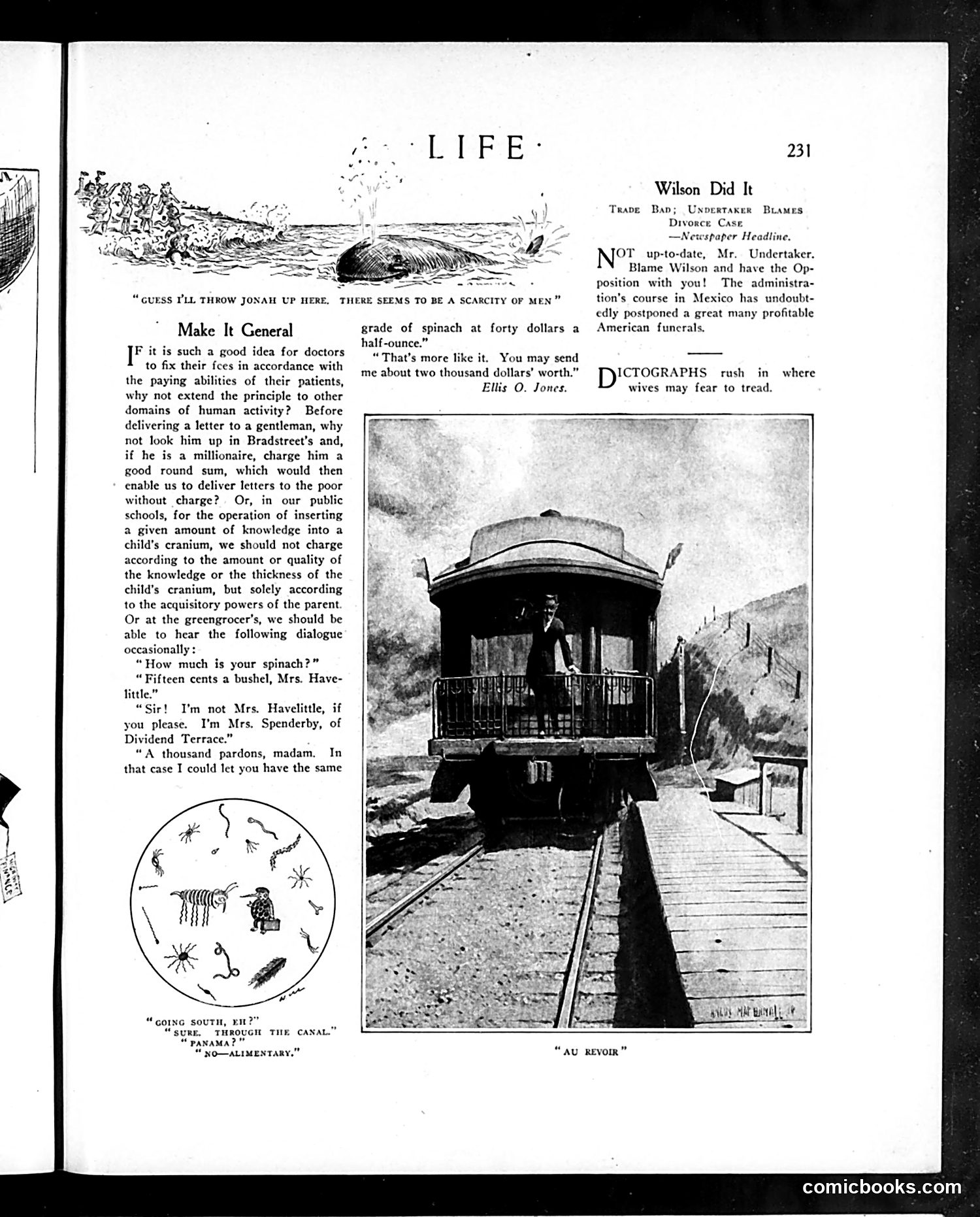
**"Make It General"** is a satirical essay by Ellis O. Jones mocking the principle of variable pricing based on ability to pay. The author proposes extending doctors' practice of sliding fees to all services—postmen charging millionaires more, schools charging by parents' wealth, grocers selling spinach at $40 per half-ounce to the wealthy. The circular diagram labeled "Going South, Eh?" appears to show microscopic organisms, humorously illustrating how absurd such pricing schemes would become. The satire critiques wealth-based pricing as economically illogical. **"Wilson Did It"** references President Woodrow Wilson's Mexican policies (likely the 1914 Veracruz intervention or ongoing Mexican Revolution instability). The headline about a "Trade Bad; Undertaker Blames Divorce Case" is reinterpreted—Republicans are apparently blaming Wilson's Mexico policy for postponing American funerals by disrupting trade, thus reducing undertakers' business. It's a cynical jab at political opportunism: opposition figures weaponizing any negative economic consequence against the administration.
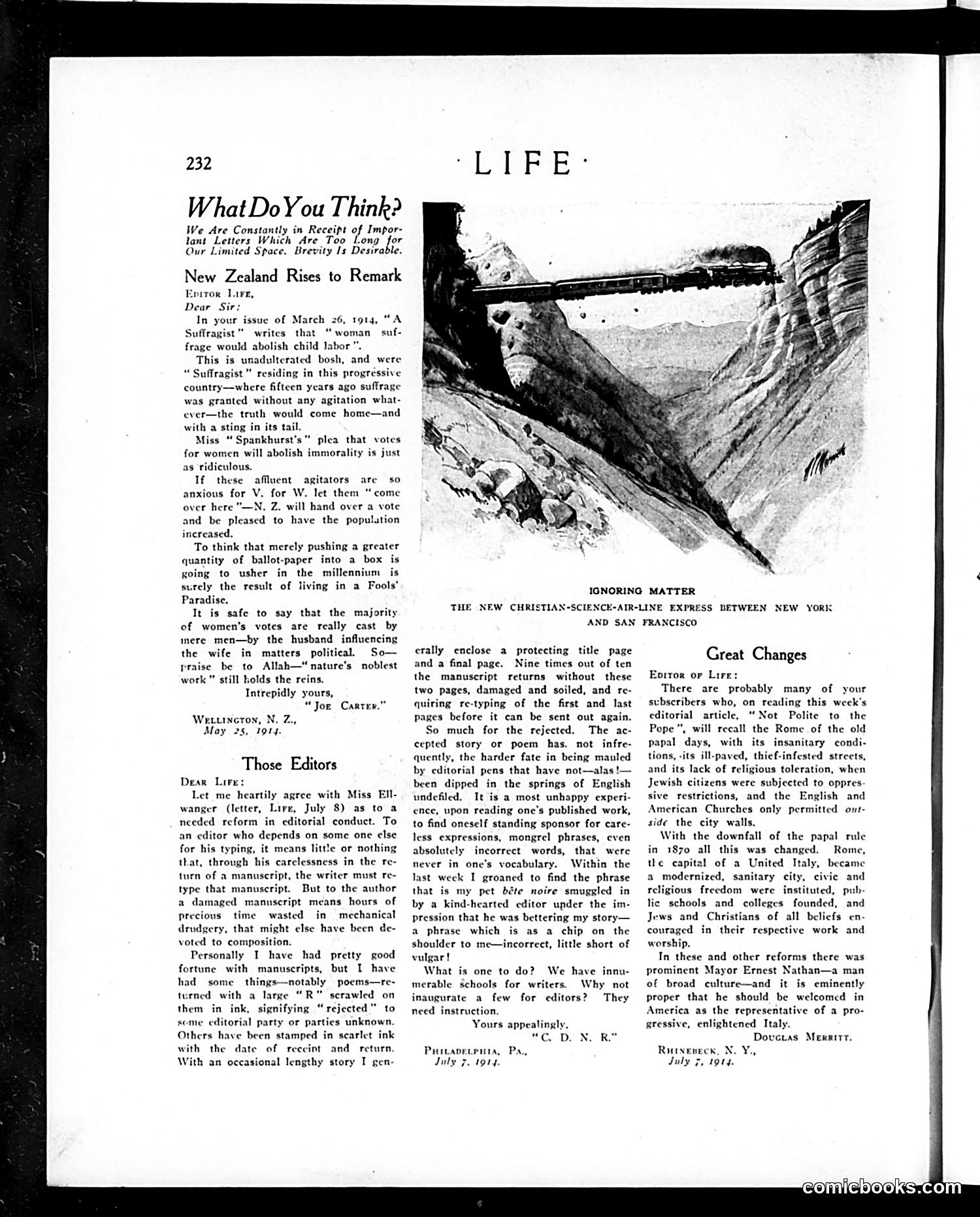
This page features readers' letters under "What Do You Think?" — a common editorial feature in *Life* magazine. **Key content:** 1. **New Zealand letter**: A reader ("Joe Carter") from Wellington responds to earlier suffrage debate, arguing that women's suffrage won't solve social problems as claimed. He mocks suffragists' optimism and notes that in New Zealand (which granted women's suffrage 15 years prior), women's votes are largely controlled by husbands anyway. 2. **Editorial complaint letter**: A writer criticizes magazine editors for damaging submitted manuscripts through careless handling and making unauthorized edits that introduce grammatical errors or change intended phrasing. 3. **"Great Changes" piece**: References a recent *Life* editorial ("Not Polite to the Pope") about modernization in Rome, contrasting old papal Rome's poor conditions with contemporary reforms. **The cartoon** (top right) appears to show a train on a dramatic cliff or mountainside, captioning the new Christian Science air-line service between New York and San Francisco — likely satire about a fantastical or dangerous transportation claim.
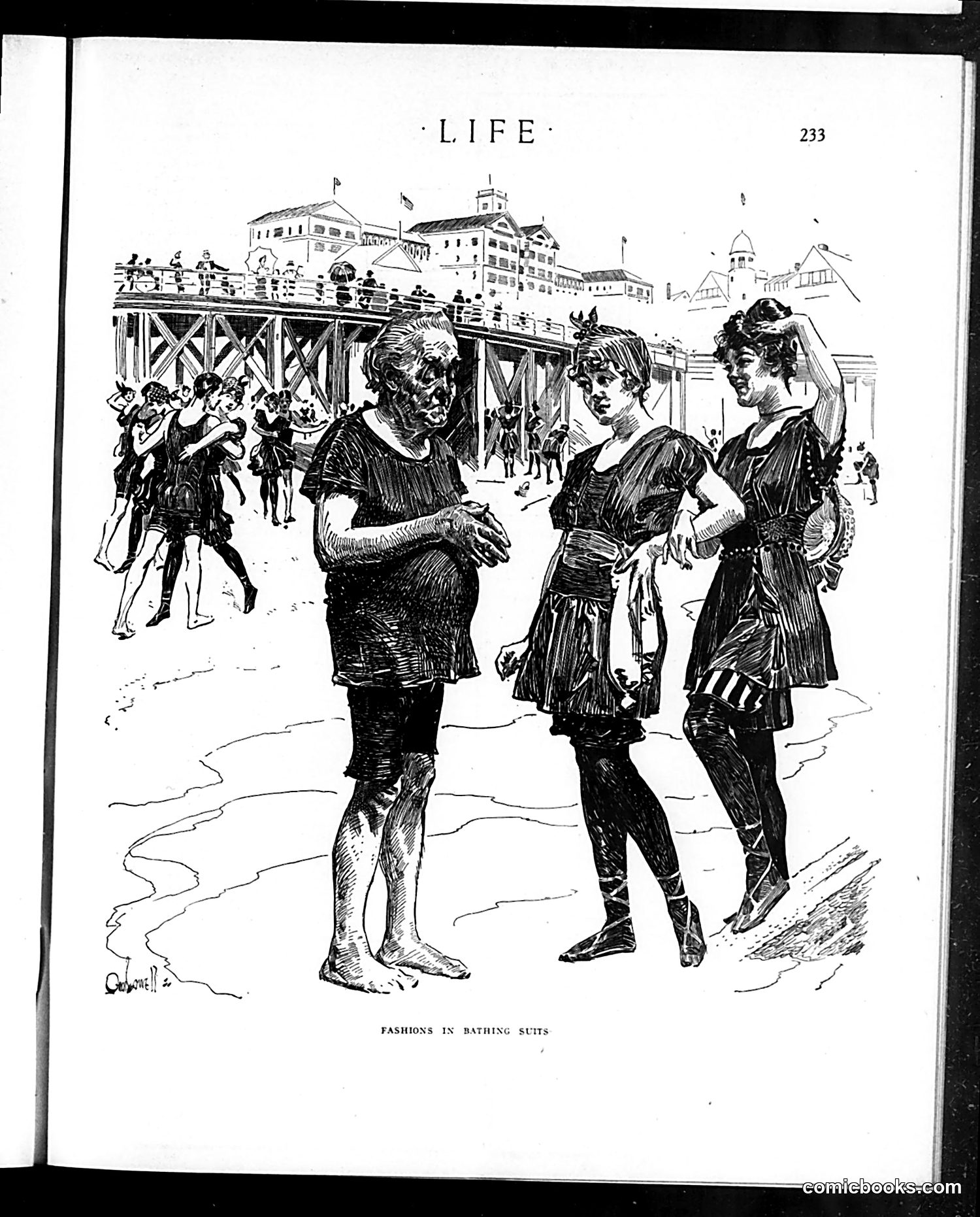
This satirical illustration depicts three women in different bathing suit styles at what appears to be a beach resort (visible pier and buildings in background). The caption "Fashions in Bathing Suits" suggests the cartoon comments on evolving swimwear trends. The figure on the left wears minimal clothing—essentially just swim briefs—while the two women on the right wear more modest, fully-sleeved bathing dresses typical of early 20th-century fashion. The stark contrast suggests satire about rapidly changing standards of female modesty and acceptable beach attire. The exaggerated physique of the nearly-nude figure emphasizes how dramatically swimwear conventions were shifting during this era, likely poking fun at both conservative and progressive attitudes toward women's fashion and public exposure.
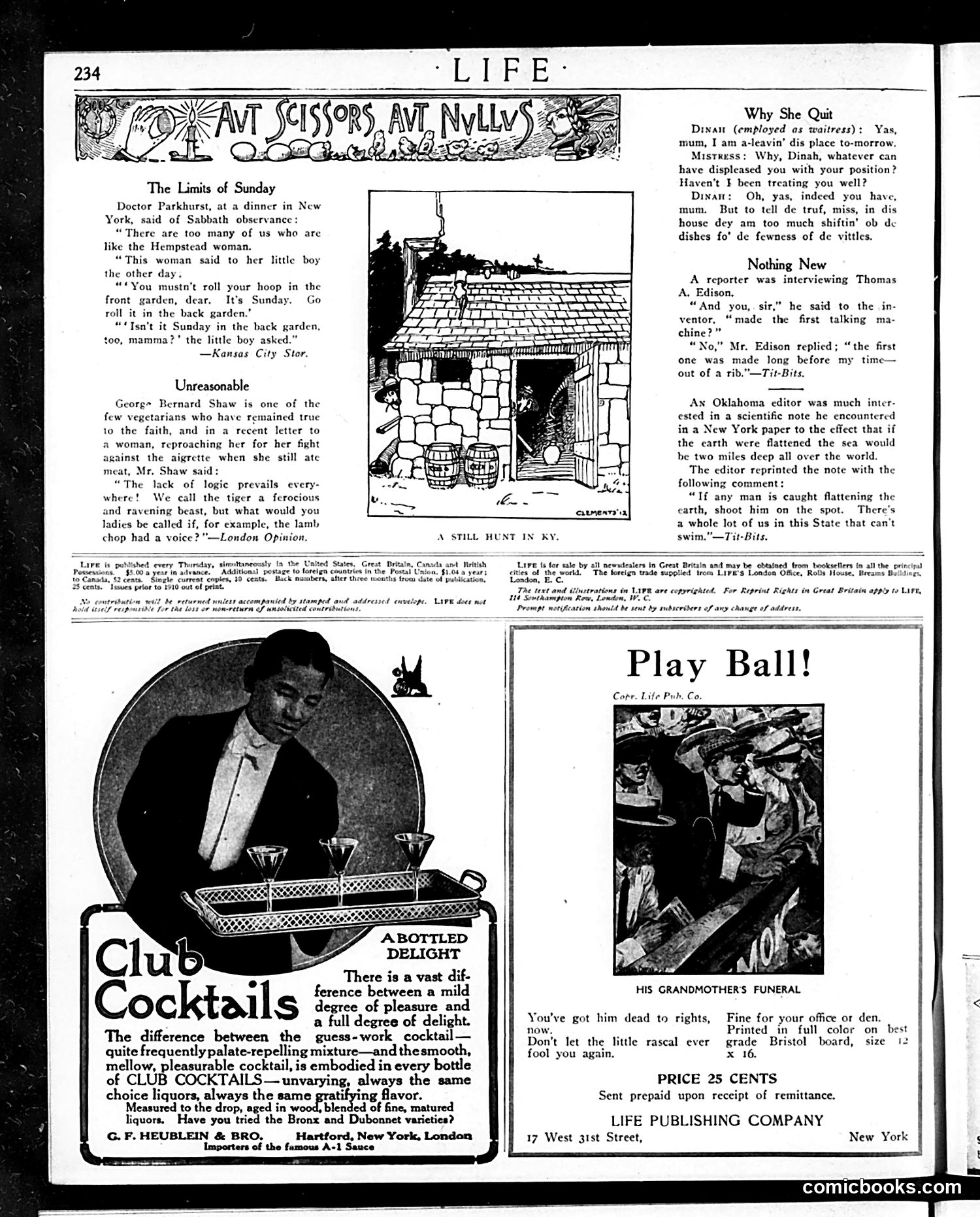
This page from Life magazine (circa early 1900s) contains humorous anecdotes and advertisements rather than political cartoons. The content satirizes social hypocrisies and absurdities: **"The Limits of Sunday"** mocks selective religious observance—a mother forbids her son rolling a hoop on Sunday in the *front* garden but allows it in the *back*, ignoring that Sunday restrictions apply everywhere. The joke critiques arbitrary piety. **"Unreasonable"** references George Bernard Shaw's vegetarianism, quoting his criticism of women wearing aigrettes (feathered hats) while eating meat—calling out logical inconsistency in ethical positions. **"Nothing New"** contains Edison making a biblical joke: his "talking machine" wasn't original since Eve (created from Adam's rib) spoke first. **"Play Ball!"** advertises a print showing children at a funeral, titled "His Grandmother's Funeral"—darkly humorous ephemera common to the era. The page also advertises Club Cocktails, emphasizing consistency and quality—a commercial parallel to the surrounding satire about standards and authenticity.
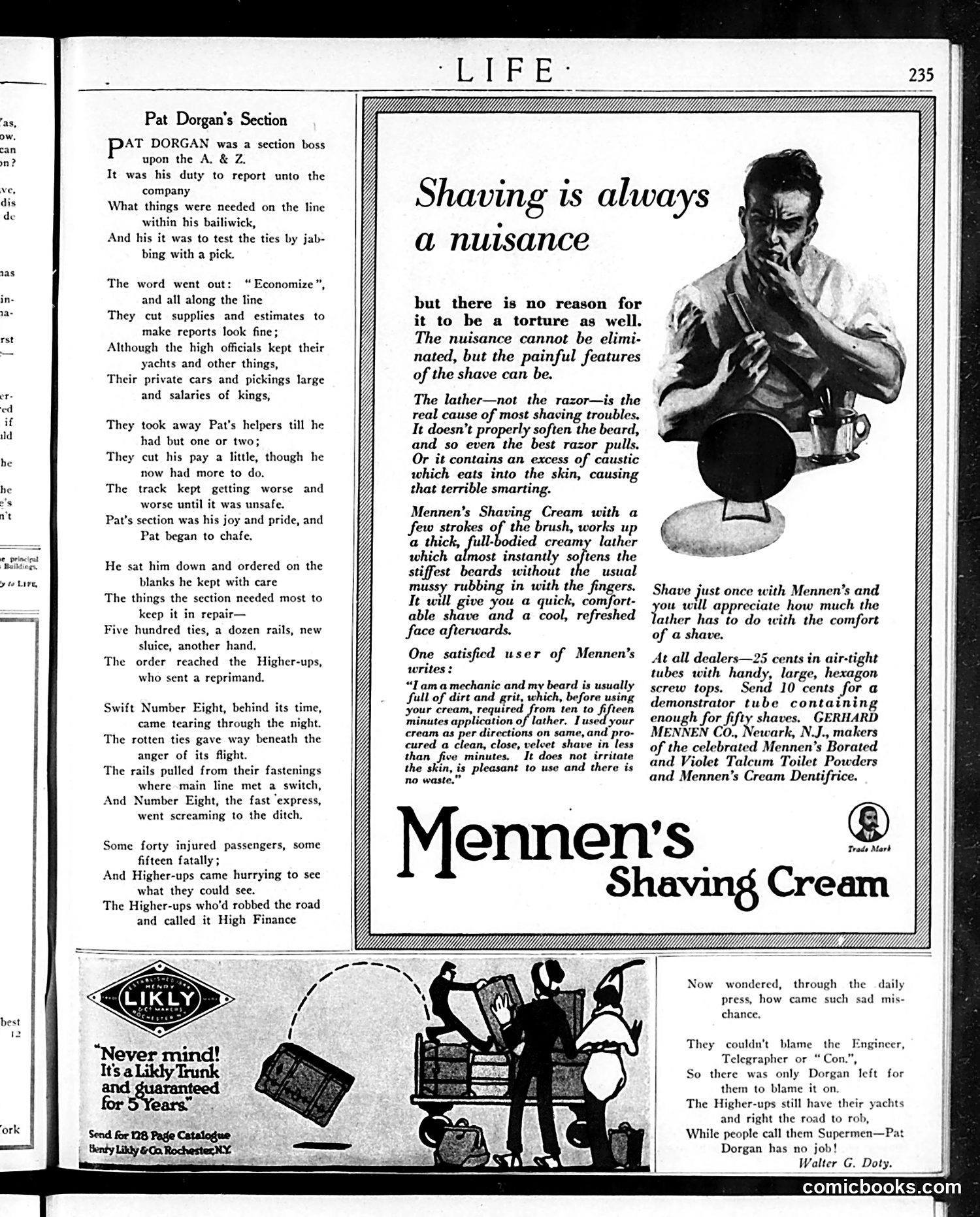
This is a narrative cartoon by Walter G. Doty satirizing railroad management corruption and workplace safety. Pat Dorgan is a railroad section boss who dutifully reports needed repairs—ties, rails, workers—but is ignored by company "Higher-ups" pursuing "High Finance" (cost-cutting and personal enrichment via yachts and large salaries). When management denies his requests, the track deteriorates. Swift Number Eight derails, killing fifteen passengers and injuring forty. Rather than blame themselves, the executives scapegoat Dorgan, who loses his job. The satire's point: corporate greed prioritizes executive luxury over worker safety and public welfare. Those responsible escape accountability while the honest worker pays the price. The dark ending—Dorgan blamed and fired while executives retain their stolen gains—emphasizes the powerlessness of working people against institutional corruption. The Mennen's Shaving Cream advertisement on the same page appears incidental to the story's serious social critique.
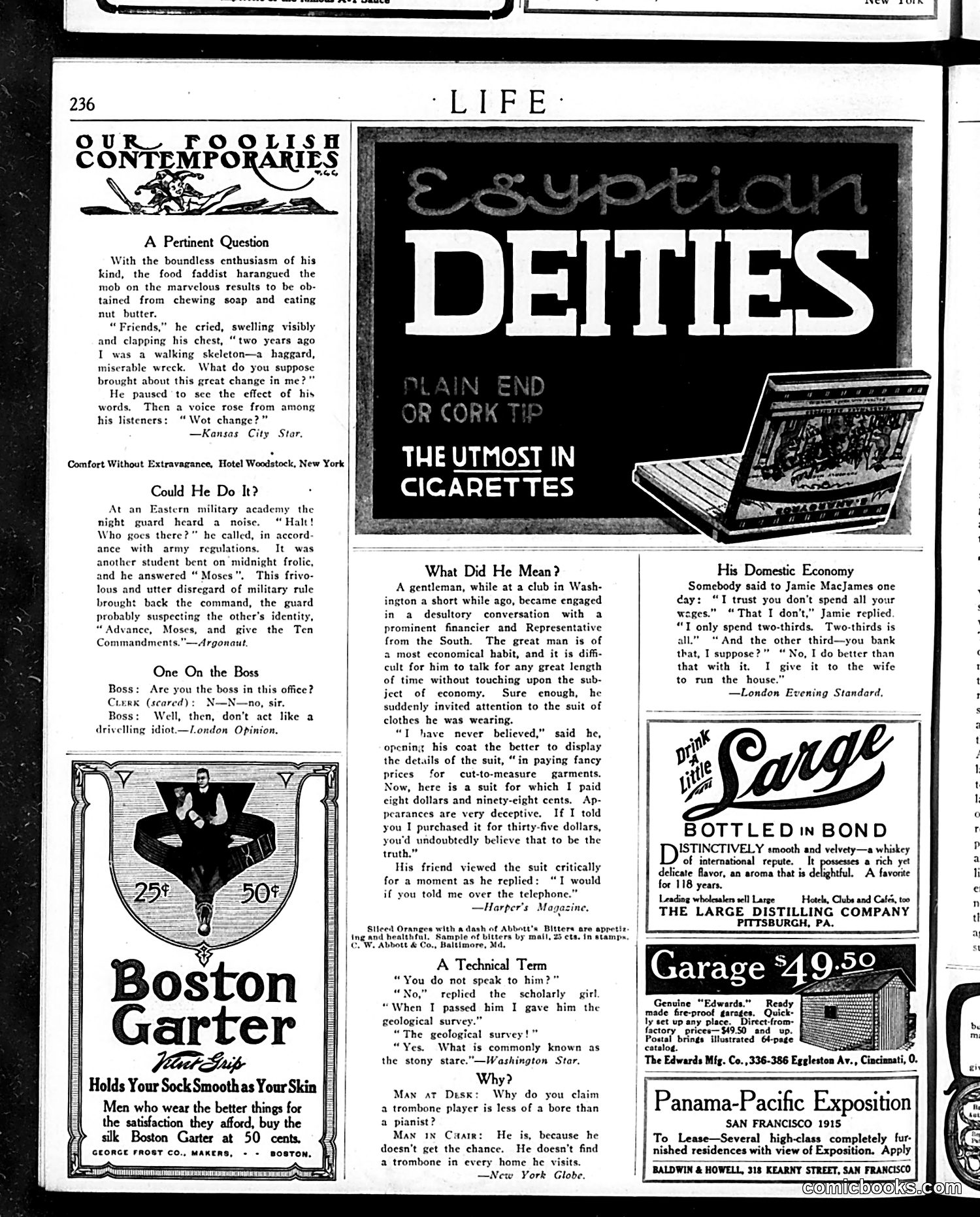
This page from *Life* magazine (a pre-1920s satirical publication) contains several short humorous anecdotes satirizing American social types and pretensions: **"A Pertinent Question"** mocks food faddists—popular figures of the era promoting dietary cures (soap-chewing, nut butter). The joke undercuts the faddist's boasts: a heckler points out he looks no different, suggesting the cure is worthless. **"Could He Do It?"** satirizes military discipline through absurdist humor about a guard demanding a student identify himself with "the Ten Commandments." **"What Did He Mean?"** ridicules wealthy Southern financiers who obsessively discuss economy while wearing expensive clothes they claim cost little—exposing hypocrisy about thrift. **"One On the Boss"** shows class reversal: a clerk corrects his boss's grammar, inverting typical workplace hierarchy for comedic effect. The remaining jokes target courtship pretense and musical bores. The page is primarily text-based humor rather than visual cartooning, typical of *Life*'s satirical format mocking contemporary social vanities.
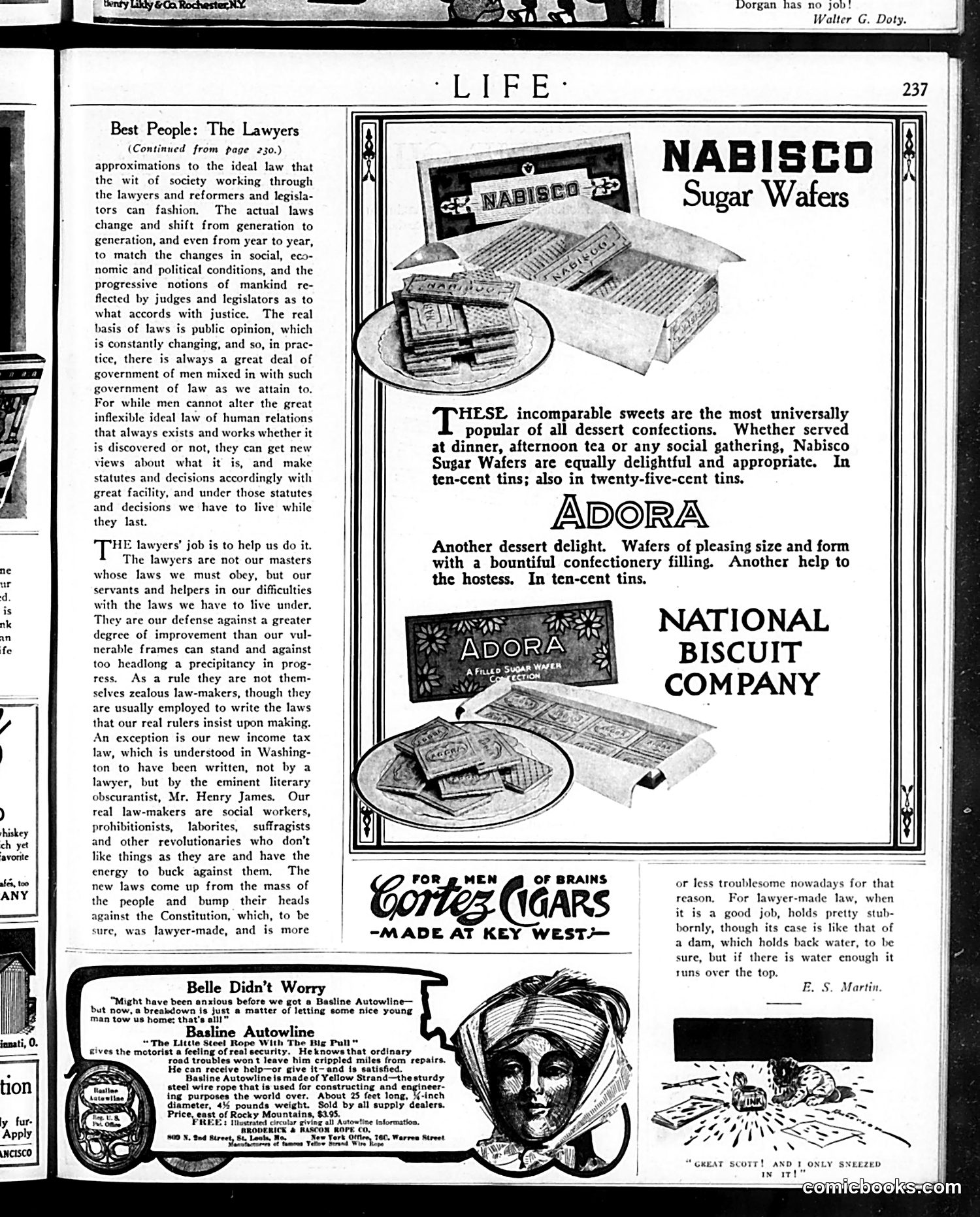
This page is primarily **advertising** interspersed with a brief satirical essay on lawyers. The main editorial content ("Best People: The Lawyers," continued from p. 230) argues that lawyers serve a practical function—not as masters imposing law, but as our defenders and helpers navigating existing rules. The author notes that real law-making comes from society's masses (social workers, labor activists, suffragists) pushing against the Constitution itself, which was ironically created by lawyers. There's gentle satire here about lawyers being overtaken by reformers and revolutionaries. The page is dominated by advertisements: **Nabisco Sugar Wafers** and **Adora** wafers (competing confectionery products), **National Biscuit Company**, **Cortez Cigars** ("for men of brains"), **Basline Autowline** (a steel rope towing device), and an Autowline anecdote called "Belle Didn't Worry" about a woman unconcerned about car breakdowns. No specific political figures or events are caricatured. The "satire" is mild commentary on institutional evolution rather than hard-hitting political cartoon work.
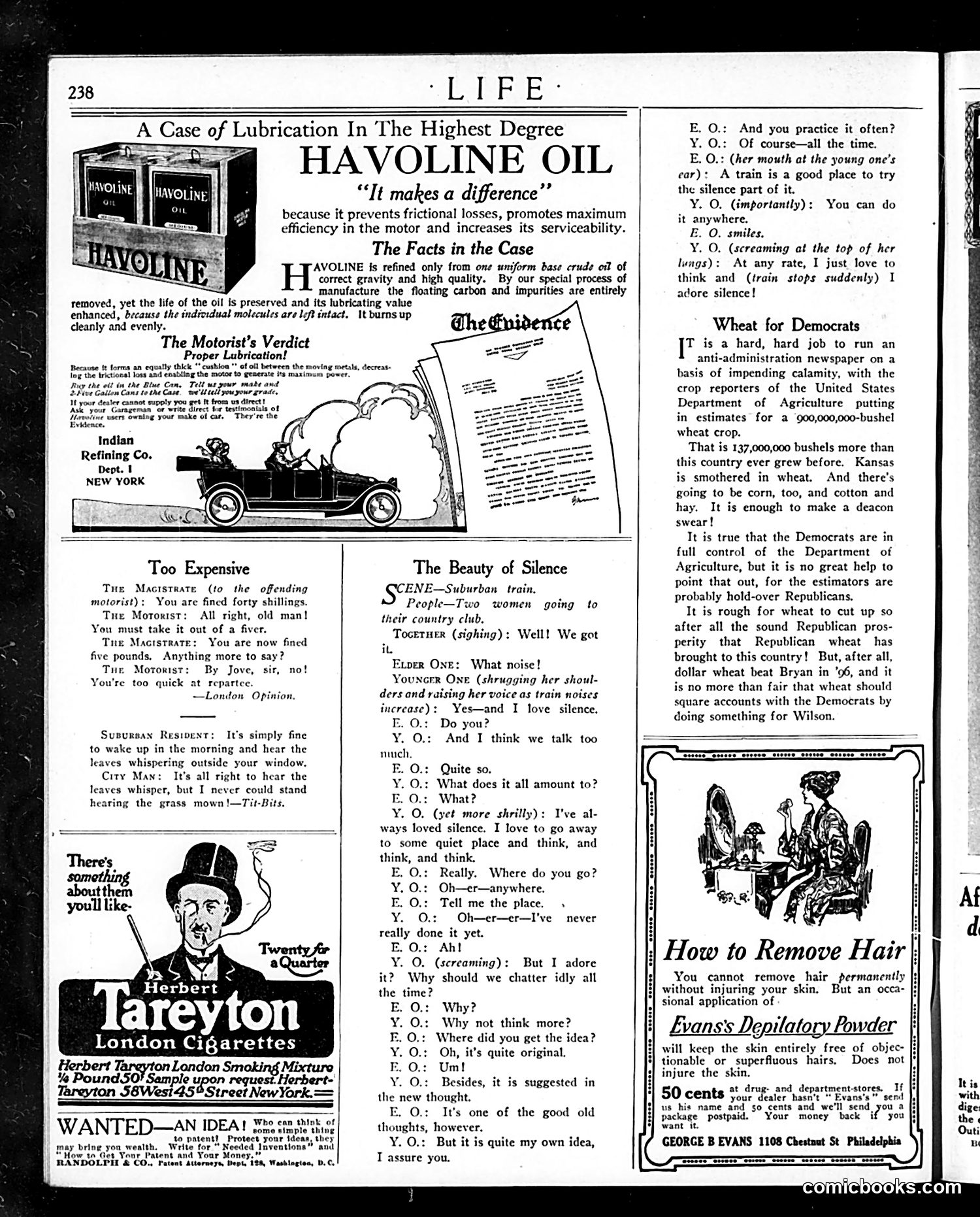
This two-panel satirical dialogue mocks upper-class hypocrisy about valuing quiet contemplation. Two women on a suburban train discuss their love of silence, yet the younger woman talks *constantly* and *loudly* throughout—even screaming about how much she adores silence. The joke's irony is straightforward: she claims to cherish quiet and deep thinking but demonstrates the opposite behavior. When the older woman suggests trains are good for practicing silence, the younger insists she practices it "all the time"—while literally shouting over train noise. The satire targets pretentious attitudes: the younger woman adopts fashionable ideas about mindfulness and inner reflection while being completely oblivious to her own contradiction. Her final scream about adoring silence (precisely when the train stops) delivers the punchline. The cartoon reflects early 20th-century satirical humor about modern affectations and shallow enthusiasm for intellectual or spiritual trends among the leisure classes.
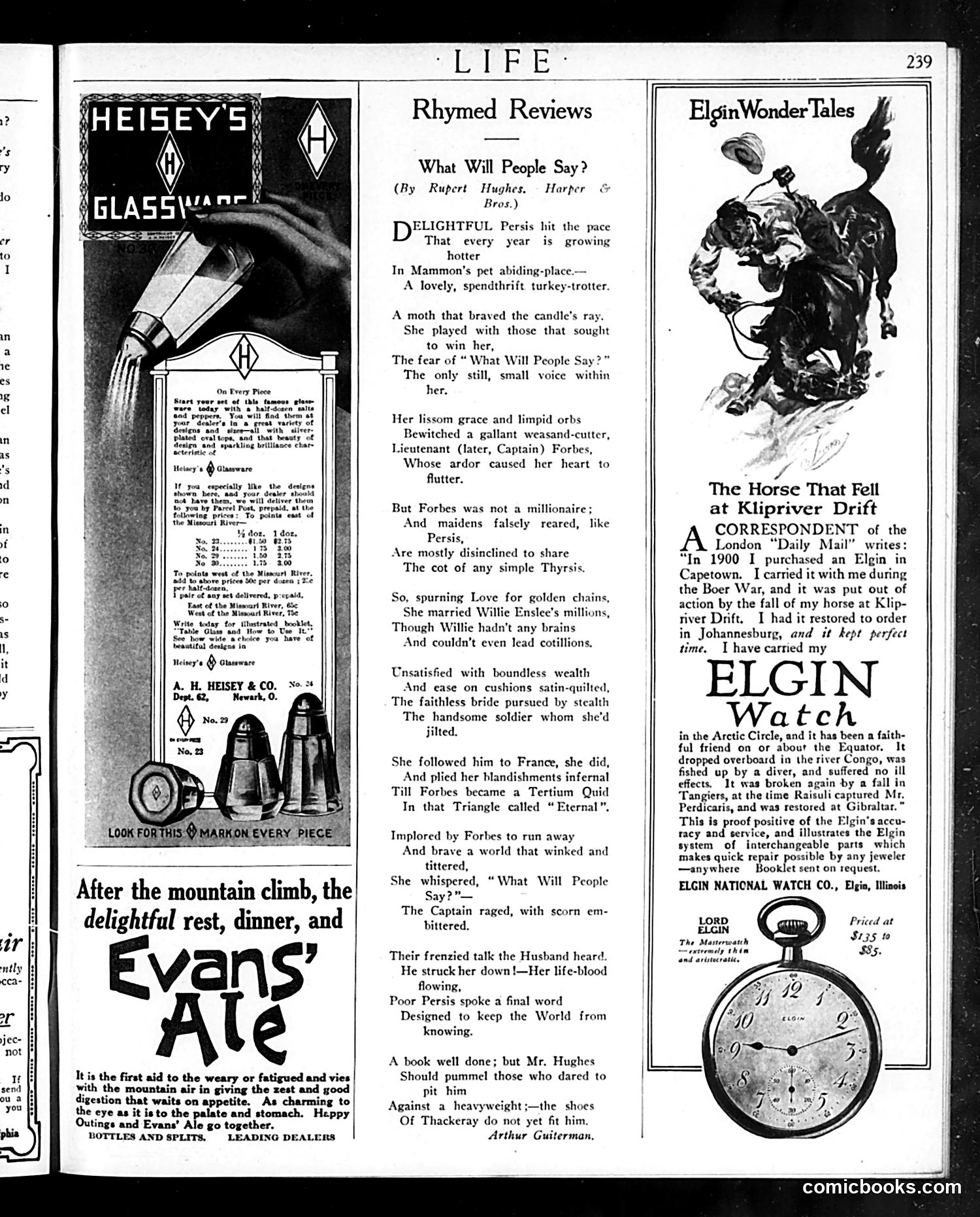
This page contains three distinct elements: **advertisements** (Heisey's Glassware, Evans' Ale) and **editorial content** (a book review and a watch testimonial). The central feature is a **rhymed book review** by Arthur Guiterman of Rupert Hughes' novel *"What Will People Say?"* The satirical poem mocks the plot: Persis, a wealthy but shallow socialite, marries rich but dull Willie Enslee while secretly pining for the handsome but poor Captain Forbes. When Forbes begs her to run away, she refuses, asking "What Will People Say?"—prioritizing social reputation over love. Her husband kills her in a rage. Guiterman's critique is dismissive: Hughes tries to compete with serious literature but lacks the skill of Thackeray. The right column features an **Elgin Watch testimonial** from a Boer War correspondent describing his watch's durability through extreme conditions—Klipriver Drift, the Arctic, the Equator, the Congo—positioning it as reliable through adventure. Together, these satirize both sentimental Victorian morality tales and marketing claims of product invincibility.
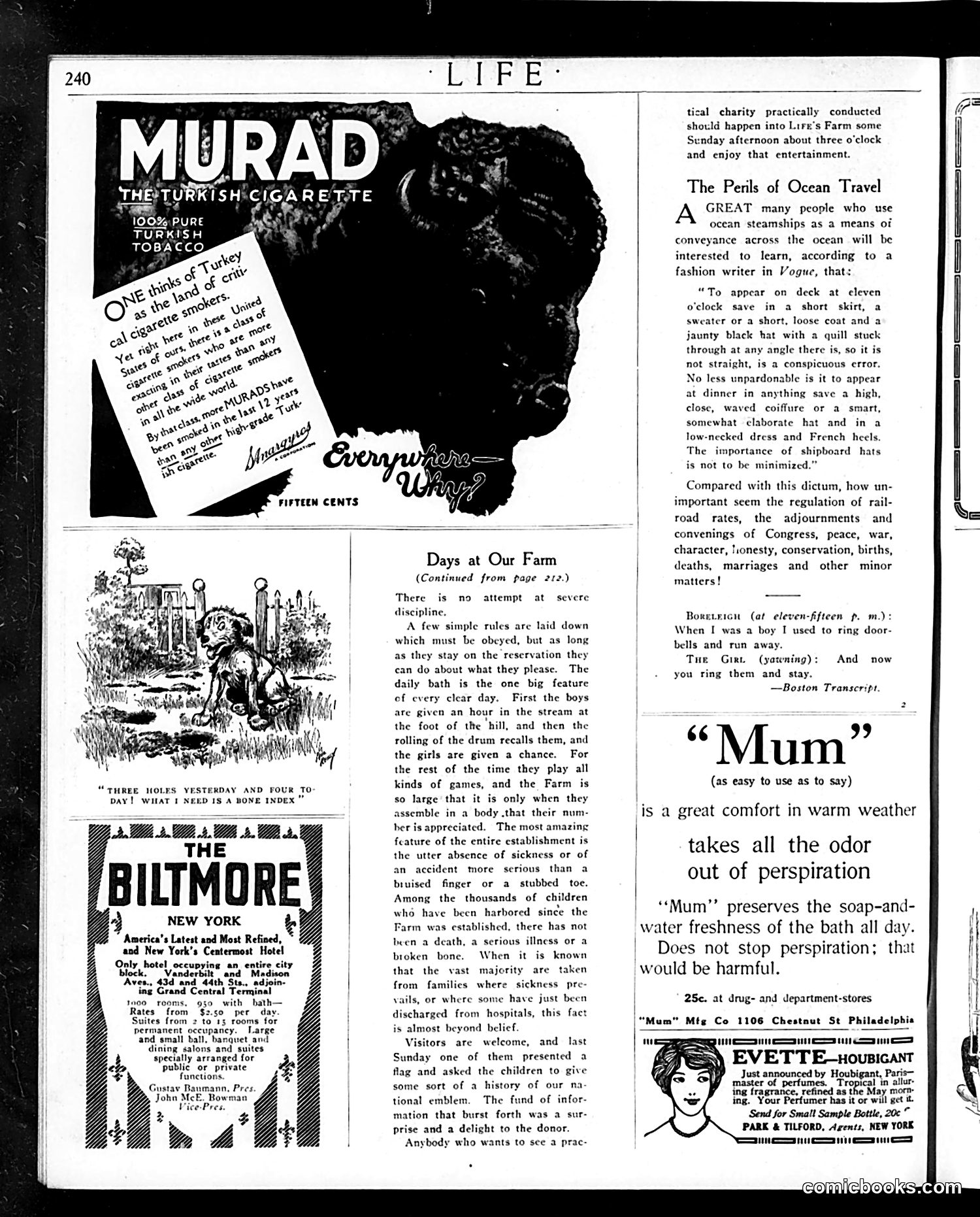
**The Farm Cartoon:** The small illustration shows a boy counting moles on his body with frustration—a visual joke about skin conditions from outdoor farm life. The caption "THREE MOLES YESTERDAY AND FOUR TODAY! WHAT I NEED IS A BONE INDEX" humorously suggests he's developing so many moles they need cataloging. This accompanies an article praising a charitable farm for underprivileged children, ironically contrasting the romanticized benefits of fresh-air therapy with bodily side effects. **"The Perils of Ocean Travel":** This satirizes fashion magazine obsession with trivial shipboard dress codes. The Vogue excerpt prescribes elaborate rules for women's appearance (skirts, hats, evening wear), while the satire sardonically notes how unimportant these seem compared to actual societal concerns—Congress, war, births, deaths. It mocks upper-class preoccupation with fashion minutiae. **The remaining content** consists primarily of hotel and product advertisements typical of 1920s *Life* magazine.
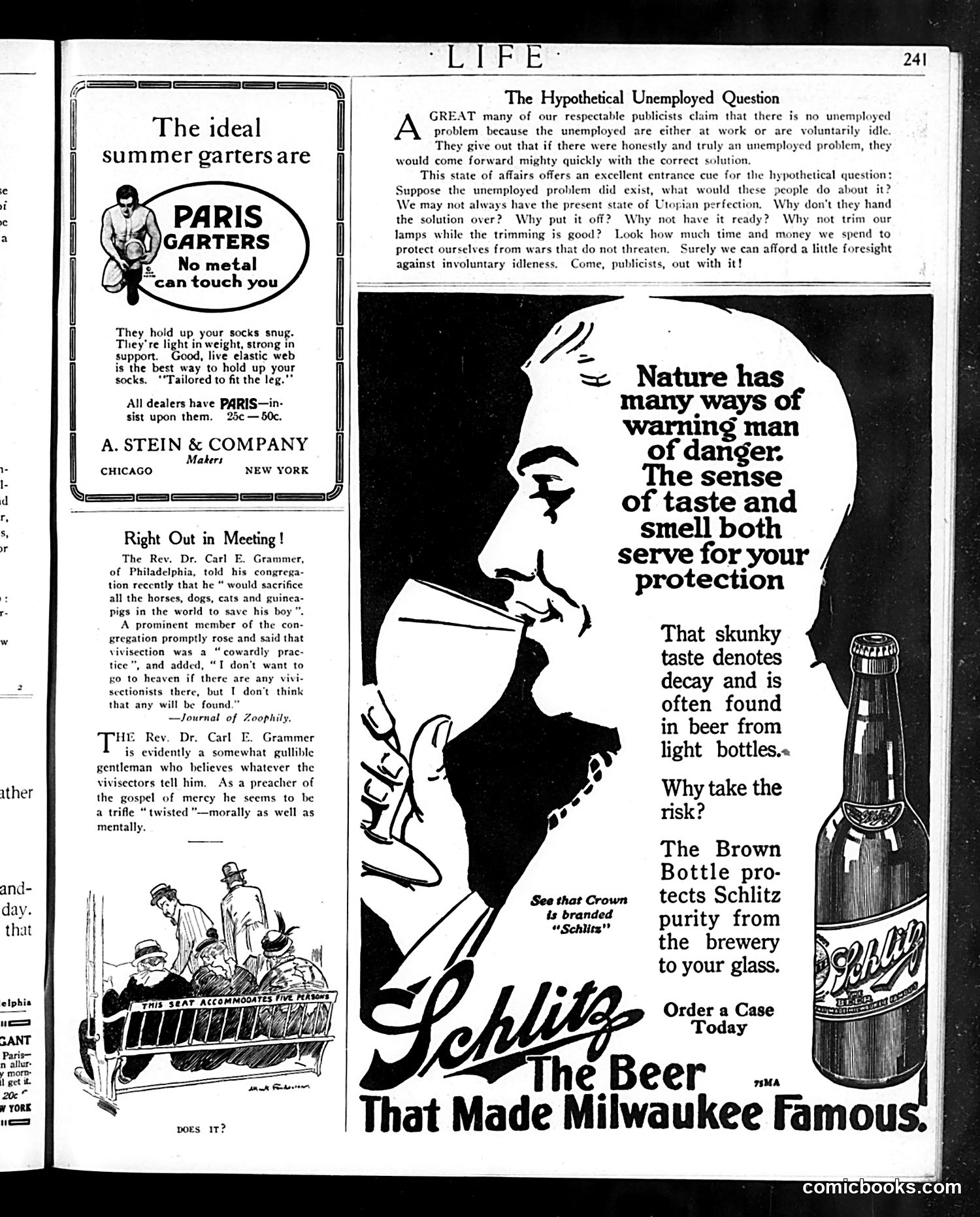
This page combines several distinct elements: advertisements and satirical commentary on early 20th-century American issues. **Left side:** Paris garters advertisement (hosiery) and a brief satire mocking Reverend Carl E. Grammer of Philadelphia, who claimed he'd sacrifice all animals to save his son. The satire ridicules this as hypocritical moralizing—he wouldn't actually follow through on such extreme statements. **Right side:** "The Hypothetical Unemployed Question" satirizes public figures and economists who deny unemployment exists, claiming joblessness is voluntary idleness. The piece challenges them: if unemployment isn't real, why won't they propose solutions anyway? It's sarcasm exposing their evasiveness on a genuine social problem. **Bottom:** A Schlitz beer advertisement using taste/smell as metaphors for danger detection, warning consumers that "skunky" taste indicates spoilage—solved by brown bottles protecting beer from light. The page reflects Progressive-era concerns about social responsibility, hypocrisy, and labor issues circa 1910s.
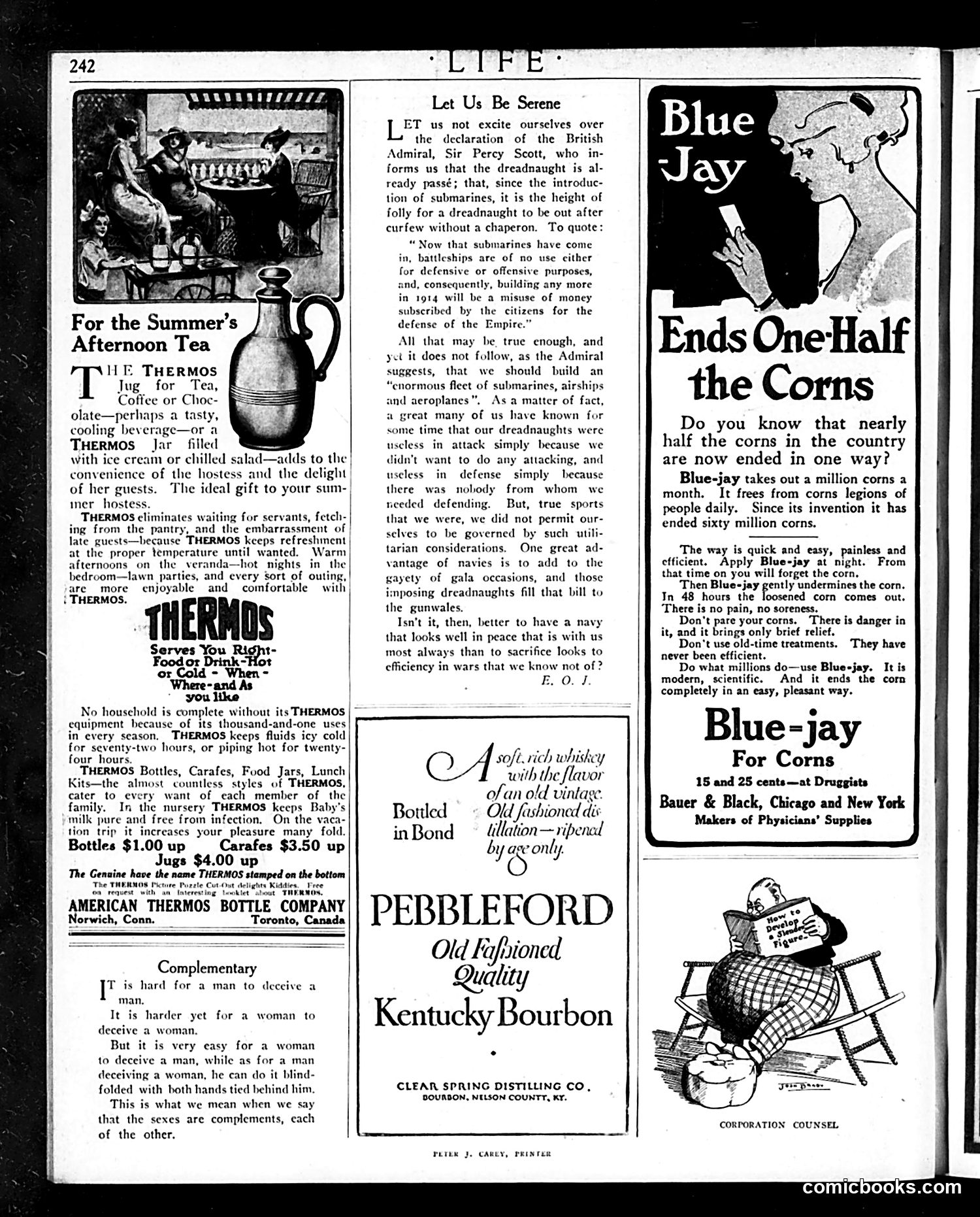
This page mixes advertisements with satirical commentary typical of early 1900s *Life* magazine. The central editorial piece, "Let Us Be Serene," mocks British Admiral Sir Percy Scott's 1914 declaration that dreadnought battleships are obsolete due to submarines. The author sarcastically argues that warships serve primarily aesthetic purposes at "gala occasions" rather than practical defense—since Britain faces no actual threat. The satire cuts both ways: it ridicules the Admiral's alarmism while exposing the absurdity of maintaining expensive naval displays for purely social reasons during potential wartime. The page otherwise contains period advertisements: Thermos bottles (emphasizing convenience for summer entertaining), Pebbleford Kentucky Bourbon, and Blue-Jay corn remover. The "Complementary" text block offers gender-based humor typical of the era, suggesting women are easily deceived by men. No political cartoons appear; the satire is primarily textual rather than visual.
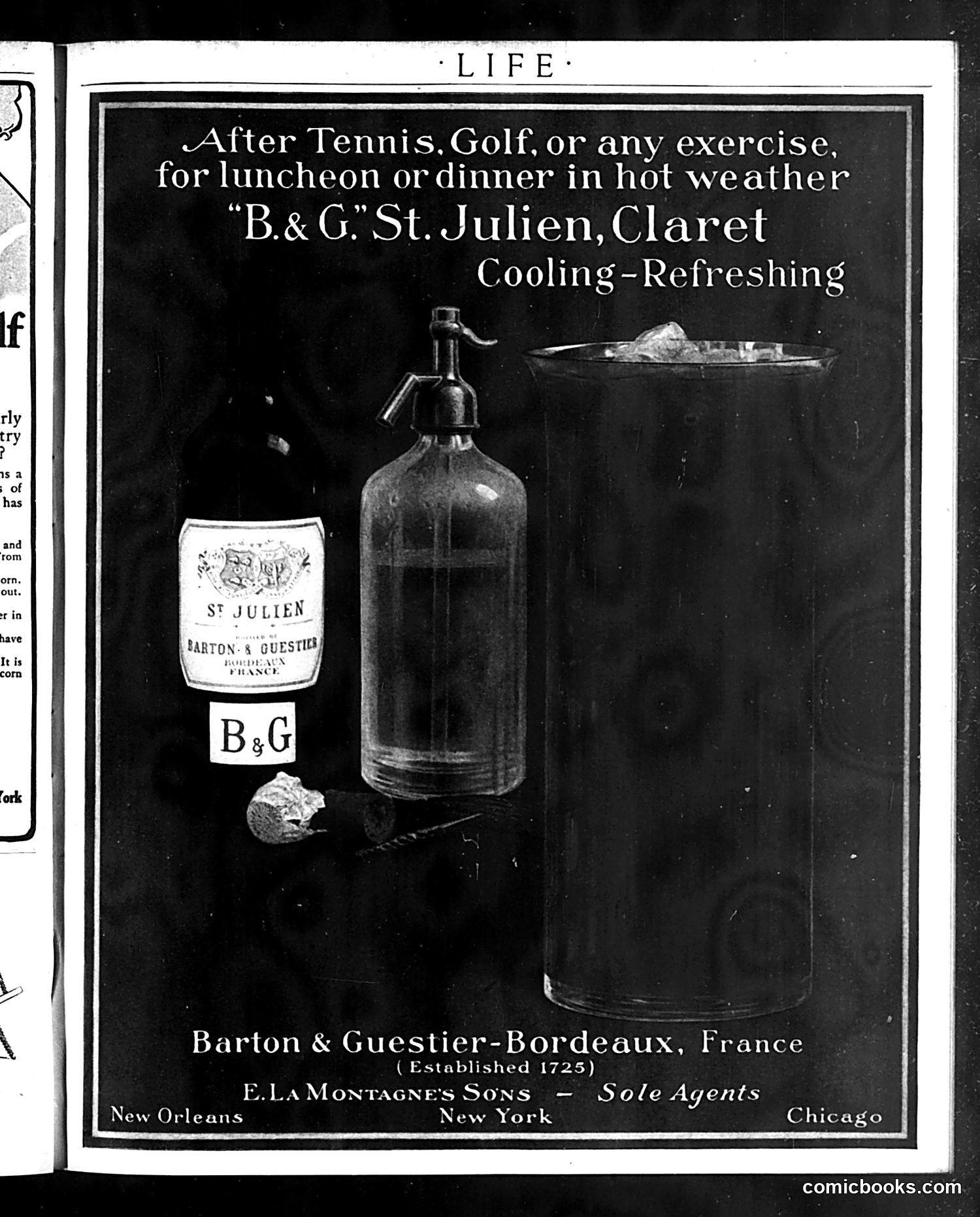
This is a **wine advertisement**, not a cartoon or satire. It promotes "B.&G." St. Julien Claret, a French wine from the Bordeaux region, marketed as ideal for post-exercise refreshment in hot weather. The ad features a wine bottle and a siphon bottle (likely for carbonation or serving), with the tagline emphasizing the wine's "Cooling-Refreshing" properties. The manufacturer, Barton & Guestier (established 1725), is identified as a legitimate French wine house, with E. La Montagne's Sons as sole U.S. agents in New Orleans, New York, and Chicago. This reflects early 20th-century advertising conventions in *Life* magazine, where alcohol was marketed as a health tonic and social beverage for the leisure class engaging in sports and recreation.
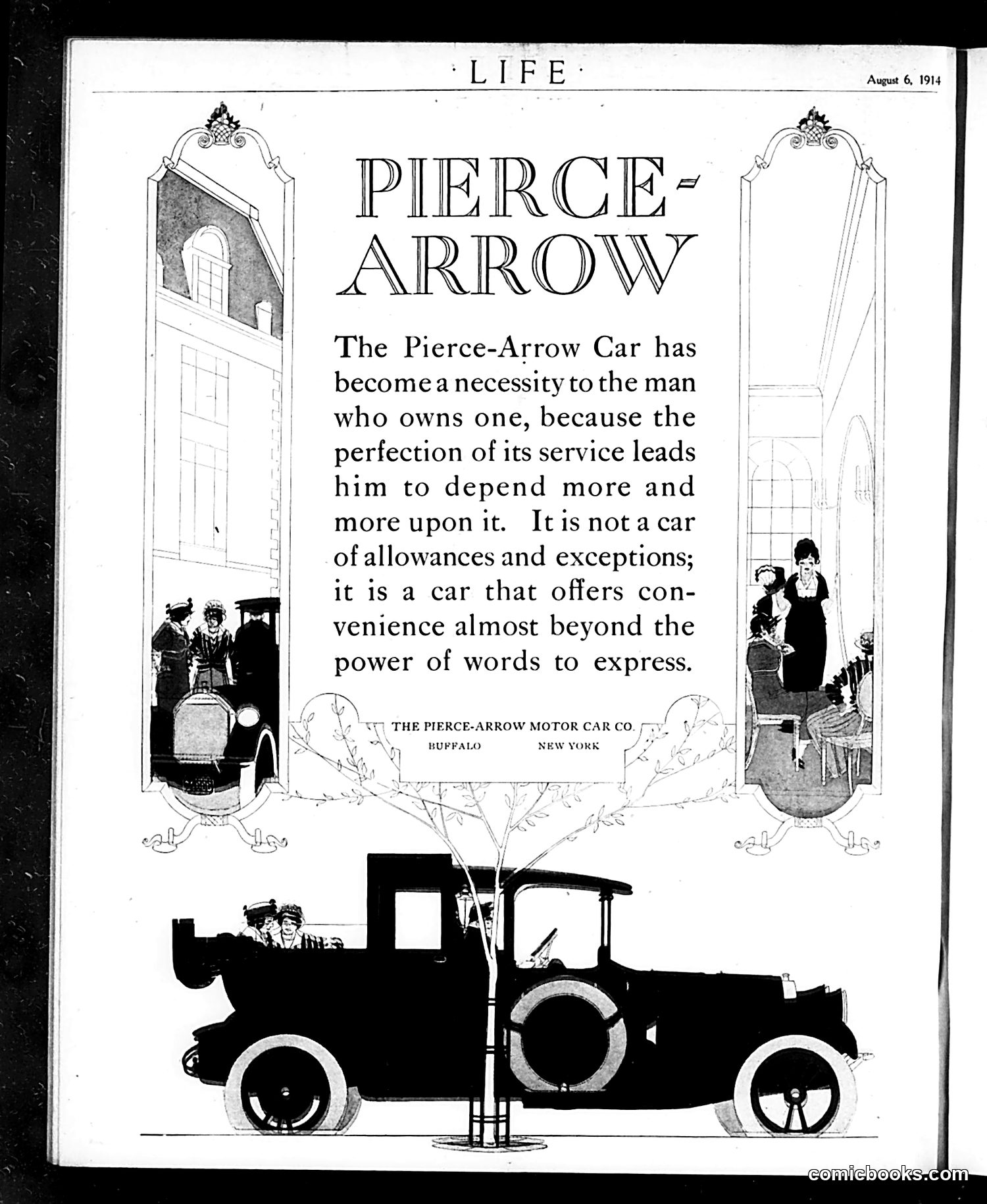
This is primarily a **luxury car advertisement**, not political satire. The page promotes the Pierce-Arrow Motor Car Company (Buffalo, New York) in *Life* magazine's August 6, 1914 issue. The advertisement uses decorative Art Nouveau-style illustrations showing wealthy figures—well-dressed women and men in formal attire—exiting elegant buildings and using the automobile. These images signal the car's association with affluence and convenience. The text emphasizes the Pierce-Arrow as a "necessity" for its owners due to superior service and reliability, positioning it as a status symbol for the wealthy. The timing (1914, early automotive era) reflects when automobiles were luxury goods for the elite, not mass-market transportation. There is no apparent political satire here—this is straightforward aspirational advertising targeting *Life's* affluent readership.