
Life, 1914-08-06 · page 37 of 40
Life — August 6, 1914 — page 37: what you’re looking at
What you’re looking at
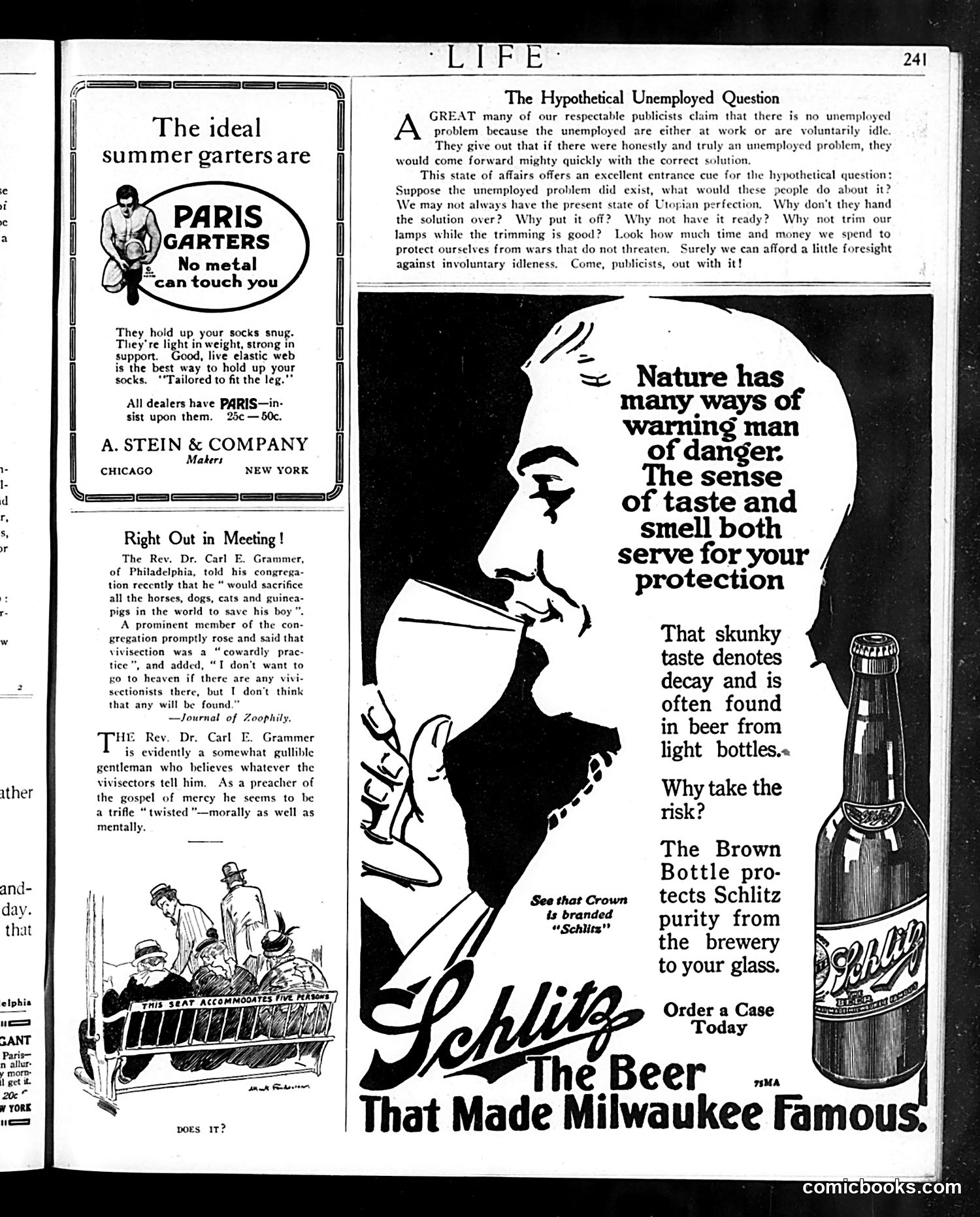
This page combines several distinct elements: advertisements and satirical commentary on early 20th-century American issues. **Left side:** Paris garters advertisement (hosiery) and a brief satire mocking Reverend Carl E. Grammer of Philadelphia, who claimed he'd sacrifice all animals to save his son. The satire ridicules this as hypocritical moralizing—he wouldn't actually follow through on such extreme statements. **Right side:** "The Hypothetical Unemployed Question" satirizes public figures and economists who deny unemployment exists, claiming joblessness is voluntary idleness. The piece challenges them: if unemployment isn't real, why won't they propose solutions anyway? It's sarcasm exposing their evasiveness on a genuine social problem. **Bottom:** A Schlitz beer advertisement using taste/smell as metaphors for danger detection, warning consumers that "skunky" taste indicates spoilage—solved by brown bottles protecting beer from light. The page reflects Progressive-era concerns about social responsibility, hypocrisy, and labor issues circa 1910s.
📄 Transcribed text from this page (OCR, searchable)
Machine-transcribed from the original scan — historical spelling and the odd misread are preserved.
EEISERE The ideal | I summer garters are They hold up your socks snug. They're light in weight, strong in support. Good, live elastic web is the best way to hold up your socks. ‘‘Tailored to fit the leg.’ All dealers have PARIS: sist upon them. 25c — 50c. A. STEIN & COMPANY Makers CHICAGO NEW YORK Right Out in Meeting ! The Rev. Dr. Carl E. Grammer, of Philadelphia, told his congrega- tion recently that he “ would sacrifice all the horses, dogs, cats and guinea- pigs in the world to save his boy”. A prominent member of the con- gregation promptly rose and said that vivisection was a “cowardly prac- tice, and added, “I don't want to go to heaven if there are any vivi- sectionists there, but T don't think that any will be found.” —Journal of Zoophily. HE Rev. Dr. Carl E. Grammer is evidently a somewhat gullible gentleman who believes whatever the vivisectors tell him. As a preacher of the gospel of mercy he seems to be a trifle “twisted "—morally as well as mentally, The Hypothetical Unemployed Question GREAT many of our respectable publicists claim that there is no unemployed A problem because the unemployed are cither at work or are voluntarily idle, They give out that if there were honestly and truly an unemployed problem, they would come forward mighty quickly with the correct solution. This state of affairs offers an excellent entrance cue for the hypothetical question: Suppose the unemployed problem did exist, what would these people do about it? We may not always have the present state of Utopian perfection. Why don't they hand the solution over? Why put it off? Why not have it ready? Why not trim our lamps while the trimming is good? Look how much time and money we spend to protect ourselves from wars that do not threaten. Surely we can afford a little foresight against involuntary idleness. Come, publicists, out with it! =~ Nature has many ways of warning man of danger. The sense of taste and smell both serve for your protection =N That skunky taste denotes decay and is often found in beer from light bottles.« Why take the risk? The Brown Bottle pro- tects Schlitz purity from the brewery to your glass. Order a Case Today The Beer That Made Milwaukee Famou comicbooks.com