
Life, 1914-08-06 · page 16 of 40
Life — August 6, 1914 — page 16: what you’re looking at
What you’re looking at
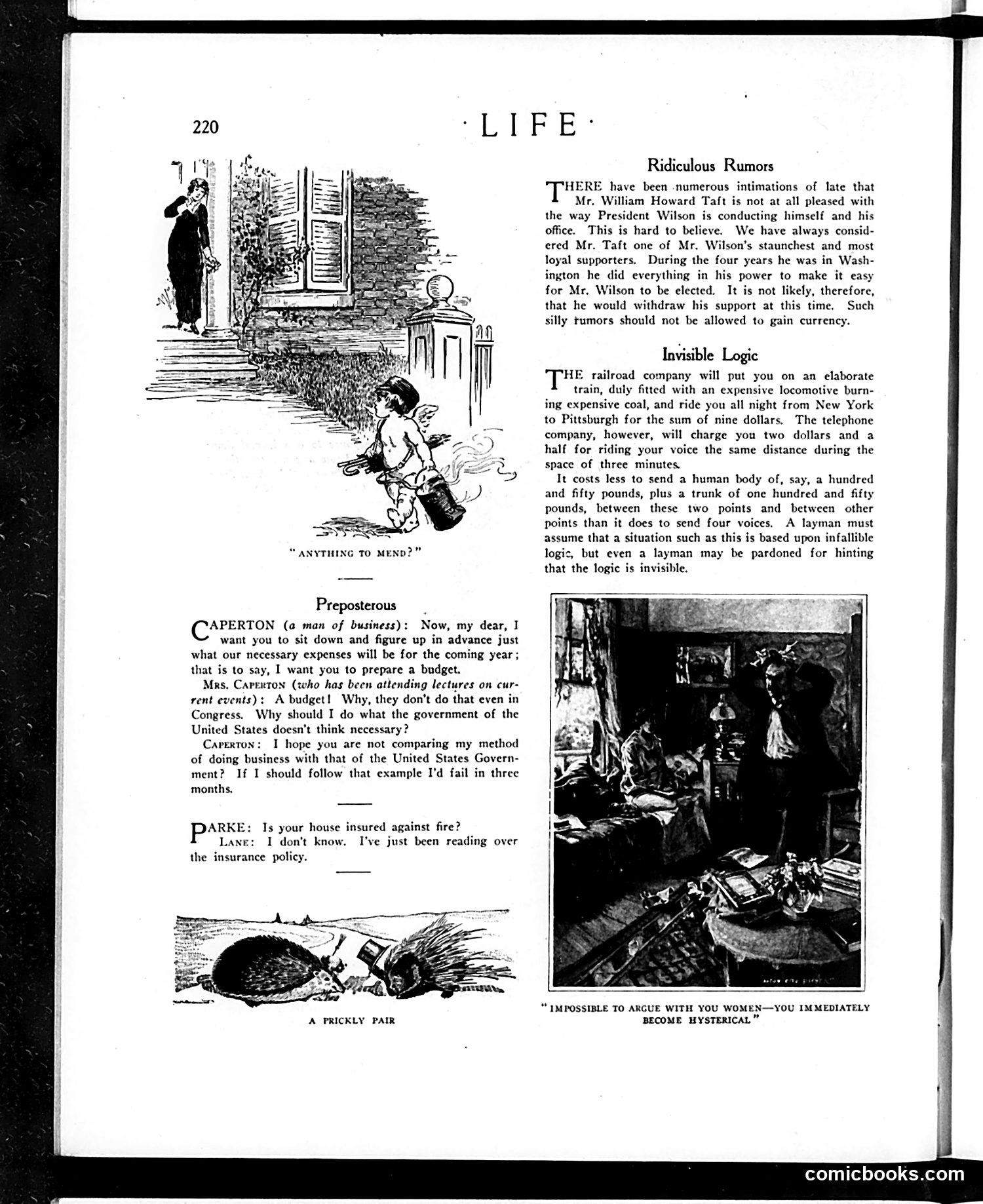
This page contains four separate satirical pieces from Life magazine: **"Ridiculous Rumors"** mocks gossip that former President William Howard Taft disapproves of President Wilson. Life sarcastically defends Taft's loyalty, implying the rumors are absurd—though the very fact that Life addresses them suggests tension between these political figures existed. **"Invisible Logic"** critiques the railroad and telephone industries' pricing inconsistencies: trains transport heavy bodies cheaply overnight, yet phones charge substantially more to transmit voices over the same distance. The satire highlights corporate pricing logic as irrational or deliberately exploitative. **"Preposterous"** satirizes a husband-wife dynamic where the wife, having attended lectures on current events, refuses to budget because Congress doesn't. The husband's exasperated retort—that his business would fail following government's example—mocks both governmental financial irresponsibility and women's newfound political awareness. **"A Prickly Pair"** (cartoon) and the final illustration address gender conflict, suggesting women become "hysterical" when arguing, reinforcing period stereotypes about female emotionality versus male rationality.
📄 Transcribed text from this page (OCR, searchable)
Machine-transcribed from the original scan — historical spelling and the odd misread are preserved.
‘LIFE? Ridiculous Rumors HERE have been numerous intimations of late that Mr. William Howard Taft is not at all pleased with the way President Wilson is conducting himself and his office. This is hard to believe. We have always consid- ered Mr. Taft one of Mr. Wilson’s staunchest and most loyal supporters. During the four years he was in Wash- ington he did everything in his power to make it easy for Mr. Wilson to be elected. It is not likely, therefore, that he would withdraw his support at this time. Such silly rumors should not be allowed to gain currency. Invisible Logic HE railroad company will put you on an elaborate train, duly fitted with an expensive locomotive burn- ing expensive coal, and ride you all night from New York to Pittsburgh for the sum of nine dollars, The telephone company, however, will charge you two dollars and a half for riding your voice the same distance during the space of three minutes It costs less to send a human body of, say, a hundred and fifty pounds, plus a trunk of one hundred and fifty pounds, between these two points and between other 2 — = points than it does to send four voices. A layman must oad = assume that a situation such as this is based upon infallible “ANYTHING TO MEND?” logic, but even a layman may be pardoned for hinting that the logic is invisible. Preposterous APERTON (a man of business): Now, my dear, I want you to sit down and figure up in advance just what our necessary expenses will be for the coming year; that is to say, I want you to prepare a budget. Mrs. Carenton (who has been attending lectures on cur- rent events): A budget! Why, they don’t do that even in Congress. Why should I do what the government of the United States doesn’t think necessary? Carerton: I hope you are not comparing my method of doing business with that of the United States Govern- ment? If I should follow that example I'd fail in three months. Is your house insured against fire? I don't know. I've just been reading over “IMPOSSIBLE TO ARGUE WITH YOU WOMEN—YOU IMMEDIATELY A PRICKLY PAIR BECOME HYSTERICAL comicbooks.com