
Life, 1914-08-06 · page 19 of 40
Life — August 6, 1914 — page 19: what you’re looking at
What you’re looking at
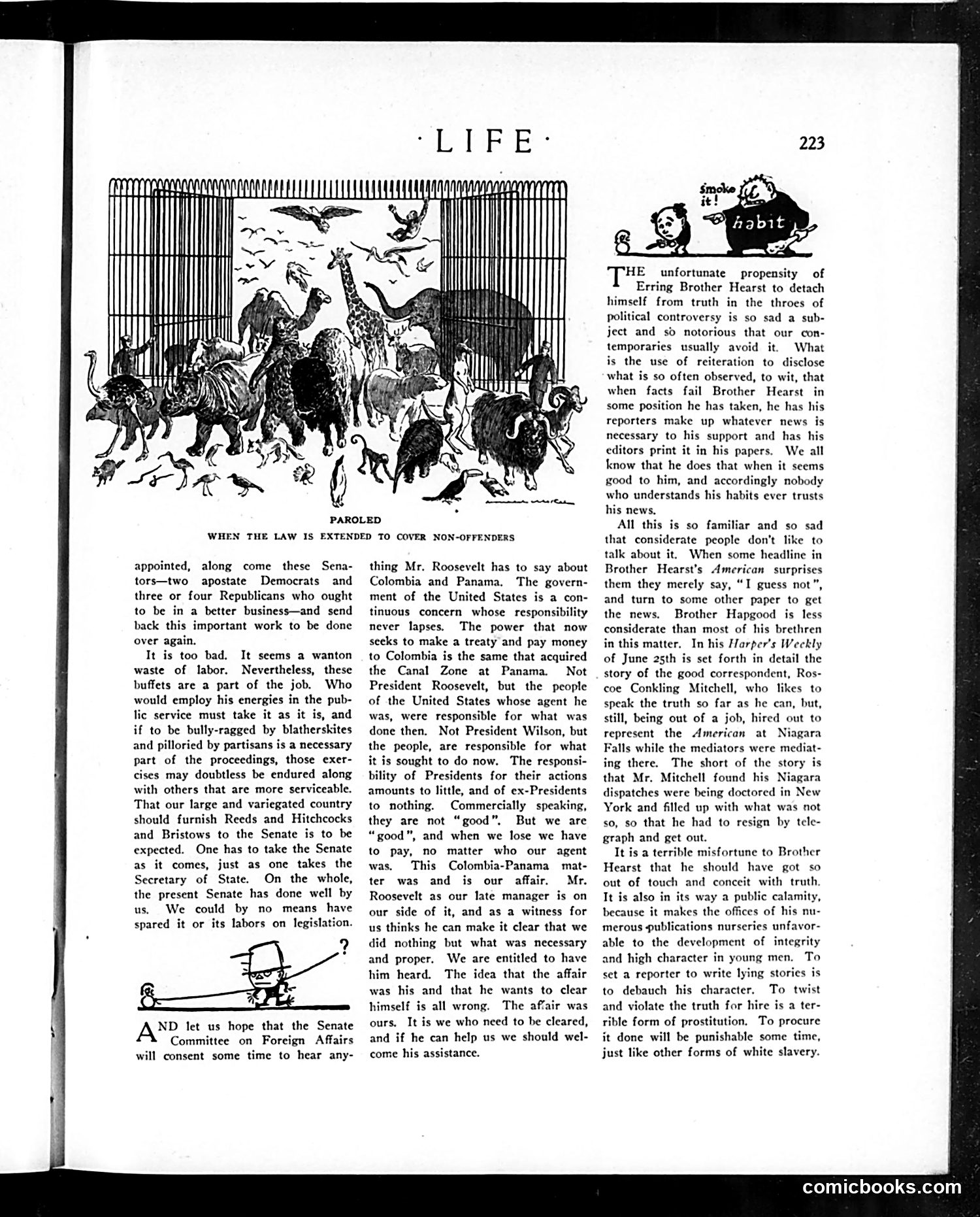
This page contains two satirical pieces critiquing American political figures and institutions circa early 1900s. **Left cartoon & text:** Attacks Senate obstructionists—specifically naming Senators Reed, Hitchcock, and Bristow—for repeatedly rejecting and returning legislation for revision. Life sarcastically defends tolerating these "buffets" as necessary to democratic process, though calling them "blatherskites" (loudmouths). **Right section:** Criticizes William Randolph Hearst's newspaper *The American* for fabricating news to support political positions. The piece references correspondent Roscoe Conkling Mitchell, whose dispatches from Niagara Falls mediation talks were allegedly doctored in New York. Life condemns Hearst for systematically manufacturing false news when facts don't support his agenda, suggesting readers know to distrust his papers and consult competitors instead. Both pieces target political manipulation through Senate obstruction and yellow journalism—key Progressive Era concerns.
📄 Transcribed text from this page (OCR, searchable)
Machine-transcribed from the original scan — historical spelling and the odd misread are preserved.
| eae Mt LIFE WHEN THE LAW IS EXTENDED TO COVER NON-OFFENDERS appointed, along come these Sena- tors—two apostate Democrats and three or four Republicans who ought to be in a better business—and send back this important work to be done over again. It is too bad, It seems a wanton waste of labor. Nevertheless, these buffets are a part of the job. Who would employ his energies in the pub- lic service must take it as it is, and if to be bully-ragged by blatherskites and pilloried by partisans is a necessary part of the proceedings, those exer- cises may doubtless be endured along with others that are more serviceable. That our large and variegated country should furnish Reeds and Hitchcocks and Bristows to the Senate is to be expected. One has to take the Senate as it comes, just as one takes the Secretary of State. On the whole, the present Senate has done well by us. We could by no means have spared it or its labors on legislation. 9 R AS let us hope that the Senate Committee on Foreign Affairs will consent some time to hear any- thing Mr. Roosevelt has to say about Colombia and Panama. The govern- ment of the United States is a con- tinuous concern whose responsibility never lapses. The power that now secks to make a treaty and pay money to Colombia is the same that acquired the Canal Zone at Panama. Not President Roosevelt, but the people of the United States whose agent he was, were responsible for what was done then. Not President Wilson, but the people, are responsible for what it is sought to do now. The responsi- bility of Presidents for their actions amounts to little, and of ex-Presidents to nothing. Commercially speaking, they are not “good”, But we are “good”, and when we lose we have to pay, no matter who our agent was. This Colombia-Panama mat- ter was and is our affair, Mr. Roosevelt as our late manager is on our side of it, and as a witness for us thinks he can make it clear that we did nothing but what was necessary and proper. We are entitled to have him heard. The idea that the affair was his and that he wants to clear himself is all wrong. The affair was ours. It is we who need to be cleared, and if he can help us we should wel- come his assistance. 'HE unfortunate propensity of Erring Brother Hearst to detach himself from truth in the throes of political controversy is so sad a sub- ject and sd notorious that our con- temporaries usually avoid it. What is the use of reiteration to disclose what is so often observed, to wit, that when facts fail Brother Hearst in some position he has taken, he has his reporters make up whatever news is necessary to his support and has his editors print it in his papers. We all know that he does that when it seems good to him, and accordingly nobody who understands his habits ever trusts his news, All this is so familiar and so sad that considerate people don’t like to talk about it. When some headline in Brother Hearst's American surpri them they merely say, “I guess not” and turn to some other paper to get the news, Brother Hapgood is less considerate than most of his brethren in this matter. In his Harper's Weekly of June 25th is set forth in detail the story of the good correspondent, Ros- coe Conkling Mitchell, who likes to speak the truth so far as he can, but, still, being out of a job, hired out to represent the American at Niagara Falls while the mediators were mediat- ing there. The short of the story is that Mr. Mitchell found his Niagara dispatches were being doctored in New York and filled up with what was not so, so that he had to resign by tele- graph and get out. It is a terrible misfortune to Brother Hearst that he should have got so out of touch and conceit with truth. It is also in its way a public calamity, because it makes the offices of his nu- merous publications nurseries unfavor- able to the development of integrity and high character in young men, To set a reporter to write lying stories is to debauch his character. To twist and violate the truth for hire is a ter- rible form of prostitution, To procure it done will be punishable some time, just like other forms of white slavery. comicbooks.com