
Life, 1914-08-06 · page 18 of 40
Life — August 6, 1914 — page 18: what you’re looking at
What you’re looking at
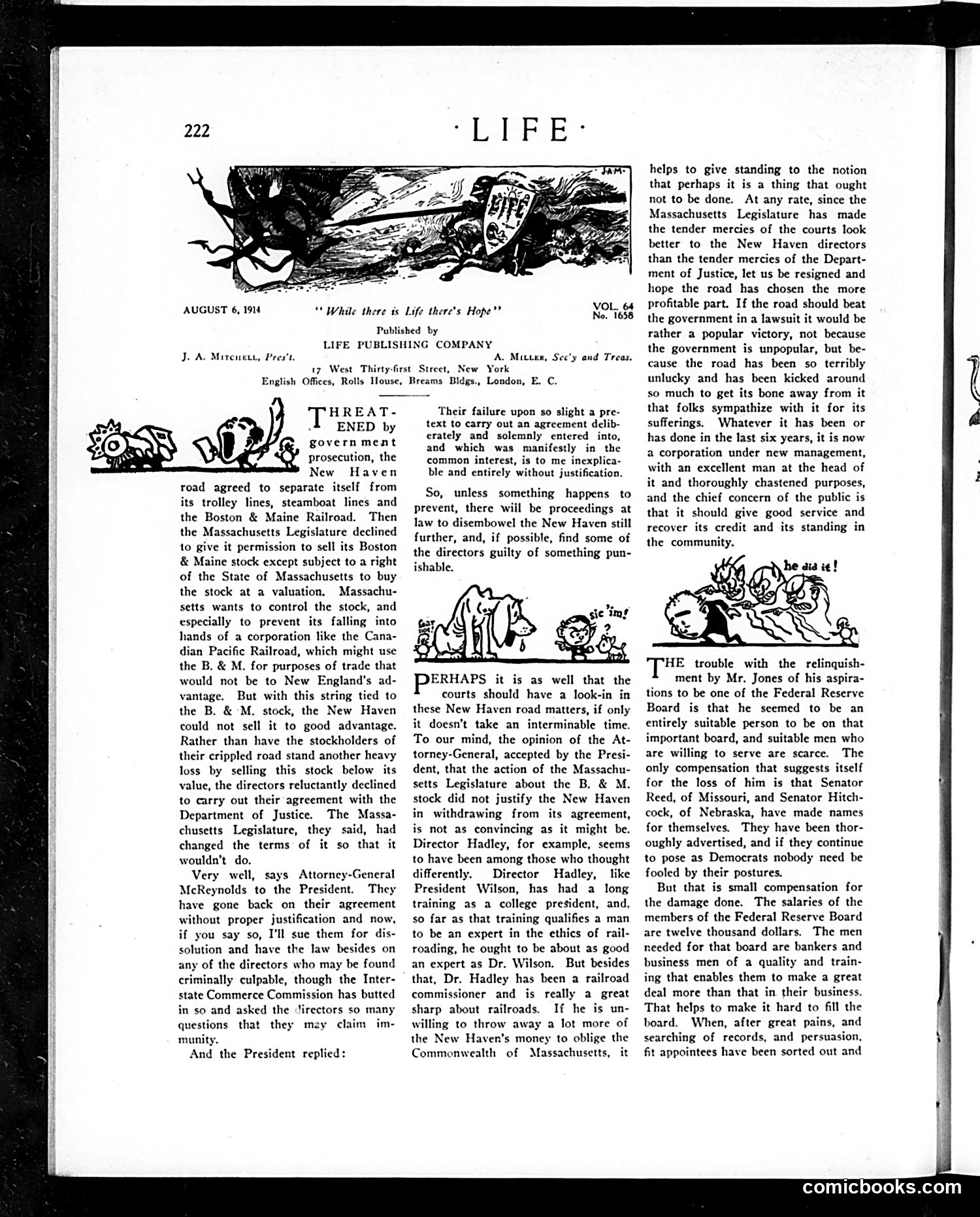
This page satirizes a dispute over the New Haven Railroad's corporate structure. The U.S. Department of Justice sued to force the New Haven to divest itself of subsidiary lines (trolleys, steamboats, the Boston & Maine Railroad) to prevent monopolistic control. The railroad initially agreed but then backed out when Massachusetts imposed conditions on selling the B&M stock that made the deal unprofitable. The article mocks this reversal, with President Wilson and Attorney-General McReynolds threatening dissolution proceedings. However, Life suggests the railroad director Hadley (a former college president and railroad commissioner with ethical training) may have a point—that Massachusetts's interference made the original agreement impossible to fulfill. The small cartoon (visible but unclear in detail) likely comments humorously on this bureaucratic tangle. The piece ultimately expresses resignation that courts rather than politicians will resolve the matter, hoping the railroad wins because popular opinion favors beating government overreach.
📄 Transcribed text from this page (OCR, searchable)
Machine-transcribed from the original scan — historical spelling and the odd misread are preserved.
AUGUST 6, 1914 “While there ts Life there's Hope" Published by LIFE J. A. Mircnett, Pres't. PUBLISHING COMPANY A. Mitter, Sec’y and Treas. 17 West Thirty-first Street, New York English Offices, Rolls House, Breams Bldgs., London, E. C. HREAT- ENED by government CY’ prosecution, the Me New Haven road agreed to separate itself from its trolley lines, steamboat lines and the Boston & Maine Railroad. Then the Massachusetts Legislature declined to give it permission to sell its Boston & Maine stock except subject to a right of the State of Massachusetts to buy the stock at a valuation, Massachu- setts wants to control the stock, and especially to prevent its falling into hands of a corporation like the Cana- dian Pacific Railroad, which might use the B. & M. for purposes of trade that would not be to New England’s ad- vantage. But with this string tied to the B. & M. stock, the New Haven could not sell it to good advantage. Rather than have the stockholders of their crippled road stand another heavy loss by selling this stock below its value, the directors reluctantly declined to carry out their agreement with the Department of Justice. The Massa- chusetts Legislature, they said, had changed the terms of it so that it wouldn’t do. Very well, says Attorney-General McReynolds to the President. They have gone back on their agreement without proper justification and now, if you say so, I'll sue them for dis- solution and have the law besides on any of the directors who may be found criminally culpable, though the Inter- state Commerce Commission has butted in so and asked the ‘irectors so many questions that they may claim im- munity. And the President replied: Their failure upon so slight a pre- text to carry out an agreement delib- erately and solemnly entered into, and which was manifestly in the common interest, is to me inexplica- ble and entirely without justification. So, unless something happens to prevent, there will be proceedings at law to disembowel the New Haven still further, and, if possible, find some of the directors guilty of something pun- ishable. ERHAPS it is as well that the courts should have a look-in in these New Haven road matters, if only it doesn’t take an interminable time. To our mind, the opinion of the At- torney-General, accepted by the Presi- dent, that the action of the Massachu- setts Legislature about the B. & M. stock did not justify the New Haven in withdrawing from its agreement, is not as convincing as it might be. Director Hadley, for example, seems to have been among those who thought differently. Director Hadley, like President Wilson, has had a long training as a college president, and, so far as that training qualifies a man to be an expert in the ethics of rail- roading, he ought to be about as good an expert as Dr. Wilson. But besides that, Dr. Hadley has been a railroad commissioner and is really a great sharp about railroads. If he is un- willing to throw away a lot more of the New Haven’s money to oblige the Commonwealth of Massachusetts, it helps to give standing to the notion that perhaps it is a thing that ought not to be done. At any rate, since the Massachusetts Legislature has made the tender mercies of the courts look better to the New Haven directors than the tender mercies of the Depart- ment of Justice, let us be resigned and hope the road has chosen the more profitable part. If the road should beat the government in a lawsuit it would be rather a popular victory, not because the government is unpopular, but be- cause the road has been so terribly unlucky and has been kicked around so much to get its bone away from it that folks sympathize with it for its sufferings. Whatever it has been or has done in the last six years, it is now a corporation under new management, with an excellent man at the head of it and thoroughly chastened purposes, and the chief concern of the public is that it should give good service and recover its credit and its standing in the community. he aia i¢! Te trouble with the relinquish- ment by Mr. Jones of his aspira- tions to be one of the Federal Reserve Board is that he seemed to be an entirely suitable person to be on that important board, and suitable men who are willing to serve are scarce. The only compensation that suggests itself for the loss of him is that Senator Reed, of Missouri, and Senator Hitch- cock, of Nebraska, have made names for themselves. They have been thor- oughly advertised, and if they continue to pose as Democrats nobody need be fooled by their postures. But that is small compensation for the damage done. The salaries of the members of the Federal Reserve Board are twelve thousand dollars. The men needed for that board are bankers and business men of a quality and train- ing that enables them to make a great deal more than that in their business. That helps to make it hard to fill the board. When, after great pains, and searching of records, and persuasion, fit appointees have been sorted out and comicbooks.com