
Life, 1914-08-06 · page 28 of 40
Life — August 6, 1914 — page 28: what you’re looking at
What you’re looking at
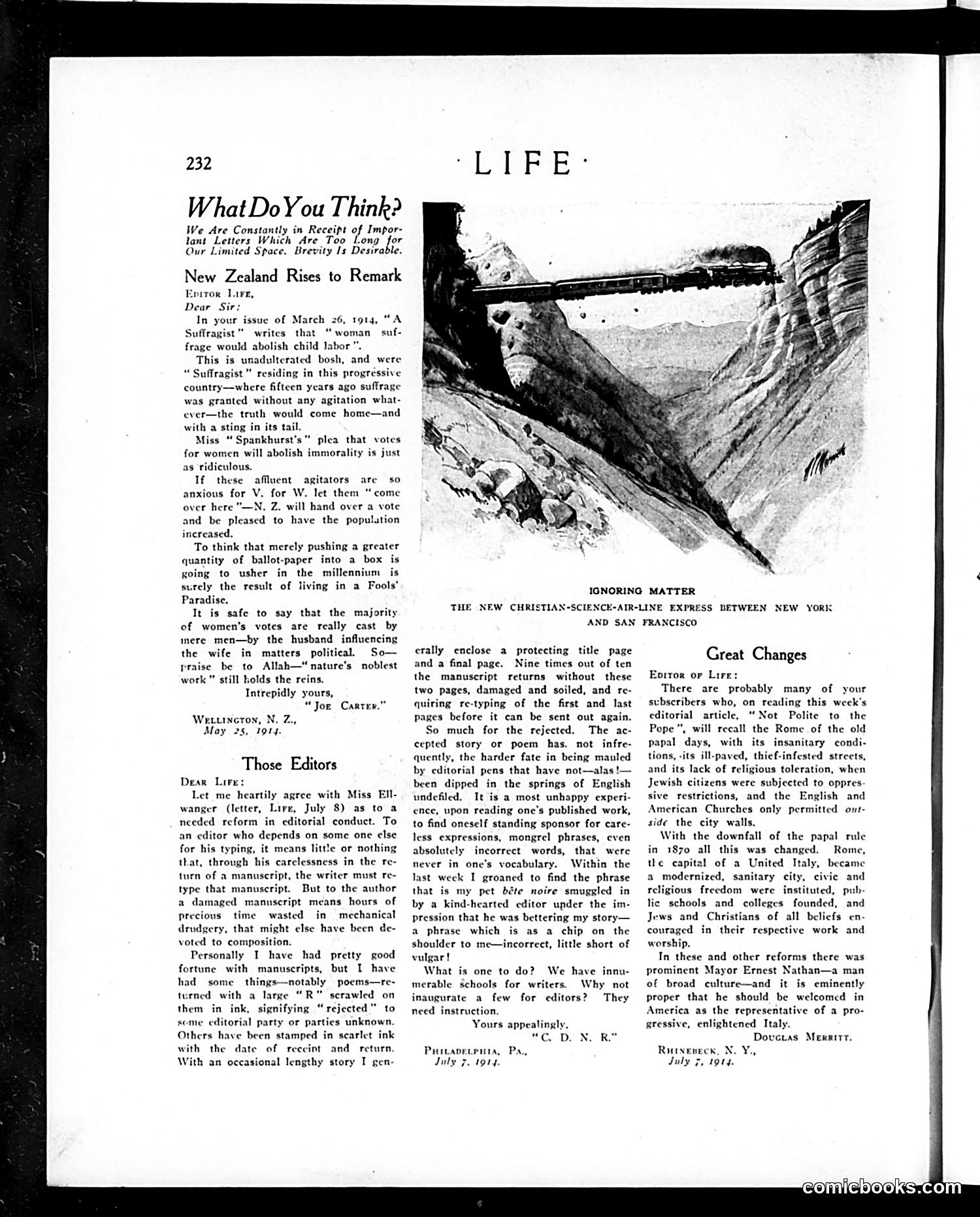
This page features readers' letters under "What Do You Think?" — a common editorial feature in *Life* magazine. **Key content:** 1. **New Zealand letter**: A reader ("Joe Carter") from Wellington responds to earlier suffrage debate, arguing that women's suffrage won't solve social problems as claimed. He mocks suffragists' optimism and notes that in New Zealand (which granted women's suffrage 15 years prior), women's votes are largely controlled by husbands anyway. 2. **Editorial complaint letter**: A writer criticizes magazine editors for damaging submitted manuscripts through careless handling and making unauthorized edits that introduce grammatical errors or change intended phrasing. 3. **"Great Changes" piece**: References a recent *Life* editorial ("Not Polite to the Pope") about modernization in Rome, contrasting old papal Rome's poor conditions with contemporary reforms. **The cartoon** (top right) appears to show a train on a dramatic cliff or mountainside, captioning the new Christian Science air-line service between New York and San Francisco — likely satire about a fantastical or dangerous transportation claim.
📄 Transcribed text from this page (OCR, searchable)
Machine-transcribed from the original scan — historical spelling and the odd misread are preserved.
232 What DoY ou Think? We Are Constantly in Receipt of Impor- lant Letters Which Are Too Long for Our Limited Space. Brevity Is Desirable. New Zealand Rises to Remark Tor Lire, Dear Sit In your issue of March 26, 1914, “A Suffragist” writes that “woman suf- frage would abolish child labor". This is unadulterated bosh, and were “ Suffragist” residing in this progressive country—where fifteen years ago suftr: was granted without any agitation what- ever—the truth would come home—and with a sting in its tail. Miss “ Spankhurst's” plea that votes for women will abolish immorality is just as ridiculous. If these aMuent agitators are so anxious for V. for W. let them “come over here”. Z. will hand over a vote and be pleased to have the population increased, To think that merely pushing a greater quantity of ballot-paper into a box is going to usher in the millennium is surely the result of living in a Fools’ Paradise. It is safe to say that the majority of women’s votes are really cast by mere men—by the husband influencing the wife in matters political. So— praise be to Allah—‘ nature's noblest work” still holds the reins. Intrepidly yours, “Jor Carter.” Ton, N. 25, 1914. Wetttn May Those Editors Dear Lire: Let me heartily agree with Miss EI wanger (letter, Lire, July 8) as to a needed reform in editorial conduct. To an editor who depends on some one else for his typing, it means little or nothing that, through his carelessness in the turn of a manuscript, the writer must re- type that manuscript. But to the author a damaged manuscript means hours of wasted in mechanical have been de- Precious time drudgery, that might else voted to composition. Personally I have had pretty good fortune with manuscripts, but I have had some things—notably poems—re- turned with a large “R" scrawled on them in ink, signifying “rejected” to seme editorial party or parties unknown. Others have been stamped in scarlet ink with the date of receipt and return. With an occasional lengthy story T gen- IGNORING MATTER NEW CHRISTIAN-SCIED AND SAN erally enclose a protecting title page and a final page. Nine times out of ten the manuscript returns without these two pages, damaged and soiled, and re- quiring re-typing of the first and last pages before it can be sent out again. So much for the rejected. The ac- cepted story or poem has. not infre- quently, the harder fate in being mauled by editorial pens that have not—alas!— been dipped in the springs of English undefiled. It is a most unhappy experi- ence, upon reading one’s published work, to find oneself standing sponsor for care- less expressions, mongrel phrases, even absolutely incorrect words, that were never in one’s vocabulary. Within the last week I groaned to find the phrase that is my pet béte noire smuggled i by a kind-hearted editor upder the im- pression that he was bettering my story— a phrase which is as a chip on the shoulder to me—incorrect, little short of vulgar! What is one to do? merable schools for writers. inaugurate a few for editors? need instruction. Yours appealingl: “GD. N. We have innu- Why not They Pricavecenuta, Pa, July 7, 1914. -AIR-LINE EXPRESS BETWEEN NEW YORK FRANCISCO Great Changes Eorror or Lire: There are probably many of your subscribers who, on reading this week's editorial article, “Not Polite to the Pope”, will recall the Rome of the old papal days, with its insanitary condi- tions, -its ill-paved, thief-infested streets, and its lack of religious toleration, when Jewish zens were subjected to oppres: sive restrictions, and the English and American Churches only permitted ont- side the city walls. With the downfall of the papal rule in 1870 all this was changed. Rome, the capital of a United Italy, became a modernized, sanitary city, civic and religious freedom were instituted, pub- lic schools and colleges founded, and Jews and Christians of all beliefs en- couraged in their respective work and worship. In these and other reforms there was prominent Mayor Ernest Nathan—a man of broad culture—and it is eminently proper that he should be welcomed in America as the representative of a pro- gressive, enlightened Italy. Dovctas Merritt. Rutvewecn, N. Y., July 7, 1914.