
Life, 1914-08-06 · page 24 of 40
Life — August 6, 1914 — page 24: what you’re looking at
What you’re looking at
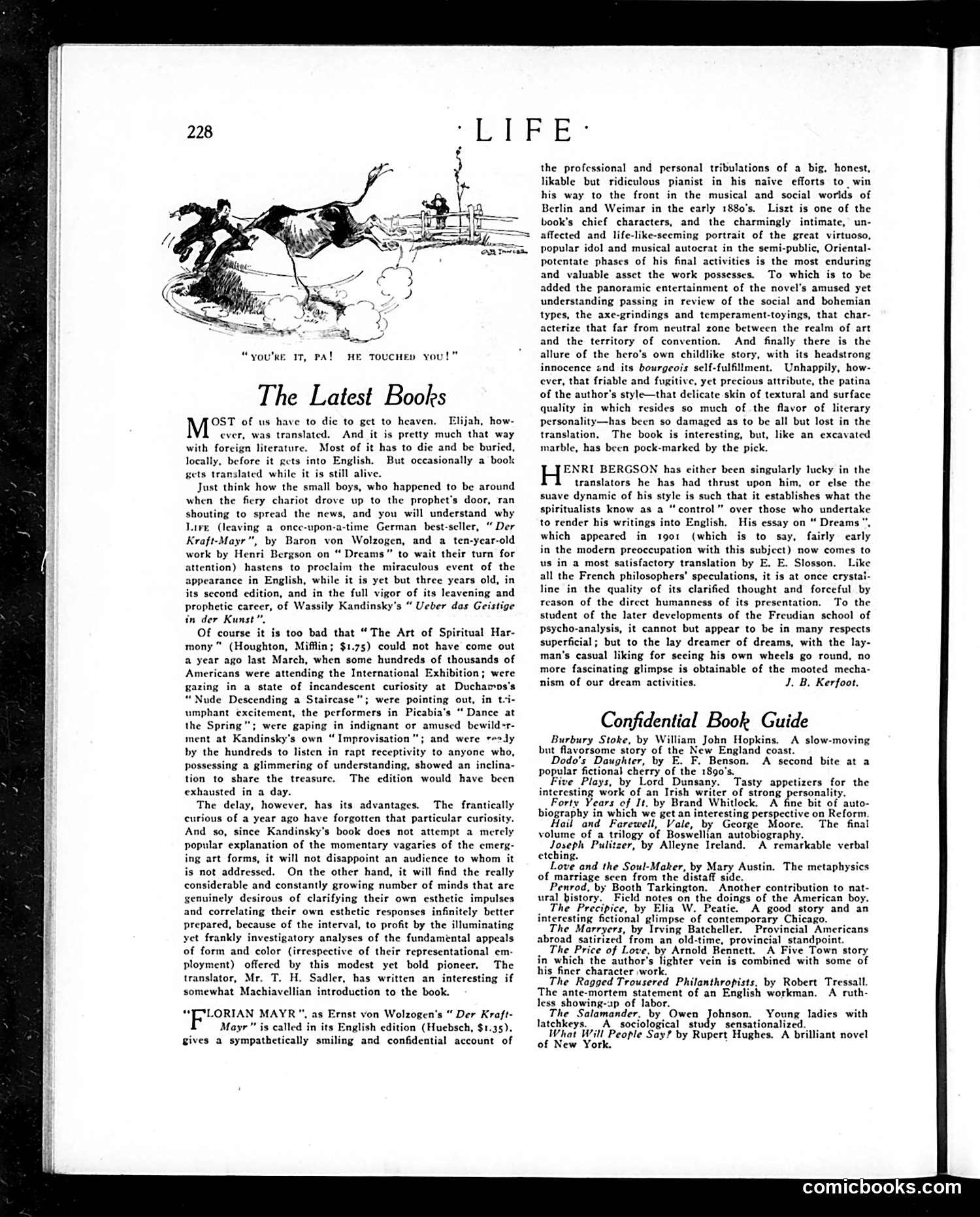
## The Cartoon The small illustration at top shows a figure being thrown or propelled violently, with the caption "YOU'RE IT, PA! HE TOUCHED YOU!" This appears to be a children's playground joke—a "tag" game reference—where the humor likely derives from the innocent physical contact between children, possibly with double-entendre implications given the era's sensibilities. ## The Content This page reviews newly translated books, primarily discussing Wassily Kandinsky's "The Art of Spiritual Harmony" and Ernst von Wolzogen's "Der Kraft-Mayr." The satire comments on the timing of literary translations: the Kandinsky book appears three years after the 1913 Armory Show (referenced through Duchamp's "Nude Descending a Staircase"), when American interest in modern art had cooled. The reviewer argues this delay is actually beneficial—the public is now intellectually prepared to appreciate Kandinsky's theoretical approach rather than merely gawking at avant-garde novelty. The tone is sophisticated and encouraging toward experimental art while gently mocking earlier sensationalism around modernism.
📄 Transcribed text from this page (OCR, searchable)
Machine-transcribed from the original scan — historical spelling and the odd misread are preserved.
“i PIB “you're 17, PA! HE ToucHED you!” The Latest Books OST of us have to dic to get to heaven. Elijah, how- ever, was translated. And it is pretty much that way with foreign literature. Most of it has to die and be buried, locally, before it gets into English, But occasionally a book gets translated while it is still alive. Just think how the small boys, who happened to be around when the fiery chariot drove up to the prophet’s door, ran shouting to spread the news, and you will understand why Lire (leaving a once-upon-a-time German best-seller, “ Der Kraft-Mayr”, by Baron von Wolzogen, and a ten-year-old work by Henri Bergson on “ Dreams” to wait their turn for attention) hastens to proclaim the miraculous event of the appearance in English, while it is yet but three years old, in its second edition, and in the full vigor of its leavening and prophetic career, of Wassily Kandinsky’s “ Ueber das Geistige in der Kunst Of course it is too bad that “The Art of Spiritual Har- mony” (Houghton, Mifflin; $1.75) could not have come out a year ago last March, when some hundreds of thousands of Americans were attending the International Exhibition; were azing in a state of incandescent curiosity at Duchamos's Nude Descending a Staircase”; were pointing out, in t-i- umphant excitement, the performers in Picabia's “ Dance at the Spring"; were gaping in indignant or amused bewild-r- ment at Kandinsky's own “Improvisation”; and were resly by the hundreds to listen in rapt receptivity to anyone who, possessing a glimmering of understanding, showed an inclina- tion to share the treasure. The edition would have been exhausted in a day. The delay, however, has its advantages. The frantically curious of a year ago have forgotten that particular curiosity. And so, since Kandinsky’s book does not attempt a merely popular explanation of the momentary vagaries of the emerg- ing art forms, it will not disappoint an audience to whom it is not addressed. On the other hand, it will find the really considerable and constantly growing number of minds that are genuinely desirous of clarifying their own esthetic impulses and correlating their own esthetic responses infinitely better prepared, because of the interval, to profit by the illuminating yet frankly investigatory analyses of the fundamental appeals of form and color (irrespective of their representational em- ployment) offered by this modest yet bold pioneer. The translator, Mr. T. H. Sadler, has written an interesting if somewhat Machiavellian introduction to the book. “TOLORIAN MAYR", as Ernst von Wolzogen's “ Der Kraft- Mayr” is called in its English edition (Huebsch, $1.35). gives a sympathetically smiling and confidential account of the professional and personal tribulations of a big. honest, likable but ridiculous pianist in his naive efforts to win his way to the front in the musical and social worlds of Berlin and Weimar in the early 1880's. Liszt is one of the book's chief characters, and the charmingly intimate, un- affected and life-like-seeming portrait of the great virtuoso, popular idol and musical autocrat in the semi-public, Oriental- potentate phases of his final activities is the most enduring and valuable asset the work possesses. To which is to be added the panoramic entertainment of the novel's amused yet understanding passing in review of the social and bohemian types, the axe-grindings and temperament-toyings, that char- acterize that far from neutral zone between the realm of art and the territory of convention. And finally there is the allure of the hero’s own childlike story, with its headstrong innocence snd its bourgeois self-fulfillment. Unhappily, how- ever, that friable and fugitive, yet precious attribute, the patina of the author's style—that delicate skin of textural and surface quality in which resides so much of the flavor of literary personality—has been so damaged as to be all but lost in the translation, The book is interesting, but, like an excavated marble, has been pock-marked by the pick. ENRI BERGSON has cither been singularly lucky in the translators he has had thrust upon him, or else the suave dynamic of his style is such that it establishes what the spiritualists know as a “control” over those who undertake to render his writings into English, His essay on “ Dreams“, which appeared in 1901 (which is to say, fairly early in the modern preoccupation with this subject) now comes to us in a most satisfactory translation by E. E. Slosson. Like all the French philosophers’ speculations, it is at once cryst, line in the quality of its clarified thought and forceful by reason of the dircct humanness of its presentation. To the student of the later developments of the Freudian school of psycho-analy: it cannot but appear to be in many respect superficial; but to the lay dreamer of dreams, with the la; man's casual liking for seeing his own wheels go round, no more fascinating glimpse is obtainable of the mooted mecha- nism of our dream activities. J. B. Kerfoot. Confidential Book Guide Burbury Stoke, by William John Hopkins. A slow-moving but flavorsome story of the New England coast. Dodo's Daughter, by E. F. Benson. A second bite at a popular fictional cherry of the 1890's. Five Plays, by Lord Dunsany. Tasty appetizers for the interesting work of an Irish writer of strong personality. Forty Years of It. by Brand Whitlock. A fine bit of auto- biography in which we get an interesting perspective on Reform. Hail and Farewell, Vale, by George Moore. The final volume of a trilogy of Boswellian autobiography. Joseph Pulitzer, by Alleyne Ireland. A remarkable verbal etching. Love and the Soul-Maker, by Mary Austin. The metaphysics of marriage seen from the distaff side. Penrod, by Booth Tarkington. Another contribution to nat- ural bistory. Field notes on the doings of the American boy. The Precipice, by Elia W. Peatie. A good story and an interesting fictional glimpse of contemporary Chicago. The Marryers, by Irving Batcheller. Provincial Americans abroad satirized’ from an old-time, provincial standpoint. __ The Price of Love, by Arnold Bennett. A Five Town story in which the author's lighter vein is combined with some of his finer character ;work. The Ragged Trousered Philanthropists, by Robert Tressall. The ante-mortem statement of an English workman. A ruth- less showing-ap of labor. The Salamander. by Owen Johnson. Young ladies with latchkeys. A. sociological study sensationalized. What Will People Say? by Rupert Hughes. A brilliant novel of New York. comicbooks.com