
Life, 1914-08-06 · page 26 of 40
Life — August 6, 1914 — page 26: what you’re looking at
What you’re looking at
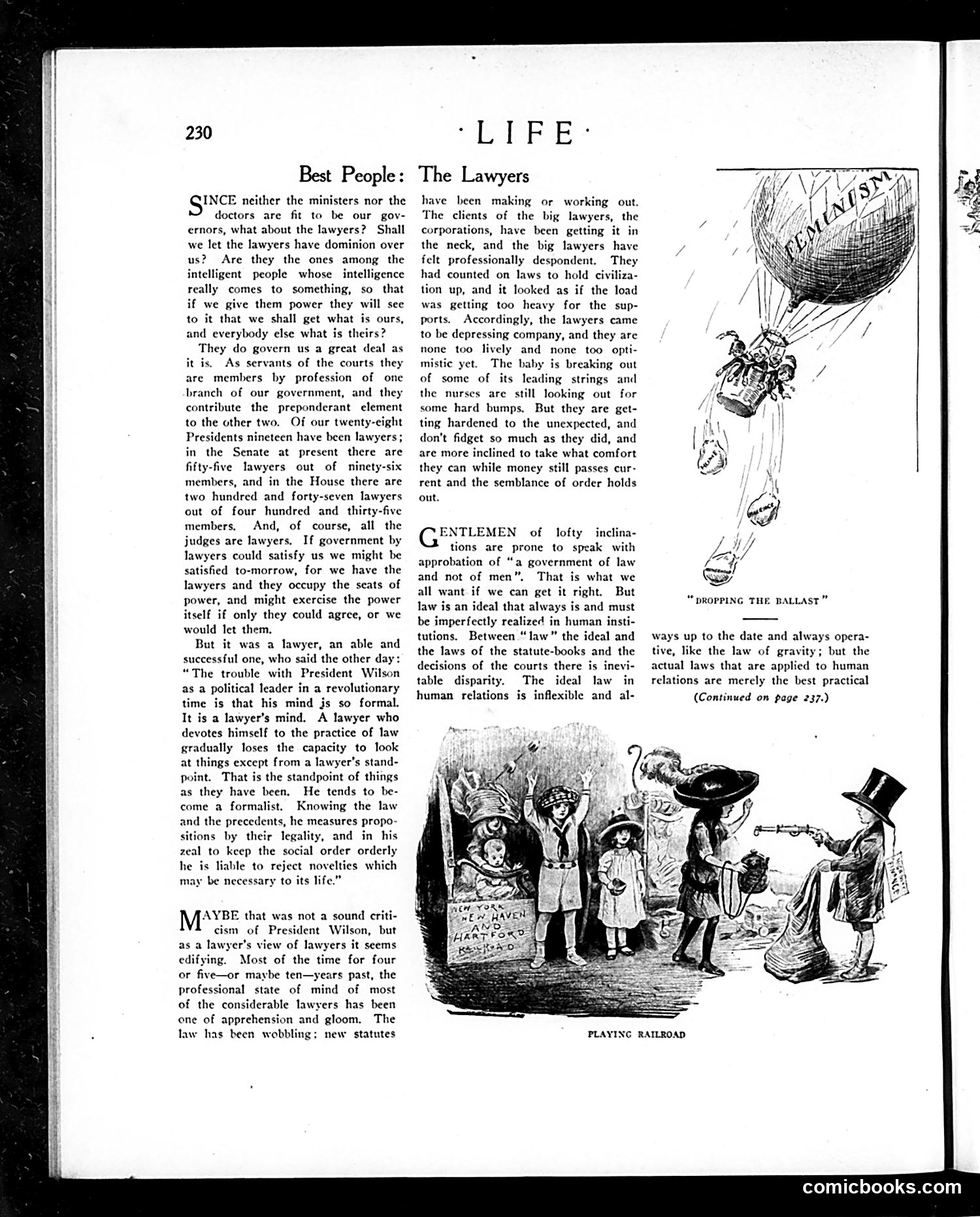
This satirical article critiques lawyer-dominated government in America. The text notes that 19 of 28 U.S. Presidents were lawyers, plus majorities in Congress and all judges—yet this hasn't solved societal problems. The article's key argument: lawyers think like formalists bound by precedent, making them poor leaders during revolutionary times. It specifically criticizes President Wilson as having "a lawyer's mind" too focused on legality rather than necessary change. The two cartoons illustrate this critique: - **"Dropping the Ballast"** shows a ship discarding cargo—symbolizing society shedding old legal constraints - **"Playing Railroad"** depicts children playing with toy trains, suggesting lawyers' outdated thinking is childish The satire suggests that while lawyers provide order, their rigid adherence to existing law prevents necessary social reform. The piece advocates for pragmatism over legal formalism during turbulent times.
📄 Transcribed text from this page (OCR, searchable)
Machine-transcribed from the original scan — historical spelling and the odd misread are preserved.
230 Best People : INCE neither the ministers nor the doctors are fit to be our gov- ernors, what about the lawyers? Shall we let the lawyers have dominion over us? Are they the ones among the intelligent people whose intelligence really comes to something, so that if we give them power they will see to it that we shall get what is ours, and everybody else what is theirs? They do govern us a great deal as it is. As servants of the courts they are members by profession of one branch of our government, and they contribute the preponderant element to the other two. Of our twenty-eight Presidents nineteen have been lawyers; in the Senate at present there are fifty-five lawyers out of ninety-six members, and in the House there are two hundred and forty-seven lawyers out of four hundred and thirty-five members, And, of course, all the judges are lawyers, If government by lawyers could satisfy us we might be satisfied to-morrow, for we have the lawyers and they occupy the seats of power, and might exercise the power itself if only they could agree, or we would let them, But it was a lawyer, an able and successful one, who said the other day: “The trouble with President Wilson as a political leader in a revolutionary time is that his mind js so formal. It is a lawyer’s mind. A lawyer who devotes himself to the practice of law gradually loses the capacity to look at things except from a lawyer’s stand- point. That is the standpoint of things as they have been. He tends to be- come a formalist. Knowing the law and the precedents, he measures propo- sitions by their legality, and in his zeal to keep the social order orderly he is liable to reject novelties which may be necessary to its life.” AYBE that was not a sound criti- cism of President Wilson, but as a lawyer’s view of lawyers it seems edifying. Most of the time for four or five—or maybe ten—years past, the professional state of mind of most of the considerable lawyers has been one of apprehension and gloom, The law has been wobbling; new statutes “LAPCESE The Lawyers have been making or working out. The clients of the big lawyers, the corporations, have been getting it in the neck, and the big lawyers have felt. professionally despondent. They had counted on laws to hold civiliza- tion up, and it looked as if the load was getting too heavy for the sup- ports. Accordingly, the lawyers came to be depressing company, and they are none too lively and none too opti- mistic yet. The baby is breaking out of some of its leading strings and the nurses are still looking out for some hard bumps. But they are get- ting hardened to the unexpected, and don't fidget so much as they did, and are more inclined to take what comfort they can while money still passes cur- rent and the semblance of order holds out. NTLEMEN of lofty inclina- tions are prone to speak with approbation of “a government of law and not of men”, That is what we all want if we can get it right. But law is an ideal that always is and must be imperfectly realized in human insti- tutions. Between “law” the ideal and the laws of the statute-books and the decisions of the courts there is inevi- table disparity. The ideal law in human relations is inflexible and al- BB crt YORN ene BA NDA “DROPPING THE BALLAST” ways up to the date and always opera- tive, like the law of gravity; but the actual laws that are applied to human relations are merely the best practical (Continued on page 237.) PLAYING RAILROAD dl Ss, comicbooks.com