
A complete issue · 44 pages · 1914
Life — July 2, 1914
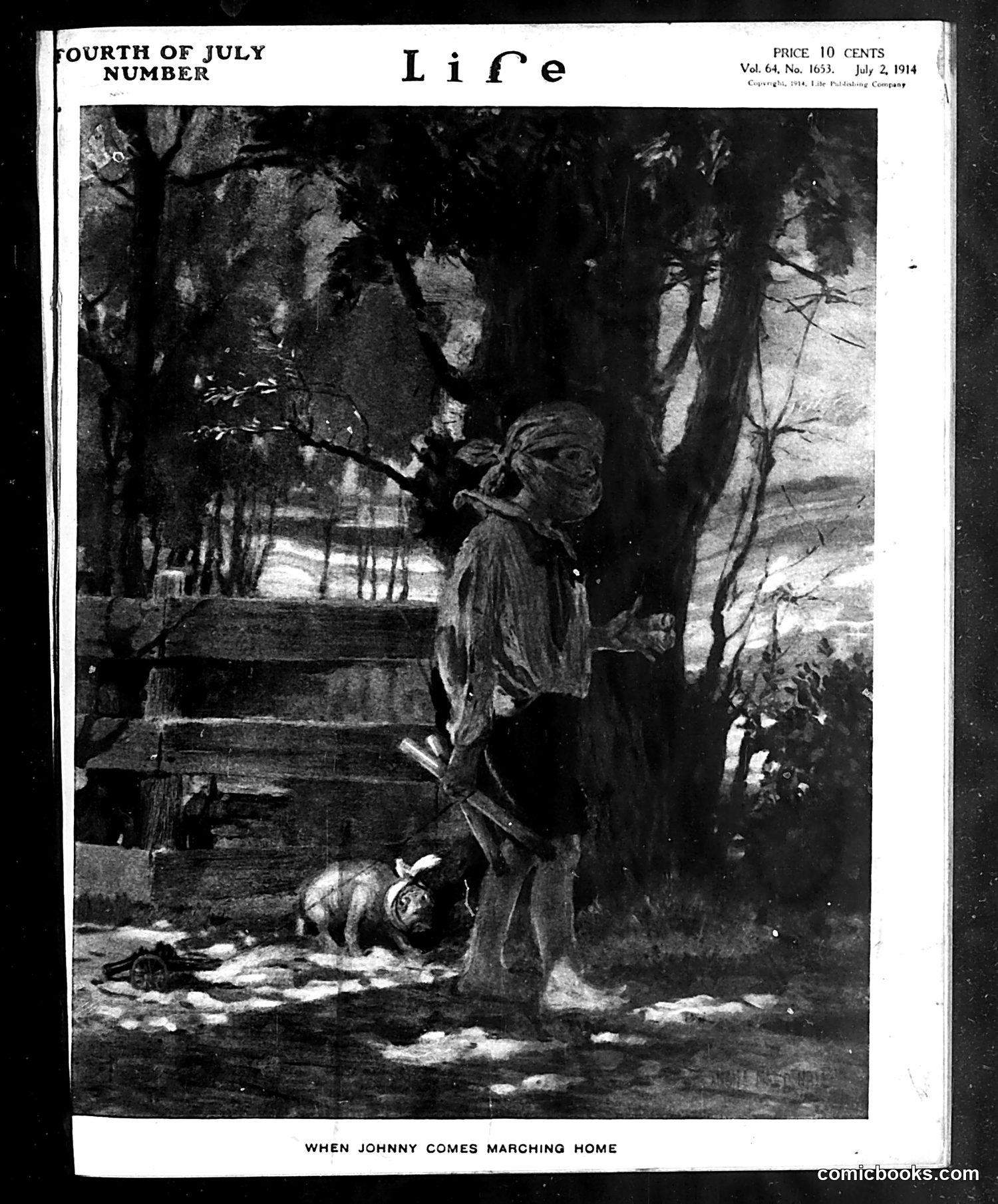
This is a Fourth of July Number cover from Life magazine (July 2, 1914). The image depicts a woman greeting a soldier returning home, illustrated as a sentimental domestic scene beneath trees near water. The caption references the famous Civil War song "When Johnny Comes Marching Home." However, given the 1914 date—before U.S. entry into World War I—this likely carries ironic weight. The romanticized imagery of a soldier's homecoming contrasts with the magazine's satirical tradition, possibly commenting on American militarism, war enthusiasm, or the gap between patriotic sentiment and battlefield reality. The composition evokes both patriotic nostalgia and potential critique of glorifying warfare.
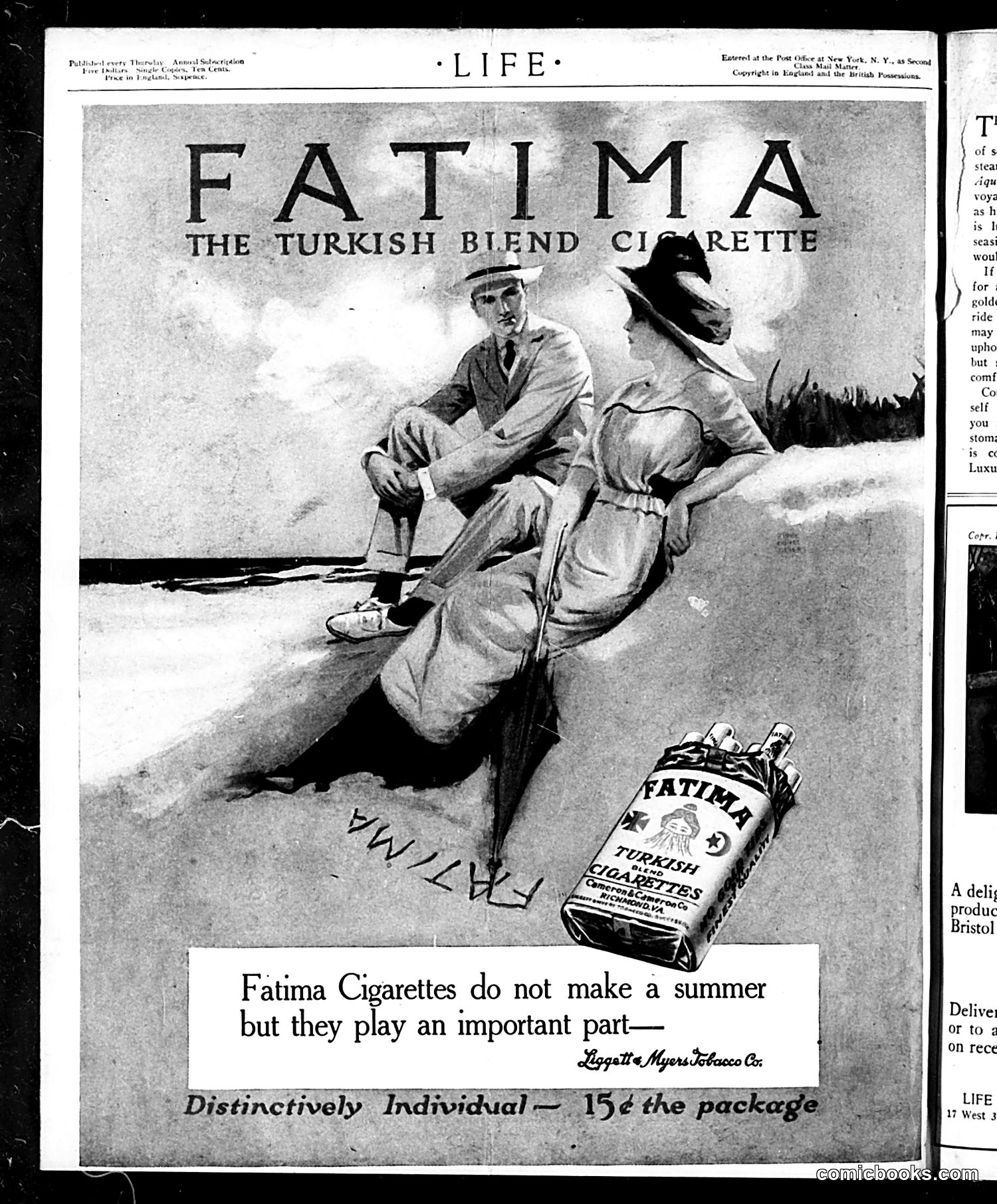
This page is primarily a **cigarette advertisement** for Fatima brand Turkish blend cigarettes, not political satire. The image shows two figures in winter clothing by a frozen lake or snowy landscape. One appears to be fishing through ice while the other watches. The advertisement's tagline states: "Fatima Cigarettes do not make a summer but they play an important part—" The joke is a pun on "playing an important part": the cigarettes don't literally create warm weather, but smoking them might provide comfort during cold weather activities like ice fishing. The ad emphasizes the product is "Distinctively Individual — 15¢ the package," marketed by Liggett & Myers Tobacco Co. This reflects early 20th-century advertising that used humor and lifestyle imagery to market cigarettes without health warnings.
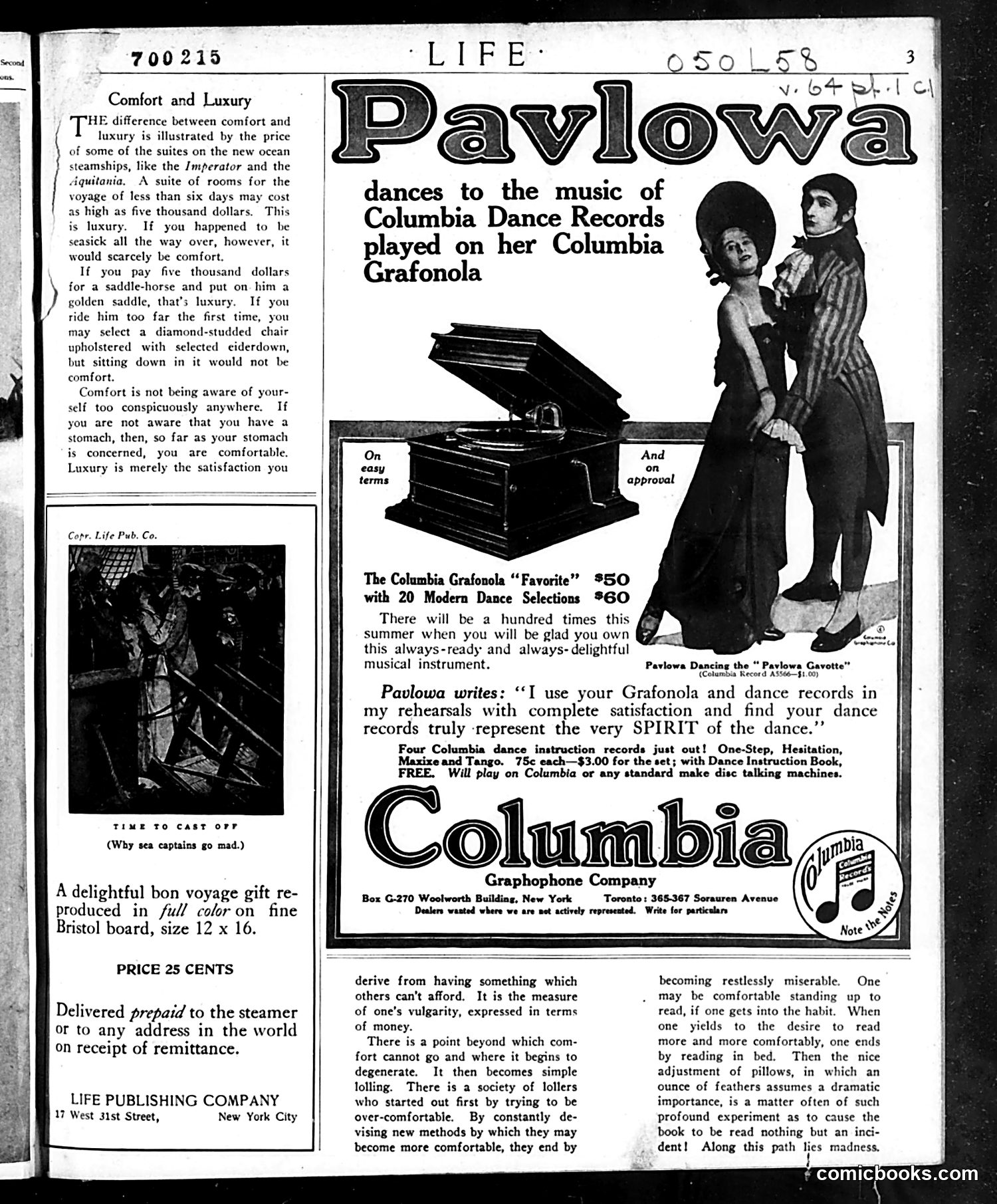
This page is primarily an **advertisement**, not satirical content. The dominant feature is a Columbia Graphophone Company ad promoting their "Pavlowa" gramophone model and dance records. The ad features **Anna Pavlova**, the famous Russian ballet dancer (identified by the caption "Pavlowa Dancing the 'Pavlowa Gavette'"). The advertisement leverages her celebrity status to market Columbia's dance records and gramophones, quoting her endorsement about using Columbia equipment in rehearsals. The left column contains unrelated editorial content about comfort versus luxury, plus a separate small ad for a Bristol board gift item. This appears to be a **paid celebrity endorsement advertisement** rather than editorial satire—a common marketing strategy of the era using famous performers to promote consumer products.
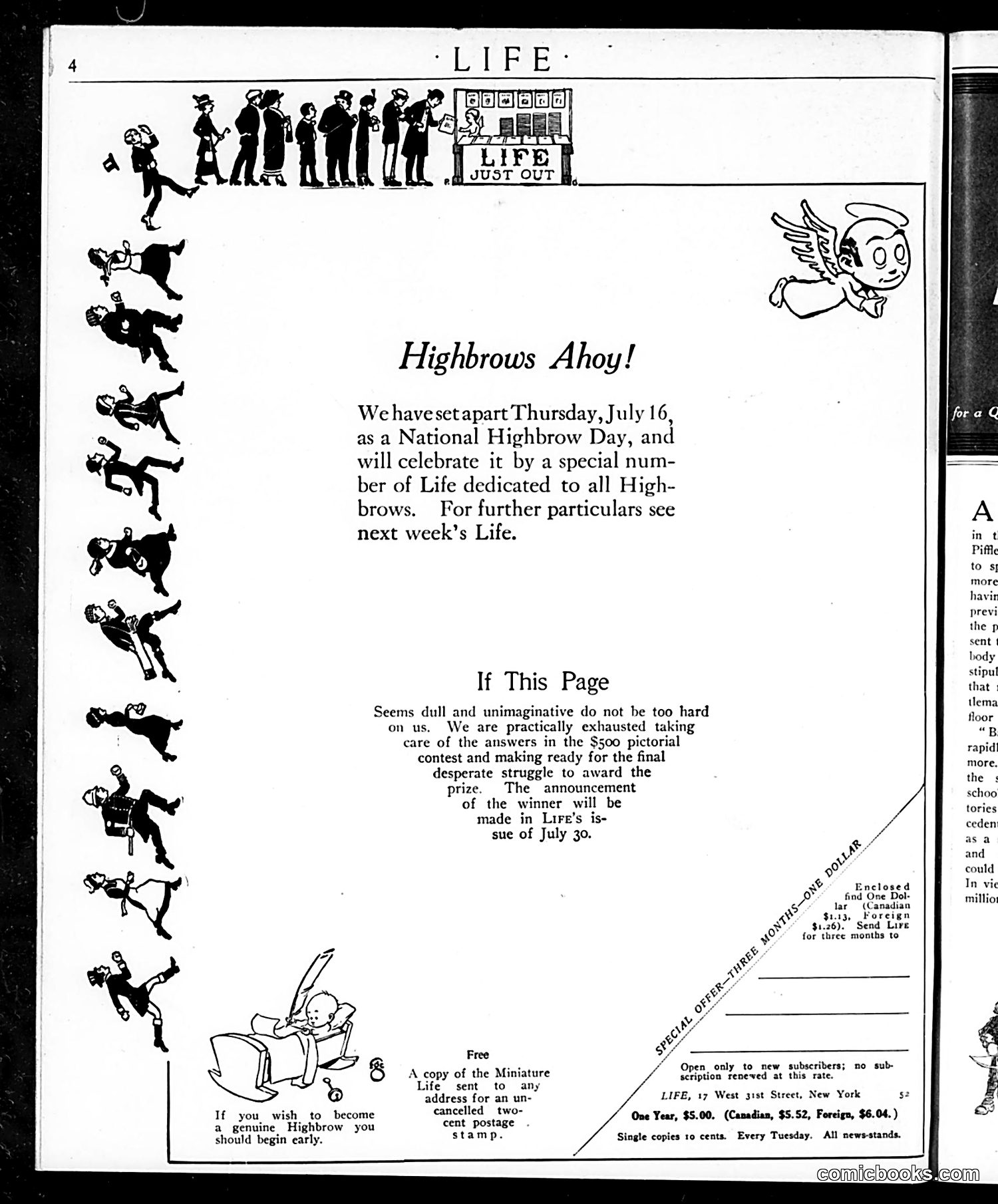
This page announces "National Highbrow Day" on Thursday, July 16, with Life magazine dedicating a special issue to celebrating intellectuals and cultural elites—a satirical inversion typical of Life's humor. The left margin features a vertical sequence of silhouetted figures in exaggerated poses—apparently representing "highbrows" engaged in affected, pretentious behaviors: striking theatrical attitudes, gesturing dramatically, and generally appearing self-important and ridiculous. This visual satire mocks the stereotypical highbrow as pompous and absurdly self-conscious. The editorial note admits the current page is "dull and unimaginative" because staff are exhausted managing a $500 pictorial contest. The cherub illustration reinforces the lighthearted tone. The satire targets intellectual pretension rather than genuine intelligence, poking fun at affected cultural superiority.
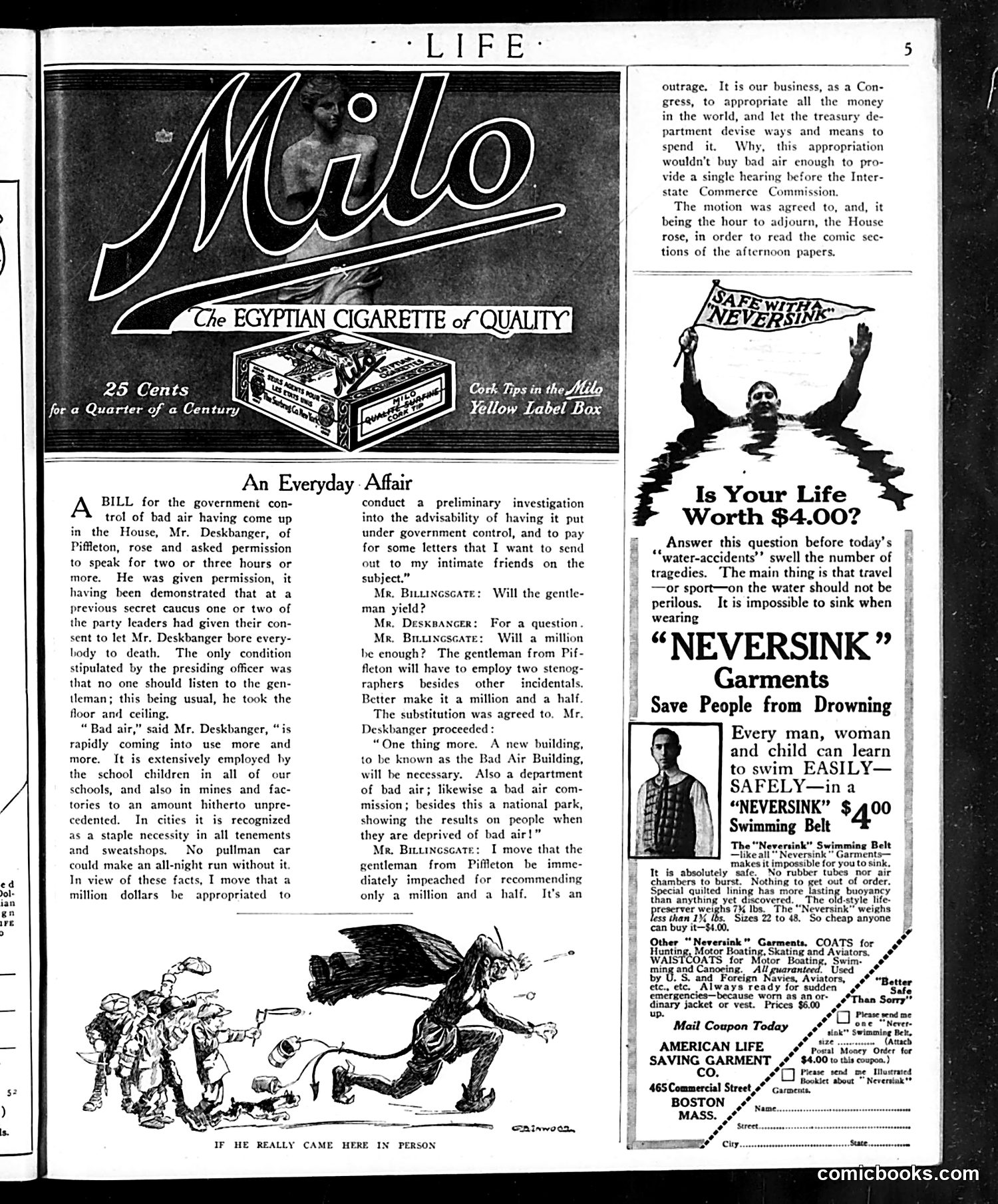
This page is primarily **advertising** (Milo cigarettes, Neversink swimming belts) with one political cartoon titled "An Everyday Affair." The cartoon depicts a **congressman's proposal for government control of "bad air,"** satirizing what appears to be **Progressive Era debates about industrial pollution and government regulation**. Mr. Deskbanger argues the government should fund a "Bad Air Building" to study pollution's health effects, which he claims costs "a million and a half" dollars. The satire targets **two things**: excessive government spending on research and the absurdity of treating air pollution as something requiring massive bureaucratic infrastructure rather than direct regulation of factories. The cartoon ridicules both wasteful government expansion and the ineffectiveness of studying problems rather than solving them.
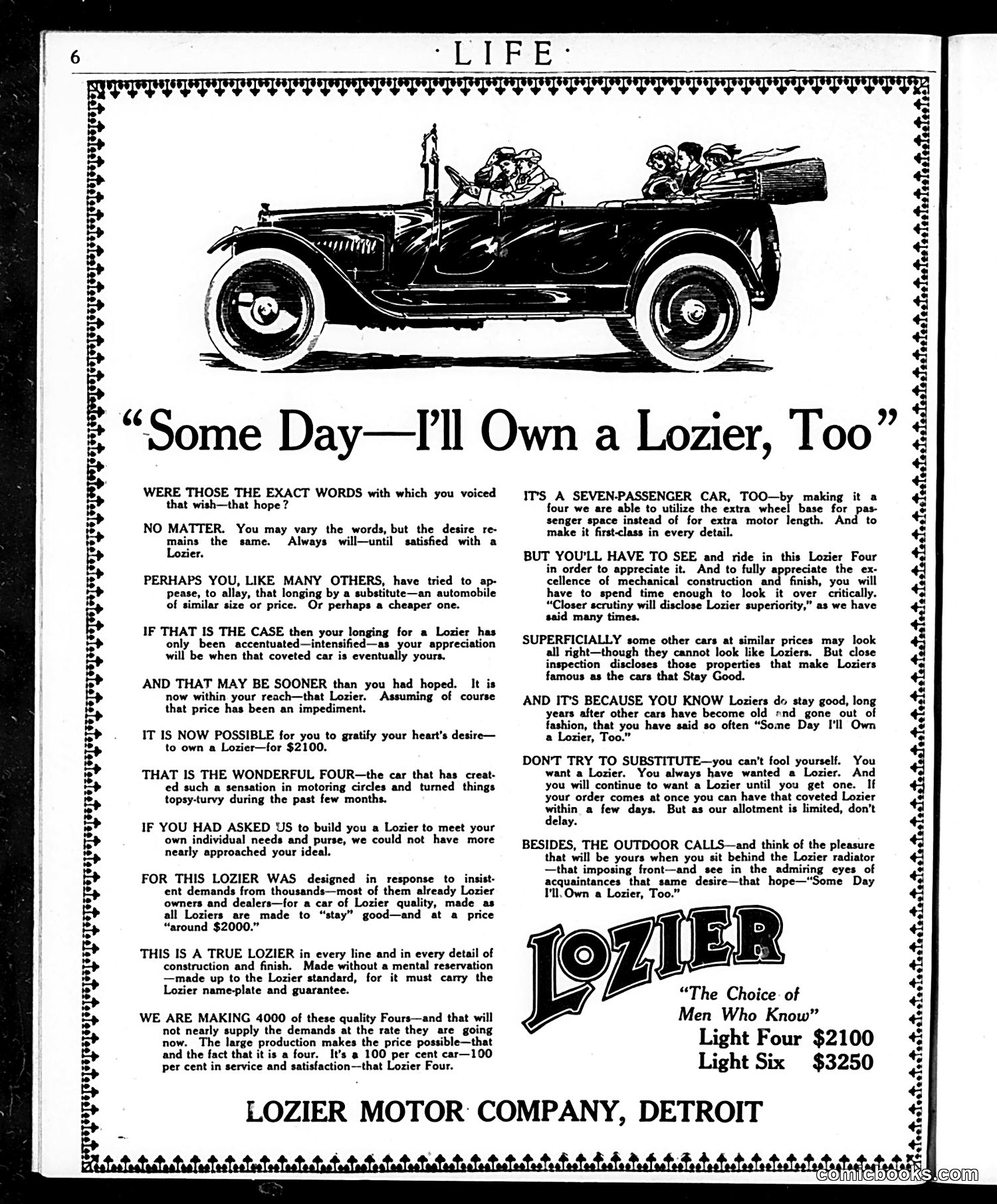
This page is primarily a **Lozier automobile advertisement**, not political satire. It appeals to aspiring car owners with the tagline "Some Day—I'll Own a Lozier, Too," addressing working-class desires for automobile ownership. The ad acknowledges that many people substitute cheaper cars while dreaming of Loziers. It argues that Lozier quality justifies the price ($2,100 for the Light Four; $3,250 for the Light Six) and promises rapid fulfillment—"within a few days"—if customers order now. The seven-passenger vehicle shown represents practical luxury. The advertisement targets readers' aspirations while suggesting that owning a Lozier isn't merely a distant fantasy but an achievable goal through timely purchase. This reflects early 20th-century consumer culture and automobile marketing strategies.
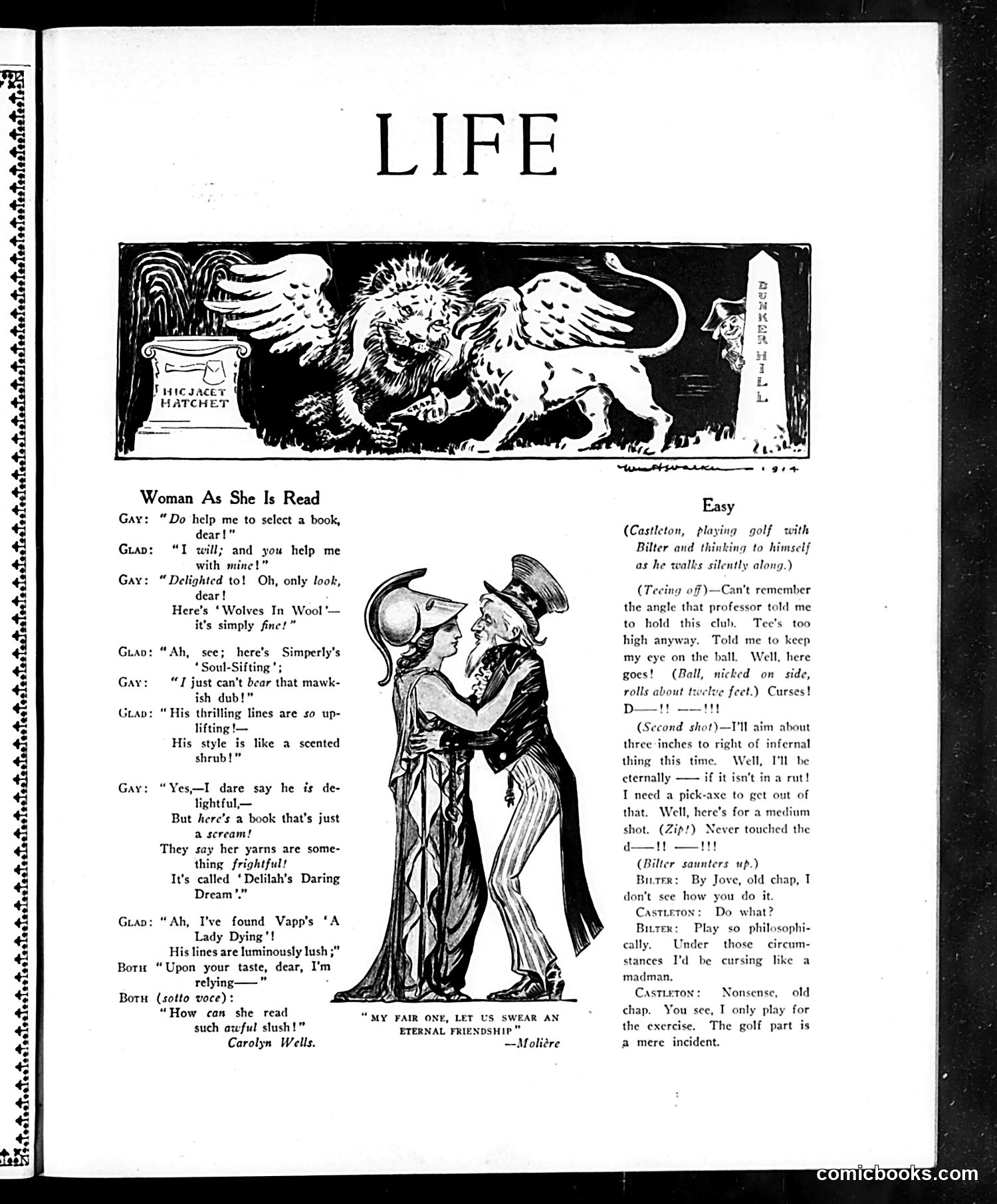
This page satirizes women's reading habits and romantic interests through two pieces: **Left side ("Woman As She Is Read"):** A dialogue between "Gay" and "Glad" (likely stock characters representing different female types) discussing sensational novels. They mock women who read melodramatic fiction with titles like "Wolves In Wool" and "Delilah's Daring Dream," criticizing both the overwrought prose and women readers' supposed gullibility for such stories. The satire targets both pulp literature and female audiences. **Right side ("Easy"):** A humorous golf anecdote featuring characters Castleton and Bitter, with Molière's quote about "eternal friendship." This mocks male social posturing during casual sports. The overall commentary reflects early 20th-century gender stereotypes: women as easily manipulated by cheap romance novels, men as philosophically pretentious.
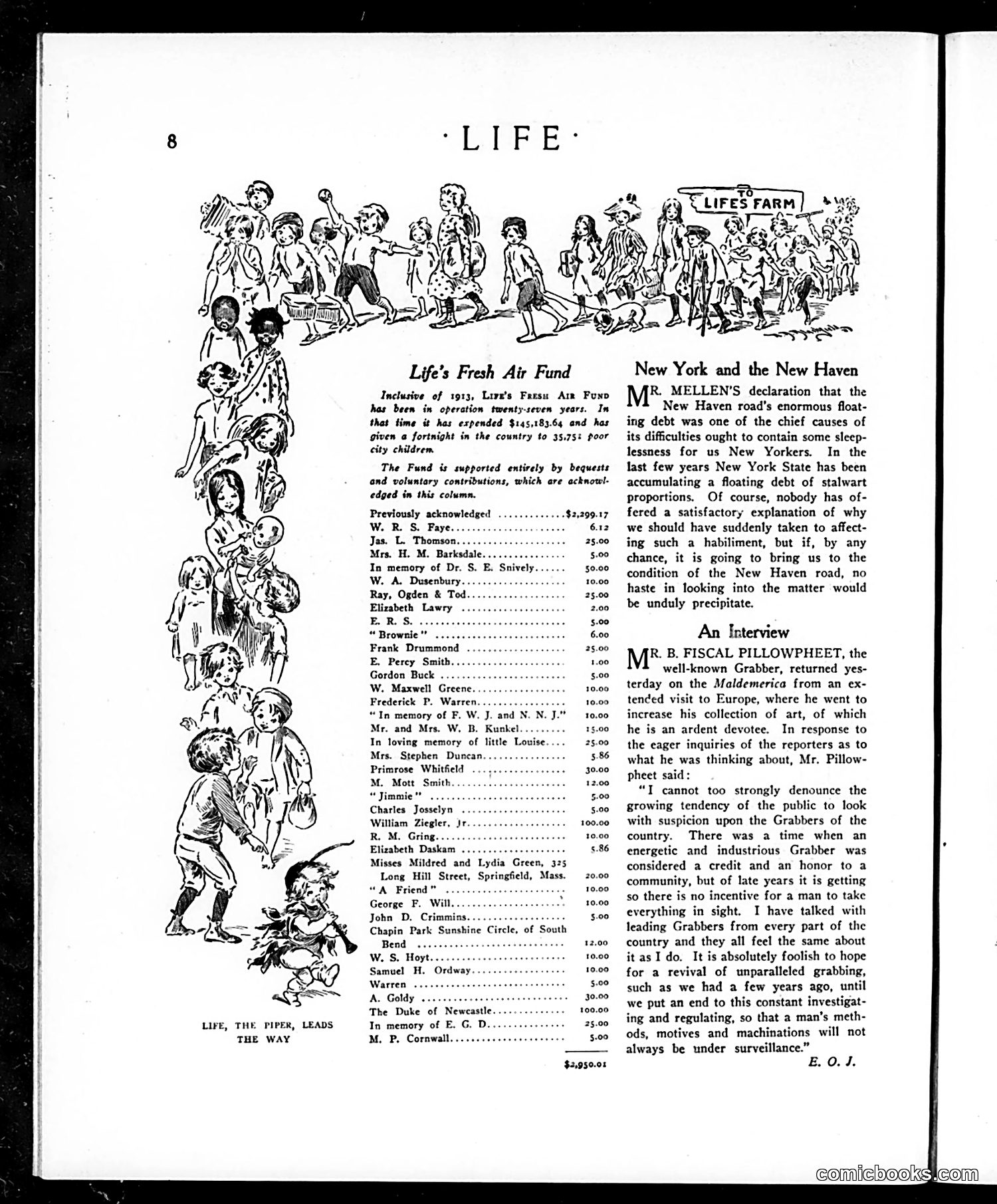
This page combines charitable fundraising with social commentary. The left side features an illustrated procession of children leading toward "Life's Farm," accompanying details about **Life's Fresh Air Fund**—a real charitable initiative providing poor city children access to countryside experiences. The list shows donors and amounts contributed. The right side contains an interview with **Mr. B. Fiscal Pillowpheet** (a fictional name, likely satirizing pompous business figures) discussing his recent European travels. He critiques a growing public tendency to suspect wealthy industrialists ("Grabbers"), arguing that successful businessmen were once community assets deserving respect. He laments recent regulatory efforts that now place them under "surveillance." The satire targets Gilded Age industrialists defending themselves against Progressive Era criticism and emerging antitrust regulations.
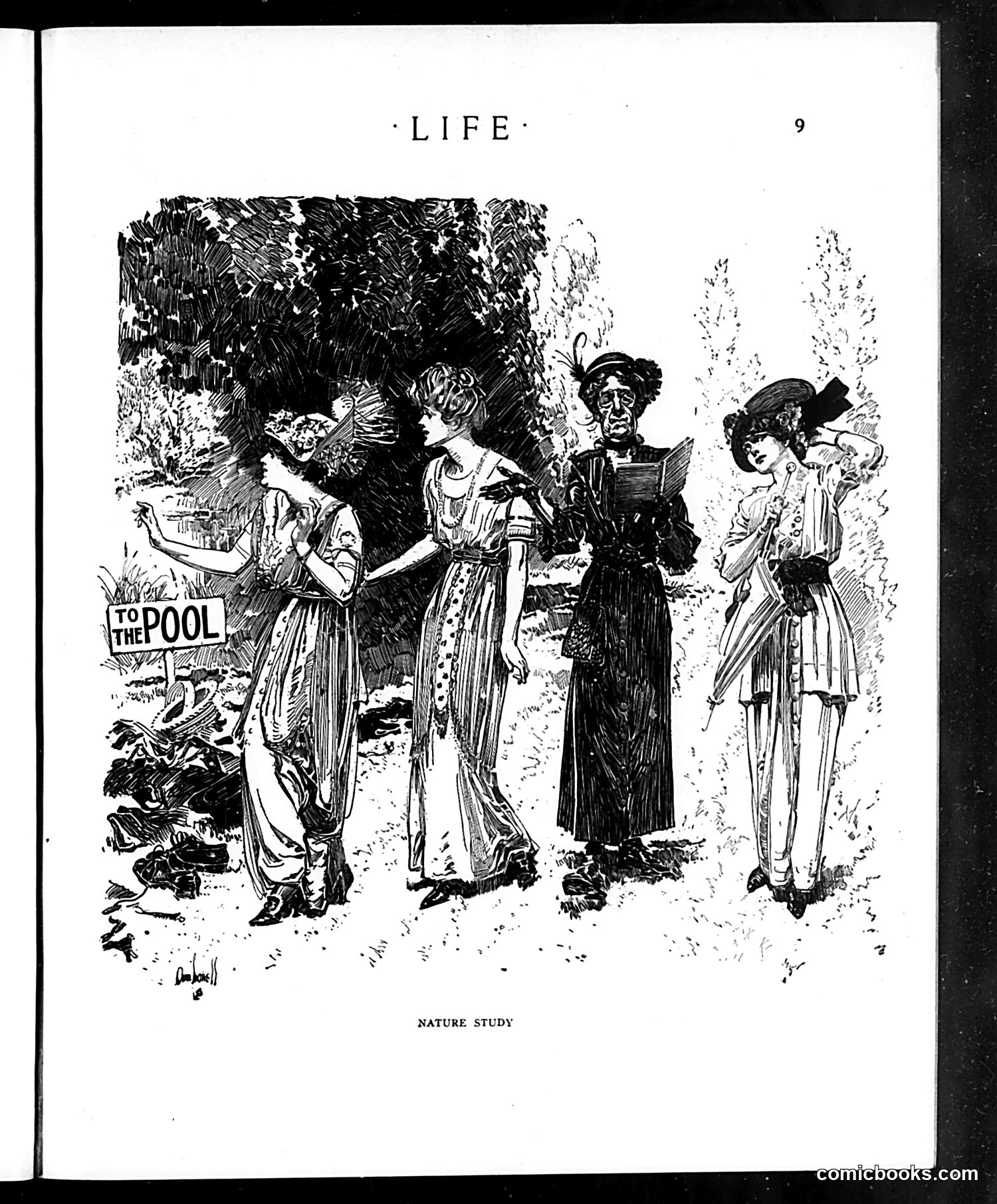
This cartoon satirizes young women engaged in "nature study"—a euphemistic activity of the era. The caption and scene suggest these fashionably dressed women are ostensibly going to observe nature at a pool (note the "TO THE POOL" sign), but the illustration implies their true interest is recreational socializing and flirtation rather than genuine natural observation. The joke relies on the period's tension between women's claimed educational or scientific pursuits versus their actual social motivations. The women's elaborate Edwardian dress, decorative hats, and body language—some reading, some posing—mock the pretense of serious "study." This reflects early 20th-century attitudes skeptical of women's intellectual commitments.
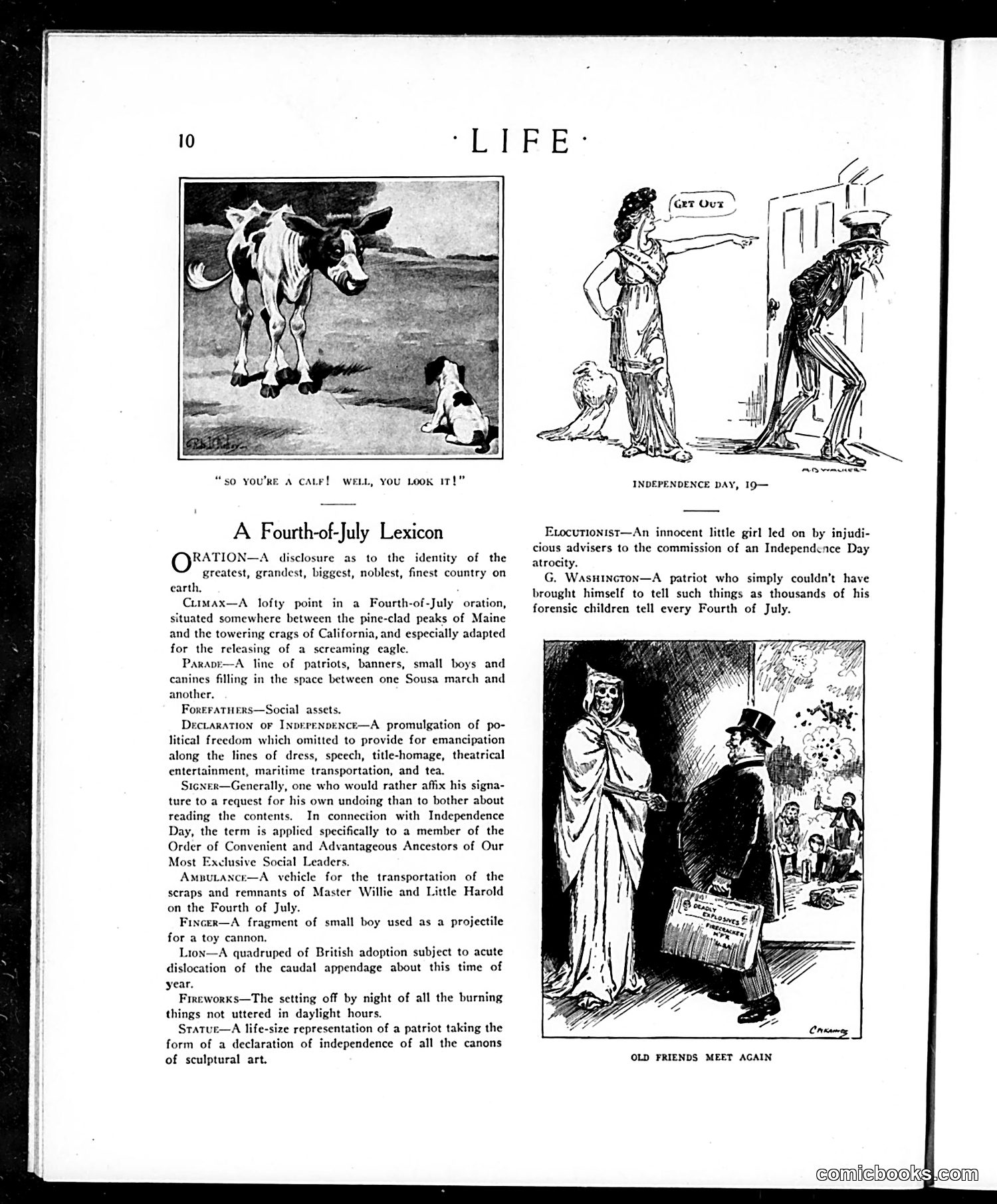
This page satirizes Fourth of July celebrations through humorous definitions. The top cartoon shows a woman ejecting a man labeled "GET OUT," mocking patriotic hypocrisy on Independence Day. The "Lexicon" mockingly defines patriotic terms: - **ORATION**: verbose speeches about freedom - **CLIMAX**: the dramatic eagle-release moment - **PARADE**: crowds between marching bands - **DECLARATION OF INDEPENDENCE**: ironically, a promise for freedom that ignores real inequalities - **STATUE**: patriotic sculptural representations The bottom illustration titled "Old Friends Meet Again" depicts Lady Liberty (classical female figure) greeting Uncle Sam, suggesting their annual reunion during Independence Day celebrations. The satire criticizes the gap between America's founding ideals and actual social/political practices, particularly regarding genuine freedom and equality.
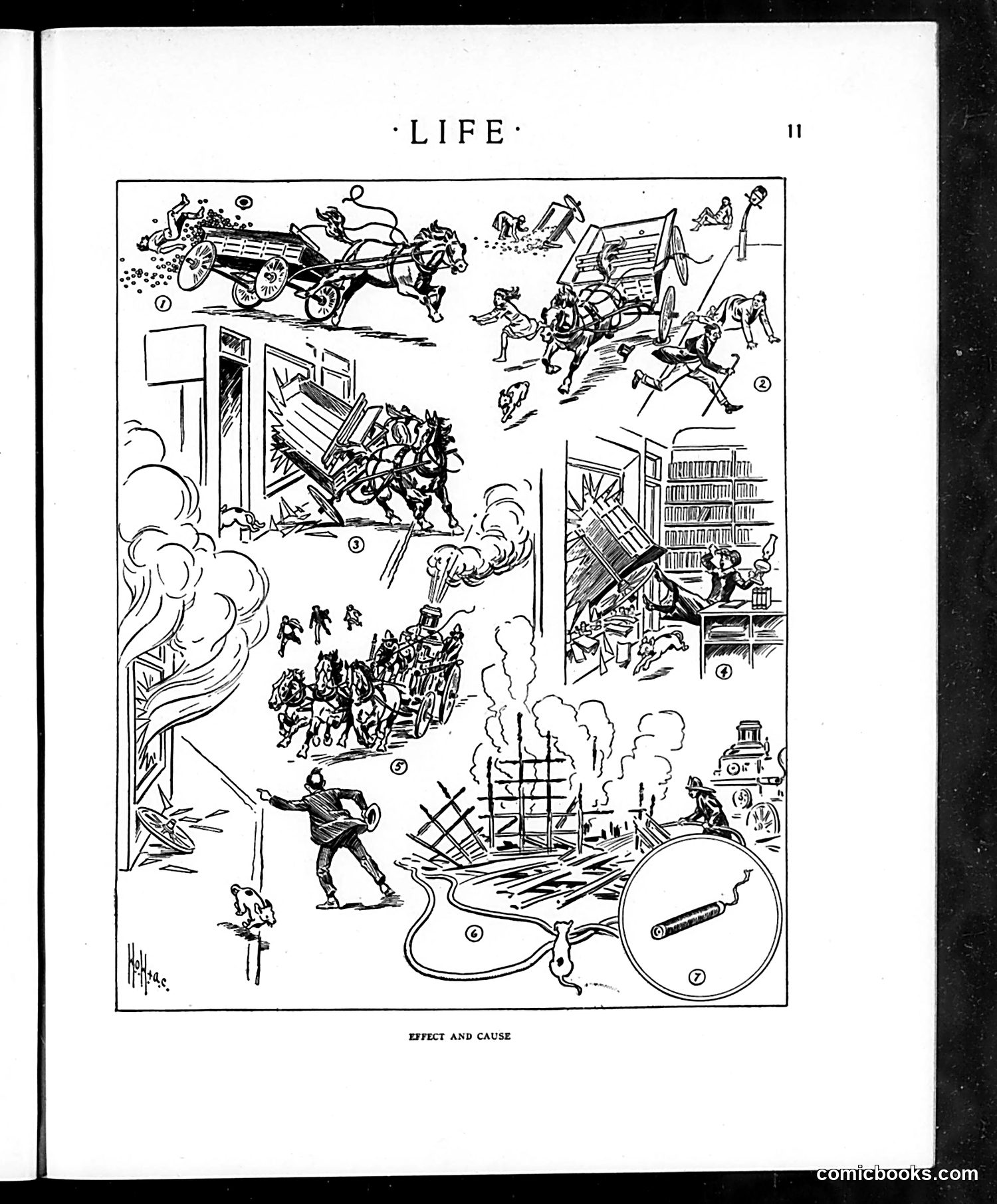
This is a satirical diagram titled "Effect and Cause" showing various disasters and chaotic scenes numbered 1-7, illustrating consequences flowing from initial causes. The cartoon depicts: - Runaway horses and overturned wagons (scenes 1, 2, 3) - A building fire with people fleeing (scene 3) - A library collapsing with falling books (scene 4) - A construction site disaster with smoke (scene 5) - What appears to be industrial or mechanical failures (scene 6, 7) A man at bottom left appears to be pulling a rope, suggesting human negligence or poor judgment as the root cause triggering the cascade of disasters above. The satire critiques how small acts of carelessness or incompetence can precipitate widespread catastrophe—a commentary on cause-and-effect in daily life or possibly workplace safety during the industrial era.
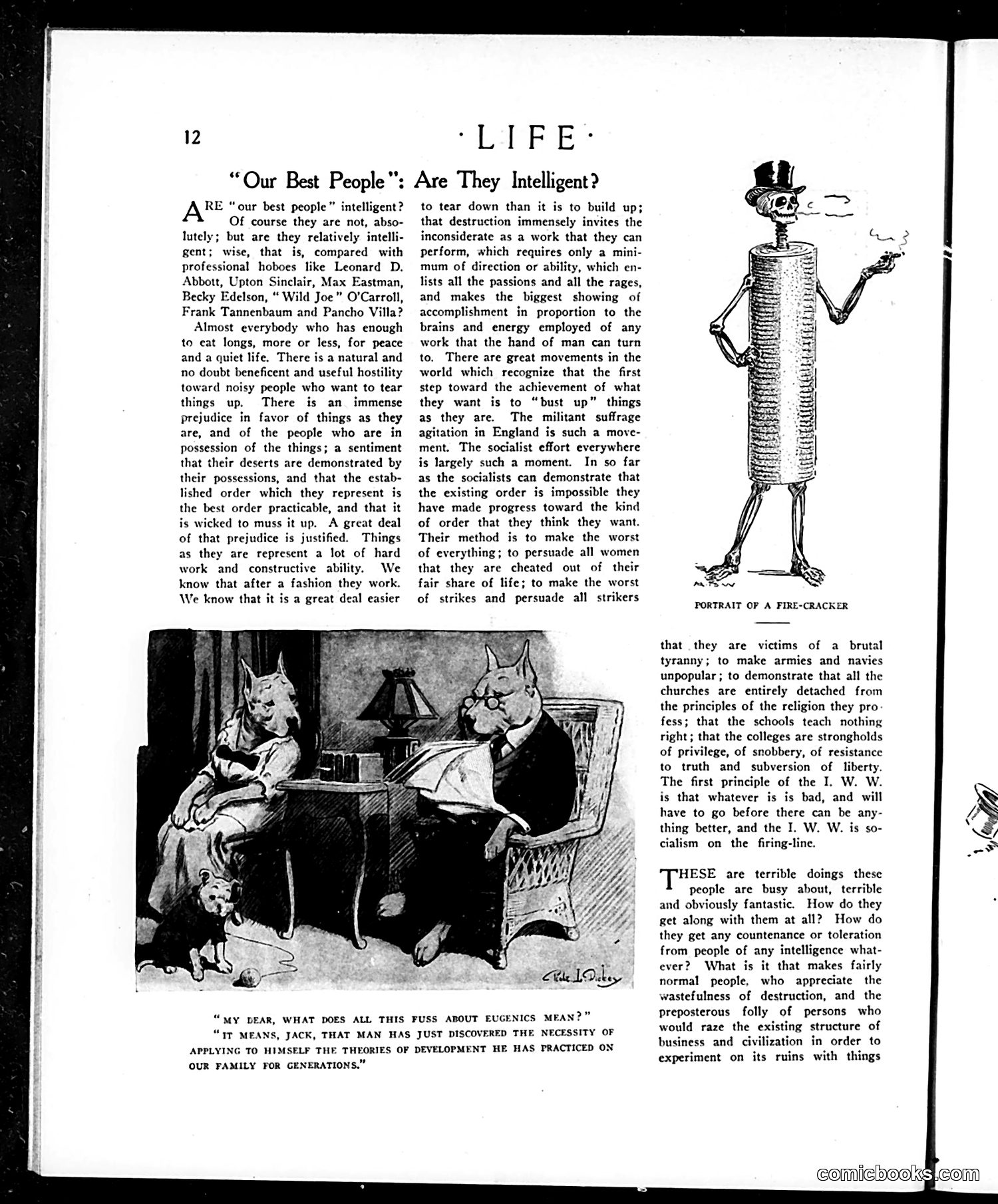
This page satirizes radical left-wing activists ("our best people") whom the author considers destructive rather than intelligent. The text criticizes socialists and the Industrial Workers of the World (I.W.W.), accusing them of making "the worst of everything" through strikes and persuading workers they're oppressed. The bottom cartoon depicts anthropomorphic dogs in conversation. One asks about "eugenics," and the other responds that a man discovered the necessity of applying development theories to "himself" through "experiment" on the family "for generations." This appears to mock both radical ideology and pseudo-scientific eugenic arguments, suggesting the author views radical reformers as dangerously misguided experimenters on society itself. The dogs may represent foolish or animalistic thinking about complex human matters.
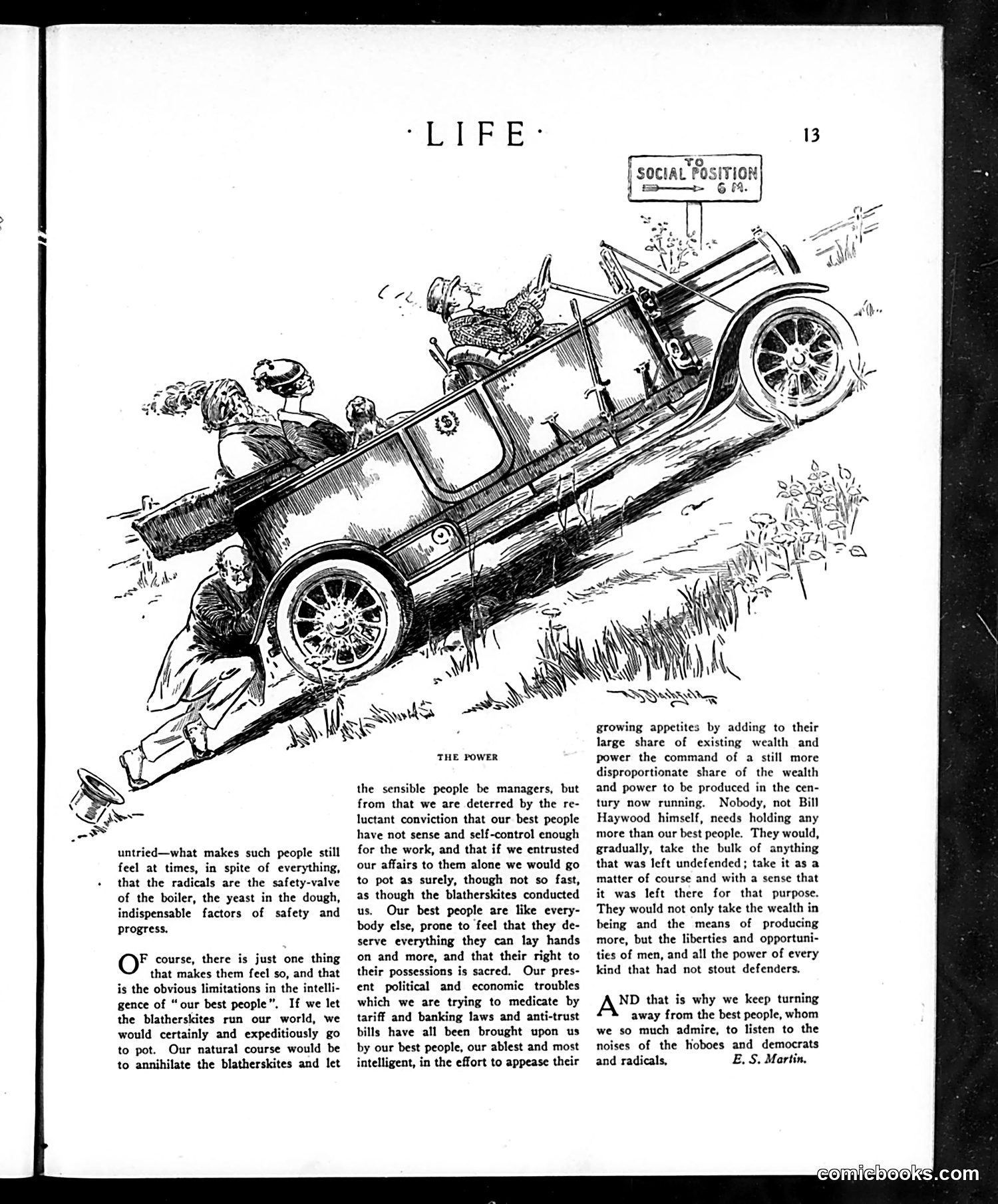
This satirical cartoon depicts an overloaded early automobile careening dangerously uphill, with passengers precariously perched and a figure struggling beneath it. The label "SOCIAL POSITION" suggests the vehicle represents wealth and status. The accompanying text criticizes America's "best people"—the wealthy and intelligent elite—for lacking self-control and judgment. The author argues these leaders have created economic troubles (tariffs, banking laws, anti-trust legislation) through incompetence, yet society continues trusting them. The cartoon's visual metaphor is clear: pursuing "social position" (the vehicle) is unstable, dangerous, and likely to crash. The struggling figure and precarious passengers suggest that chasing wealth and status destabilizes society for everyone. The satire targets the hypocrisy of revering incompetent elites.
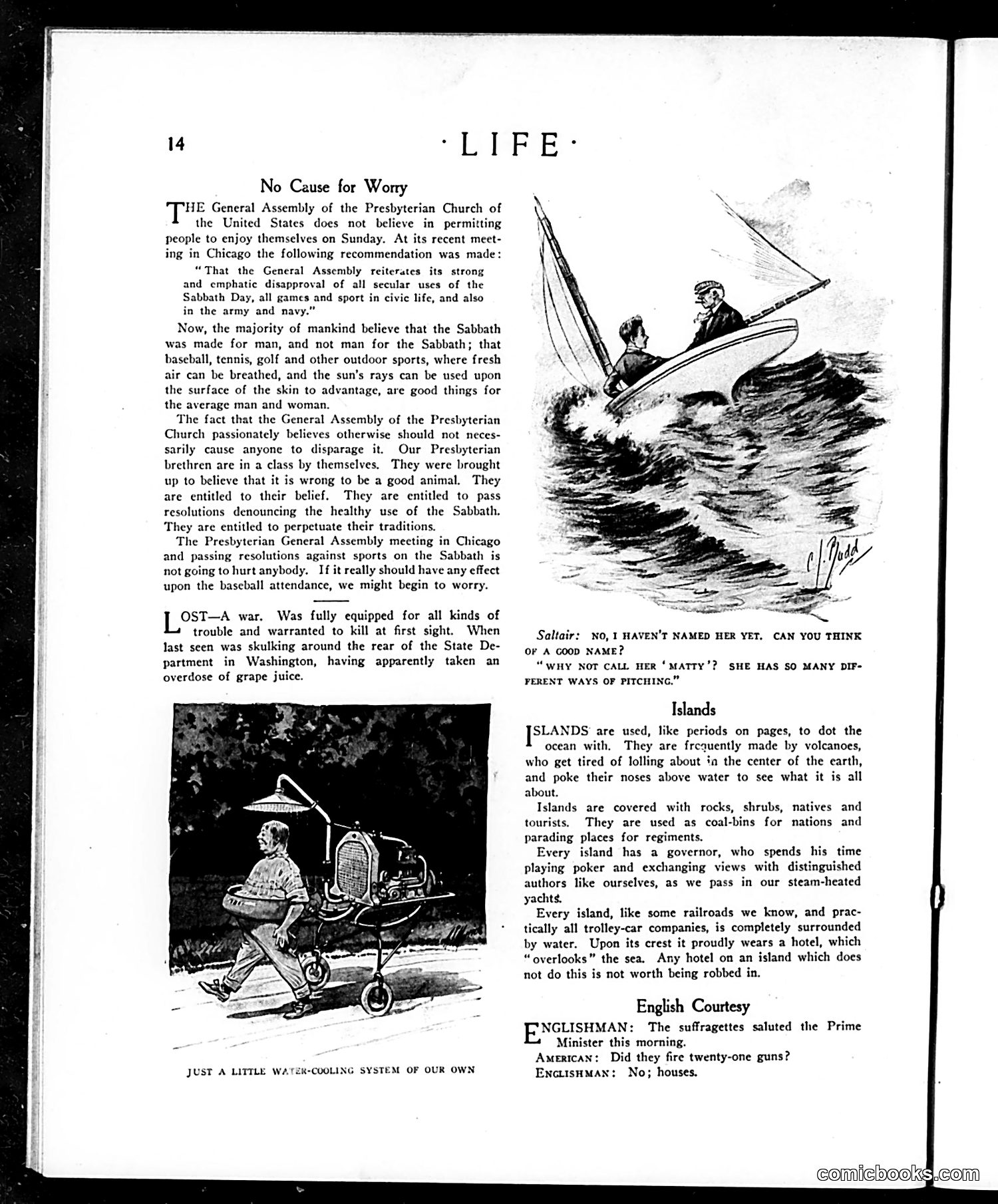
**"No Cause for Worry"** section: The Presbyterian Church's General Assembly passed resolutions disapproving secular Sunday activities like baseball and sports. The author mocks this position, arguing the Sabbath was made for humans, not vice versa, and that outdoor recreation (baseball, tennis, golf) harms no one. The concern that anti-sports resolutions might reduce baseball attendance is treated as absurd. **"Lost" cartoon**: Shows a man with what appears to be a water-cooling contraption. Caption reads "Just a little water-cooling system of our own"—likely satirizing industrial cooling systems or overheating machinery problems of the era. **"Saltair"** and **"Islands"** sections contain humorous observations about geography and tourism rather than political satire.
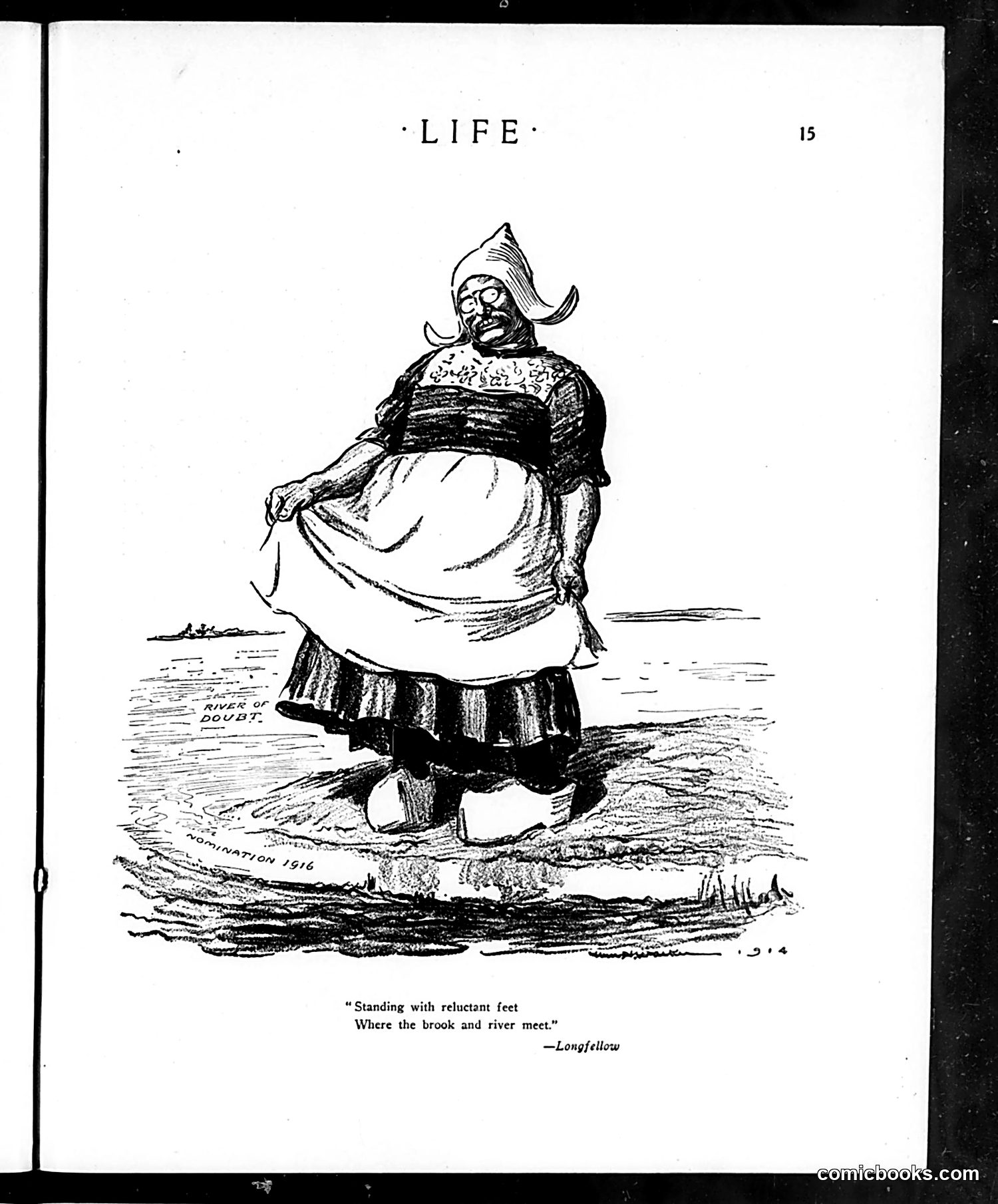
This 1916 political cartoon depicts a figure in traditional Dutch or German dress, standing uncertainly at a waterside location marked "River of Doubt." The caption quotes Longfellow's poetry about hesitation at a crossroads. The cartoon appears to address a major decision point—likely regarding America's entry into World War I, which was a contentious issue in 1916. The "reluctant feet" and the meeting of waters suggest America standing between neutrality and intervention, unable to decisively choose a direction. The figure's costume and the "River of Doubt" label indicate uncertainty about which side to support or whether to join the conflict. This reflects the genuine American ambivalence during this period before the U.S. entered the war in 1917.
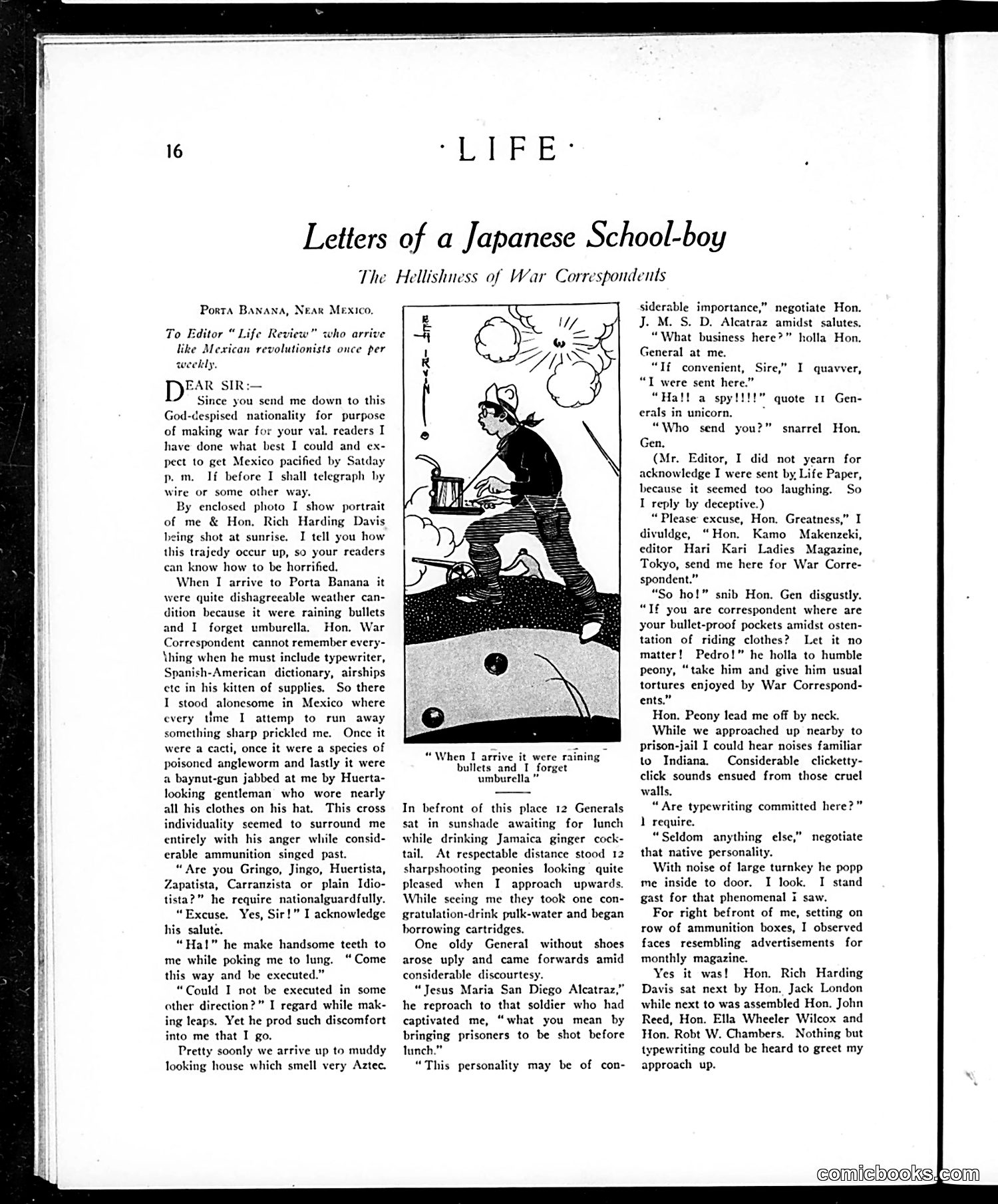
This satirical piece mocks war correspondents covering the Mexican Revolution (circa 1911-1920s) by adopting the persona of a bumbling Japanese observer writing broken English. The humor relies on: **The Satire:** The correspondent claims to represent Life magazine documenting warfare, but proves utterly incompetent—forgetting an umbrella in a firefight, unable to identify which Mexican faction he's dealing with, and nearly executed as a spy. **The Cartoon:** Shows a man at a typewriter amid gunfire and chaos, captioned "When I arrive it were raining bullets and I forget umburella"—visualizing the correspondent's absurd helplessness. **The Point:** Life magazine ridicules war correspondents as pretentious, clueless performers more concerned with appearing brave than understanding actual conflict. The broken English and exaggerated accent stereotype Japanese speech to intensify the buffoonery, suggesting correspondents like Richard Harding Davis (named in text) were self-aggrandizing frauds playing war tourists while real soldiers faced danger.
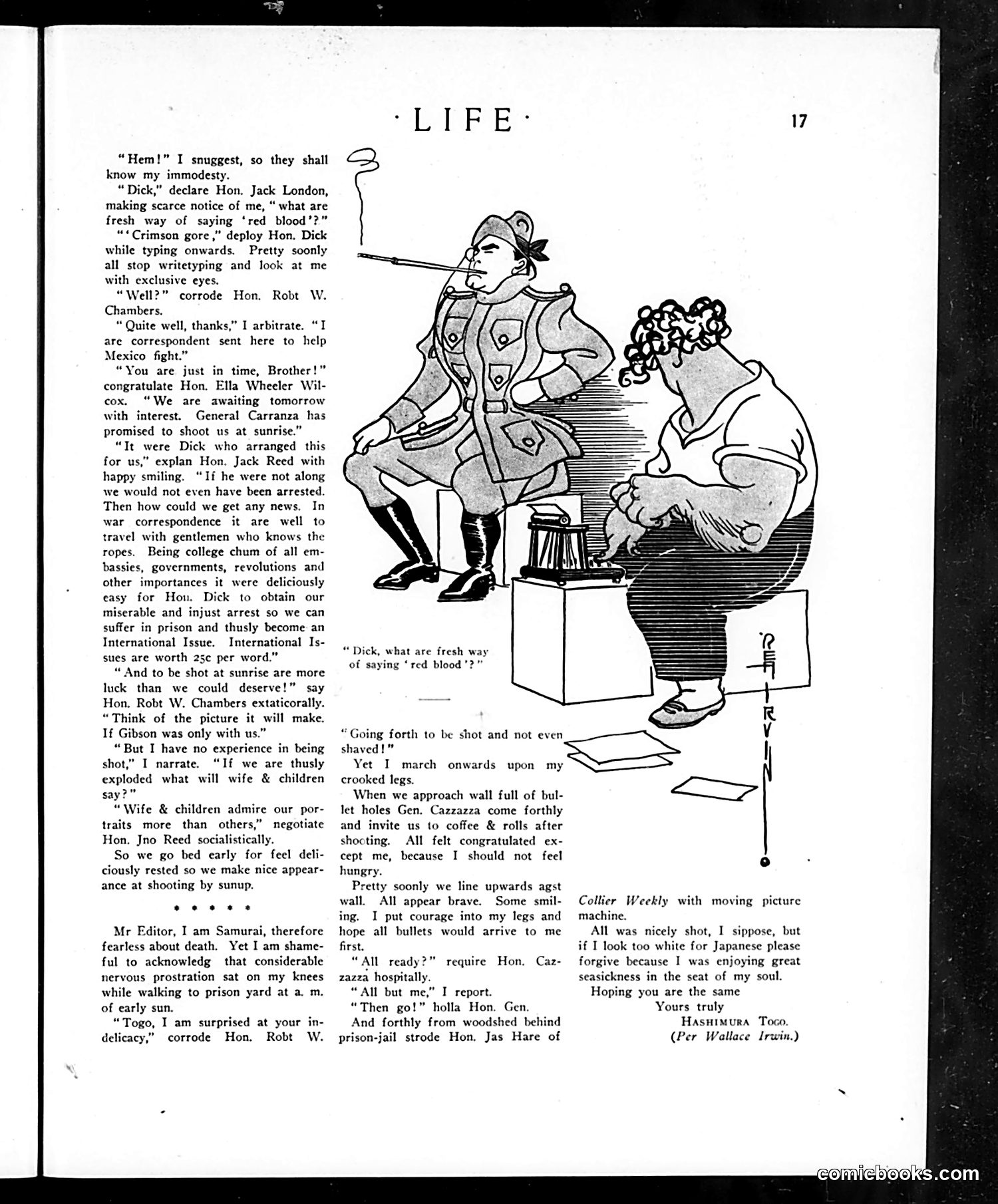
This satirical piece mocks American journalists and literary figures covering the Mexican Revolution (likely Carranza's forces, circa 1910s). The cartoon depicts a "Samurai" narrator named Hashimura Togo meeting famous writers—Jack London, Ella Wheeler Wilcox, Dick (likely John Reed, the radical journalist), and Robert W. Chambers—who are gleefully awaiting execution by firing squad. The satire targets war correspondents' self-aggrandizement: they arrange their own arrest to create "international issues" worth money ("25¢ per word"). The absurdist humor mocks their vanity (concern about being unshaved before execution), their cavalier attitude toward death, and the cynical calculation that suffering produces profitable stories. The byline credits "Wallace Irwin," suggesting this is fictional satire rather than actual reporting. The exaggerated dialect ("are," "forthly") amplifies the mockery of both the journalists' pretensions and the narrator's outsider perspective.
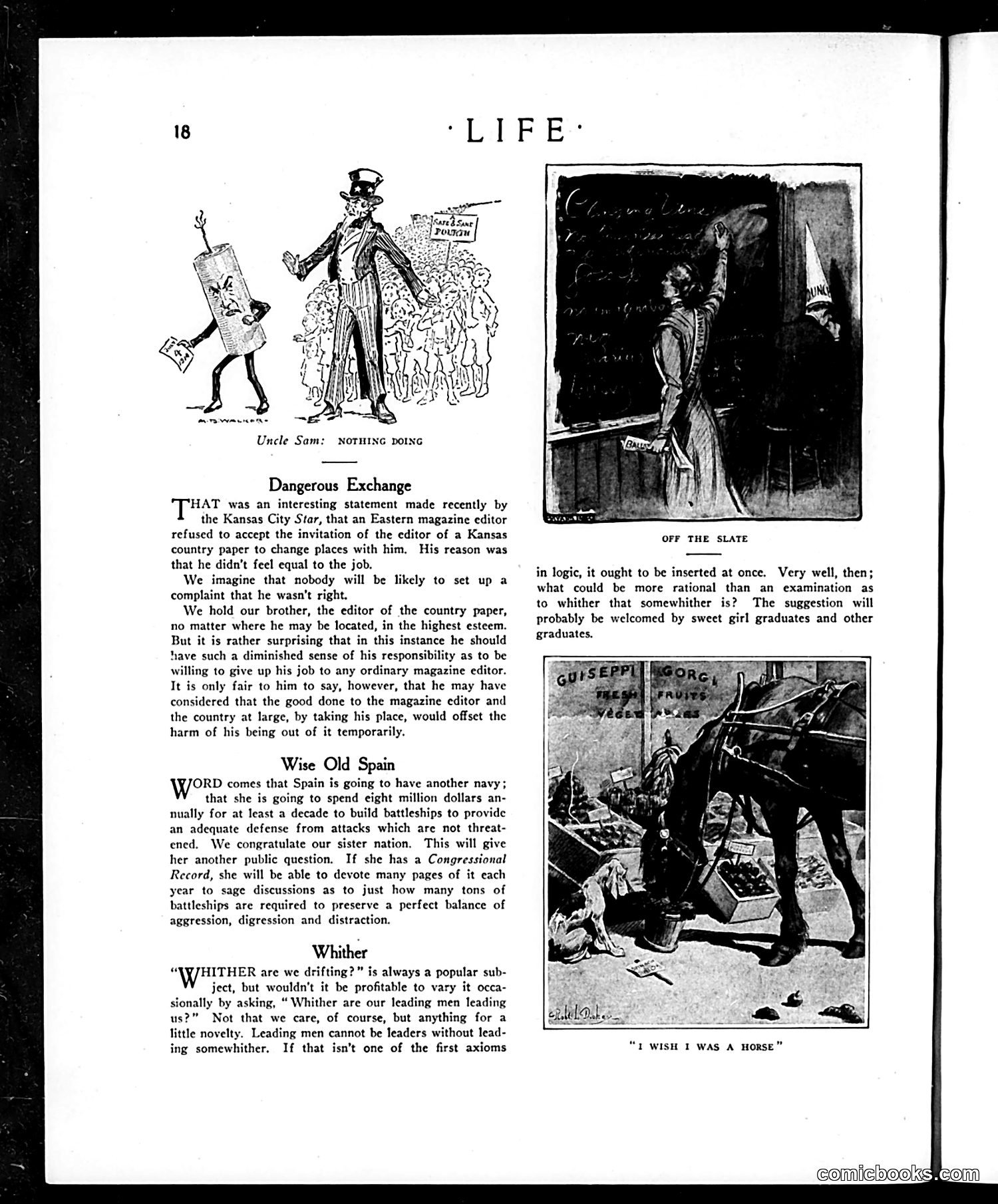
**"Uncle Sam: Nothing Doing"** (top cartoon) satirizes a proposed job swap between a Kansas country newspaper editor and an Eastern magazine editor. The Eastern editor refused, claiming he wasn't qualified for the country paper's role. Life's commentary ironically praises this humility while suggesting the country editor showed poor judgment even *offering*—implying country journalism requires more skill than city magazine work. **"Off the Slate"** (top right illustration) depicts a figure writing on a slate or blackboard, likely representing editorial commentary or public discourse. **"I Wish I Was a Horse"** (bottom illustration) shows what appears to be a working man in difficult circumstances, expressing desire to be a horse—presumably commentary on labor conditions or class struggle of the era. The page also includes sections on Spain's naval expansion plans and a philosophical meditation on leadership direction. The satire throughout reflects early 20th-century American attitudes about regional journalism hierarchies and political governance.
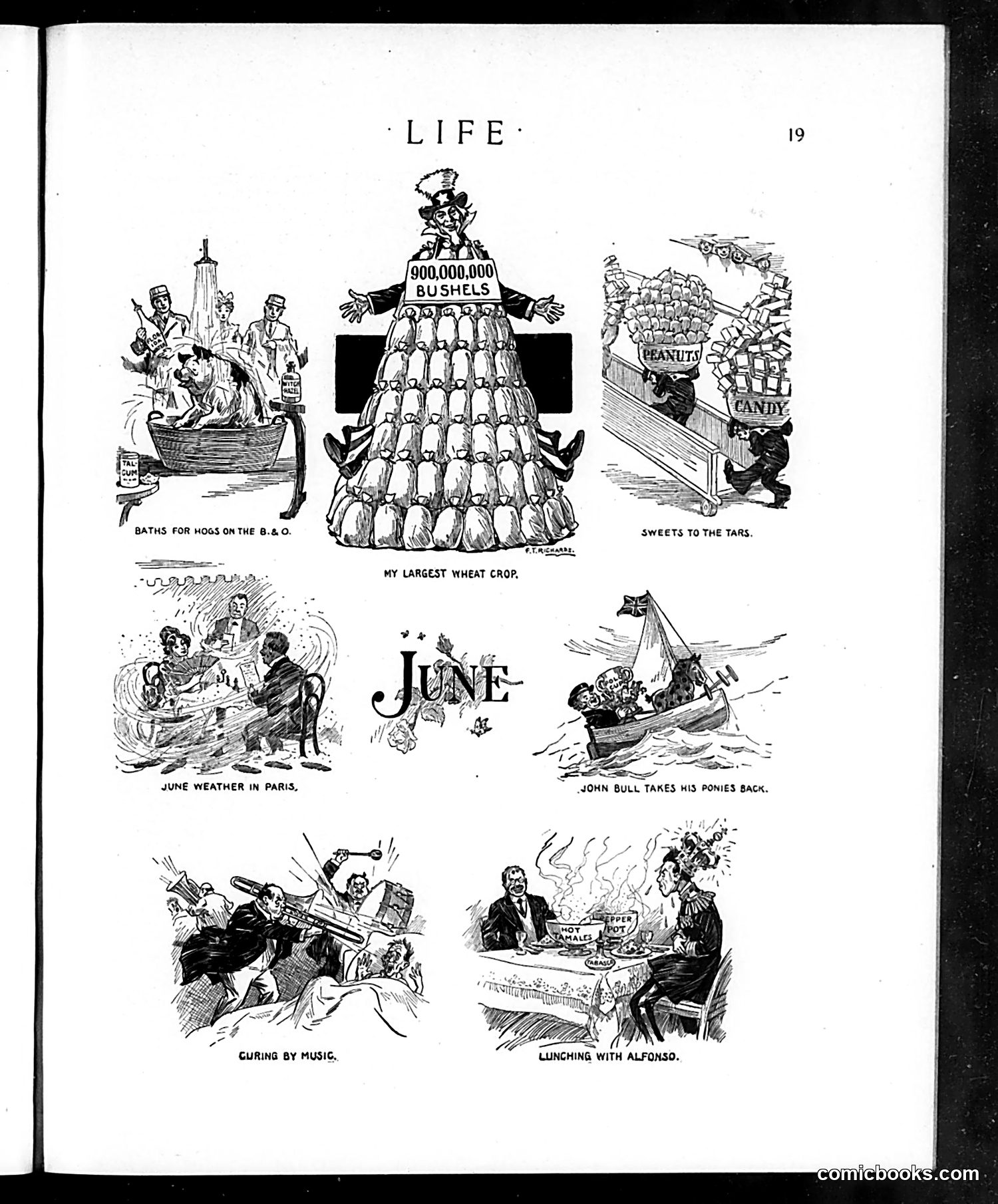
This page contains six satirical cartoons commenting on early 20th-century events, likely from June 1914 based on the visible "JUNE" text. **Key references:** - **"My Largest Wheat Crop"**: A towering figure made of bushels (900,000,000), likely satirizing American agricultural overproduction or a political figure's claims. - **"Sweets to the Tars"**: Candy being delivered to sailors, possibly mocking military supply issues or morale-building efforts. - **"John Bull Takes His Ponies Back"**: Britain (John Bull) in a boat, referencing some diplomatic or trade dispute. - **"Lunching with Alfonso"**: Alfonso XIII of Spain appears at bottom right, suggesting satirized diplomatic relations. - **"June Weather in Paris"**: Depicts chaotic weather or political turbulence in France. The cartoons use exaggeration and visual metaphor to mock political figures, agricultural policies, military logistics, and international relations of the era.
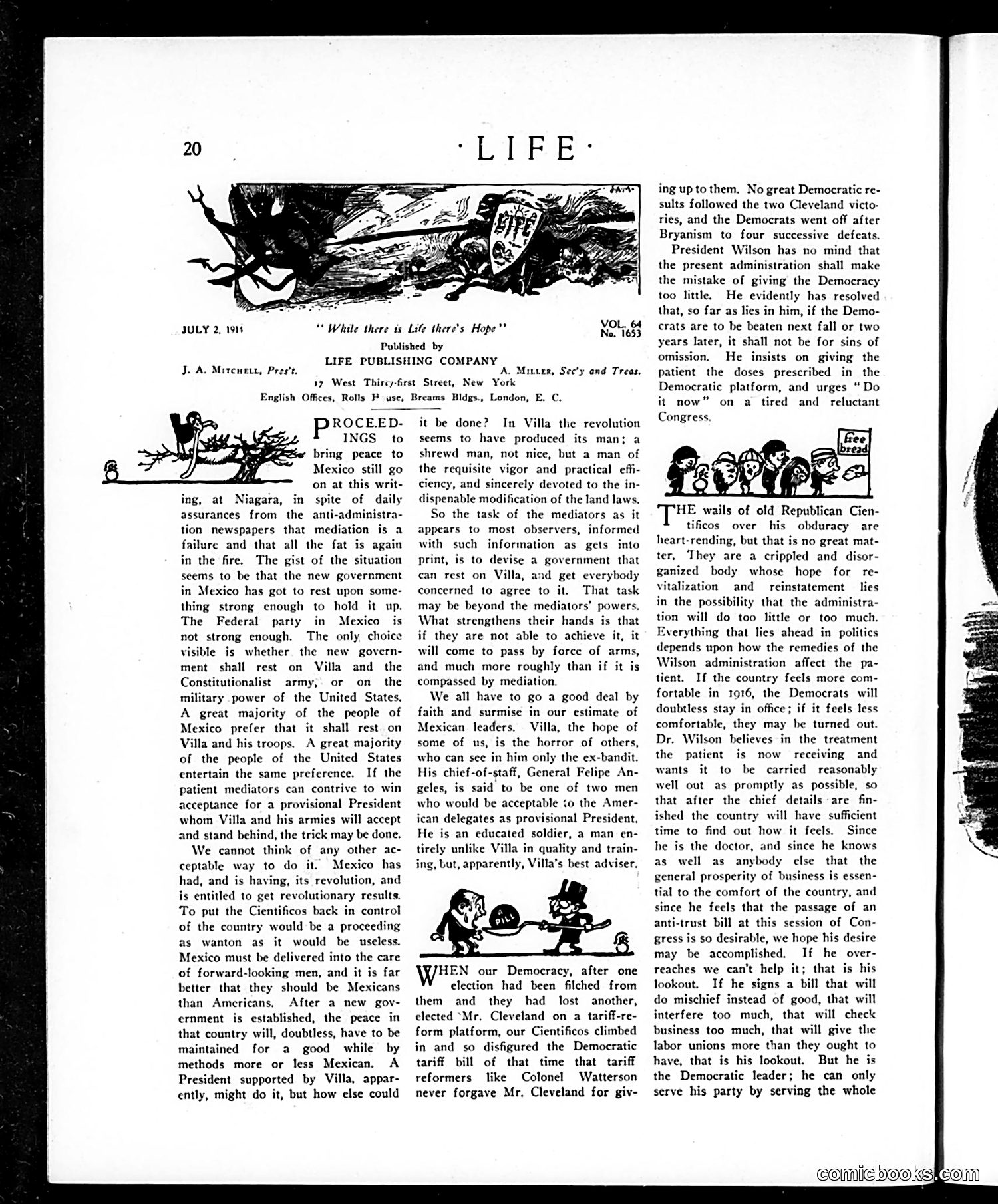
This page discusses U.S. mediation efforts during Mexico's revolution, specifically regarding Pancho Villa. The lead cartoon (top) depicts a skeletal, emaciated figure—likely representing Mexico itself or the failing revolution—with the caption "While there is Life there's Hope." The main article argues that Mexico's new government must rest on Villa and the Constitutionalist army, not on the Científicos (the old Porfirian elite) or American military power. The author presents Villa as an acceptable, if rough, revolutionary figure—"shrewd" and devoted to land reform—superior to American intervention. A secondary section criticizes Cleveland's Democratic administration for compromising on tariff reform, warning Wilson not to repeat that mistake. The satirical thrust warns against allowing reactionary forces (the Científicos, or by analogy, American conservatives) to undermine revolutionary gains. The context is World War I-era American policy toward the Mexican Revolution, with debates over supporting Villa versus other factions.
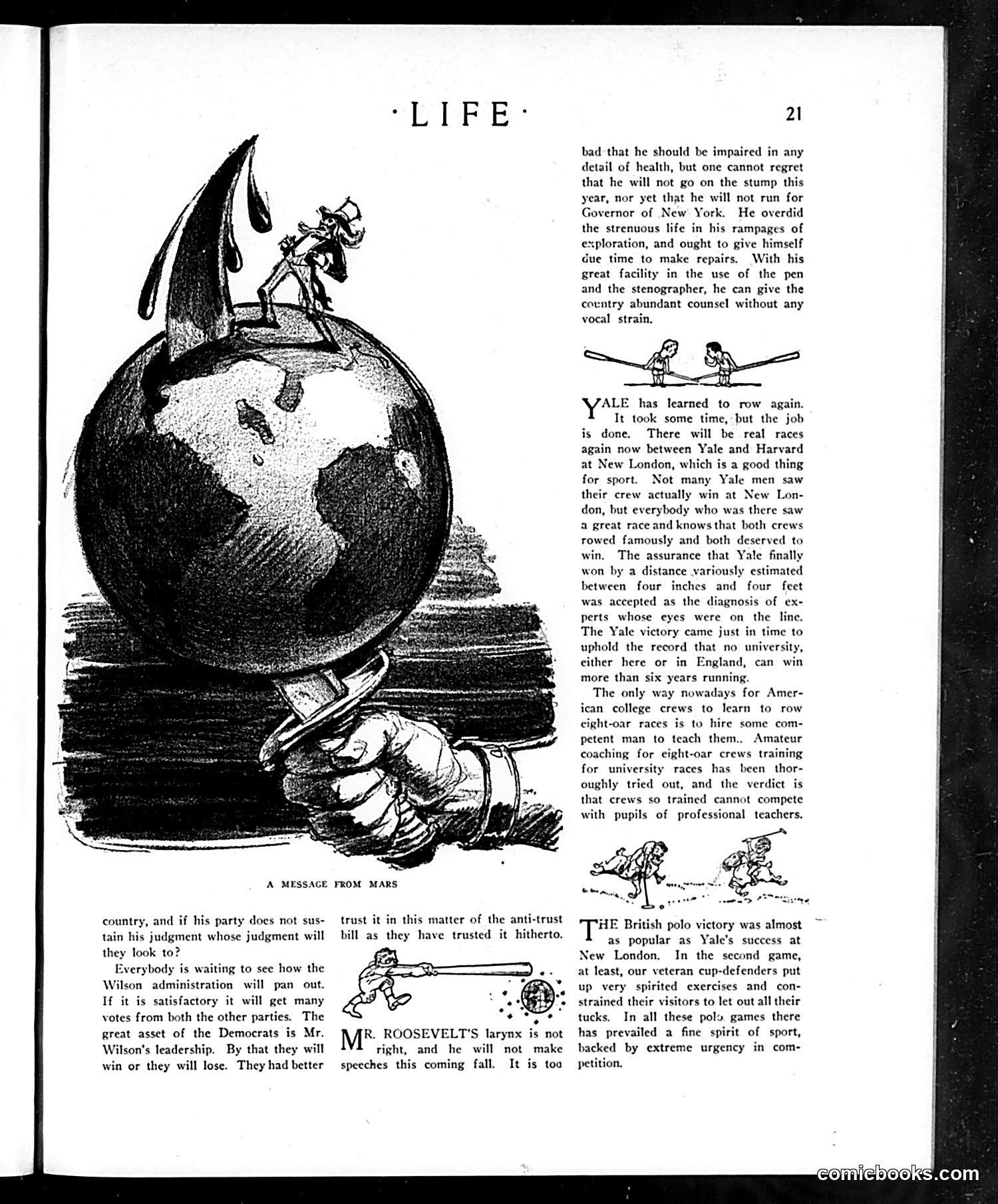
The main illustration depicts a globe being held aloft by a figure on horseback, representing Teddy Roosevelt as a conquering explorer/adventurer. The accompanying text discusses Roosevelt's laryngitis preventing him from campaigning for New York Governor—presenting this as fortunate, suggesting his "strenuous life" of exploration has worn him out. The satire mocks Roosevelt's tendency toward overextension and physical excess while implying relief that his vocal ailment will silence his political voice temporarily. The "Message from Mars" title appears to frame Roosevelt as an otherworldly, grandiose figure. The page also covers Yale's rowing victory over Harvard and British polo success—contemporary collegiate sporting triumphs used to illustrate American competitiveness and the value of professional coaching. The political context involves the Wilson administration's anti-trust policies, with commentary that Democratic success depends on Wilson's leadership continuing effectively.
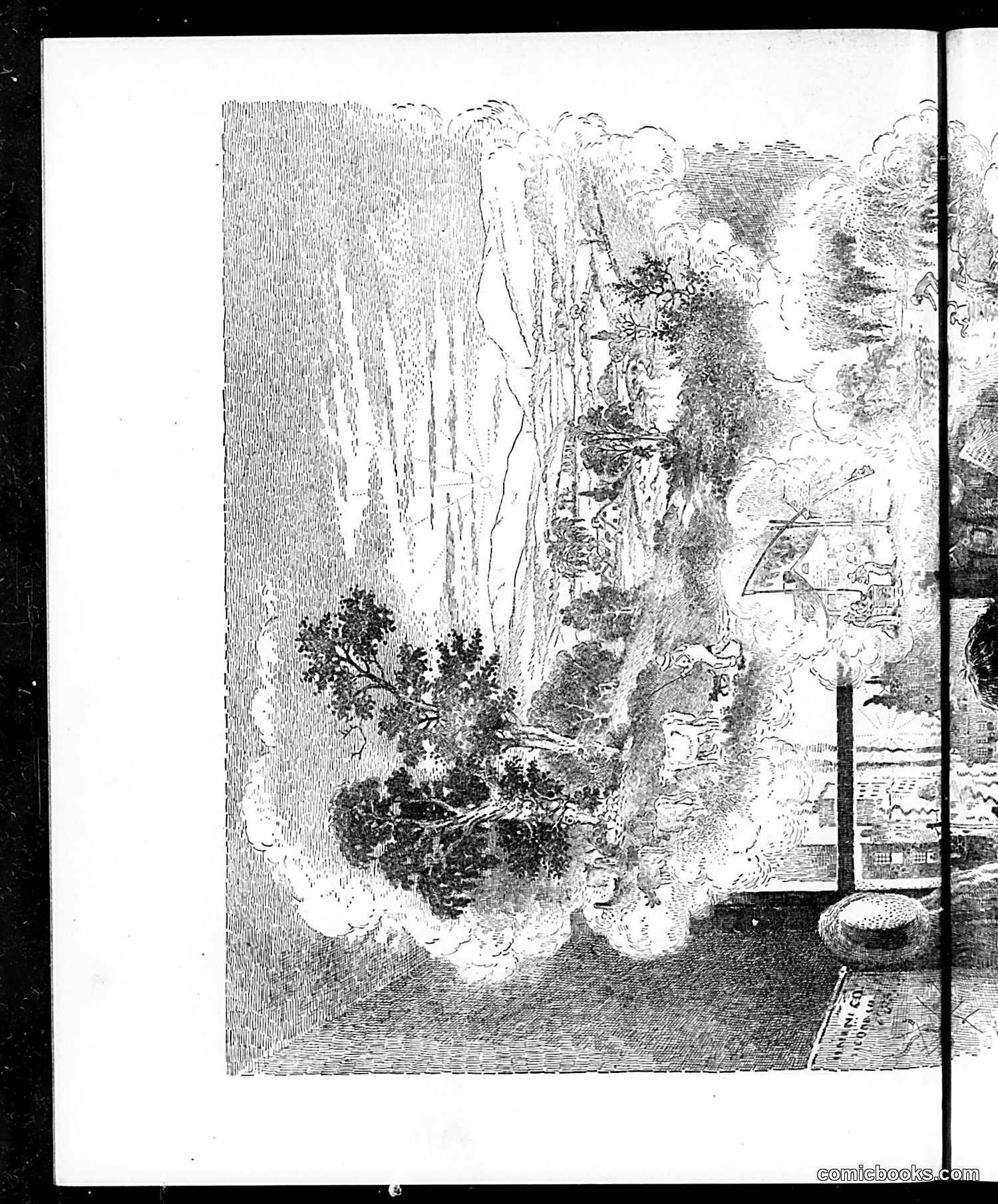
I can see this is an engraved illustration from what appears to be a 19th-century publication, but the image quality and angle make it difficult to read specific details clearly. The engraving shows a landscape or scenic view with cliffs, vegetation, and what appears to be human figures, rendered in the cross-hatching style typical of period wood or steel engravings. However, without legible text or clearer visual details identifying specific political figures, events, or satirical references, I cannot reliably explain the cartoon's meaning or context to a modern reader. The "comichooks.com" watermark suggests this is a digitized archival image, but the OCR text provided doesn't contain the actual article or caption that would clarify the satire's subject matter. I'd need a clearer image or the accompanying text to provide accurate historical analysis.
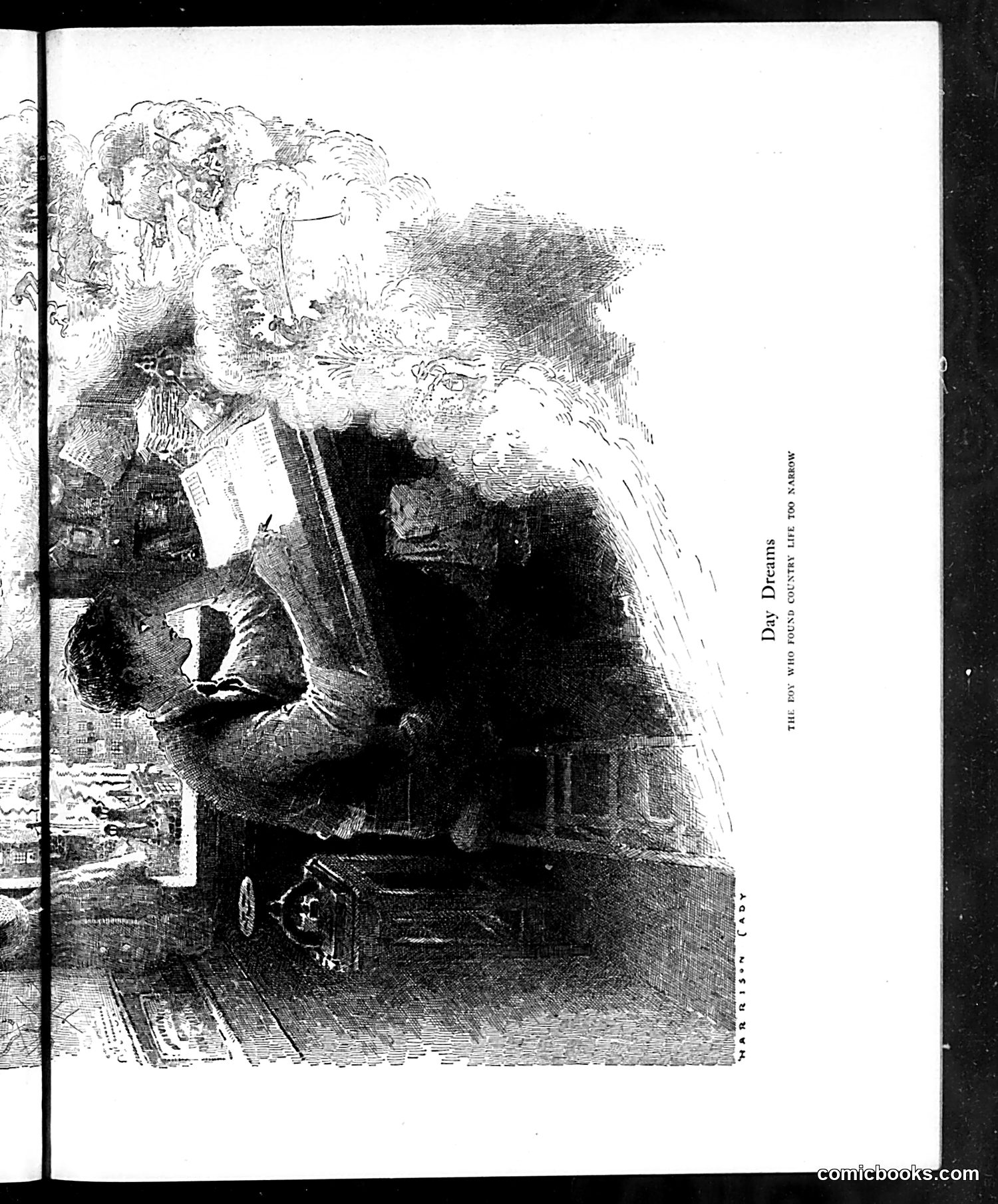
This appears to be an illustration (likely from Life magazine's satirical section) titled "Dry Dreams" or similar, showing a figure in what looks like a confined indoor space with foliage visible above. The OCR text "COUNTRY LIFE TOO NARROW" suggests the cartoon satirizes rural or country living as restrictive or limiting. The image depicts someone in a cramped, dark interior space—possibly a cellar, basement, or confined dwelling—with only a narrow opening or window showing the natural world above. The satire likely critiques the constraints of country life, perhaps mocking romantic notions of rural existence by showing its actual hardships: confined living quarters, limited opportunities, or isolation. Without clearer dating or attribution, the exact historical context remains unclear, though the engraving style suggests 19th-century publication.
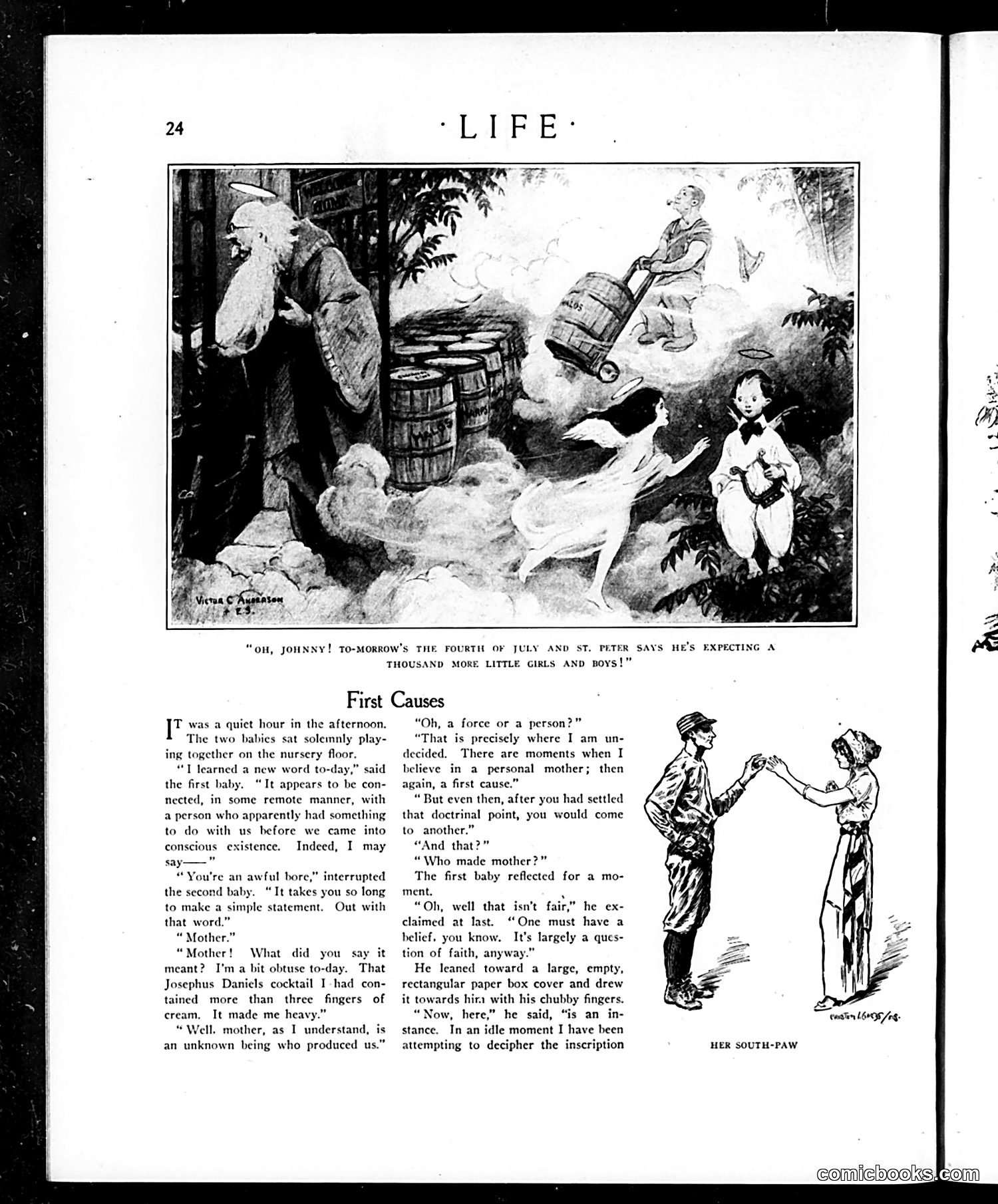
This page contains two satirical pieces from *Life* magazine: **Top illustration:** A Fourth of July scene with anthropomorphic animals (appears to be depicting immigrants or working-class figures) celebrating, with text joking that "St. Peter says he's expecting a thousand more little girls and boys"—likely a dark reference to high infant mortality rates among poor or immigrant populations in early 20th-century America. **"First Causes" (main text):** Two babies engage in philosophical debate about the concept of "mother," treating it as an abstract metaphysical problem rather than a concrete fact. The satire mocks pseudo-intellectual pseudo-philosophy and religious debates of the era—the babies' pretentious vocabulary and circular reasoning about faith versus reason reflect contemporary intellectual arguments. One baby references a "Josephus Daniels cocktail" (Secretary of the Navy under Wilson, known for naval prohibition policies), adding topical humor. The accompanying sketch "Her South-Paw" shows a man and woman in a dispute, likely depicting marital conflict. The overall theme appears to be satirizing overintellectualization and abstract thinking removed from simple reality.
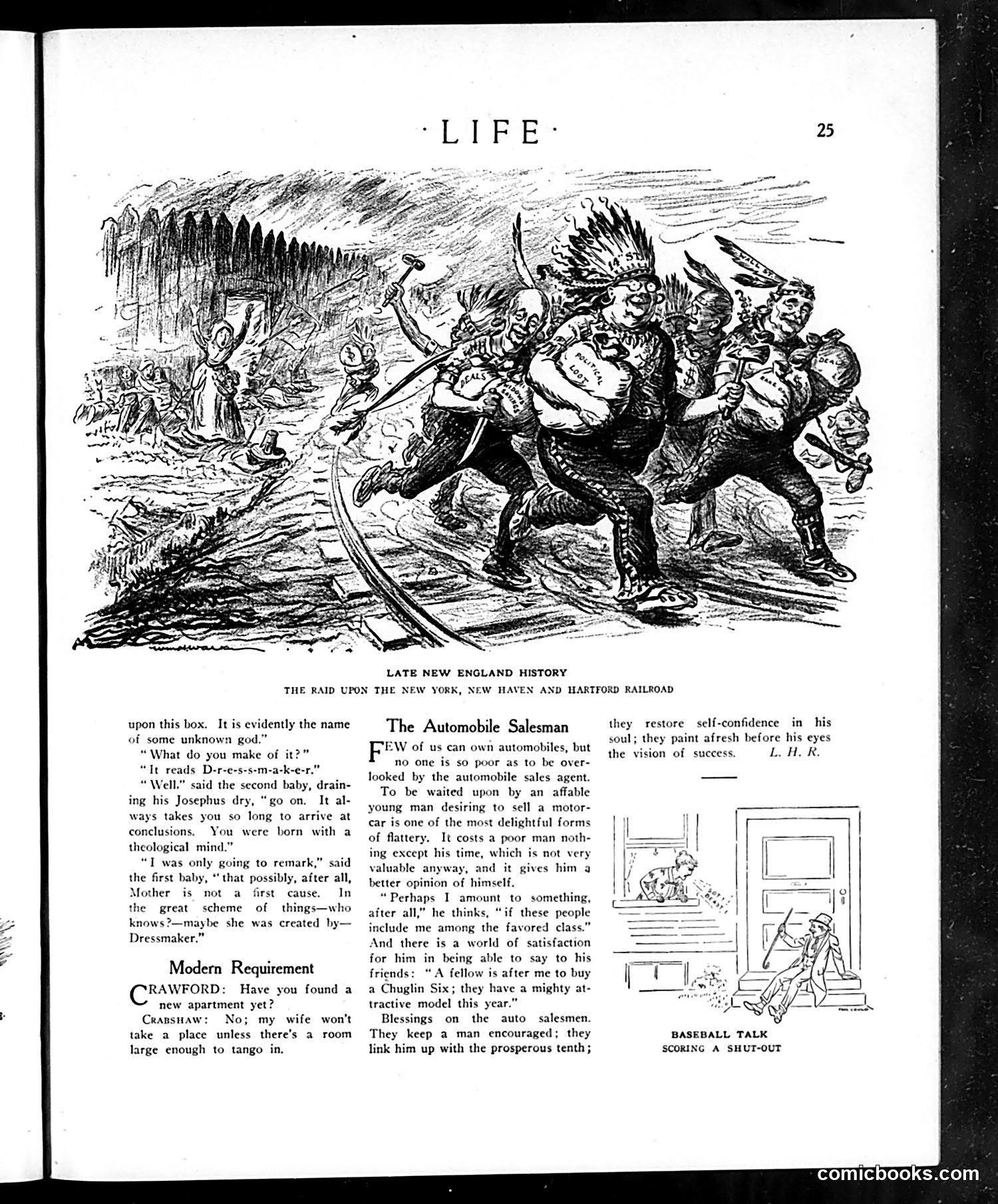
This page contains three separate satirical pieces typical of early 20th-century Life magazine humor: 1. **"Late New England History"** (top cartoon): A chaotic sketch depicting what appears to be a raid on the New York, New Haven and Hartford Railroad. The exaggerated, wild figures suggest either labor unrest or criminal activity against the railroad—a topical concern of the era. 2. **"Modern Requirement"** (brief dialogue): A joke about contemporary apartment-hunting where a wife demands a room large enough for the tango—the fashionable dance craze of the period. The humor mocks modern consumer expectations and entertainment culture. 3. **"The Automobile Salesman"** (main article with cartoon): Satirizes the psychological manipulation of car salesmen, who flatter working-class men by suggesting they're important enough to be courted as customers. The piece gently mocks both the salesmen's tactics and the poor man's vulnerability to flattery about prosperity. The magazine's humor targets modern consumer culture, labor relations, and social pretension through light satire rather than harsh criticism.
This page is a **book review section**, not a political cartoon. It satirizes the Italian Futurist movement, specifically F.T. Marinetti's literary theories. The satire ridicules Marinetti's manifesto to radically simplify language by eliminating adjectives, adverbs, prepositions, and conjunctions—reducing writing to scattered nouns on a page. The reviewer mocks this as analogous to how silent films let audiences supply their own emotional interpretation. The joke: Marinetti's extreme linguistic minimalism is so absurd that conventional novels like Elia W. Peatie's "The Precipice"—which rely heavily on descriptive language to convey nuance and character—would become "unobtainable" in a Futurist future. The reviewer uses elaborate, ornate prose *itself* to mock the Futurist position, creating ironic contrast. This reflects early 20th-century American literary skepticism toward avant-garde European movements perceived as pretentious and impractical.
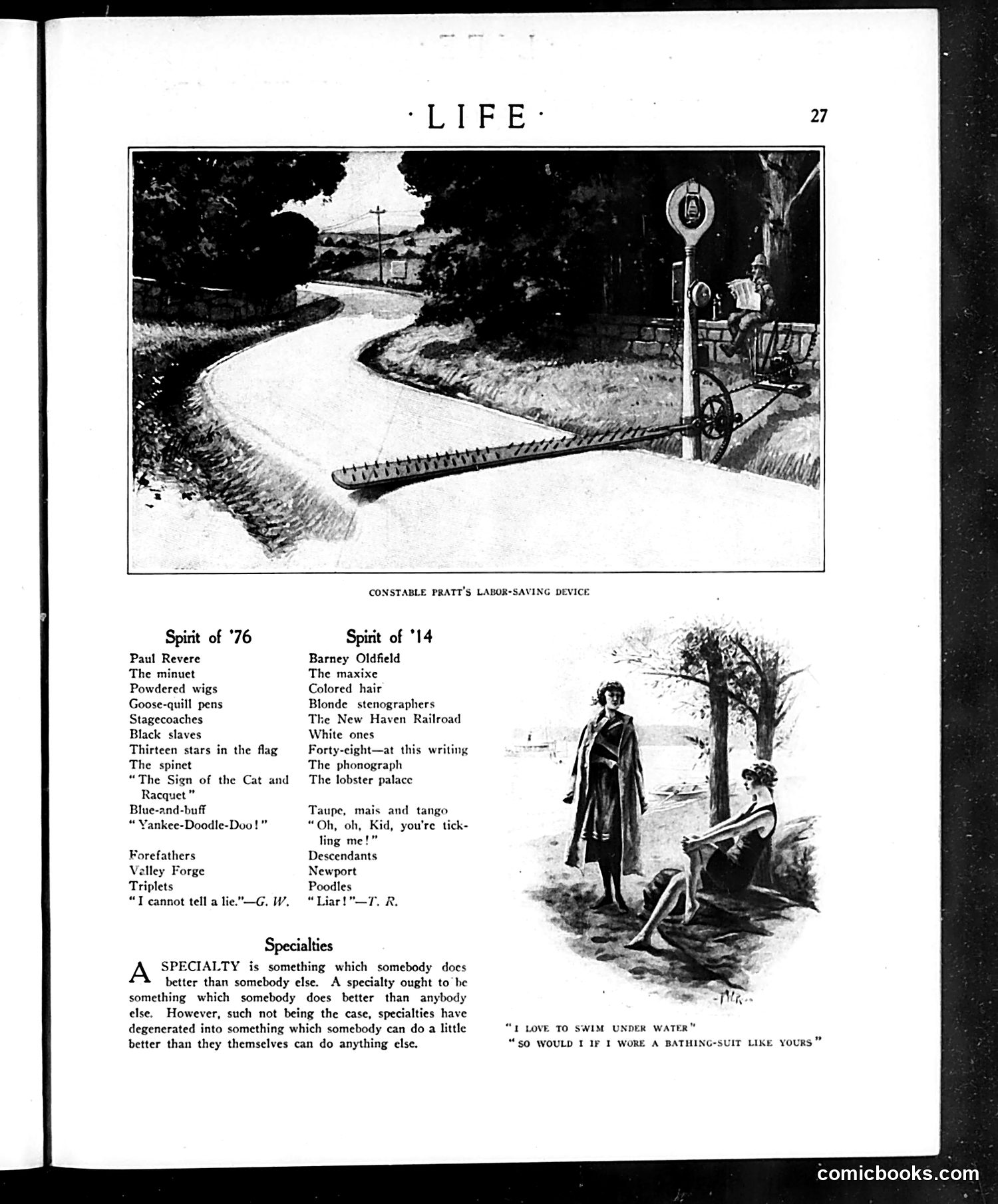
This page contrasts American culture across roughly 140 years through two satirical lists: "Spirit of '76" (Revolutionary era) versus "Spirit of '14" (1914, the magazine's present). The left list invokes founding ideals: Paul Revere, Valley Forge, George Washington's honesty. The right list mocks modern 1914 equivalents: racing driver Barney Oldfield, the maxixe dance, stenographers, and Theodore Roosevelt ("Liar!"). The satire suggests American values have devolved from noble revolutionary principles to frivolous modernity—fast cars, jazz dances, and office workers replace patriots and virtue. The top illustration shows "Constable Pratt's Labor-Saving Device," apparently a farming contraption. The bottom cartoon depicts two women; the dialogue jokes about bathing suits, likely mocking contemporary fashion or gender relations. Overall, the page employs nostalgic contrast to critique 1914 American culture as shallow and materialistic compared to the founding era.
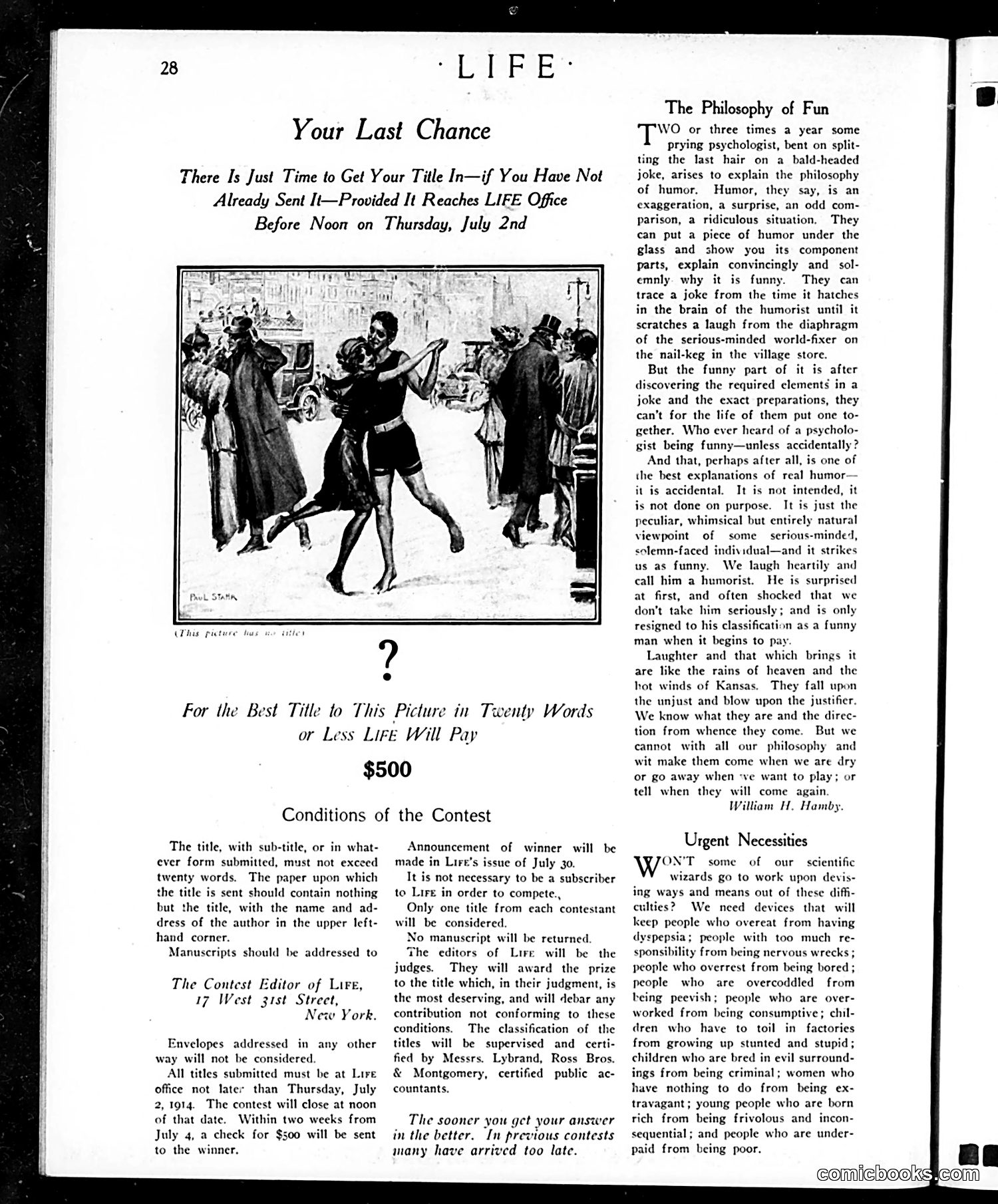
This page features a **caption contest** where readers submit titles for the cartoon image—a chaotic street scene showing a thin, energetic figure conducting or performing wildly amid a crowd of formally-dressed onlookers. The contest offers $500 for the best twenty-word title, with entries due by July 2, 1914. The accompanying essay, "The Philosophy of Fun" by William H. Hamby, argues that genuine humor is **accidental rather than intentional**—that psychologists cannot manufacture jokes, only discover why existing ones work. True humor, he claims, arises naturally from the peculiar viewpoint of a serious person, striking audiences unexpectedly. The cartoon likely satirizes **social pretension or unconventional behavior disrupting formal society**, though without identifying the specific figure, the exact target remains unclear. The contest itself was a popular engagement strategy for Life magazine.
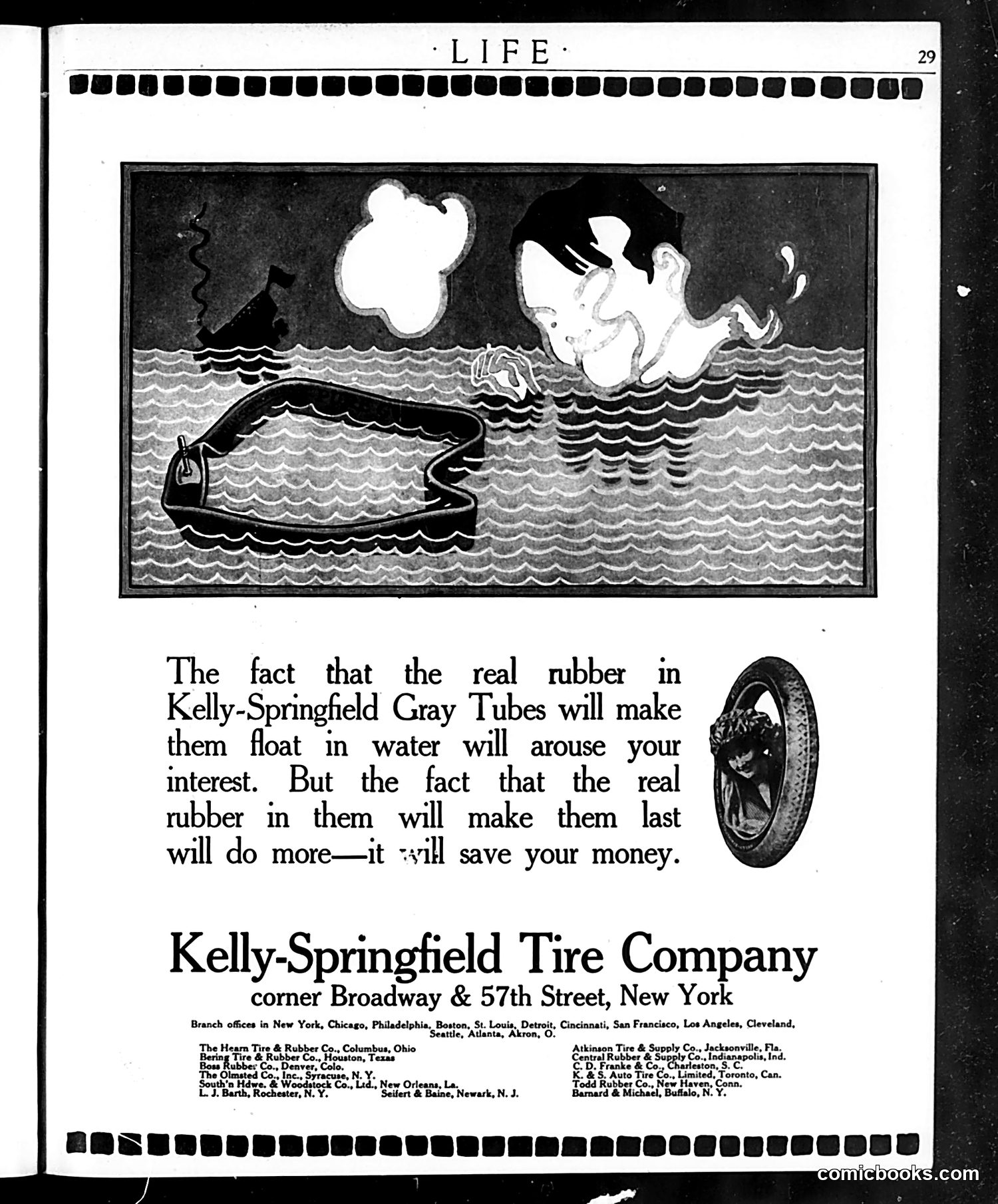
This page is primarily a **tire advertisement** for Kelly-Springfield, not political satire. The illustration depicts tubes floating in water—a visual demonstration of the product's buoyancy claim. The ad's appeal is straightforward commercial messaging: Kelly-Springfield Gray Tubes contain "real rubber" that makes them both float (an interesting novelty feature) and last longer (the practical benefit that saves money). The copy emphasizes durability as the superior selling point over the mere curiosity of water flotation. The illustration showing a boat and floating tubes in stylized waves is meant to showcase this flotation property visually. This was likely a genuine product feature marketed during the early automobile tire era, when rubber quality and durability were genuine competitive differentiators between manufacturers. There is no satire or political commentary present on this page.
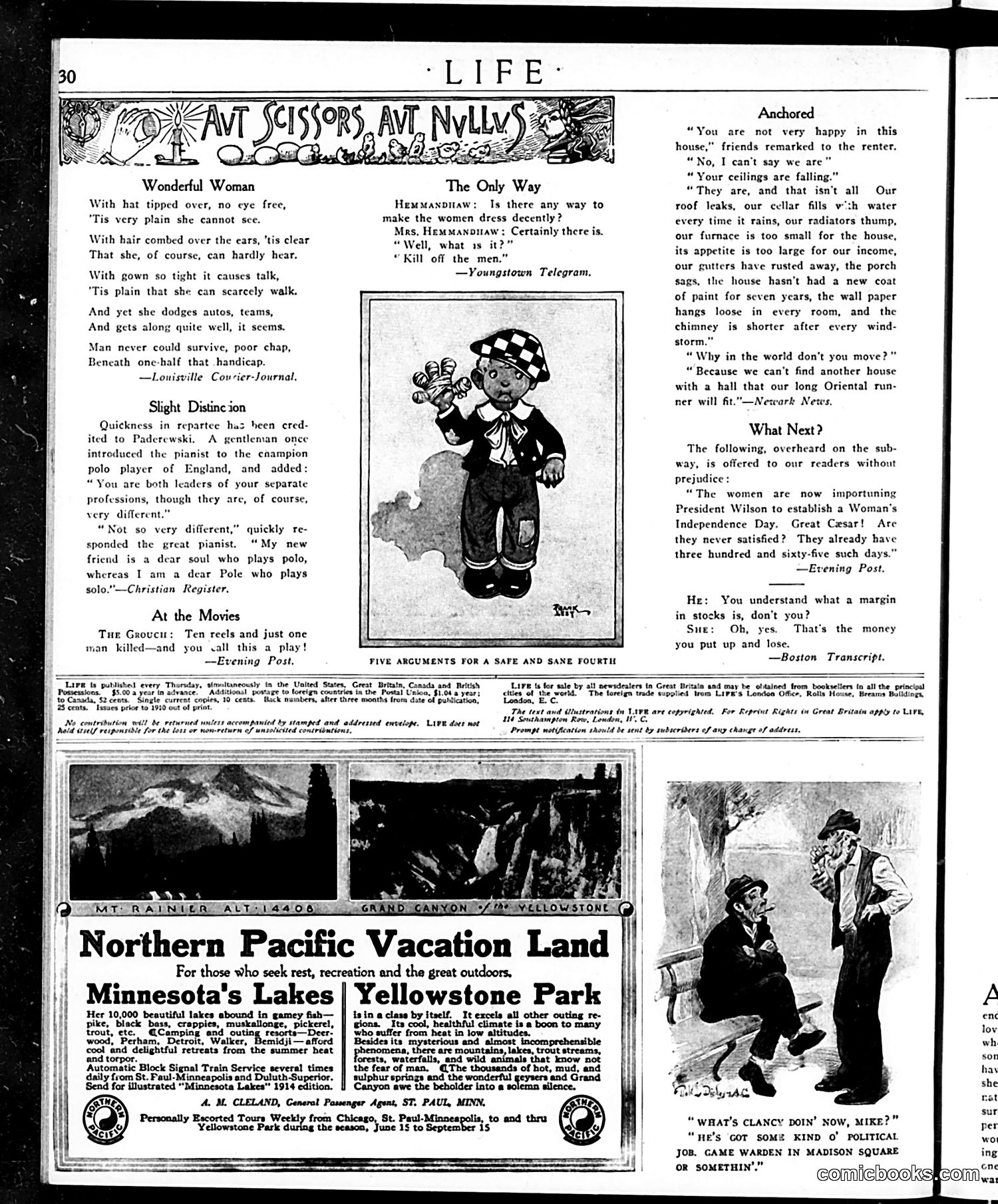
This page from Life magazine contains several short satirical pieces typical of early 20th-century American humor: **"Wonderful Woman"** mocks the restrictive fashion and social constraints on women—the poem notes she's dressed so tightly she can barely walk or see, yet somehow manages better than men would under such conditions. It's satirizing both impractical women's fashion and the paradox of female resilience despite handicapping dress codes. **"Slight Distinction"** is a pun-based joke about Paderewski (a famous pianist) distinguishing himself from a polo player by wordplay on his Polish heritage. **"Anchored"** satirizes renters stuck in a deteriorating house—unable to find another suitable property despite the building's numerous failures. **"What Next?"** mocks women's suffrage advocates, suggesting they already have "three hundred and sixty-five" independence days (meaning every day). The page also includes a stock-market joke and vacation advertisements. The humor reflects early-1900s attitudes toward women's rights, fashion, and class anxieties—perspectives notably dated today.
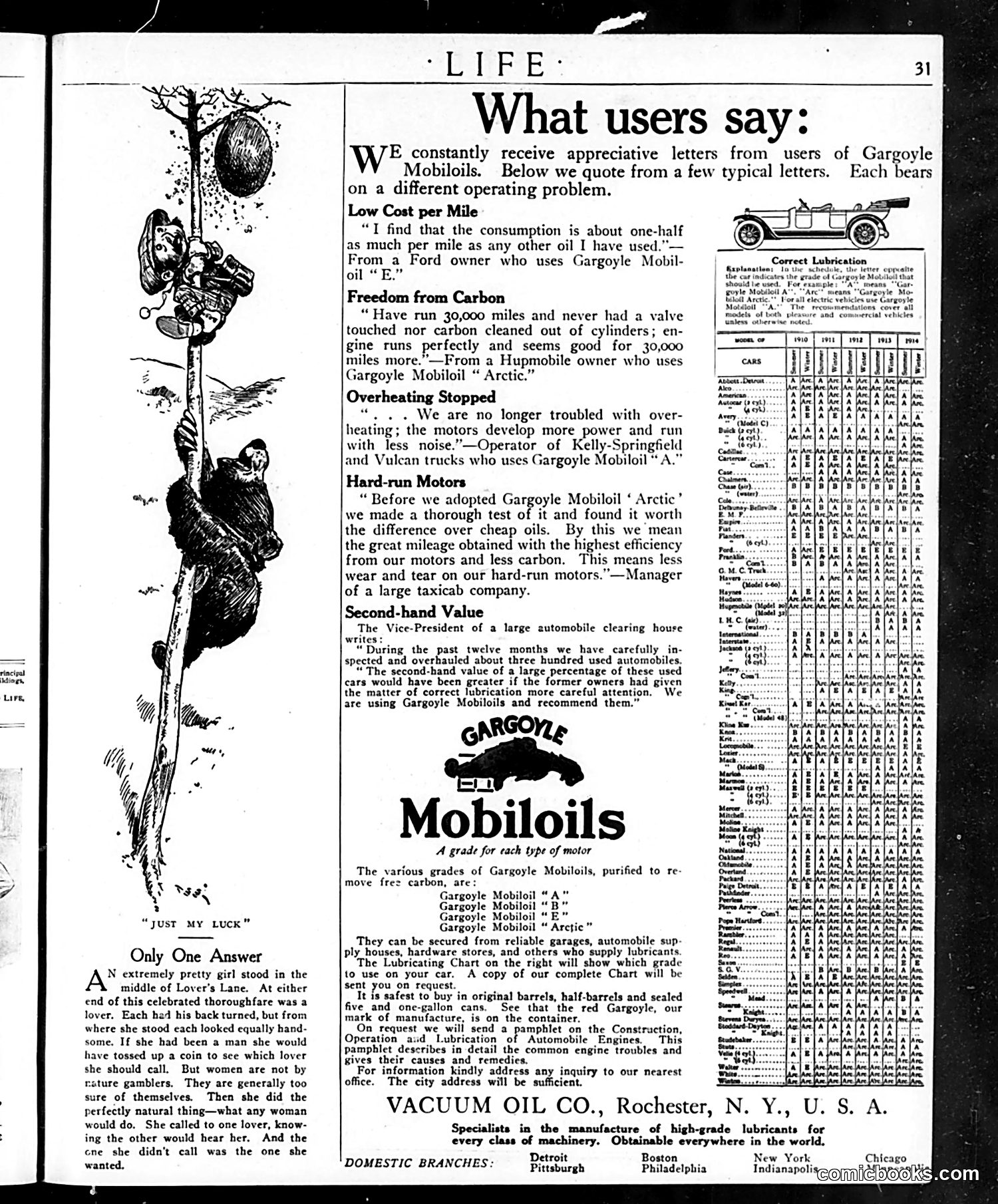
This page is primarily a **Gargoyle Mobiloils advertisement** featuring testimonials from satisfied automotive customers about engine oil performance. The cartoon "Just My Luck" appears to be a satirical commentary on female indecision and romantic choice. It depicts a woman in Lover's Lane standing between two suitors, each with his back turned. The joke's "punchline" (explained in the text below) is that the woman, unable to gamble like a man would, resorts to calling out to one lover—thereby inevitably attracting the *other* one she actually wanted. The satire plays on early 20th-century gender stereotypes: women are portrayed as "sure of themselves" yet paradoxically unable to make direct choices, instead relying on indirect tactics that backfire. The title "Just My Luck" suggests the woman's romantic misfortune results from her own poor decision-making strategy rather than chance. The cartoon serves no direct connection to the oil advertisement below it—it's simply filler content typical of *Life* magazine's satirical approach to everyday life and social behavior.
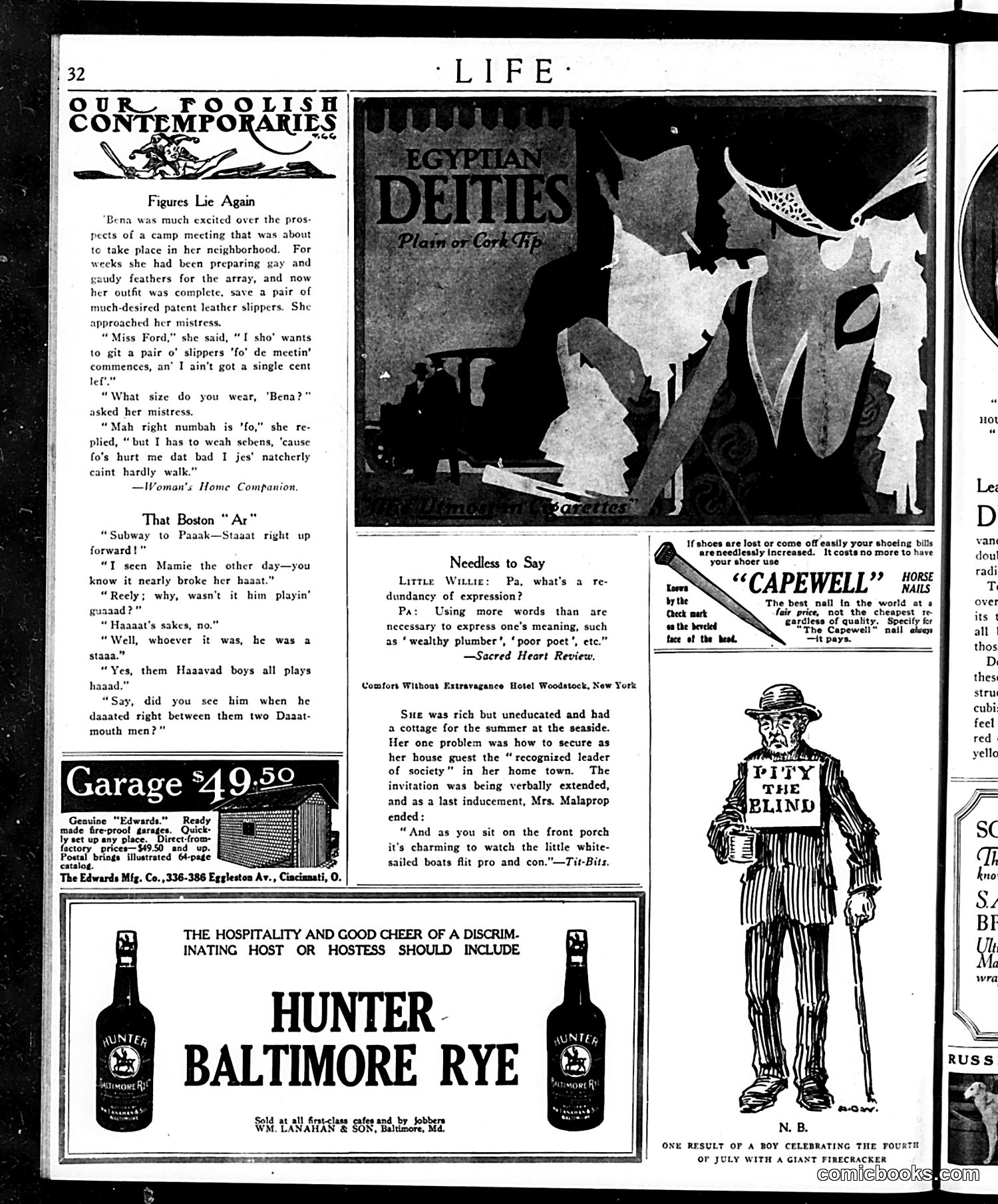
This page contains several humorous anecdotes satirizing dialect humor and social pretension, common in early 20th-century American comedy: **"Figures Lie Again"**: A Black servant named Bena claims she wears size 4 shoes but needs size 7 because size 4 "hurt me dat bad I jes' natcherly caint hardly walk." The joke mocks her illogical reasoning—she's lying about her actual shoe size to justify a request. **Boston dialect pieces**: Satirize exaggerated regional accents, particularly Boston's pronunciation of "r" sounds ("park" becomes "paaak"). **"Needless to Say"**: A father defines "redundancy of expression" using examples like "wealthy plumber" and "poor poet"—combinations that contradict themselves or add unnecessary words. **Mrs. Malaprop story**: Satirizes social climbing and malapropisms (word misuse)—the wealthy but uneducated woman says boats "flit pro and con" (backward usage). The page is primarily **advertising** (shoes, garages, liquor), with humor used to fill editorial space. The satire targets working-class dialect, regional accents, and social pretension—typical of this era's humor standards.
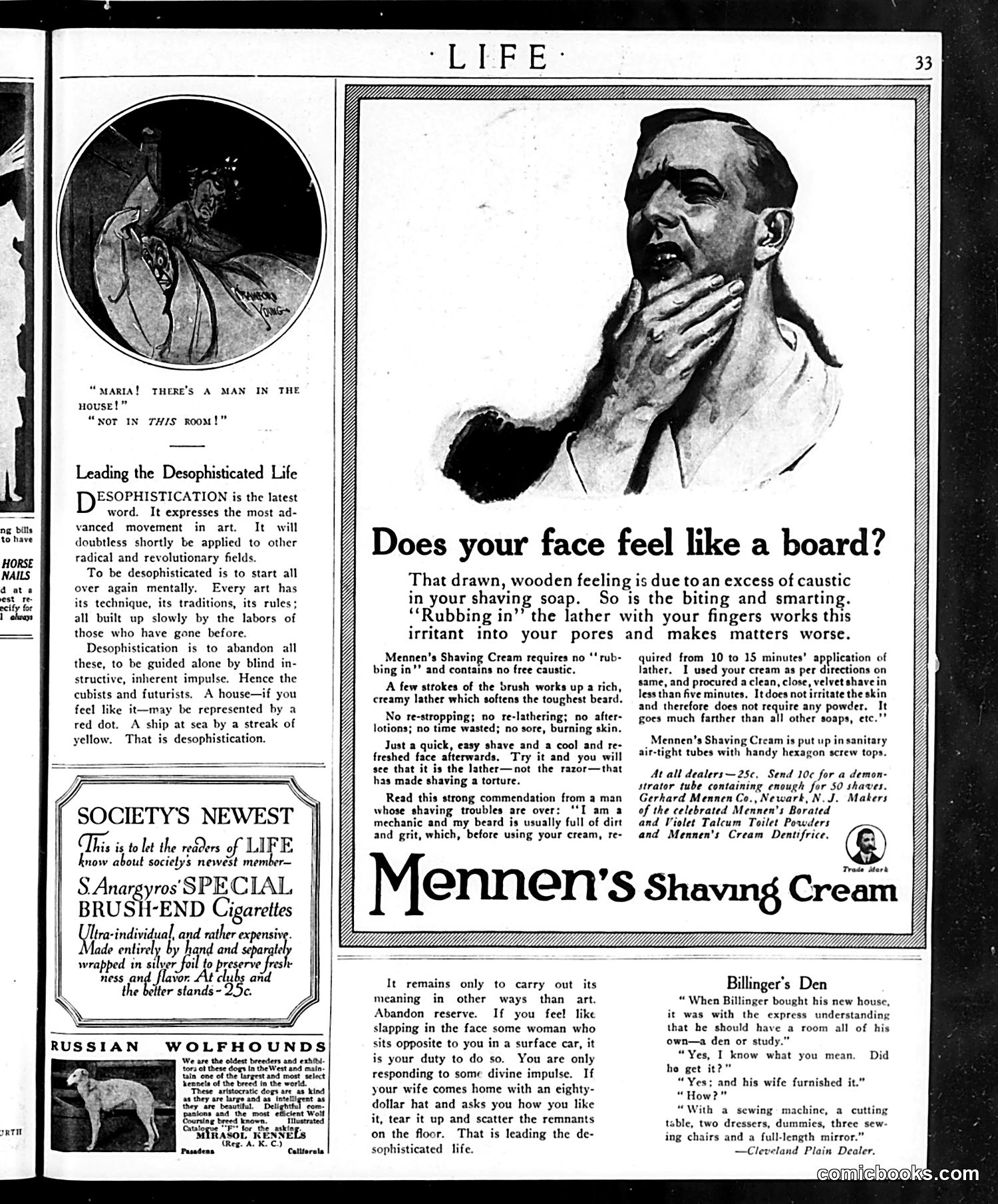
This page satirizes early 20th-century artistic and social movements through the concept of "desophistication." **The Cartoon (top left):** A woman recoils from a man in her home, exclaiming "There's a man in the house! Not in this room!" This illustrates the article's point about abandoning social conventions—the satire suggests that truly "desophisticated" people would act on raw impulse rather than propriety. **The Main Article:** Mocks avant-garde art movements (cubism, futurism) that rejected tradition to follow "blind instinctive impulse"—representing a ship as a yellow streak, a house as a red dot. The piece extends this mockery to social behavior, suggesting if one truly embraced "desophistication," one should slap women in streetcars or destroy a wife's hat rather than follow civilized restraint. **Context:** This reflects 1910s-1920s anxiety about modernism and social upheaval. Life's satire defends conventional behavior and artistic tradition against radical movements viewed as destruction masquerading as progress. The remainder contains advertisements (Mennen's Shaving Cream, cigarettes, Russian wolfhounds) and a separate joke about a husband's "den" appropriated by his wife's sewing supplies.
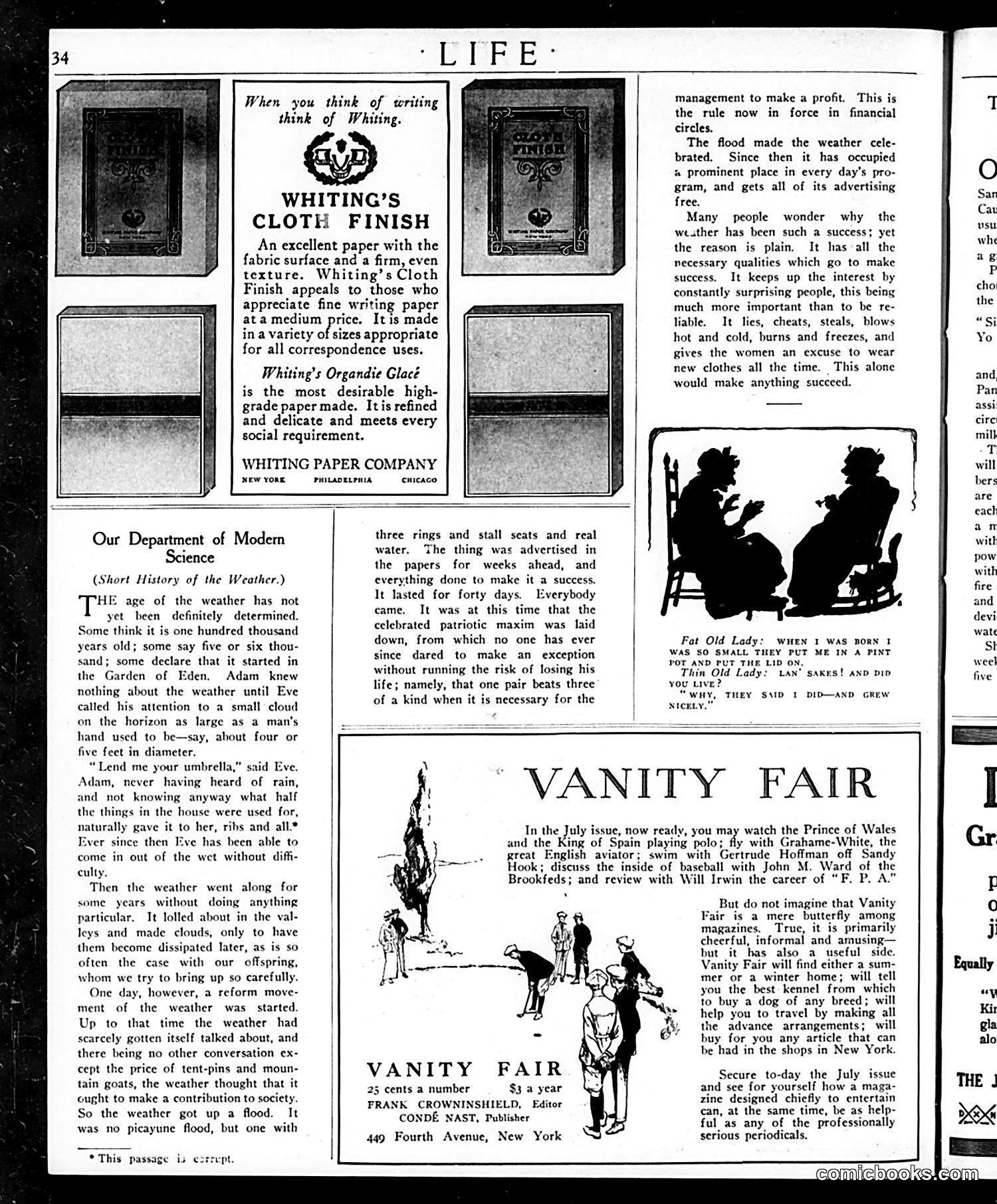
This page primarily contains **advertising and humor columns** rather than political cartoons. The main humor piece is "Our Department of Modern Science: (Short History of the Weather)" — a satirical mock-history that personifies weather as a character seeking social prominence. It humorously traces weather from Adam and Eve (inventing the umbrella origin story) through its "reform movement," climaxing when weather "got up a flood" to gain publicity. The satire targets how the weather and modern phenomena constantly "surprise" people while being fundamentally unreliable—yet people accept this because it's entertaining and gives women "an excuse to wear new clothes." The small cartoon shows two elderly women discussing being tiny at birth, a joke about exaggeration. Otherwise, the page features **advertisements** for Whiting's writing paper and announcements for Vanity Fair magazine's July issue, mentioning celebrities like the Prince of Wales and aviator Grahame-White. There is no identifiable political satire here—just gentle social humor about human nature and commercial culture.
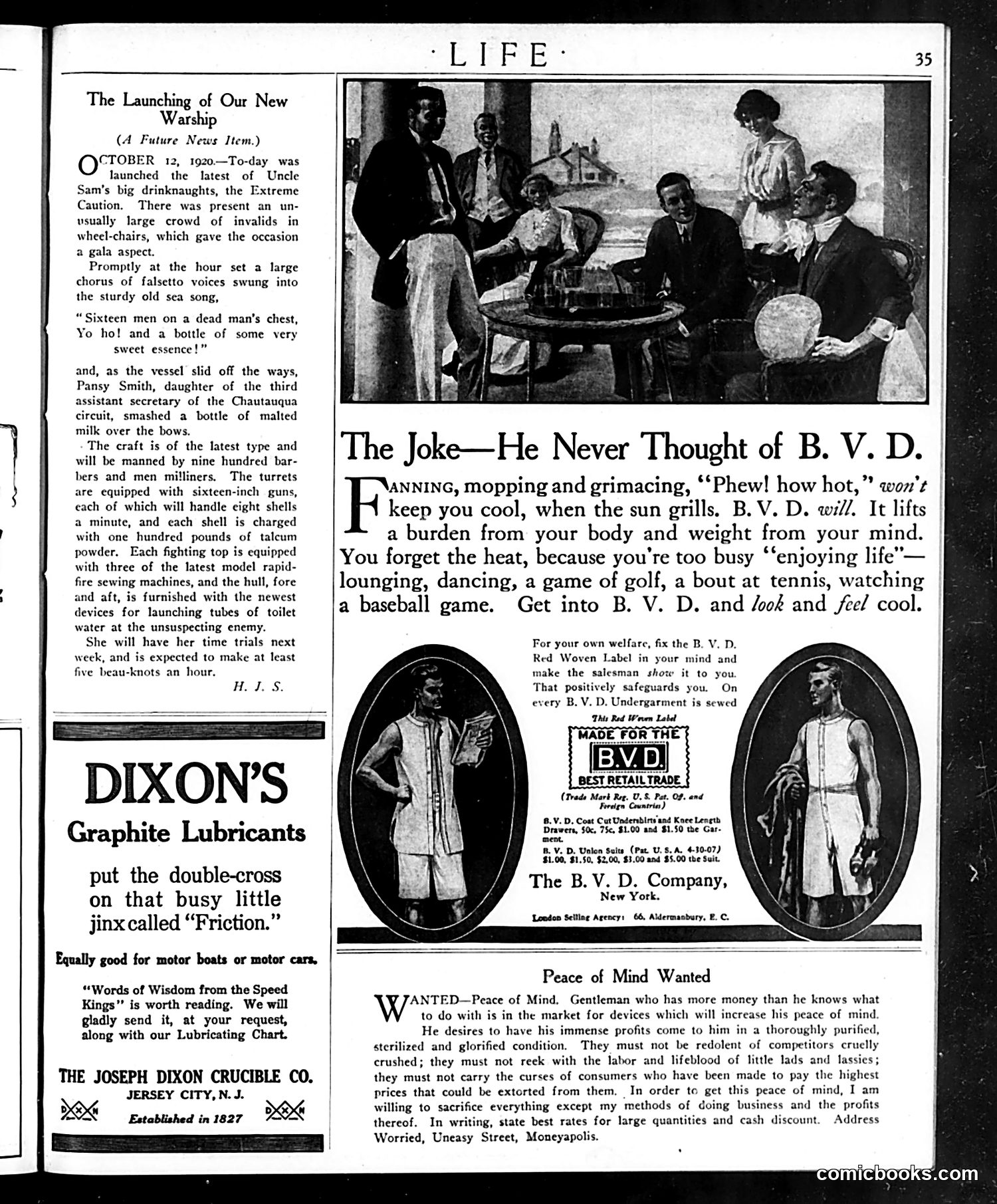
This page contains satirical commentary on Prohibition-era America mixed with period advertising. **"The Launching of Our New Warship"** mocks the temperance movement through absurdist humor. The warship "Extreme Caution" is launched with malted milk instead of champagne—a jab at Prohibition advocates. The crew consists of "barbers and men milliners" (stereotypically effeminate professions), and weapons use talcum powder instead of gunpowder. The satire suggests that Prohibition will emasculate American military power and that overly cautious policies produce ineffectual results. **"The Joke—He Never Thought of B.V.D."** is a straightforward advertisement for men's undergarments, using heat relief as its selling point—likely aimed at summer comfort. **"Peace of Mind Wanted"** is a sharp satirical ad mocking wealthy industrialists who want "pure" profits untainted by worker exploitation or consumer harm. It exposes the hypocrisy of capitalists seeking moral legitimacy while refusing to change unethical business practices. The page reflects post-WWI American anxieties about Prohibition's effects and class tensions during the early 1920s.
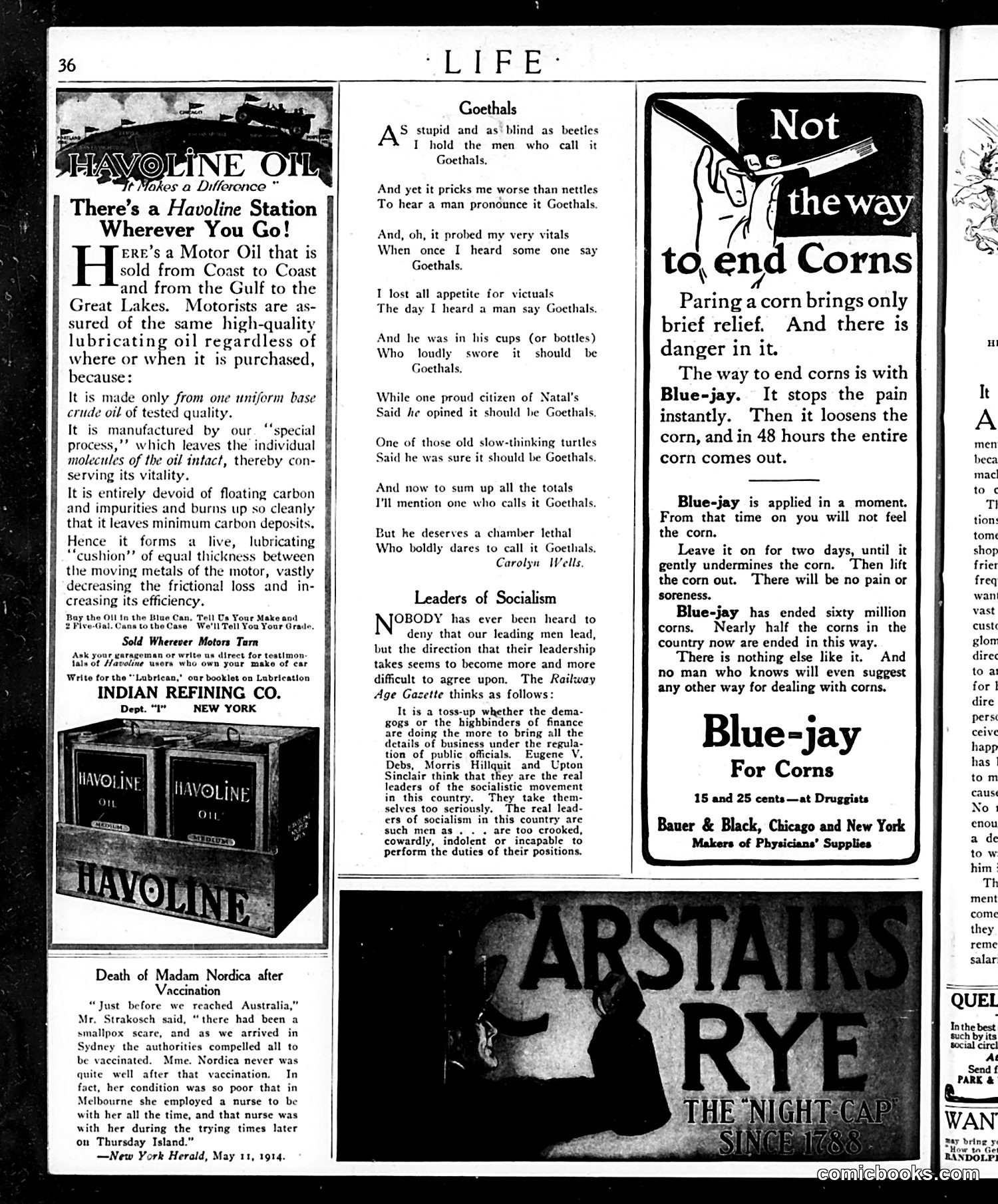
This page contains advertisements and satirical content typical of Life magazine's format. **"Goethals" Poem** (by Carolyn Wells): A humorous complaint about mispronunciation of the name "Goethals"—likely referring to **George Washington Goethals**, the prominent Army engineer overseeing the Panama Canal construction. The satire mocks how various people—from drunk men to citizens to slow-witted individuals—mispronounce his name, expressing exaggerated outrage at each instance. It's light social satire about a contemporary public figure's name. **"Leaders of Socialism"**: A brief editorial snippet from *Railway Age Gazette* sarcastically arguing that actual socialist leaders (naming **Eugene V. Debs, Morris Hillquit, and Upton Sinclair**—real figures in the American socialist movement) are less responsible for socialism's spread than corrupt businessmen and politicians too incompetent to do their jobs properly. The satire suggests incompetent capitalism inadvertently promotes socialism. The remainder consists of product advertisements (Havoline Oil, Blue-jay corn remedy) and an unrelated anecdote about opera singer Mme. Nordica's death following vaccination.
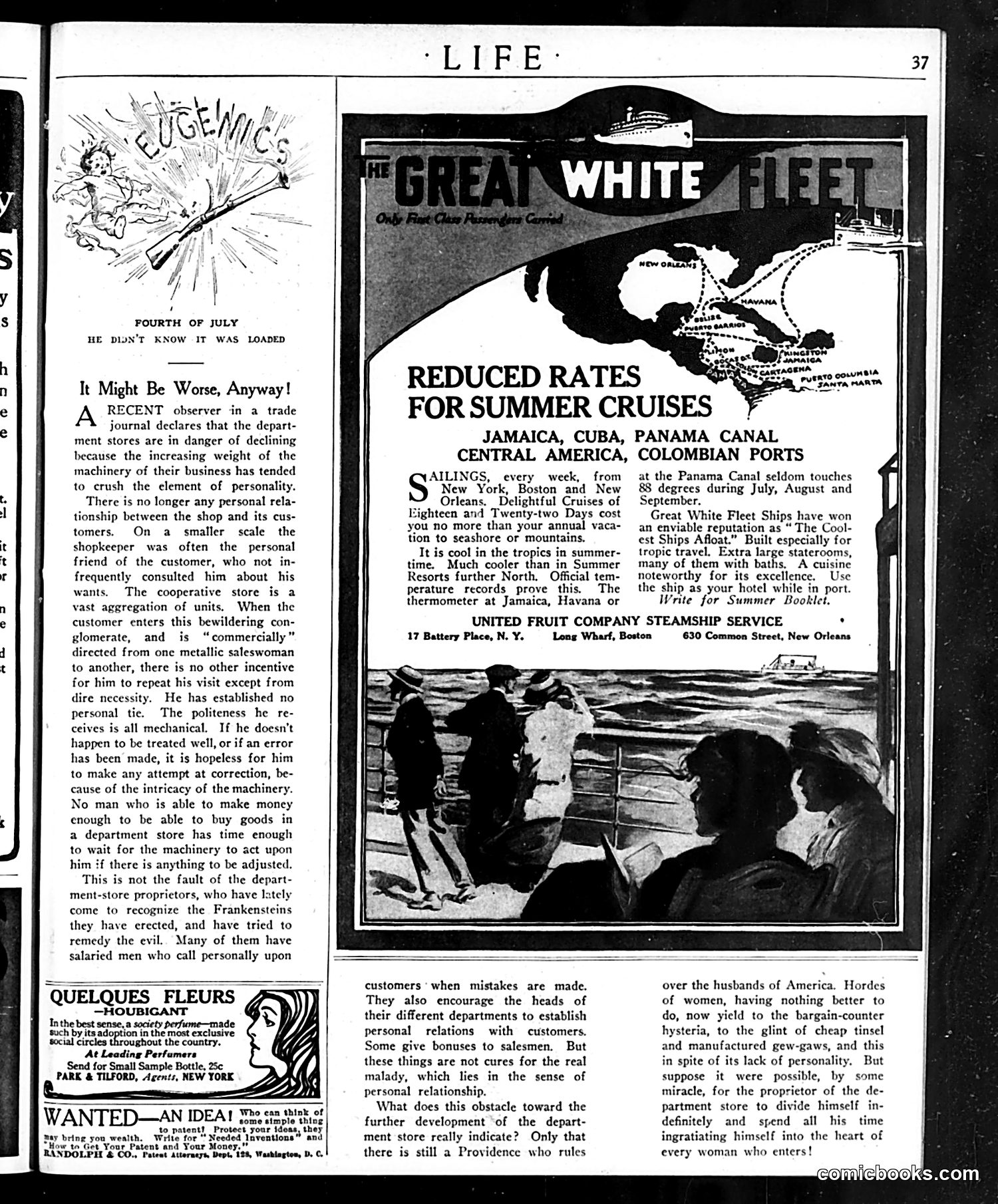
**The Cartoon:** The small illustration titled "Fourth of July / He Didn't Know It Was Loaded" depicts a cherub or cupid figure being knocked backward by an explosion from a rifle. This is a visual pun—a play on the common accident excuse "I didn't know it was loaded"—applied to Independence Day fireworks mishaps. It's a darkly humorous commentary on Fourth of July accidents. **The Main Article:** The lengthy essay critiques modern department stores, arguing they've become impersonal "Frankensteins" of machinery and bureaucracy. The author laments that stores lack the personal relationships that small shopkeepers once maintained with customers. When errors occur, the complex system prevents correction. He suggests only "Providence" (divine intervention, used sarcastically) protects American husbands from wives' compulsive shopping at bargain counters. **The Point:** This reflects early-20th-century anxiety about industrialization and commercialization destroying human connection and personal service—a common Progressive Era critique of modern consumer capitalism.
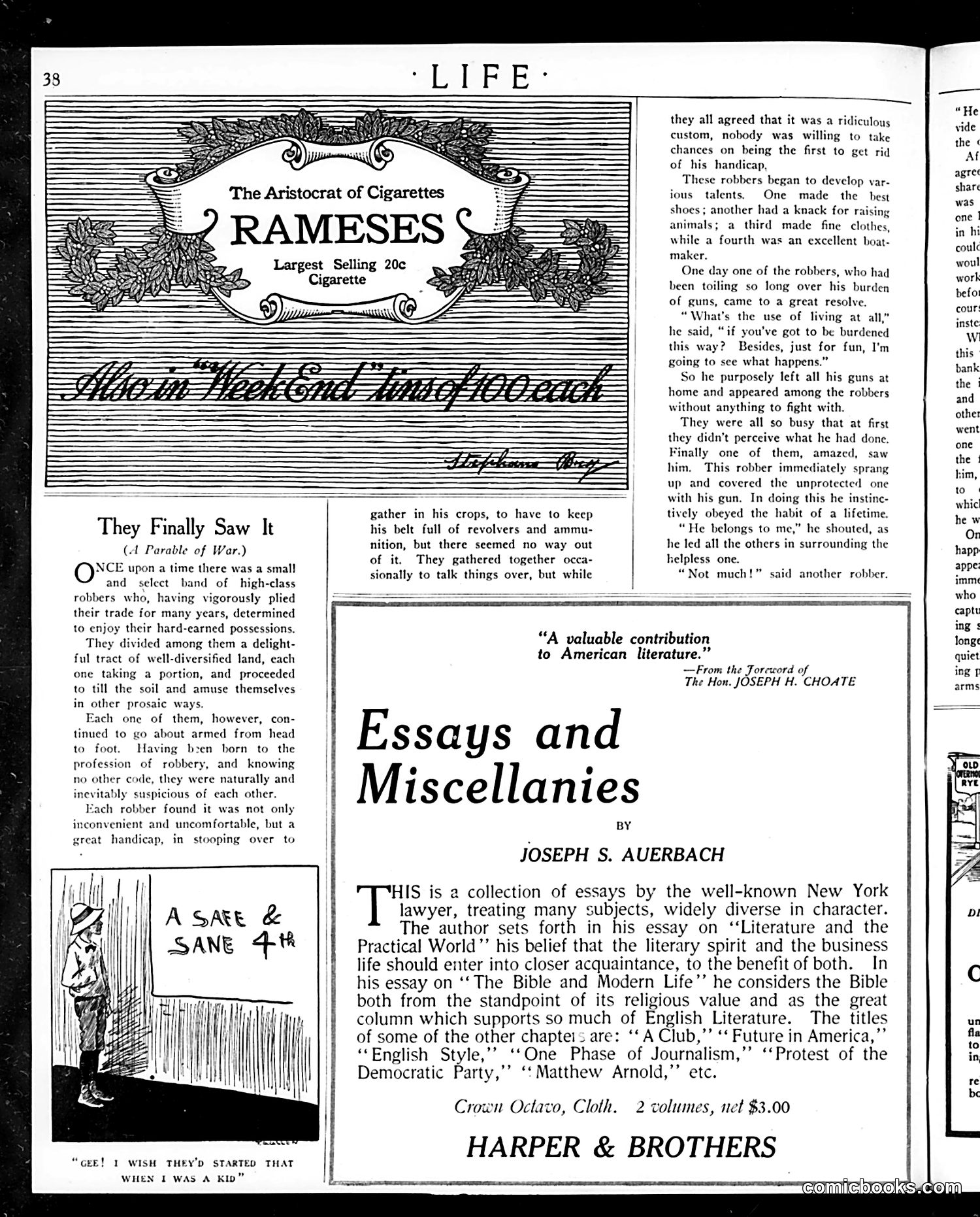
This page contains a satirical parable titled "They Finally Saw It" about disarmament and international relations, likely commentary on post-World War I arms reduction efforts. The story describes former "robbers" (nations) who divide land and attempt peaceful farming but remain armed "from head to foot" out of mutual suspicion. One robber courageously disarms, appearing defenseless—only to be immediately threatened and surrounded by the others, who revert to their violent habits. The parable's point: nations cannot unilaterally disarm when trust is absent; collective security requires simultaneous commitment. The satirical cartoon below shows a child saying "Gee! I wish they'd started that when I was a kid"—suggesting the lesson applies universally and should have been learned earlier. The page also advertises Rameses cigarettes and Joseph Auerbach's essay collection, but these are commercial content unrelated to the political satire above.
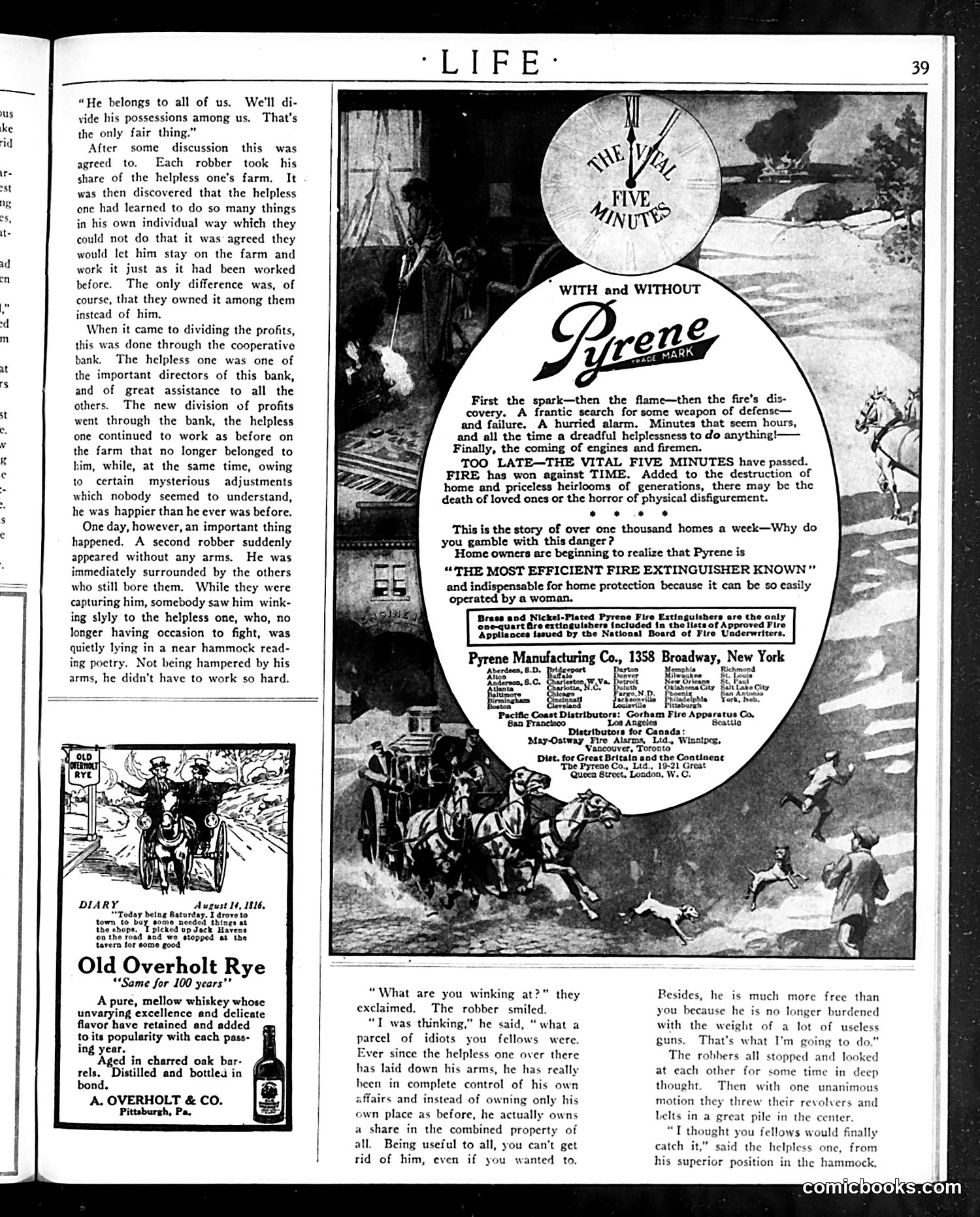
This page contains a satirical parable about socialism and collective ownership. The main narrative depicts robbers who seize a helpless man's farm, then discover he's so skilled and useful that they must keep him on as a worker—but now under collective ownership through a cooperative bank. The twist: the helpless man becomes happier and gains actual power despite losing title to his property, while the armed robbers remain burdened by their weapons. The political point appears to be satire *for* socialism or collective economics: the parable suggests that shared ownership and mutual dependence can paradoxically increase individual freedom and happiness compared to competitive individualism. When a second disarmed robber appears, he explains the real power lies with the useful, unarmed man—suggesting disarmament and cooperation trump armed force. The page also contains advertisements (Old Overholt Rye whiskey and Pyrene fire extinguishers), typical of Life's format at this period.
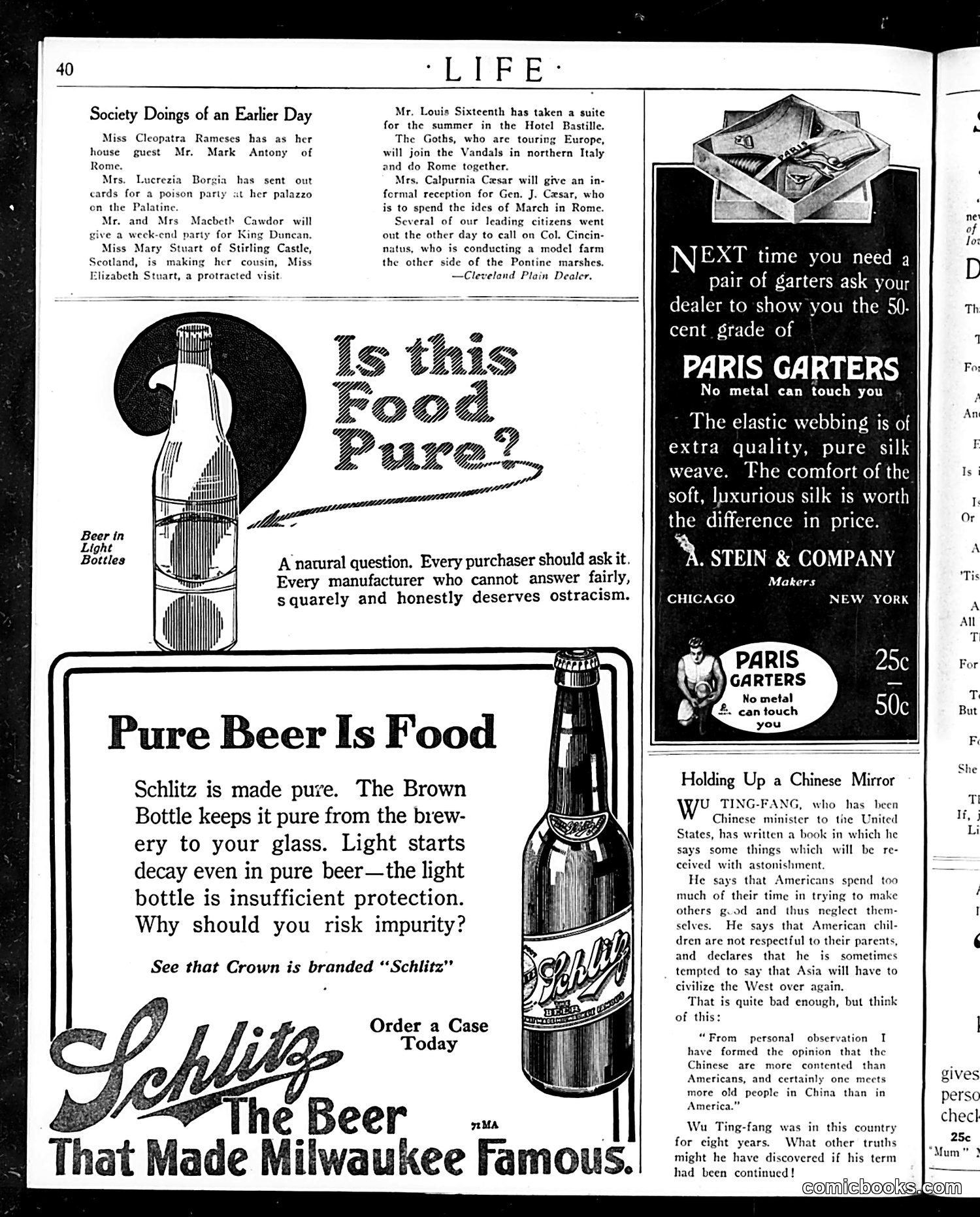
This page contains two main satirical pieces: **"Society Doings of an Earlier Day"** (top left) is a humor column that anachronistically places historical and literary figures in modern social situations—Louis XVI at a hotel called "the Bastille," Cleopatra with Mark Antony, Lady Macbeth hosting parties. The joke is the incongruity of treating fictional/ancient figures as contemporary society gossip. **"Holding Up a Chinese Mirror"** (right) discusses Wu Ting-fang, the actual Chinese minister to the U.S., who wrote a book criticizing American culture. The satirist mocks Wu's observations—particularly his claim that Chinese are more content than Americans and that older people are more respected in China—by suggesting these critiques reveal uncomfortable truths about American society. The "mirror" metaphor implies foreign criticism can expose domestic flaws we ignore. The rest of the page is advertising (Schlitz beer, Paris garters).
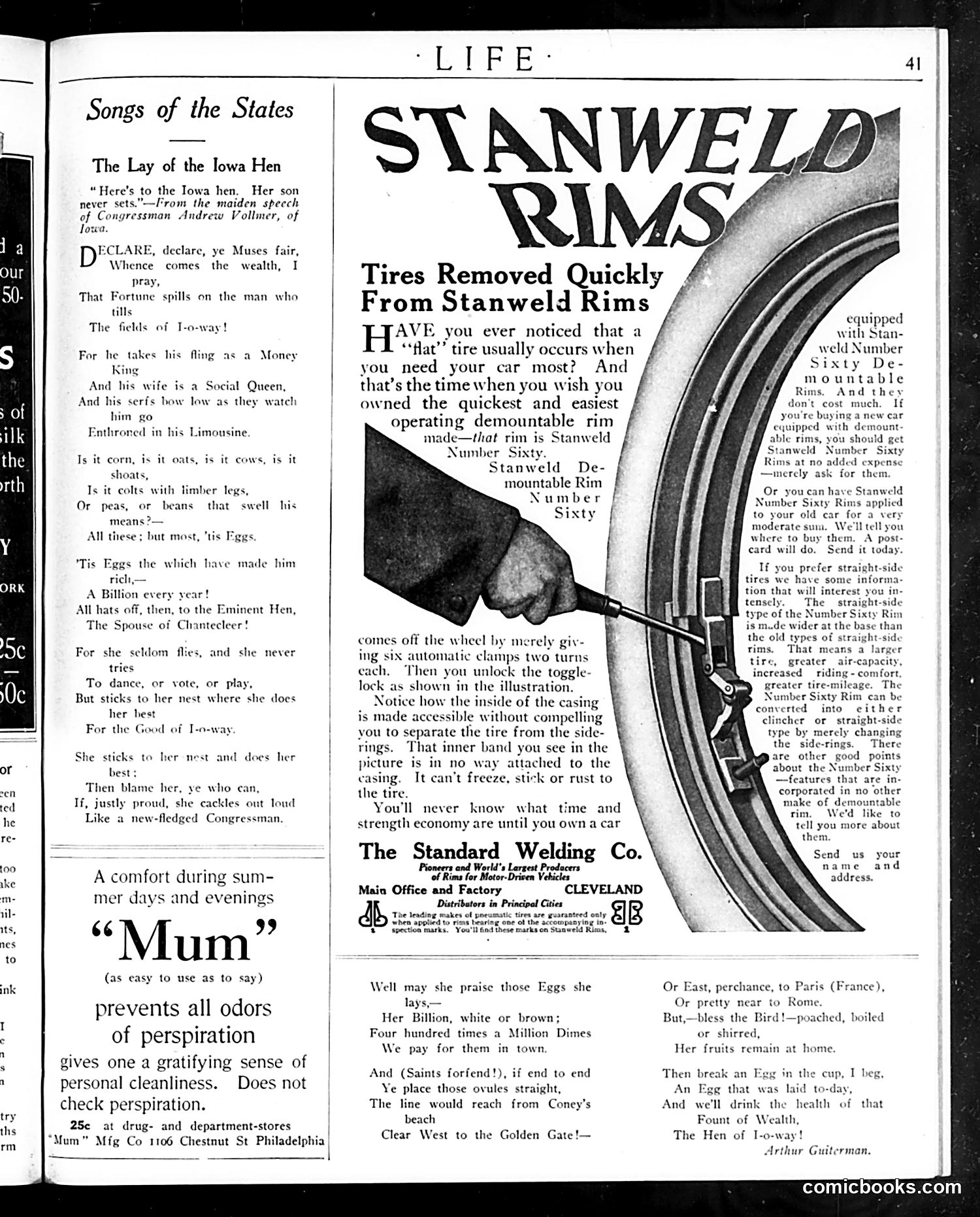
This page features a humorous poem satirizing Iowa congressman Andrew Vollmer's maiden speech, which apparently praised Iowa's agricultural productivity by declaring "Here's to the Iowa hen. Her son never sets"—a patriotic-sounding but nonsensical boast. The poem mockingly elaborates on this absurdity, celebrating an imaginary Iowa farmer-king enriched by hen eggs. The satire targets Vollmer's inflated rhetoric and Iowa's agricultural self-importance. By inflating his statement to ridiculous proportions—claiming billions of eggs annually and suggesting egg production extends from Iowa to distant locations—Life magazine ridicules overwrought congressional speeches and provincial boosterism. The poem's closing couplet ("Then break an Egg in the cup, I beg, / And we'll drink the health of that Fount of Wealth, / The Hen of Io-wa!") drives home the mockery of treating humble egg production as source of tremendous wealth. The remainder of the page contains period advertising unrelated to the satire.
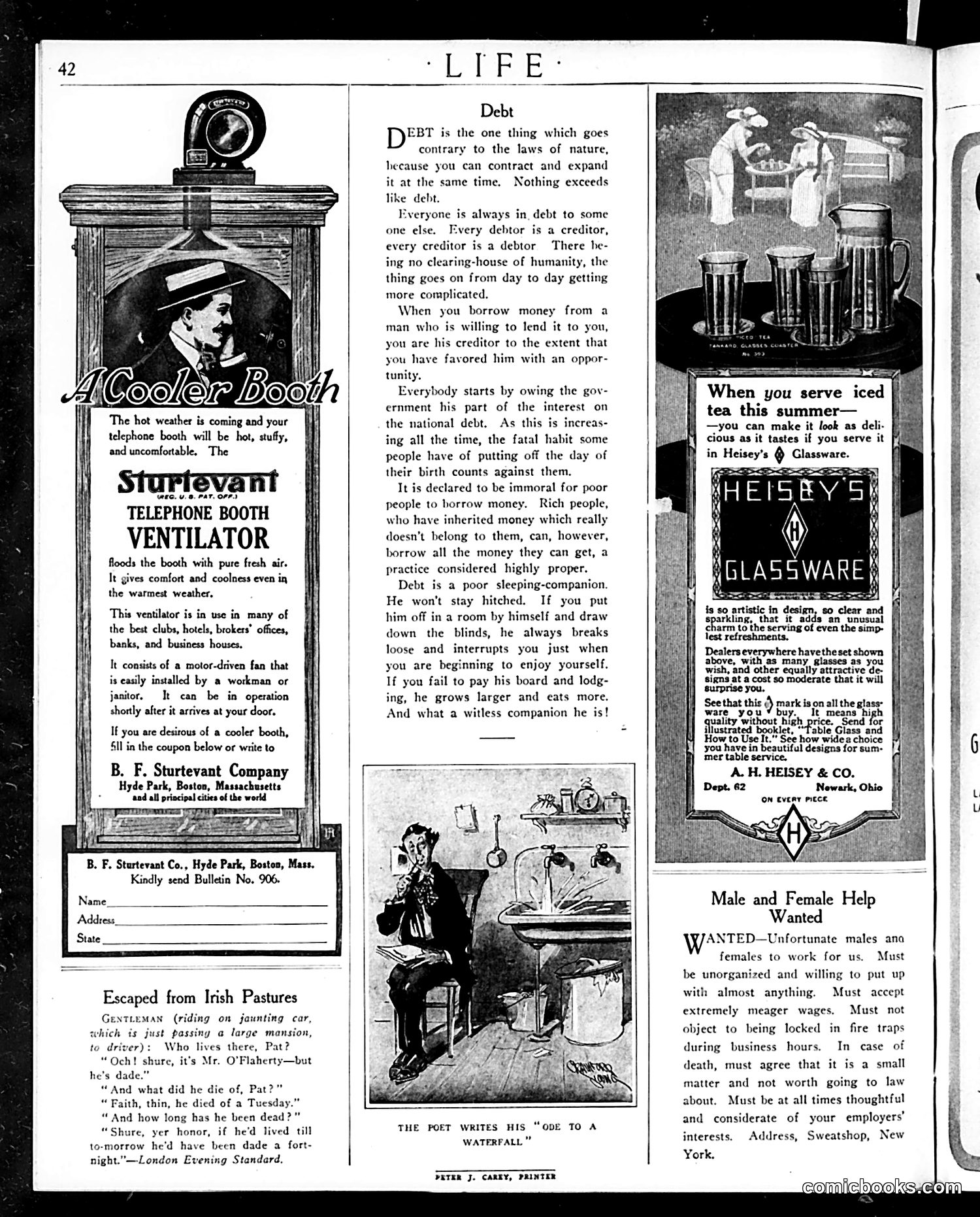
This page contains three distinct items: **Left side:** Advertisement for a Sturtevant telephone booth ventilator—a practical cooling device for the uncomfortable small booths common in early 20th-century offices and public spaces. **Center:** A satirical essay on debt, arguing that borrowing money is hypocritically judged. The author notes the poor are condemned for borrowing while the wealthy freely do so with inherited money. Debt is personified as an unwelcome, intrusive houseguest that grows larger if unpaid. This reflects pre-Depression anxieties about personal and national debt. **Bottom center:** A humorous Irish dialect joke about a man who "died of a Tuesday"—absurdist wordplay typical of period ethnic humor. **Right side:** Advertisement for Heisey glassware and a darkly cynical "help wanted" ad sarcastically seeking "unfortunate" workers willing to accept starvation wages, locked fire-trap conditions, and dangerous conditions—likely satirizing exploitative labor practices of the era.
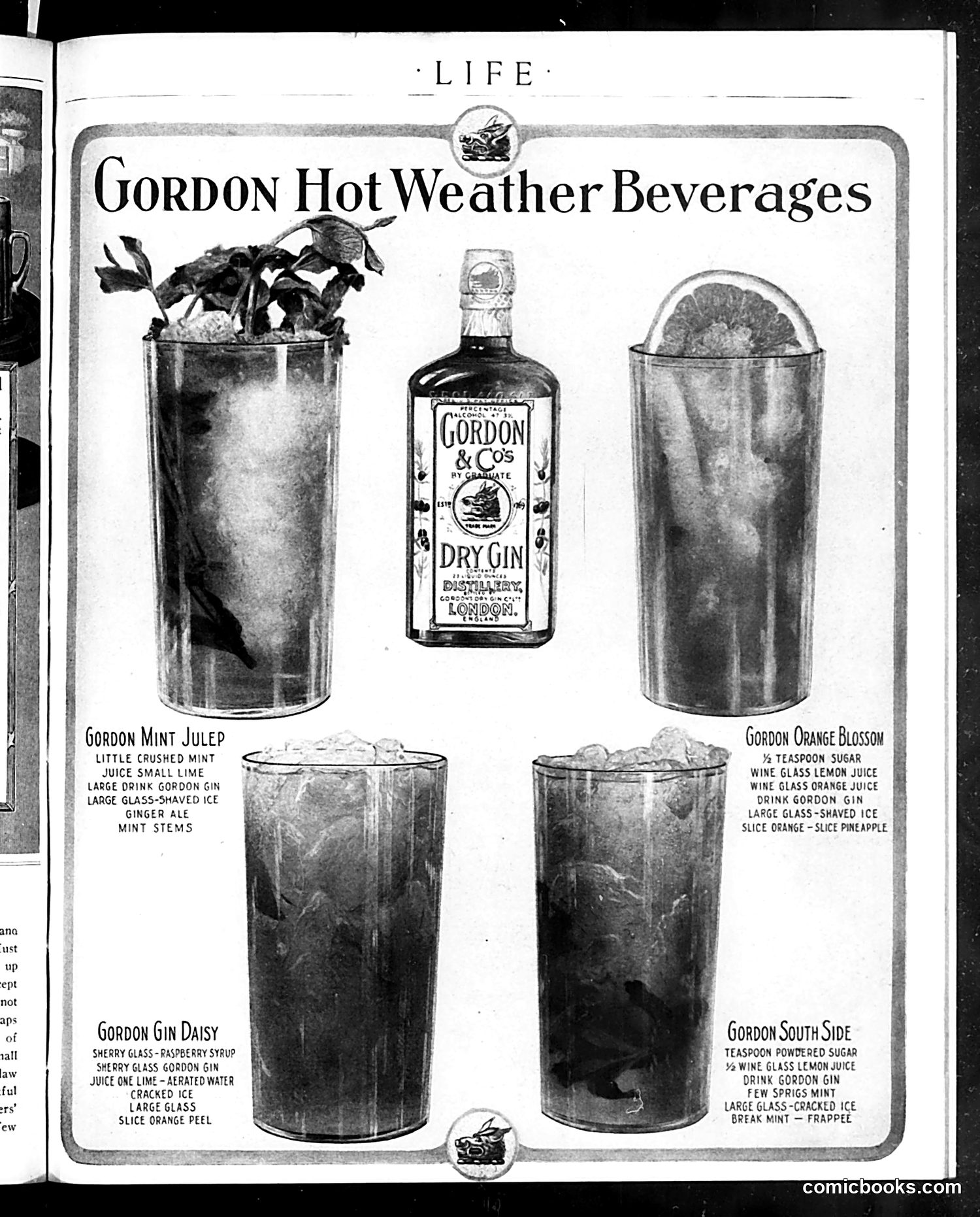
This is a product advertisement, not satire or political commentary. It's a full-page ad for Gordon & Co's Dry Gin featuring four "hot weather beverages" — cocktail recipes designed for warm-weather consumption. The recipes (Mint Julep, Gin Daisy, Orange Blossom, and South Side) are presented with ingredient lists and accompanying drink illustrations. The central image shows a Gordon's Dry Gin bottle. This appears to be from the pre-Prohibition or early Prohibition era, when such alcohol advertisements were still permitted in mainstream magazines like Life. The ad positions gin-based cocktails as sophisticated, refreshing summer drinks for affluent readers.
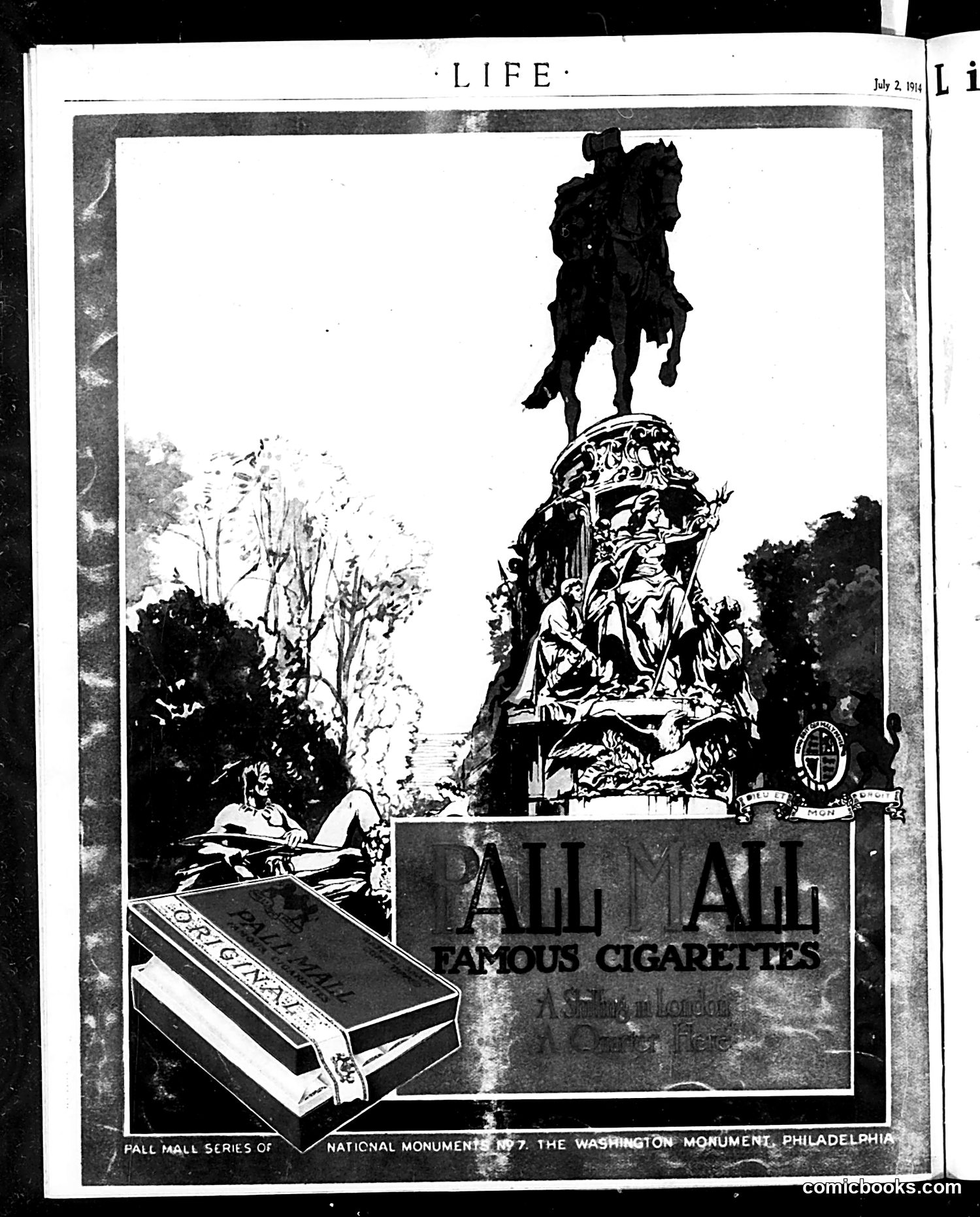
This is a **Pall Mall cigarette advertisement** disguised as patriotic content, part of their "National Monuments" series. The ad features the Washington Monument in Philadelphia, with an equestrian statue atop it and allegorical figures carved into its base. A reclining man examines a Pall Mall cigarette package in the foreground. The satire is straightforward: the advertisement ironically elevates a commercial product by associating it with American patriotic monuments and classical artistic imagery. By placing the cigarette package alongside a grand national memorial, the ad suggests Pall Mall cigarettes deserve the same reverence as American heritage. This reflects early 20th-century advertising tactics that used nationalism and high culture to market consumer goods—a practice modern readers would recognize as manipulative brand positioning.