
Life, 1914-07-02 · page 34 of 44
Life — July 2, 1914 — page 34: what you’re looking at
What you’re looking at
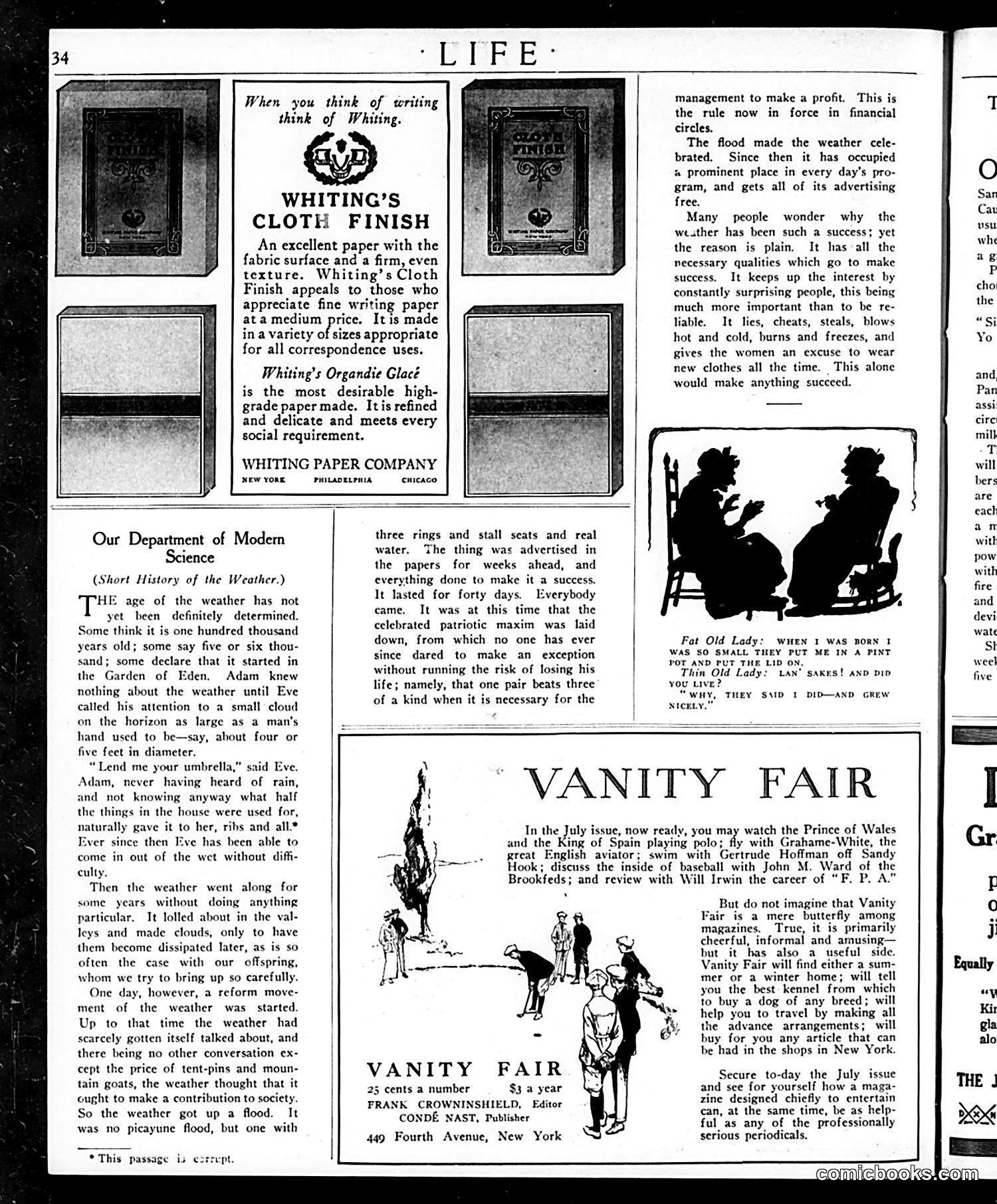
This page primarily contains **advertising and humor columns** rather than political cartoons. The main humor piece is "Our Department of Modern Science: (Short History of the Weather)" — a satirical mock-history that personifies weather as a character seeking social prominence. It humorously traces weather from Adam and Eve (inventing the umbrella origin story) through its "reform movement," climaxing when weather "got up a flood" to gain publicity. The satire targets how the weather and modern phenomena constantly "surprise" people while being fundamentally unreliable—yet people accept this because it's entertaining and gives women "an excuse to wear new clothes." The small cartoon shows two elderly women discussing being tiny at birth, a joke about exaggeration. Otherwise, the page features **advertisements** for Whiting's writing paper and announcements for Vanity Fair magazine's July issue, mentioning celebrities like the Prince of Wales and aviator Grahame-White. There is no identifiable political satire here—just gentle social humor about human nature and commercial culture.
📄 Transcribed text from this page (OCR, searchable)
Machine-transcribed from the original scan — historical spelling and the odd misread are preserved.
When you think of writing think of Whiting. s WHITING’S CLOTH FINISH An excellent paper with the fabric surface and a firm, even texture. Whiting’s Cloth Finish appeals to those who appreciate fine writing paper ata medium price. Itis made in a variety of sizes appropriate for all correspondence uses. Whiting’s Organdie Glacé is the most desirable high- grade paper made. Itis refined and delicate and meets every social requirement. WHITING PAPER COMPANY ‘NEW YORE PHILADELPIIA, ceuicaco Our Department of Modem Science (Short History of the Weather.) 'HE age of the weather has not yet been definitely determined. Some think it is one hundred thousand years old; some say five or six thou- sand; some declare that it started in the Garden of Eden. Adam knew nothing about the weather until Eve called his attention to a small cloud on the horizon as large as a man's hand used to be—say, about four or five feet in diameter. “Lend me your umbrella,” said Eve. dam, never having heard of rain, d not knowing anyway what half the things in the house were used for, naturally gave it to her, ribs and all.* Ever since then Eve has been able to come in out of the wet without diffi- culty. Then the weather went along for some years without doing anything particular. It lolled about in the val- Ieys and made clouds, only to have them become dissipated later, as is so often the case with our offspring, whom we try to bring up so carefully. One day, however, a reform move- ment of the weather was started. Up to that time the weather had scarcely gotten itself talked about, and there being no other conversation ex- cept the price of tent-pins and moun- tain goats, the weather thought that it ought to make a contribution to society. So the weather got up a flood. It was no picayune flood, but one with *This passage is corrept. three rings and stall seats and real water. The thing was advertised in the papers for weeks ahead, and everything done to make it a success. It lasted for forty days. Everybody came. It was at this time that the celebrated patriotic maxim was laid down, from which no one has ever since dared to make an exception without running the risk of losing his life; namely, that one pair beats three of a kind when it is necessary for the management to make a profit. This is the rule now in force in financial circles, The flood made the weather cele- brated. Since then it has occupied & prominent place in every day’s pro- gram, and gets all of its advertising free. Many people wonder why the wether has been such a success; yet the reason is plain, It has all the necessary qualities which go to make success. It keeps up the interest by constantly surprising people, this being much more important than to be re- liable. It lies, cheats, steals, blows hot and cold, burns and freezes, and gives the women an excuse to wear new clothes all the time. This alone would make anything succeed. Fat Old Lady: wien 1 was norN 1 WAS SO SMALL THEY PUT ME IN A PINT POT AND PUT THE LID ON. Thin Old Lady: Lan’ sakes! and DID you Live? “WHY, THEY S\ID I DID—AND GREW NICELY.” VANITY FAIR In the July issue, now ready, you may watch the Prince of Wales and the ean of Spain play polo; fly with Grahame-White, the great English aviator; swim with Gertrude Hoffman off Sandy Hook; discuss the inside of baseball with John M. Ward of the Brookfeds; and review with Will Irwin the career of “F. P. A.” VANITY FAIR 25 cents a number $3 a year FRANK CROWNINSHIELD, Editor CONDE NAST, Publisher 449 Fourth Avenue, New York But do not imagine that Vanity Fair is a mere butterfly among magazines. True, it is primarily cheerful, informal and amusing— but it has also a useful side. Vanity Fair will find either a sum- mer or a winter home; will tell you the best kennel from which to buy a dog of any breed; will help you to travel by making all the advance arrangements; will buy for you any article that can be had in the shops in New York. Secure to-day the July issue and sce for yourself how a maga- zine designed chiefly to entertain can, at the same time, be as help- ful as any of the professionally serious periodicals.