
Life, 1914-07-02 · page 21 of 44
Life — July 2, 1914 — page 21: what you’re looking at
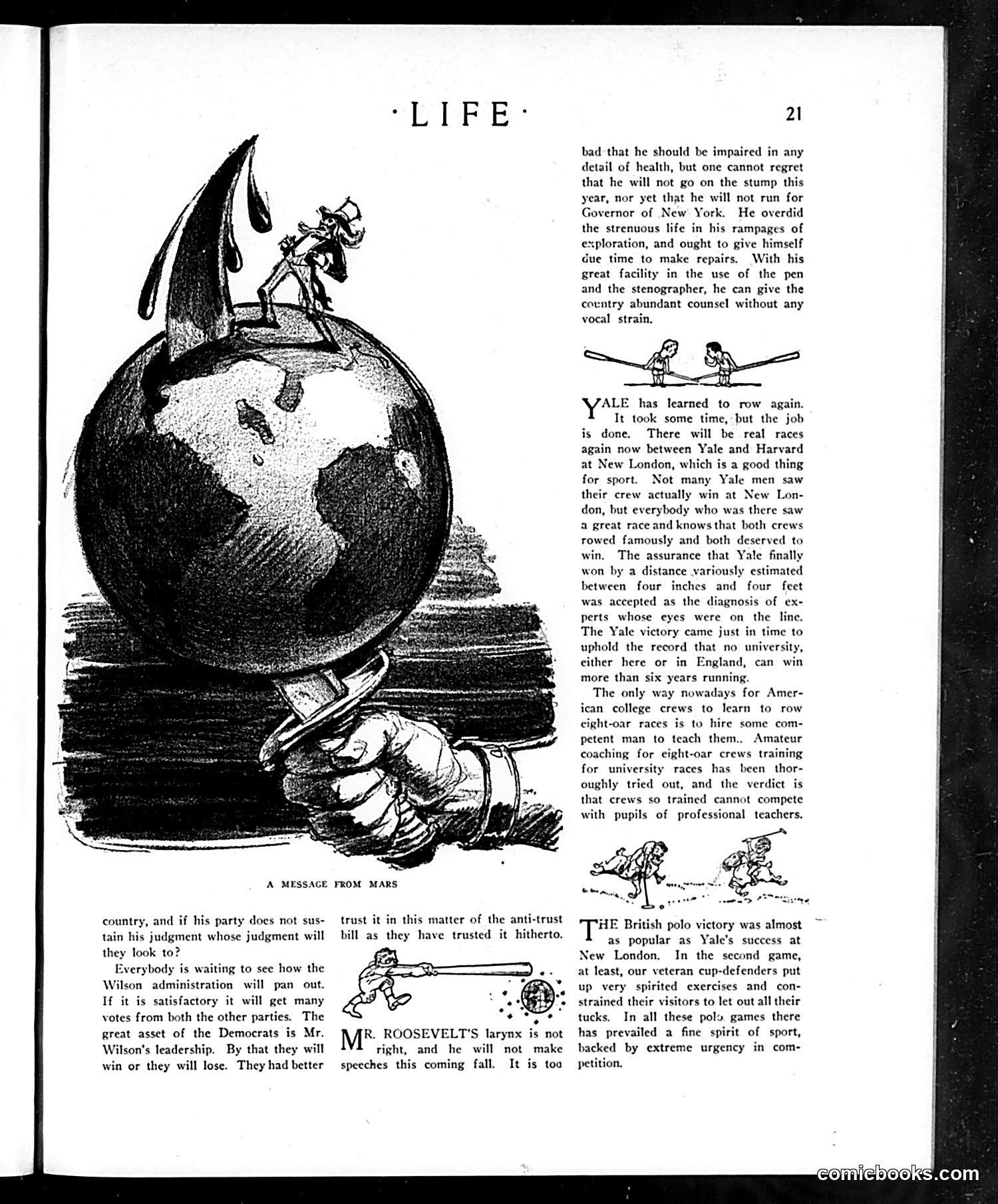
What you’re looking at
The main illustration depicts a globe being held aloft by a figure on horseback, representing Teddy Roosevelt as a conquering explorer/adventurer. The accompanying text discusses Roosevelt's laryngitis preventing him from campaigning for New York Governor—presenting this as fortunate, suggesting his "strenuous life" of exploration has worn him out. The satire mocks Roosevelt's tendency toward overextension and physical excess while implying relief that his vocal ailment will silence his political voice temporarily. The "Message from Mars" title appears to frame Roosevelt as an otherworldly, grandiose figure. The page also covers Yale's rowing victory over Harvard and British polo success—contemporary collegiate sporting triumphs used to illustrate American competitiveness and the value of professional coaching. The political context involves the Wilson administration's anti-trust policies, with commentary that Democratic success depends on Wilson's leadership continuing effectively.
📄 Transcribed text from this page (OCR, searchable)
Machine-transcribed from the original scan — historical spelling and the odd misread are preserved.
A MESSAGE FROM MARS country, and if his party does not sus- tain his judgment whose judgment will they look to? Everybody is waiting to see how the Wilson administration will pan out. If it is satisfactory it will get many votes from both the other parties. The great asset of the Democrats is Mr. Wilson’s leadership. By that they will win or they will lose. They had better trust it in this matter of the anti-trust bill as they have trusted it hitherto. R. ROOSEVELT'S larynx is not right, and he will not make speeches this coming fall. It is too 21 bad that he should be impaired in any detail of health, but one cannot regret that he will not go on the stump this year, nor yet that he will not run for Governor of New York. He overdid the strenuous life in his rampages of exploration, and ought to give himself Gue time to make repairs. With his great facility in the use of the pen and the stenographer, he can give the country abundant counsel without any vocal strain, ALE has learned to row again. It took some time, but the job is done. There will be real races again now between Yale and Harvard at New London, which is a good thing for sport. Not many Yale men saw their crew actually win at New Lon- don, but everybody who was there saw a great race and knows that both crews rowed famously and both deserved to win, The assurance that Yale finally won by a distance variously estimated between four inches and four feet was accepted as the diagnosis of ex- perts whose eyes were on the line. The Yale victory came just in time to uphold the record that no university, either here or in England, can win more than six years running. The only way nowadays for Amer- ican college crews to learn to row cight-oar races is to hire some com- petent man to teach them.. Amateur coaching for eight-oar crews training for university races has been thor- oughly tried out, and the verdict is that crews so trained cannot compete with pupils of professional teachers. HE British polo victory was almost as popular as Yale's success at New London, In the second game, at least, our veteran cup-defenders put up very spirited exercises and con- strained their visitors to let out all their tucks. In all these polo. games there has prevailed a fine spirit of sport, backed by extreme urgency in com- petition,