
Life, 1914-07-02 · page 20 of 44
Life — July 2, 1914 — page 20: what you’re looking at
What you’re looking at
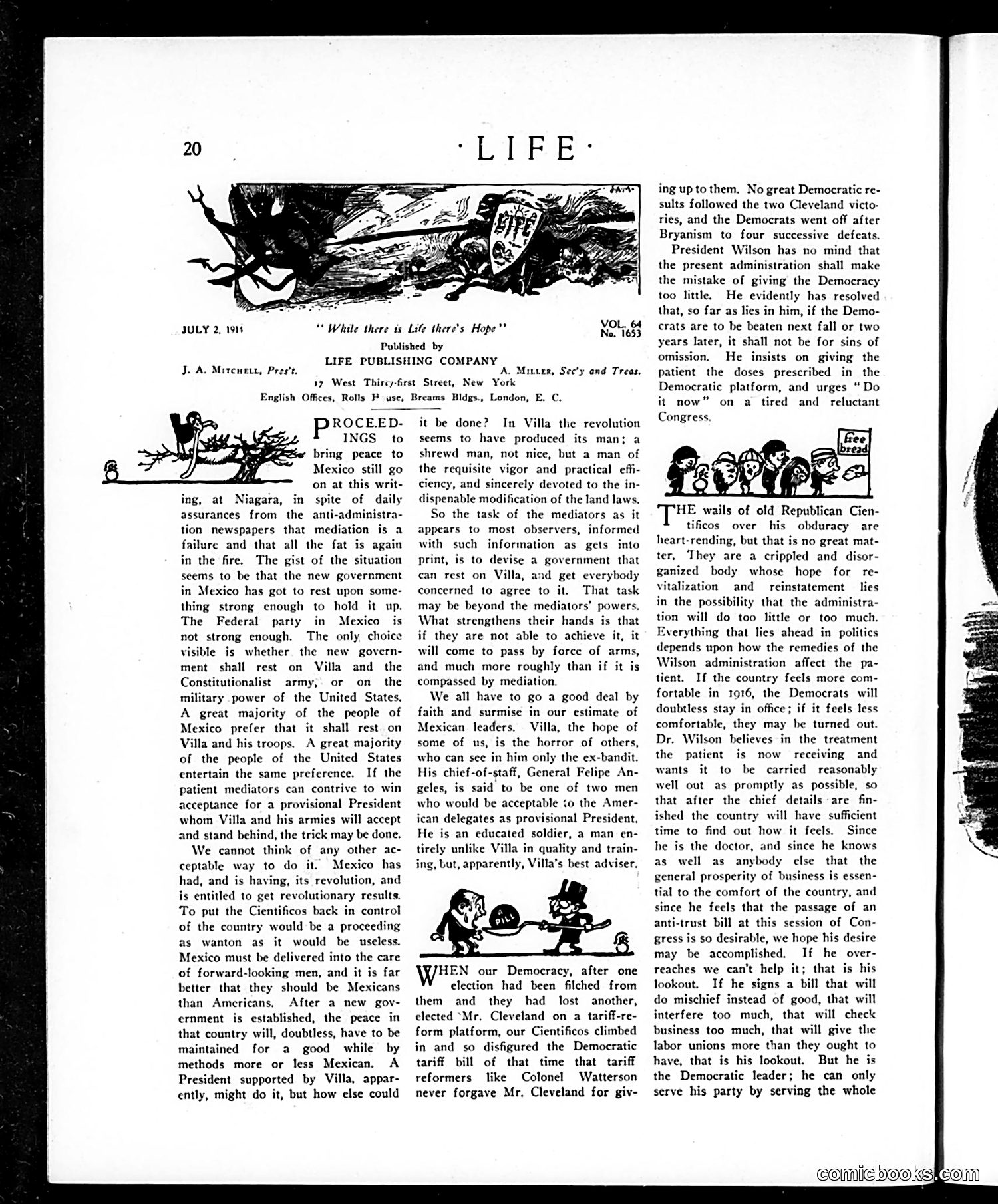
This page discusses U.S. mediation efforts during Mexico's revolution, specifically regarding Pancho Villa. The lead cartoon (top) depicts a skeletal, emaciated figure—likely representing Mexico itself or the failing revolution—with the caption "While there is Life there's Hope." The main article argues that Mexico's new government must rest on Villa and the Constitutionalist army, not on the Científicos (the old Porfirian elite) or American military power. The author presents Villa as an acceptable, if rough, revolutionary figure—"shrewd" and devoted to land reform—superior to American intervention. A secondary section criticizes Cleveland's Democratic administration for compromising on tariff reform, warning Wilson not to repeat that mistake. The satirical thrust warns against allowing reactionary forces (the Científicos, or by analogy, American conservatives) to undermine revolutionary gains. The context is World War I-era American policy toward the Mexican Revolution, with debates over supporting Villa versus other factions.
📄 Transcribed text from this page (OCR, searchable)
Machine-transcribed from the original scan — historical spelling and the odd misread are preserved.
JULY 2, 1918 ‘* While there is Life there's Hope"* No, 1653 Published by LIFE PUBLISHING COMPANY J. A. Mirenrtt, Pres't. A. Minter, Sec’y and Treas, 17 West Thircy-first Street, New York English Offices, Rolls FP use, Breams Bldgs., London, E. C. ROCE.ED- INGS to bring peace to Mexico still go on at this writ- ing, at Niagara, in spite of daily assurances from the anti-administra- tion newspapers that mediation is a failure and that all the fat is again in the fire. The gist of the situation seems to be that the new government in Mexico has got to rest upon some- thing strong enough to hold it up. The Federal party in Mexico is not strong enough. The only, choice visible is whether the new govern- ment shall rest on Villa and the Constitutionalist. army, or on the military power of the United States. A great majority of the people of Mexico prefer that it shall rest on Villa and his troops, A great majority of the people of the United States entertain the same preference. If the patient mediators can contrive to win acceptance for a provisional President whom Villa and his armies will accept and stand behind, the trick may be done. We cannot think of any other ac- ceptable way to do it. Mexico has had, and is having, its revolution, and is entitled to get revolutionary results. To put the Cientificos back in control of the country would be a proceeding as wanton as it would be useless. Mexico must be delivered into the care of forward-looking men, and it is far better that they should be Mexicans than Americans, After a new gov- ernment is established, the peace in that country will, doubtless, have to be maintained for a good while by methods more or less Mexican. A President supported by Villa, appar- ently, might do it, but how else could it be done? In Villa the revolution seems to have produced its man; a shrewd man, not nice, but a man of the requisite vigor and practical e' ciency, and sincerely devoted to the in- dispenable modification of the land laws. So the task of the mediators as it appears to most observers, informed with such information as gets into print, is to devise a government that can rest on Villa, and get everybody concerned to agree to it, That task may be beyond the mediators’ powers. What strengthens their hands is that if they are not able to achieve i will come to pass by force of arms, and much more roughly than if it is compassed by mediation We all have to go a good deal by faith and surmise in our estimate of Mexican leaders, Villa, the hope of some of us, is the horror of others, who can see in him only the ex-bandit. His chief-of-staff, General Felipe An- geles, is said to be one of two men who would be acceptable to the Amer- ican delegates as provisional President. He is an educated soldier, a man en- tirely unlike Villa in quality and train- ing, but, apparently, Villa’s best adviser. HEN our Democracy, after one election had been filched from them and they had lost another, elected ‘Mr. Cleveland on a tariff-re- form platform, our Cientificos climbed in and so disfigured the Democratic tariff bill of that time that tariff reformers like Colonel Watterson never forgave Mr, Cleveland for giv- ing up to them. No great Democratic re- sults followed the two Cleveland victo- ries, and the Democrats went off after Bryanism to four successive defeats. President Wilson has no mind that the present administration shall make the mistake of giving the Democracy too little. He evidently has resolved that, so far as lies in him, if the Demo- crats are to be beaten next fall or two years later, it shall not be for sins of omission. He insists on giving the patient the doses prescribed in the Democratic platform, and urges “Do it now” on a tired and reluctant Congress. THe wails of old Republican Cien- tificos over his obduracy are heart-rending, but that is no great mat- ter. They are a crippled and disor- ganized body whose hope for re- vitalization and reinstatement lies in the possibility that the administra- tion will do too little or too much. Everything that lies ahead in politics depends upon how the remedies of the Wilson administration affect the pa- tient. If the country feels more com- fortable in 1916, the Democrats will doubtless stay in office; if it feels less comfortable, they may be turned out. Dr. Wilson believes in the treatment the patient is now receiving and wants it to be carried reasonably well out as promptly as possible, so that after the chief details are fin- ished the country will have sufficient time to find out how it feels. Since he is the doctor, and since he knows as well as anybody else that the general prosperity of business is essen- tial to the comfort of the country, and since he feels that the passage of an anti-trust bill at this session of Con- gress is so desirable, we hope his desire may be accomplished. If he over- reaches we can’t help it; that is his lookout. If he signs a bill that will do mischief instead of good, that will interfere too much, that will check business too much, that will give the labor unions more than they ought to have, that is his lookout. But he is the Democratic leader; he can only serve his party by serving the whole comichooks