
Life, 1914-07-02 · page 38 of 44
Life — July 2, 1914 — page 38: what you’re looking at
What you’re looking at
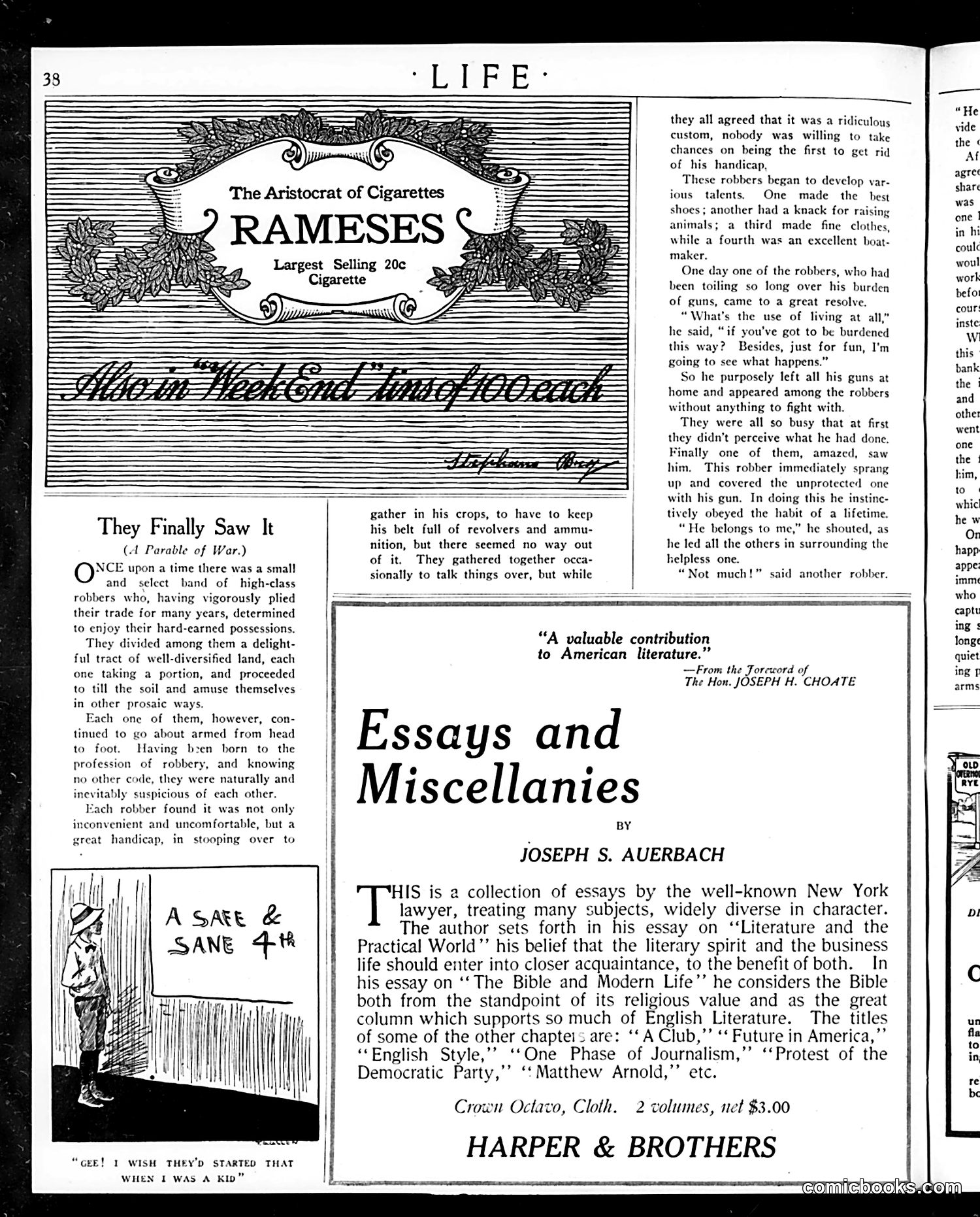
This page contains a satirical parable titled "They Finally Saw It" about disarmament and international relations, likely commentary on post-World War I arms reduction efforts. The story describes former "robbers" (nations) who divide land and attempt peaceful farming but remain armed "from head to foot" out of mutual suspicion. One robber courageously disarms, appearing defenseless—only to be immediately threatened and surrounded by the others, who revert to their violent habits. The parable's point: nations cannot unilaterally disarm when trust is absent; collective security requires simultaneous commitment. The satirical cartoon below shows a child saying "Gee! I wish they'd started that when I was a kid"—suggesting the lesson applies universally and should have been learned earlier. The page also advertises Rameses cigarettes and Joseph Auerbach's essay collection, but these are commercial content unrelated to the political satire above.
📄 Transcribed text from this page (OCR, searchable)
Machine-transcribed from the original scan — historical spelling and the odd misread are preserved.
The Aristocrat of Cigarettes -—? =. =v I: LZ Fr RAMESES Largest Selling 20c Cigarette They Finally Saw It (4 Parable of War.) NCE upon a time there was a small and select band of high-class robbers who, having vigorously plied their trade for many years, determined to enjoy their hard-earned possessions. They divided among them a delight- ful tract of well-diversified land, each one taking a portion, and proceeded to till the soil and amuse themselves in other prosaic ways. Each one of them, however, con- tinued to go about armed from head to foot. Having ben born to the profession of robbery, and knowing no other code, they were naturally and inevitably suspicious of each other. h robber found it was not only nconvenient and uncomfortable, but a great handicap, in stooping over to “Gee! 1 WISH THEY'D STARTED THAT WHEN 1 Was A KID” gather in his crops, to have to keep his belt full of revolvers and ammu- nition, but there seemed no way out of it. They gathered together occa- sionally to talk things over, but while “A valuable contribution they all agreed that it was a ridiculous custom, nobody was willing to take chances on being the first to get rid of his handicap, These robbers began to develop var- ious talents. One made the best shoes; another had a knack for raising animals; a third made fine clothes, while a fourth was an excellent boat- maker. One day one of the robbers, who had been toiling so long over his burden of guns, came to a great resolve. “What's the use of living at all; he you've got to be burdened this way? Besides, just for fun, I'm going to see what happens.” So he purposely left all his guns at home and appeared among the robbers without anything to fight with. They were all so busy that at first they didn’t perceive what he had done. Finally one of them, amazed, saw him. This robber immediately sprang up and covered the unprotected one with his gun. In doing this he instinc- tively obeyed the habit of a lifetime. “He belongs to me,” he shouted, as he led all the others in surrounding the helpless one. “Not much!” said another robber. to American literature.” Essays lawyer, treating man The author sets fort. and Miscellanies BY JOSEPH S. AUERBACH HIS is a collection of essays by the well-known New York subjects, widely diverse in character. in his essay on ‘‘Literature and the —From the Forecord of The Hon. JOSEPH H. CHOATE Practical World’’ his belief that the literary spirit and the business life should enter into closer acquaintance, to the benefit of both. In his essay on ‘‘The Bible and Modern Life’’ he considers the Bible both from the standpoint of its religious value and as the great column which supports so much of English Literature. The titles of some of the other chapteis are: ‘‘A Club,’’ ‘‘ Future in America,” “English Style,’’ ‘‘One Phase of Journalism,’’ ‘‘Protest of the Democratic Party,’’ ‘‘Matthew Arnold,” etc. Crown Oclavo, Cloth. HARPER & BROTHERS 2 volumes, net $3.00 — “He vide the « Af agre share was one | in hi coulc woul work befor cour! inste Wi this bank the i and other went one the | him, to whic he w captt ing s longe quiet ing p arms iGComiebooks*c om