
Life, 1914-07-02 · page 26 of 44
Life — July 2, 1914 — page 26: what you’re looking at
What you’re looking at
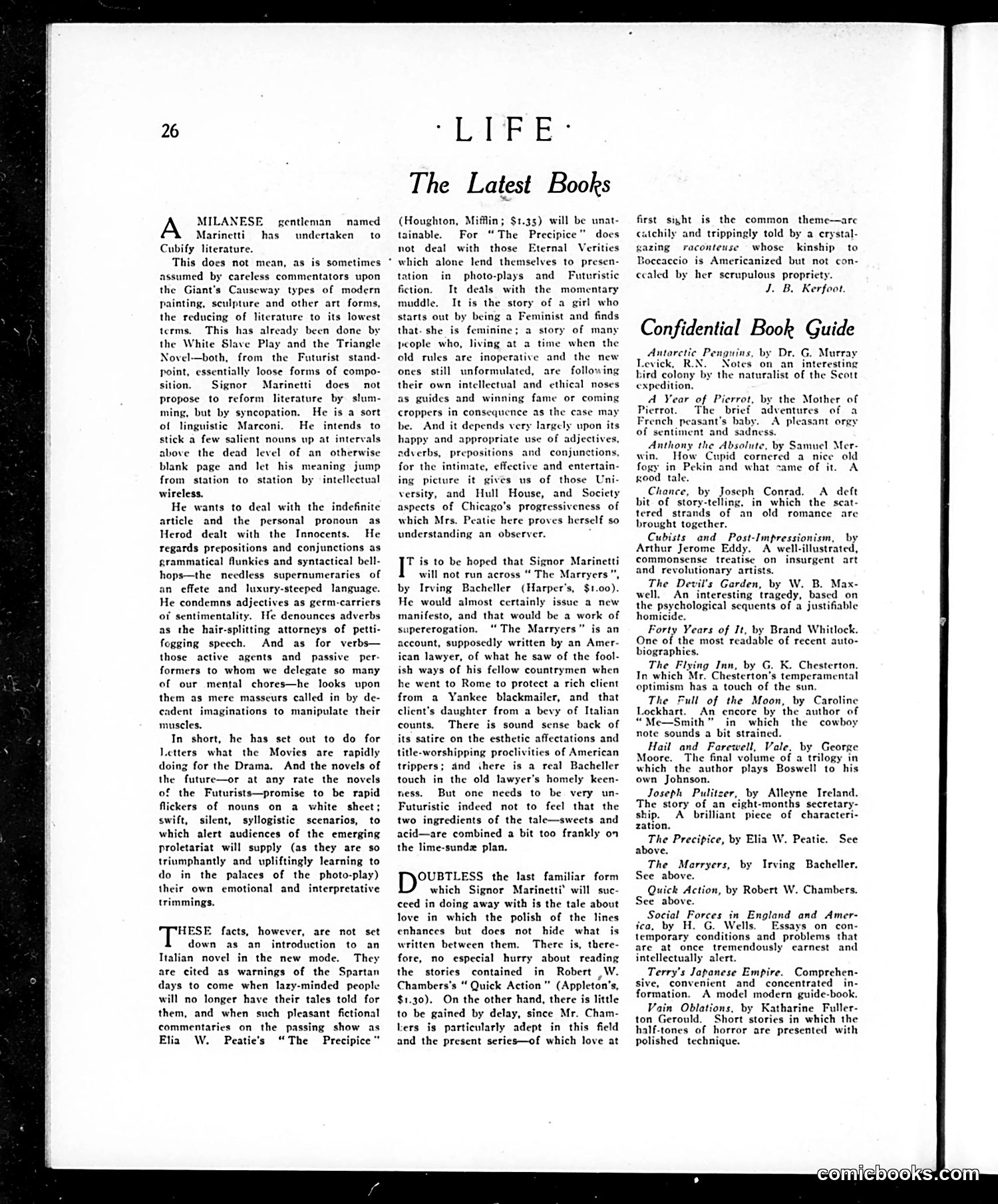
This page is a **book review section**, not a political cartoon. It satirizes the Italian Futurist movement, specifically F.T. Marinetti's literary theories. The satire ridicules Marinetti's manifesto to radically simplify language by eliminating adjectives, adverbs, prepositions, and conjunctions—reducing writing to scattered nouns on a page. The reviewer mocks this as analogous to how silent films let audiences supply their own emotional interpretation. The joke: Marinetti's extreme linguistic minimalism is so absurd that conventional novels like Elia W. Peatie's "The Precipice"—which rely heavily on descriptive language to convey nuance and character—would become "unobtainable" in a Futurist future. The reviewer uses elaborate, ornate prose *itself* to mock the Futurist position, creating ironic contrast. This reflects early 20th-century American literary skepticism toward avant-garde European movements perceived as pretentious and impractical.
📄 Transcribed text from this page (OCR, searchable)
Machine-transcribed from the original scan — historical spelling and the odd misread are preserved.
A MILANESE Marinetti Cubify literature. This does not mean, as is sometimes assumed by careless commentators upon the Giant's Causeway types of modern painting, sculpture and other art forms, the reducing of literature to its lowest terms. This has already been done by the White Slave Play and the Triangle Novel—both, from the Futurist stand- point, essentially loose forms of compo- sition. Signor Marinetti does not Propose to reform literature by slum- ming, but by syncopation. He is a sort of linguistic Marconi. He intends to stick a few salient nouns up at intervals above the dead level of an otherwise blank page and let his meaning jump from station to station by intellectual wireless, He wants to deal with the indefinite article and the personal pronoun as Herod dealt with the Innocents. He regards prepositions and conjunctions as grammatical flunkies and syntactical bell- hops—the needless supernumeraries of an effete and luxury-steeped language. He condemns adjectives as germ-carriers of sentimentality, He denounces adverbs as the hair-splitting attorneys of petti- fogging speech. And as for verbs— those active agents and passive per- formers to whom we delegate so many of our mental chores—he looks upon them as mere masseurs called in by de- cadent imaginations to manipulate their muscles. In short, he has set out to do for letters what the Movies are rapidly doing for the Drama. And the novels of the future—or at any rate the novels of the Futurists—promise to be rapid flickers of nouns on a white sheet; swift, silent, syllogistic scenarios, to which alert audiences of the emerging proletariat will supply (as they are so triumphantly and upliftingly learning to do in the palaces of the photo-play) their own emotional and interpretative trimmings. gentleman named has undertaken to THESE facts, however, are not set down as an introduction to an Italian novel in the new mode. They are cited as warnings of the Spartan days to come when lazy-minded people will no longer have their tales told for them, and when such pleasant fictional commentaries on the passing show as Elia W. Peatie’s “The Precipice” ed a ola The Latest Books (Houghton, Miffiin; $1.35) will be unat- tainable. For “The Precipice” does not deal with those Eternal Verities which alone lend themselves to presen- tation in photo-plays and Futuristic fiction. It deals with the momentary muddle. It is the story of a girl who starts out by being a Feminist and finds that. she is feminine; a story of many people who, living at a time when the old rules are inoperative and the ne ones still unformulated, are following their own intellectual and ethical noses as guides and winning fame or coming croppers in consequence as the case may be. And it depends very largely upon its happy and appropriate use of adjectives, adverbs, prepositions and conjunctions, for the intimate, effective and entertain- ing picture it gives us of those Uni- versity, and Hull House, and Society aspects of Chicago's progressiveness of which Mrs. Peatie here proves herself so understanding an observer. T is to be hoped that Signor Marinetti will not run across “ The Marryers”, by Irving Bacheller (Harper's, $1.00). He would almost certainly issue a new manifesto, and that would be a work of supererogation. ‘The Marryers” is an account, supposedly written by an Amer- ican lawyer, of what he saw of the fool- ish ways of his fellow countrymen when he went to Rome to protect a rich client from a Yankee blackmailer, and that client’s daughter from a bevy of Italian counts. There is sound sense back of its satire on the esthetic affectations and title-worshipping proclivities of American trippers; and .here is a real Bacheller touch in the old lawyer's homely keen- ness. But one needs to be very un- Futuristic indeed not to feel that the two ingredients of the tale—sweets and acid—are combined a bit too frankly on the lime-sundz plan. OUBTLESS the last familiar form which Signor Marinetti’ will suc- cced in doing away with is the tale about love in which the polish of the lines enhances but docs not hide what is written between them. There is, there- fore, no especial hurry about reading the stories contained in Robert |W. Chambers’s “ Quick Action” (Appleton’s, $1.30). On the other hand, there is little to be gained by delay, since Mr. Cham- Lers is particularly adept in this field and the present series—of which love at first. sight is the common theme—arc catchily and trippingly told by a erystal- ing raconteuse whose kinship to occaccio is Americanized but not con- cealed by her scrupulous propriety. J.B. Kerfoot. Confidential Book Guide Antarctic Penguins, by Dr. G. Murr: vick, R.N. Notes on an_ interesti bird colony by the naturalist of the Scott expedition, A Year of Pierrot, by the Mother of Pierrot. The brief adventures of a French peasant’s baby. A pleasant orgy of sentiment and sadness. Anthony the Absolute. by Samuel Mer- win, How Cupid cornered a nice old fogy in Pekin and what came of it. A good tale. Chance, by Joseph Conrad. A deft bit of story-telling, in which the scat- tered strands of an old romance are brought together. Cubists and Post-Impressionism, by Arthur Jerome Eddy. A well-illustrated, commonsense treatise on insurgent art and revolutionary artists. The Devil's Garden, by W. B. Max- well, An interesting tragedy, based on the psychological sequents of a justifiable homicide. Forty Years of It, by Brand Whitlock. One of the most readable of recent auto- biographies. The Flying Inn, by G. K. Chesterton. In which Mr. Chesterton's temperamental optimism has a touch of the sun. The Full of the Moon, by Caroline Lockhart. An encore by the author of “Me—Smith” in which the cowboy note sounds a bit strained. Hail and Farewell, Vale, by George Moore. The final volume of a trilogy in which the author plays Boswell to his own Johnson. Joseph Pulitzer, by Alleyne Ireland. The story of an cight-months secretary ship. A brilliant piece of characteri- zation. The Precipice, by Elia W. Peatie. above. The Marryers, See above. Quick Action, by Robert W. Chambers. See above. Social Forces in England and Amer- ica, by H. G. Wells. Essays on con- temporary conditions and problems that are at once tremendously earnest and intellectually alert. Terry's Japanese Empire. Comprehen- sive, convenient and concentrated in- formation. A model modern guide-boo Vain Oblations, by Katharine Fuller- ton Gerould. Short stories in which the half-tones of horror are presented with polished technique. See by Irving Bacheller.