
A complete issue · 40 pages · 1914
Life — April 9, 1914
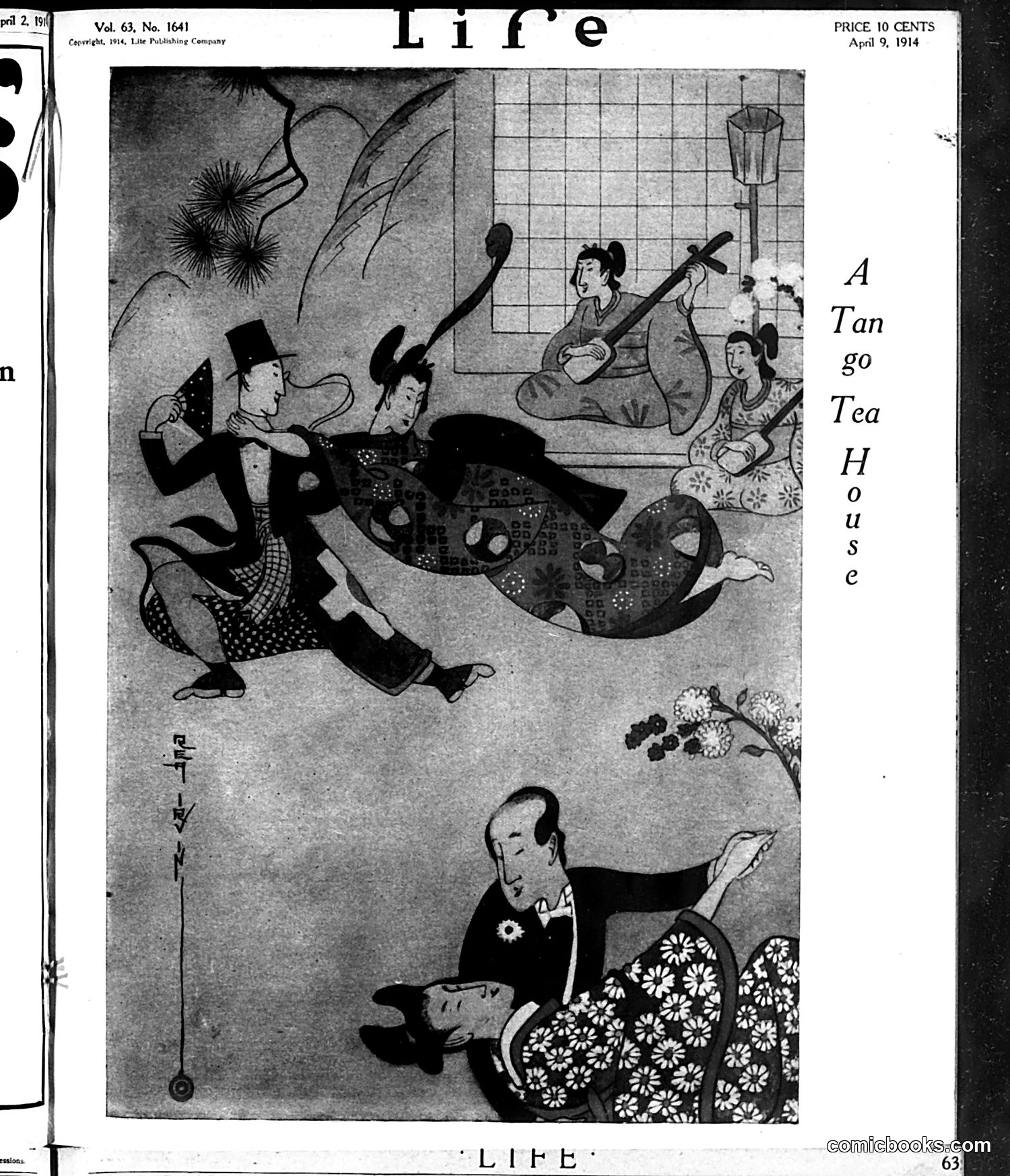
This satirical illustration mocks the early 1910s craze for the tango dance and "tea house" social gatherings. The cartoon depicts a chaotic scene where upper-class figures perform an exaggerated tango—the Argentine dance that had recently scandalized American society as sexually suggestive and morally questionable. The well-dressed gentleman in the top hat and the elaborately dressed woman dominate the composition, dancing wildly while onlookers play music and watch. The dignified older man at bottom appears disapproving, likely representing conservative social critics. The joke targets how respectable society had embraced the once-controversial tango in fashionable settings, transforming a dance deemed immoral into acceptable entertainment for tea socials—a commentary on how quickly moral standards shift with trends.
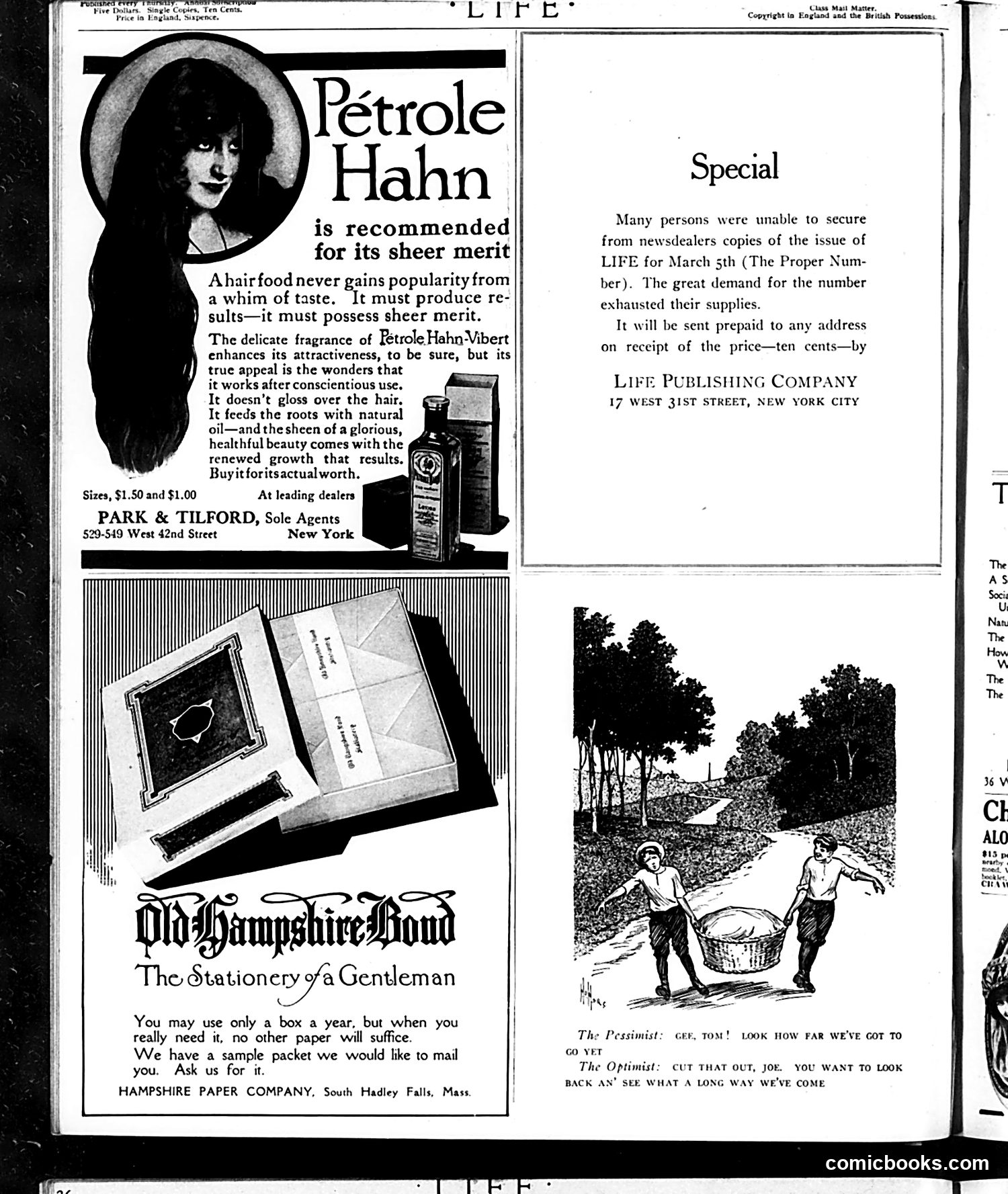
This page is primarily **advertising with one cartoon**. **The Cartoon** (lower right): Shows two men carrying a large basket on a country road. The "Pessimist" complains they haven't gone far; the "Optimist" counters that they've come a long way. This is a straightforward **optimist-vs-pessimist joke**—a common satirical format contrasting opposing attitudes toward the same situation. No specific political or social event is referenced; it's generic humor about temperament. **The Advertisements** dominate: Pétrole Hahn hair product, Old Hampshire Bond stationery, and a Life Publishing Company notice about back-issue availability. These are period commercial messages typical of 1910s-era magazines, with no satirical content.
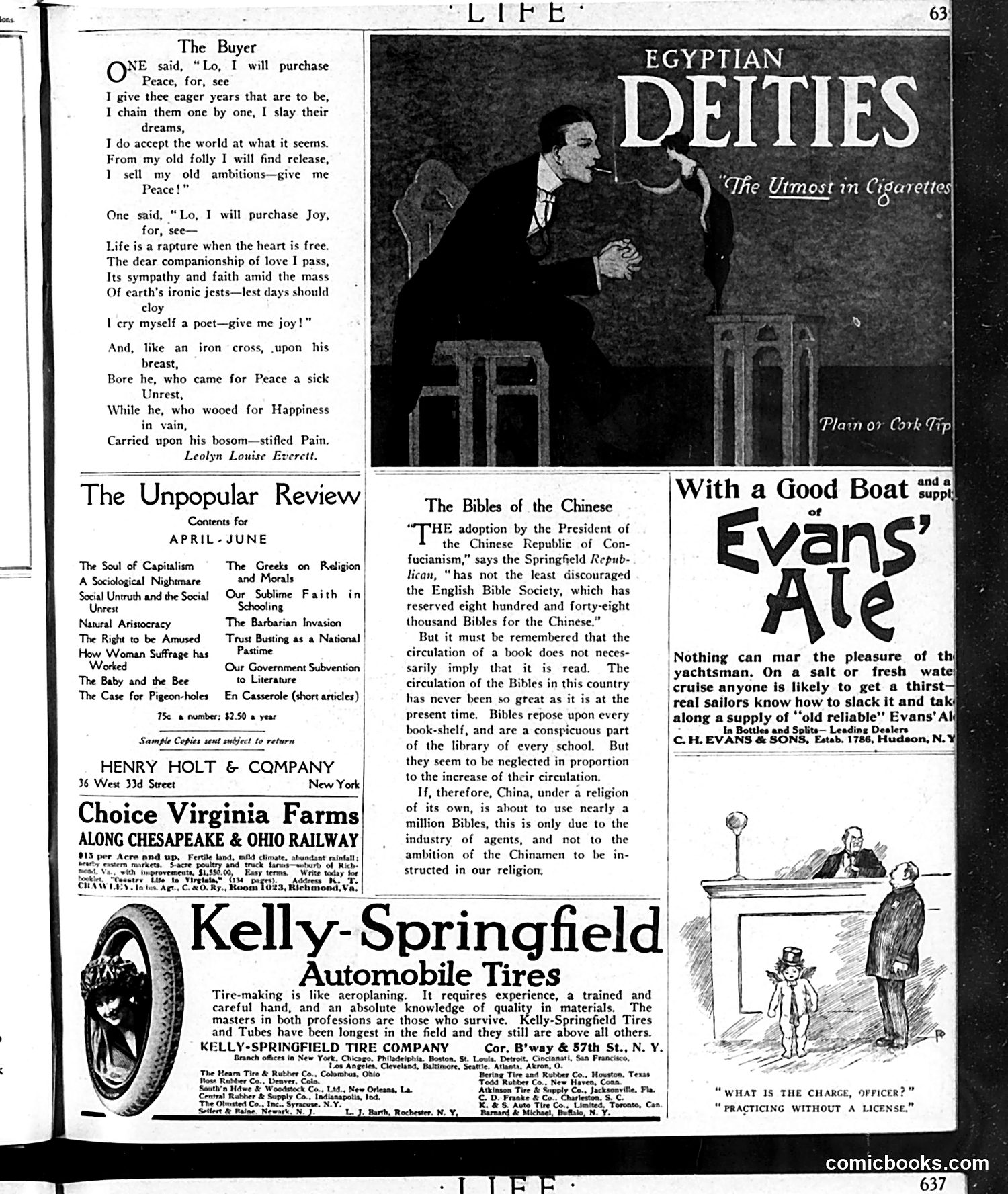
This page is primarily **advertising and literary content** rather than political satire. The dominant features are: 1. **"The Buyer"** — A poem by Leolyn Louise Everett about life choices (Peace vs. Joy vs. Happiness) 2. **"The Unpopular Review"** — A table of contents listing serious topics (capitalism, religion, suffrage, bureaucracy) 3. **Commercial advertisements** for Egyptian Deities cigarettes, Virginia farmland, Kelly-Springfield automobile tires, and Evans' Ale 4. **"The Bibles of the Chinese"** — An article discussing Bible distribution in China, arguing that Christian missionary work (not Chinese religion) explains high Bible circulation 5. **A small cartoon** showing a sailor being questioned about unlicensed boat operation The page reflects early 20th-century American interests: business, religion, consumption, and genteel literary culture.
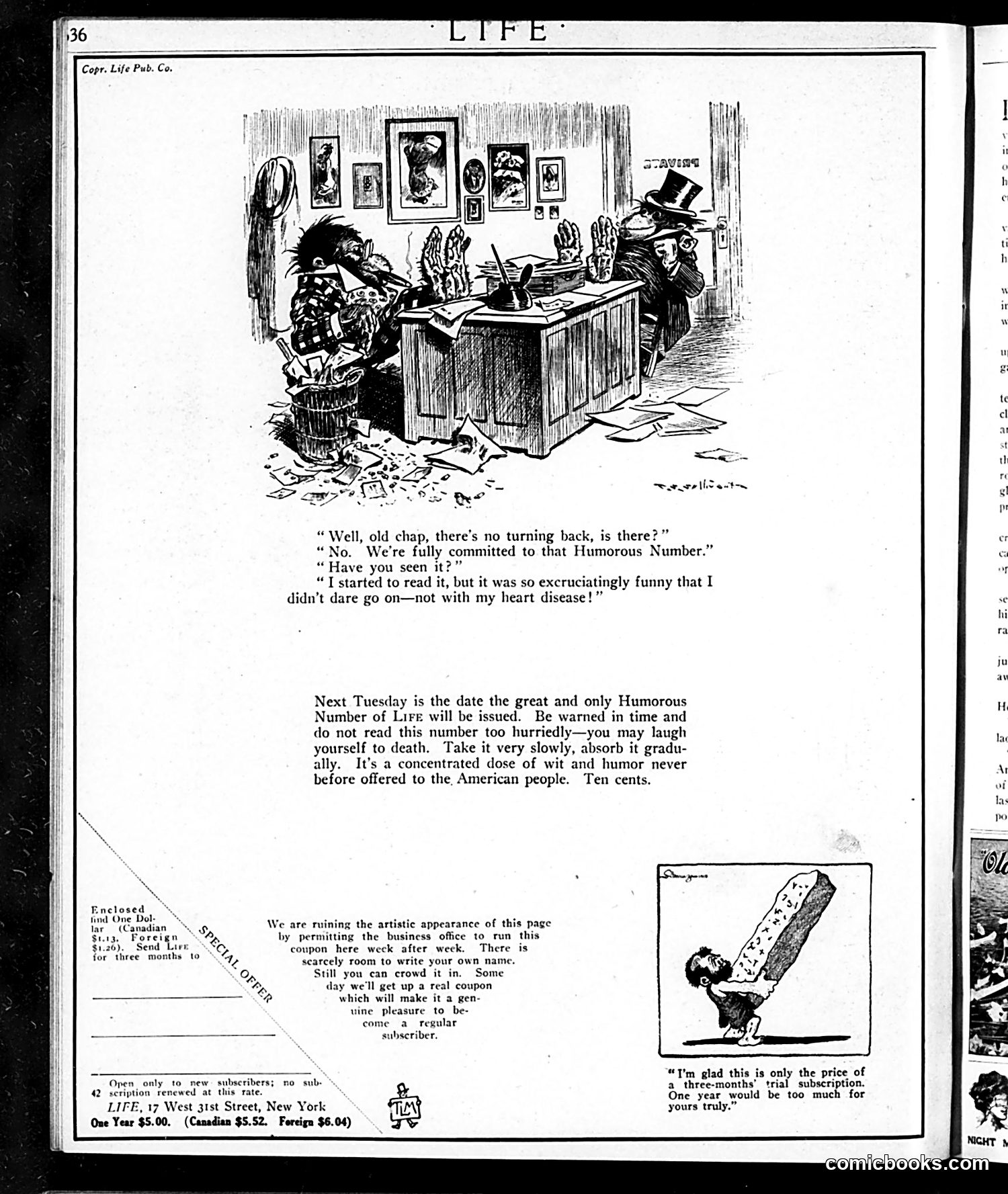
This page contains two cartoons advertising Life's upcoming "Humorous Number." **Top cartoon**: Two men in a business office discuss a funny publication. One, wearing a top hat, appears to be an editor or publisher; the other sits at a desk. The dialogue indicates they're committed to producing humorous content, though one reader found it so funny it endangered his heart condition. **Bottom cartoon**: A small figure struggles to hold an oversized rolled document or publication, captioning that a year's subscription would be too expensive. Both cartoons promote Life's special humor issue, emphasizing the magazine's comedic ambitions. The satire suggests readers should approach the publication cautiously—the humor is potent enough to pose health risks. The page functions primarily as self-promotional advertising rather than political commentary.
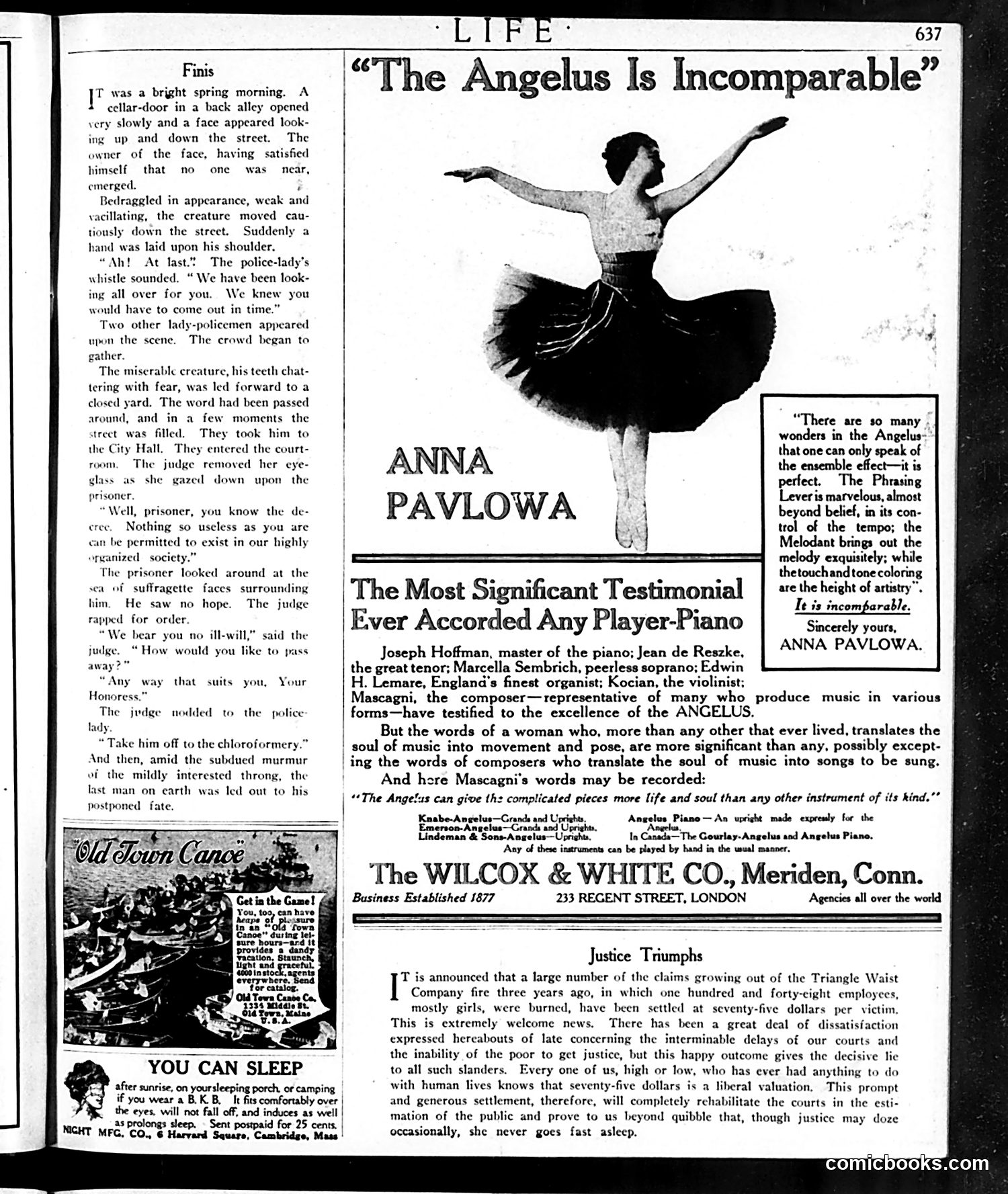
This page is primarily **advertising and editorial content**, not political cartoons. The main feature promotes **Anna Pavlowa**, a famous ballet dancer, through an advertisement for the Angelus piano. The large illustration shows a ballerina in classical pose; the accompanying testimonial quotes prominent musicians praising the instrument's ability to express "the soul of music." A secondary article titled "Justice Triumphs" discusses settlement of claims from the **Triangle Waist Company fire** (a historical labor disaster where workers, mostly young women, died). The piece celebrates that victims' families received seventy-five dollars compensation and expresses optimism about court reform. The lower left contains an unrelated advertisement for "Old Town Canoe." This reflects early 20th-century *Life* magazine's mix of highbrow cultural endorsements and progressive commentary on social issues.
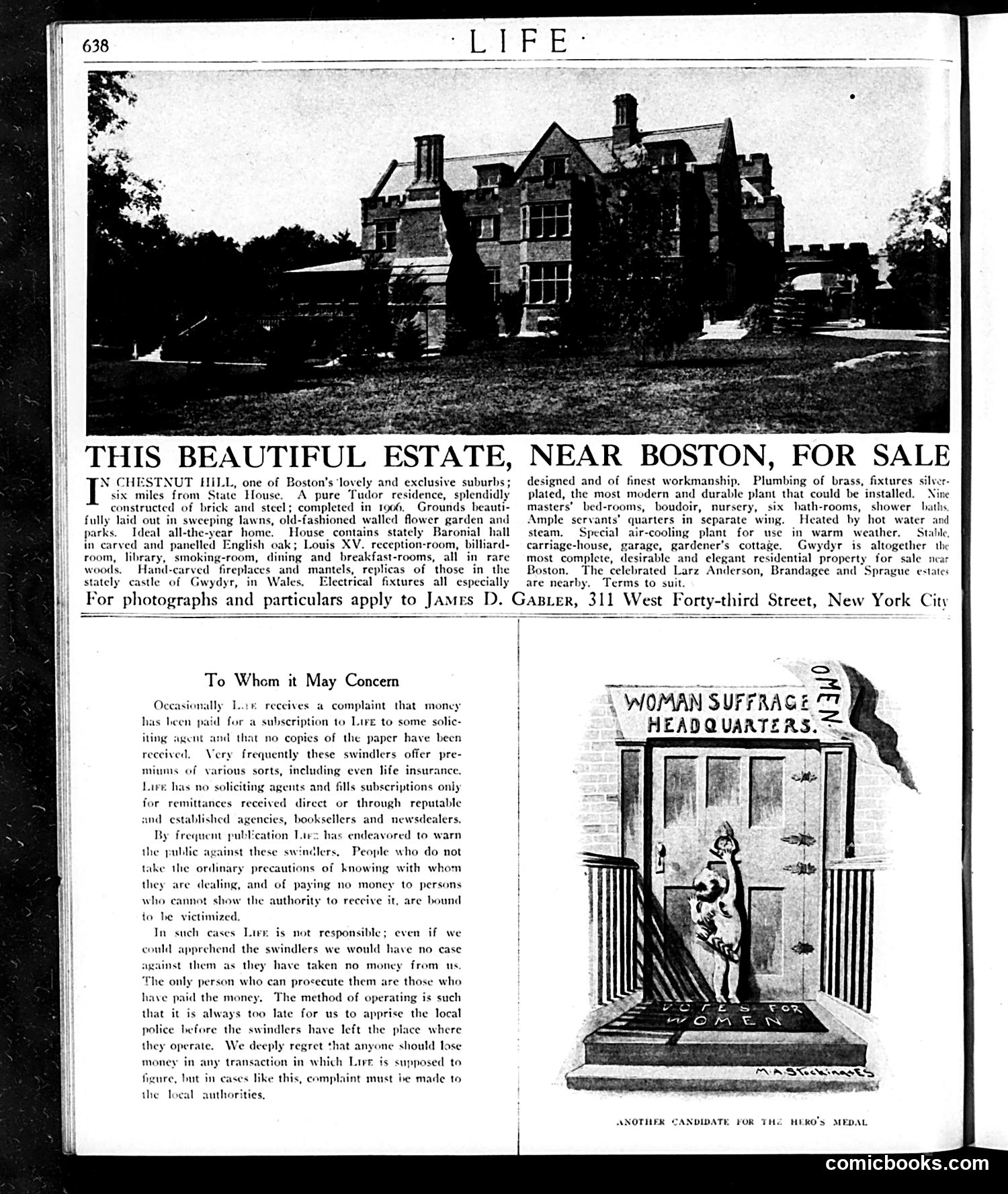
This page contains two distinct items: **Top**: A real estate advertisement for an estate near Boston, presented as genuine property listing. **Bottom**: A political cartoon titled "Another Candidate for the Hero's Medal." It depicts a storefront labeled "Woman Suffrage Headquarters" with a figure inside. The satire appears to mock the women's suffrage movement by presenting a suffragist as a candidate for some kind of "hero's medal"—likely using sarcasm to ridicule suffragists' activism. The cartoon reflects early-20th-century opposition to women's voting rights, treating suffrage advocacy as absurd enough to warrant satirical portrayal. The "hero's medal" reference suggests mockery of suffragists' self-perception as champions of a cause.
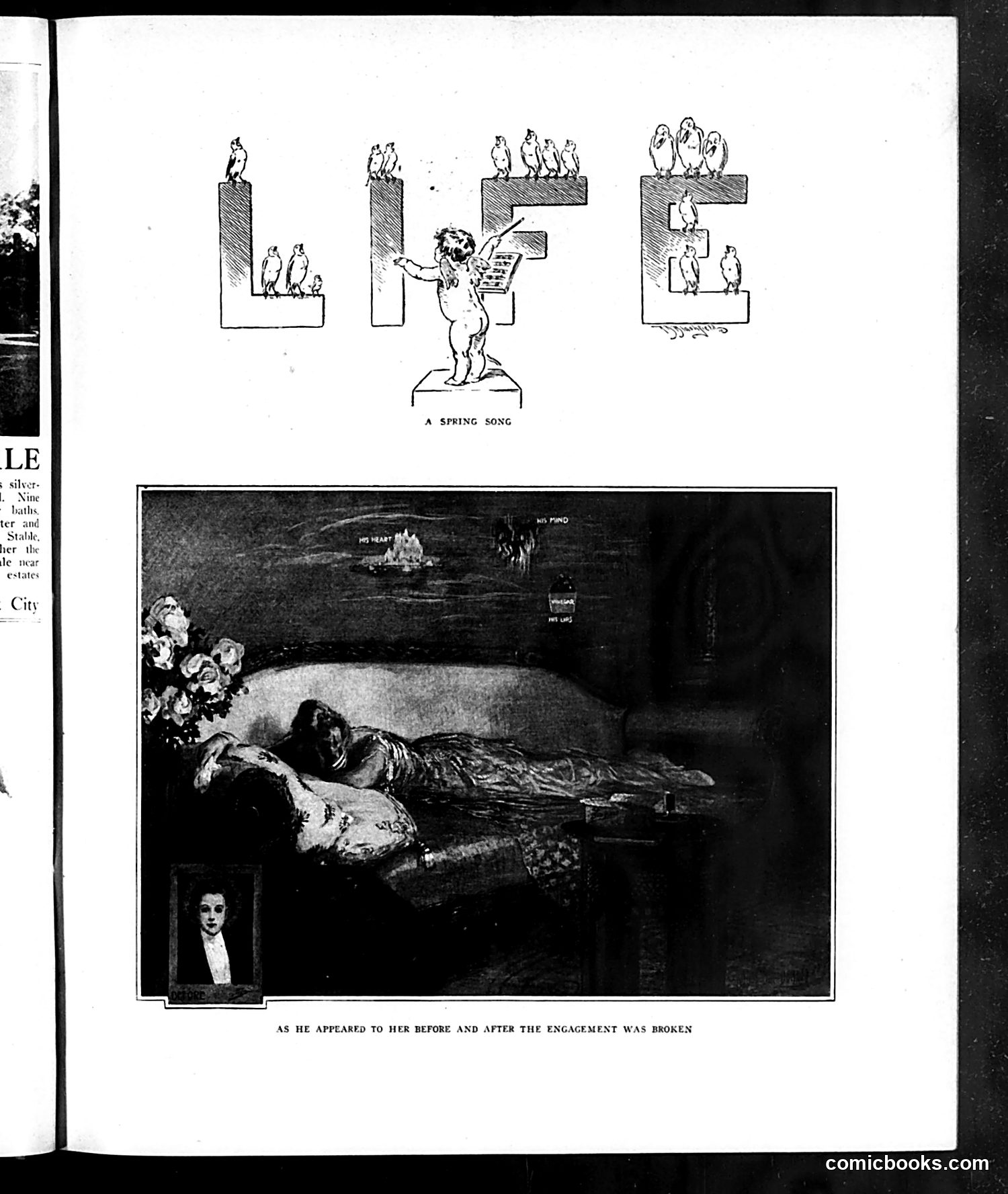
This page contains two separate visual pieces: **Top:** "A Spring Song" - A playful typographic illustration where the letters L-I-F-E are formed from architectural structures (towers and platforms) with small figures climbing on them. A cherub or cupid figure stands in the center, seemingly conducting or orchestrating the composition. This appears to be a decorative masthead or title treatment celebrating spring and vitality. **Bottom:** A romantic/melodramatic scene captioned "As He Appeared to Her Before and After the Engagement Was Broken." The image shows a woman reclining on a bed in what appears to be a dreamlike or memory sequence, with a man's face visible in an inset. The artwork uses contrasting light and shadow to suggest emotional distress or disillusionment about a failed engagement - likely satirizing romantic disappointment or the gap between idealized love and harsh reality.
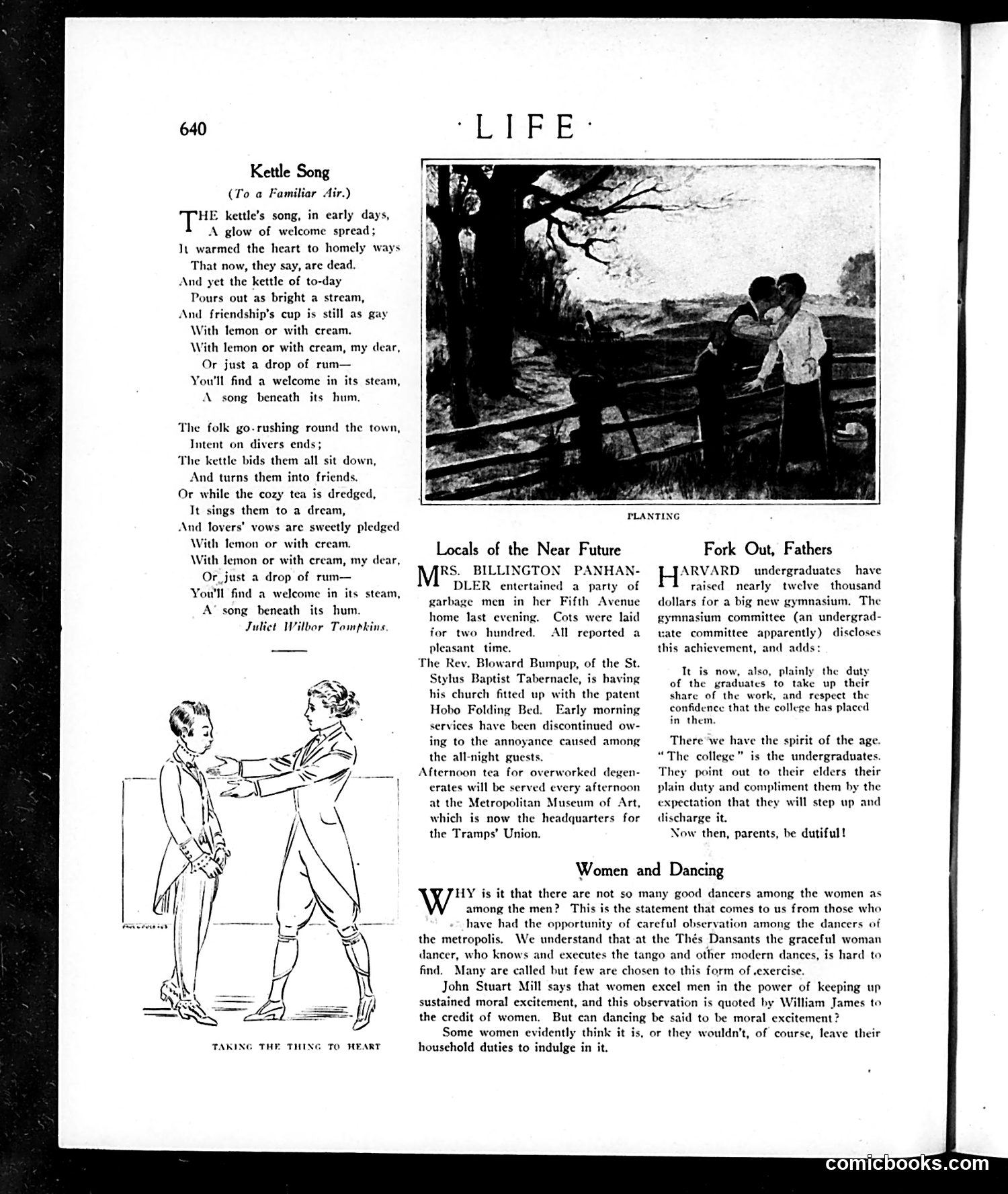
This page contains three distinct sections: **"Kettle Song"** (upper left): A nostalgic poem celebrating the warmth of hospitality and tea-drinking, attributed to Juliet Wilbor Tompkins. **"Taking the Thing to Heart"** (lower left): A simple line-drawing cartoon showing a man and woman in what appears to be a romantic or flirtatious interaction, likely humorous social commentary on courtship or relationships. **"Women and Dancing"** (lower right): An essay questioning why fewer women excel as dancers compared to men, citing observer accounts from metropolitan dance venues. It references John Stuart Mill's ideas about women maintaining moral excitement, then sardonically suggests women either lack interest in dancing or won't abandon household duties for it—social satire on women's limited opportunities and societal constraints. The overall theme addresses social customs, gender roles, and domesticity in early 20th-century America.
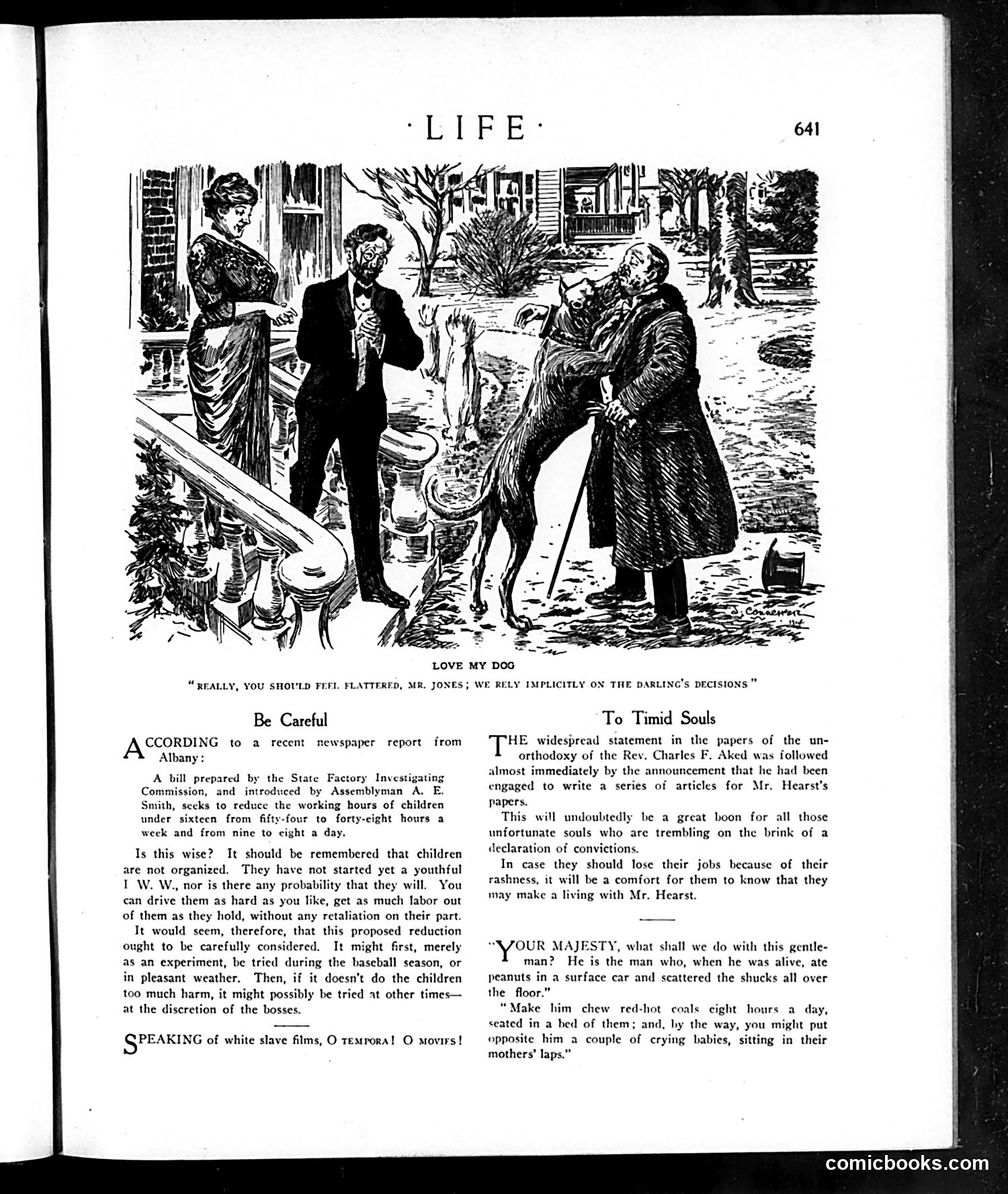
The cartoon titled "Love My Dog" depicts a social satire about class and propriety. A well-dressed man and woman encounter two rougher-looking men with a dog on a street. The caption reads: "Really, you should fifi! Flattered, Mr. Jones; we rely implicitly on the darling's decisions." This appears to mock upper-class affectation—the elegant couple pretends their dog makes social decisions about whom they associate with, using the pet as a polite excuse to avoid interaction with lower-class men. The joke satirizes how the wealthy use social pretexts and their pets' supposed preferences to justify class-based exclusion. Below are two articles: "Be Careful" discusses a factory bill reducing child working hours, and "To Timid Souls" comments on religious controversy involving Rev. Charles F. Aked and William Randolph Hearst's papers.
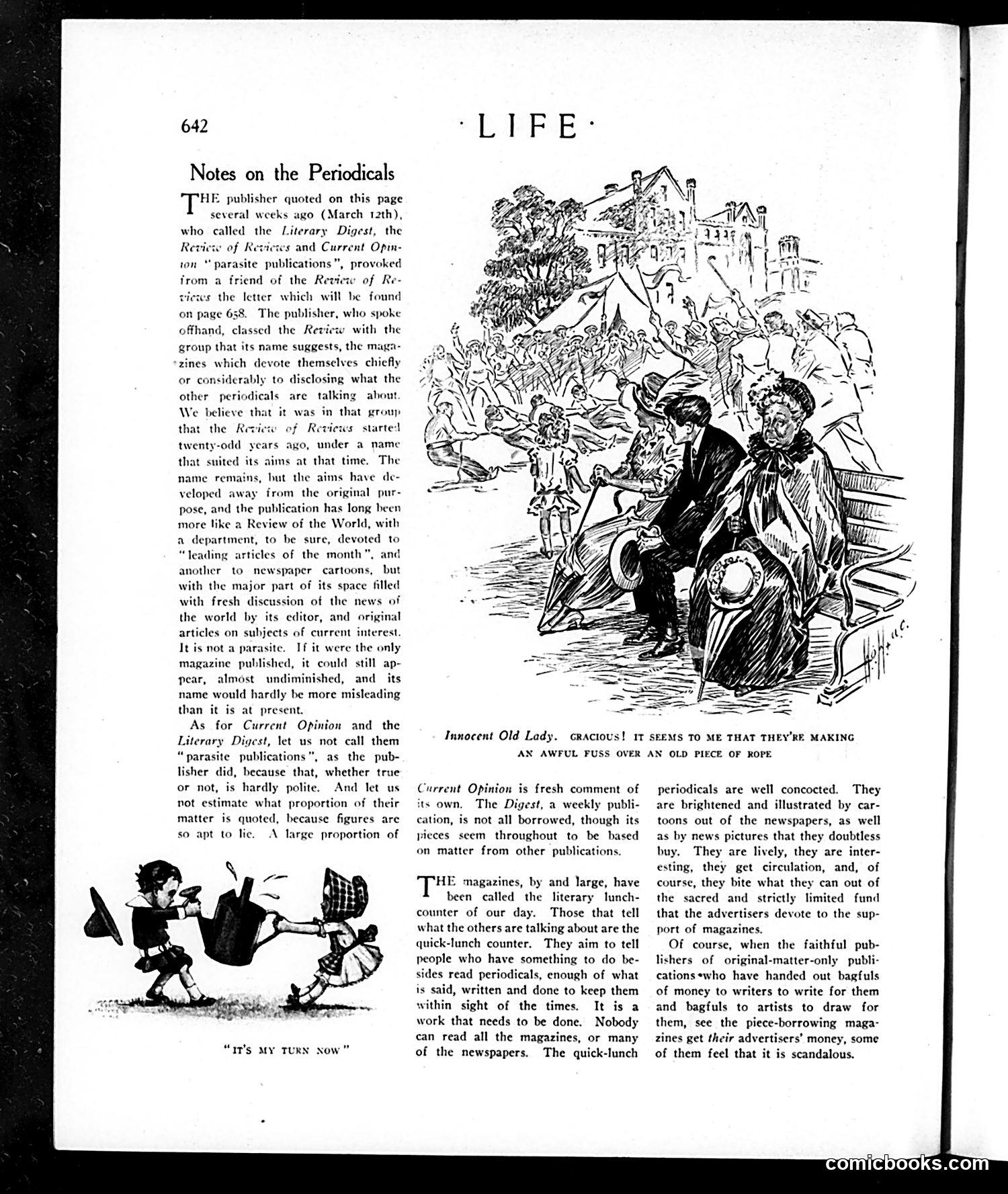
This page discusses literary periodicals and their role in publishing. The main illustration shows "Innocent Old Lady" commenting on what appears to be a fuss over "an old piece of hope" — likely satirizing public concern over trivial matters in periodicals. The smaller cartoon labeled "It's My Turn Now" depicts a figure being kicked or thrown, likely commenting on competition or conflict among publications or contributors. The text defends *Current Opinion* and the *Literary Digest* against being called "parasite publications," arguing they provide valuable editorial commentary and original content rather than simply borrowing from other sources. The satire targets the magazine world's internal rivalries and accusations of plagiarism common in early 20th-century publishing.
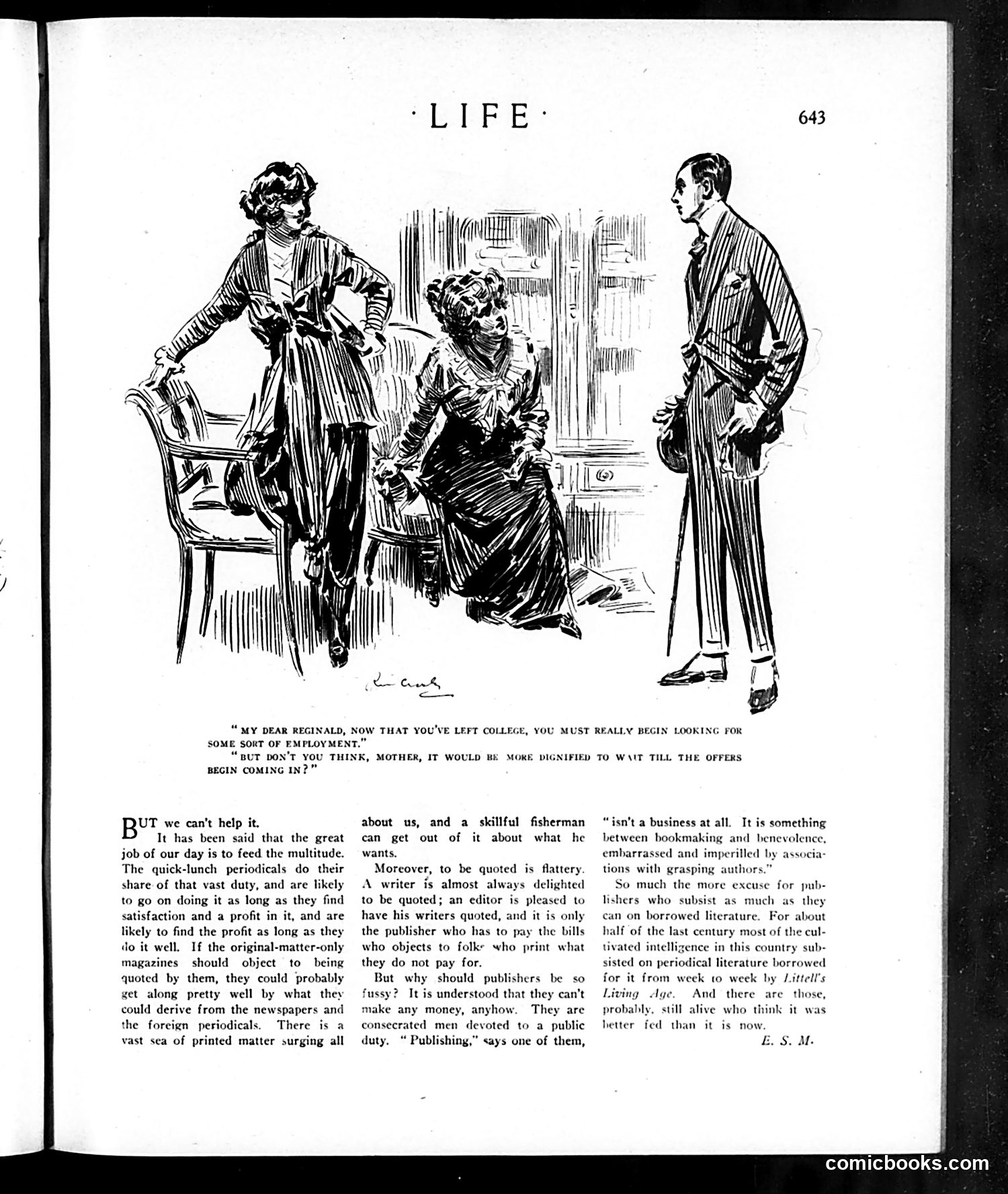
This cartoon satirizes early-20th-century employment anxieties for college graduates. The scene shows three figures—two women and a man—in what appears to be a parlor. One woman stands assertively while another sits; the man listens. The dialogue suggests a mother advising her son that after leaving college, he must seek employment, but "it would be more dignified to wait till the offers begin coming in." The satire targets upper-class assumptions about social standing: the notion that a respectable young man shouldn't actively *seek* work but should wait passively for prestigious job offers to arrive. This reflects period anxieties about status, employment, and the changing economy where such expectations were increasingly unrealistic.
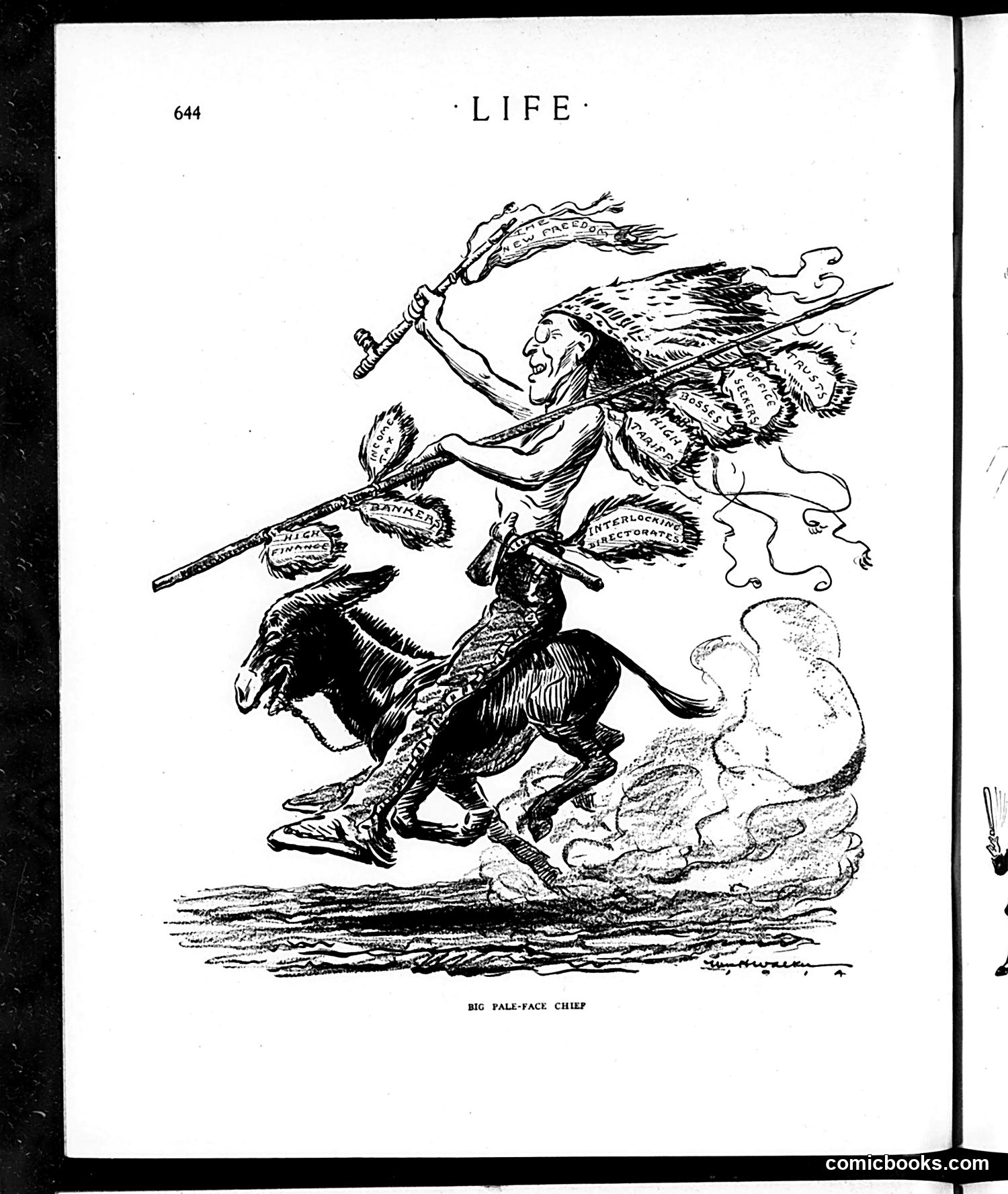
This political cartoon depicts a Native American figure on horseback wielding a tomahawk and sword, adorned with what appear to be scalps or trophies labeled with references to railroad companies ("HIGH BANK," "INTERLOCKING DIRECTORATES"). The figure rides energetically across clouds of smoke. The satire appears to critique powerful railroad magnates or corporate chiefs of the era, sarcastically calling them a "Big Pale-Face Chief." The Native American imagery inverts typical stereotypes—rather than portraying Indigenous peoples as violent, the cartoon uses this framing to mock wealthy industrial leaders as ruthless and warlike in their business practices. The labeled scalps suggest they've "conquered" or destroyed competing railroad interests through interlocking directorates and monopolistic practices.
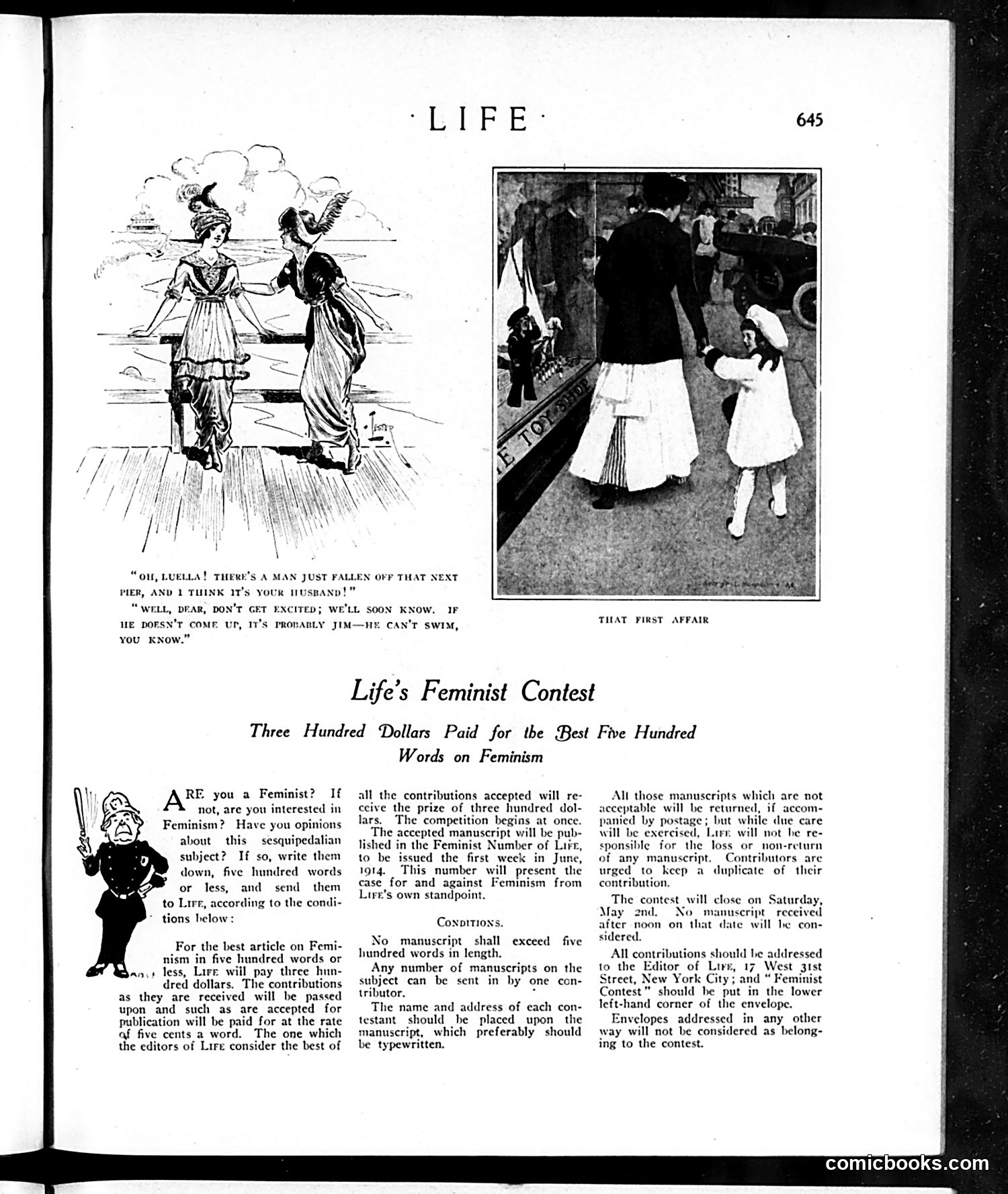
This page contains two distinct elements: **Top cartoons:** A satirical sketch showing two women on a pier. One warns the other that a man has fallen off the pier. The punchline—that he "can't swim"—relies on the stereotype that women lack concern for men's welfare or competence. **Main content:** Life magazine announces a "Feminist Contest" offering $300 for the best 500-word essay on feminism. The contest invites readers to submit arguments about feminism, with contributions judged and published in Life's "Feminist Number" (June 1914). The page's juxtaposition—pairing anti-feminist humor with a genuine invitation for feminist arguments—reveals Life's satirical approach: simultaneously mocking feminists while capitalizing on the era's intense debate over women's rights and suffrage.
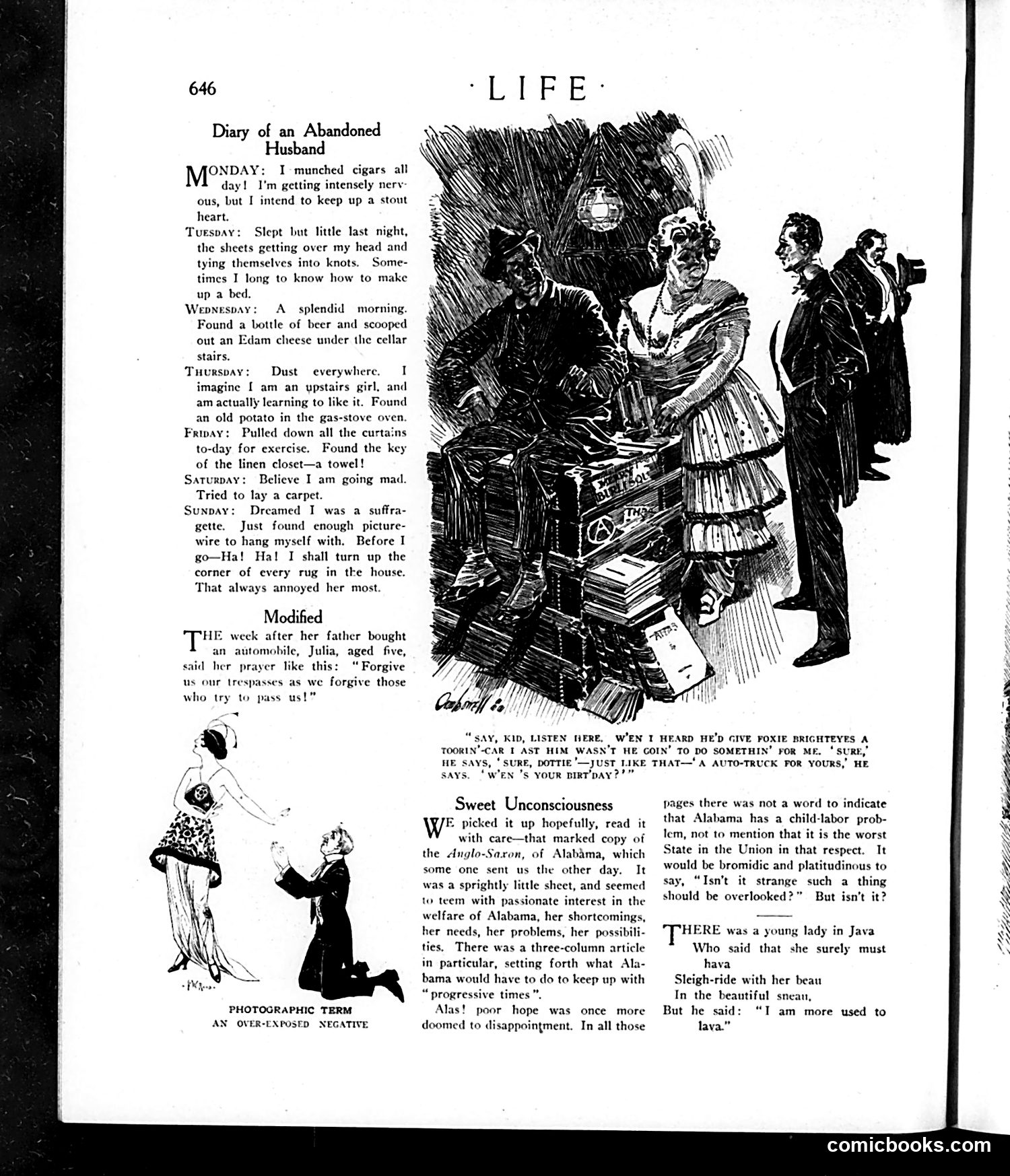
The main piece satirizes a neglectful husband managing household tasks alone after his wife leaves—he munches cigars nervously, struggles with bedmaking, finds random items in the cellar, discovers his incompetence at domestic work, and fantasizes about suicide. The satire mocks both male helplessness at housework and suggests marital discord. Below, "Modified" jokes about a child's prayer rewritten to be materialistic after her father buys a car—"Forgive us our trespasses as we forgive those who try to pass us!"—satirizing automobile culture and consumer values corrupting childhood piety. "Sweet Unconsciousness" critiques Alabama's labor practices, while an illustration at bottom depicts a woman preferring "lava" to a suitor—unclear specific reference without fuller context.
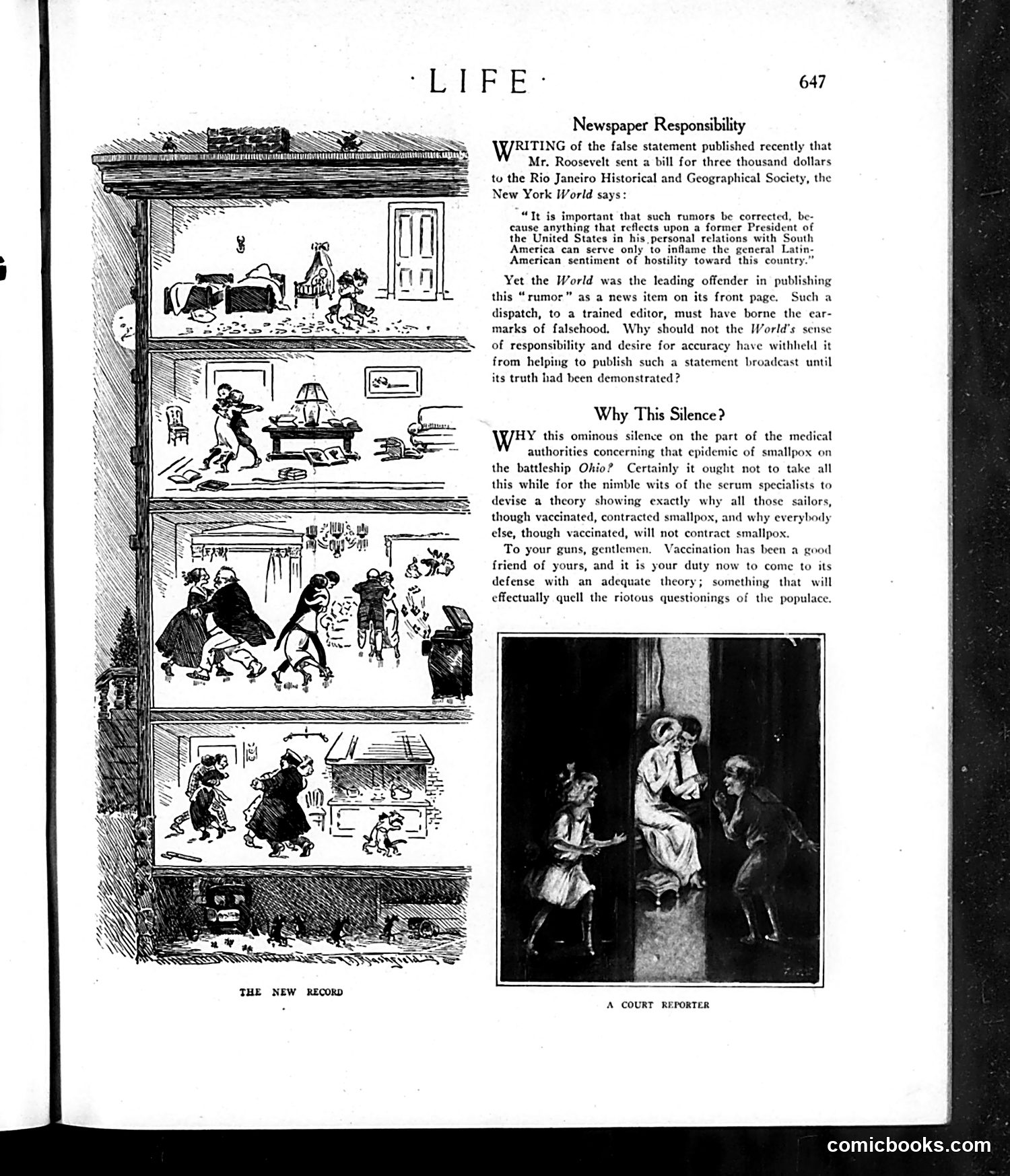
This Life magazine page (647) contains two distinct satirical pieces: **Left side ("The New Record")**: A multi-panel cartoon depicting domestic scenes of poverty and hardship—children in bare rooms, families struggling with meager conditions. The satire appears to comment on living standards or social conditions of the era. **Right side text**: Two editorial critiques: 1. **"Newspaper Responsibility"** attacks the *New York World* for publishing an unverified rumor that former President Roosevelt had billed the Rio Janeiro Historical Society $3,000. While the World later called for responsible correction, Life sarcastically notes the World itself originally spread the false story on its front page—exposing journalistic hypocrisy about accuracy and responsibility. 2. **"Why This Silence?"** criticizes medical authorities for not explaining a smallpox epidemic aboard the battleship *Ohio*, despite sailors being vaccinated. The piece demands doctors provide theoretical justification for vaccination's apparent failure to prevent the outbreak. Both pieces critique institutional failures: press irresponsibility and medical silence during public health crisis.
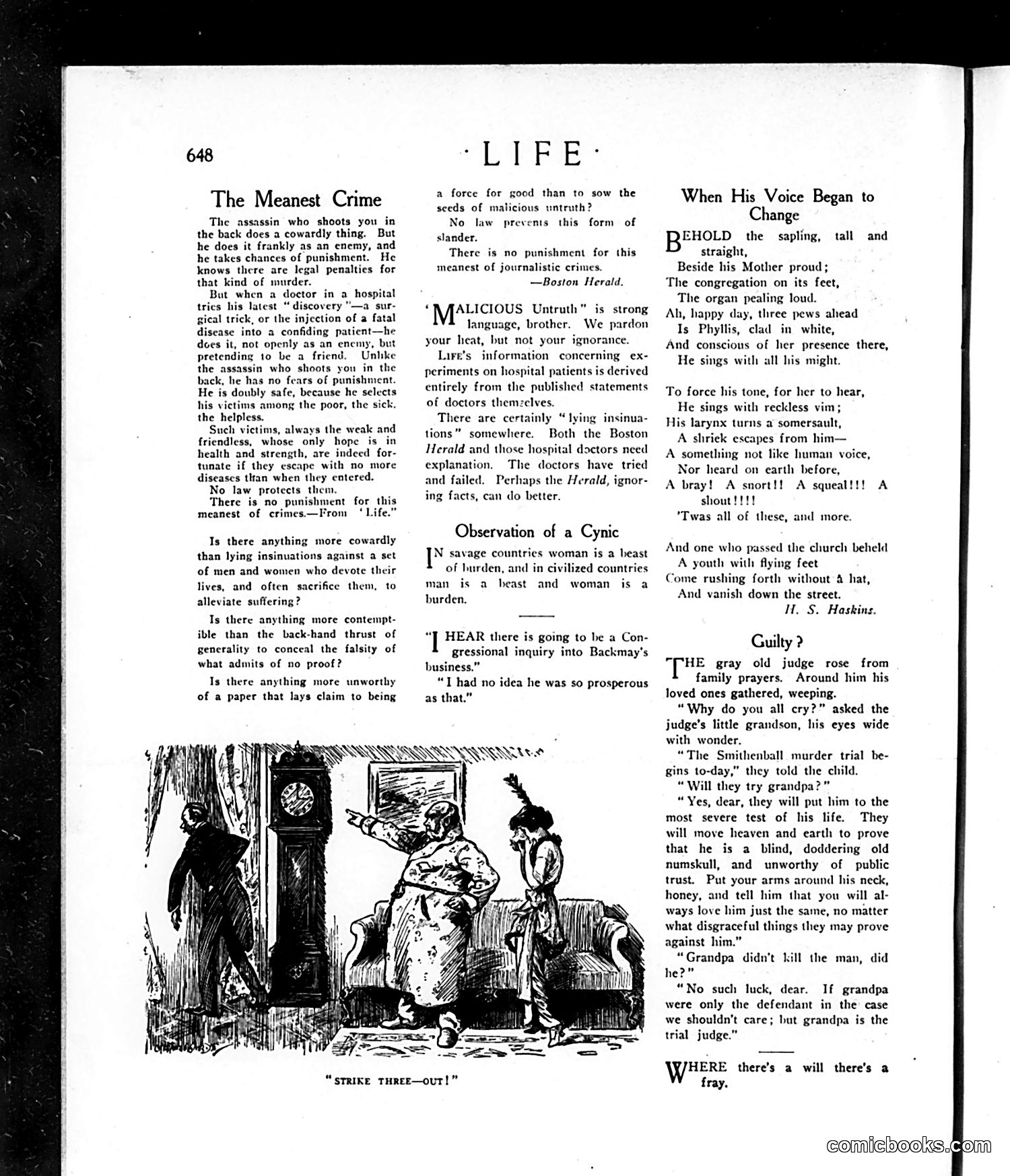
This page contains multiple satirical pieces typical of *Life* magazine's editorial approach: **"The Meanest Crime"** — A pointed attack on unethical medical experimentation. Life accuses doctors of conducting dangerous, untested procedures on poor hospital patients under the guise of scientific "discovery." The Boston Herald's response (below) defends doctors and accuses Life of making false insinuations. Life's rebuttal argues their claims derive from doctors' own published statements, suggesting the Herald should defend the facts rather than attack the magazine's motives. **"Observation of a Cynic"** — A brief misogynistic quip equating women to beasts of burden in both "savage" and "civilized" countries. **"When His Voice Began to Change"** and **"Guilty?"** — Humorous or sentimental verse pieces on adolescence and a judge's impartiality, respectively. The cartoon "Strike Three—Out!" depicts a domestic dispute, likely illustrating social commentary about family conflict or gender dynamics, though specifics are unclear from the image alone.
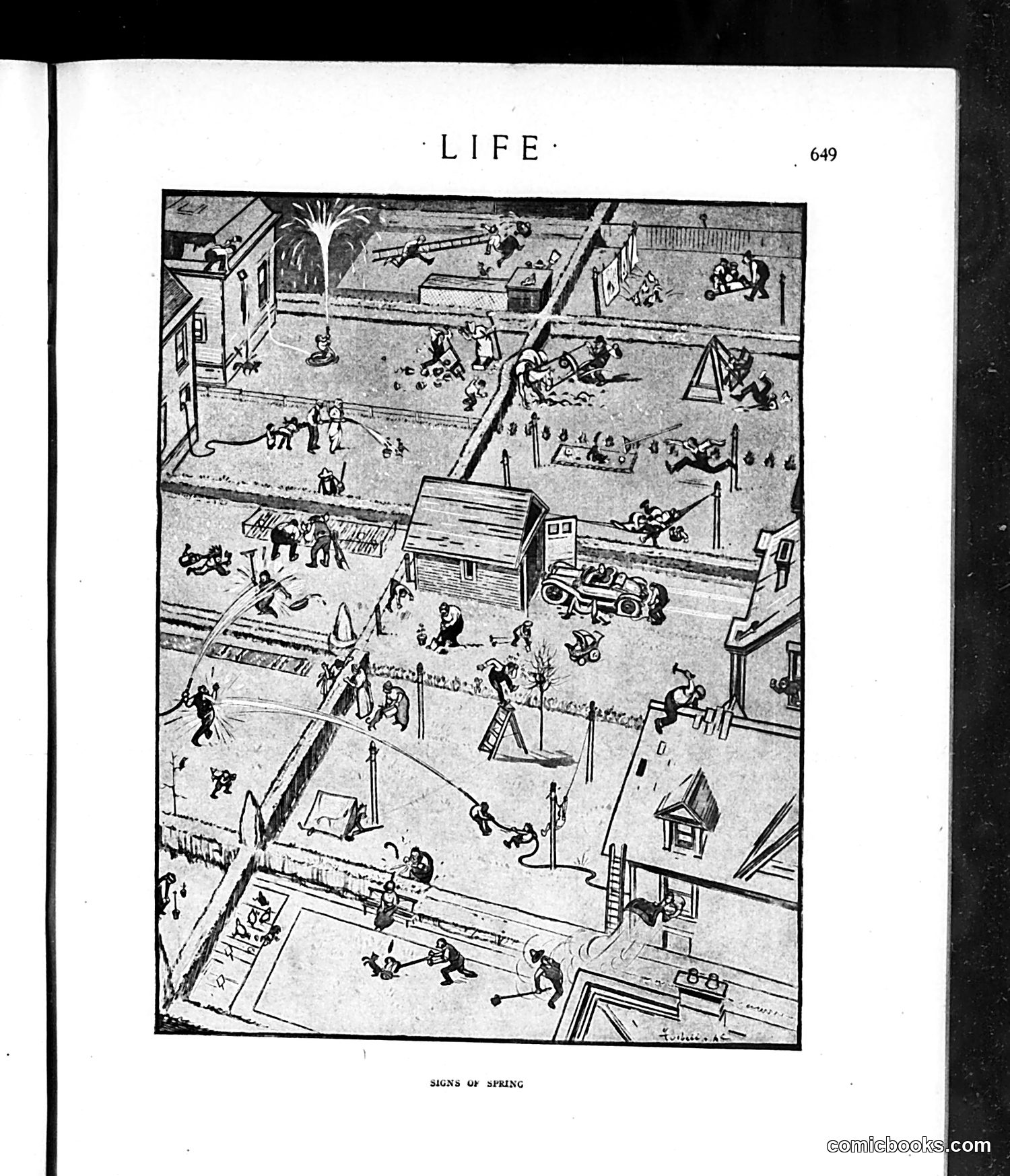
This illustration depicts a bustling urban playground or recreation area during springtime. The bird's-eye view shows dozens of people engaged in various outdoor activities across multiple levels and spaces: children playing, adults exercising, people on swings and seesaws, someone in a truck, figures climbing ladders, and groups socializing. The cartoon appears to be social commentary on urban life and leisure during spring—celebrating the season's renewal and the public's enthusiasm for outdoor activity after winter confinement. It's a humorous, densely packed scene capturing the chaos and energy of city dwellers reclaiming public spaces. The title "Signs of Spring" suggests this represents typical seasonal behavior: renewed vitality, outdoor recreation, and community gathering in shared urban spaces.
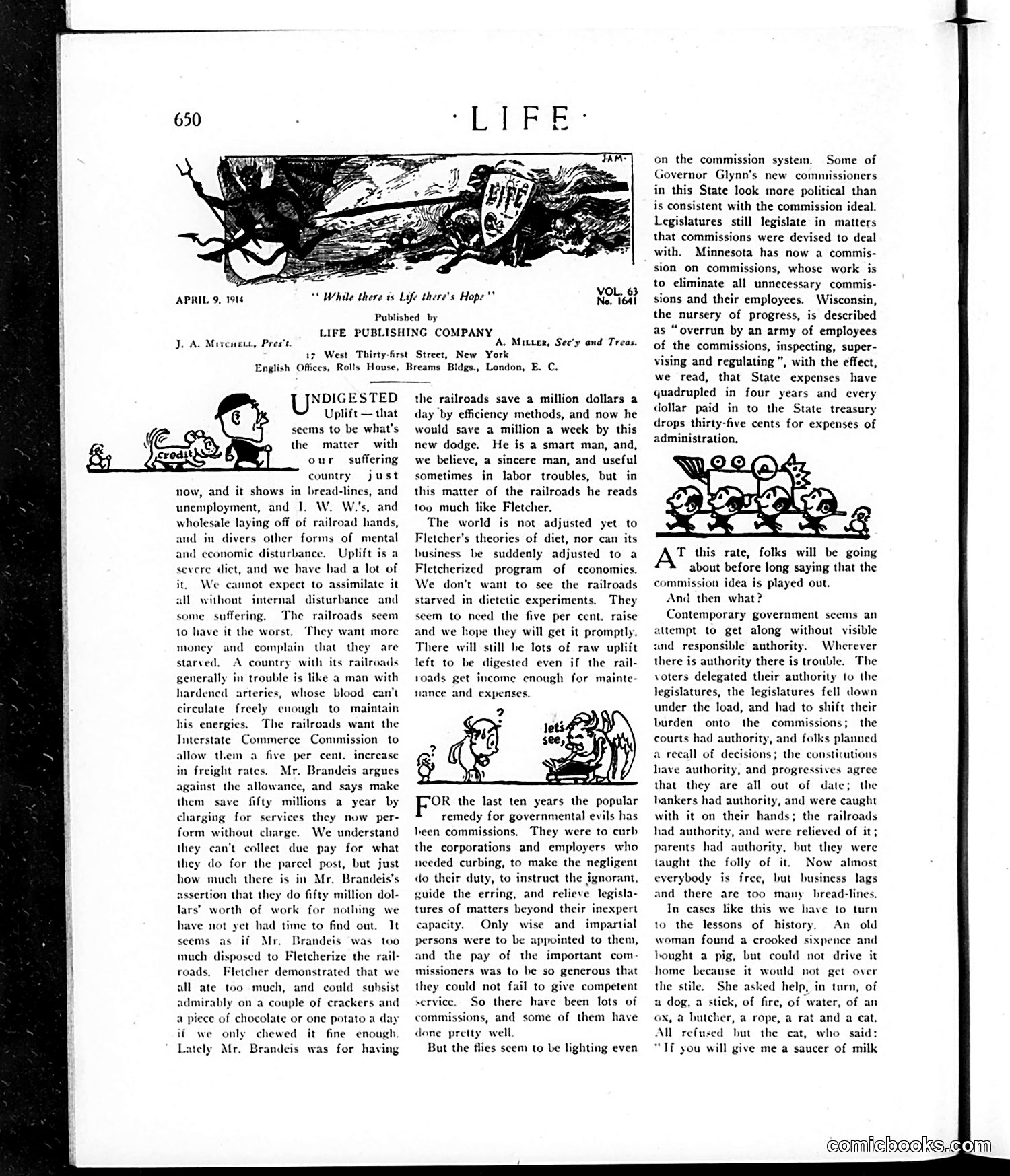
This editorial page critiques two contemporary Progressive Era policies through satirical commentary. **The "Uplift" Cartoon (top left):** Depicts the railroad industry suffering from excessive "uplift"—reformist policies. The article sarcastically compares railroads to a man with "hardened arteries," arguing they need financial relief (a 5% rate increase) rather than efficiency experiments. It mocks Louis Brandeis's approach as "Fletcherizing" the railroads—a reference to Horace Fletcher, a diet guru promoting extreme food rationing. The satire suggests Brandeis's cost-cutting is starving the industry like Fletcher's diet starves the body. **The Commission Critique (second piece):** Attacks the Progressive solution of creating government commissions to regulate corporations and reform. While praising their initial ideals, the author notes they've become politicized, duplicative, and bureaucratically bloated. Governor Glynn's commissioners appear more "political" than impartial; Wisconsin's commission system is "overrun" with employees. The underlying complaint: commissions have become ineffective bureaucratic sprawl rather than solutions. Both pieces express skeptical conservatism toward Progressive reform methods.
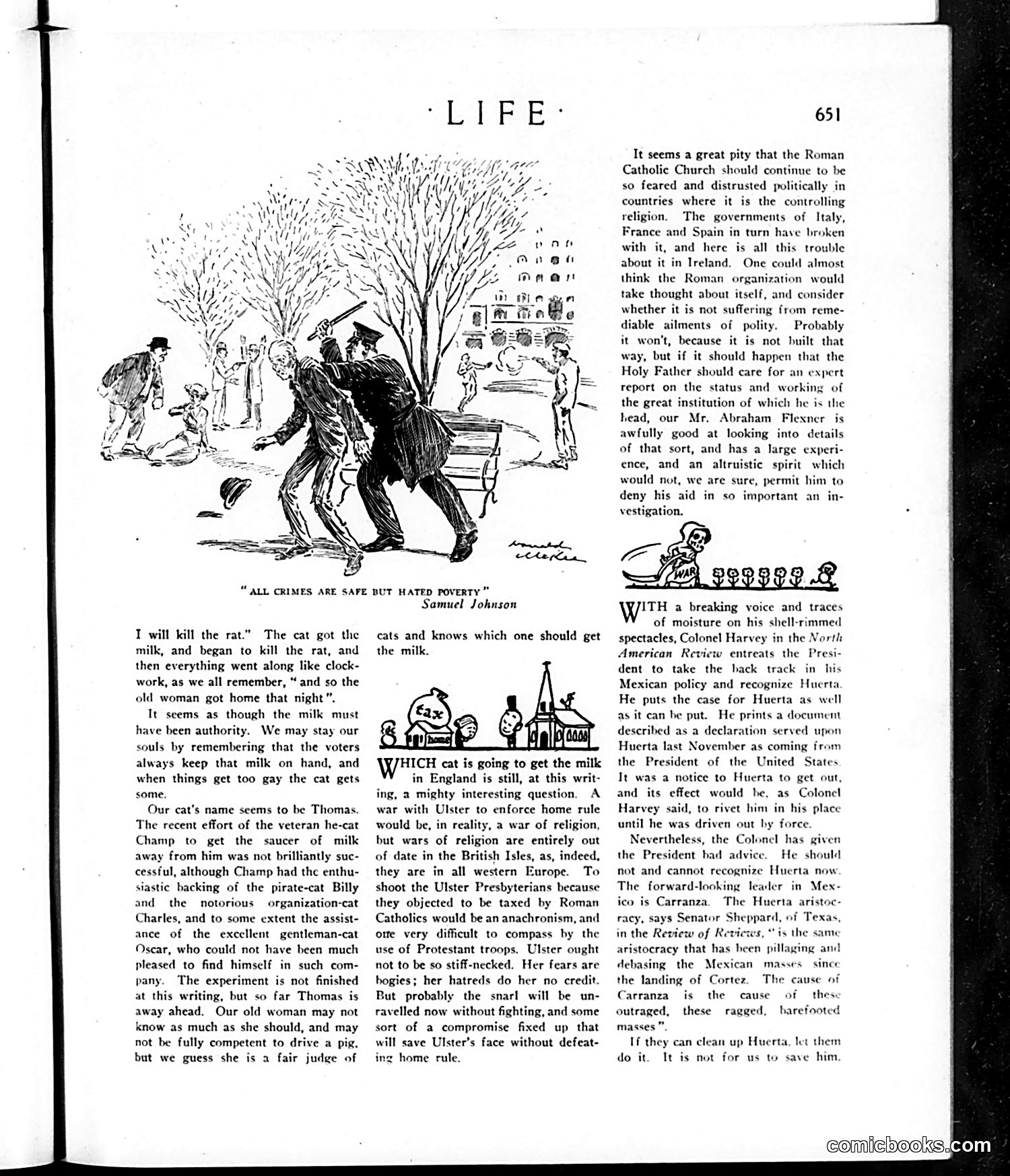
The main cartoon depicts a domestic scene with figures around a large tree, illustrating the nursery rhyme "Old Woman Who Lived in a Shoe." The accompanying text uses this fable allegorically to discuss political power dynamics—"milk" represents authority that voters maintain to control leaders ("cats"), with "Thomas" (likely referring to President Woodrow Wilson) currently holding power over rivals named "Champ," "Billy," "Charles," and "Oscar." The page's editorial section addresses two contemporary political crises: the **Irish Home Rule controversy** (involving Ulster Presbyterians' resistance to Catholic-majority rule) and **Mexican politics** under President Wilson. The editors criticize Colonel Harvey's *North American Review* for advocating recognition of Mexican general Huerta, arguing instead that reformer Carranza represents Mexico's future. The text also mentions Abraham Flexner as a potential expert advisor on institutional reform for the Catholic Church. The satire targets political hesitation and poor judgment by those in power.
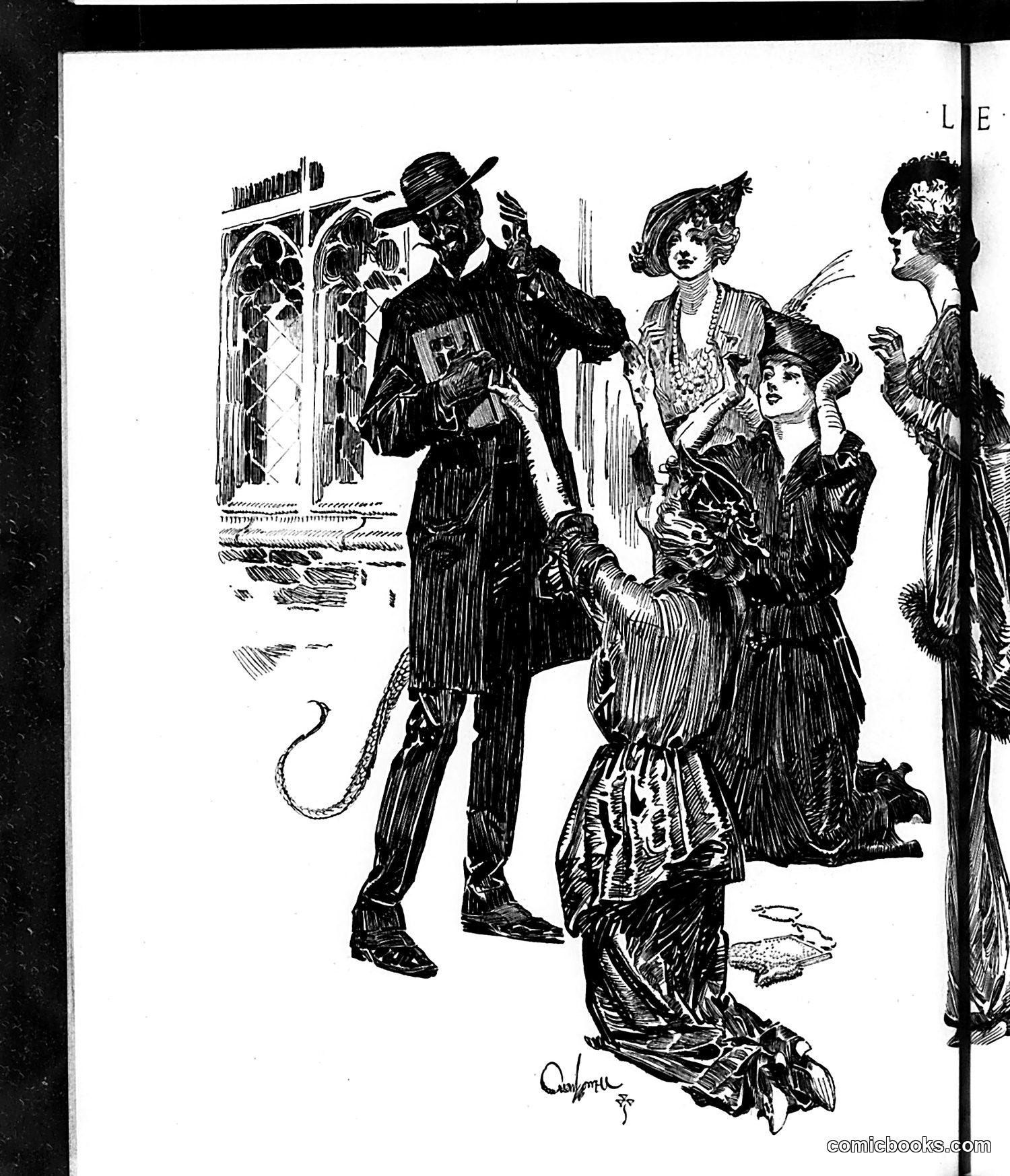
This is a pen-and-ink illustration showing a tall military or authority figure (possibly a doorman or official, given his uniform and formal stance) interacting with a group of fashionably dressed women in early 20th-century attire. The women wear elaborate hats with feathers and ornate clothing typical of the era. The setting appears to be an elegant entrance (note the decorative doorway in background). The cartoon likely satirizes social hierarchies, class distinctions, or the interactions between authority figures and society women of the period. The women's elaborate dress and the official's imposing stance suggest commentary on formality, social pretension, or access/exclusion from elite spaces. Without clearer text, the specific satirical target remains unclear, though it appears to address early 1900s social dynamics.
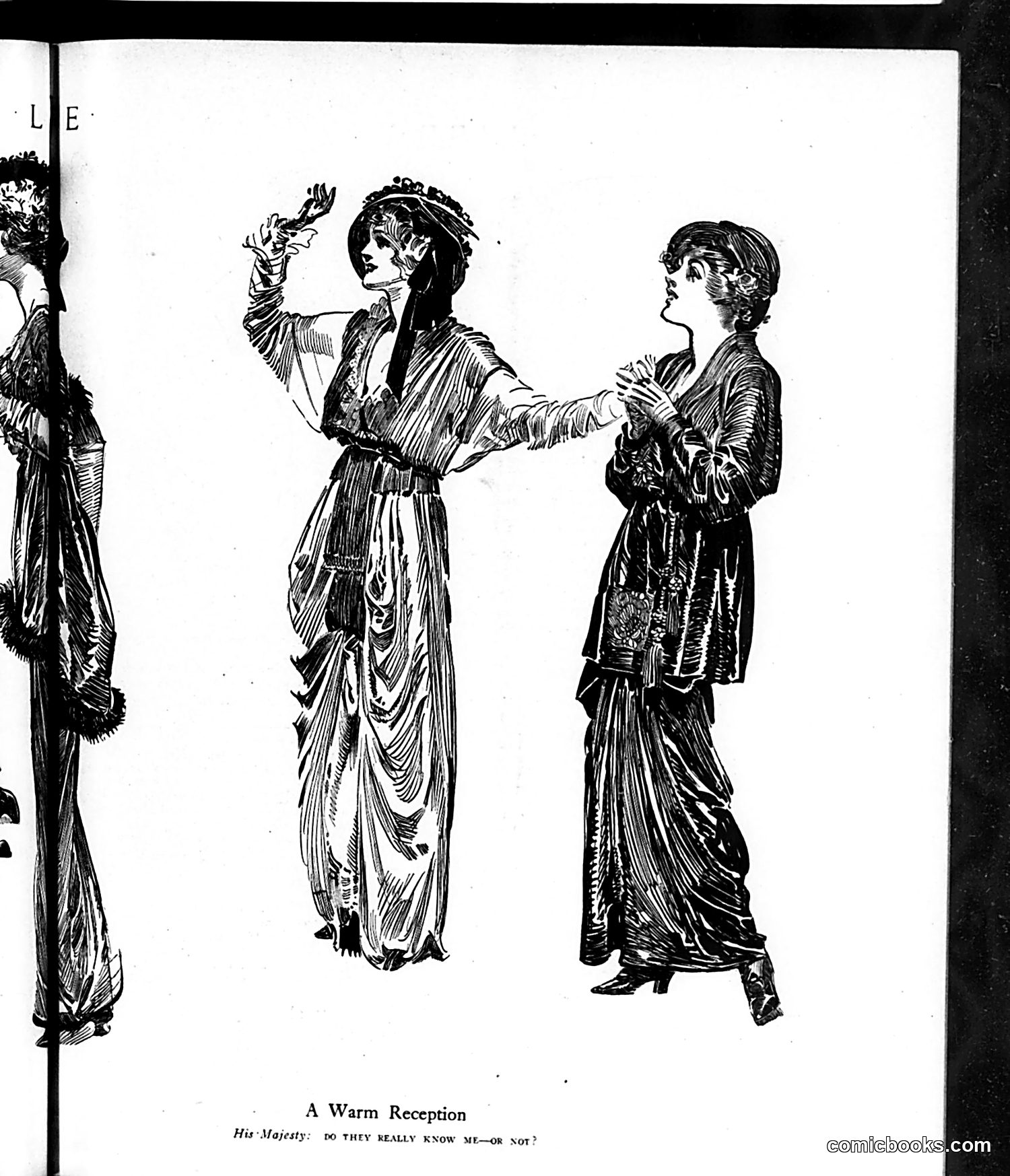
This cartoon depicts two women in Edwardian-era dress in what appears to be a social encounter. The caption reads: "His Majesty: DO THEY REALLY KNOW ME—OR NOT?" The satire likely concerns royal recognition or social status. One woman (left) gestures upward in apparent recognition or greeting, while the other (right) observes. The phrase "His Majesty" suggests uncertainty about whether someone of royal rank is being properly recognized or acknowledged in society. Without the publication date visible, the specific royal figure or contemporary event referenced is unclear. However, this reflects turn-of-the-century satirical humor about social pretension, class anxiety, and questions of proper deference to authority—common themes in *Life* magazine's commentary on American society.
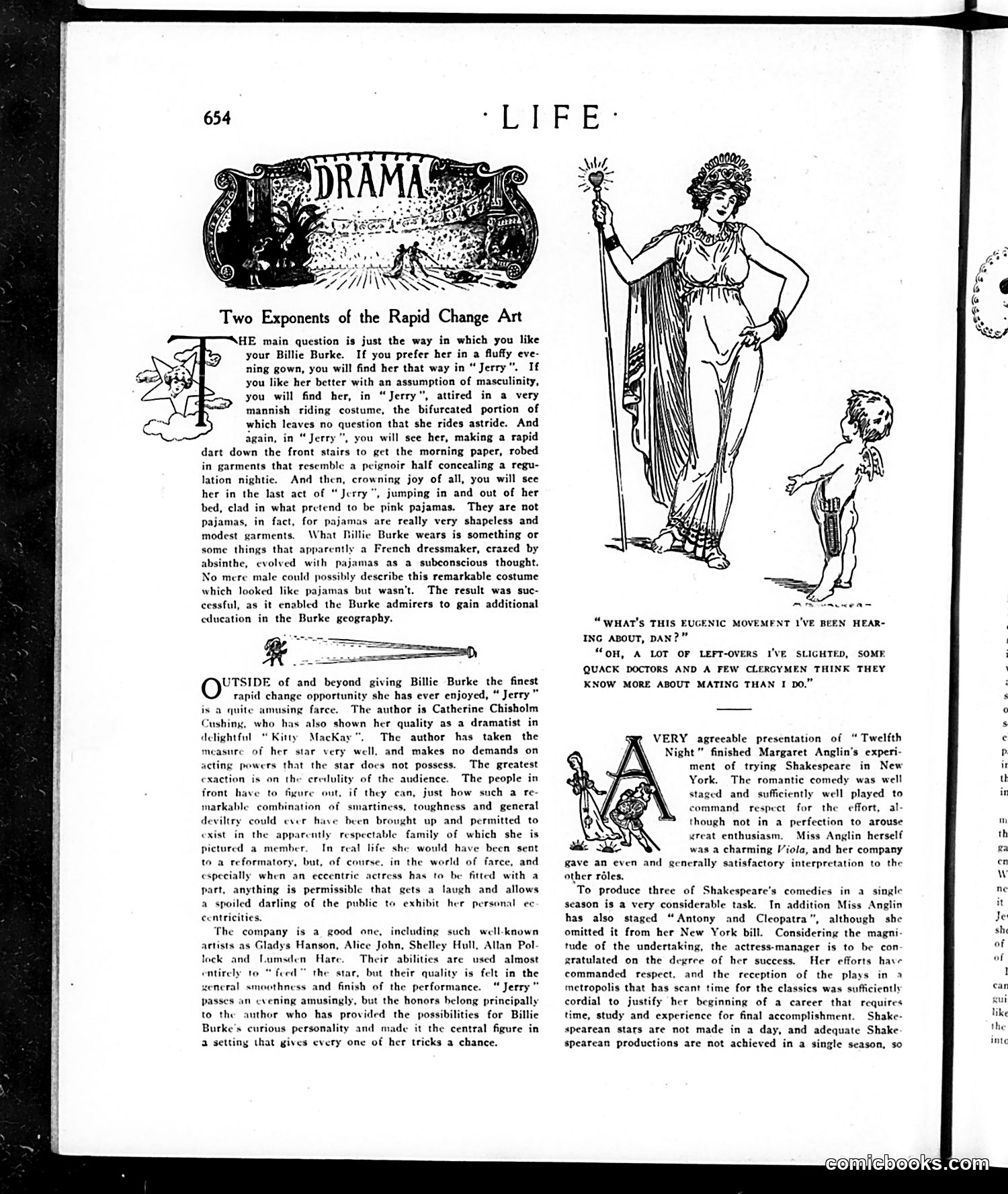
This page reviews theatrical productions, primarily focusing on actress **Billie Burke** in the farce "Jerry." The satire highlights Burke's fame for rapid costume changes—the article catalogs her various outfits throughout the play, from evening gowns to riding habits to bedroom attire. The joke is that Burke's star power carries the lightweight play; the author notes audiences must suspend disbelief accepting how such a "spoiled darling" could exist in a respectable family. A separate cartoon jokes about **eugenics**—a then-fashionable pseudoscience. A man dismisses eugenic concerns, claiming he understands mating better than "quack doctors and clergymen" promoting it. This satirizes how eugenic ideas were being popularized in the 1910s while remaining largely pseudoscientific. The page also briefly reviews Margaret Anglin's Shakespeare production of "Twelfth Night," praising her performance as Viola.
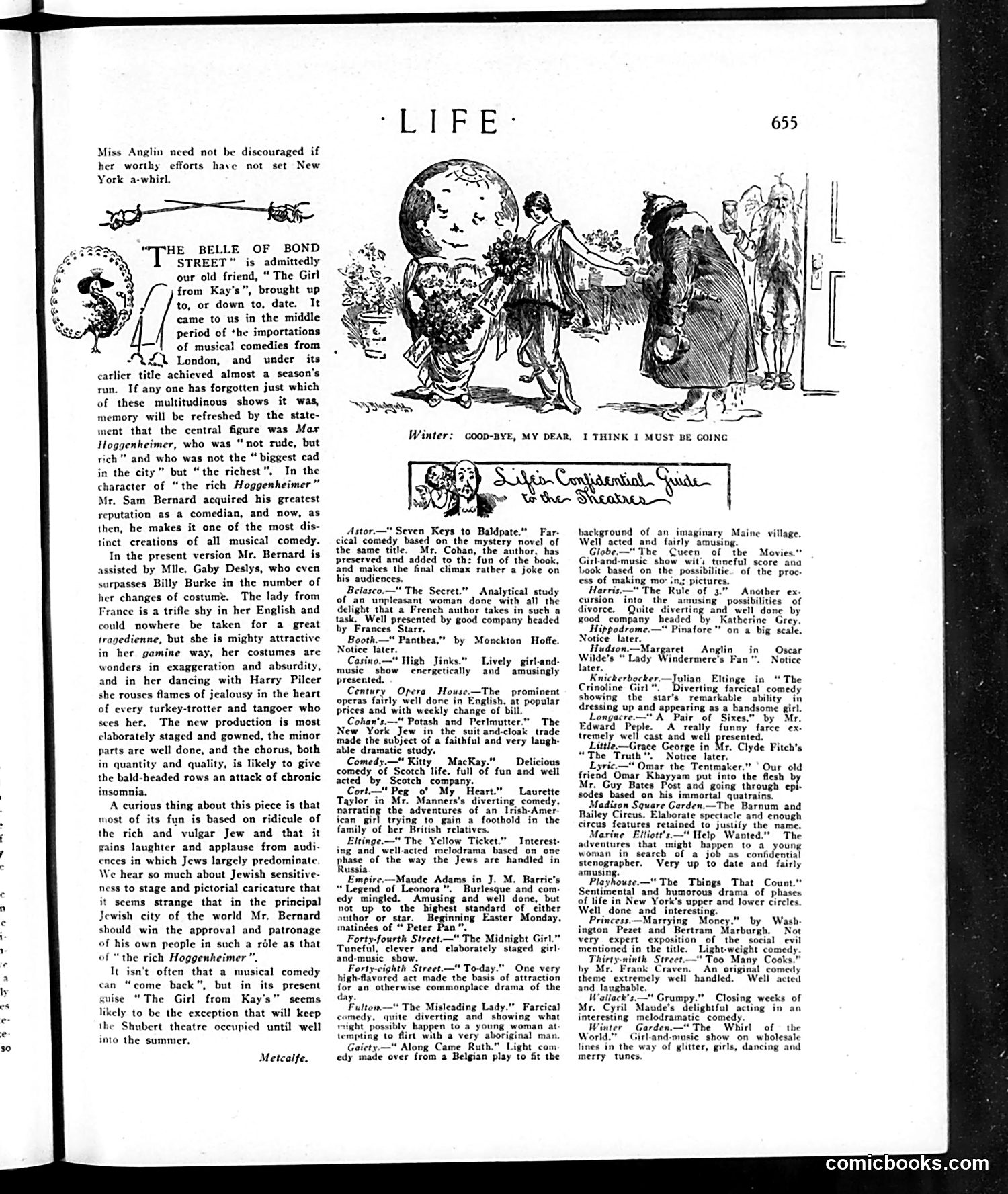
This page reviews a Broadway revival of "The Girl from Kay's," a musical comedy now retitled "The Belle of Bond Street." The cartoon depicts Winter (personified as an elderly figure) saying goodbye, likely representing the theatrical season's end. The main text discusses a curious social phenomenon: the show's central character, "the rich Hoggenheimer," is a caricatured wealthy Jewish figure played by Sam Bernard. The critic (Metcalfe) notes the apparent paradox that this stereotypical portrayal—ridiculing "the rich and vulgar Jew"—succeeds precisely in New York's largely Jewish audience, contradicting assumptions about Jewish sensitivity to such stage caricatures. The piece reflects early 20th-century theatrical conventions where ethnic stereotyping was standard entertainment, and the "Hoggenheimer" type was a recognizable comedic archetype of the period.
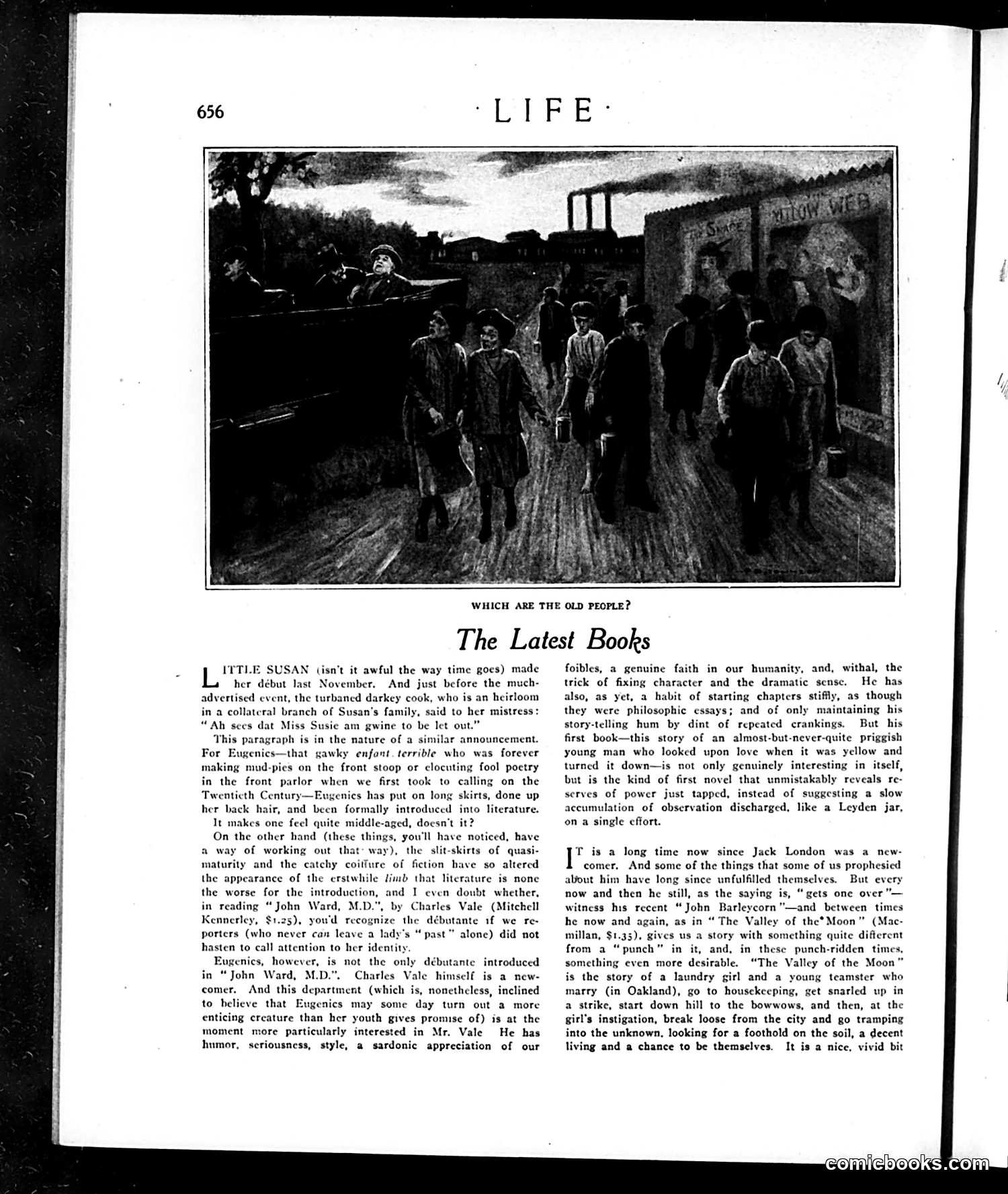
This is a book review section from *Life* magazine titled "The Latest Books," with a satirical illustration captioned "Which Are the Old People?" The image shows a crowd of people of varying ages gathered together, with the caption's joke being that it's difficult to distinguish old from young—a visual commentary on how modern fashion and styles have blurred generational distinctions. The reviews discuss new novels by Charles Vale (*John Ward, M.D.*) and Jack London (*The Valley of the Moon*). The critic playfully notes that Vale is a literary newcomer whose work shows promise despite stylistic roughness, while London—already an established author—continues producing solid work. The tone is witty and gossipy, typical of *Life's* literary commentary for an educated readership. The reviews emphasize character development, dramatic sense, and authentic human observation as marks of good fiction.
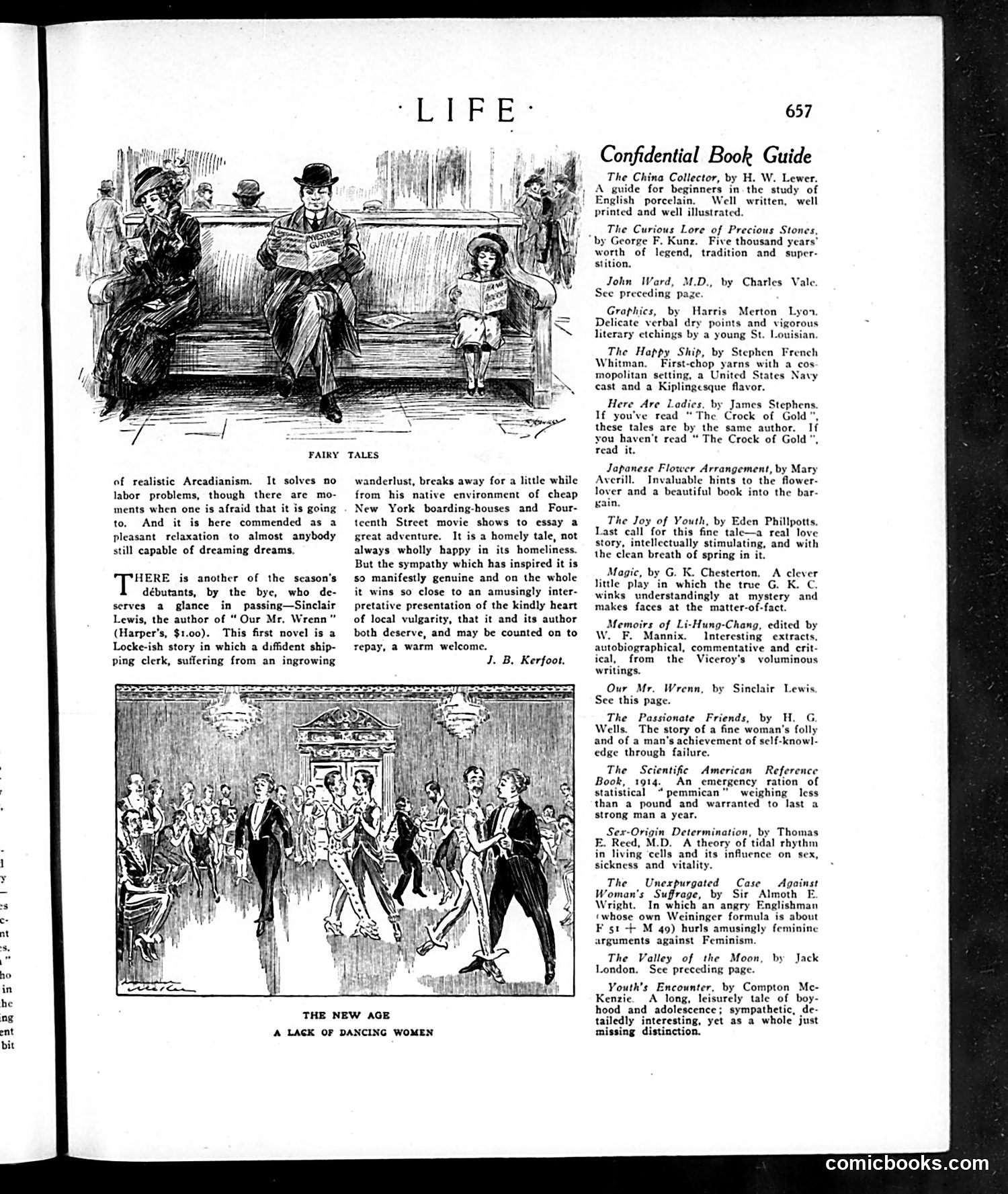
This cartoon satirizes early 20th-century social anxieties about changing gender roles and modern youth culture. The caption's ironic title suggests that contemporary society—"the new age"—paradoxically features *fewer* women dancing, despite modernization and liberation rhetoric. The image depicts a formal ball or dance hall crowded with well-dressed men in tuxedos, yet noticeably sparse on female dancers. This visual contrast makes the satirical point: despite talk of progress and the "new woman," traditional courtship rituals are breaking down. The gender imbalance implies either that women are rejecting such social occasions, or that modern life has made traditional dancing venues less appealing. The joke likely critiques anxieties among society elites about women's independence, changing social customs, and the decline of Victorian social structures—framed as an absurd complaint that progress has actually resulted in *fewer* opportunities for the anticipated pleasures of "the new age."
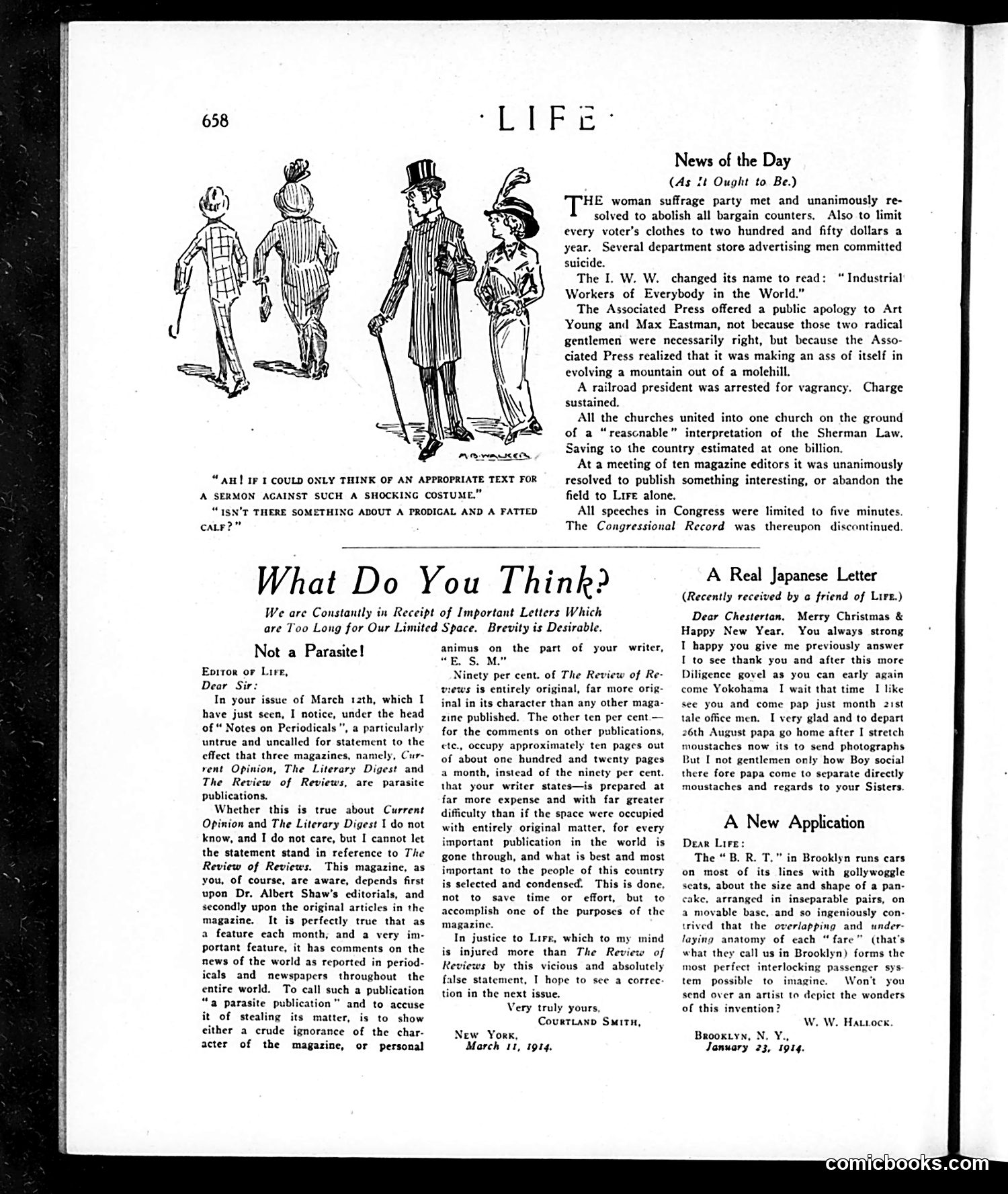
The cartoon depicts two figures in conversation, dressed in period clothing (early 1900s). One says he needs "an appropriate text for a sermon against such a shocking costume," to which the other responds with a biblical reference: "Isn't there something about a prodigal and a fatted calf?" The satire targets **women's fashion**, likely the increasingly revealing or unconventional clothing styles of the era. The second speaker's biblical allusion to the Prodigal Son parable mocks the first figure's moralistic handwringing—suggesting that condemning modern dress through sermon is as absurdly misguided as the parable's cautionary tale. The "News of the Day" section satirizes various reform movements and institutions: women's suffrage activists, labor organizations (I.W.W.), department stores, the railroad industry, churches, and Congress. Each item presents absurdist "reforms" (abolishing bargain counters, limiting clothing budgets, limiting congressional speeches) as satirical critiques of contemporary social movements and institutions that Life's editors viewed skeptically.
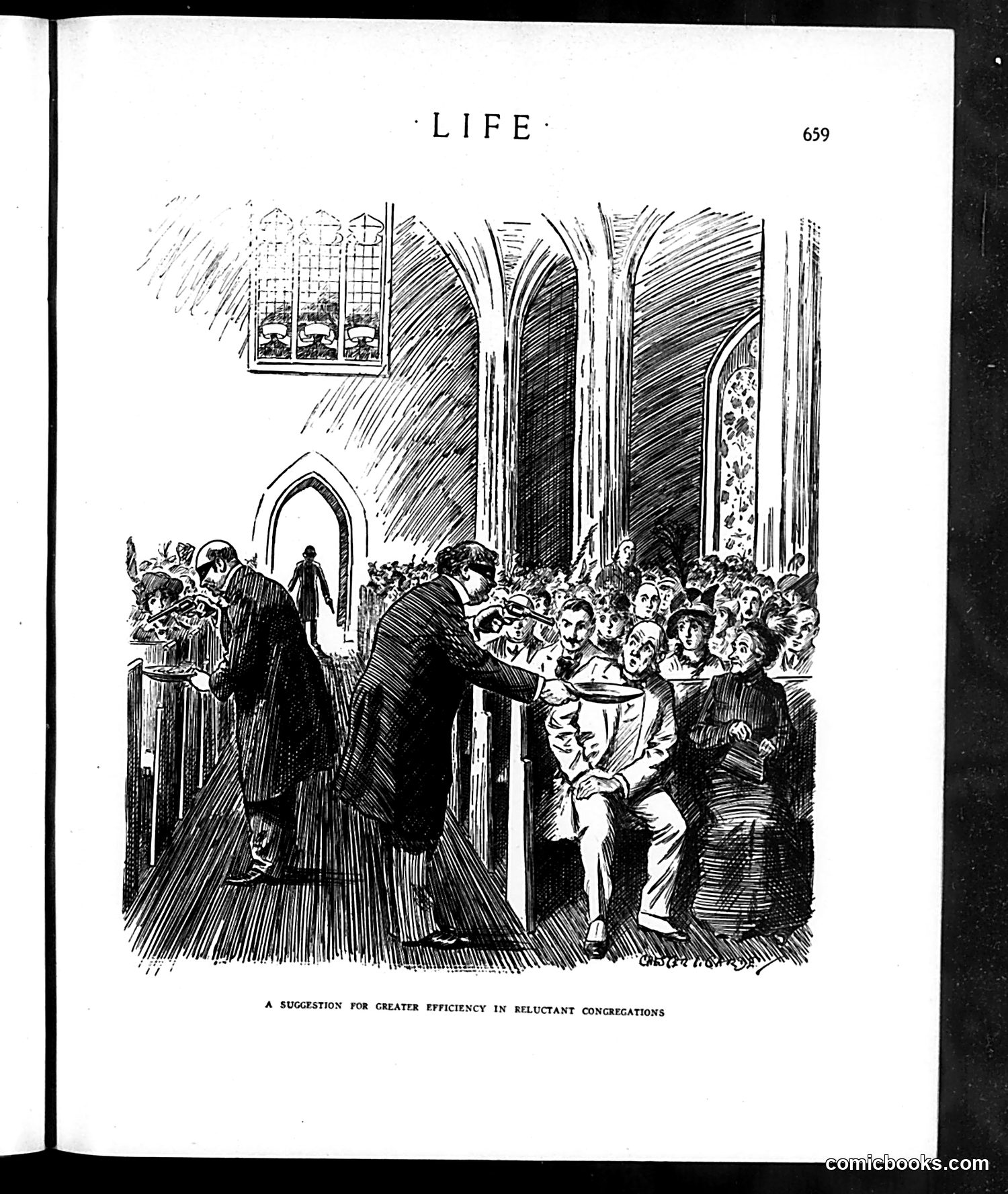
This is a satirical cartoon titled "A Suggestion for Greater Efficiency in Reluctant Congregations." The scene depicts a church interior with a clergyman appearing to use some kind of device or mechanism to push/propel reluctant congregation members into the pews. The visual joke mocks both churchgoers who attend services without enthusiasm and clergy frustrated by sparse attendance or engagement. The small window inset at top-left appears to show the same mechanism in operation, reinforcing the satirical "solution" to the problem of disengaged worshippers. The satire targets a common early-20th-century social tension: declining religious participation and the gap between nominal church membership and actual devotion. The cartoon humorously suggests that mechanical force might be needed to fill churches, mocking both institutional religion's struggles and congregants' reluctance to attend willingly.
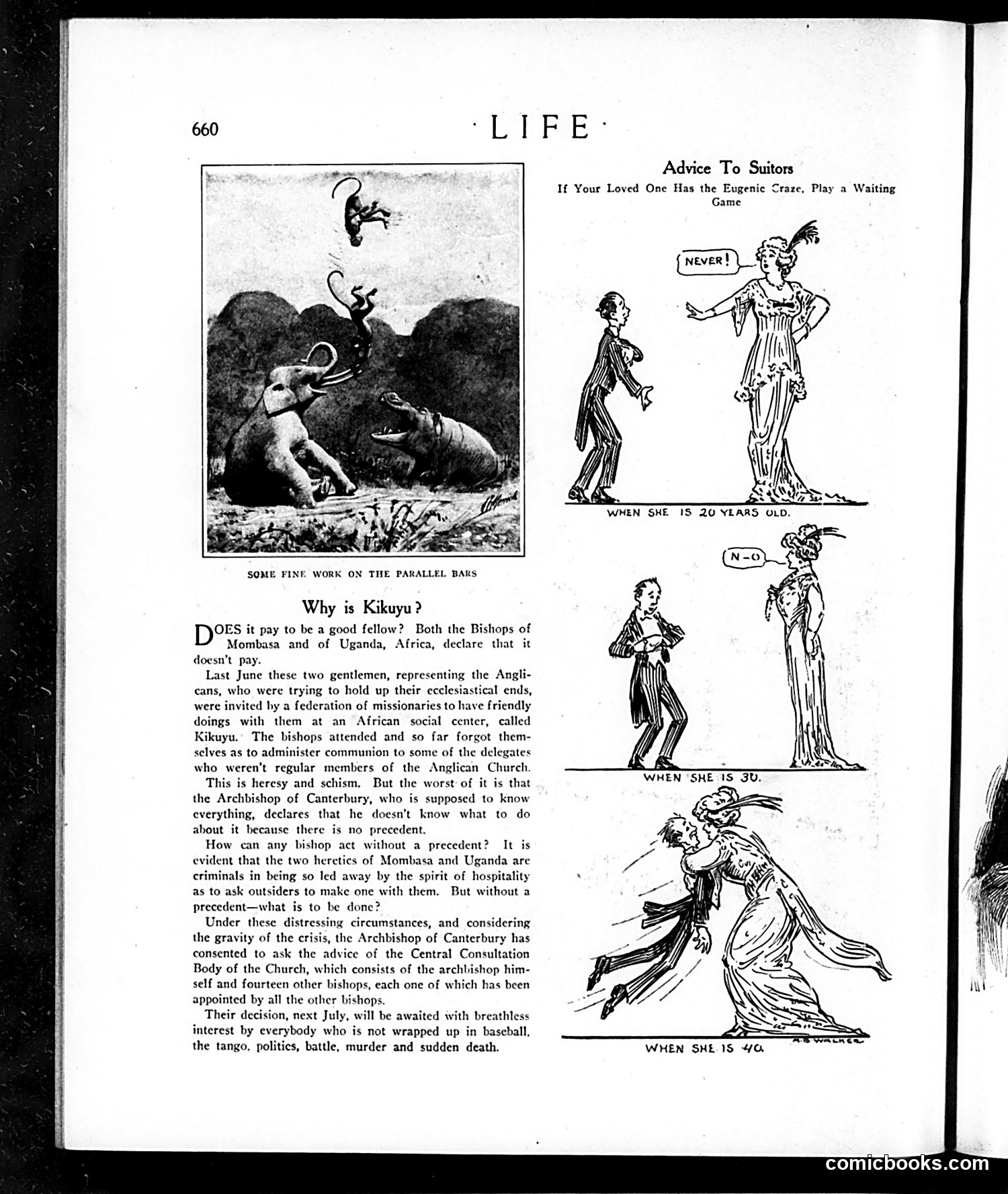
**Top Cartoon - "Advice to Suitors":** This satirizes the "eugenics craze" of the early 20th century—a pseudo-scientific movement advocating selective breeding. The cartoon shows a woman's physical decline from age 20 to 40+, suggesting men should avoid marrying women obsessed with eugenics, as they become increasingly unattractive and unstable over time. The humor relies on mocking both eugenics believers and women's changing appearance. **Main Article - "Why is Kikuyu?":** This satirizes Anglican Church bureaucracy and rigidity. Two African bishops attended a missionary social event at Kikuyu and administered communion to non-Anglican members—an act of Christian hospitality deemed heretical. The Archbishop of Canterbury claims helplessness due to lack of precedent. The article mockingly suggests that rigid institutional rules prevent sensible action, while the Church convenes multiple bishops to debate what common sense should dictate.
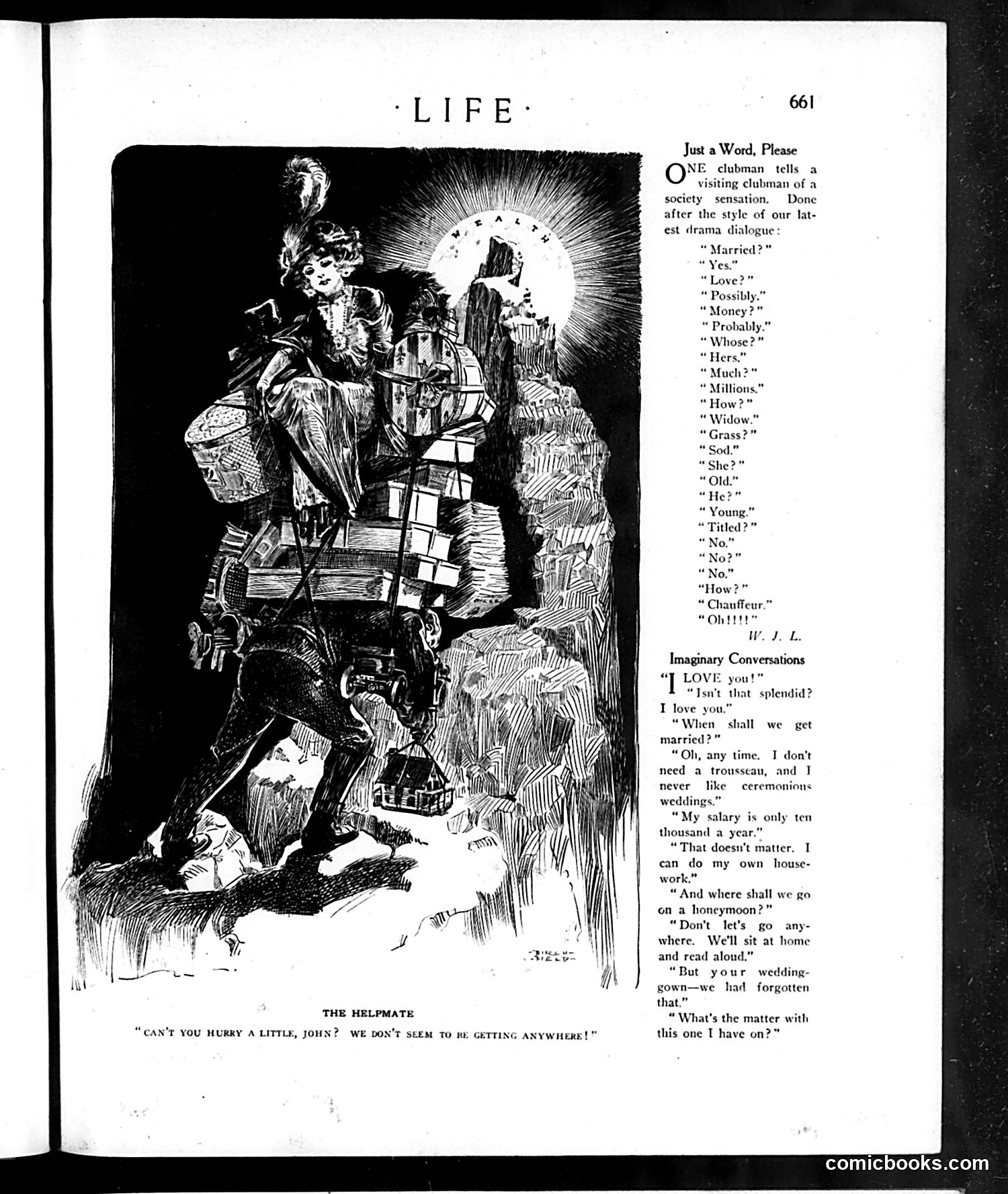
This cartoon satirizes marital discord and the frustrations of matrimony. The illustration shows an impatient wife urging her husband to hurry, with the caption suggesting their marriage is stalled or going nowhere—a visual pun on the couple appearing stuck or immobile. The accompanying text sections mock both high-society marriages and idealized romantic conventions. "Just a Word, Please" ridicules society weddings where couples marry for wealth rather than love, reducing matrimonial motivations to cynical questions about money and status. "Imaginary Conversations" parodies overly romantic or impractical engagement dialogues popular in contemporary drama, presenting absurdly unrealistic lovers who claim indifference to ceremony, salary, and honeymoons. Together, the page satirizes early 20th-century marriage—whether the mundane reality of unhappy spouses or the theatrical fantasy of perfectly compatible romantics—as equally ridiculous. The humor targets both actual marital strain and sentimental fiction about love.
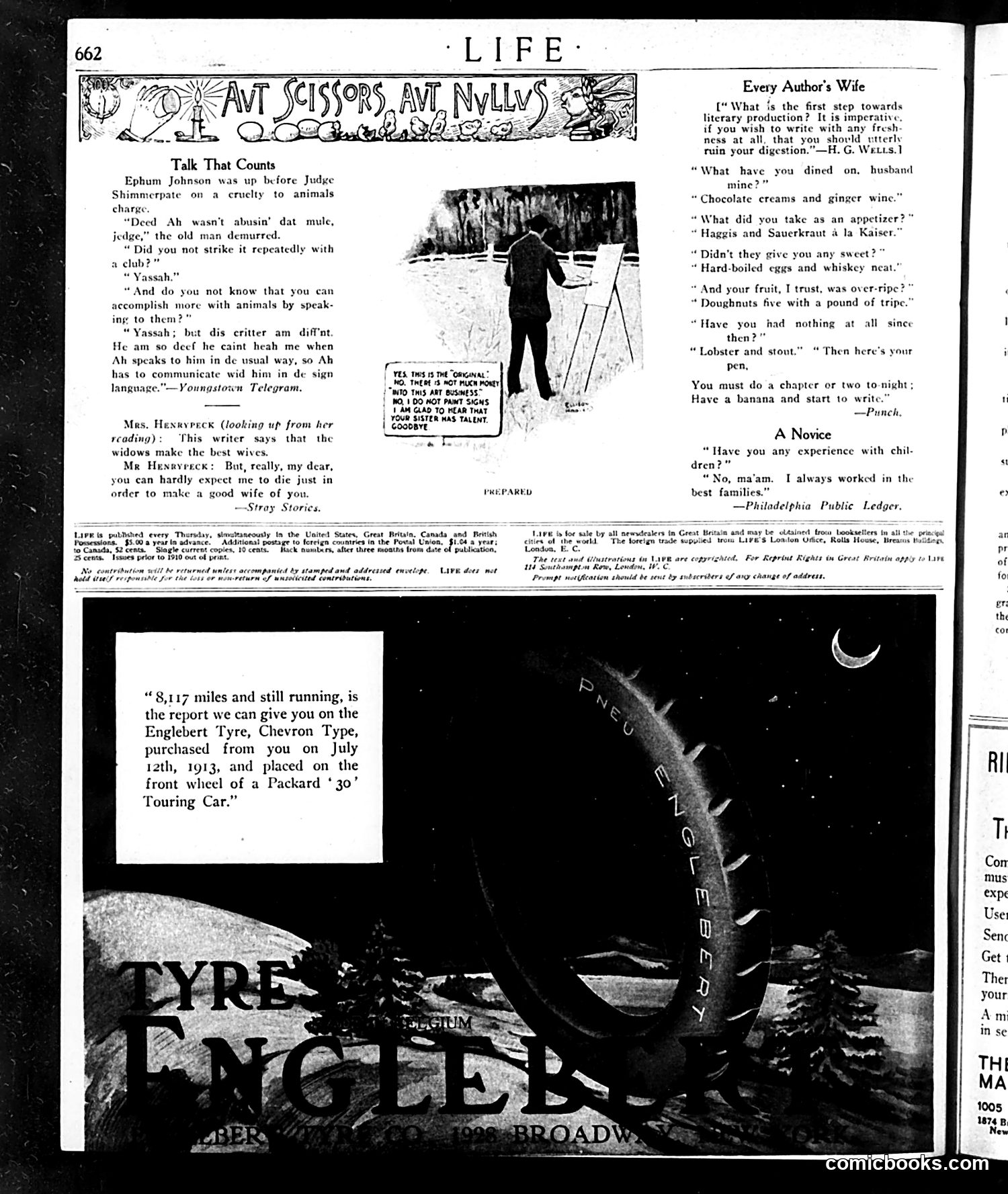
This page contains three satirical pieces typical of Life's humor: 1. **"Talk That Counts"**: A dialect humor piece featuring an African American defendant (Ephum Johnson) explaining to a judge that he beats his mule because the animal is deaf and requires "sign language." The satire targets the defendant's illogical reasoning rather than animal cruelty itself—a common comedic trope of the era. 2. **"Every Author's Wife"**: Mocks the romantic notion that writers need specific dietary suffering for creativity. The wife catalogs absurd, indigestible foods her husband consumed (haggis, sauerkraut, hard-boiled eggs, lobster, stout), then demands he write anyway while eating a banana. Satire targets both pretentious literary advice and marital dynamics. 3. **"A Novice"**: Brief joke about a job applicant claiming experience with "best families" rather than actual childcare. The page also includes a Dunlop tire advertisement emphasizing durability (8,117 miles on a 1913 Packard automobile).
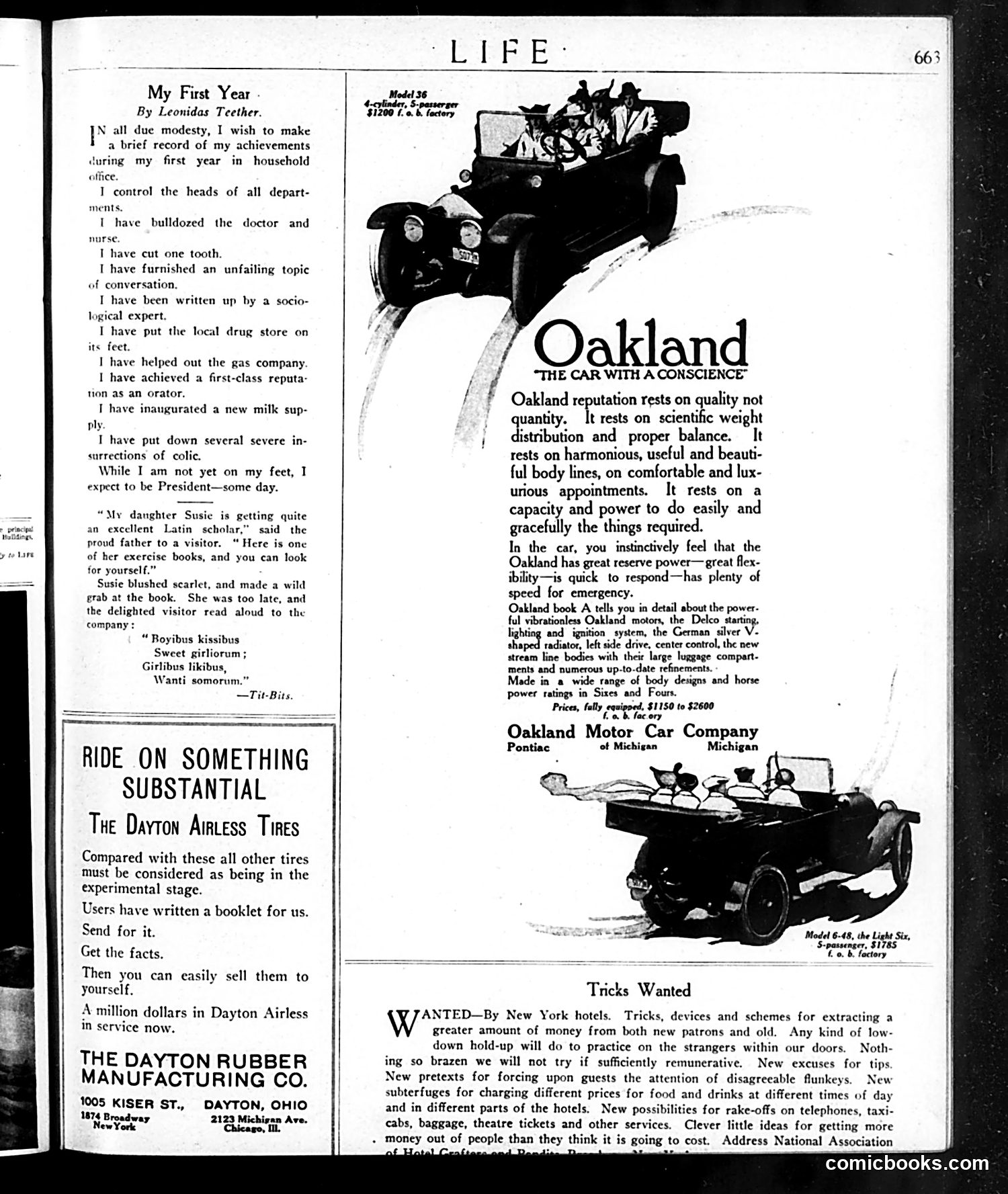
This page contains **satirical humor pieces and advertisements** typical of early 20th-century Life magazine. **"My First Year" by Leonidas Teether:** A comic monologue from the perspective of an infant boasting of accomplishments during his first year—controlling household staff, bullying the doctor, cutting a tooth, and generating conversation. The joke is the baby's absurdly grandiose self-assessment, culminating in the claim he'll become President "some day." A brief anecdote about a girl named Susie embarrassed by her Latin composition adds gentle domestic humor. **"Tricks Wanted":** A satirical "help wanted" ad from New York hotels soliciting dishonest schemes to extract money from guests—overcharging, forcing unnecessary services, and exploiting strangers. The humor lies in the brazen, tongue-in-cheek admission of widespread hotel fraud. **Advertisements:** Oakland automobiles and Dayton Airless Tires dominate the page, using contemporary marketing language emphasizing quality, engineering, and performance. The page reflects early 1900s attitudes toward infant behavior, gender relations, and commercial ethics—presented through satire rather than serious criticism.
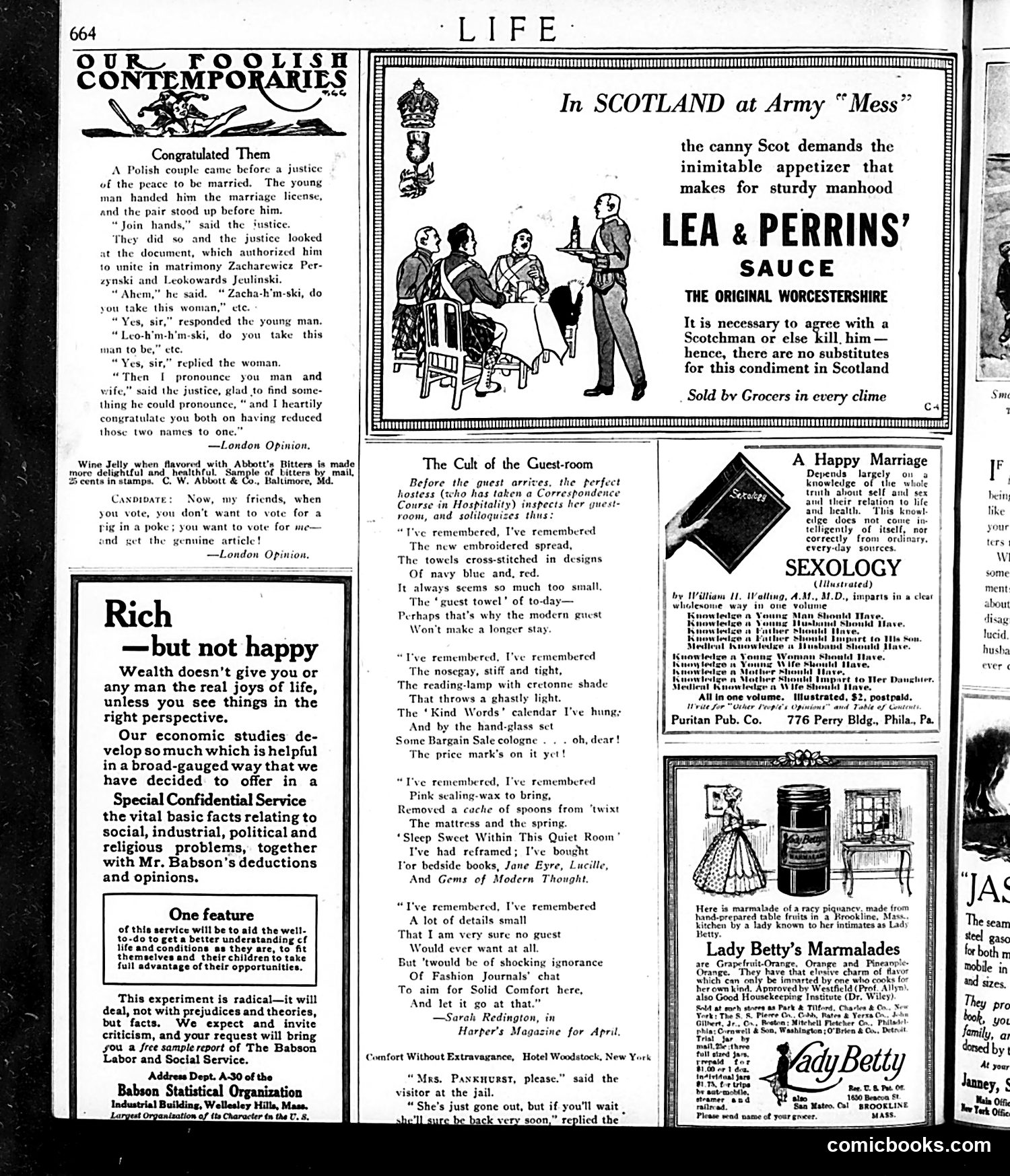
This Life magazine page contains several satirical pieces mocking social pretensions and linguistic absurdities: **"Congratulated Them"** ridicules a Polish couple's difficult surnames (Zacharewicz Perzynski and Leokowards Jeulinski). The joke: a justice of the peace struggles to pronounce their names, then congratulates them on reducing "those two names to one"—implying their marriage simplified linguistic chaos. The satire targets both immigrant name difficulty and the judge's obliviousness. **"Candidate" joke** mocks a political candidate's transparent dishonesty, comparing voting for him to buying "a pig in a poke" (getting something unseen). **"The Cult of the Guest-room"** satirizes the obsessive, pretentious hostess who fusses over guest-room details (embroidered spreads, scent) while creating an actually uncomfortable space—suggesting performative hospitality over genuine comfort. The advertisements interspersed (Lea & Perrins sauce, Babson Statistical Organization, Sexology book) appear unrelated to the satire itself.
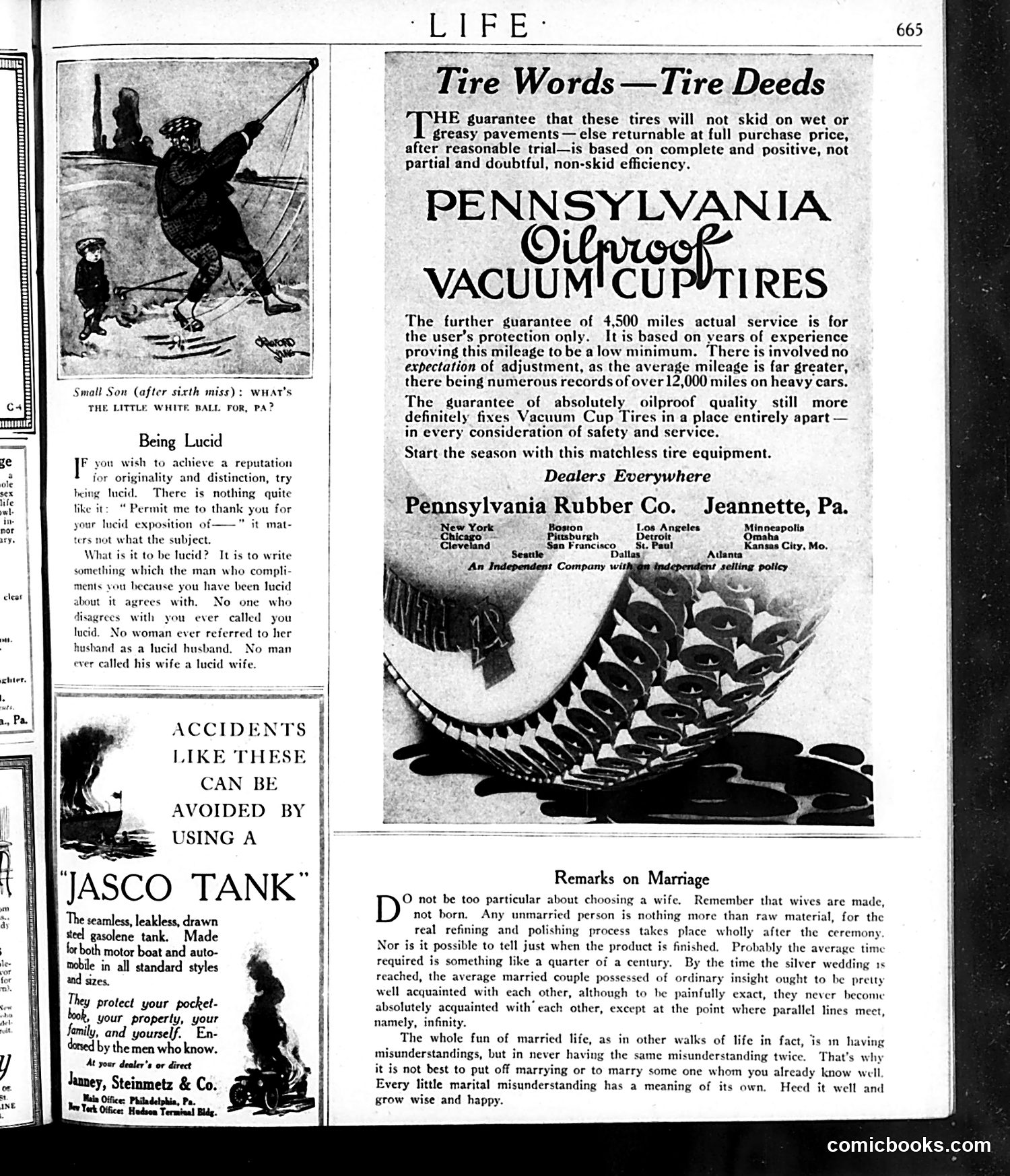
This page consists primarily of **advertisements and advice columns** rather than political satire. The cartoon at top left shows a small boy asking his father "What's the little white ball for, Pa?"—a gentle, non-satirical domestic humor about golf. Below that, "Being Lucid" is a brief humorous essay satirizing the term "lucid." It jokes that people only call you lucid when they *agree* with you, never otherwise—and certainly no spouse would describe their partner that way. It's social commentary on how we use flattery dishonestly. The rest is straight advertising: JASCO TANK gasoline containers (emphasizing safety), Pennsylvania Vacuum Cup Tires (with performance guarantees), and a lengthy column titled "Remarks on Marriage" offering cynical yet earnest advice about wives as projects requiring decades of "refining and polishing." **Context for modern readers**: This reflects early 20th-century attitudes—particularly the patronizing view of wives as unfinished products needing husbands' improvement—presented here as conventional wisdom rather than questioned.
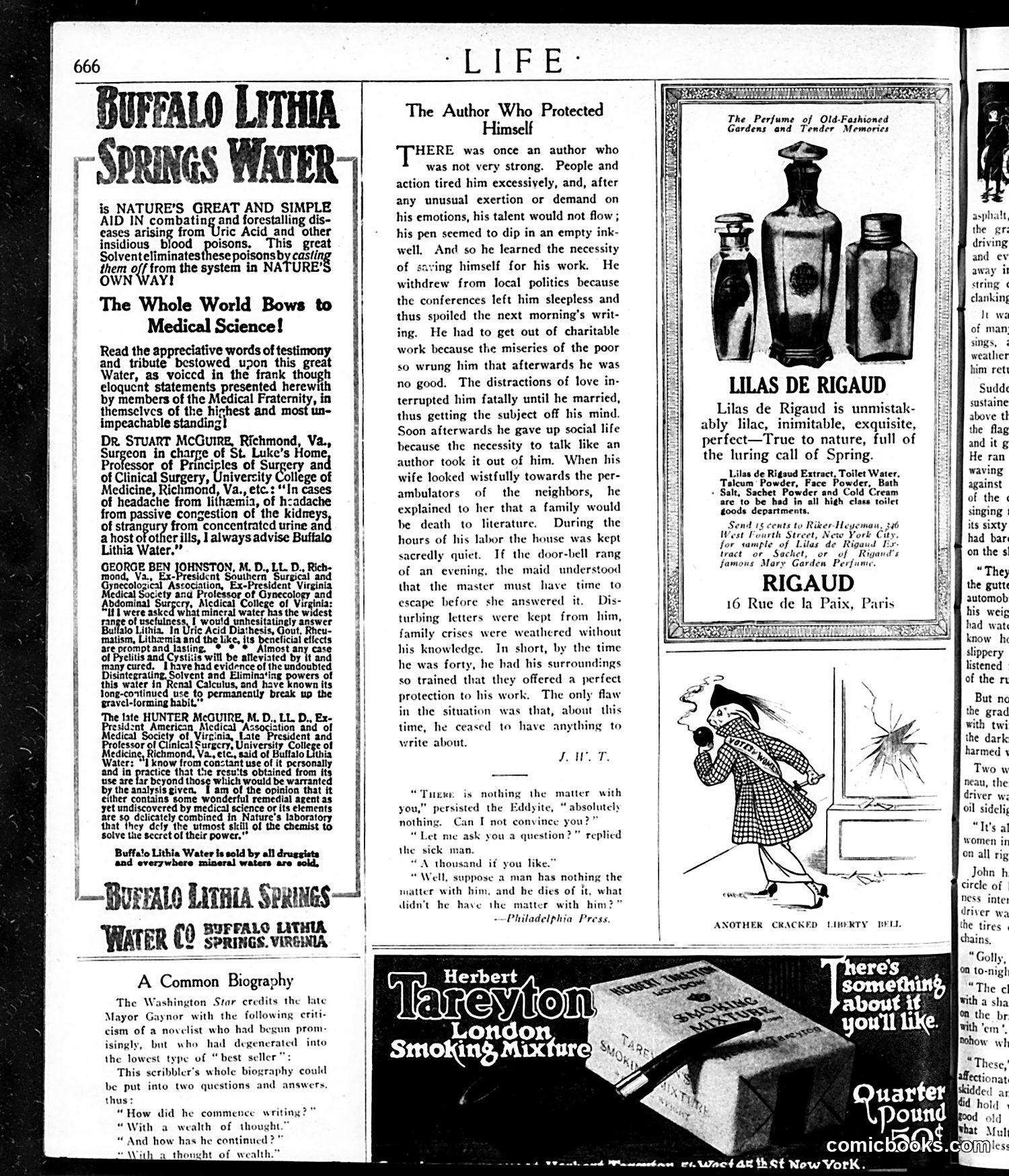
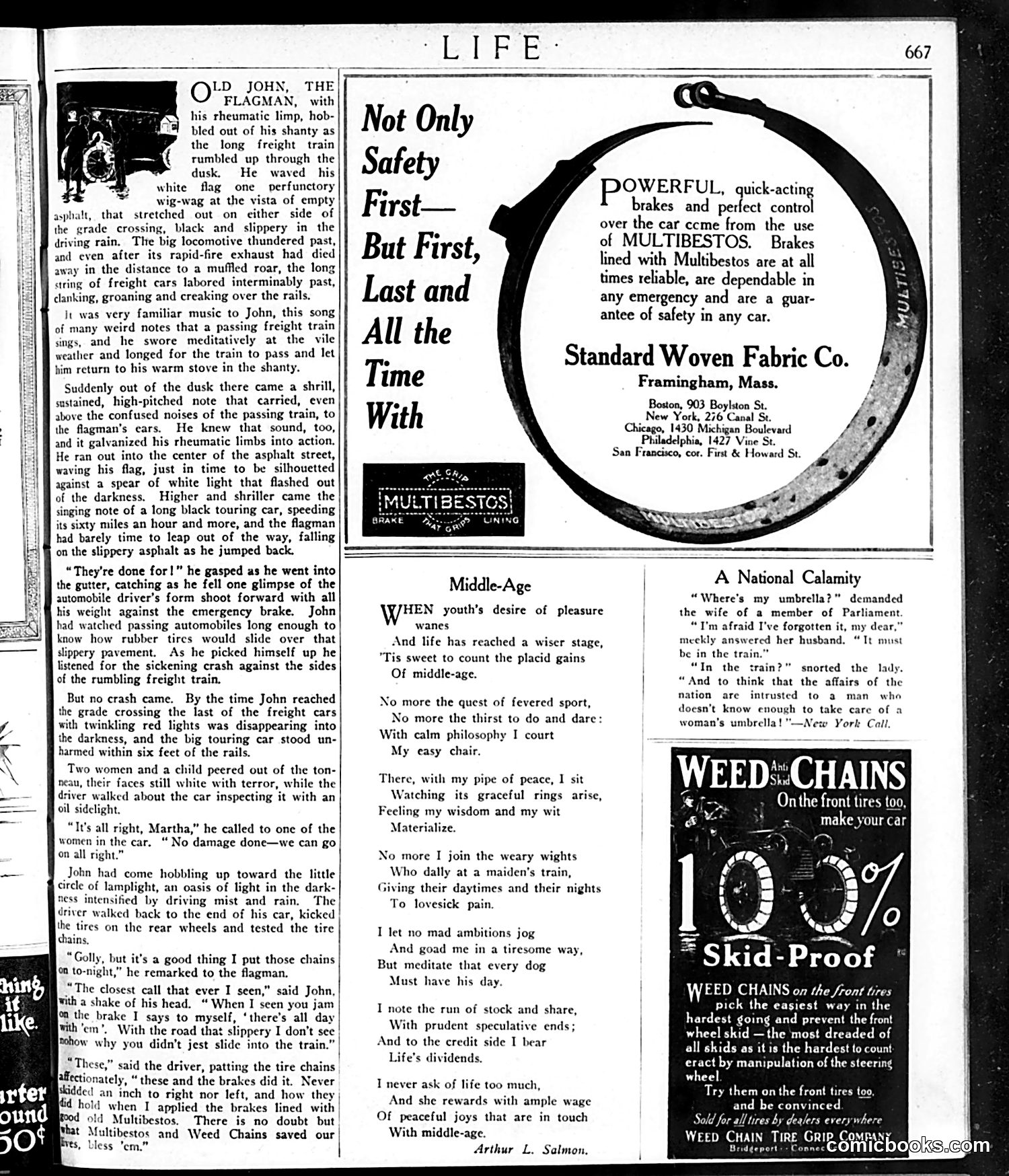
This page combines a serialized story with period automobile advertisements. The narrative follows "Old John," a railroad flagman, who nearly gets struck by a speeding automobile at a grade crossing during rain. The car's driver manages to stop just short of the freight train, avoiding catastrophe. The story is essentially an advertisement disguised as fiction. After the dramatic near-miss, the driver credits his safety to two products: **Multibestos brake linings** and **Weed Chains** (tire chains for traction). The concluding dialogue explicitly promotes these items as lifesaving equipment. This reflects early 20th-century automotive marketing strategy—using cautionary tales to sell safety products. The "Safety First" messaging was a genuine public concern during the automobile's dangerous early years, when collisions and skids were common. The advertisement leverages anxiety about modern vehicle risks to promote specific brake and tire products as consumer necessities.
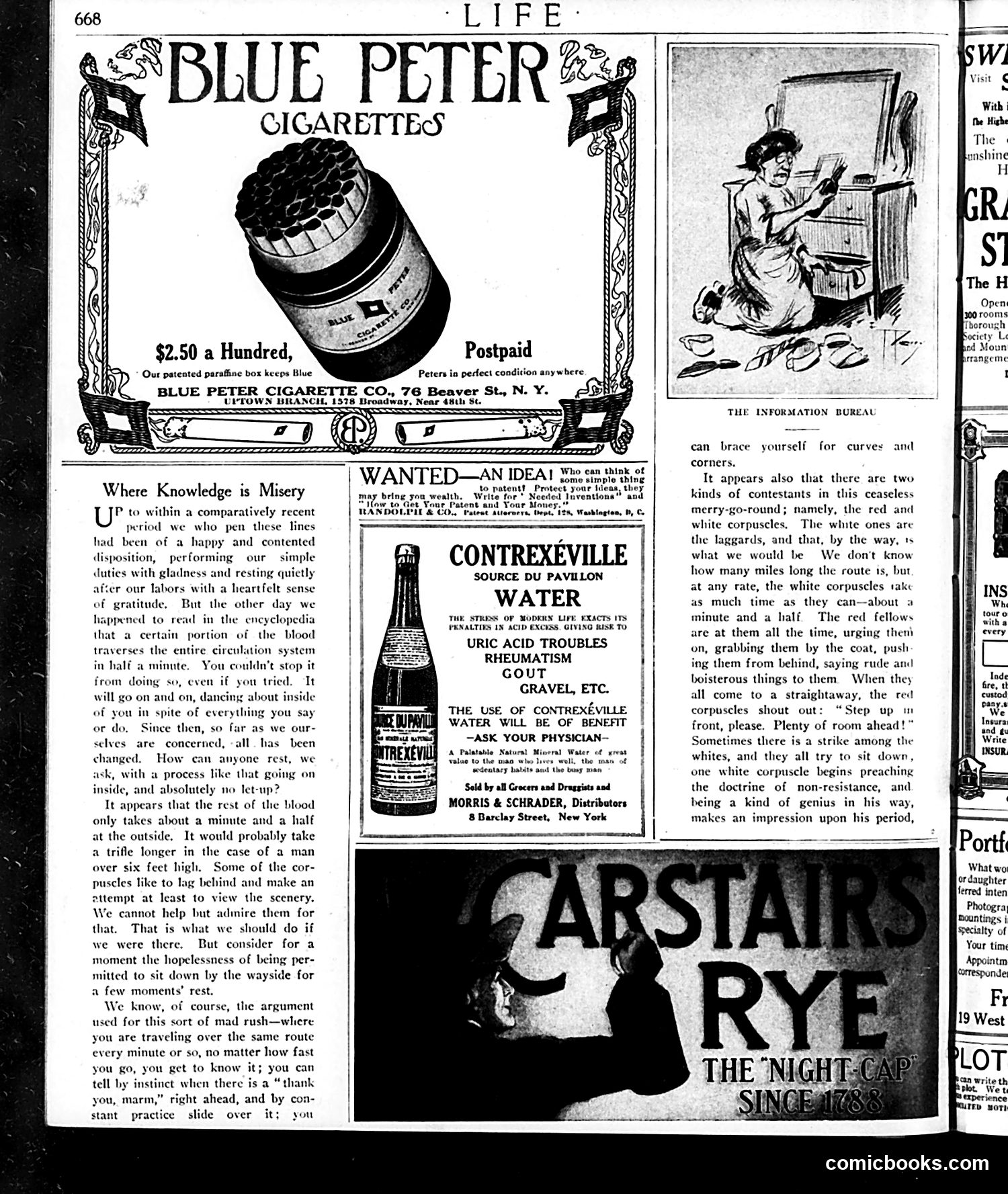
This page is primarily **advertising and filler content** rather than political satire. The main elements are: **Advertisements:** - Blue Peter Cigarettes ($2.50 per hundred) - Contrexéville Water (a French mineral water marketed for treating gout and rheumatism) - "Zustain Rye" whiskey (bottom) - Patent/invention service ads **Editorial Content:** The "Where Knowledge is Misery" essay is humorous *social commentary* rather than political satire. It describes the author's anxiety after learning that blood circulates through the body in 90 seconds—creating existential dread about this unstoppable bodily process. The piece uses personification of red and white blood corpuscles as hardworking versus lazy workers in a "merry-go-round" system. **The Information Bureau** section addresses readers' questions about bodily functions (corset curves, white corpuscles). There are **no identifiable political figures or caricatures**. This appears to be a typical early-20th-century *Life* magazine page mixing light humor about science and bodily awareness with commercial advertisements.
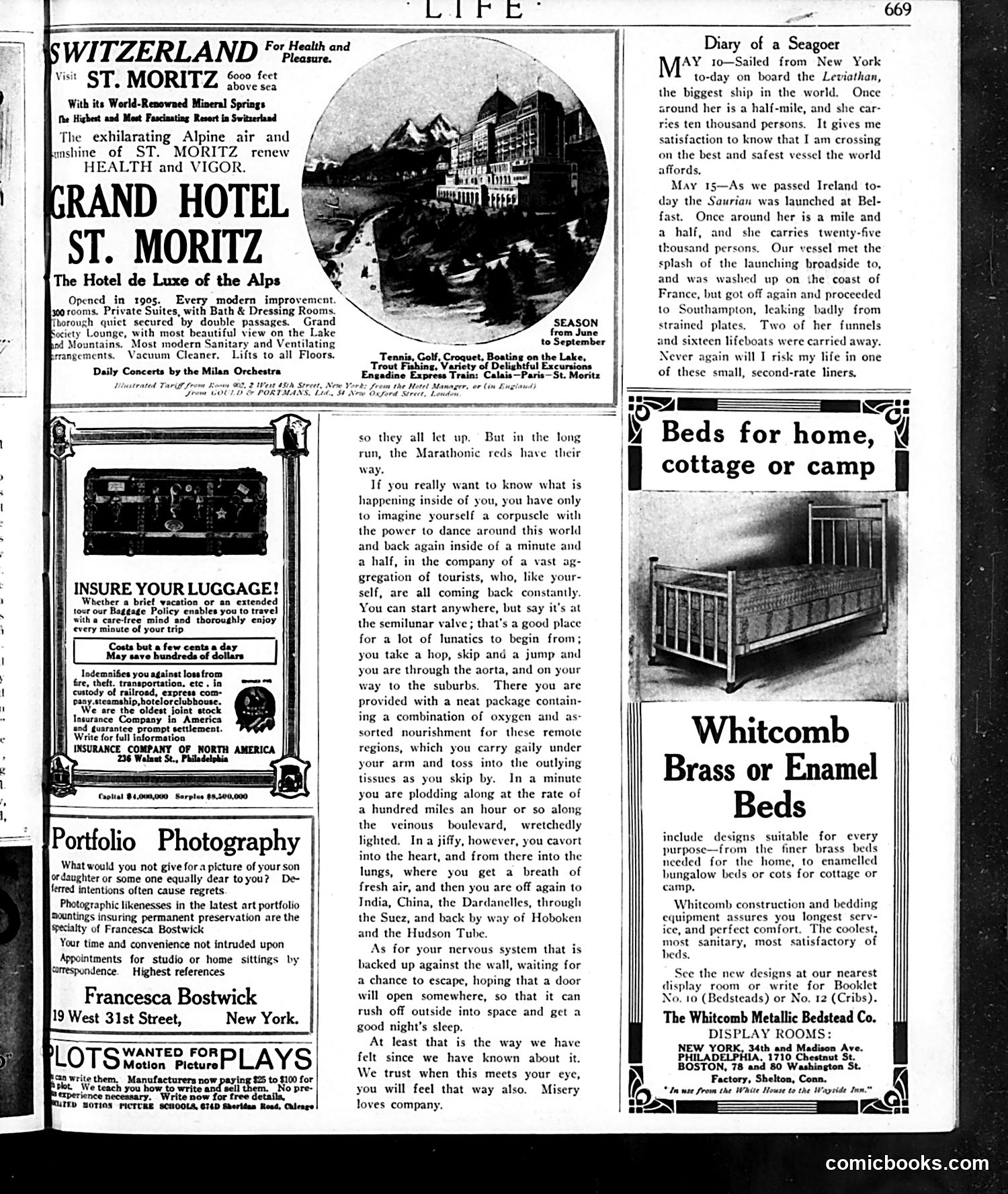
This page is primarily **advertising and editorial content**, not political satire. It contains: **Major advertisements:** - Grand Hotel St. Moritz (Swiss Alpine resort) - Whitcomb Brass or Enamel Beds - Insurance Company of North America (luggage insurance) - Portfolio Photography services by Francesca Bostwick **Editorial content:** A humorous essay titled "Diary of a Seagoer" (top right), describing a transatlantic voyage on the Saurian, the "biggest ship in the world." The main text is a whimsical medical/anatomical piece imagining oneself as a blood corpuscle traveling through the human body—a metaphor for tourism and constant movement. **Social context:** This reflects early 20th-century leisure culture for the wealthy: luxury travel, resort tourism, and the "grand tour" mentality. The corpuscle essay gently satirizes the era's frenetic tourist culture and nervous modern life, but it's gentle humor rather than sharp political commentary. The page reflects Life magazine's typical mix of advertising, travel writing, and light social commentary aimed at affluent readers.
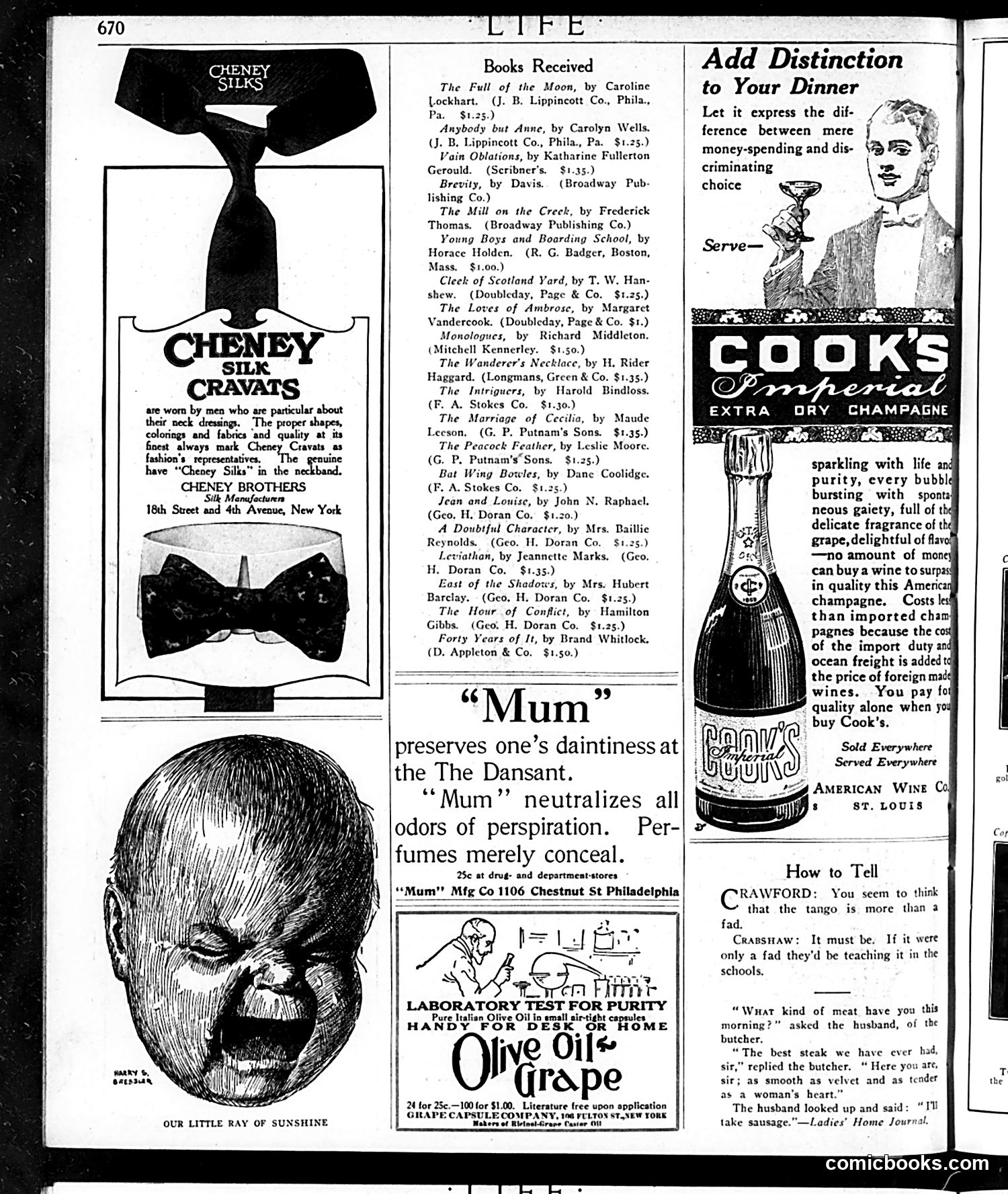
This is primarily a **advertisements and book reviews page** from an early 20th-century Life magazine, with minimal satirical content. **The main cartoon** ("Our Little Ray of Sunshine") shows a detailed engraving of a woman's face, apparently illustrating the advertised "Mum" deodorant—which "neutralizes all odors of perspiration." The image appears to be ironic commentary on feminine hygiene anxiety, a common advertising theme of the era. **Other notable elements:** - **Cheney Brothers** silk neckwear ads emphasize proper gentlemanly dress - **Cook's champagne** advertisement appeals to refined dinner culture and positions American wine as quality-competitive with imports - A humorous dialogue ("How to Tell") mocks the tango's status as a mere fad versus genuine social practice - Book listings reflect popular fiction of the period The page reflects **early 1900s consumer culture**: anxieties about propriety (perspiration, proper dress), emerging mass-marketing psychology, and class-conscious consumption. The subtle humor targets modern consumers' aspirations toward sophistication and distinction through purchased goods.
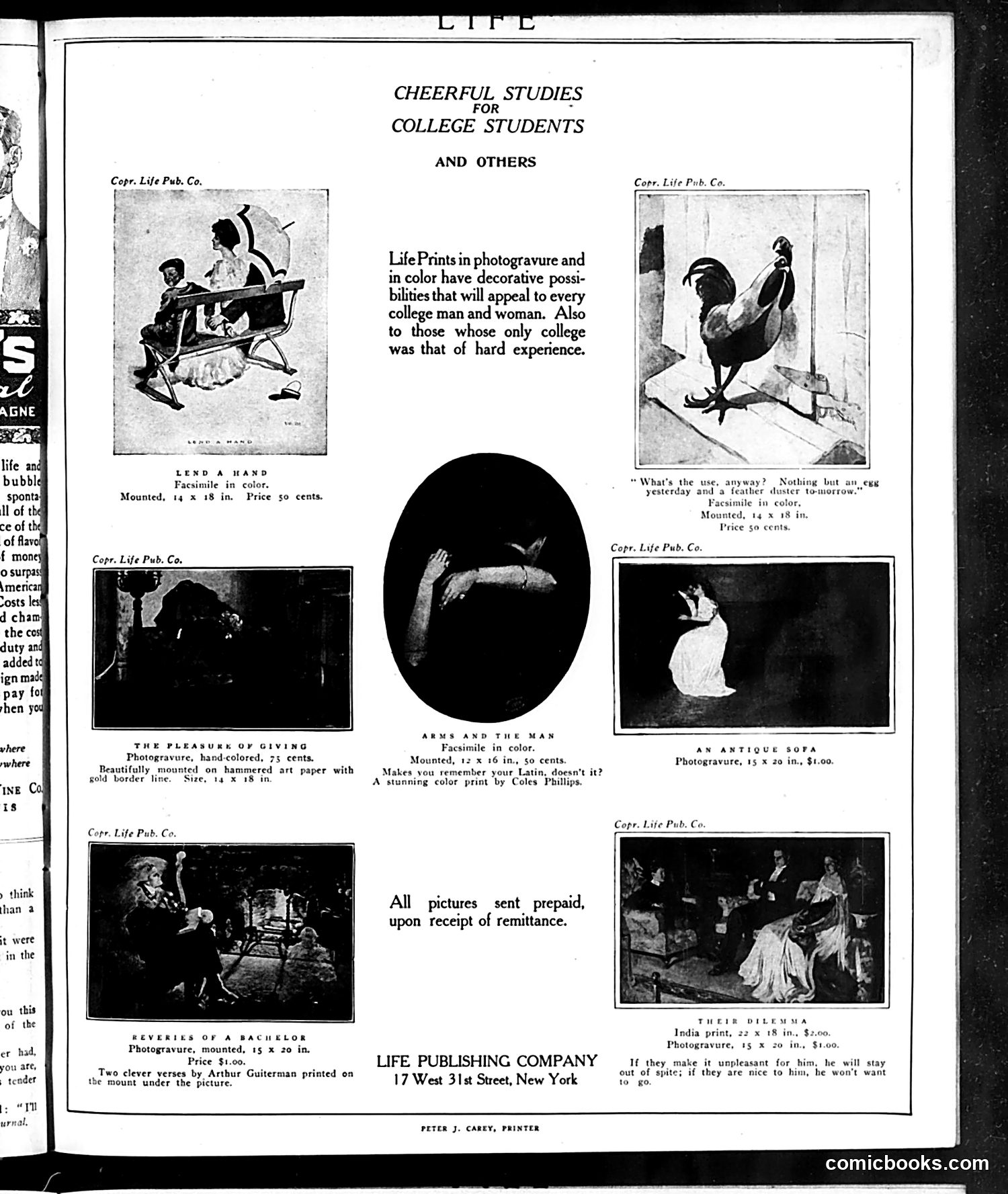
This is an advertisement page for Life Publishing Company selling decorative prints suitable for college students and others. Rather than political satire, it showcases artwork available for purchase in various formats (photogravure, facsimile in color, etc.) at different price points. The images depict genteel domestic and romantic scenes: a couple at leisure ("Lend a Hand"), a rooster in a doorway ("What's the use, anyway?"), classical figures ("Arms and the Man"), a bachelor's reveries, and social gatherings ("Their Dilemma"). The artist Coles Phillips is credited for at least one work. The copy emphasizes these prints' "decorative possibilities" appeal to college-educated audiences. The small accompanying verses—notably one by Arthur Guiterman—add clever, humorous captions. This appears to be a straightforward commercial catalog page marketing lifestyle imagery to affluent, educated consumers rather than satirical political commentary.
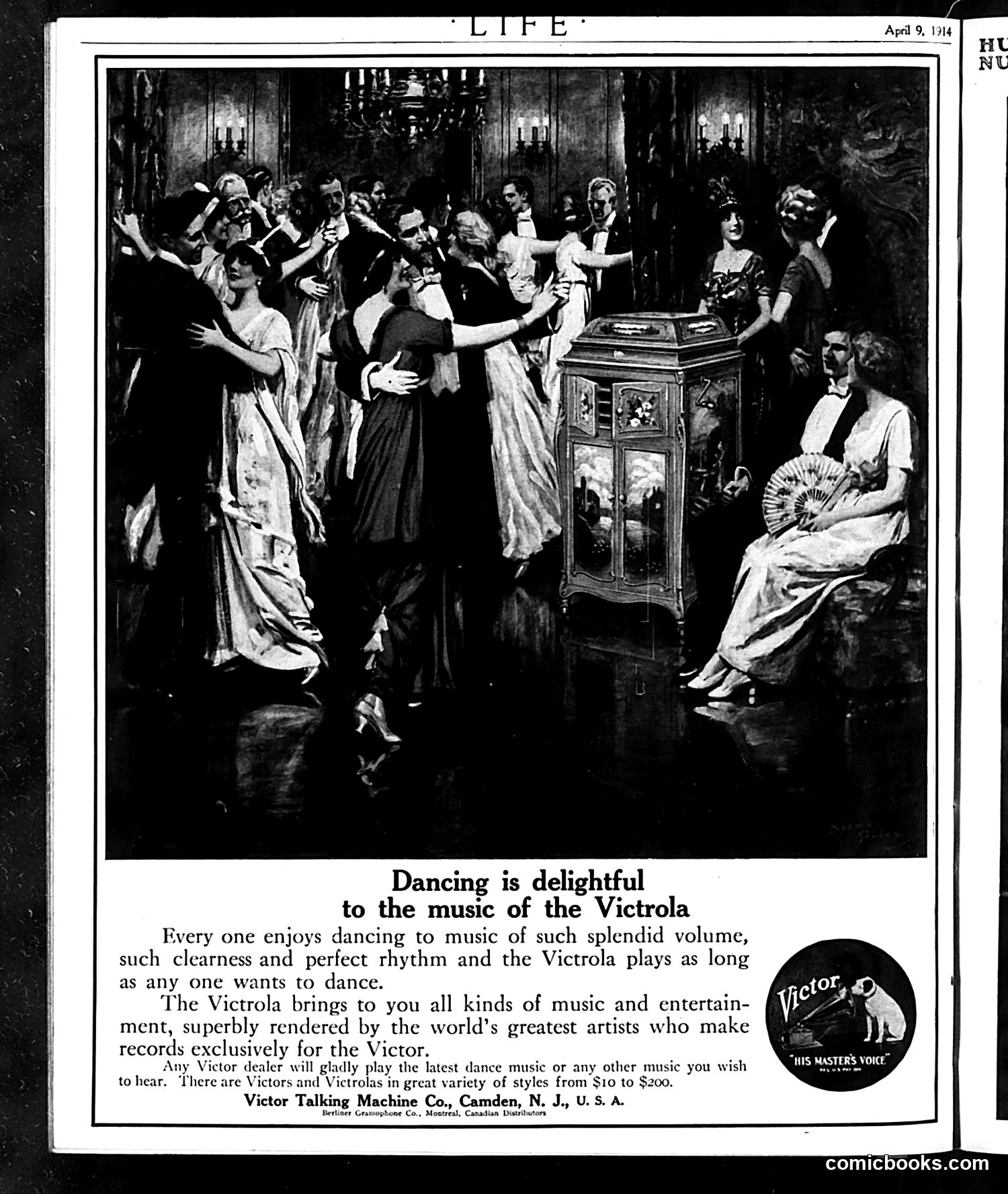
This is a **Victrola phonograph advertisement**, not political satire. It depicts an elegant early-20th-century dance party where well-dressed men and women dance in a formal parlor while a Victrola (Victor Talking Machine Company's gramophone) provides music from a decorative cabinet. The ad emphasizes the phonograph's advantages: superior sound quality, volume, and ability to play continuously—allowing guests to dance as long as desired. It highlights that the Victrola reproduces recordings by "the world's greatest artists," positioning it as a luxury item for the wealthy. The price range ($10-$200, substantial sums in 1914) and formal dress code signal this as aspirational advertising targeting middle to upper-class consumers. The "His Master's Voice" logo (Victor's famous trademark showing a dog listening to a gramophone) appears in the corner, reinforcing brand recognition. This represents early consumer marketing celebrating modern technology's role in home entertainment.