
Life, 1914-04-09 · page 22 of 40
Life — April 9, 1914 — page 22: what you’re looking at
What you’re looking at
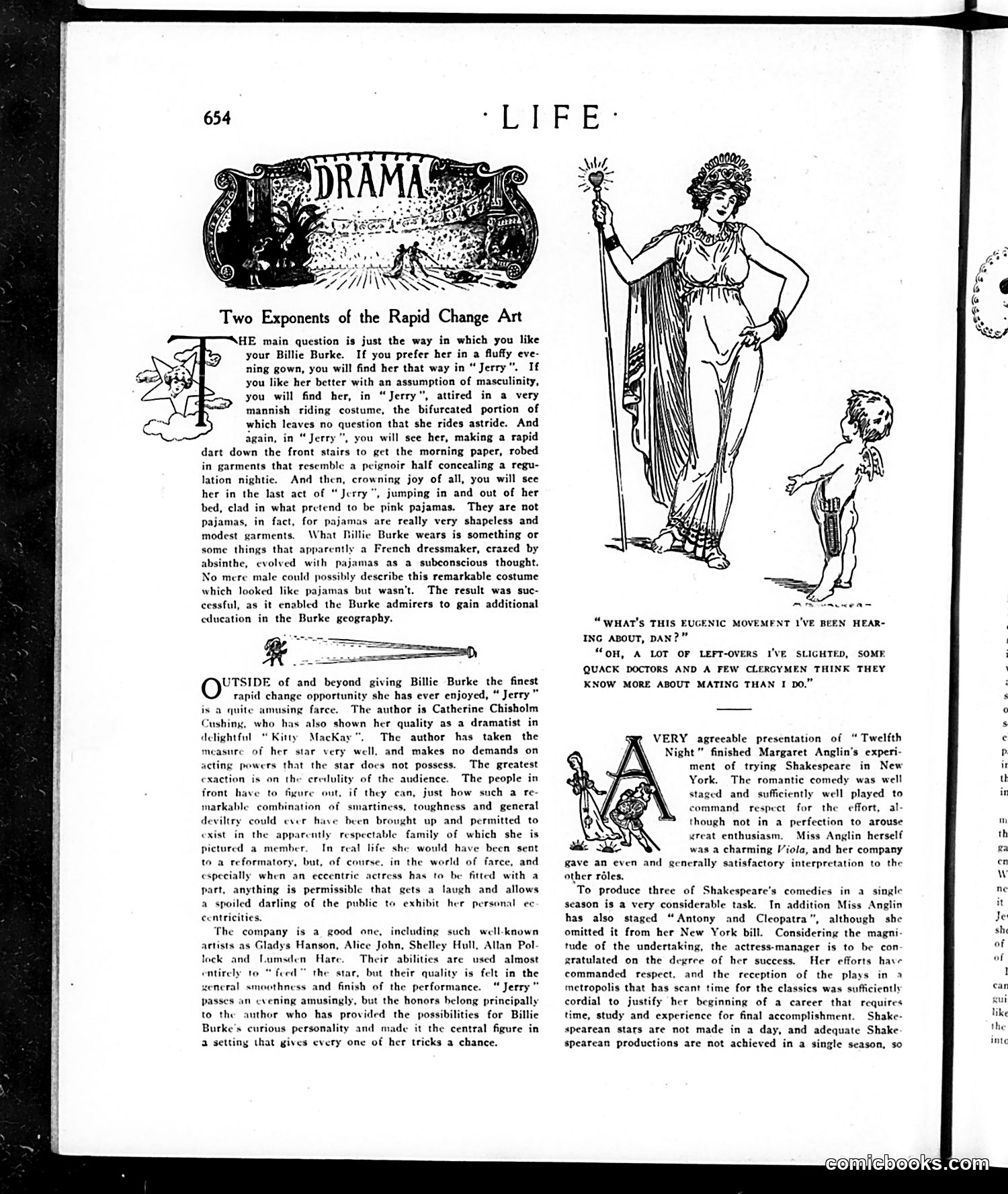
This page reviews theatrical productions, primarily focusing on actress **Billie Burke** in the farce "Jerry." The satire highlights Burke's fame for rapid costume changes—the article catalogs her various outfits throughout the play, from evening gowns to riding habits to bedroom attire. The joke is that Burke's star power carries the lightweight play; the author notes audiences must suspend disbelief accepting how such a "spoiled darling" could exist in a respectable family. A separate cartoon jokes about **eugenics**—a then-fashionable pseudoscience. A man dismisses eugenic concerns, claiming he understands mating better than "quack doctors and clergymen" promoting it. This satirizes how eugenic ideas were being popularized in the 1910s while remaining largely pseudoscientific. The page also briefly reviews Margaret Anglin's Shakespeare production of "Twelfth Night," praising her performance as Viola.
📄 Transcribed text from this page (OCR, searchable)
Machine-transcribed from the original scan — historical spelling and the odd misread are preserved.
Two Exponents of the Rapid Change Art HE main question is just the way in which you like your Billie Burke. If you prefer her in a fluffy eve- ning gown, you will find her that way in “Jerry”. If you like her better with an assumption of masculinity, you will find her, in “Jerry”, attired in a very mannish riding costume, the bifurcated portion of which leaves no question that she rides astride. And again, in “Jerry”, you will see her, making a rapid dart down the front stairs to get the morning paper, robed in garments that resemble a peignoir half concealing a regu- lation nightie. And then, crowning joy of all, you will see her in the last act of “Jerry”, jumping in and out of her bed, clad in what pretend to be pink pajamas. They are not pajamas, in fact, for pajamas are really very shapeless and modest garments. What Billie Burke wears is something or some things that apparently a French dressmaker, crazed by absinthe, evolved with pajamas as a subconscious thought. No mere male could possibly describe this remarkable costume which looked like pajamas but wasn't. The result wa: cessful, as it enabled the Burke admirers to gain add education in the Burke geography. UTSIDE of and beyond giving Billie Burke the finest rapid change opportunity she has ever enjoyed, “ Jerry” is a quite amusing farce. The author is Catherine Chisholm Cushing, who has also shown her quality as a dramatist in delightful “ Kitty MacKay", The author has taken the measure of her star very well, and makes no demands on acting powers that the star docs not possess. The greatest cxaction is on the credulity of the audience. The people in front have to figure out, if they can, just how such a re- markable combination of smartiness, toughness and general deviltry could ever have n brought up and permitted to exist in the apparently respectable family of which she is pictured a member. In real life she would have been sent to a reformatory, but, of course. in the world of farce, and especially when an eccentric actress has to be fitted with a part, anything is permissible that gets a laugh and allows a spoiled darling of the public to exhibit her personal ec centricities. The company is a good one, including such well-known artists as Gladys Hanson, Alice John, Shelley Hull, Allan Pol lock and Lumsden Hare. Their abilities are used almost entirely to “feed” the star, but their quality is felt in the xencral smoothness and finish of the performance. “Jerry” passes an cvening amusingly, but the honors belong principally to the author who has provided the possibilities for Billie Burke's curious personality and made it the central figure in a setting that gives every one of her tricks a chance. “WHAT'S THIS EUGENIC MOVEMENT 1'VE BEEN HEAR- ING ABOUT, DAN?” “OH, A LOT OF LEFT-OVERS I'VE SLIGHTED, SOME QUACK DOCTORS AND A FEW CLERGYMEN THINK THEY KNOW MORE ABOUT MATING THAN I DO.” VERY agreeable presentation of “ Twelfth Night” finished Margaret Anglin's experi- ment of trying Shakespeare in New York. The romantic comedy was well staged and sufficiently well played to command respect. for the effort, al though not in a perfection to arouse great enthusiasm. Miss Anglin herself was a charming Viola, and her company gave an even and generally satisfactory interpretation to the other réles. To produce three of Shakespeare's comedies in a single season is a very considerable task. In addition Miss Anglin has also staged “Antony and Cleopatra”, although she omitted it from her New York bill. Considering the magni tude of the undertaking, the actress-manager is to be con gratulated on the degree of her success. Her efforts have commanded respect, and the reception of the plays in > metropolis that has scant time for the classics was sufficiently cordial to justify her beginning of a career that requires time, study and experience for final accomplishment. Shake- spearean stats are not made in a day, and adequate Shake spearean productions are not achieved in a single season, so