
Life, 1914-04-09 · page 25 of 40
Life — April 9, 1914 — page 25: what you’re looking at
What you’re looking at
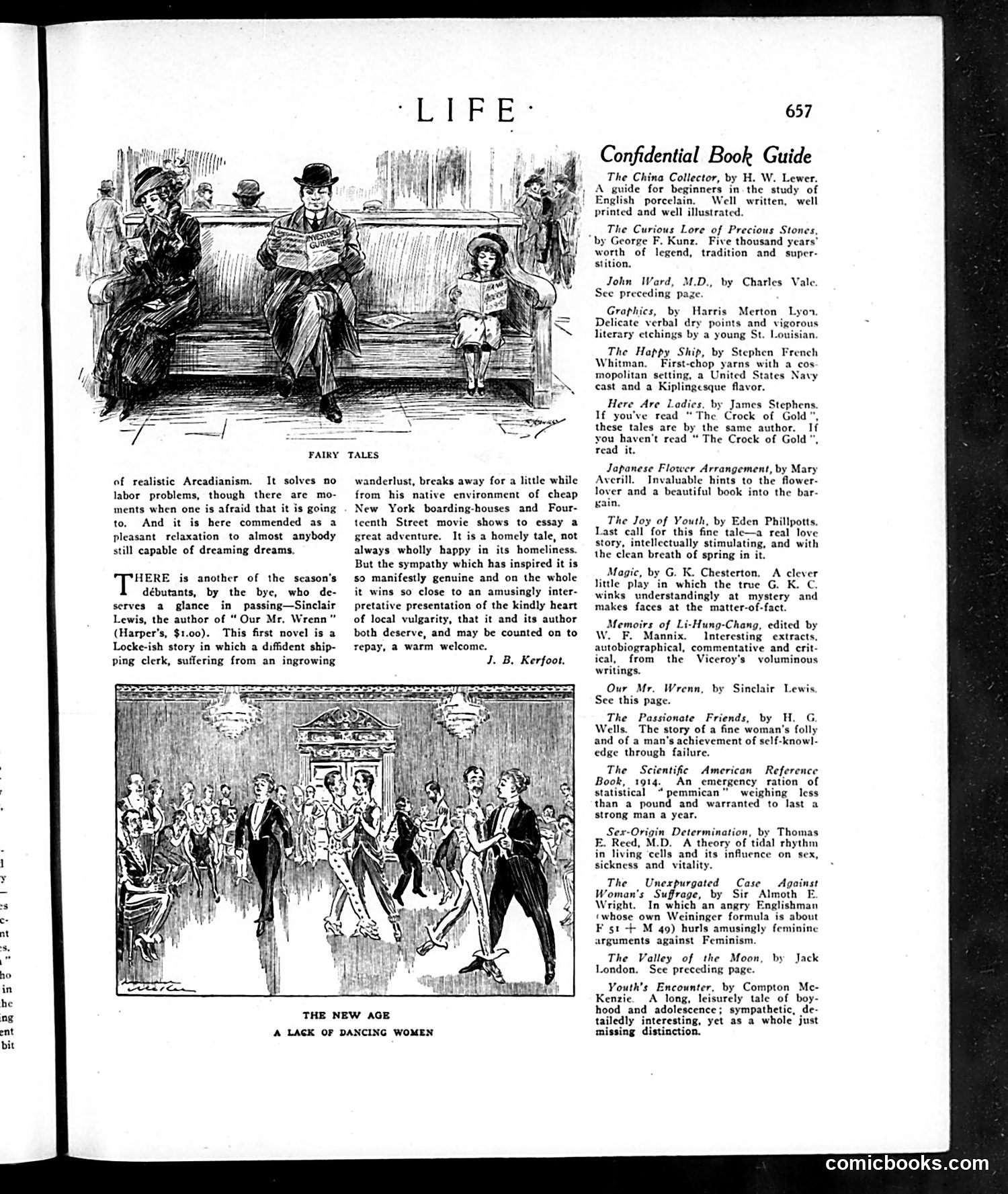
This cartoon satirizes early 20th-century social anxieties about changing gender roles and modern youth culture. The caption's ironic title suggests that contemporary society—"the new age"—paradoxically features *fewer* women dancing, despite modernization and liberation rhetoric. The image depicts a formal ball or dance hall crowded with well-dressed men in tuxedos, yet noticeably sparse on female dancers. This visual contrast makes the satirical point: despite talk of progress and the "new woman," traditional courtship rituals are breaking down. The gender imbalance implies either that women are rejecting such social occasions, or that modern life has made traditional dancing venues less appealing. The joke likely critiques anxieties among society elites about women's independence, changing social customs, and the decline of Victorian social structures—framed as an absurd complaint that progress has actually resulted in *fewer* opportunities for the anticipated pleasures of "the new age."
📄 Transcribed text from this page (OCR, searchable)
Machine-transcribed from the original scan — historical spelling and the odd misread are preserved.
FAIRY of realistic Arcadianism. It solves no labor problems, though there are mo- ments when one is afraid that it is going to, And it is here commended as a pleasant relaxation to almost anybody still capable of dreaming dreams. HERE is another of the season's débutants, by the bye, who de- serves. a glance in passing—Sinclair Lewis, the author of “Our Mr, Wrenn” (Harper's, $1.00). This first novel is a Locke-ish story in which a diffident ship- ping clerk, suffering from an ingrowing TALES wanderlust, breaks away for a little while from his native environment of cheap New York boarding-houses and Four- teenth Street movie shows to essay a great adventure. It is a homely tale, not always wholly happy in its homeliness. But the sympathy which has inspired it is so manifestly genuine and on the whole it wins so close to an amusingly inter- pretative presentation of the kindly heart of local vulgarity, that it and its author both deserve, and may be counted on to repay, a warm welcome. J. B. Kerfoot. THE NEW AGE A LACK OF DANCING WOMEN “by George F. Kunz. 657 Confidential Book Guide The China Collector, by H. W. Lewer. A guide for beginners in the study of English porcelain. Well written, well printed and well illustrated. The Curious Lore of Precious Sto' Five thousand years’ worth of legend, tradition and super- stition, John Ward, M.D., by Charles Vale. See preceding page. Graphics, by Harris Merton Lyor. Delicate verbal dry points and vigorous literary etchings by a young St. Louisian. The Happy Ship, by Stephen French Whitman. First-chop yarns with a cos mopolitan setting, a United States Navy cast and a Kiplingesque flavor. Here Are Ladies. by James Stephens. If you've read “The Crock of Gold”, these tales are by the same author. If you haven't read “ The Crock of Gold”, read it. Japanese Flower Arrangement, by Mary Averill. Invaluable hints to the flower- lover and a beautiful book into the bar- gain, The Joy of Youth, by Eden Phillpotts. Last call for this fine tale—a real love story, intellectually stimulating, and with the clean breath of spring in it. Magic, by G. K. Chesterton. A clever little play in which the true G. K. C. winks understandingly at mystery and makes faces at the matter-of-fact. Memoirs of Li-Hung-Chang, edited by W. F. Mannix. Interesting extracts, autobiographical, commentative and crit: ical, from the Viceroy’s voluminous writings. Our Mr. Wrenn, by Sinclair Lewis. Sce this page. The Passionate Friends, by H. G Wells, The story of a fine woman's folly and of a man’s achievement of self-knowl- edge through failure. The Scientific American Reference Book, 1914. An emergency ration of statistical “pemmican" weighing less than a pound and warranted to last a strong man a year. Sex-Origin Determination, by Thomas E. Reed, M.D. A theory of ‘tidal rhythm in living cells and its influence on sex, sickness and vitality. The | Unexpurgated Case Against Woman's Suffrage, by Sir Almoth E. Wright. In which an angry Englishman «whose own Weininger formula is about F 51 + M 49) hurls amusingly feminine arguments against Feminism. The Valley of the Moon, by London. See preceding page. Youth's Encounter, by Compton Mc- Kenzie. A long, leisurely tale of boy- hood and adolescence; sympathetic, de- tailedly interesting, yet as a whole just missing distinction. Jack comicbooks.com