
Life, 1914-04-09 · page 19 of 40
Life — April 9, 1914 — page 19: what you’re looking at
What you’re looking at
The main cartoon depicts a domestic scene with figures around a large tree, illustrating the nursery rhyme "Old Woman Who Lived in a Shoe." The accompanying text uses this fable allegorically to discuss political power dynamics—"milk" represents authority that voters maintain to control leaders ("cats"), with "Thomas" (likely referring to President Woodrow Wilson) currently holding power over rivals named "Champ," "Billy," "Charles," and "Oscar." The page's editorial section addresses two contemporary political crises: the **Irish Home Rule controversy** (involving Ulster Presbyterians' resistance to Catholic-majority rule) and **Mexican politics** under President Wilson. The editors criticize Colonel Harvey's *North American Review* for advocating recognition of Mexican general Huerta, arguing instead that reformer Carranza represents Mexico's future. The text also mentions Abraham Flexner as a potential expert advisor on institutional reform for the Catholic Church. The satire targets political hesitation and poor judgment by those in power.
📄 Transcribed text from this page (OCR, searchable)
Machine-transcribed from the original scan — historical spelling and the odd misread are preserved.
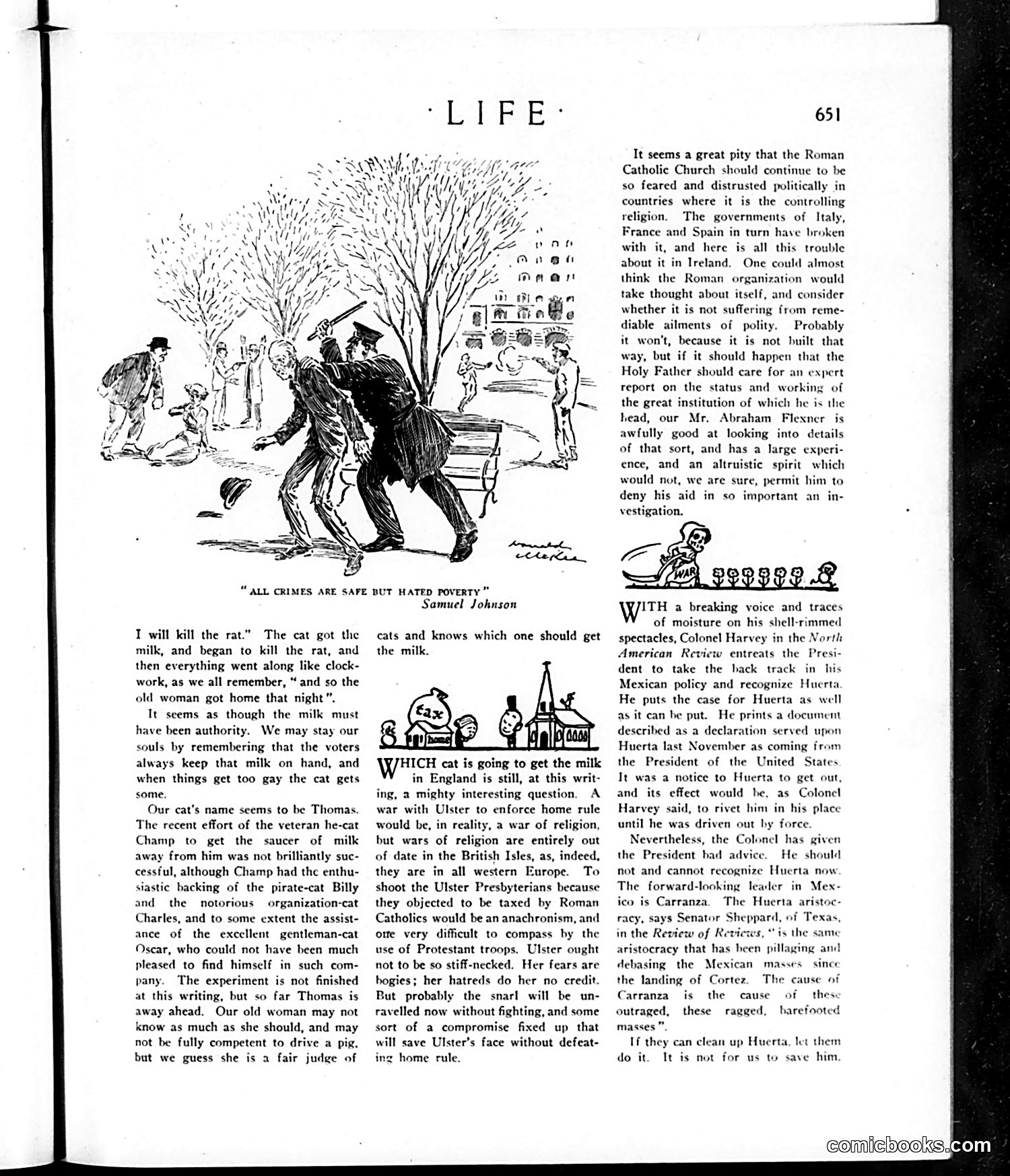
“ALL CRIMES ARE SAFE BUT HATED POVERTY” I will kill the rat." The cat got the milk, and began to kill the rat, and then everything went along like clock- work, as we all remember, “and so the old woman got home that night”. It seems as though the milk must have been authority. We may stay our souls by remembering that the voters always keep that milk on hand, and when things get too gay the cat gets some. Our cat's name seems to be Thomas. The recent effort of the veteran he-cat Champ to get the saucer of milk away from him was not brilliantly suc- cessful, although Champ had the enthu- siastic backing of the pirate-cat Billy and the notorious organization-cat Charles, and to some extent the assist- ance of the excellent gentleman-cat Oscar, who could not have been much pleased to find himself in such com- pany. The experiment is not finished at this writing, but so far Thomas is away ahead. Our old woman may not know as much as she should, and may not be fully competent to drive a pig, but we guess she is a fair judge of Samuel Johnson cats and knows which one should get the milk. ‘e. \ricr cat is going to get the milk in England is still, at this writ- ing, a mighty interesting question, A war with Ulster to enforce home rule would be, in reality, a war of religion, but wars of religion are entirely out of date in the British Isles, as, indeed, they are in all western Europe. To shoot the Ulster Presbyterians because they objected to be taxed by Roman Catholics would be an anachronism, and ome very difficult to compass by the use of Protestant troops. Ulster ought not to be so stiff-necked. Her fears are bogies; her hatreds do her no credit. But probably the snarl will be un- ravelled now without fighting, and some sort of a compromise fixed up that will save Ulster’s face without defeat- ing home rule. 651 It seems a great pity that the Roman Catholic Church should continue to be so feared and distrusted politically in countries where it is the controlling religion. The governments of Italy, France and Spain in turn have broken with and here is all this trouble about it in Ireland. One could almost think the Roman organization would take thought about itself, and consider whether it is not suffering from reme- diable ailments of polity, Probably it won't, because it is not built that way, but if it should happen that the Holy Father should care for an expert report on the status and working of the great institution of which he is the head, our Mr. Abraham Flexner is awfully good at looking into details of that sort, and has a large experi- ence, and an altruistic spirit which would not, we are sure, permit him to deny his aid in so important an in- vestigation. TK Witt a breaking voice and traces of moisture on his shell-rimmed spectacles, Colonel Harvey in the North American Review entreats the dent to take the back track in his Mexican policy and recognize Huerta He puts the case for Huerta as well as it can he put. He prints a document described as a declaration served upon Huerta last November as coming from the President of the United States It was a notice to Huerta to get out, and its effect would be, as Colonel Harvey said, to rivet him in his place until he was driven out by force. Nevertheless, the Colonel has given the President bad advice. He should not and cannot recognize Huerta now The forward-looking leader in Mex- ico is Carranza. The Huerta aristoc- racy, says Senator S of Texas, in the Review of Reviews, “ is the same aristocracy that has been pillaging anid debasing the Mexican masses sin the landing of Cortez. The cause Carranza is the cause of these outraged, these ragged, barefooted masses". If they can clean up Huerta, let them do it. It is not for us to save him. Presi- heppard comichooks,