
Life, 1914-04-09 · page 24 of 40
Life — April 9, 1914 — page 24: what you’re looking at
What you’re looking at
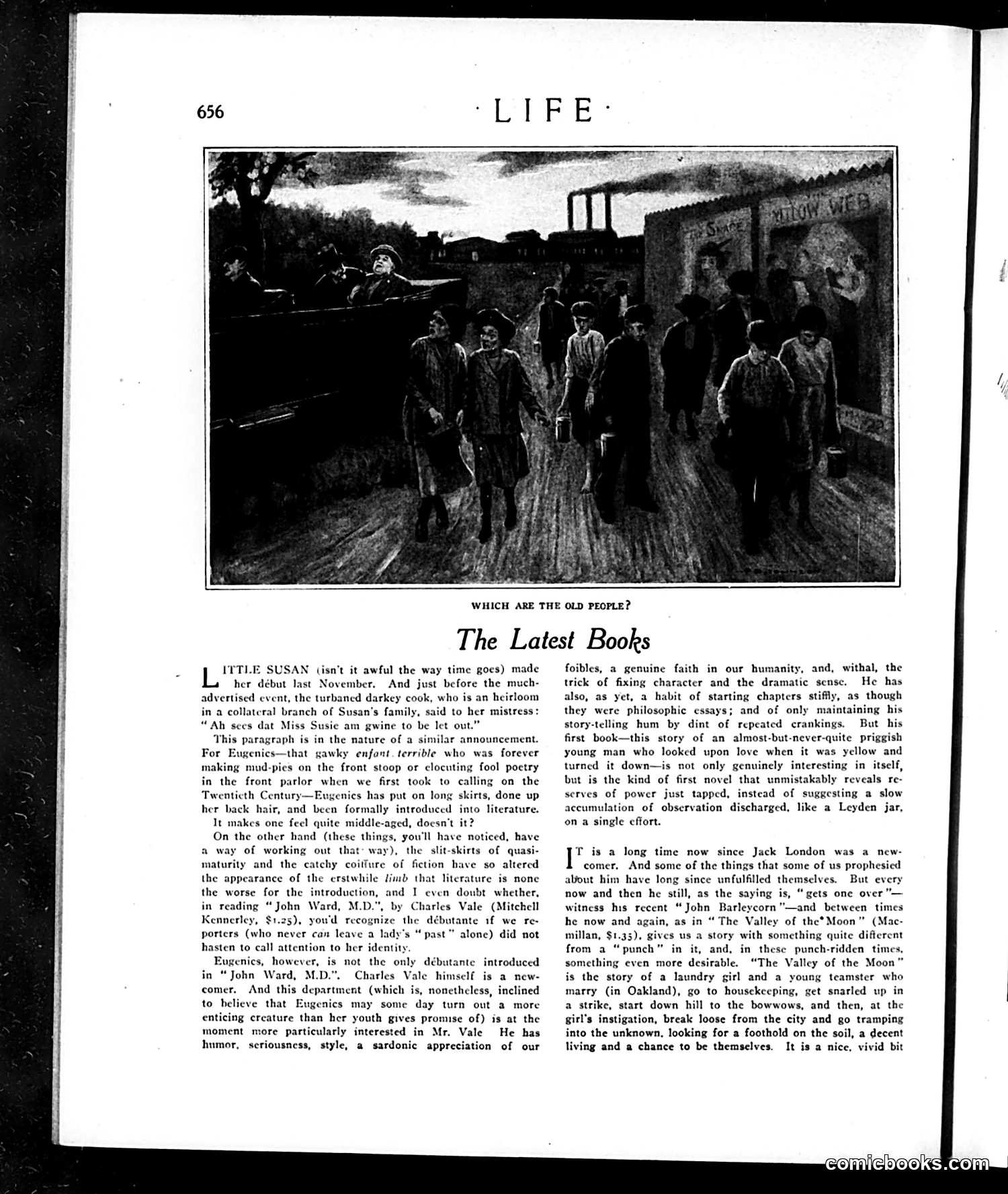
This is a book review section from *Life* magazine titled "The Latest Books," with a satirical illustration captioned "Which Are the Old People?" The image shows a crowd of people of varying ages gathered together, with the caption's joke being that it's difficult to distinguish old from young—a visual commentary on how modern fashion and styles have blurred generational distinctions. The reviews discuss new novels by Charles Vale (*John Ward, M.D.*) and Jack London (*The Valley of the Moon*). The critic playfully notes that Vale is a literary newcomer whose work shows promise despite stylistic roughness, while London—already an established author—continues producing solid work. The tone is witty and gossipy, typical of *Life's* literary commentary for an educated readership. The reviews emphasize character development, dramatic sense, and authentic human observation as marks of good fiction.
📄 Transcribed text from this page (OCR, searchable)
Machine-transcribed from the original scan — historical spelling and the odd misread are preserved.
WHICH ARE THE OLD PEOPLE? The Latest Books ITTLE SUSAN (isn’t it awful the way time goes) made her début last November. And just before the much- advertised event, the turbaned darkey cook, who is an heirloom in a collateral branch of Susan’s family, said to her mistress: “Ab sees dat Miss Susie am gwine to be let out.” This paragraph is in the nature of a similar announcement. For that gawky enfant. terrible who was forever making mud-pies on the front stoop or clocuting fool poetry in the front parlor when we first took to calling on the Twenticth Century—Eugenics has put on long skirts, done up her back hair, and been formally introduced into literature. It makes one feel quite middle-aged, doesn’t it? On the other hand (these things, you'll have noticed, have y of working out that: way), the slit-ski of quasi- maturity and the catchy coitfure of fiction have so altered the appearance of the erstwhile /imb that literature is none the worse for the introduction, and I even doubt whether, in reading “John Ward, M.L by Charles Vale (Mitchell Kennerley, $1.25), you'd recognize the débutante 1f we re- porters (who never can leave a lady's “ past” alone) did not hasten to call attention to her identity. Eugenics, however, is not the only débutante introduced in “John Ward, M.D.”. Charles Vale himself is a new- comer. And this department (which is, nonetheless, inclined to believe that Eugenics may some day turn out a more enticing creature than her youth gives promise of) is at the moment more particularly interested in Mr. Vale He has humor, seriousness, style, a sardonic appreciation of our foibles, a genuine faith in our humanity, and, withal, the trick of fixing character and the dramatic sense, He has also, as yet, a habit of starting chapters stiffly, as though they were philosophic essays; and of only maintaining his story-telling hum by dint of repeated crankings. But his first book—this story of an almost-but-never-quite priggish young man who looked upon love when it was yellow and turned it down—is not only genuinely interesting in itself, but is the kind of first novel that unmistakably reveals re- serves of power just tapped, instead of suggcsting a slow accumulation of observation discharged, like a Leyden jar, on a single effort. I" is a long time now since Jack London was a new- comer, And some of the things that some of us prophesied about him have long since unfulfilled themselves. But every now and then he still, as the saying is, “gets one over "— witness his recent “John Barleycorn ”—and between times he now and again, as in “ The Valley of the*Moon” (Mac- millan, $1.35), gives us a story with something quite different from a “punch” in it, and, in these punch-ridden times, something even more desirable. “The Valley of the Moon” is the story of a laundry girl and a young teamster who marry (in Oakland), go to housekeeping, get snarled up in a strike, start down hill to the bowwows, and then, at the girl's instigation, break loose from the city and go tramping into the unknown, looking for a foothold on the soil, a decent living and a chance to be themselves. It is a nice, vivid bit