
Life, 1914-04-09 · page 26 of 40
Life — April 9, 1914 — page 26: what you’re looking at
What you’re looking at
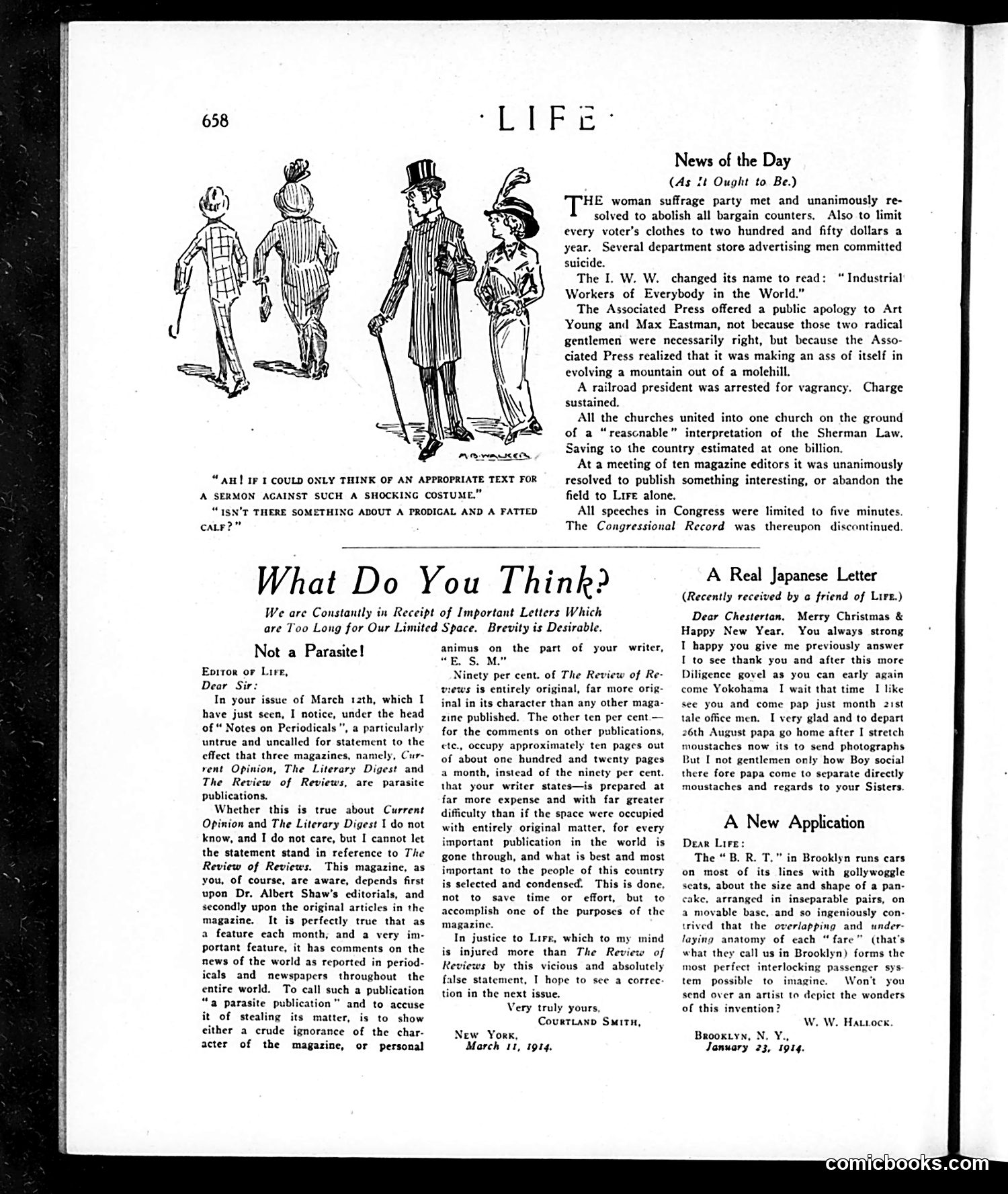
The cartoon depicts two figures in conversation, dressed in period clothing (early 1900s). One says he needs "an appropriate text for a sermon against such a shocking costume," to which the other responds with a biblical reference: "Isn't there something about a prodigal and a fatted calf?" The satire targets **women's fashion**, likely the increasingly revealing or unconventional clothing styles of the era. The second speaker's biblical allusion to the Prodigal Son parable mocks the first figure's moralistic handwringing—suggesting that condemning modern dress through sermon is as absurdly misguided as the parable's cautionary tale. The "News of the Day" section satirizes various reform movements and institutions: women's suffrage activists, labor organizations (I.W.W.), department stores, the railroad industry, churches, and Congress. Each item presents absurdist "reforms" (abolishing bargain counters, limiting clothing budgets, limiting congressional speeches) as satirical critiques of contemporary social movements and institutions that Life's editors viewed skeptically.
📄 Transcribed text from this page (OCR, searchable)
Machine-transcribed from the original scan — historical spelling and the odd misread are preserved.
a “aul IF I COULD ONLY THINK OF AN APPROPRIATE TEXT FOR A SERMON AGAINST SUCH A SHOCKING COSTUME.” “ISN'T THERE SOMETHING ABOUT A PRODIGAL AND A FATTED Cc . News of the Day (As ft Ought to Be.) HE woman suffrage party met and unanimously re- solved to abolish all bargain counters. Also to limit every voter’s clothes to two hundred and fifty dollars a year. Several department store advertising men committed suicide. The I. W. W. changed its name to read: Workers of Everybody in the World.” The Associated Press offered a public apology to Art Young andl Max Eastman, not because those two radical gentlemen were necessarily right, but because the Asso- ciated Press realized that it was making an ass of itself in evolving a mountain out of a molehill. A railroad president was arrested for vagrancy. sustained. All the churches united into one church on the ground of a “reascnable” interpretation of the Sherman Law. Saving to the country estimated at one billion. At a meeting of ten magazine editors it was unanimously resolved to publish something interesting, or abandon the field to Lire alone. All speeches in Congress were limited to five minutes. The Congressional Record was thereupon discontinued. “Industrial Charge What Do You Think? We are Constantly in Receipt of Important Letters Which are Too Long for Our Limited Space. Brevity is Desirable. Not a Parasite! Epitor oF Lire, Dear Sir: In your issue of March 12th, which I have just seen, I notice, under the head of “ Notes on Periodicals", a particularly untrue and uncalled for statement to the effect that three magazines, namely, Cur- rent Opinion, The Literary Digest and The Review of Reviews, are parasite publications. Whether this is true about Current Opinion and The Literary Digest 1 do not know, and I do not care, but I cannot let the statement stand in reference to The Review of Reviews. This magazine, as you, of course, are aware, depends first upon Dr. Albert Shaw's editorials, and secondly upon the original articles in the magazine. It is perfectly true that as a feature each month, and a very im- portant feature, it has comments on the news of the world as reported in period- icals and newspapers throughout the entire world. To call such a publication “a parasite publication” and to accuse it of stealing its matter, is to show either a crude ignorance of the char- acter of the magazine, or personal animus on the part of your writer, “E. S.M.” ety per cent. of The Review of Re- views is entirely original, far more orig- inal in its character than any other maga- zine published. The other ten per cent — for the comments on other publications, ete., occupy approximately ten pages out of about one hundred and twenty pages a month, instead of the ninety per cent. that your writer states—is prepared at far more expense and with far greater difficulty than if the space were occupied with entirely original matter, for every important publication in the world is gone through, and what is best and most important to the people of this country is selected and condensed. This is done, not to save time or effort, but to accomplish one of the purposes of the magazine. In justice to Lire, which to my mind is injured more than The Review of Reviews by this vicious and absolutely false statement, I hope to see a correc: tion in the next issue. Very truly yours, Courttanp Smitn, New York, March 11, 1914. A Real Japanese Letter (Recently received by o friend of Lire.) Dear Chestertan. Merry Christmas & Happy New Year. You always strong I happy you give me previously answer I to see thank you and after this more Diligence govel as you can early again come Yokohama I wait that time I like see you and come pap just month 21st tale office men. I very glad and to depart 26th August papa go home after I stretch moustaches now its to send photographs But [ not gentlemen only how Boy social there fore papa come to separate directly moustaches and regards to your Sisters. A New Application Dear Lire: The “B. R. T.” in Brooklyn runs cars on most of its lines with gollywoggle seats, about the size and shape of a pan- cake, arranged in inseparable pairs, on a movable base, and so ingeniously con- trived that the overlapping and under- laying anatomy of each “ fare” (that's what they call us in Brooklyn) forms the most perfect interlocking passenger sys tem possible to imagine. Won't you send over an artist to depict the wonders of this invention? W. W. Hatrock. Brooxtyw, N. Y., January 23, 1914.