
Life, 1914-04-09 · page 18 of 40
Life — April 9, 1914 — page 18: what you’re looking at
What you’re looking at
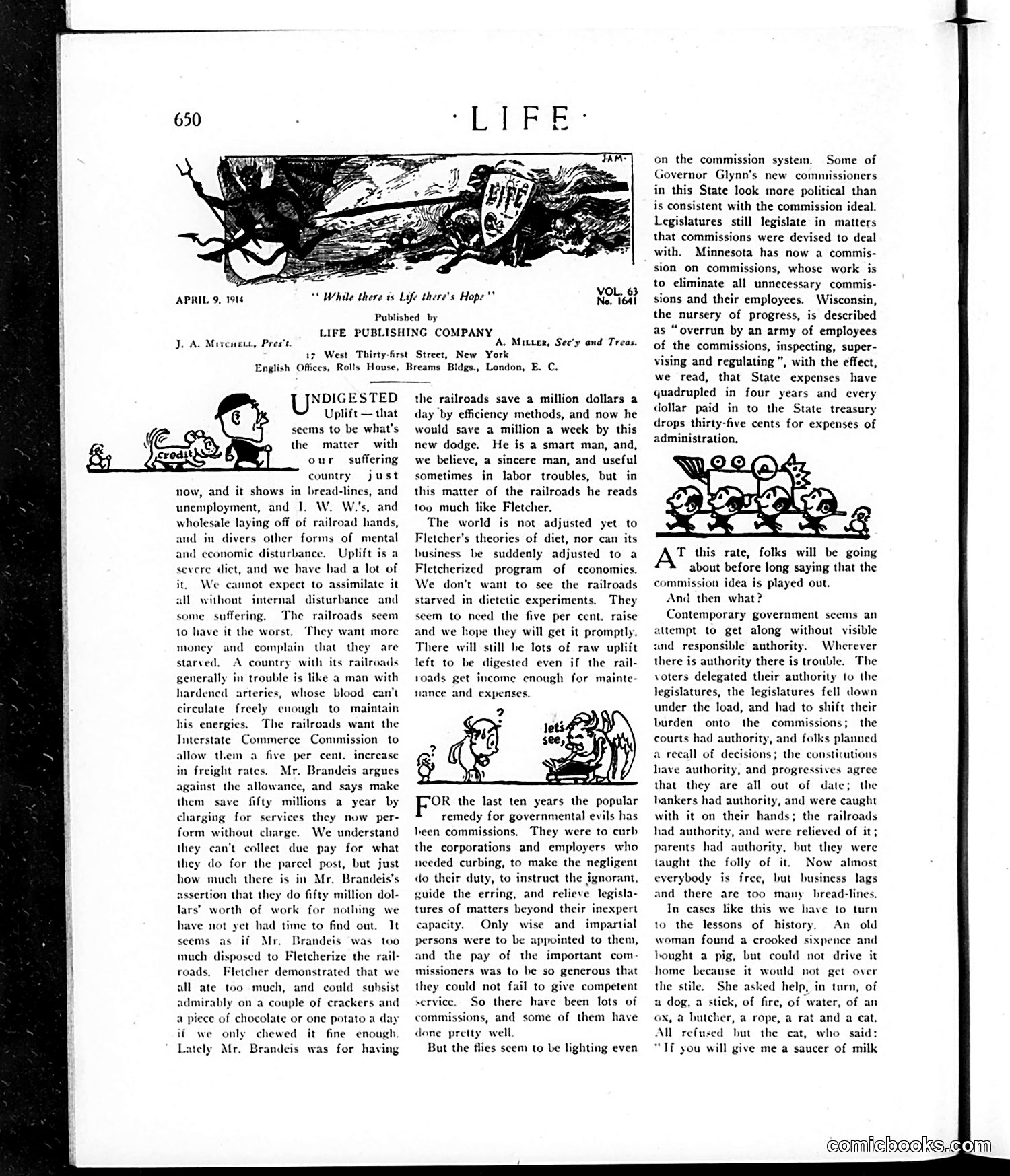
This editorial page critiques two contemporary Progressive Era policies through satirical commentary. **The "Uplift" Cartoon (top left):** Depicts the railroad industry suffering from excessive "uplift"—reformist policies. The article sarcastically compares railroads to a man with "hardened arteries," arguing they need financial relief (a 5% rate increase) rather than efficiency experiments. It mocks Louis Brandeis's approach as "Fletcherizing" the railroads—a reference to Horace Fletcher, a diet guru promoting extreme food rationing. The satire suggests Brandeis's cost-cutting is starving the industry like Fletcher's diet starves the body. **The Commission Critique (second piece):** Attacks the Progressive solution of creating government commissions to regulate corporations and reform. While praising their initial ideals, the author notes they've become politicized, duplicative, and bureaucratically bloated. Governor Glynn's commissioners appear more "political" than impartial; Wisconsin's commission system is "overrun" with employees. The underlying complaint: commissions have become ineffective bureaucratic sprawl rather than solutions. Both pieces express skeptical conservatism toward Progressive reform methods.
📄 Transcribed text from this page (OCR, searchable)
Machine-transcribed from the original scan — historical spelling and the odd misread are preserved.
APRIL 9, 1914 ‘* While there ts Life there's Hope"* Published by LIFE PUBLISHING COMPANY J. A. Mirenens, Pres’. A. Mitter, Sec’y and Treas. 17 West Thirty-first Street, New York English Offices, Rolls House, Breams Bldgs., London, E. C. NDIGESTED Uplift — that seems to be what's the matter with our suffering country just now, and it shows in bread-lines, and unemployment, and I. W. W.'s, and wholesale laying off of railroad hands, and in divers other forms of mental and cconomic disturbance. Uplift is a severe diet, and we have had a lot of it. We cannot expect to assimilate it all without internal and some suffering. The seem to have it the worst. They want more money and complain that they are starved. A country with its railroads generally in trouble is like a man with hardened arteries, whose blood can't circulate freely cnough to maintain his energies. The railroads want the Interstate Commerce Commission to allow a five per cent. increase in freight rates. Mr. Brandeis argues inst the allowance, and says make ve fifty millions a year by charging for services they now per- form without charge. We understand they can't collect due pay for what they do for the parcel post, but just how much there is in Mr, Brandeis’s ertion that they do fifty million dol- lars’ worth of work for nothing we have not yet had time to find out. It seems as if Mr. Brandeis was too much disposed to Fletcherize the rail- roads. Fletcher demonstrated that we all ate much, and could subsist admirably on a couple of crackers and a piece of chocolate or one potato a day if we only chewed it fine enough. Lately Mr. Brandeis was for having disturbance roads them them the railroads save a million dollars a by efficiency methods, and now he would save a million a week by this new dodge. He is a smart man, and, we believe, a sincere man, and useful sometimes in labor troubles, but in this matter of the railroads he reads too much like Fletcher, The world is not adjusted yet to Fletcher's theories of diet, nor can its business be suddenly adjusted to a Fletcherized program of economies We don't want to sce the railroads starved in dietctic experiments. They seem to need the five per cent. raise and we hope they will get it promptly. There will still he lots of raw uplift left to be digested even if the rail- roads get income enough for mainte- nance and expenses. ‘OR the last ten years the popular remedy for governmental evils has heen commissions. They were to curb the corporations and employers who needed curbing, to make the negligent do their duty, to instruct the ignorant, guide the erring, and relieve legisla- tures of matters beyond their inexpert capacity. Only and impartial persons were to be appointed to them, and the pay of the important com- missioners was to be so generous that they could not fail to give competent service. So there have been lots of commissions, and some of them have done pretty well But the flies seem to be lighting even wise on the commission system. Some of Governor Glynn's new commissioners in this State look more political than is consistent with the commission ideal. Legislatures still legislate in matters that commissions were devised to deal with. Minnesota has now a commis- sion on commissions, whose work is to eliminate all unnecessary commis- sions and their employees. Wisconsin, the nursery of progress, is described as “overrun by an army of employees of the commissions, inspecting, super- vising and regulating”, with the effect, we read, that State expenses have quadrupled in four years and every dollar paid in to the State treasury drops thirty-five cents for expenses of administration. T this rate, folks will be going about before long saying that the commission idea is played out. And then what? Contemporary government seems an altempt to get along without visible und responsible authority. Wherever there is authority there is trouble. The voters delegated their authority to the legislatures, the legislatures fell down under the load, and had to shift their burden onto the commissions; the courts had authority, and folks planned a recall of decisions; the constitutions have authority, and progressives agree that they are all out of date; the hankers had authority, and were caught with it on their hands; the railroads had authority, and were relieved of it; parents had authority, but they were taught the folly of it. Now almost everybody is free, but business la and there are too many bread-lines. In cases like this we have to turn to the lessons of history, An old woman found a crooked sixpence and bought a pig, but could not drive it home because it would not get over the stile. She asked help, in turn, of a dog, a stick, of fire, of water, of an ox, a butcher, a rope, a rat and a cat. All refused but the cat, who said: “If you will give me a saucer of milk comichooks.