
Life, 1914-04-09 · page 16 of 40
Life — April 9, 1914 — page 16: what you’re looking at
What you’re looking at
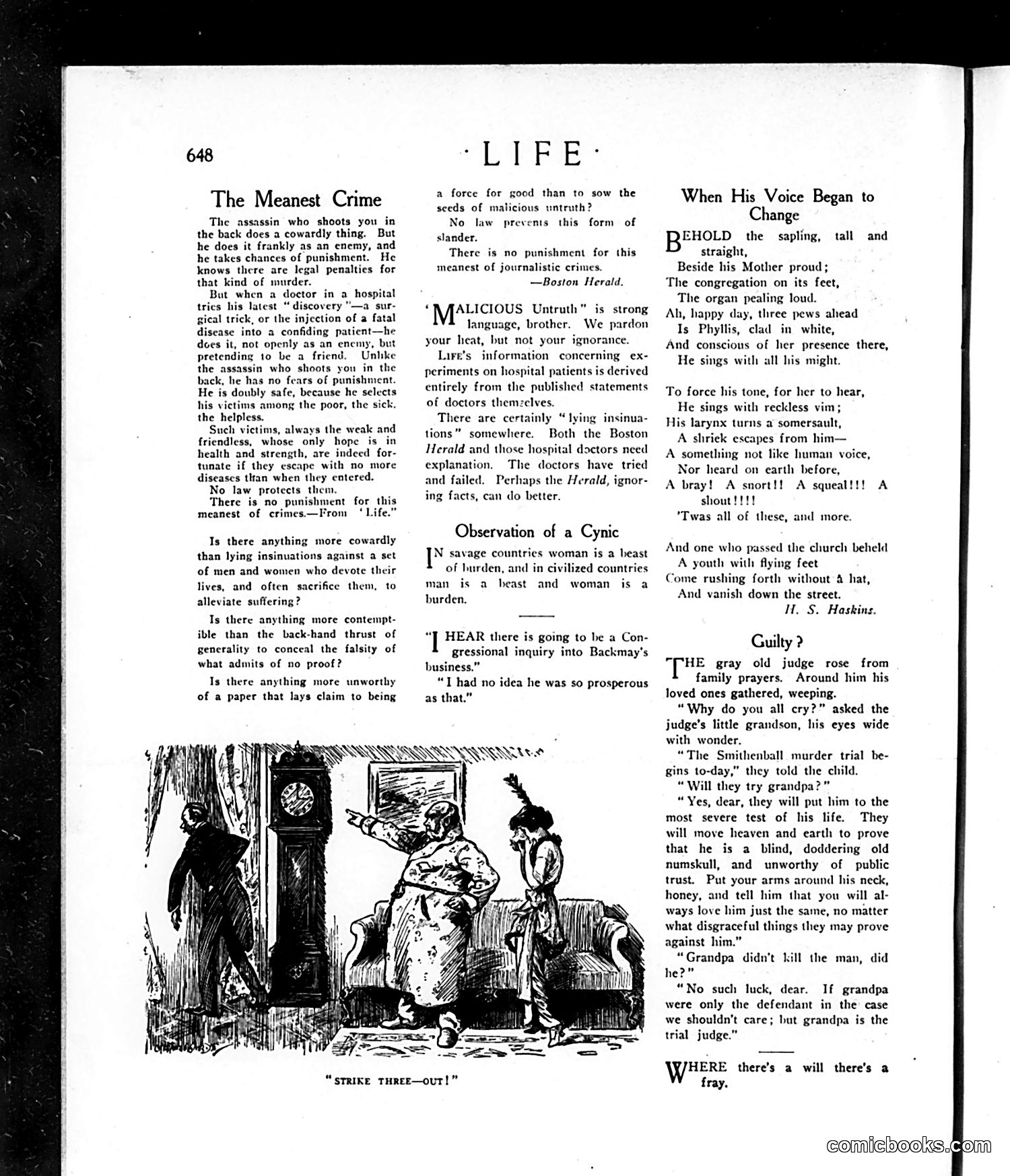
This page contains multiple satirical pieces typical of *Life* magazine's editorial approach: **"The Meanest Crime"** — A pointed attack on unethical medical experimentation. Life accuses doctors of conducting dangerous, untested procedures on poor hospital patients under the guise of scientific "discovery." The Boston Herald's response (below) defends doctors and accuses Life of making false insinuations. Life's rebuttal argues their claims derive from doctors' own published statements, suggesting the Herald should defend the facts rather than attack the magazine's motives. **"Observation of a Cynic"** — A brief misogynistic quip equating women to beasts of burden in both "savage" and "civilized" countries. **"When His Voice Began to Change"** and **"Guilty?"** — Humorous or sentimental verse pieces on adolescence and a judge's impartiality, respectively. The cartoon "Strike Three—Out!" depicts a domestic dispute, likely illustrating social commentary about family conflict or gender dynamics, though specifics are unclear from the image alone.
📄 Transcribed text from this page (OCR, searchable)
Machine-transcribed from the original scan — historical spelling and the odd misread are preserved.
648 The Meanest Crime The assassin who shoots you in the back does a cowardly thing. But he does it frankly as an enemy, and he takes chances of punishment. He knows there are legal penalties for that kind of murder. But when a doctor in a hospital tries his latest “discovery "—a sur- gical trick, or the injection of a fatal disease into a confiding patient—he does it, not openly as an enemy, but pretending to be a friend. Unhke the assassin who shoots you in the back, he has no fears of punishment. He is doubly safe, because he sel his victims among the poor, the sick. the helpless. Such vict always the weak and friendless, whose only hope is in health and strength, are indeed for- tunate if they escape with no more diseases than when they entered. No law protects them. There is no punishment for this meanest of crimes—From ‘ Life.” Is there anything more cowardly than lying insinuations against a set of men and women who devote their lives, and often sacrifice them, to alleviate suffering? Is there anything more contempt- ible than the back-hand thrust of generality to conceal the falsity of what admits of no proof? Is there anything more unworthy of a paper that lays claim to being “RE a force for good than to sow the seeds of malicious untruth? No law prevents this form of slander. There is no punishment for this meanest of journalistic crimes. —Boston Herald. ? ALICIOUS Untruth” is strong language, brother. We pardon your heat, but not your ignorance. Lire’s information concerning ex- periments on hospital patients is derived entirely from the published statements of doctors themzelves. There are certainly “lying insinua- tions” somewhere. Both the Boston Herald and those hospital doctors need explanation, The doctors have tried and failed. Perhaps the Herald, ignor- ing facts, can do better. Observation of a Cynic [8 savage countries woman is a beast of burden, and in civilized countries beast and man is a is a burden. woman “T HEAR there is going to be a Con- gressional inquiry into Backmay's business.” “T had no idea he was so prosperous as that.” iit SIA “STRIKE THREE—ouT!” When His Voice Began Change EHOLD the sapling, tall straight, Beside his Mother proud; The congregation on its feet, The organ pealing loud. Ah, happy day, three pews ahead Is Phyllis, clad in white, And conscious of her presence there, He sings with all his might. To force his tone, for her to hear, He sings with reckless vim; His larynx turns a somersault, A shriek escapes from him— A something not like human voice, Nor heard on earth before, bray! A snort!! A squeal!!! A shout !!!! Twas all of 11 and more. And one who passed the church beheld A youth with flying feet Come rushing forth without & hat, And vanish down the street. H. S. Haskins. Guilty ? THE gray old judge rose from family prayers. Around him his loved ones gathered, weeping. “Why do you all cry?” asked the judge’s little grandson, his eyes wide with wonder. “The Smithenball murder trial be- gins to-day,” they told the child. “Will they try grandpa?” “Yes, dear, they will put him to the most severe test of his life. They will move heaven and earth to prove that he is a blind, doddering old numskull, and unworthy of public trust. Put your arms around his neck, honey, and tell him that you will al- ways love him just the same, no matter what disgraceful things they may prove against him.” “Grandpa didn’t kill the man, did he?” “No such luck, dear. If grandpa were only the defendant in the case we shouldn't care; but grandpa is the trial judge.” HERE fray. there’s a will there's a comichooks.qom