
A complete issue · 44 pages · 1913
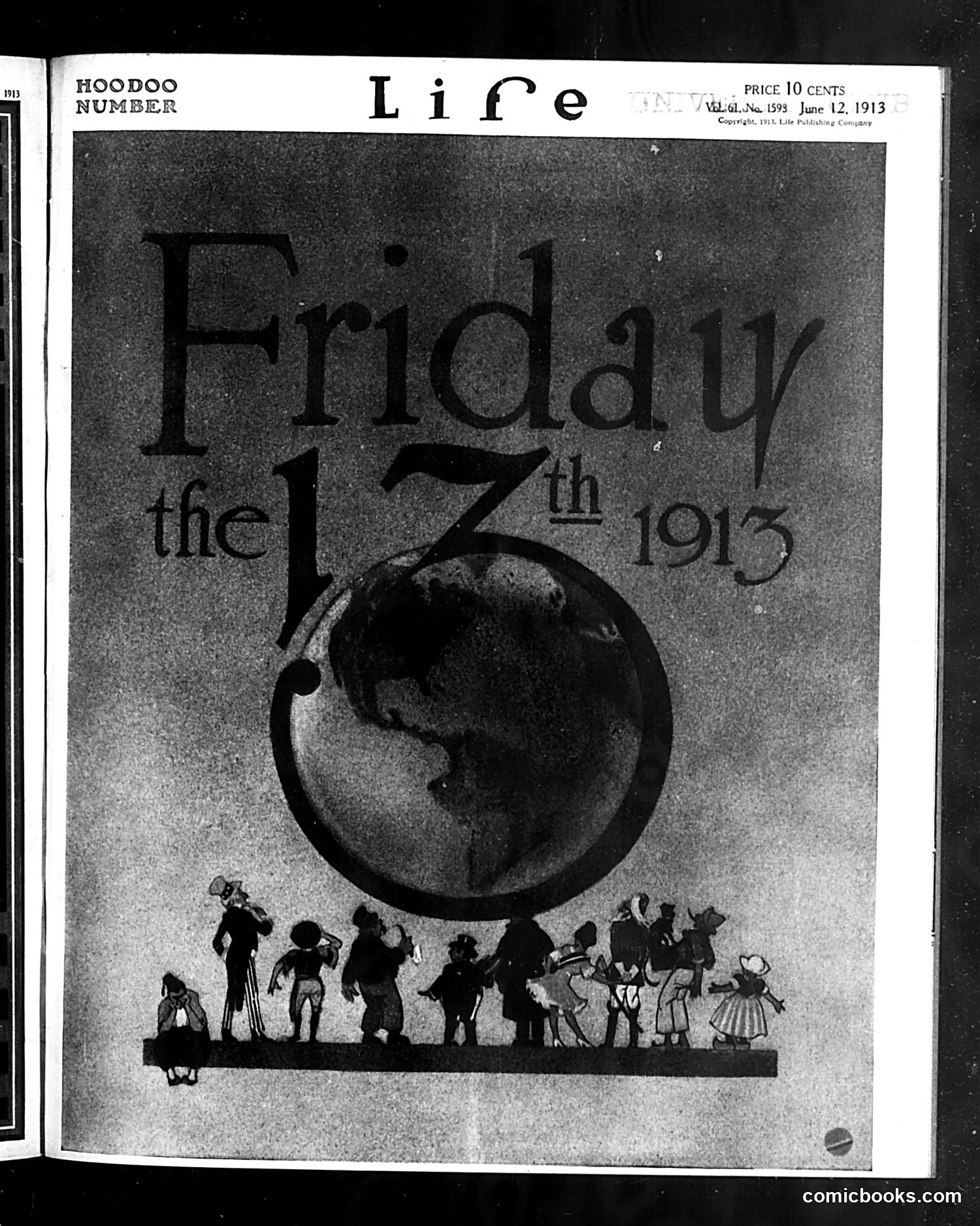
Life — June 12, 1913
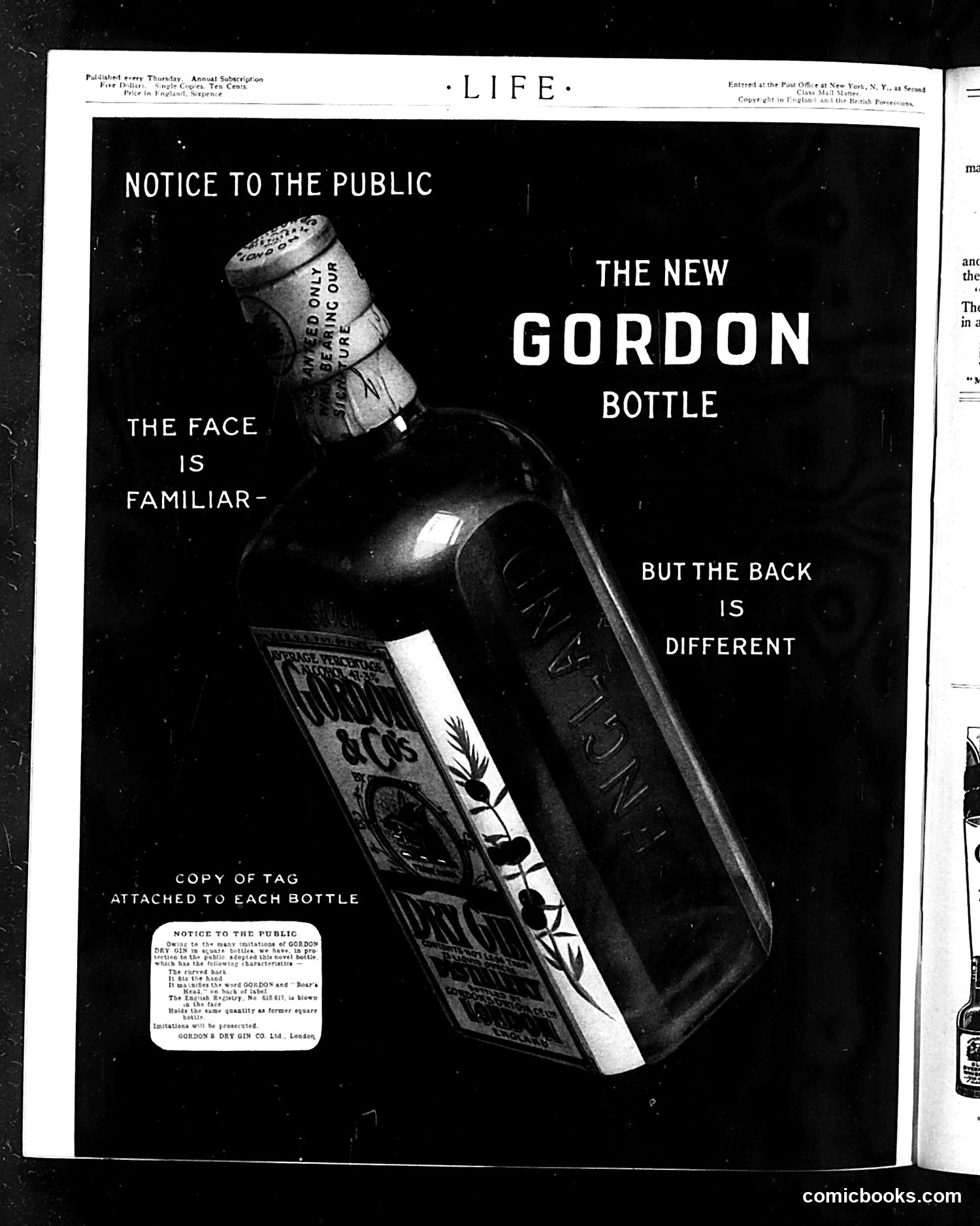
This is a product advertisement rather than political satire. It announces a redesigned Gordon's Gin bottle to the public, appearing in *Life* magazine. The ad highlights a marketing strategy: the bottle's front face remains recognizable to consumers (maintaining brand familiarity), but the back has been redesigned. A tag attached to each bottle explains the changes to purchasers. The small text box at bottom appears to contain legal or explanatory copy regarding the bottle's new design characteristics. This represents straightforward commercial advertising—Gordon's Dry Gin promoting a packaging update to existing customers. The "Notice to the Public" framing adds formality and legitimacy to what is essentially a consumer product notification about bottle redesign.
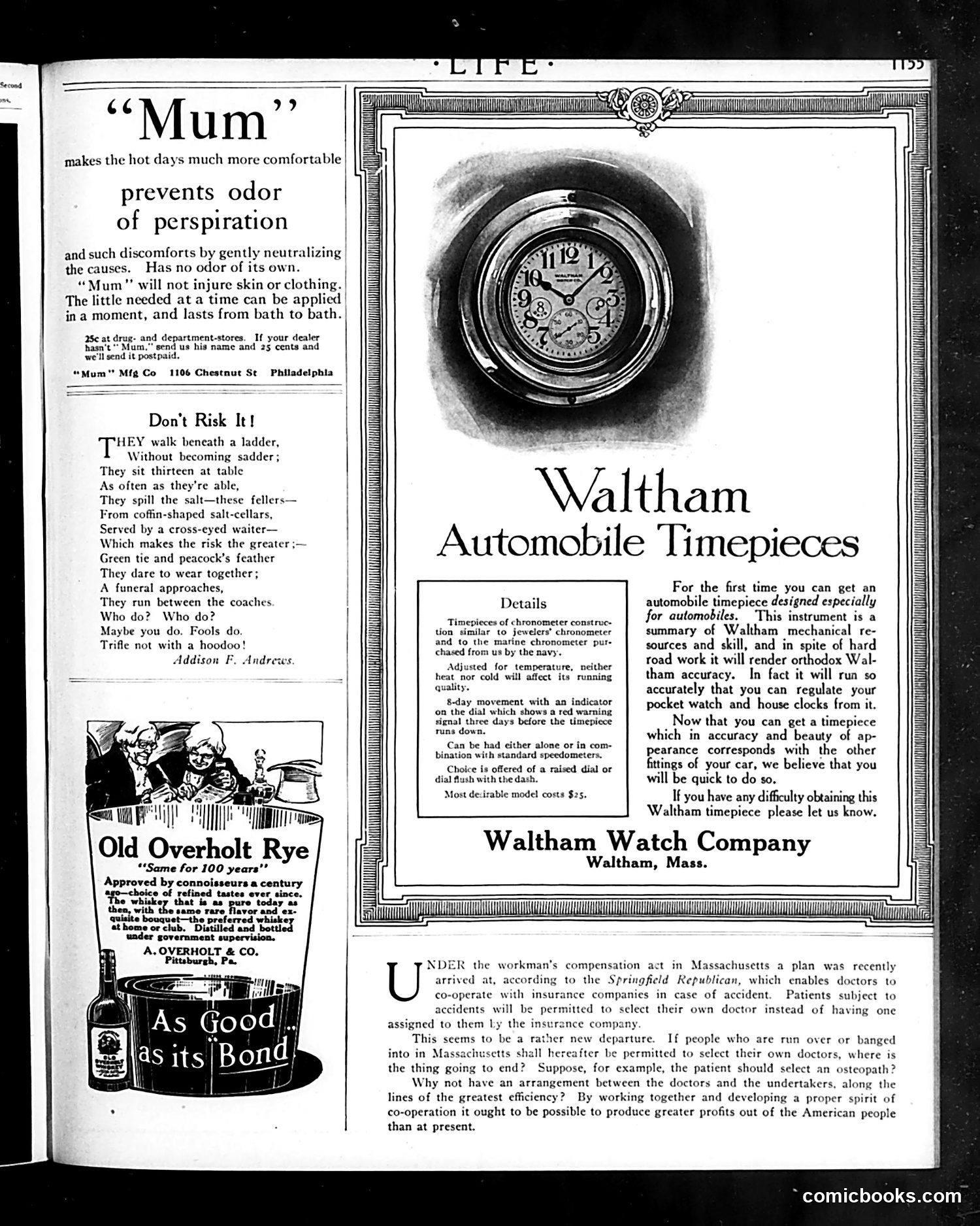
This page is primarily **advertising**, not political satire. The main content includes: 1. **"Mum" deodorant ad** (left): Promotes a perspiration odor neutralizer for hot weather, priced at 25 cents. 2. **"Don't Risk It!" poem** (left): A humorous cautionary verse about the superstitions surrounding walking under ladders, sitting thirteen at table, and other folk omens—likely satirizing people's irrational beliefs. 3. **Waltham Automobile Timepieces ad** (right): Showcases a car dashboard clock, emphasizing precision engineering for automobiles. 4. **Old Overholt Rye whiskey ad** (bottom left): Markets the liquor as approved by connoisseurs for 100 years. The page reflects early 20th-century consumer culture, product marketing, and contains a mild satirical poem about superstition rather than political commentary.
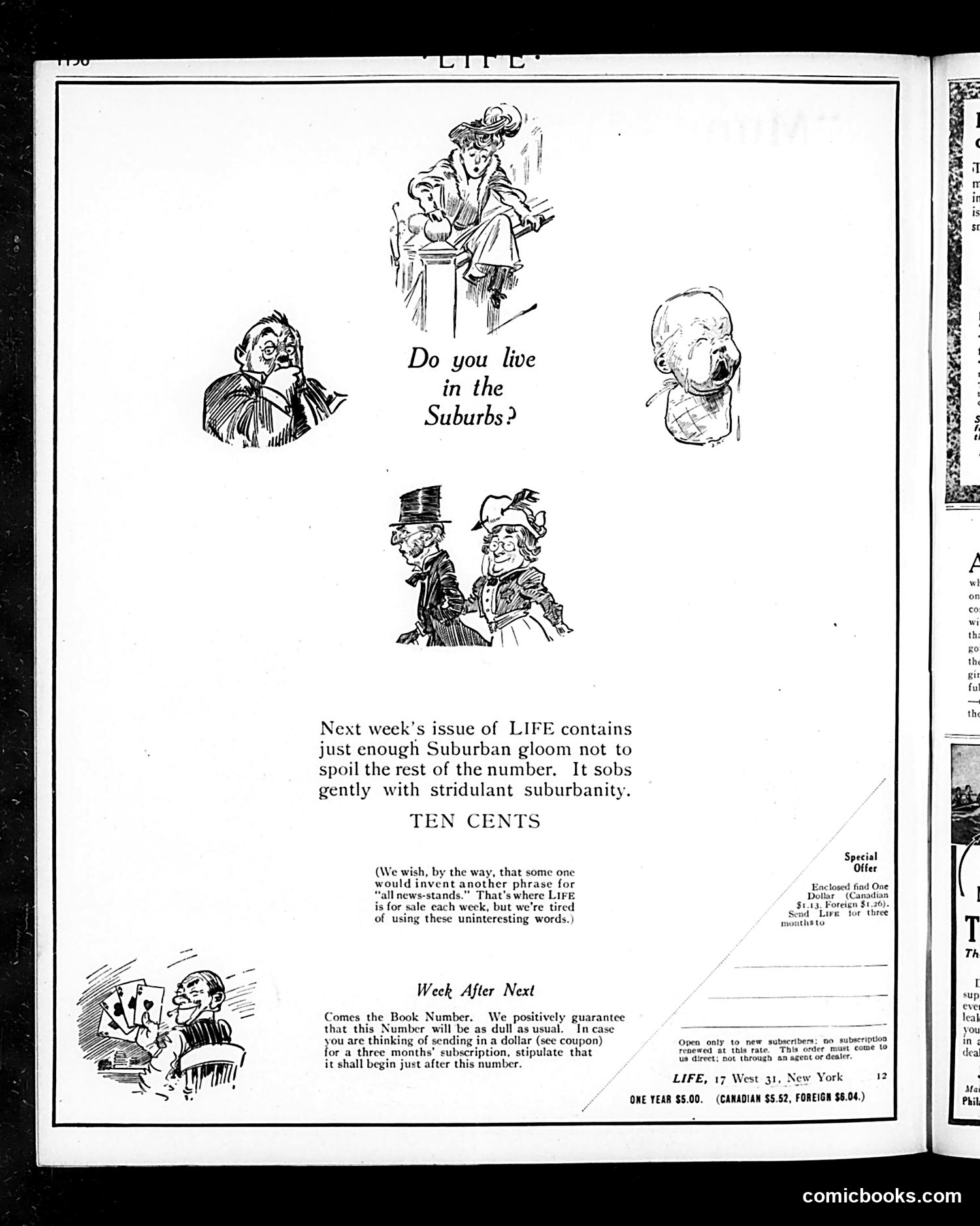
This page advertises next week's issue with a satirical theme: "Do you live in the Suburbs?" The cartoon sketches show various character types—working-class and middle-class figures depicted with exaggerated features typical of early-20th-century caricature. The accompanying text mocks suburban life with phrases like "stridulant suburbanity" (likely meaning harsh or grating suburban character). The satire suggests suburban living represents a kind of cultural decline or pretension worth ridiculing. The bottom section advertises "Week After Next," promoting the "Book Number" issue and offering subscription deals. A small cartoon shows someone excitedly handling money—advertising the value proposition. This reflects Life's role as sophisticated urban satire, poking fun at middle-class suburban expansion during America's suburban boom era.
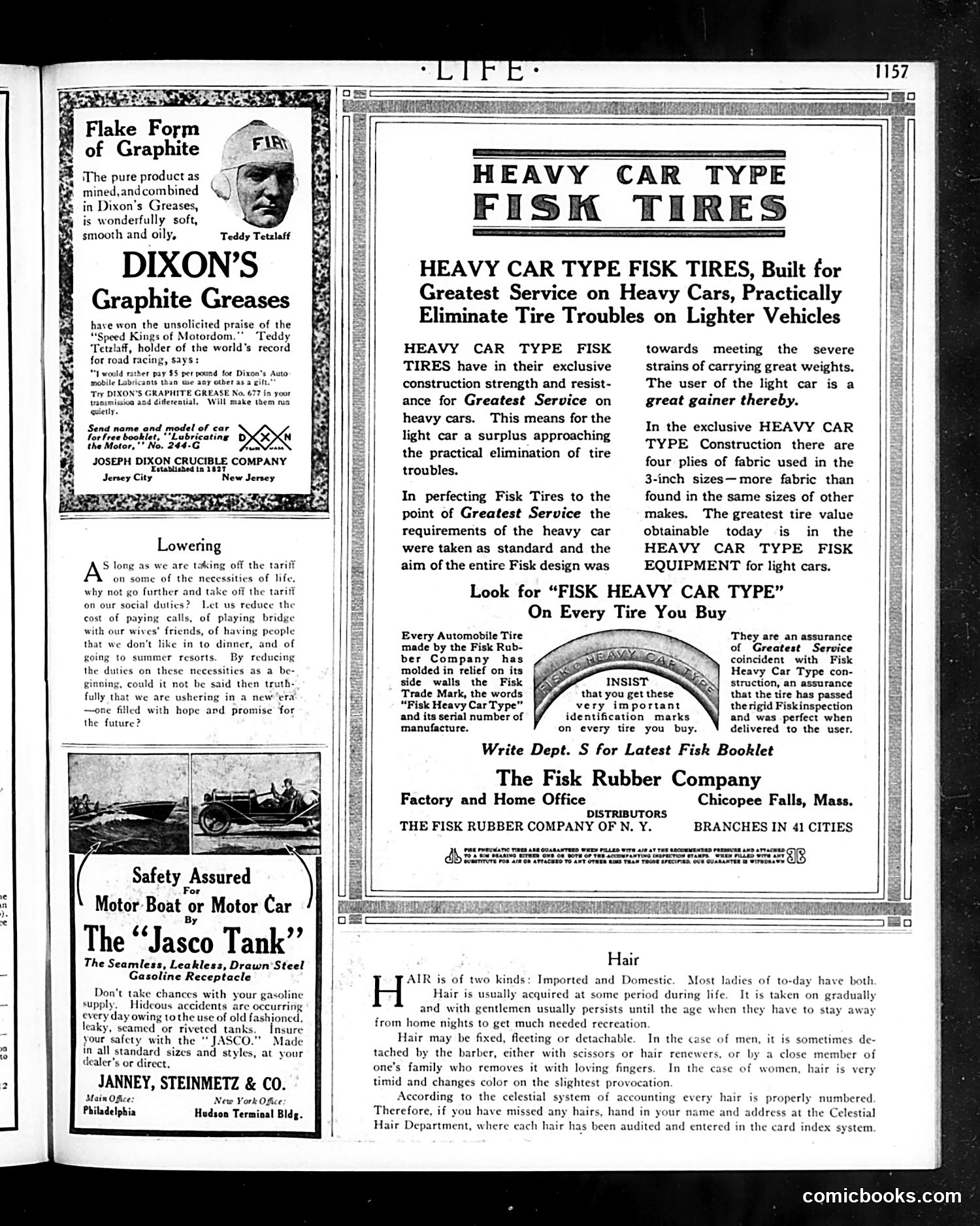
This page is primarily **advertising content** rather than satirical cartoons. It contains three distinct advertisements: 1. **Dixon's Graphite Greases** (left): Features Teddy Roosevelt (labeled "Teddy Testiloff"), using his celebrity endorsement to promote motor lubricant. The reference to Roosevelt's racing interests makes him a fitting spokesperson. 2. **Fisk Heavy Car Type Tires** (center/right): A substantial advertisement emphasizing tire durability for heavy vehicles, with brand identification marks and distributor information. 3. **Jasco Tank** and **Hair** articles (bottom): The Jasco Tank promotes seamless steel gasoline containers; the "Hair" section discusses hair care practices. The page reflects early 20th-century advertising conventions where celebrity endorsements and practical automotive products dominated lifestyle magazines' revenue.
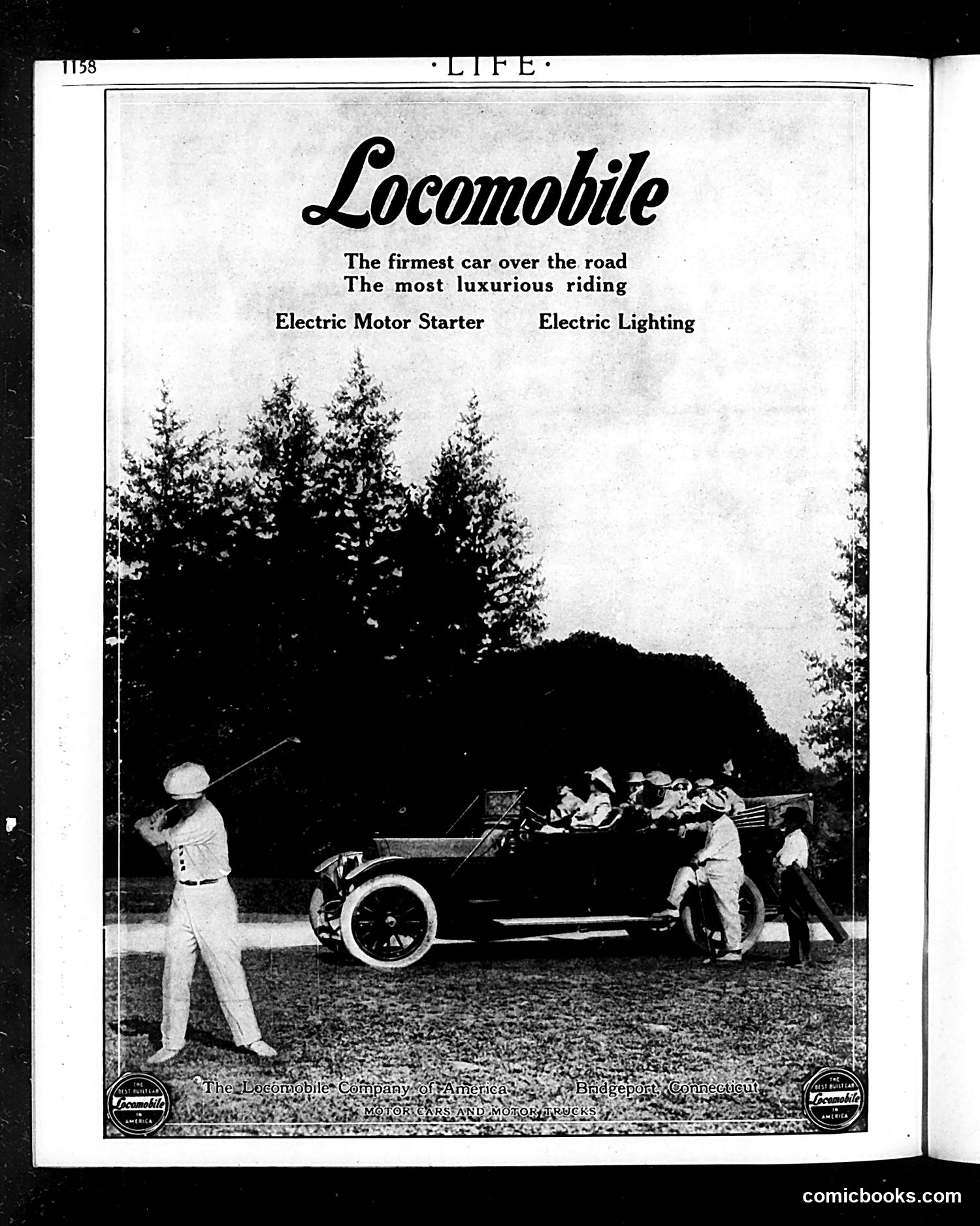
This is primarily a **Locomobile automobile advertisement**, not political satire. The page promotes the Locomobile car with the tagline "The firmest car over the road / The most luxurious riding." The image shows a leisure scene: a man batting a baseball while a Locomobile automobile full of passengers waits nearby, with other men standing around. The advertisement highlights features like "Electric Motor Starter" and "Electric Lighting"—modern conveniences for the era. The implicit message is that the Locomobile is so reliable and comfortable that owners can leisurely pursue recreational activities (baseball) without worry. This reflects early 1900s marketing aimed at wealthy consumers, positioning the automobile as enabling a lifestyle of ease and pleasure rather than mere transportation.
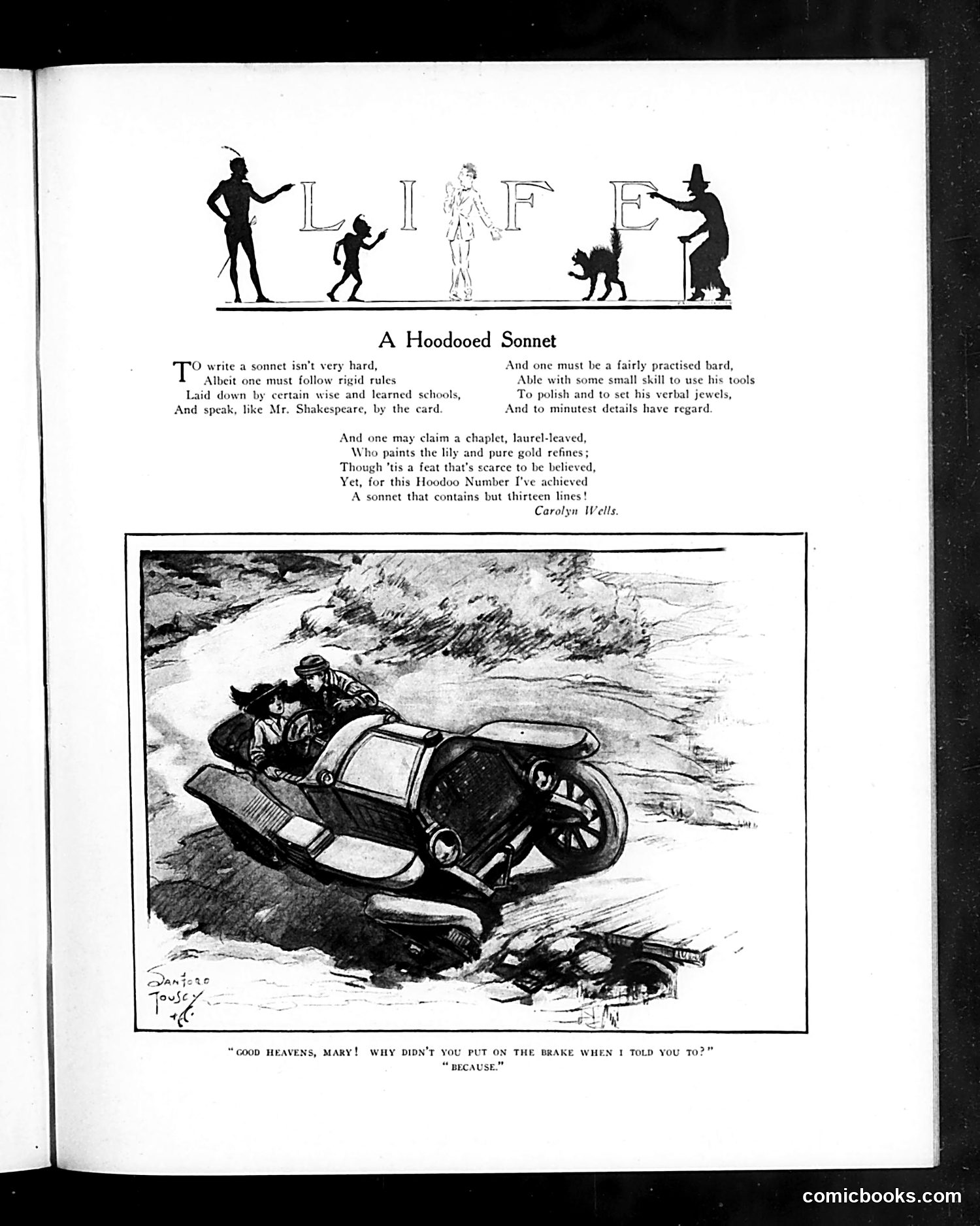
This page presents "A Hoodooed Sonnet" by Carolyn Wells—a playful poem about the difficulty of writing sonnets while following strict poetic rules. The humorous illustration below depicts a motorcycle accident, with two people in a sidecar that has crashed on a hillside. The cartoon's caption reads: "Good heavens, Mary! Why didn't you put on the brake when I told you to?" / "Because." The joke combines the sonnet's theme about constraints and rules with the illustration's ironic situation: the driver gave explicit instructions ("put on the brake"), yet the passenger did the opposite. The single-word answer "Because" humorously suggests no logical reason exists—pure stubbornness or inexplicable human behavior. The "hoodoo" (bad luck) referenced in the title connects to this consequence of not following rules.
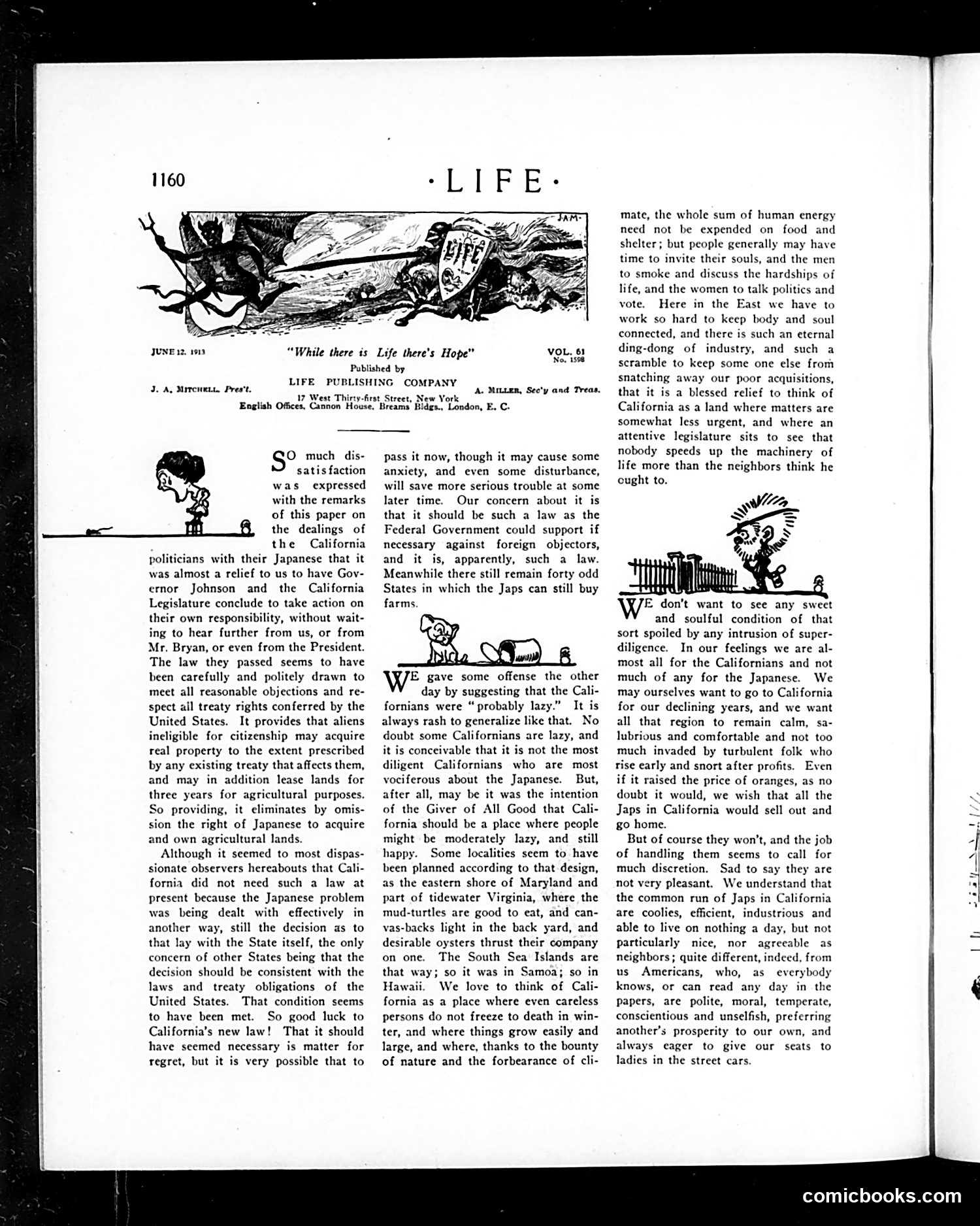
This editorial page addresses California's **anti-Japanese sentiment and discriminatory land laws**. The text criticizes Governor Johnson and the California Legislature for restricting Japanese land ownership rights—legislation apparently passed without waiting for federal guidance or presidential approval. The cartoons (appearing to mock California politicians) illustrate the article's central argument: that California's actions are hypocritical and economically short-sighted, treating Japanese residents unfairly despite their contributions to the state. The piece defends Japanese Californians against stereotypes of laziness, arguing they're industrious and deserving of better treatment. It advocates for California as a more tolerant place where people of different backgrounds could coexist peacefully—a progressive stance for 1919, when anti-Asian discrimination was widespread and legally enforced.
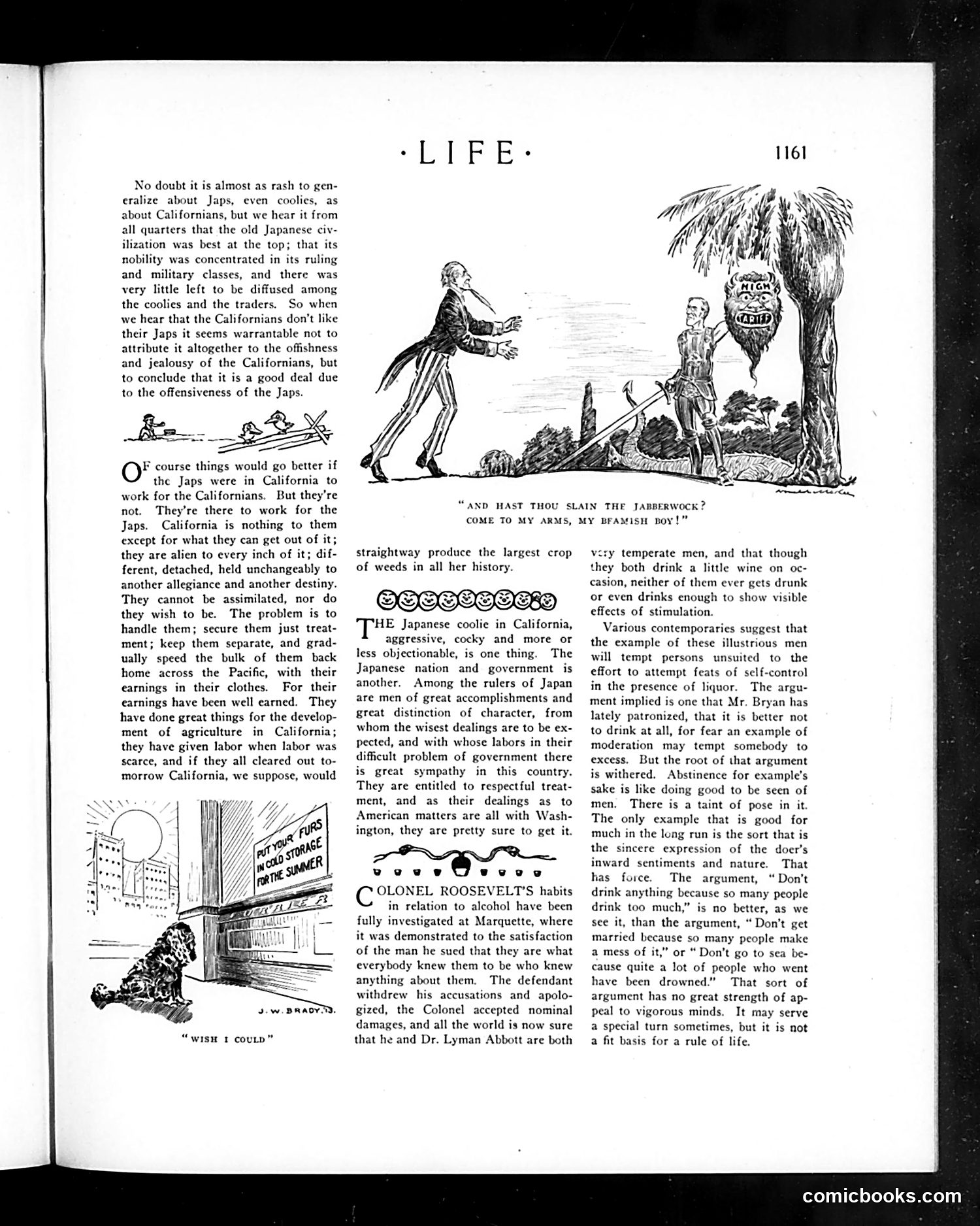
This page satirizes anti-Japanese sentiment in California during the early 20th century. The main cartoon depicts a figure labeled "AND HAST THOU SLAIN THE JABBERWOCK?" — referencing Lewis Carroll's nonsense poem to mock dramatic overreaction to Japanese immigration. The article discusses Japanese laborers in California, acknowledging their work contributions while expressing concerns about their "separation" from American society. The text argues they cannot assimilate and should be kept segregated, reflecting the era's xenophobic attitudes. The secondary cartoon ("WISH I COULD") shows a figure trapped in a storage box, likely commenting on restrictions or containment of Japanese workers. The overall tone treats Japanese immigration as a manageable "problem" requiring control, reflecting widespread racist ideology of that period.
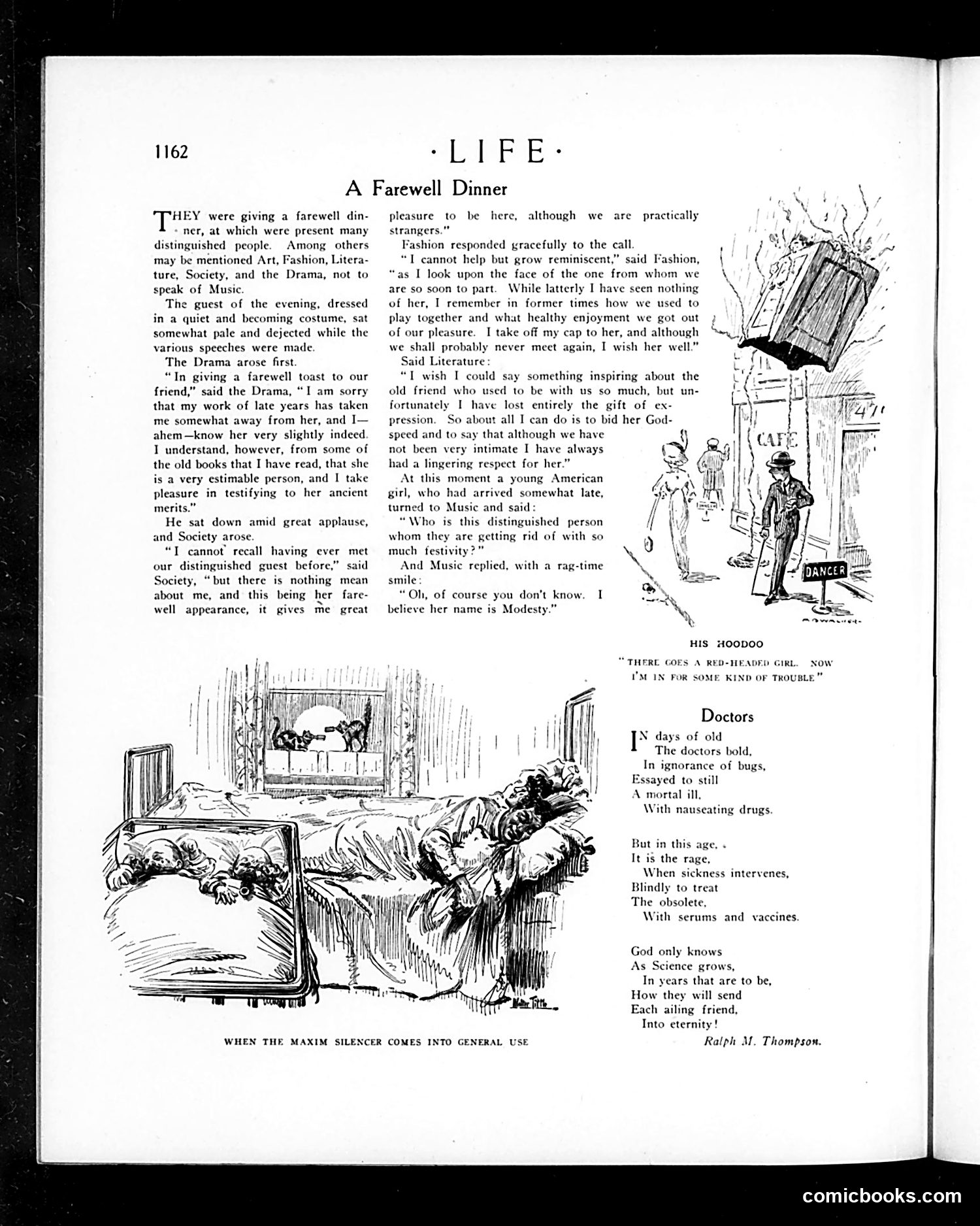
This page contains two satirical pieces: **"A Farewell Dinner"** depicts a social gathering where various cultural figures (Art, Fashion, Literature, Society, Drama, Music) bid goodbye to a departing female guest named "Modesty." The joke is that Modesty—representing propriety and decorum—is being cast out or abandoned by modern society. Each guest offers insincere platitudes while essentially celebrating her departure, suggesting early 20th-century anxiety about declining social standards and changing moral values. **"When the Maxim Silencer Comes Into General Use"** shows a couple in bed undisturbed by noise, with the caption suggesting that gun silencers will eventually become common household items. This darkly humorous cartoon satirizes technological progress by imagining a dystopian future where silenced weapons are normalized. Both pieces reflect period concerns about modernity's social consequences.
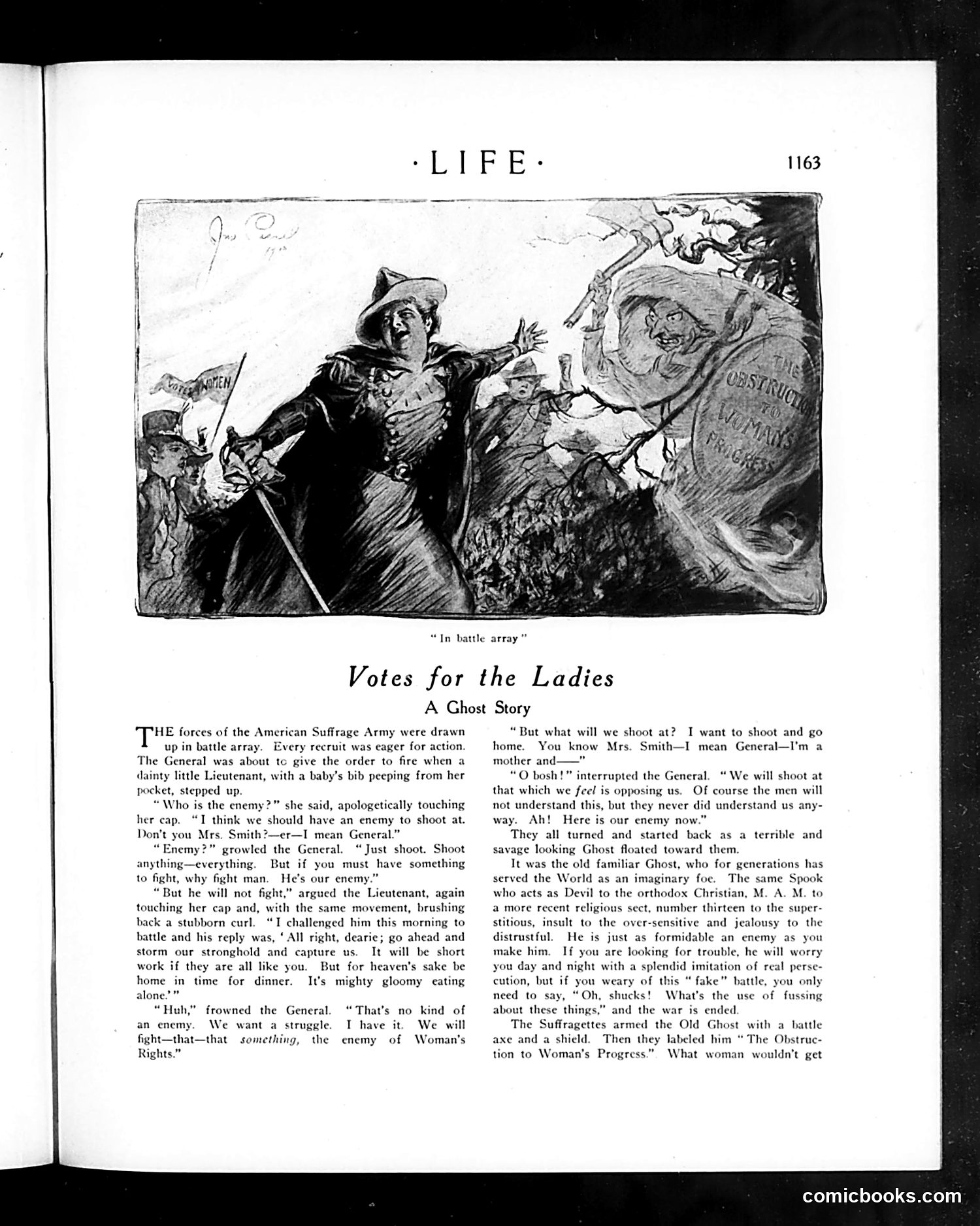
This satirical story mocks the women's suffrage movement by portraying suffragettes as a threatening "Ghost" or specter haunting military leaders. The General and his men, depicted in battle array, must confront this phantom enemy—the "Obstruction to Woman's Progress," as they label it. The satire works by treating women's demand for voting rights as a militaristic threat requiring combat. The General dismisses the suffragettes as not a "real" enemy, yet they're portrayed as fearsome and inescapable. The story's punchline—that soldiers need only deny the "fake" battle to end it—suggests suffragettes are delusional or that their cause is illusory rather than legitimate. This represents anti-suffrage sentiment, ridiculing activists rather than engaging their arguments.
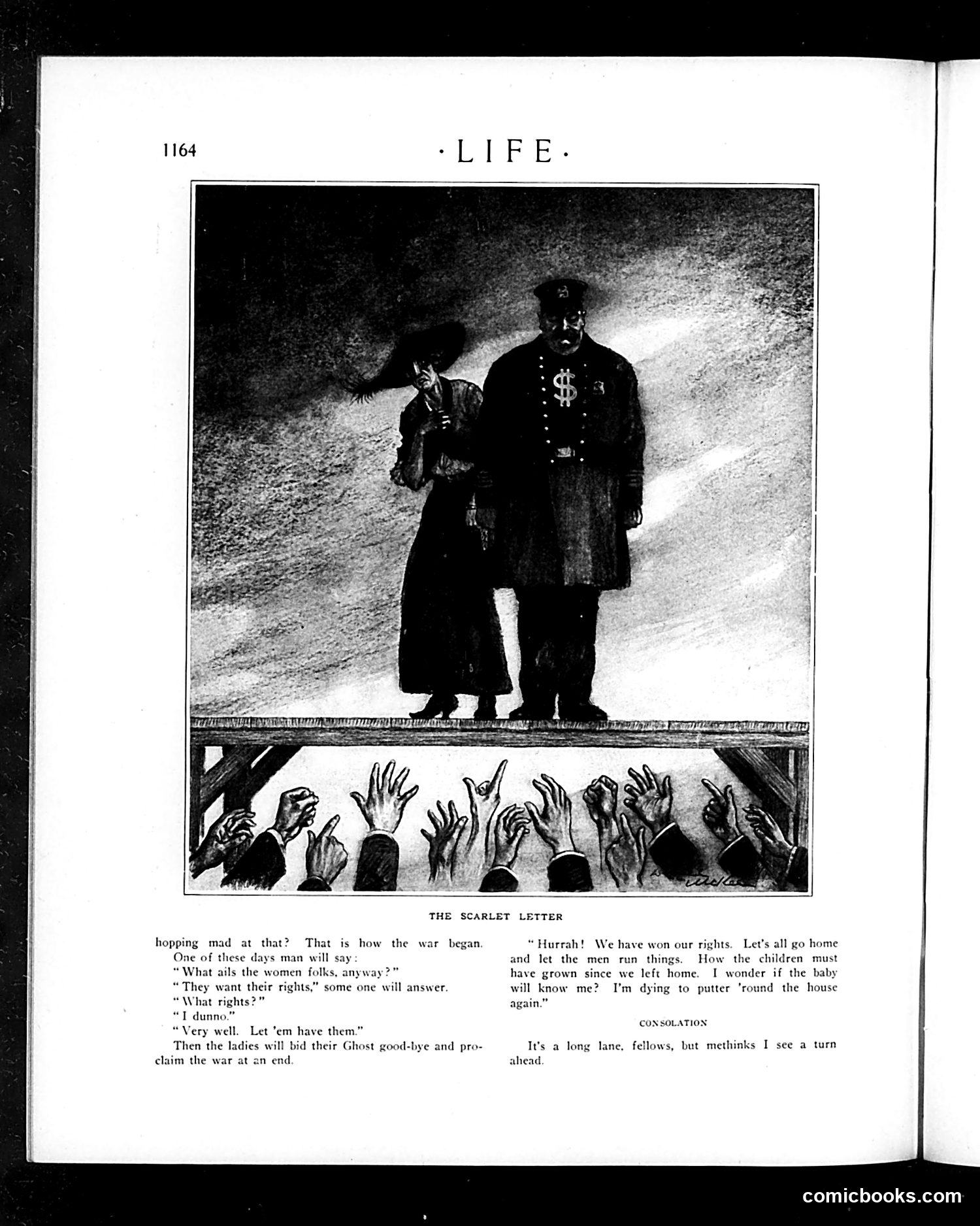
This political cartoon satirizes women's suffrage activism during a wartime period. The illustration shows two figures on a platform above a crowd of raised hands—likely depicting suffragettes demanding voting rights while men are away fighting. The accompanying text mocks this timing, with dialogue suggesting that demanding "women's rights" during wartime is inappropriate ("hopping mad at that? That is how the war began"). The satire implies that women should wait until after the war ends to pursue political equality. The title "The Scarlet Letter" references Nathaniel Hawthorne's novel about social condemnation, suggesting the suffragettes are being marked as troublemakers for pressing their cause during national crisis. This represents anti-suffrage sentiment common during WWI.
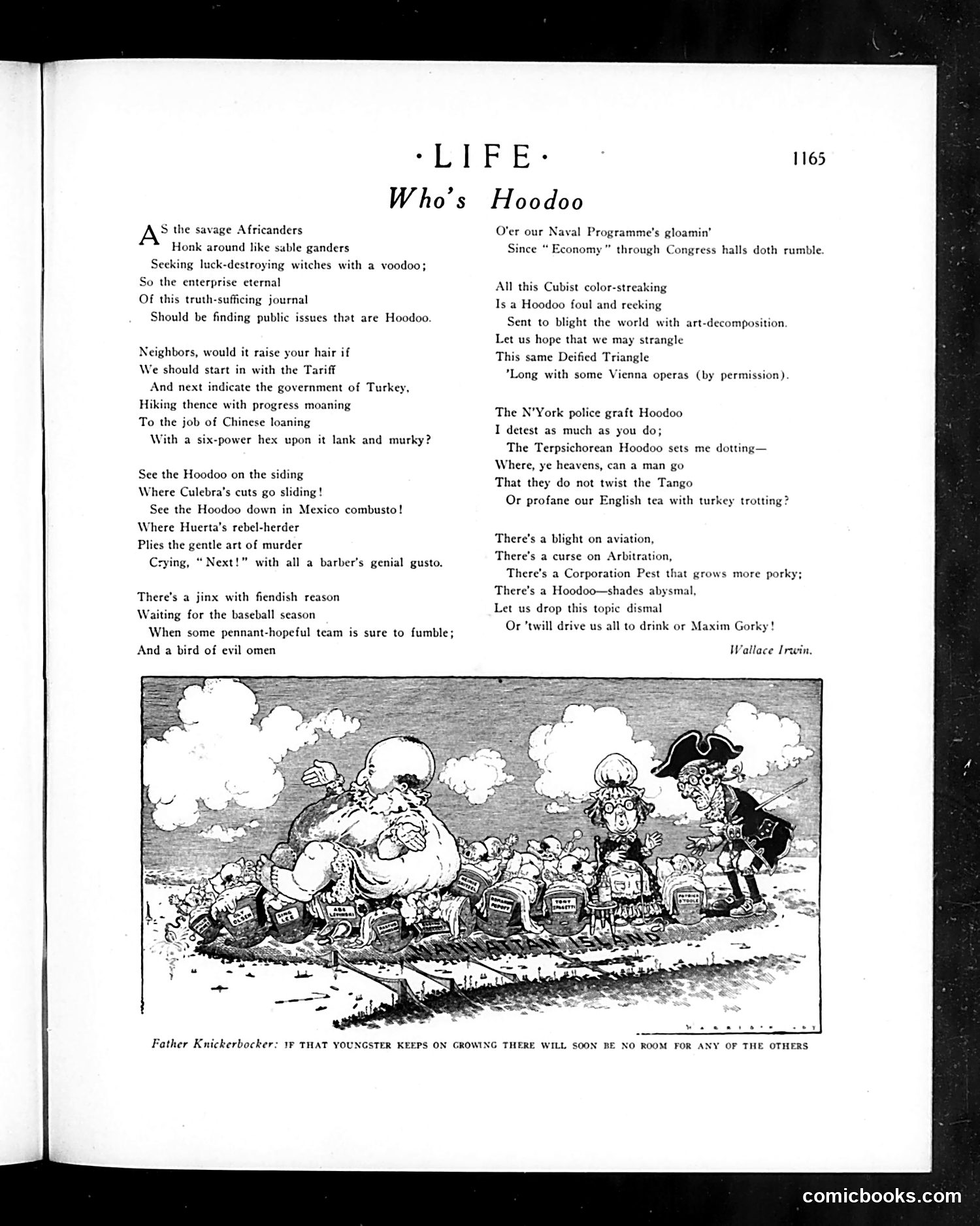
This page satirizes American anxieties about unexplained misfortunes blamed on "hoodoo" (bad luck or curse). The poem catalogs contemporary problems—tariffs, Chinese loans, baseball jinxes, naval scandals, corporate corruption—attributing them to vague supernatural forces rather than actual policy failures. The cartoon depicts "Father Knickerbocker" (personification of New York) surrounded by bloated figures labeled with social ills, growing so large they'll soon crowd each other out. The satire mocks how Americans blamed "hoodoo" for problems actually caused by government incompetence, economic policy, and institutional failure. Rather than address real causes, the culture scapegoated invisible supernatural forces—a critique of public irresponsibility and magical thinking replacing serious analysis.
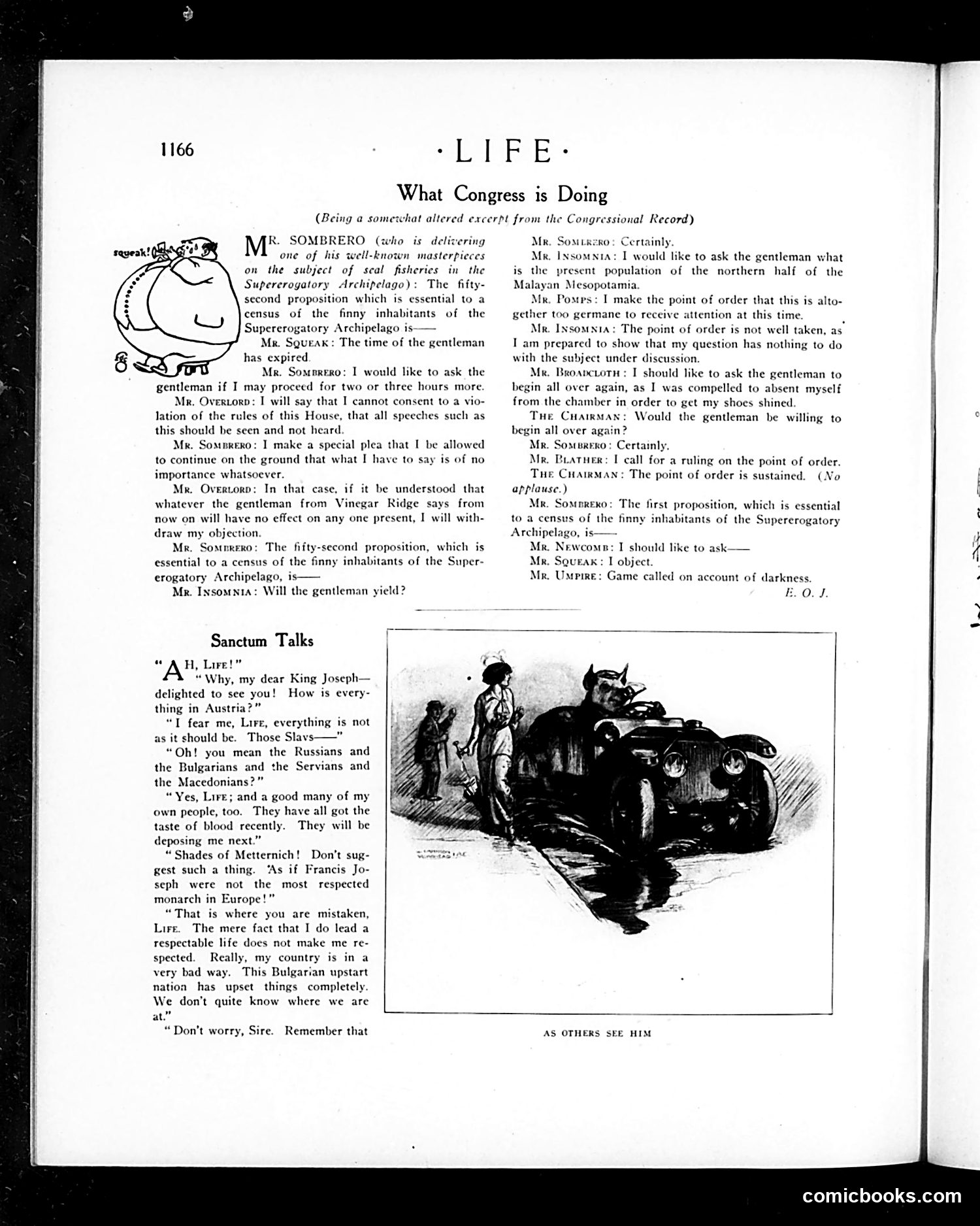
**"What Congress is Doing"** presents a heated congressional debate about the Supererogatory Archipelago census. Mr. Sombrero proposes counting "finny inhabitants," which Mr. Overlord opposes as violating debate rules. The exchange satirizes Congress's procedural chaos—members constantly interrupting, raising points of order, and losing focus on substantive issues. **"Sanctum Talks"** features a conversation between King Joseph and "Life" about Austria's political troubles, referencing Slavic populations (Russians, Bulgarians, Serbians, Macedonians). The king dismisses concerns, claiming he maintains respectability despite his country being "in a very bad way." The cartoon "As Others See Him" (right) depicts a grotesque demon-like figure—likely representing Austria-Hungary's destabilizing influence in European affairs.
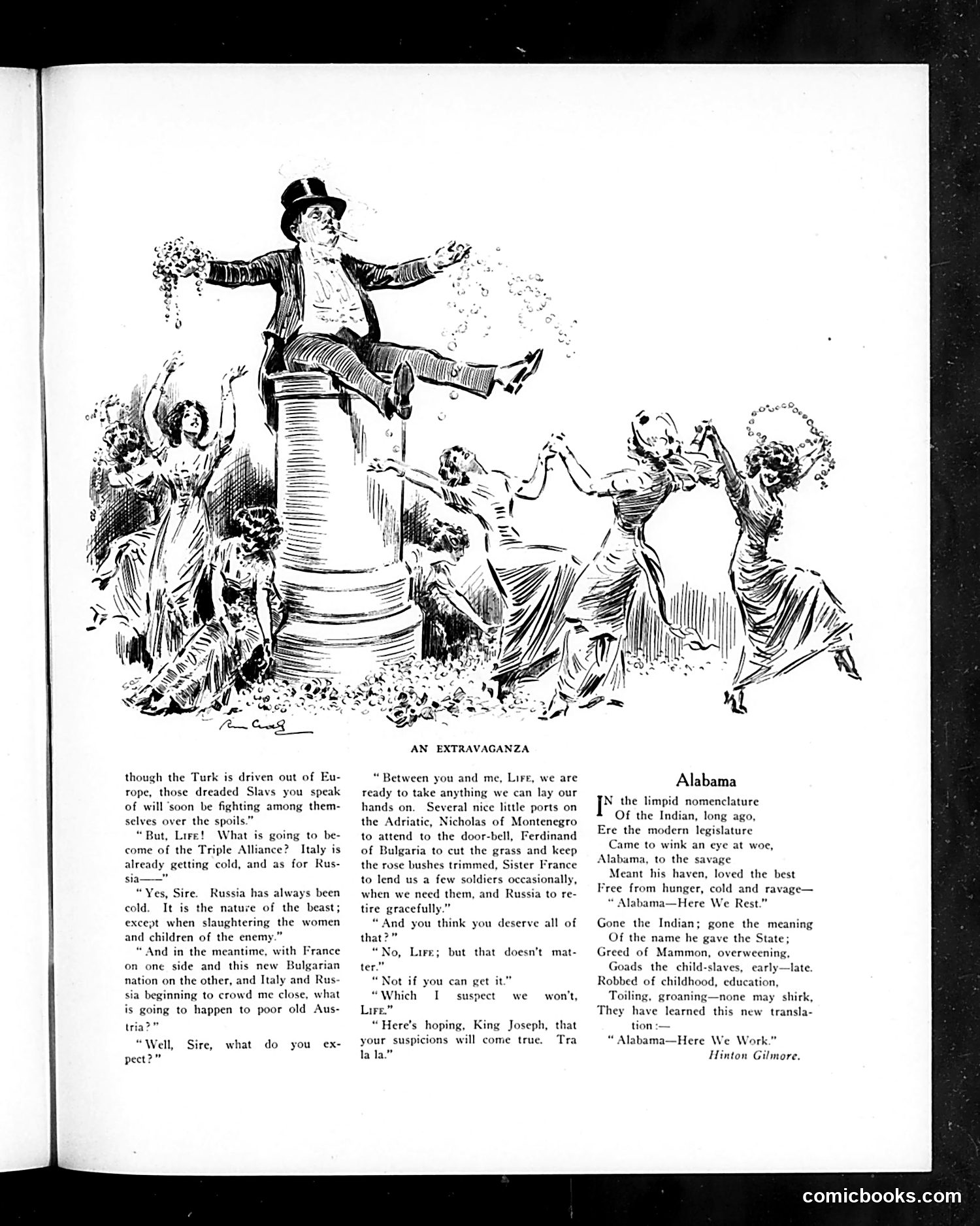
**"An Extravaganza"** depicts a dialogue between an unnamed European monarch (likely Austria-Hungary's emperor) and his advisor "Lire," discussing the collapse of the Ottoman Empire and territorial ambitions following the Turk's expulsion from Europe. The satire mocks the scramble for power among European nations—Russia, Italy, France, and the Balkans—each eyeing territorial gains and weakened neighbors. The caricatured figures represent competing imperial interests; the joke is the naked cynicism: leaders openly discussing theft of ports and subjugation of smaller nations ("Ferdinand of Bulgaria to cut the grass"). **"Alabama"** is a serious poem by Hinton Gilmore lamenting the corruption of the state's name—once meaning a Native American refuge, now synonymous with child labor exploitation ("Here We Work" replacing "Here We Rest"). It contrasts the region's original meaning with industrial-era degradation and the betrayal of vulnerable populations. Together, the page juxtaposes cynical imperial geopolitics with domestic American moral failure.
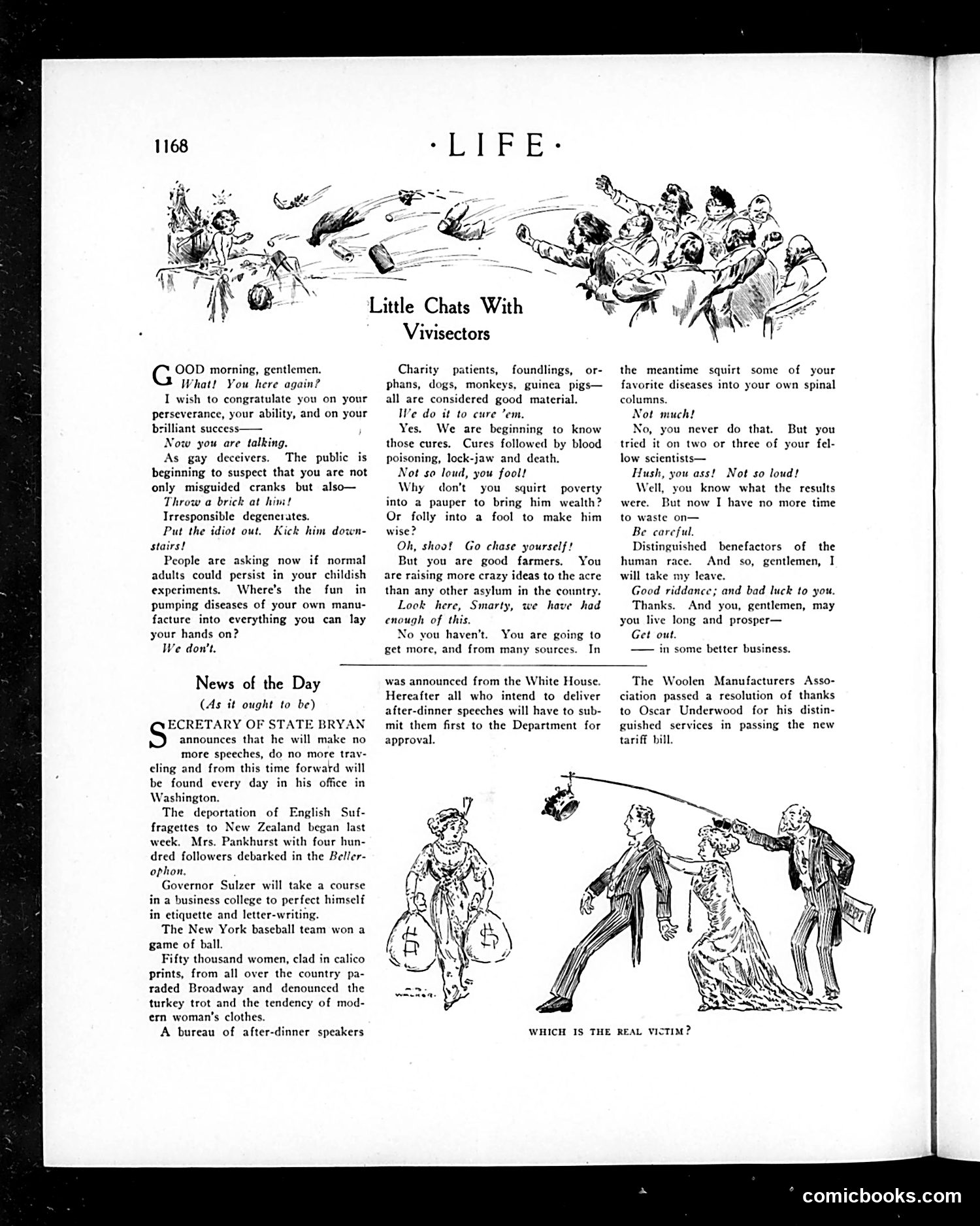
This dialogue cartoon attacks animal experimentation (vivisection), a major early-20th-century controversy. A critic confronts laboratory researchers who experiment on "charity patients, foundlings, orphans, dogs, monkeys, guinea pigs." The satire highlights the hypocrisy: researchers justify testing on the poor and vulnerable to "cure" diseases, yet their experiments produce poisoning and death. When challenged why they don't test on themselves or fellow scientists, they deflect with hostility. The final cartoon panel, "Which is the Real Victim?", depicts a well-dressed gentleman being attacked by street thugs—sarcastically suggesting vivisectors (not their test subjects) are the true victims of criticism. The "News of the Day" section parodies government absurdity through exaggeration (Bryan's office-bound decree, Suffragettes deported, after-dinner speeches requiring approval)—typical Life magazine political mockery of the Progressive Era.
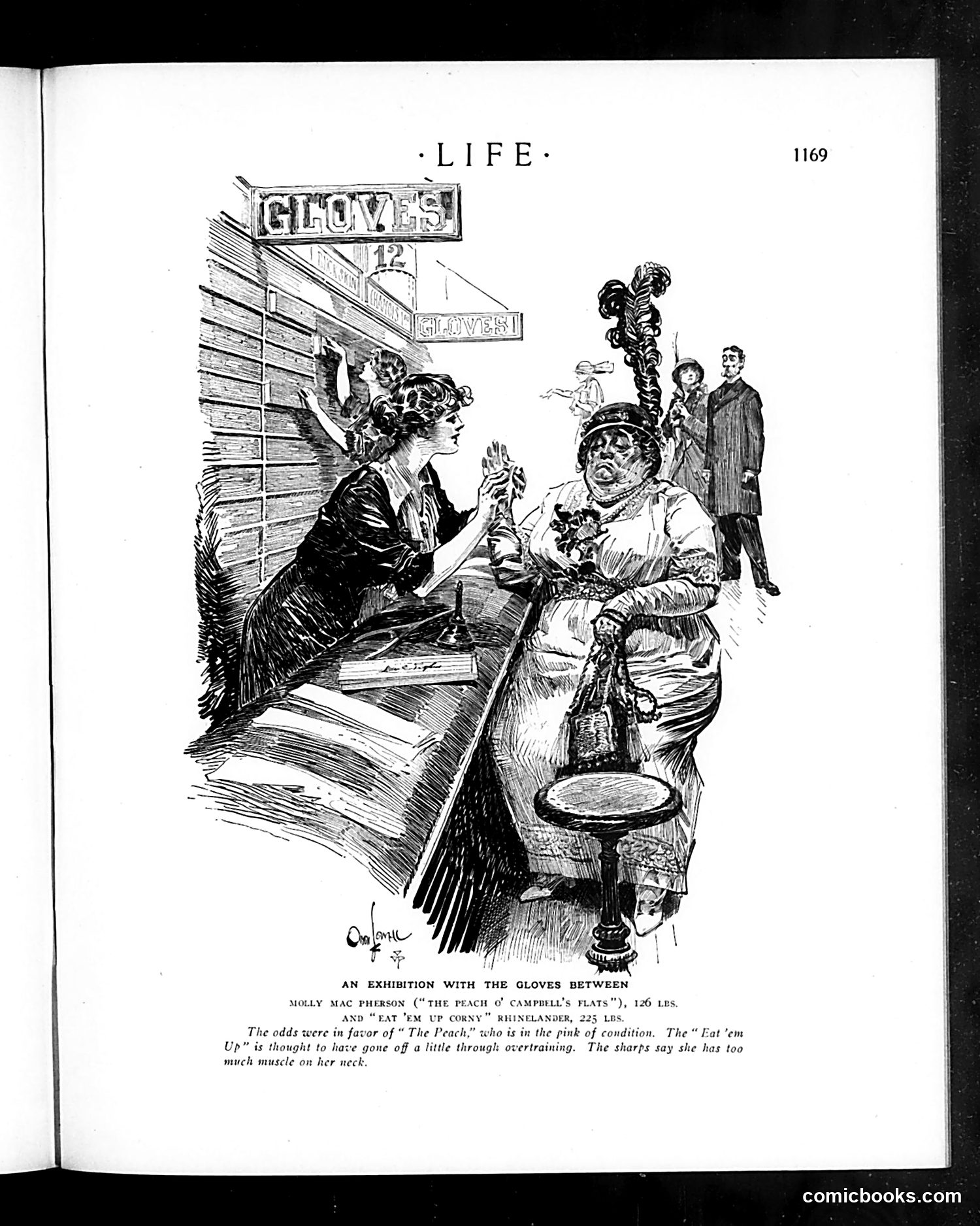
This is a boxing satire from Life magazine depicting a women's boxing match between two competitors: "Molly Mac Pherson" (nicknamed "The Peach o' Campbell's Flats," 126 lbs.) and "Eat 'Em Up Corny" Rhinelander (225 lbs.). The cartoon mocks the era's fascination with women's boxing exhibitions—a controversial spectacle that attracted both curiosity and moral disapproval. The joke plays on the stark weight disparity (nearly 100 pounds) and the pseudo-expert commentary about their physical condition ("too much muscle on her neck," "overtraining"). The illustration shows an elegantly-dressed woman (left) presumably promoting or watching the match, while spectators observe in the background. The satire targets the absurdity of such mismatched "sporting" events and the pretentious analysis surrounding them, likely critiquing both the spectacle itself and those who took it seriously.
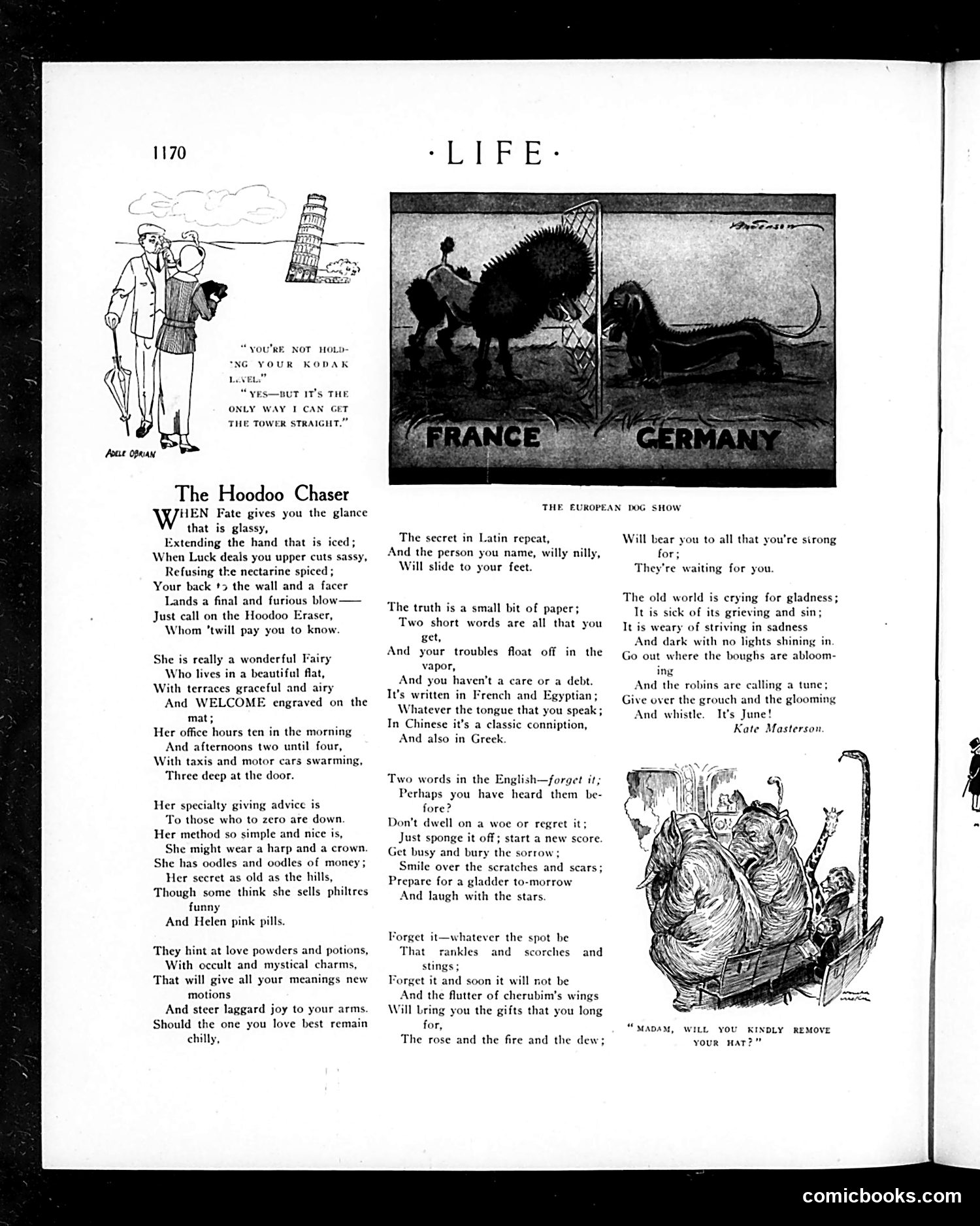
**The Hoodoo Chaser** (left): A humorous poem mocking the era's fascination with fortune tellers and pseudo-mystical advisors. The "Hoodoo Eraser" is a fairy-tale charlatan who claims to solve life's problems through occult means—love potions, Latin incantations, French and Egyptian spells. The satire's punchline: her actual secret is simply two English words: "forget it." Life ridicules both the gullible clients seeking magical solutions and the fraudulent practitioners exploiting them, while promoting instead pragmatic self-help philosophy (move on, stay busy, find joy). **The European Dog Show** (right): A darkly satirical cartoon depicting France and Germany as grotesque, exaggerated dogs in a show. This likely references post-WWI tensions and military competition between these nations, caricaturing national character through animal grotesqueness. The caption "MADAM, WILL YOU KINDLY REMOVE YOUR HAT?" suggests absurd politeness masking underlying hostility—a commentary on European diplomatic pretense amid underlying antagonism.
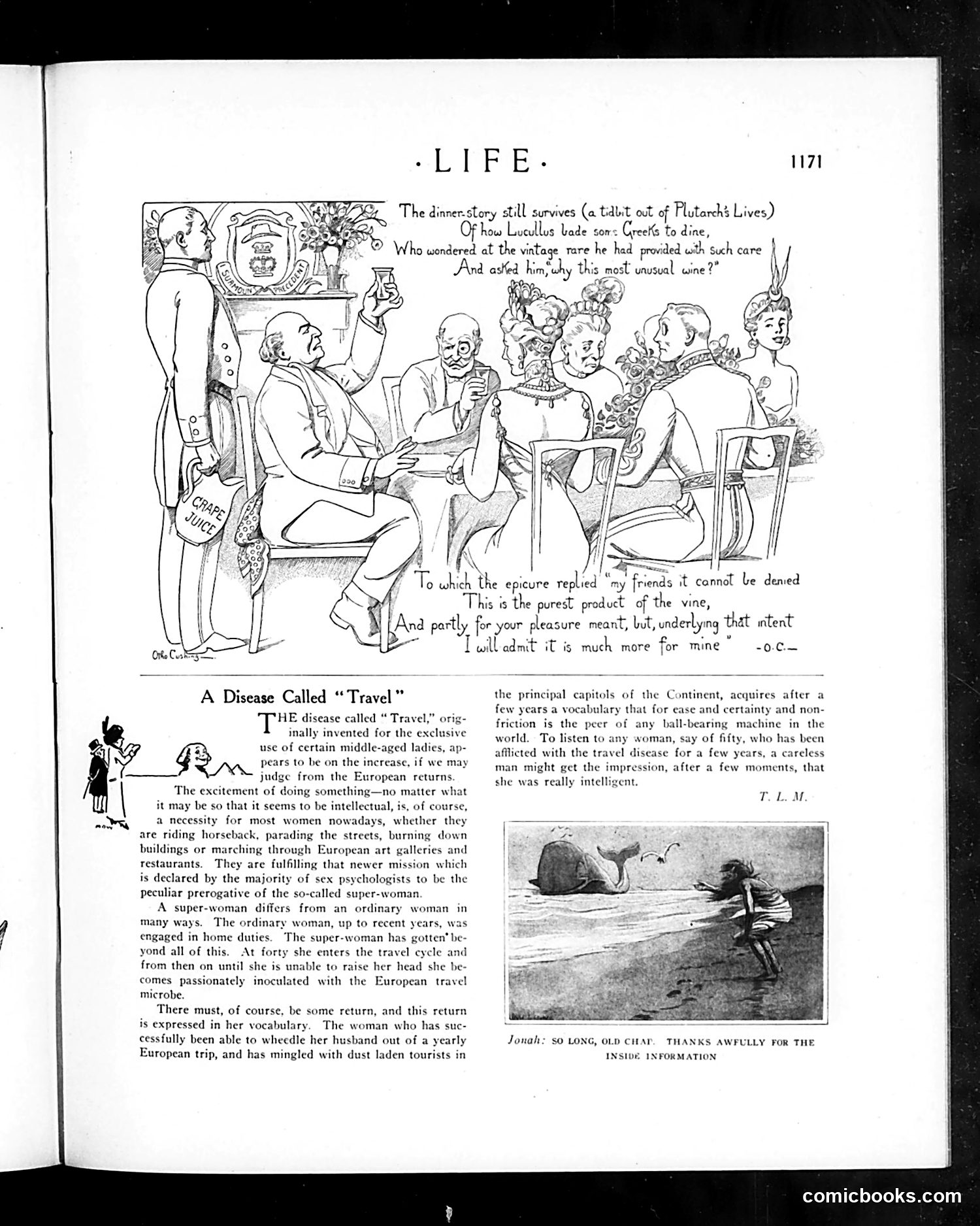
This 1920s *Life* magazine page satirizes emerging social changes regarding women's independence and leisure travel. **Top cartoon**: A dinner scene referencing classical literature (Plutarch's *Lives*), where an epicurean host serves rare wine. The joke plays on excessive refinement and showing off—likely mocking how wealthy diners use elaborate displays to impress. **Main article**: "A Disease Called 'Travel'" mocks middle-aged women who, newly freed from domestic duties, become obsessed with European tourism. The piece ridicules the contemporary concept of the "super-woman"—women entering public life and travel—suggesting they're intellectually shallow despite claiming sophistication. The satire implies these women merely acquire affected vocabulary and pretense from Continental travel, not genuine culture. **Bottom image**: A beach scene with the caption about "inside information," likely a separate humorous piece. The satire reflects anxiety about women's changing roles and expanding freedoms in the post-WWI era, presenting female leisure travel as superficial rather than empowering.
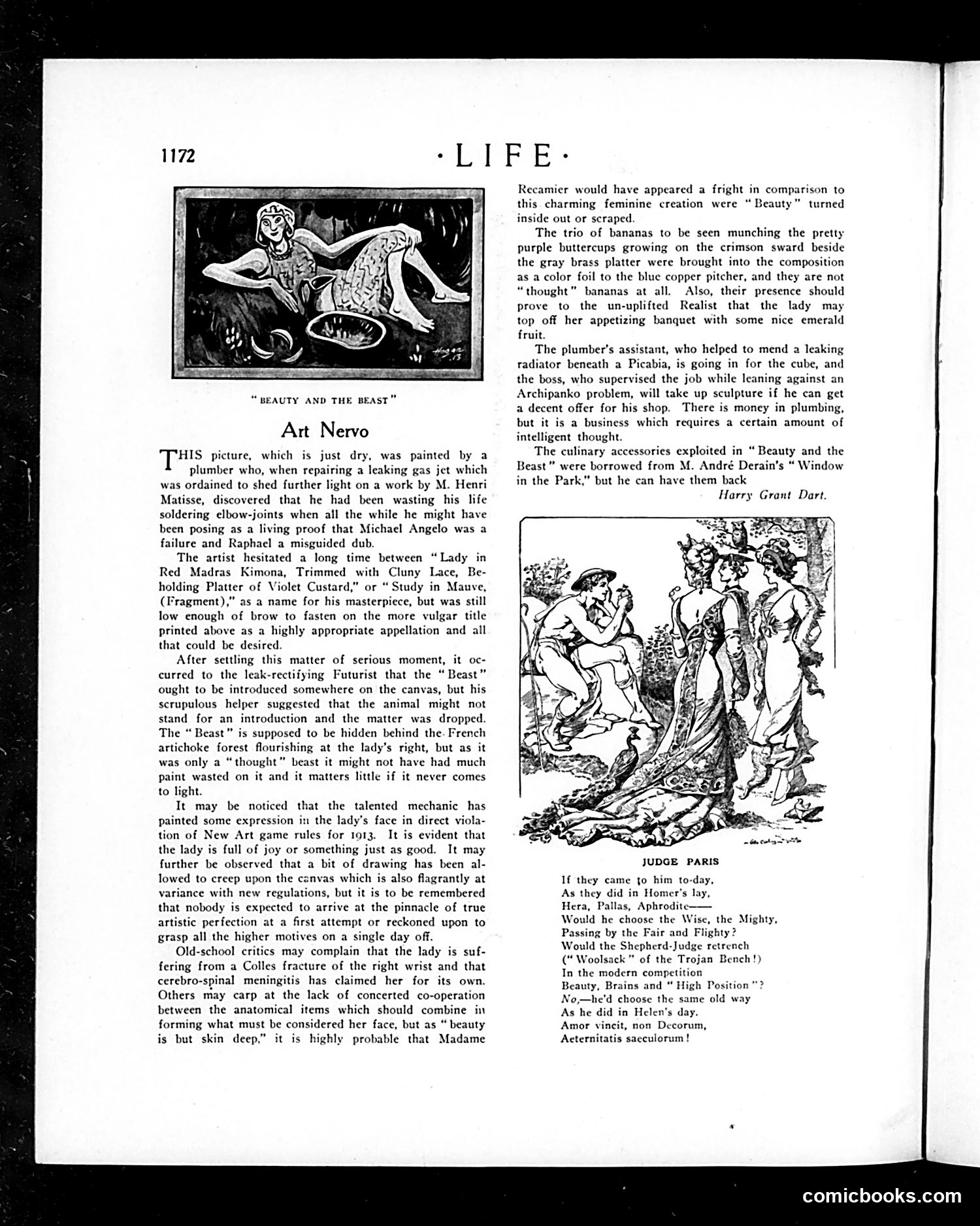
This is a mock-serious critique of modernist art, specifically targeting Futurism and related avant-garde movements (circa 1913, based on "New Art game rules for 1913"). The cartoon titled "Beauty and the Beast" depicts a deliberately awkward, anatomically incorrect female figure in an absurdist composition. **The satire's target:** A plumber turned artist who applies modernist principles—hidden subjects, illogical spatial relationships, anatomical distortion—while abandoning traditional artistic skill. Life's critic sarcastically "praises" the work's violations of classical art rules, the artist's visible struggle to maintain modernist orthodoxy, and the pretentious title-selection process. **The joke:** Modernist art is presented as so divorced from recognizable reality and technical skill that a plumber could produce it. The detailed absurdities (invisible "thought beasts," expressionless faces mandated by style, borrowed culinary props) mock both the movement's opacity and its practitioners' pretensions to profundity. The accompanying poem about Judge Paris offers unrelated classical satire.
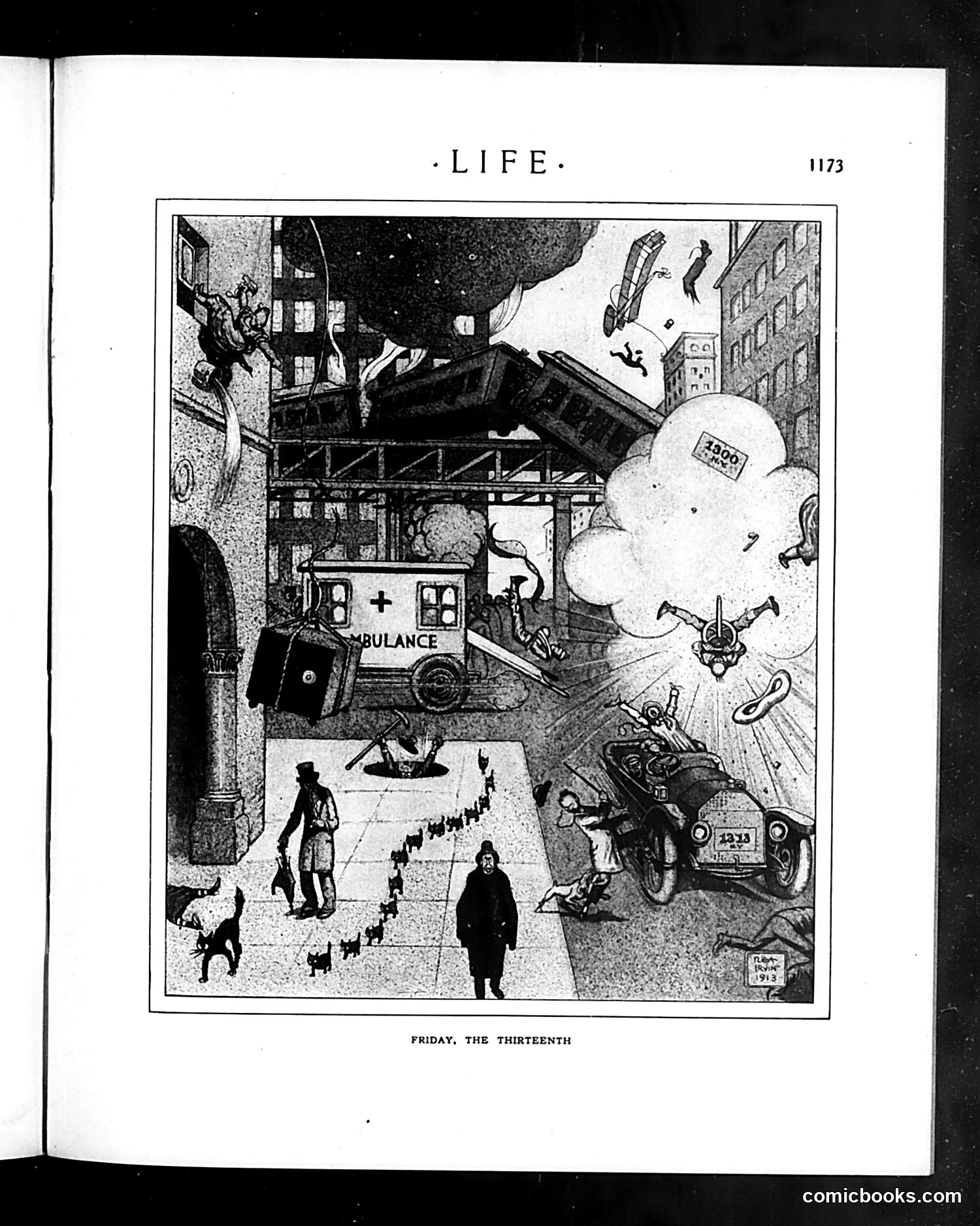
This cartoon depicts urban chaos and disaster in a chaotic bird's-eye-view street scene. The title references the superstition surrounding Friday the 13th as an unlucky day. The image shows multiple catastrophes simultaneously: an ambulance, crashed vehicles, people falling from buildings, structural collapse, and general mayhem in a city street. A person stands calmly amid the destruction, seemingly indifferent. The satire appears to mock superstitious beliefs about bad luck—by showing exaggerated, impossible simultaneous disasters, the cartoonist suggests the absurdity of attributing everyday misfortunes to a calendar date rather than to actual causes like carelessness, poor infrastructure, or human error. The cartoon ridicules superstition while implicitly critiquing modern urban hazards and safety issues.
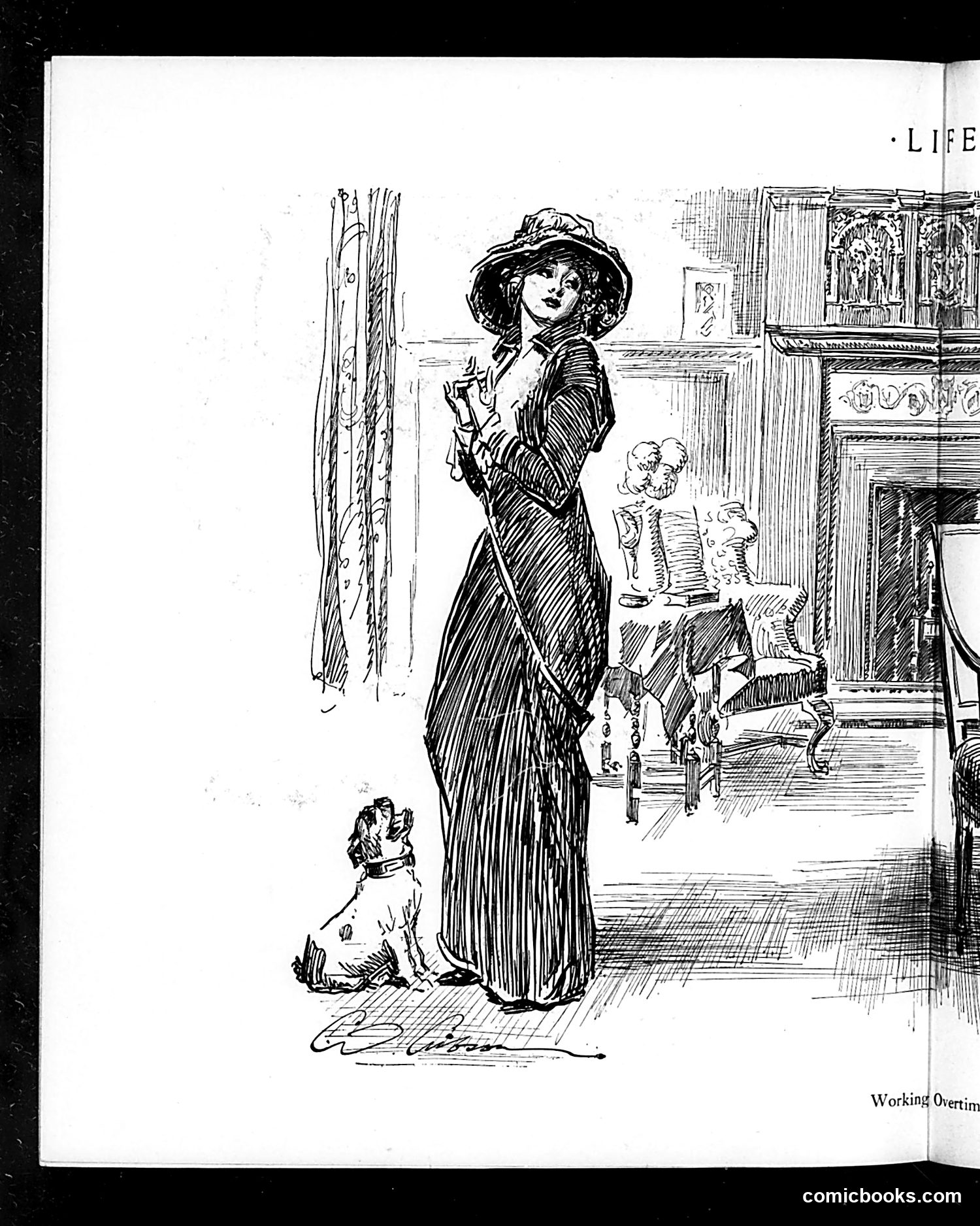
This sketch depicts a fashionably dressed woman with an elaborate hat, standing in an elegant interior with decorative elements and a fireplace. A small dog sits obediently at her feet. In the background, other figures appear to be working or attending to tasks. The title "Working Overtime" suggests satire about domestic labor or service work. The contrast between the woman's refined appearance and leisure pose against the busier figures behind her likely critiques class dynamics or the invisible labor of household staff. The dog's presence may reinforce themes of status or dependency. Without additional context or caption text visible, the specific satirical target remains somewhat unclear, though it appears to comment on wealth, leisure, and labor hierarchies in early 20th-century American society.
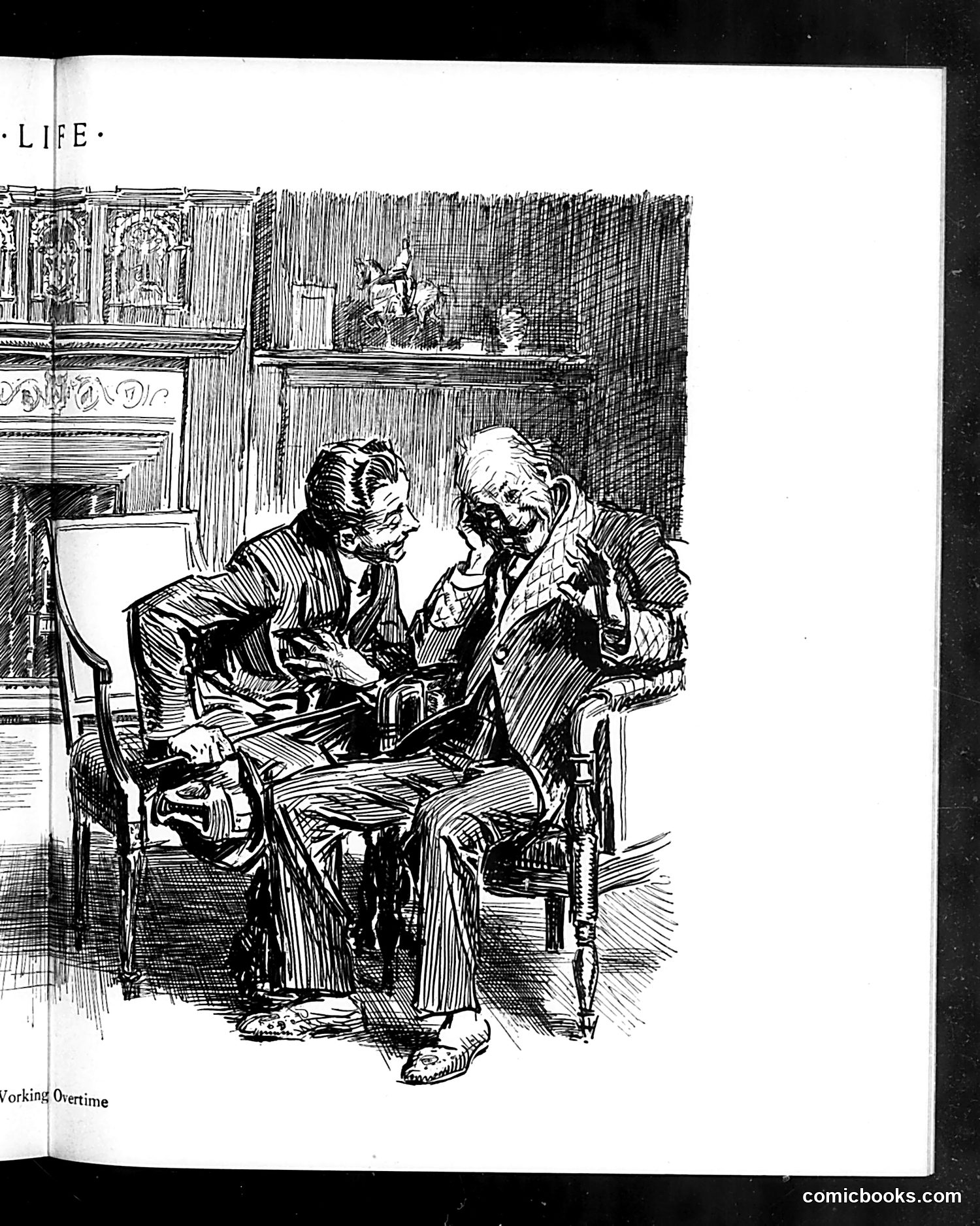
This cartoon depicts two men in business attire engaged in what appears to be a serious or heated conversation in an ornate interior setting. Based on the title "Working Overtime," the satire likely comments on labor practices or workplace excess during the industrial era when *Life* was prominent. The exaggerated facial expressions and body language suggest tension or disagreement between the figures—possibly depicting a boss/worker dynamic or a business dispute. The formal clothing and decorated interior suggest these are men of some social standing, making the cartoon's point likely a critique of wealthy businessmen or executives and their labor practices. Without additional context or visible publication date, the specific historical reference remains unclear, though the style suggests late 19th or early 20th century.
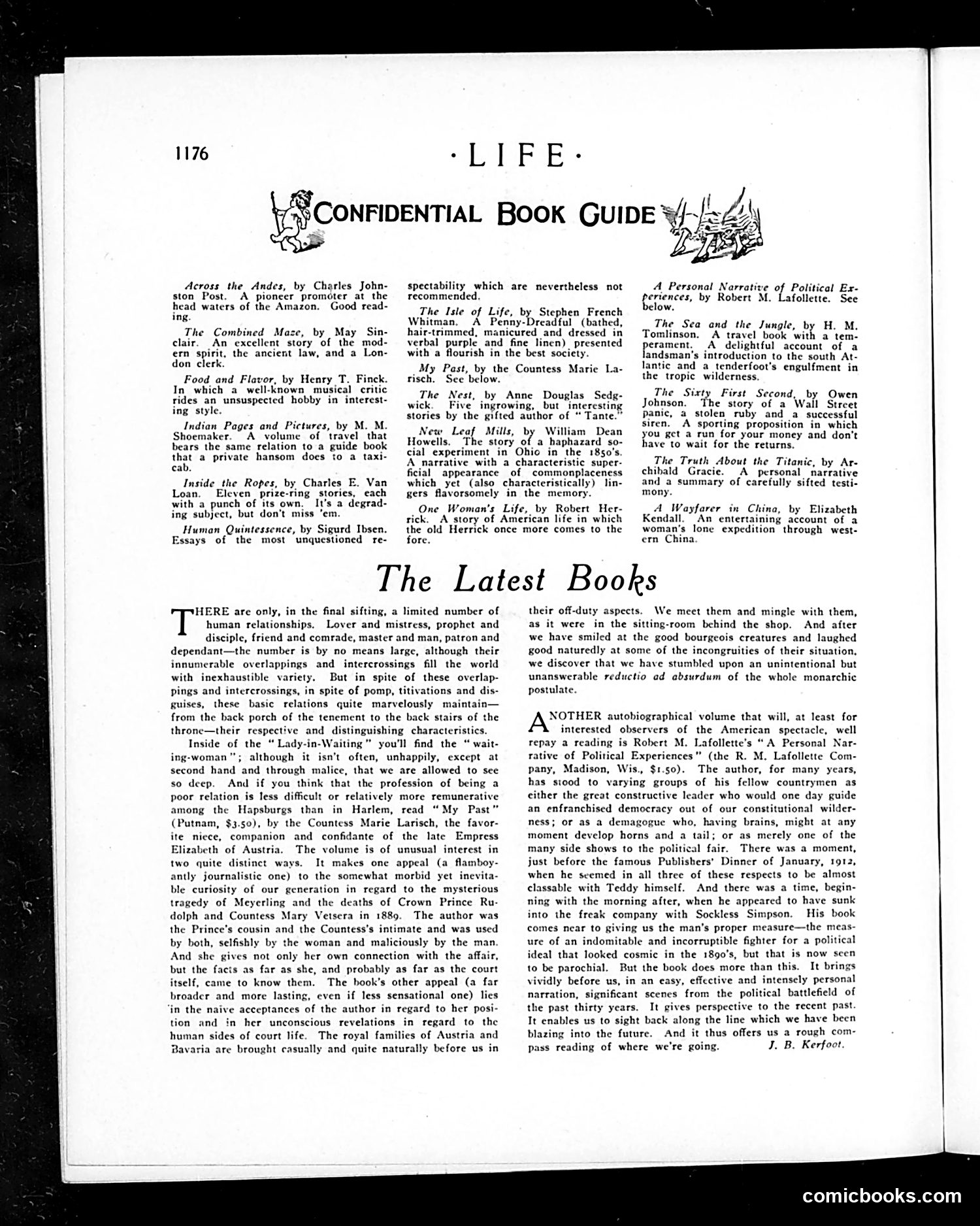
This is a **book review section**, not a political cartoon. It presents brief, witty critiques of contemporary books in the style of Life's satirical voice. The reviews use clever wordplay and backhanded compliments typical of the magazine's irreverent tone. Key examples: - *Indian Pages and Pictures* is compared to "a private hansom" rather than a "taxi-cab"—suggesting it's outdated - *The Isle of Life* is called a "Penny-Dreadful" dressed up in fancy language - *One Woman's Life* notes Herrick's return to form The featured review discusses Robert M. La Follette's *A Personal Narrative of Political Experiences*—likely the progressive Wisconsin senator. The lengthy commentary praises his memoir for offering genuine political insight spanning thirty years, distinguishing it from typical political memoirs by its "intensely personal" and honest perspective. For modern readers: Life's book reviews combined literary criticism with social commentary, mocking pretension while genuinely evaluating merit—essentially the magazine's satirical trademark applied to literature.
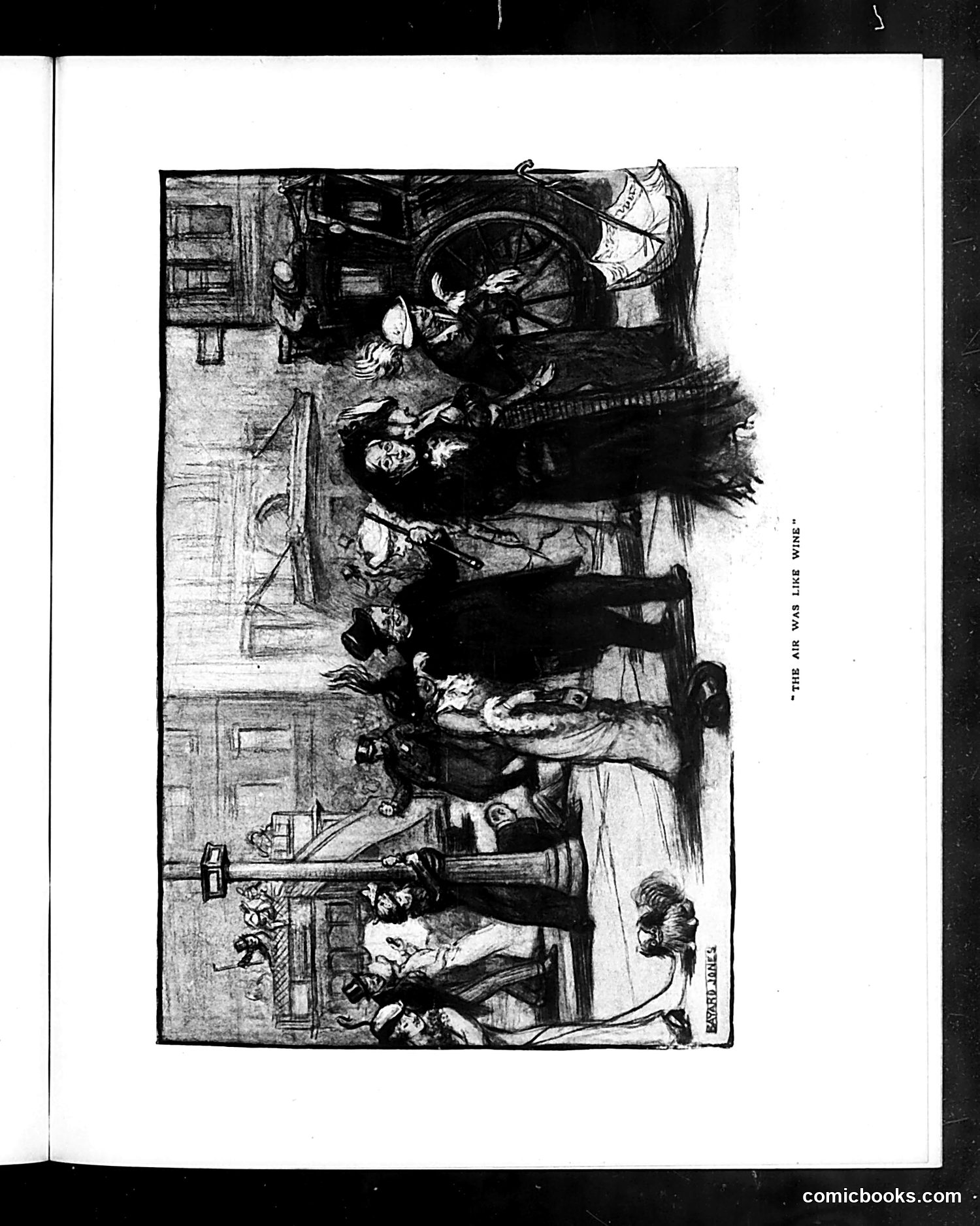
I can see this is a black and white etching or engraving printed in Life magazine, but the OCR text provided is largely illegible—it appears to be garbled characters rather than readable text. From the IMAGE alone, I can discern what appears to be a domestic interior scene with multiple figures in period clothing (possibly 18th or 19th century based on the style), but the specific identities of the figures, the precise narrative, and the satirical point are unclear without legible text or caption. The caption visible on the right margin appears to read "THE AIR WAS LIKE WINE" but this alone doesn't clarify the cartoon's meaning or political/social commentary. **I cannot reliably explain this cartoon's specific satirical intent without clearer text or additional context.**
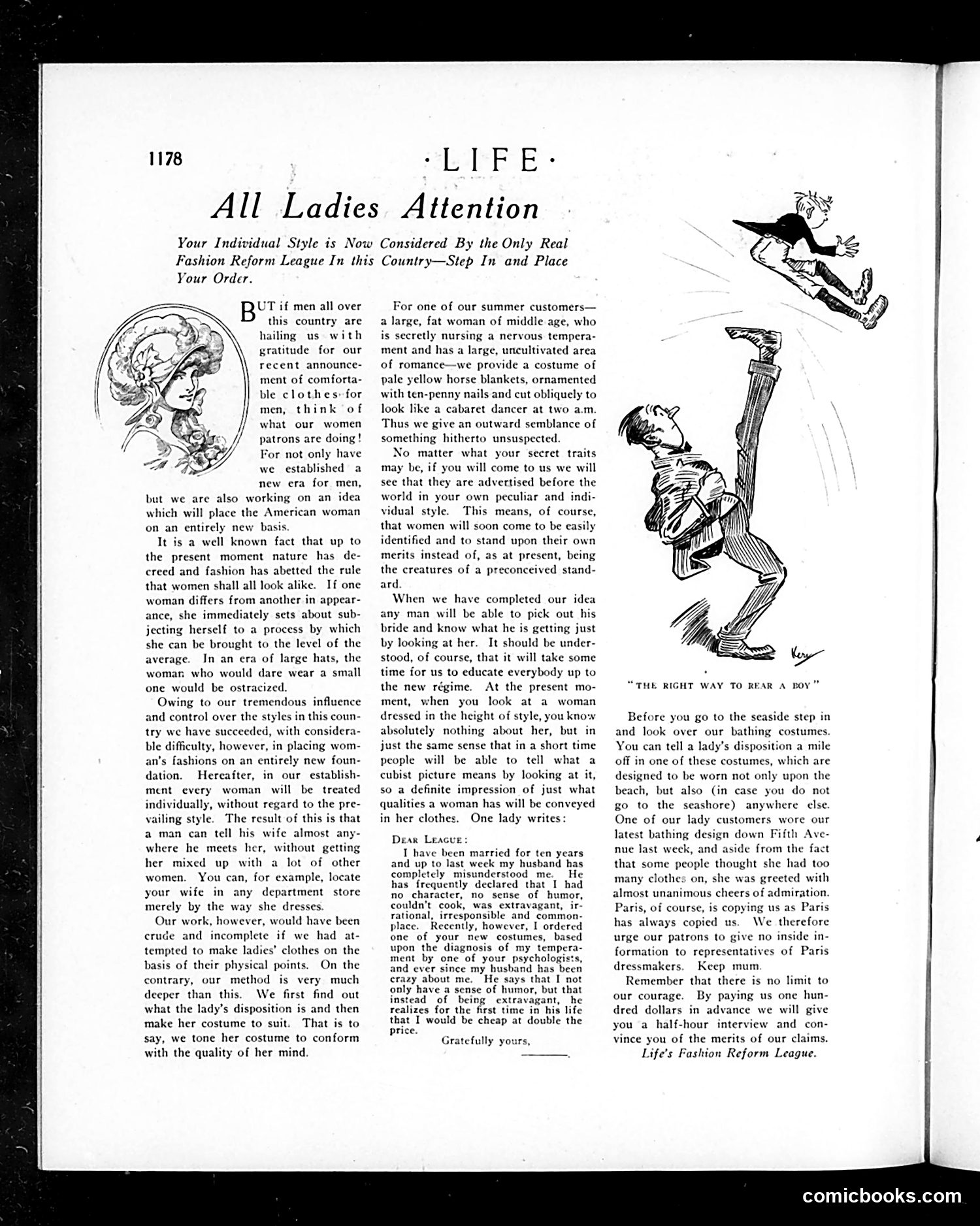
This page satirizes both the "Fashion Reform League" (a fictional organization) and early 20th-century psychology's pretensions. The satire works on multiple levels: **The Setup**: A fake company claims to design women's clothing based on psychological temperament rather than conventional fashion, allowing husbands to "identify" their wives and know their true character by appearance alone. **The Joke**: The absurdity escalates throughout. A nervous, romantic middle-aged woman gets a costume of "pale yellow horse blankets...cut obliquely to look like a cabaret dancer at two a.m." The accompanying illustration shows impossibly contorted male figures, mocking exaggerated masculinity. **The Target**: The satire critiques pseudoscientific personality assessment and the era's obsession with revealing inner character through external appearance—a popular but dubious idea. It also mocks the notion that women's individuality should be made visible/readable to men, and husbands' desire to fully "know" their wives through clothing. The closing letter from a woman whose husband finally understands her after she wears the "psychological costume" undercuts the entire premise with irony.
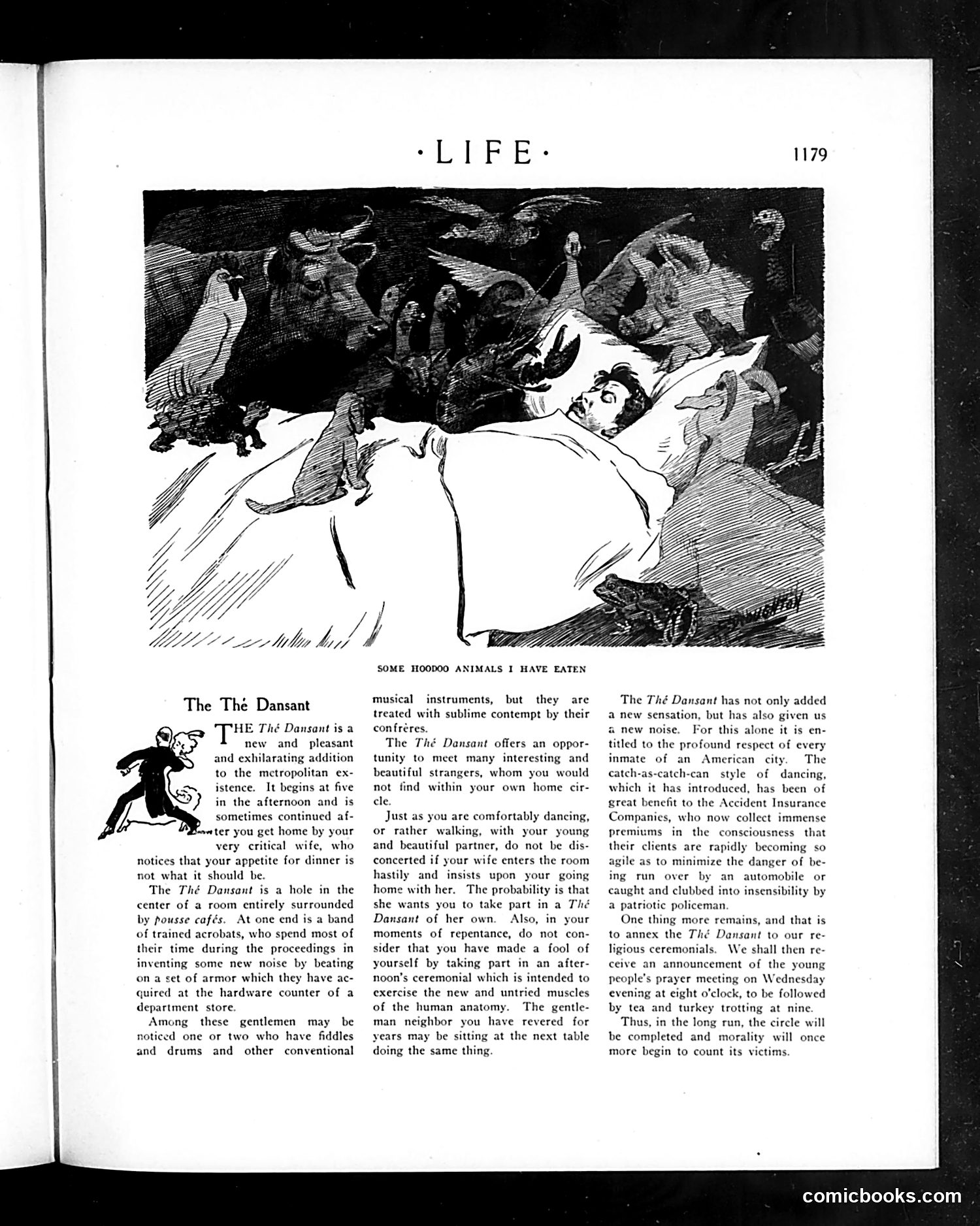
This is satirical commentary on the "thé dansant" (afternoon tea dance), a fashionable metropolitan social custom of the early 1900s. The cartoon, titled "Some Hoodoo Animals I Have Eaten," depicts a man surrounded by fantastical creatures while in bed—likely representing the digestive consequences of overindulgence at these events. The accompanying article mocks the thé dansant's social pretensions: men abandoning wives to dance with strangers, wives retaliating by dragging husbands home, and the "catch-as-catch-can style of dancing" causing injury. The satire culminates in dark humor: suggesting these dances be annexed to religious services, implying the activity leads to moral degradation—hence "morality will once more begin to count its victims." The piece ridicules both the fad itself and metropolitan society's breathless adoption of trendy amusements.
This page contains the magazine's **reader letters section**, not cartoons. It presents three letters debating the California-Japanese immigration controversy of 1913—a heated issue when California's legislature was considering anti-Japanese agricultural restrictions. **The debate:** - **Letter 1** (Walker D. Hives, New York) criticizes Life's May 15 editorial for unfairly attacking California farmers as lazy and backward, arguing New York's "tolerance" stems from indifference rather than principle. - **Letter 2** (Julia E. Harmon, California) objects to Life's framing: the magazine reported only 3,000 Japanese in agriculture, implying they *chose* to avoid farming, when actually California had *legally excluded* them. She demands credit for exclusionary laws. - **Letter 3** (partially visible) defends Life's advocacy journalism, arguing exaggeration is necessary to mobilize public sentiment for reform. **The satire:** The letters reveal period attitudes: California's proud defense of racial exclusion laws, regional tension between coasts, and Life's self-defense of its muckraking methods.
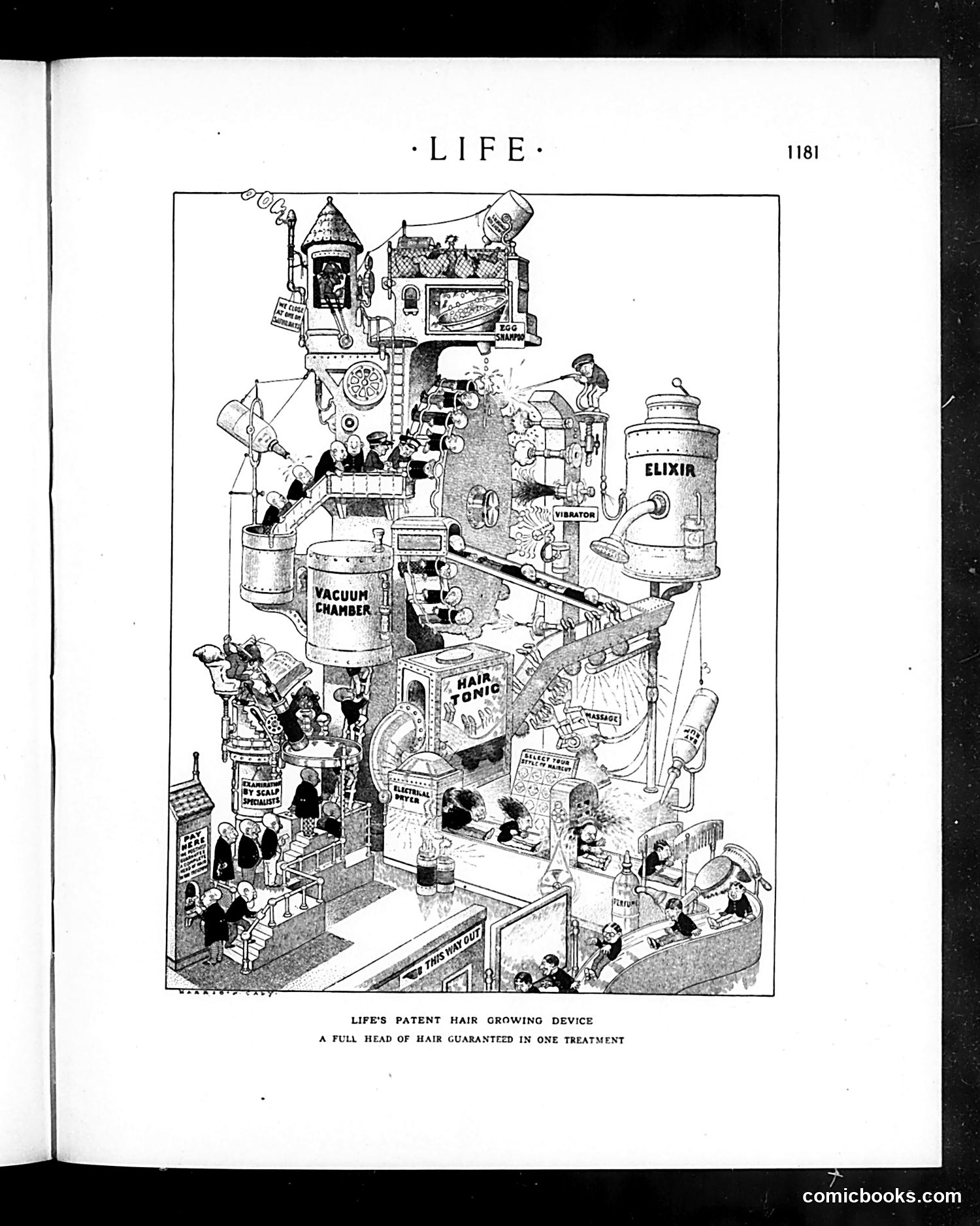
This is a satirical advertisement for a fictional "patent hair growing device"—a towering, absurdly complex machine filled with gears, tubes, chambers, and various labeled components (Vacuum Chamber, Elixir, Hair Tonic, Electrical Dryer, etc.). The satire mocks two things: (1) the proliferation of quack hair-loss remedies heavily advertised in the early 20th century, which promised miraculous results, and (2) the public's gullibility in believing increasingly elaborate pseudo-scientific contraptions. The comically overcomplicated machine—complete with people being processed through it—suggests that such devices were absurd theater designed to separate desperate, balding men from their money. The caption's promise of "a full head of hair guaranteed in one treatment" further emphasizes the unrealistic claims typical of these fraudulent products.
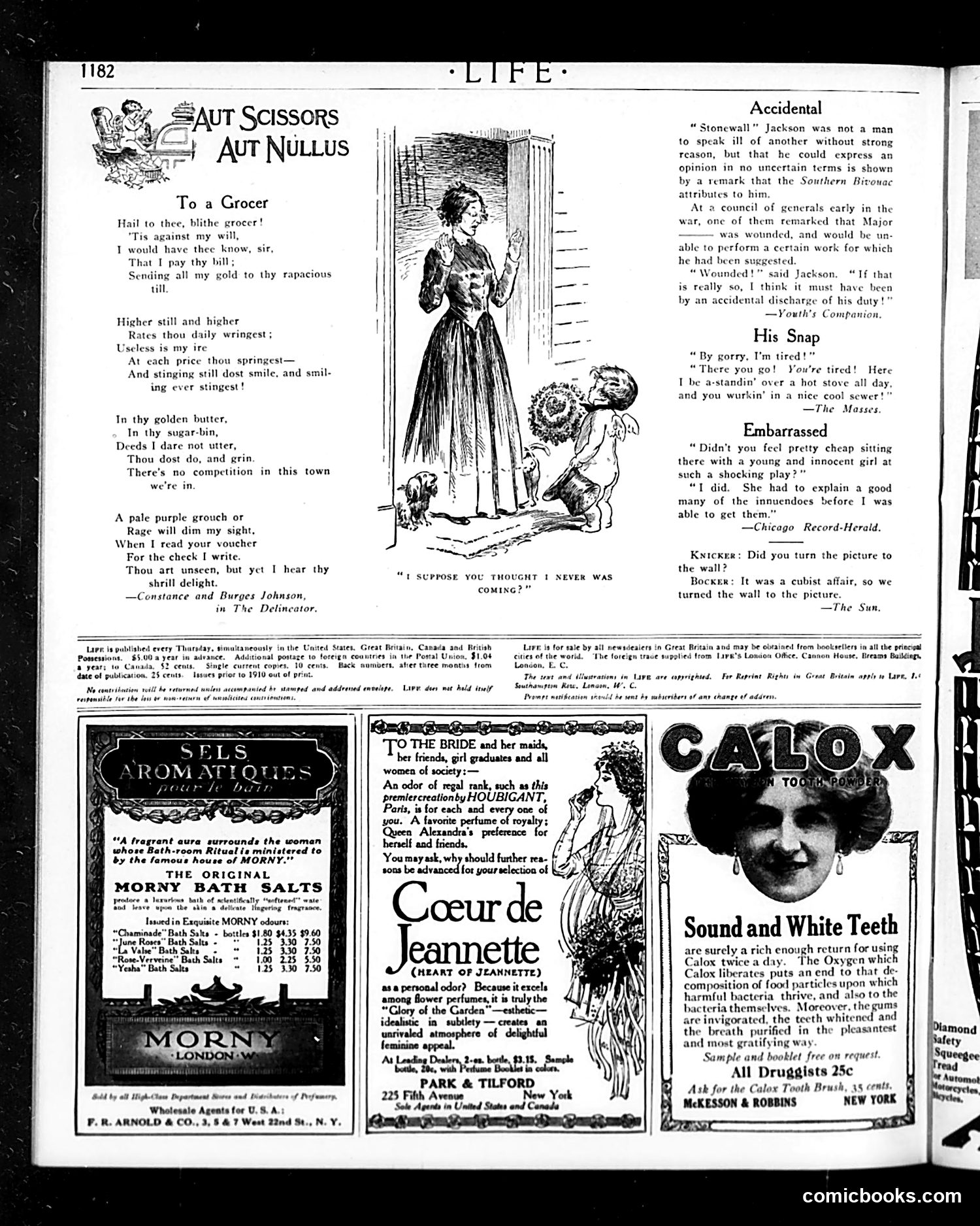
This page contains satirical poetry and short humor pieces typical of early 20th-century Life magazine, plus period advertisements. The main cartoon features a poem "To a Grocer" by Constance and Burges Johnson, complaining bitterly about inflated grocery prices and the grocer's profiteering. The illustration shows a woman confronting a cheerful grocer—satire on the economic frustration of rising living costs and merchant greed during this era. Below are brief humorous anecdotes: one about Confederate General "Stonewall" Jackson dismissing a wounded officer's excuse, another about marital banter over housework, and jokes about social embarrassment at theater and modern art (cubism). The advertisements promote luxury goods: Morny bath salts, Houbigant perfume ("Coeur de Jeannette"), and Calox toothpaste—targeting affluent readers despite the page's complaints about grocery inflation. This ironic juxtaposition reflects Life's audience: educated, middle-to-upper-class Americans who could afford both satire and luxury.

This page is **not a cartoon or satire**—it's a straightforward automobile tire advertisement from an early 20th-century issue of *Life* magazine. The ad promotes Diamond (No-Clinch) Tires, emphasizing technical features like increased "air-room" for comfort and durability. Key selling points include "Vitalized Rubber" (a toughened rubber compound), a "Safety (Squeegee) Tread" for grip on wet roads, and a "No-Pinch Safety Flap" for inner tube protection. The large tire illustration on the left shows the product's distinctive diamond-pattern tread design. A cross-section diagram demonstrates internal construction. The appeal targets practical concerns of early automobile owners: tire durability, fuel efficiency, inner tube longevity, and road safety. The claim of "25,000 Diamond Dealers" suggests widespread availability. This represents typical early automotive advertising, using technical language to justify premium pricing during an era when tire quality significantly affected vehicle performance and reliability.
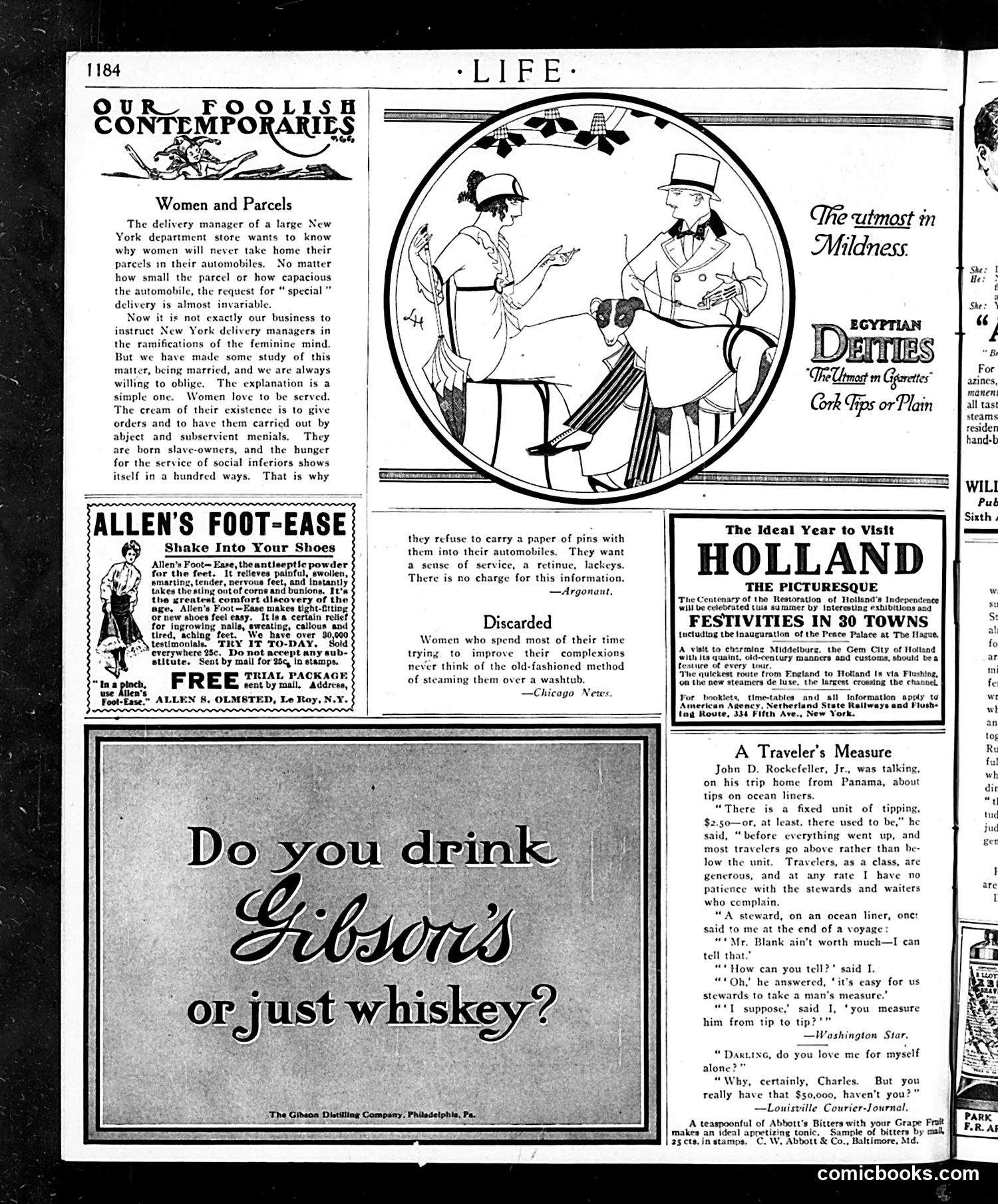
This Life magazine page contains satirical commentary on social behavior, primarily targeting women's attitudes toward service and consumerism. The main article mocks women who refuse to transport their own department store purchases, insisting on paid delivery instead. The satirist suggests this reflects women's desire to be served by "subservient menials"—that they're inherently authoritarian and enjoy exercising power over social inferiors. The piece dismisses this as natural feminine psychology: "Women love to be served." A secondary anecdote ridicules women who spend effort on beauty treatments while ignoring simple, old-fashioned methods like steam facials. The page also includes advertisements (Allen's Foot-Ease powder, Egyptian cigarettes, Gibson whiskey) and travel promotions, typical of the era. **Context for modern readers:** The satire reflects early 20th-century gender stereotypes presenting women as frivolous, status-conscious, and inherently bossy. What the writer treats as amusing character flaws—wanting service delivery—we'd now recognize as reasonable consumer choice.
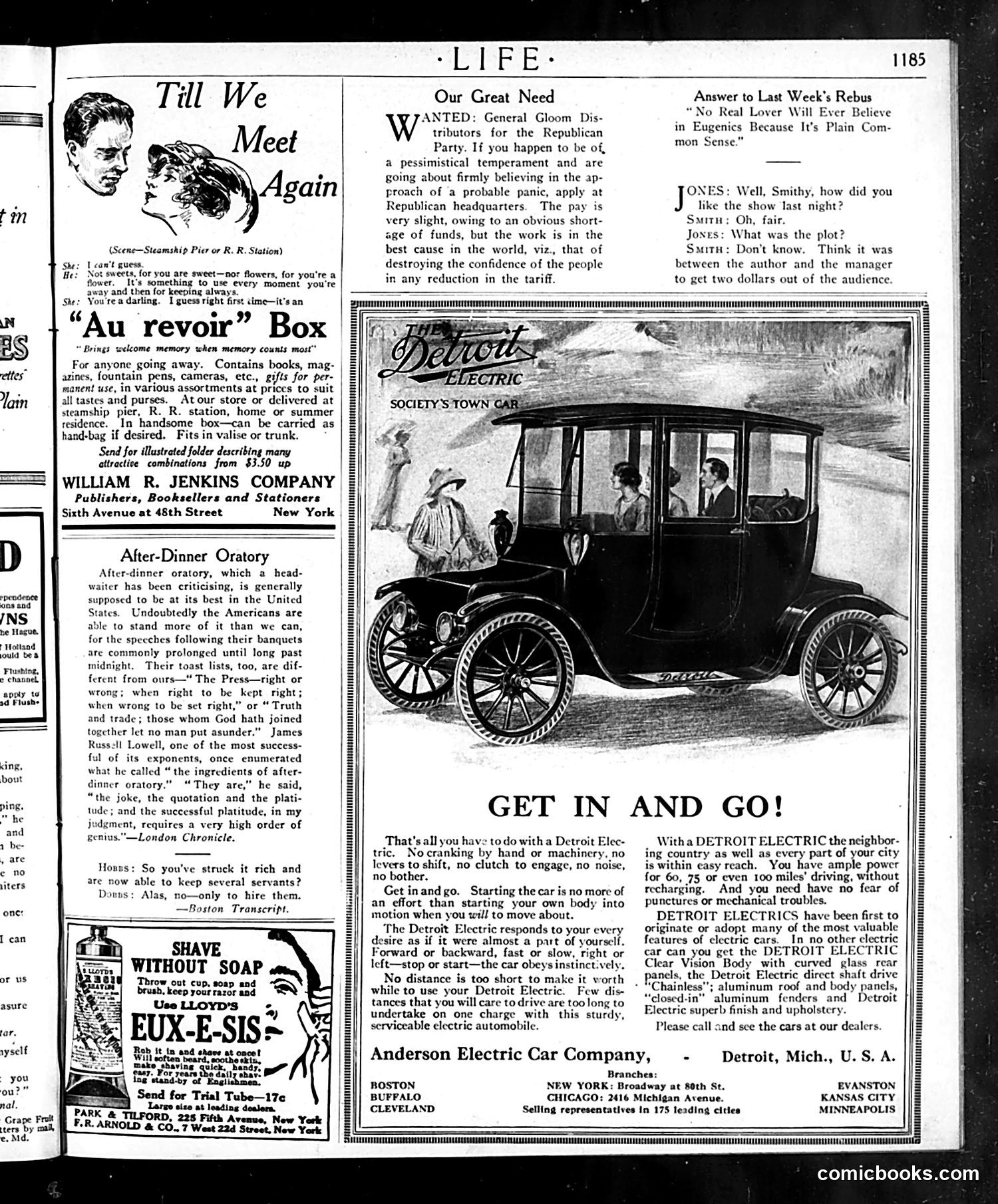
This page combines advertising with light social satire typical of early 20th-century *Life* magazine. **Main Content:** The "Till We Meet Again" cartoon depicts a romantic farewell scene at a steamship or train station, advertising an "Au revoir" Box—a gift package containing books, pens, and other items for travelers. The joke relies on the woman guessing what her suitor offers: something to use constantly while apart, suggesting the box as a memory-keeping device during separation. **Secondary Pieces:** "Our Great Need" satirizes Republican Party pessimism, mockingly advertising for "General Gloom Distributors" to spread panic about tariffs—likely referencing contemporary political anxieties about trade policy. "After-Dinner Oratory" discusses American banquet speeches, citing James Russell Lowell on their ingredients: jokes, quotations, and platitudes. **Advertising:** The Detroit Electric Car advertisement dominates the page, emphasizing the vehicle's ease of operation ("Get In and Go!") with no hand-cranking required—a major selling point for early automobiles.
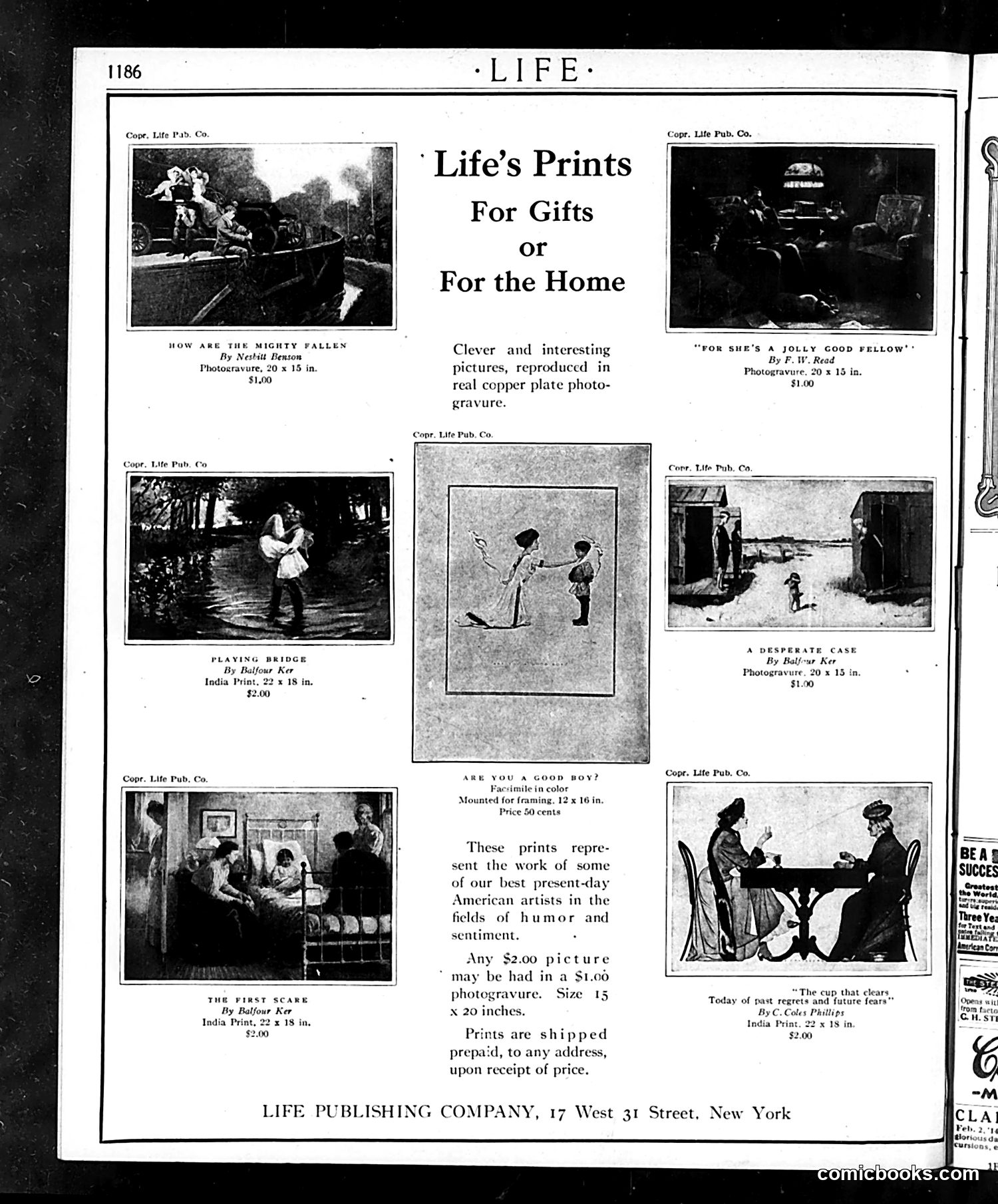
This is primarily an **advertisement page**, not a political cartoon. Life Publishing Company is selling art prints for home decoration and gifts, featuring works by popular American illustrators of the era (Balfour Ker, F.W. Read, C. Coles Phillips, and others). The prints depict sentimental domestic scenes—children playing, couples in romantic moments, social gatherings—reflecting early 20th-century middle-class values. Titles like "Are You a Good Boy?" and "The Cup That Clears" emphasize morality and sentiment. The page demonstrates how Life magazine monetized its illustrated content, offering photogravure reproductions at various price points ($1-2). This was a standard publishing business model: build readership with humorous/sentimental art, then sell prints to decorate American homes. The imagery reflects prevailing gender roles and romantic ideals of the period rather than satirical commentary.
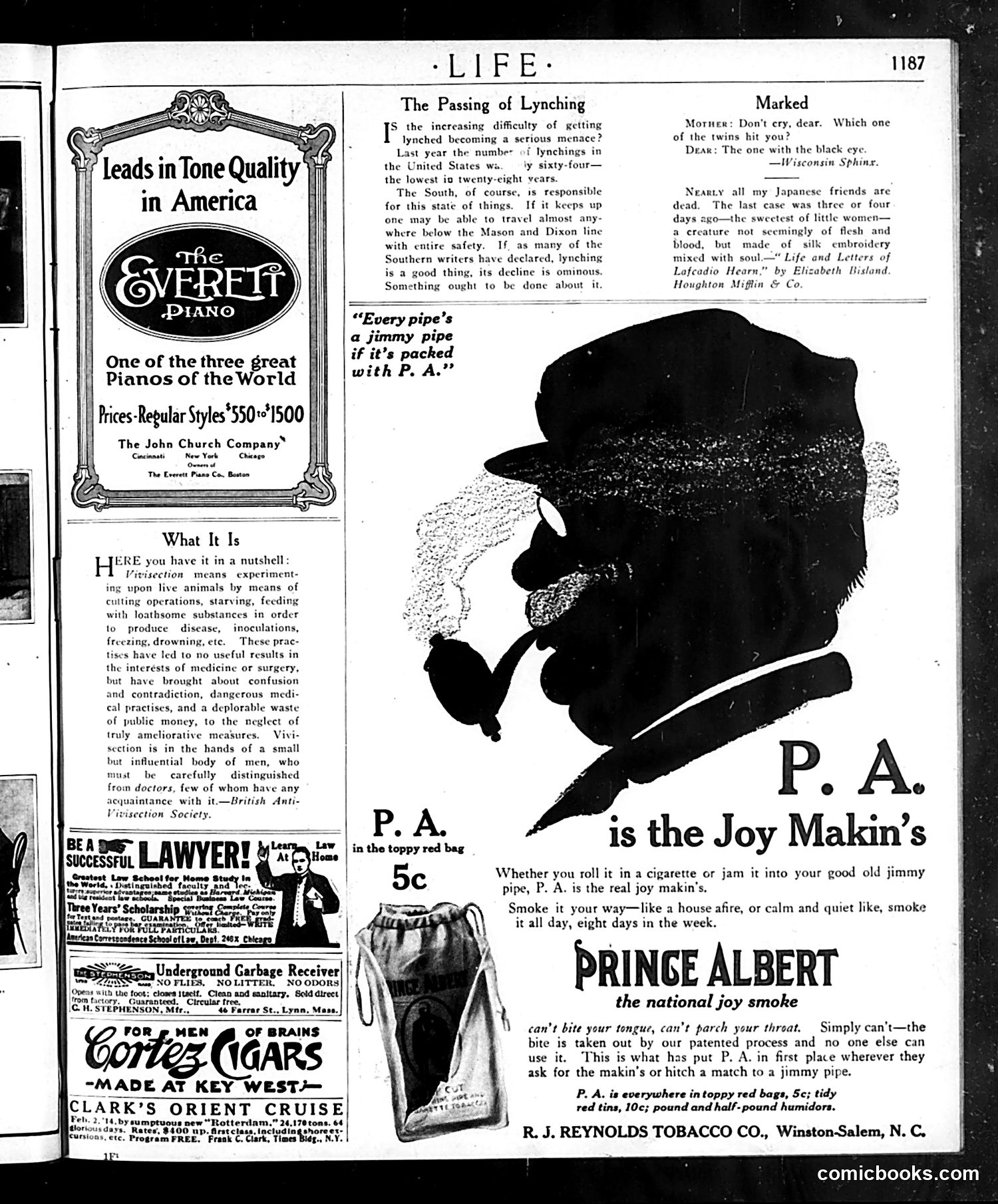
This page contains primarily **advertising and brief satirical commentary** rather than a formal cartoon. The main editorial content is "The Passing of Lynching," which reports factually that lynchings in the United States have declined to their lowest number in 28 years—only 64 the prior year. The piece sardonically notes that Southern writers who praised lynching as "a good thing" should logically welcome its decline, then pointedly states "Something ought to be done about it"—suggesting the practice should be actively eliminated rather than merely declining naturally. The page also includes anti-vivisection advocacy (animal testing criticism) and numerous period advertisements: Everett Pianos, P.A. tobacco ("Prince Albert"), Cortez Cigars, and a law school correspondence course. The silhouette illustration accompanying the P.A. tobacco ad is a generic smoking figure, not a specific caricature or political reference—it's simply product marketing common to early 20th-century advertising.
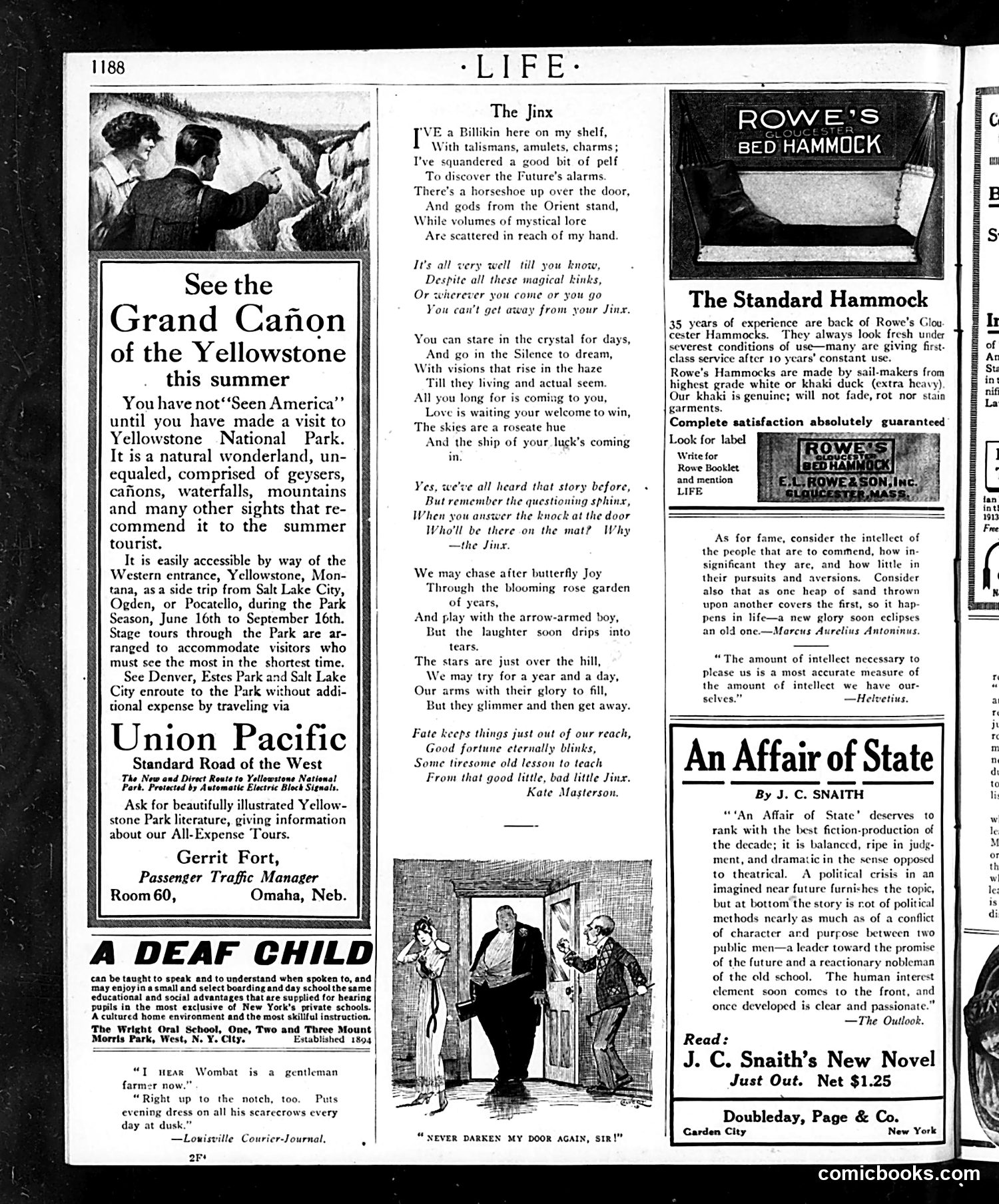
This page is primarily **advertising and literary content** rather than political satire. The main illustrated cartoon (bottom center, captioned "Never Darkens My Door Again, Sir!") shows a domestic scene—a woman confronting a man at a doorway while another figure watches—but appears to be a generic illustration accompanying serialized fiction rather than editorial commentary. The page's content is dominated by: 1. **Union Pacific railroad advertising** promoting Yellowstone National Park tourism 2. **"The Jinx"** — a poem by Kate Masterson about bad luck and fate, suggesting superstition was a popular theme 3. **Rowe's Hammock advertisement** emphasizing durability 4. **Book promotion** for J.C. Snaith's novel *An Affair of State*, described as political fiction The only potentially satirical element is the poem's meditation on superstition and inevitability, but this reads as entertainment rather than pointed social critique. This page reflects Life's mixed role as both humor magazine and lifestyle publication circa 1912.
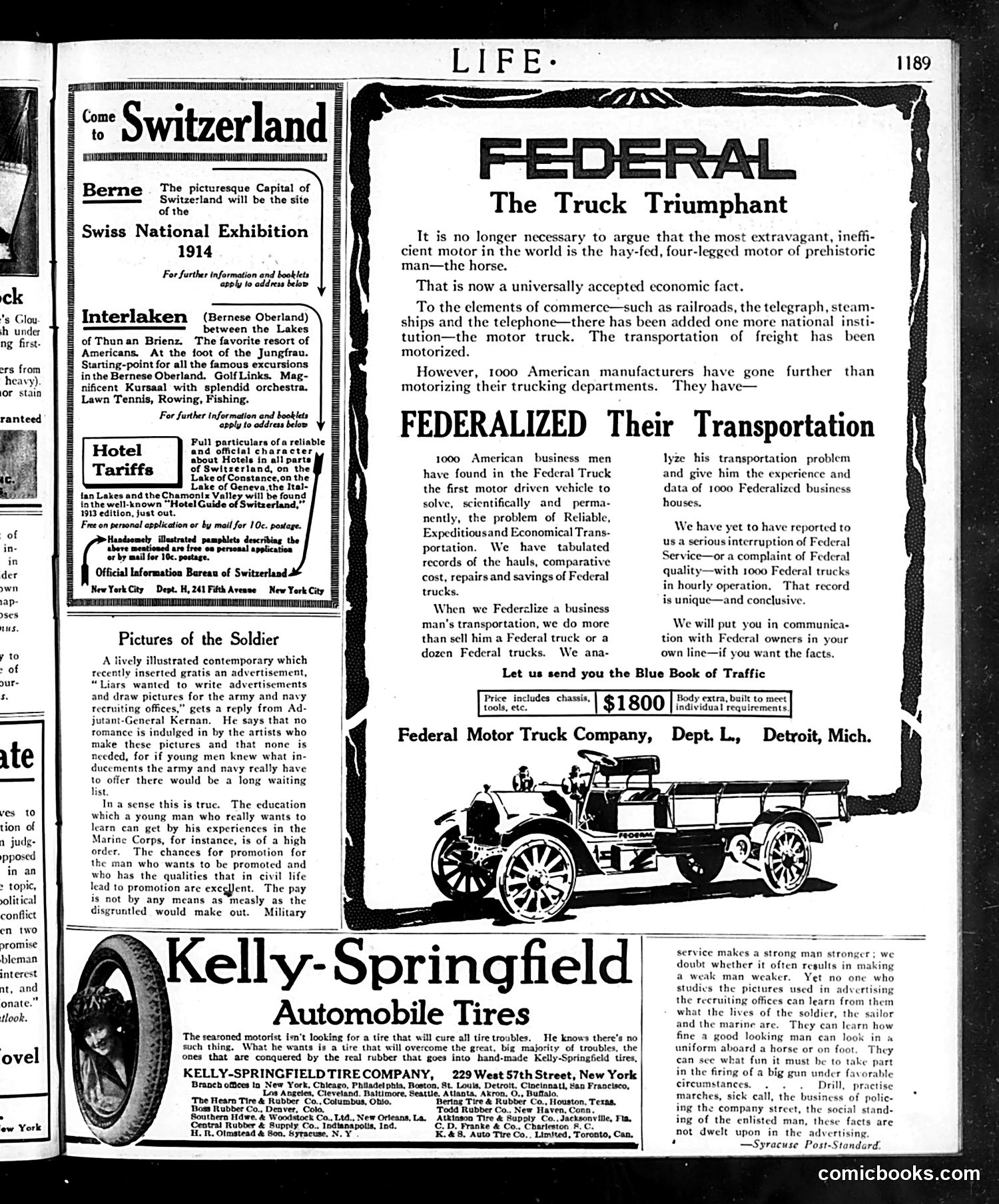
This page is primarily **advertising and travel promotion**, not political satire. The left column advertises Switzerland as a tourist destination for the 1914 Swiss National Exhibition, promoting Berne, Interlaken, and hotels—standard travel marketing of the era. The dominant content is a **Federal Motor Truck Company advertisement** claiming that 1,000 American manufacturers have "Federalized" their transportation using Federal trucks. The ad emphasizes reliability and efficiency, offering a "Blue Book of Traffic" for $1,800. A smaller section titled "Pictures of the Soldier" discusses military recruiting advertisements, noting that the army doesn't need romantic imagery—real military benefits (education, promotion prospects, physical strengthening) are sufficient incentive. **No clear political cartoon or satire is present.** The page reflects early 20th-century commercial confidence in motorized transportation replacing horse-drawn vehicles, presented straightforwardly as progress rather than as subject for satire.
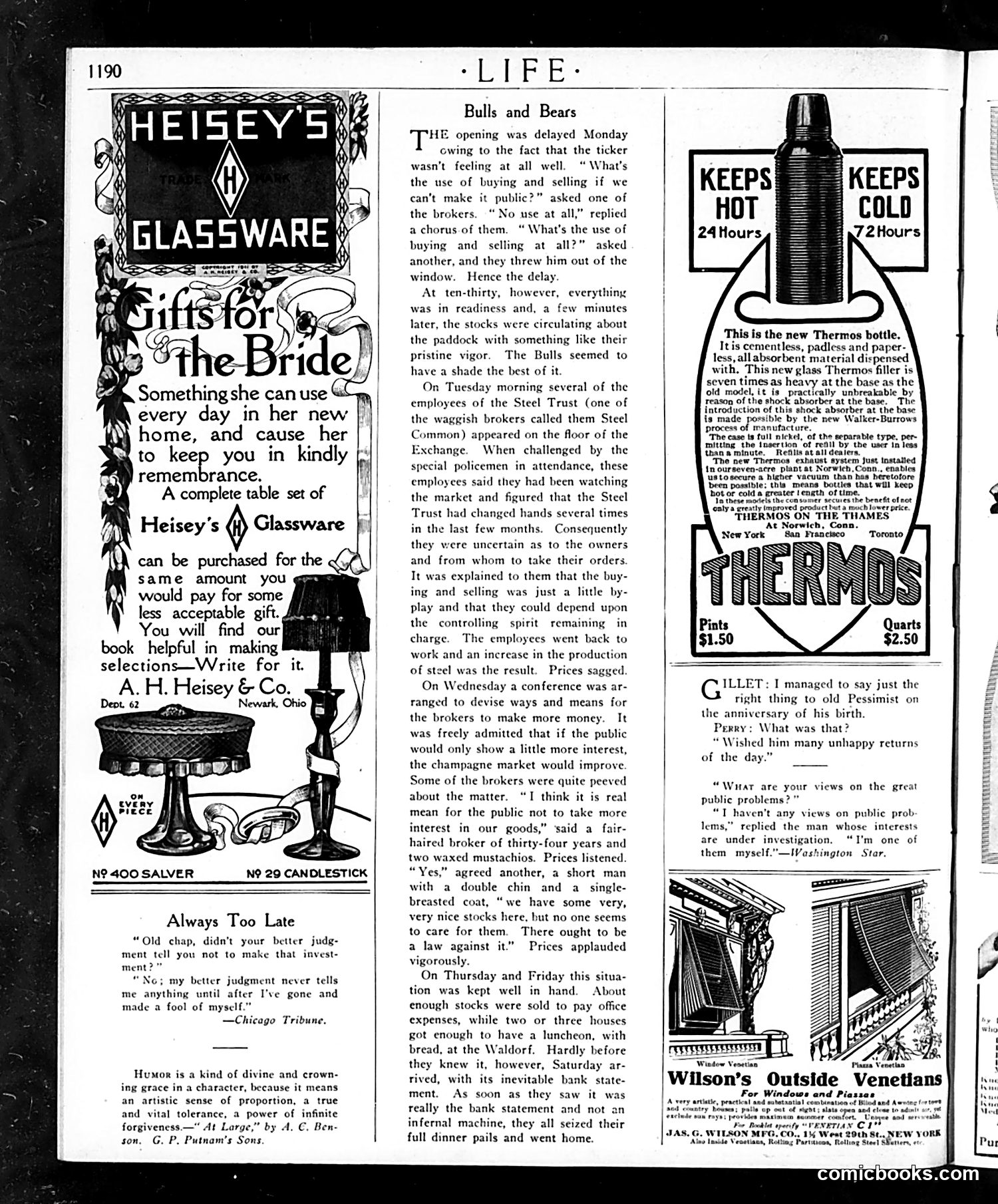
This satirical piece mocks stock market speculation and broker behavior during what appears to be early 20th-century financial trading. **The Setup:** A broken ticker tape machine delays market opening, prompting brokers to question whether trading matters if the public can't see prices—leading one to be thrown out a window for suggesting buying and selling itself is pointless. **The Satire:** The story depicts brokers as disconnected from market fundamentals. Steel Trust employees appear confused about who actually owns the company after multiple trades. A conference reveals brokers' real concern: insufficient public *interest* (not investment value), with one lamenting that lack of public excitement threatens the champagne market. **The Point:** Life satirizes how brokers prioritize generating trading activity and personal profit over genuine economic productivity. The week ends with them collecting "dinner pails"—suggesting manual laborers deserve their wages more than speculators do. This reflects Progressive Era skepticism toward Wall Street excess and the separation between financial manipulation and actual industrial work.
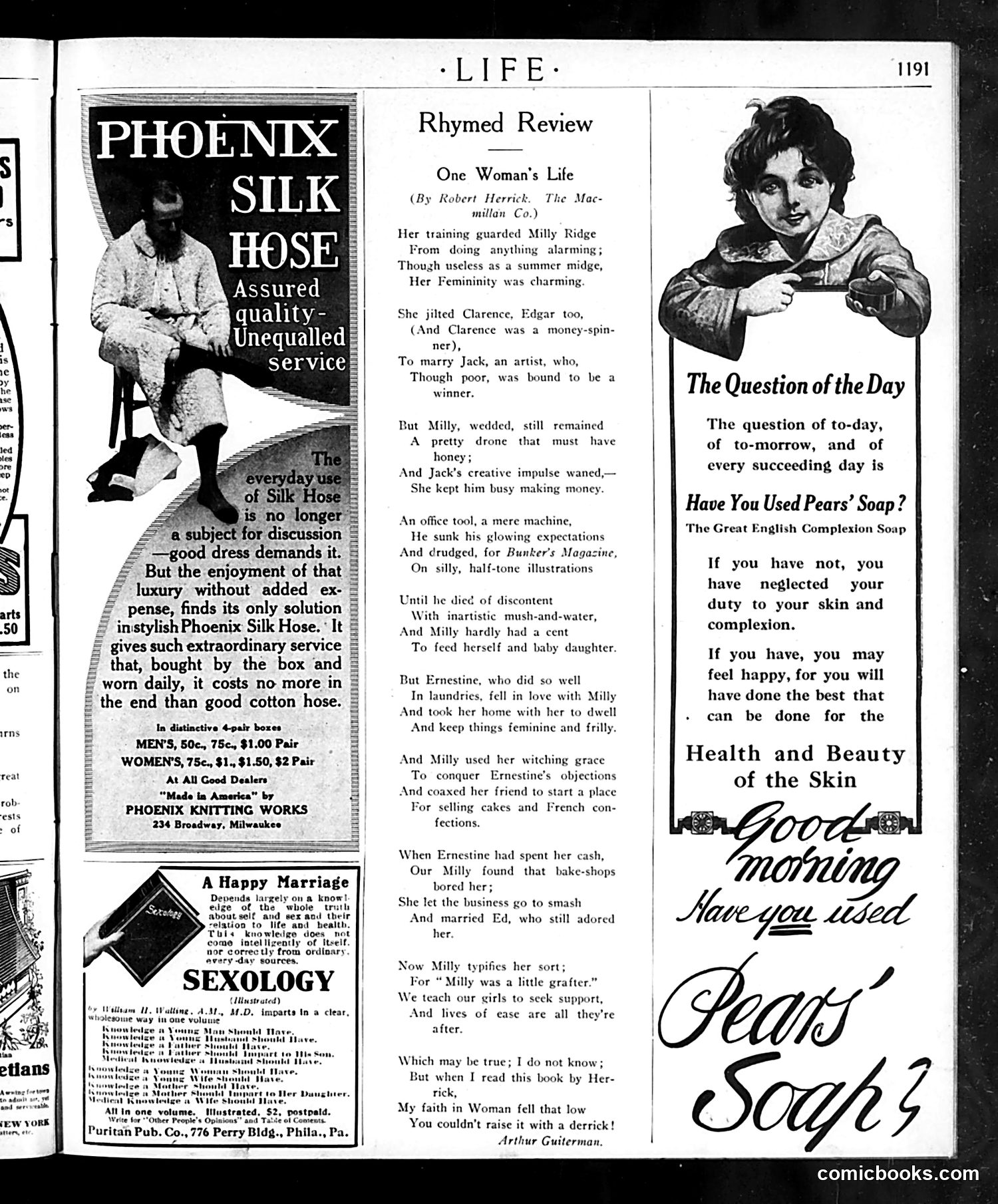
This page from *Life* magazine combines satirical book review with period advertising. The central feature is Arthur Guiterman's rhymed review of Robert Herrick's novel *One Woman's Life*, which critiques women's economic dependence and parasitic behavior. The poem follows "Milly Ridge," a woman raised to be decorative but useless, who serially marries for security rather than love. She drains her artist husband Jack's creative ambitions by forcing him into commercial illustration work; after his death from discontent, she exploits her friend Ernestine's business venture, then abandons it to marry again. Guiterman's satirical point—expressed in his closing lines—is withering: the novel illustrates that women are taught to seek financial support and leisure rather than independence or contribution. His exaggerated claim that reading the book destroyed his faith in women reflects early 20th-century anxieties about female economic parasitism and lack of purpose. The surrounding advertisements for silk stockings and beauty soap reinforce the era's consumer culture aimed at women, adding ironic context to the review's critique of female materialism.
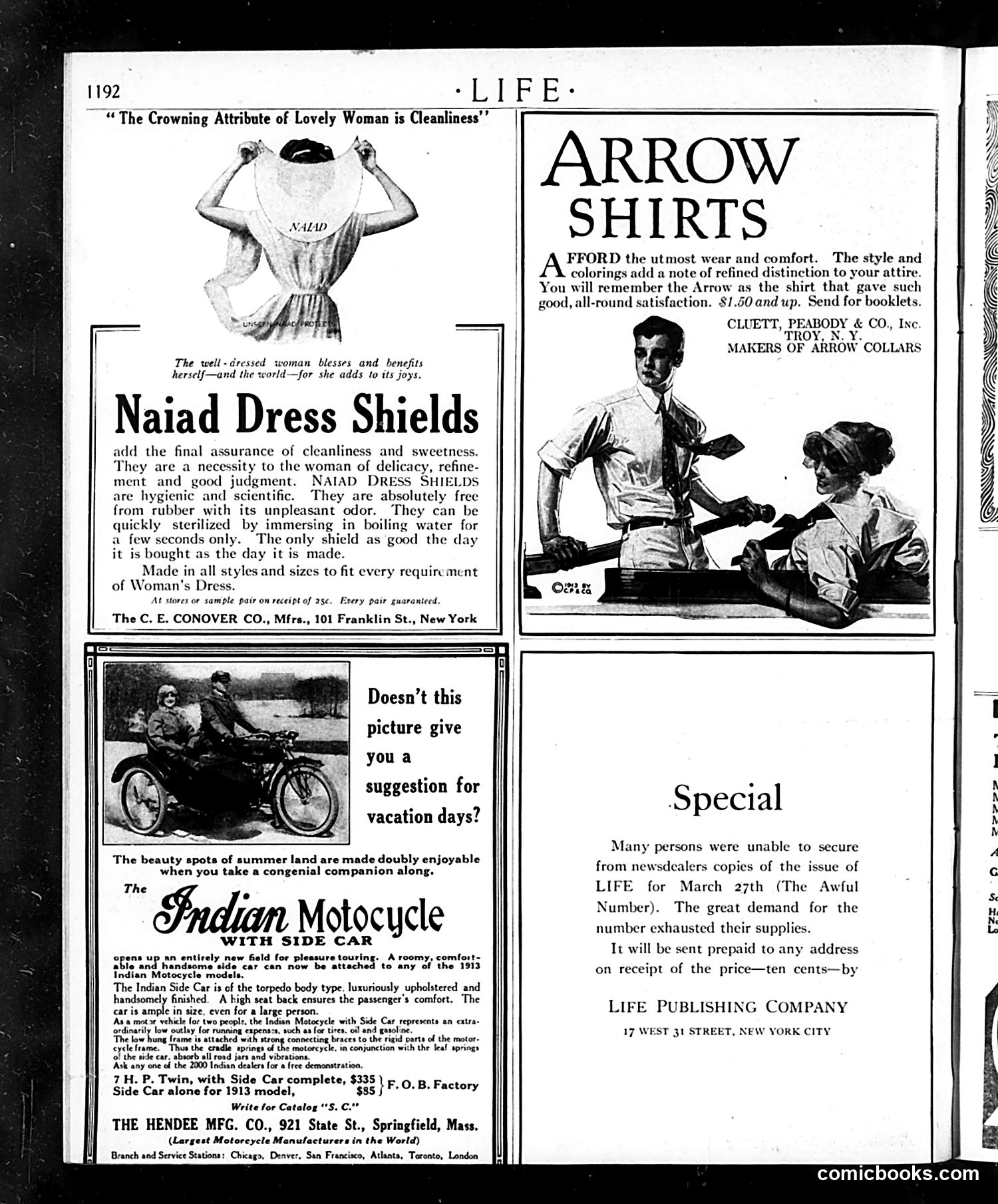
This page is primarily **advertising**, not satire or political cartoons. It contains four distinct ads targeting early 1900s consumers: 1. **Naiad Dress Shields**: Underarm absorbent pads for women's dresses, marketed as essential to cleanliness and "good judgment"—reflecting period anxieties about female bodily functions and social propriety. 2. **Arrow Shirts**: Standard menswear advertising emphasizing comfort and refined appearance. 3. **Indian Motorcycle with Sidecar**: Promotes leisure touring, showing a couple enjoying countryside drives—reflecting newfound automotive freedom and recreational dating culture. 4. **Publisher's Notice**: Life Publishing announces a sold-out March 27th issue and offers reprints. The ads reveal **social attitudes**: women's preoccupation with hygiene and discretion, gender-segregated marketing, and the motorcycle as a novel tool for courtship and adventure. There is no political satire present on this page.
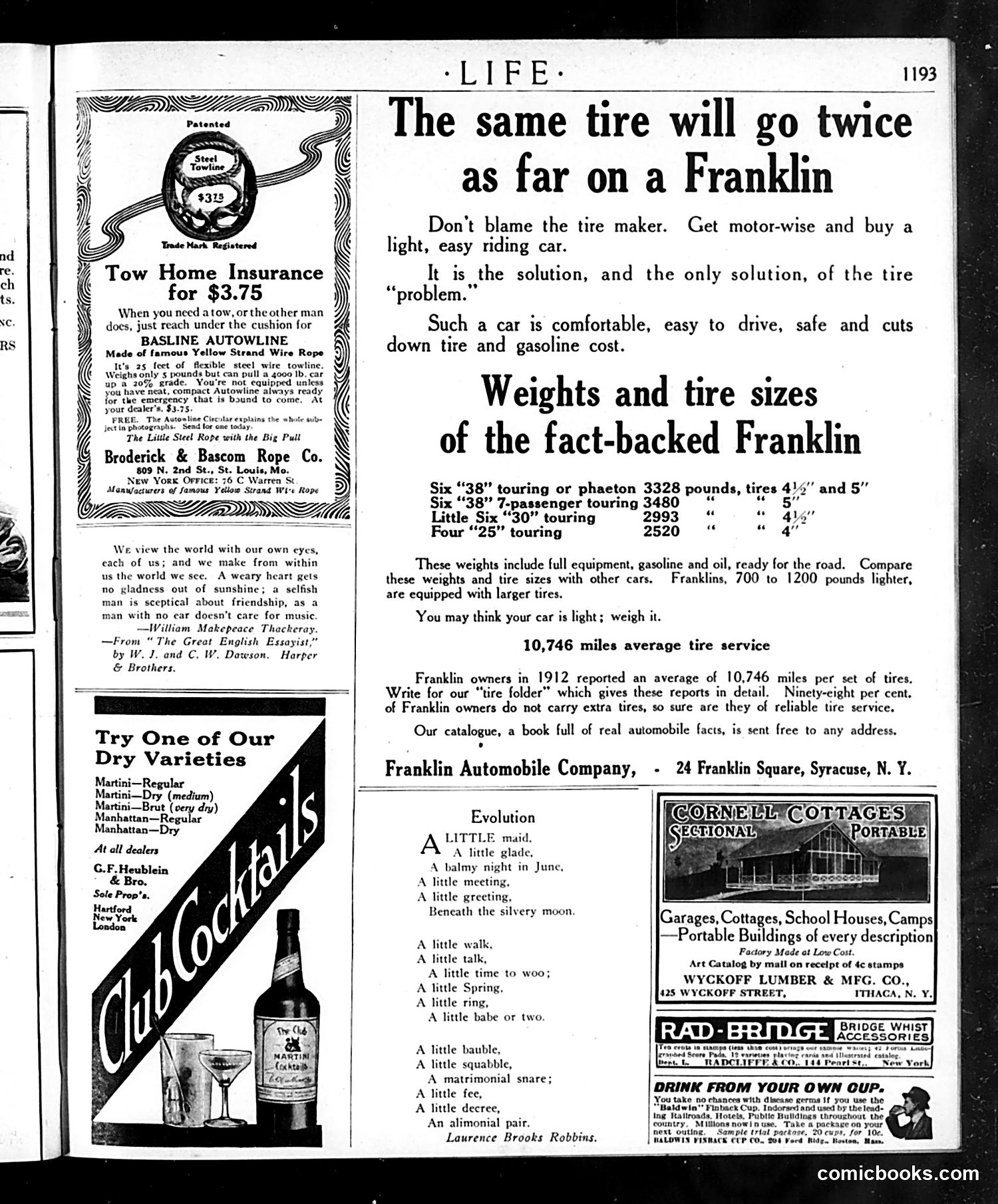
This page is primarily **advertising** with minimal editorial content. The main advertisements promote: 1. **Franklin Automobile** - The dominant ad argues that buying a lighter Franklin car solves tire wear problems. It presents tire degradation not as a manufacturing issue but as a vehicle-weight problem, claiming Franklins (700-1200 lbs lighter) achieve double the tire mileage. The ad cites 1912 owner data showing 10,746-mile average tire service. 2. **Supporting ads** include tow rope insurance, portable buildings, and drinking cups. 3. **Filler content**: A poem titled "Evolution" by Laurence Brooks Robbins depicts romanticized courtship progressing to marriage complications (legal fees, alimony). The Franklin ad represents **early automotive marketing** that frames product superiority through performance data and comparative specifications—a sales strategy still used today. The poetry reflects period sentimentality about romance versus its practical consequences.
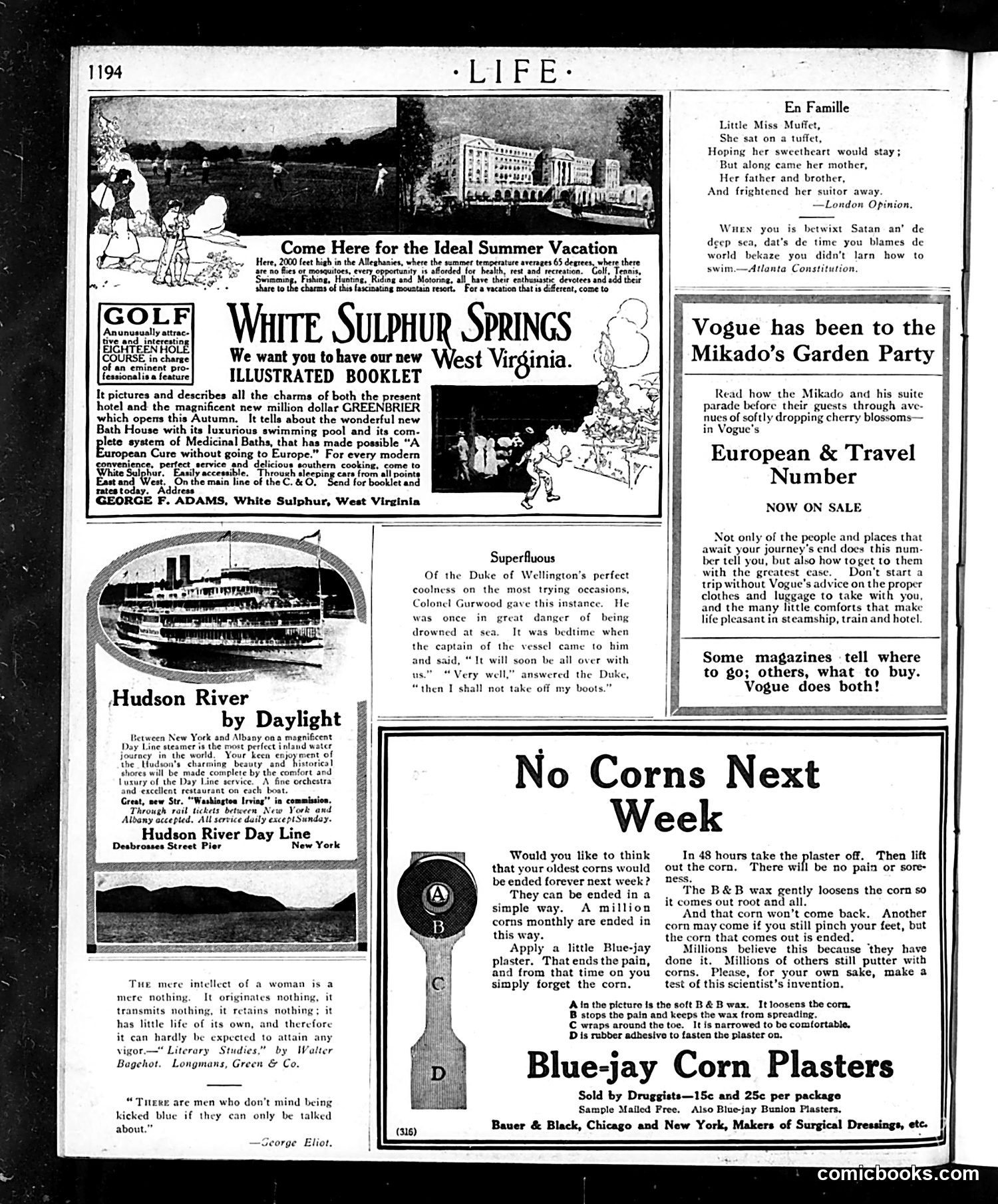
This is primarily an **advertising page** from Life magazine, circa early 1900s, containing travel and product promotions rather than political satire. **Content overview:** The page features vacation advertisements (White Sulphur Springs resort, Hudson River Day Line steamship), a Vogue magazine promotion, and a Blue-Jay Corn Plasters advertisement with instructional diagrams. **Humor elements:** Brief poetic verses appear, including a "Little Miss Muffet" parody about courtship interrupted by family, and aphoristic quotes about philosophy and gender (e.g., "The mere intellect of a woman is a mere nothing"). **Historical note:** The corn plaster ad reflects early-20th-century medical marketing typical of the era—promising painless corn removal through simple chemical application, representing pre-modern consumer medicine advertising. The page contains no identifiable political cartoons or caricatures. It's a straightforward commercial/lifestyle page reflecting period leisure activities and consumer products.
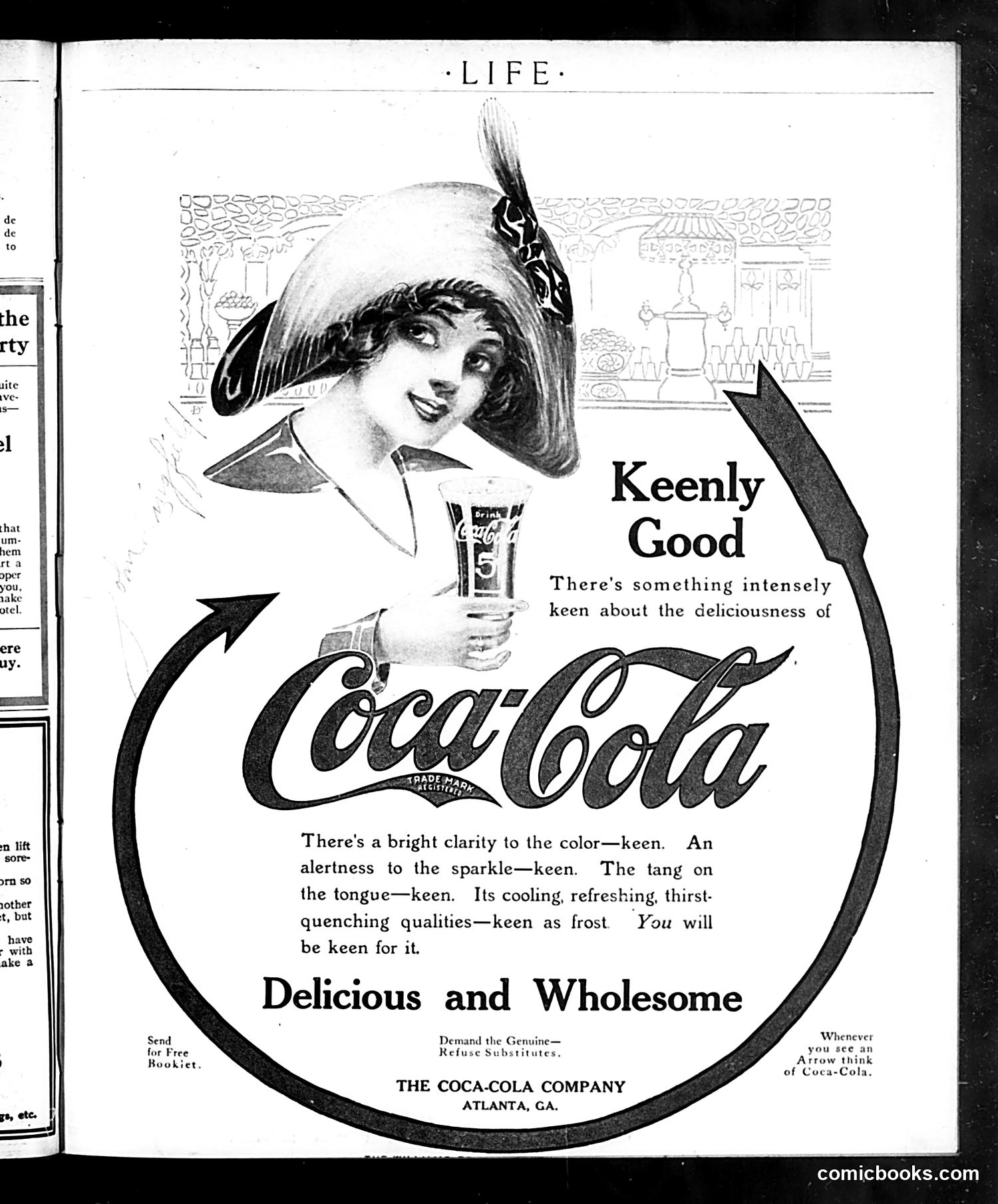
This is a **Coca-Cola advertisement**, not political satire. The page features a stylized illustration of a fashionable young woman wearing a decorative headpiece, holding a Coca-Cola bottle. The ad exploits the slang term "keen," popular in the 1920s, meaning excellent or appealing. It repeatedly uses "keen" to describe Coca-Cola's qualities—its color, sparkle, taste, and refreshing properties. The copy plays on the word: "You will be keen for it" (you will want it). The decorative circular border frames the product name prominently. Text at the bottom emphasizes buying "the Genuine" and refusing substitutes, indicating competition from imitator beverages was a concern. This represents early mass-market advertising in *Life* magazine, using contemporary slang and attractive imagery to appeal to modern, style-conscious consumers during the Jazz Age.
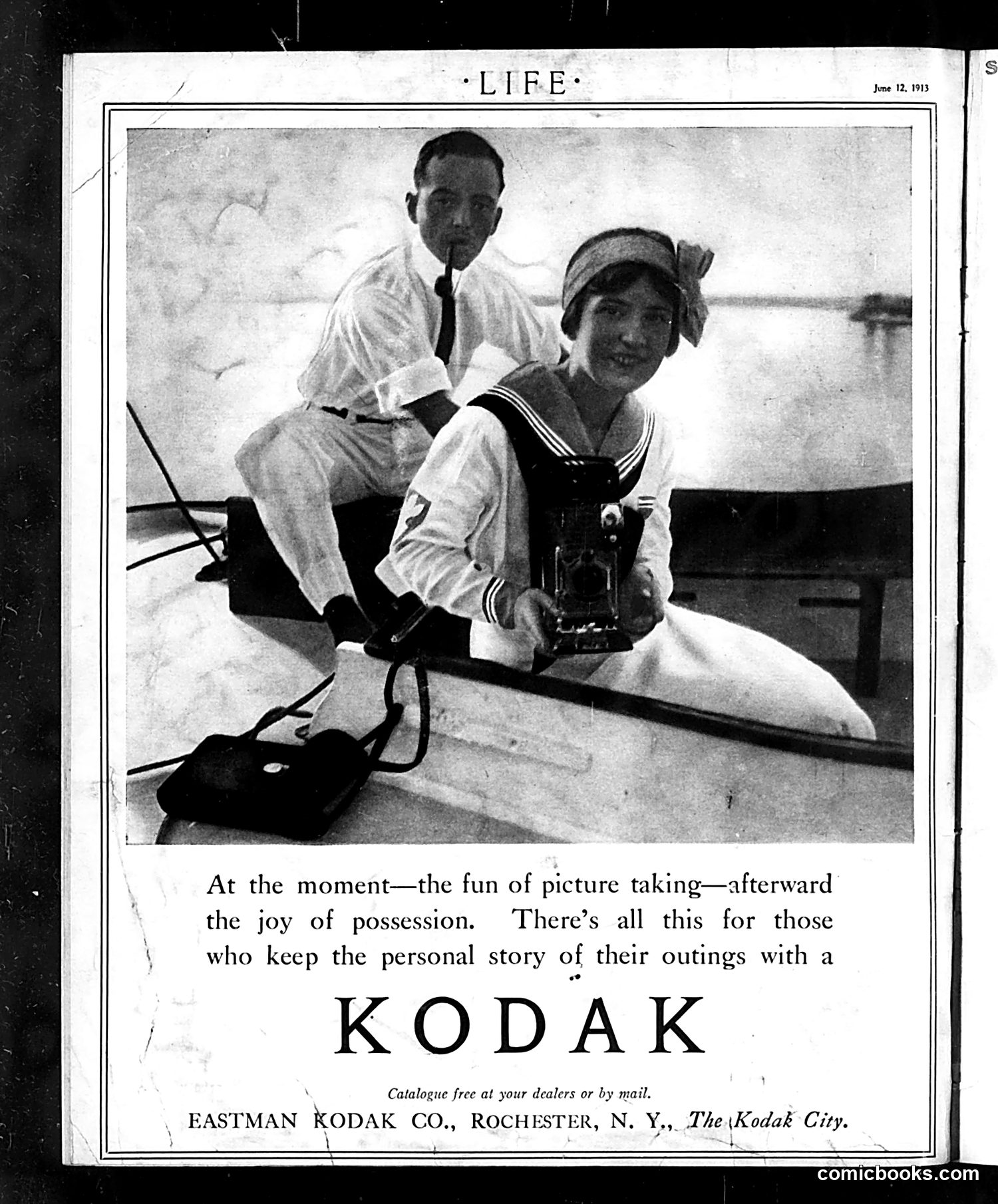
This is a Kodak advertisement from Life magazine (June 12, 1913), not a political cartoon. It shows two men on a boat—one in a suit and tie sitting behind, another in a sailor outfit holding a camera—looking at a mirror or reflective surface, presumably admiring themselves. The ad's message targets early 20th-century leisure culture: it appeals to middle-class men who took recreational "outings" and wanted to document them. The pitch emphasizes both the immediate pleasure of photography and the lasting value of preserving memories. The casual boating scene and well-dressed subjects suggest this is marketing Kodak cameras to affluent consumers as essential accessories for modern social life and personal storytelling.