
Life, 1913-06-12 · page 9 of 44
Life — June 12, 1913 — page 9: what you’re looking at
What you’re looking at
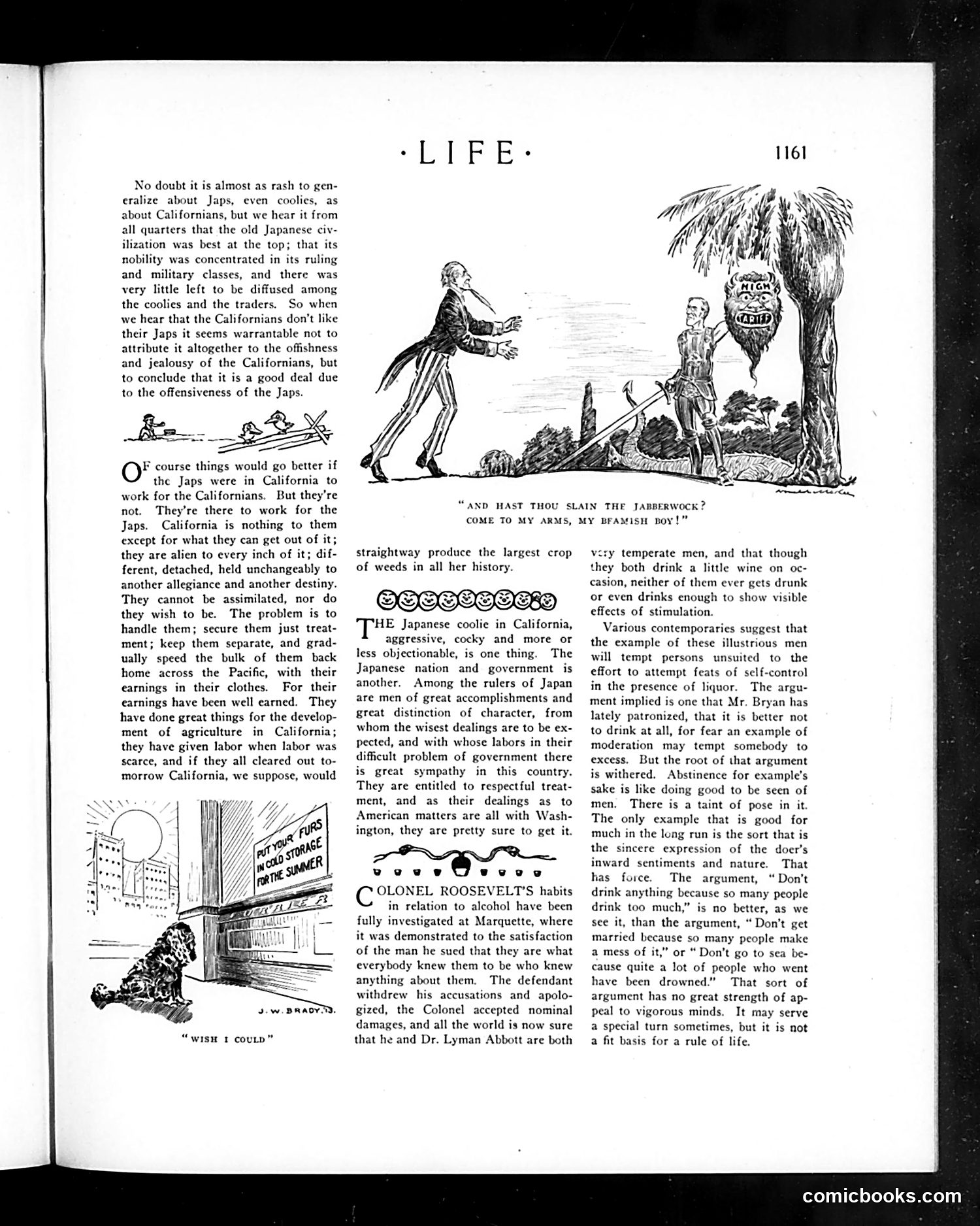
This page satirizes anti-Japanese sentiment in California during the early 20th century. The main cartoon depicts a figure labeled "AND HAST THOU SLAIN THE JABBERWOCK?" — referencing Lewis Carroll's nonsense poem to mock dramatic overreaction to Japanese immigration. The article discusses Japanese laborers in California, acknowledging their work contributions while expressing concerns about their "separation" from American society. The text argues they cannot assimilate and should be kept segregated, reflecting the era's xenophobic attitudes. The secondary cartoon ("WISH I COULD") shows a figure trapped in a storage box, likely commenting on restrictions or containment of Japanese workers. The overall tone treats Japanese immigration as a manageable "problem" requiring control, reflecting widespread racist ideology of that period.
📄 Transcribed text from this page (OCR, searchable)
Machine-transcribed from the original scan — historical spelling and the odd misread are preserved.
No doubt it is almost as rash to gen- eralize about Japs, even coolies, as about Californians, but we hear it from all quarters that the old Japanese civ- ilization was best at the top; that its nobility was concentrated in its ruling and military classes, and there was very little left to be diffused among the coolies and the traders. So when we hear that the Californians don’t like their Japs it seems warrantable not to attribute it altogether to the offishness and jealousy of the Californians, but to conclude that it is a good deal due to the offensiveness of the Japs. OF course things would go better if the Japs were in California to work for the Californians. But they’re not. They’re there to work for the Japs. California is nothing to them except for what they can get out of it; they are alien to every inch of it; dif- ferent, detached, held unchangeably to another allegiance and another destiny. They cannot be assimilated, nor do they wish to be. The problem is to handle them; secure them just treat- ment; keep them separate, and grad- ually speed the bulk of them back home across the Pacific, with their earnings in their clothes. For their earnings have been well earned. They have done great things for the develop- ment of agriculture in California; they have given labor when labor was scarce, and if they all cleared out to- morrow California, we suppose, would “wisi 1 coup” “AND HAST THOU SLAIN THE JABBERWOCK ? COME TO MY ARMS, MY BFAMISH Boy!” straightway produce the largest crop of weeds in all her history. SSCCSOSEsy 'HE Japanese coolie in California, aggressive, cocky and more or less objectionable, is one thing. The Japanese nation and government is another. Among the rulers of Japan are men of great accomplishments and great distinction of character, from whom the wisest dealings are to be ex- pected, and with whose labors in their difficult problem of government there is great sympathy in this country. They are entitled to respectful treat- ment, and as their dealings as to American matters are all with Wash- ington, they are pretty sure to get it. OLONEL ROOSEVELT’S habits in relation to alcohol have been fully investigated at Marquette, where it was demonstrated to the satisfaction of the man he sued that they are what everybody knew them to be who knew anything about them. The defendant withdrew his accusations and apolo- gized, the Colonel accepted nominal damages, and all the world is now sure that he and Dr. Lyman Abbott are both viry temperate men, and that though they both drink a little wine on oc- casion, neither of them ever gets drunk or even drinks enough to show visible effects of stimulation. Various contemporaries suggest that the example of these illustrious men will tempt persons unsuited to the effort to attempt feats of self-control in the presence of liquor. The argu- ment implied is one that Mr. Bryan has lately patronized, that it is better not to drink at all, for fear an example of moderation may tempt somebody to excess. But the root of that argument is withered. Abstinence for example's sake is like doing good to be seen of men. There is a taint of pose in it. The only example that is good for much in the long run is the sort that is the sincere expression of the doer’s inward sentiments and nature. That has force. The argument, “Don't drink anything because so many people drink too much,” is no better, as we see it, than the argument, “Don’t get married because so many people make a mess of it,” or “ Don't go to sea be- cause quite a lot of people who went have been drowned.” That sort of argument has no great strength of ap- peal to vigorous minds. It may serve a special turn sometimes, but it is not a fit basis for a rule of life. comicbooks.com