
Life, 1913-06-12 · page 8 of 44
Life — June 12, 1913 — page 8: what you’re looking at
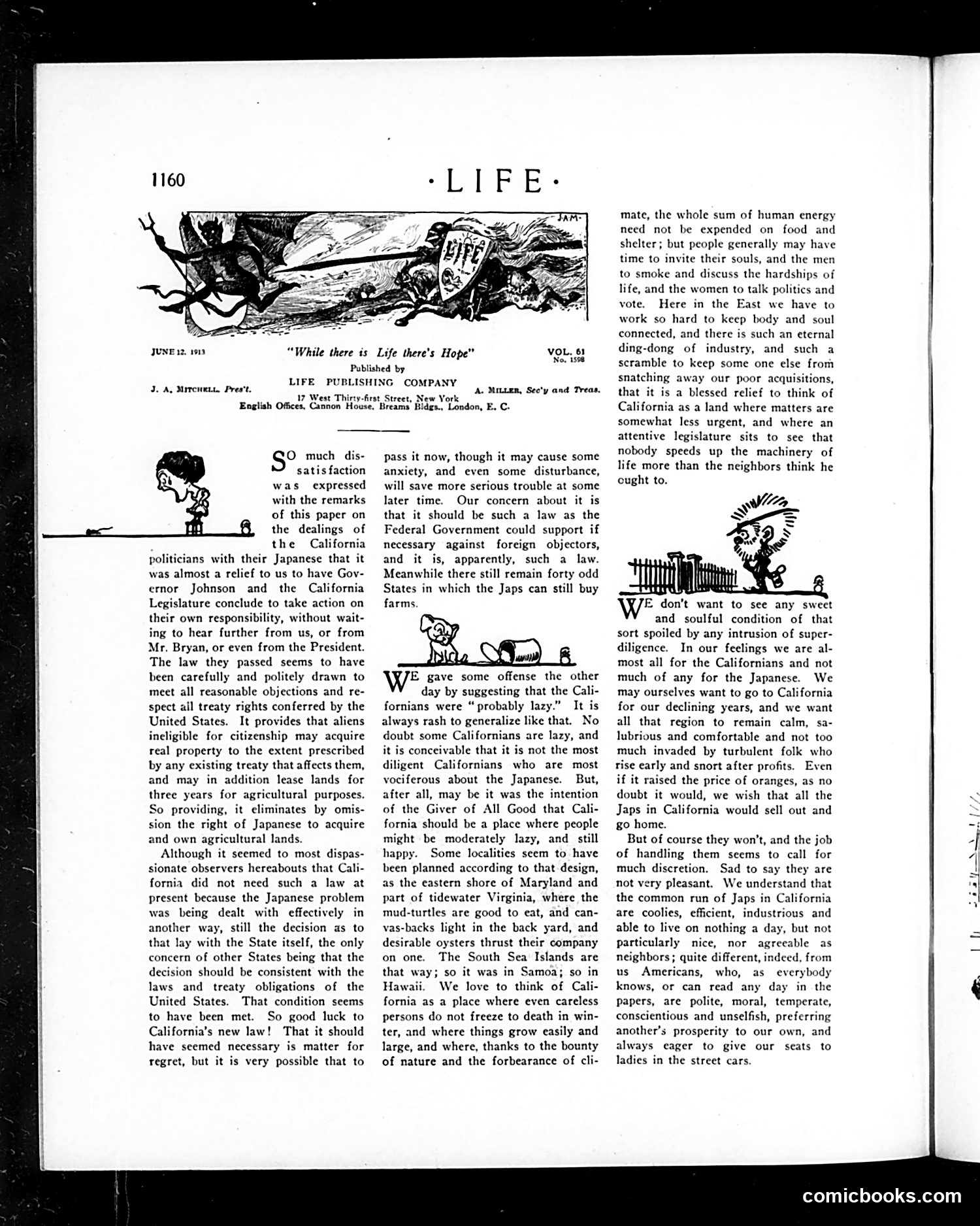
What you’re looking at
This editorial page addresses California's **anti-Japanese sentiment and discriminatory land laws**. The text criticizes Governor Johnson and the California Legislature for restricting Japanese land ownership rights—legislation apparently passed without waiting for federal guidance or presidential approval. The cartoons (appearing to mock California politicians) illustrate the article's central argument: that California's actions are hypocritical and economically short-sighted, treating Japanese residents unfairly despite their contributions to the state. The piece defends Japanese Californians against stereotypes of laziness, arguing they're industrious and deserving of better treatment. It advocates for California as a more tolerant place where people of different backgrounds could coexist peacefully—a progressive stance for 1919, when anti-Asian discrimination was widespread and legally enforced.
📄 Transcribed text from this page (OCR, searchable)
Machine-transcribed from the original scan — historical spelling and the odd misread are preserved.
JUNE 12, 1913 “While there is Life there's Hope” No. 159 Published by LIFE PUBLISHING J. A, Mrrcwent, Pres't. COMPANY A. Mitten, Sec'y and Treas, 17 West Thirty-first Street, New Vork English Offices, Cannon House, Breams’ Bldgs, London, E. C: O much dis- satisfaction was expressed with the remarks of this paper on the dealings of the California politicians with their Japanese that it was almost a relief to us to have Gov- ernor Johnson and the California Legislature conclude to take action on their own responsibility, without wait- ing to hear further from us, or from Mr. Bryan, or even from the President. The law they passed seems to have been carefully and politely drawn to meet all reasonable objections and re- spect ail treaty rights conferred by the United States. It provides that aliens ineligible for citizenship may acquire real property to the extent prescribed by any existing treaty that affects them, and may in addition lease lands for three years for agricultural purposes. So providing, it eliminates by omis- sion the right of Japanese to acquire and own agricultural lands. Although it seemed to most dispas- sionate observers hereabouts that Cali- fornia did not need such a law at present because the Japanese problem was being dealt with effectively in another way, still the decision as to that lay with the State itself, the only concern of other States being that the decision should be consistent with the laws and treaty obligations of the United States. That condition seems to have been met. So good luck to California’s new law! That it should have seemed necessary is matter for regret, but it is very possible that to Pass it now, though it may cause some anxiety, and even some disturbance, will save more serious trouble at some later time. Our concern about it is that it should be such a law as the Federal Government could support if necessary against foreign objectors, and it is, apparently, such a law. Meanwhile there still remain forty odd States in which the Japs can still buy farms. 'E gave some offense the other day by suggesting that the Cali- fornians were “probably lazy.” It is always rash to generalize like that. No doubt some Californians are lazy, and it is conceivable that it is not the most diligent Californians who are most vociferous about the Japanese. But, after all, may be it was the intention of the Giver of All Good that Cali- fornia should be a place where people might be moderately lazy, and_ still happy. Some localities seem to have been planned according to that design, as the eastern shore of Maryland and part of tidewater Virginia, where the mud-turtles are good to eat, and can- vas-backs light in the back yard, and desirable oysters thrust their company on one. The South Sea Islands are that way; so it was in Samoa; so in Hawaii. We love to think of Cali- fornia as a place where even careless persons do not freeze to death in win- ter, and where things grow easily and large, and where, thanks to the bounty of nature and the forbearance of cli- mate, the whole sum of human energy need not be expended on food and shelter; but people generally may have time to invite their souls, and the men to smoke and discuss the hardships of i nd the women to talk politics and Here in the East we have to work so hard to keep body and soul connected, and there is such an eternal ding-dong of industry, and such a scramble to keep some one else from snatching away our poor acquisitions, that it is a blessed relief to think of California as a land where matters are somewhat less urgent, and where an attentive legislature sits to see that nobody speeds up the machinery of life more than the neighbors think he cought to. W* don’t want to see any sweet and soulful condition of that sort spoiled by any intrusion of super- diligence. In our feelings we are al- most all for the Californians and not much of any for the Japanese. We may ourselves want to go to California for our declining years, and we want all that region to remain calm, sa- lubrious and comfortable and not too much invaded by turbulent folk who rise early and snort after profits. Even if it raised the price of oranges, as no doubt it would, we wish that all the Japs in California would sell out and go home. But of course they won't, and the job of handling them seems to call for much discretion. Sad to say they are not very pleasant. We understand that the common run of Japs in California are coolies, efficient, industrious and able to live on nothing a day, but not particularly nice, nor agreeable as neighbors ; quite different, indeed, from us Americans, who, as everybody knows, or can read any day in the Papers, are polite, moral, temperate, conscientious and unselfish, preferring another’s prosperity to our own, and always eager to give our seats to ladies in the street cars. comicbooks.com