
Life, 1913-06-12 · page 28 of 44
Life — June 12, 1913 — page 28: what you’re looking at
What you’re looking at
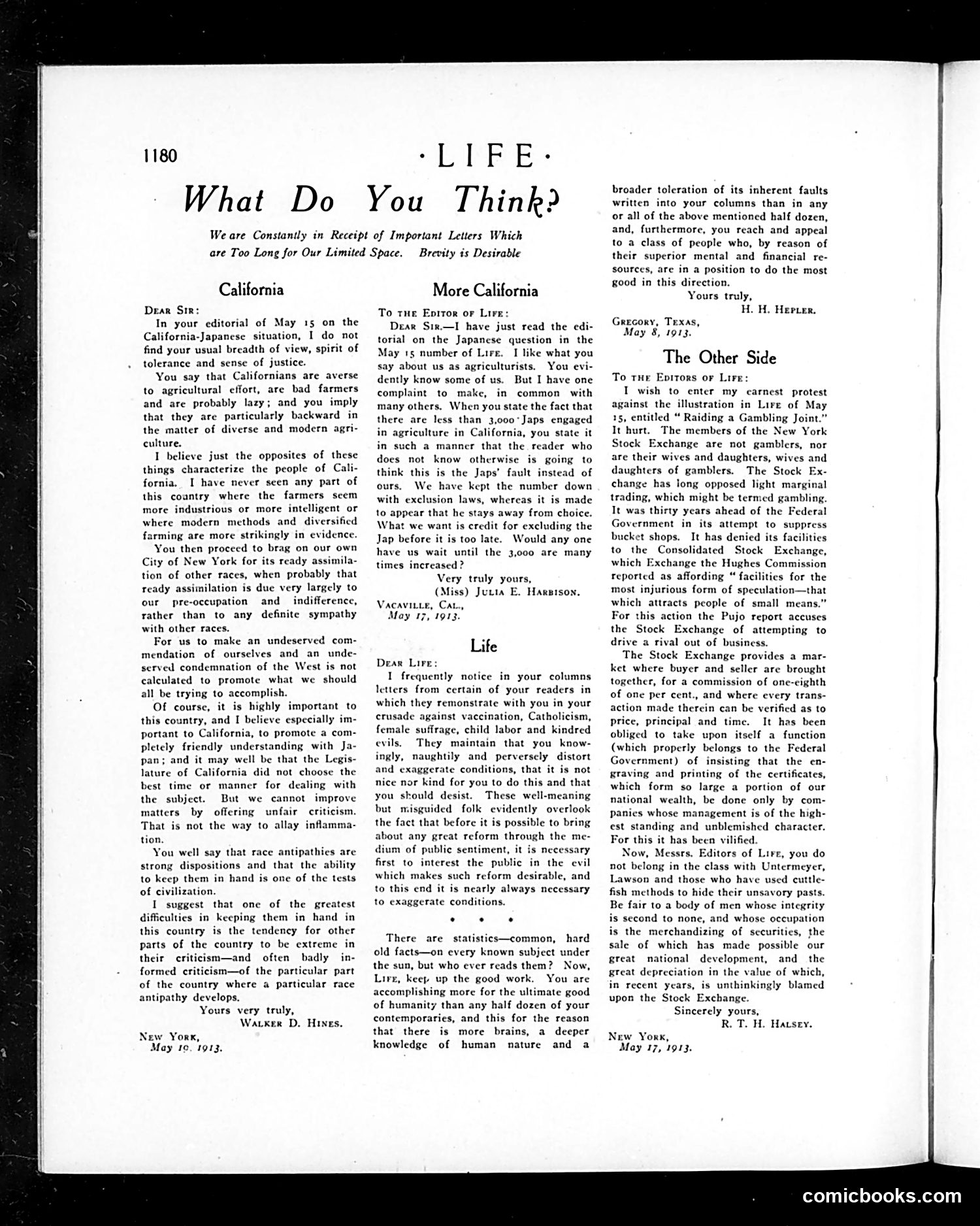
This page contains the magazine's **reader letters section**, not cartoons. It presents three letters debating the California-Japanese immigration controversy of 1913—a heated issue when California's legislature was considering anti-Japanese agricultural restrictions. **The debate:** - **Letter 1** (Walker D. Hives, New York) criticizes Life's May 15 editorial for unfairly attacking California farmers as lazy and backward, arguing New York's "tolerance" stems from indifference rather than principle. - **Letter 2** (Julia E. Harmon, California) objects to Life's framing: the magazine reported only 3,000 Japanese in agriculture, implying they *chose* to avoid farming, when actually California had *legally excluded* them. She demands credit for exclusionary laws. - **Letter 3** (partially visible) defends Life's advocacy journalism, arguing exaggeration is necessary to mobilize public sentiment for reform. **The satire:** The letters reveal period attitudes: California's proud defense of racial exclusion laws, regional tension between coasts, and Life's self-defense of its muckraking methods.
📄 Transcribed text from this page (OCR, searchable)
Machine-transcribed from the original scan — historical spelling and the odd misread are preserved.
1180 What Do “aE EBME You Think? Weare Constantly in Receipt of Important Letters Which are Too Long for Our Limited Space. California Dear Sir: In your editorial of May 15 on the California-Japanese situation, I do not find your usual breadth of view, spirit of tolerance and sense of justice. You say that Californians are averse to agricultural effort, are bad farmers and are probably lazy; and you imply that they are particularly backward in the matter of diverse and modern agri- culture. I believe just the opposites of these things characterize the people of Cali- fornia. I have never seen any part of this country where the farmers seem more industrious or more intelligent or where modern methods and diversified farming are more strikingly in evidence You then proceed to brag on our own City of New York for its ready assimila- tion of other races, when probably that ready assimilation is due very largely to our pre-occupation and indifference, rather than to any definite sympathy with other races. For us to make an undeserved com- mendation of ourselves and an unde- served condemnation of the West is not calculated to promote what we should all be trying to accomplish. Of course, it is highly important to this country, and I believe especially im- portant to California, to promote a com- pletely friendly understanding with Ja- pan; and it may well be that the Legis- lature of California did not choose the best time or manner for dealing with the subject. But we cannot improve matters by offering unfair criticism. That is not the way to allay inflamma- tion. You well say that race antipathies are strong dispositions and that the ability to keep them in hand is one of the tests of civilization. I suggest that one of the greatest difficulties in keeping them in hand in this country is the tendency for other parts of the country to be extreme in their criticism—and often badly in- formed criticism—of the particular part of the country where a particular race antipathy develops. Yours very truly, Waker D. Hives. New Yorn, May 10. 1913. Brevity is Desirable More California To tue Eprror oF Lire: Dear Sirx—I have just read the edi- torial on the Japancse question in the May 15 number of Lire. I like what you say about us as agriculturists, You evi- dently know some of us. But I have one complaint to make, in common with many others. When you state the fact that there are less than 3,000°Japs engaged in agriculture in California, you state it in such a manner that the reader who does not know otherwise is going to think this is the Japs’ fault instead of ours. We have kept the number down with exclusion laws, whereas it is made to appear that he stays away from choice. What we want is credit for excluding the Jap before it is too late. Would any one have us wait until the 3,000 are many times increased? Very truly yours, (Miss) Junta E. Harpisoy. VAcAvILLe, Cate, May 17,1913. Life Dear Lire: I frequently notice in your columns letters from certain of your readers in which they remonstrate with you in your crusade against vaccination, Catholicism, female suffrage, child labor and kindred evils, They maintain that you know- ingly, naughtily and perversely distort and exaggerate conditions, that it is not nice nor kind for you to do this and that you should desist. These well-meaning but misguided folk evidently overlook the fact that before it is possible to bring about any great reform through the me- dium of public sentiment, it is necessary first to interest the public in the evil which makes such reform desirable, and to this end it is nearly always necessary to exaggerate conditions. eo @ © There are statistics—common, hard old facts—on every known subject under the sun, but who ever reads them? Now, Lire, keep up the good work. You are accomplishing more for the ultimate good of humanity than any half dozen of your contemporaries, and this for the reason that there is more brains, a deeper Knowledge of human nature and a broader toleration of its inherent faults written into your columns than in any or all of the above mentioned half dozen, and, furthermore, you reach and appeal to a class of people who, by reason of their superior mental and financial re- sources, are in a position to do the most good in this direction. Yours truly, H. H. Herter. Grecory, Texas, May 8, 1913. The Other Side iToRS oF Liv I wish to enter my carnest Protest against the illustration in Lire of May 15, entitled “ Raiding a Gambling Joint.” It hurt. The members of the New York Stock Exchange are not gamblers, nor are their wives and daughters, wives and daughters of gamblers. The Stock Ex- change has long opposed light marginal trading, which might be termed gambling. It was thirty years ahead of the Federal Government in its attempt to suppress bucket shops. It has denied its facilities to the Consolidated Stock Exchange, which Exchange the Hughes Commission reported as affording “ facilities for the most injurious form of speculation—that which attracts people of small means.” For this action the Pujo report accuses the Stock Exchange of attempting to drive a rival out of business. The Stock Exchange provides a mar- ket where buyer and seller are brought together, for a commission of one-eighth of one per cent., and where every trans- action made therein can be verified as to price, principal and time. It has been obliged to take upon itself a function (which properly belongs to the Federal Government) of insisting that the en- graving and printing of the certificates, which form so large a portion of our national wealth, be done only by com- panies whose management is of the high- est standing and unblemished character. For this it has been vilified. Now, Messrs. Editors of Lire, you do not belong in the class with Untermeyer, Lawson and those who have used cuttle- fish methods to hide their unsavory pasts. Be fair to a body of men whose integrity is second to none, and whose occupation is the merchandizing of sccurities, the sale of which has made possible our great national development, and the great depreciation in the value of which, in recent years, is unthinkingly blamed upon the Stock Exchange. Sincerely yours, R. T. H. Hatsey. New Yor, May 17, 1913. comicbooks.com