
Life, 1913-06-12 · page 24 of 44
Life — June 12, 1913 — page 24: what you’re looking at
What you’re looking at
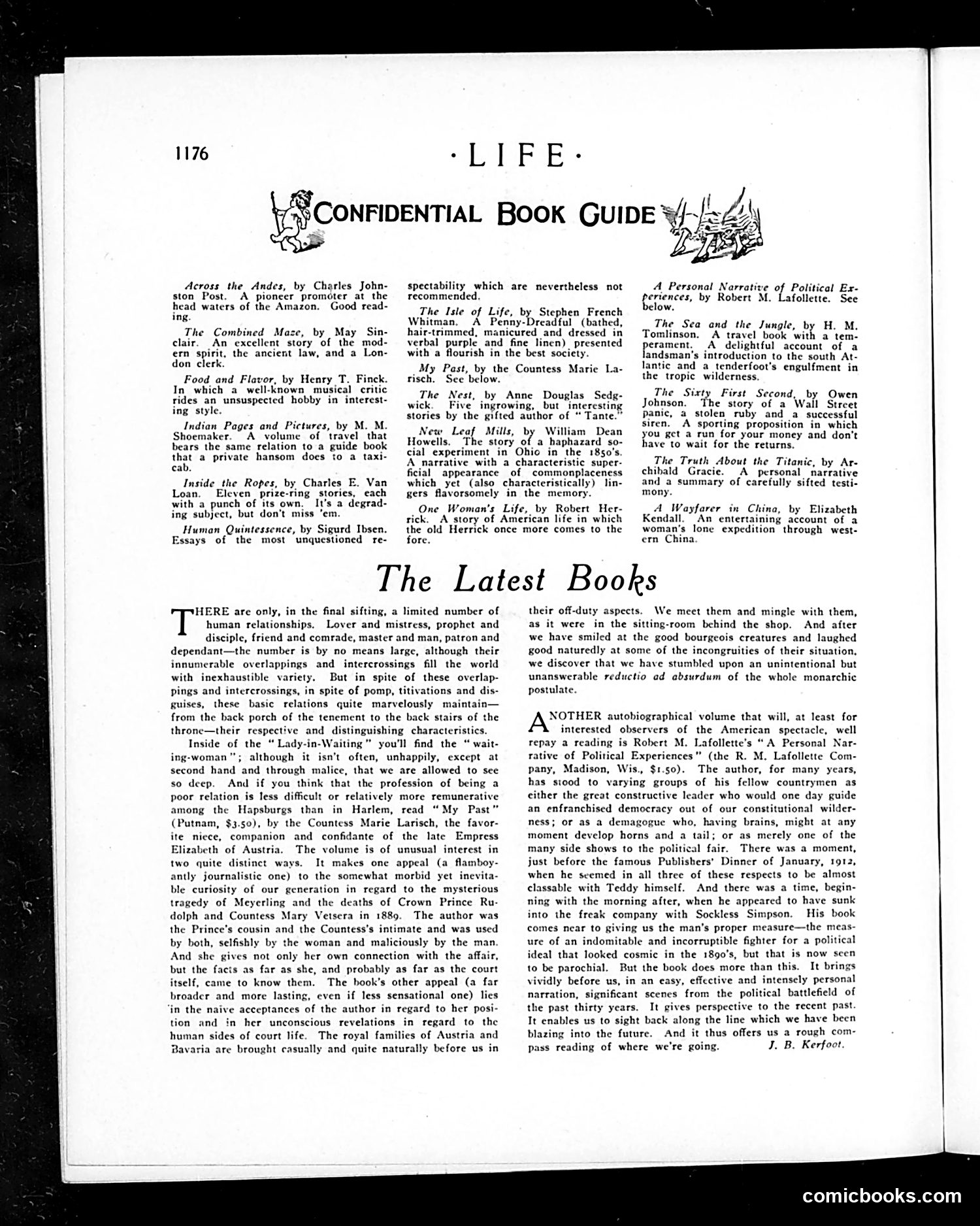
This is a **book review section**, not a political cartoon. It presents brief, witty critiques of contemporary books in the style of Life's satirical voice. The reviews use clever wordplay and backhanded compliments typical of the magazine's irreverent tone. Key examples: - *Indian Pages and Pictures* is compared to "a private hansom" rather than a "taxi-cab"—suggesting it's outdated - *The Isle of Life* is called a "Penny-Dreadful" dressed up in fancy language - *One Woman's Life* notes Herrick's return to form The featured review discusses Robert M. La Follette's *A Personal Narrative of Political Experiences*—likely the progressive Wisconsin senator. The lengthy commentary praises his memoir for offering genuine political insight spanning thirty years, distinguishing it from typical political memoirs by its "intensely personal" and honest perspective. For modern readers: Life's book reviews combined literary criticism with social commentary, mocking pretension while genuinely evaluating merit—essentially the magazine's satirical trademark applied to literature.
📄 Transcribed text from this page (OCR, searchable)
Machine-transcribed from the original scan — historical spelling and the odd misread are preserved.
CONFIDENTIAL BOOK GUIDE &- Across the Andes, by Charles John- ston Post. A pioneer promoter at the head waters of the Amazon. Good read- ing. The Combined Maze, by May Sin- clair. An excellent story of the mod- ern spirit, the ancient law, and a Lon- don clerk. Food and Flavor, by Henry T. Finck. In which a well-known musical critic ides an unsuspected hobby in interest- ing style. Indian Pages and Pictures, by M. M. Shoemaker. A volume of ‘travel that bears the same relation to a guide book that a private hansom does to a taxi- cab. Inside the Ropes, by. Charles E. Van Loan. Eleven prize-ring stories, each with a punch of its own. It's a degrad- ing subject, but don't miss ‘em. Human Quintessence, by Sigurd Ibsen. Essays of the most unquestioned re- eLGEE = spectability which are nevertheless not recommended, The Isle of Life, by Stephen French Whitman. ‘A Penny-Dreadful. (bathed, hair-trimmed, manicured and dressed in verbal purple and fine linen) presented with a flourish in the best society. My Past, by the Countess Marie La- risch. See below. ‘The Nest, by Anne Douglas Sedg- wick. Five’ ingrowing, but interesti stories by the gifted author of “ Tante New Leaf Mills, by William Dean Howells. The story of a haphazard so- cial experiment in Ohio in the 1850's. A narrative with a characteristic super- ficial appearance of commonplaceness which yet (also characteristically) lin- gers flavorsomely in the memory. One Woman's Life, by Robert Her- rick. A story of American life in which the old Herrick once more comes to the ore. A Personal Narrative oj (ene by Robert M. elow. Political Ex- afollette. See The Sea and the Jungle, by H. M. Tomlinson. ‘A travel book with a tem: erament, A delightful account of a landsman’s introduction to the south At- lantic and a tenderfoot’s engulfment in the tropic wilderness. The Sixty First Second, by Owen Johnson. The story of a Wall Street panic, a stolen ruby and a successful siren. A sporting proposition in which you get a run for your money and don't have to wait for the returns. The Truth About the Titanic, by Ar- chibald Gracie. A personal narrative and a summary of carefully sifted testi mony. A Wayfarer in China, by Elizabeth Kendall. An entertaining account of a woman's lone expedition through west- ern China The Latest Books HERE are only, in the final sifting, a limited number of Lover and mistress, prophet and human relationships. their off-duty aspects. as it were in the sitting-room behind the shop. We meet them and mingle with them, And after disciple, friend and comrade, master and man, patron and dependant—the number is by no means large, although their innumerable overlappings and intercrossings fill the world with inexhaustible variety. But in spite of these overla pings and intercrossings, in spite of pomp, titivations and d guises, these basic relations quite marvelously maintain— from the back porch of the tenement to the back stairs of the throne—their respective and distinguishing characteristics. Inside of the “ Lady-in-Waiting” you'll find the “ wait- ing-woman”; although it isn’t often, unhappily, except at second hand and through malice, that we are allowed to see so deep. And if you think that the profession of being a poor relation is less difficult or relatively more remunerativ. among the Hapsburgs than in Harlem, read “My Past (Putnam, $3.50), by the Countess Marie Larisch, the favor- ite niece, companion and confidante of the late Empress Elizabeth of Austria. The volume is of unusual interest in two quite distinct ways. It makes one appeal (a flamboy- antly journalistic one) to the somewhat morbid yet inevita- ble curiosity of our generation in regard to the mysterious tragedy of Meyerling and the deaths of Crown Prince Ru- dolph and Countess Mary Vetscra in 1889. The author was the Prince's cousin and the Countess’s intimate and was used by both, selfishly by the woman and maliciously by the man And she gives not only her own connection with the affair, but the facis as far as she, and probably as far as the court itself, came to know them. The book’s other appeal (a far broader and more lasting, even if less sensational one) lies in the naive acceptances of the author in regard to her posi- tion and in her unconscious revelations in regard to the human sides of court life. The royal families of Austria and Bavaria are brought casually and quite naturally before us in we have smiled at the good bourgeois creatures and laughed good naturedly at some of the incongruities of their situation, we discover that we have stumbled upon an unintentional but unanswerable reductio ad absurdum of the whole monarchic postulate. OTHER autobiographical volume that will, at least for interested observers of the American spectacle, well repay a reading is Robert M. Lafollette’s “A Personal Nar- rative of Political Experiences” (the R. M. Lafollette Com- pany, Madison, Wis. $1.50). The author, for many years, has siood to varying groups of his fellow countrymen as cither the great constructive leader who would one day guide an enfranchised democracy out of our constitutional wilder- ness; or as a demagogue who, having brains, might at any moment develop horns and a tail; or as merely one of the many side shows to the political fair. There was a moment, just before the famous Publishers’ Dinner of January, 1912, when he seemed in all three of these respects to be almost classable with Teddy himself. And there was a time, begin- ning with the morning after, when he appeared to have sunk into the freak company with Sockless Simpson. His book comes near to giving us the man’s proper measure—the meas- ure of an indomitable and incorruptible fighter for a political ideal that looked cosmic in the 1890's, but that is now scen to be parochial. But the book does more than this. It brings vividly before us, in an easy, effective and intensely personal narration, significant scenes from the political battlefield of the past thirty years. It gives perspective to the recent past It enables us to sight back along the line which we have been blazing into the future. And it thus offers us a rough com- pass reading of where we're going. J. B. Kerfoot comicbooks.com