
Life, 1913-06-12 · page 19 of 44
Life — June 12, 1913 — page 19: what you’re looking at
What you’re looking at
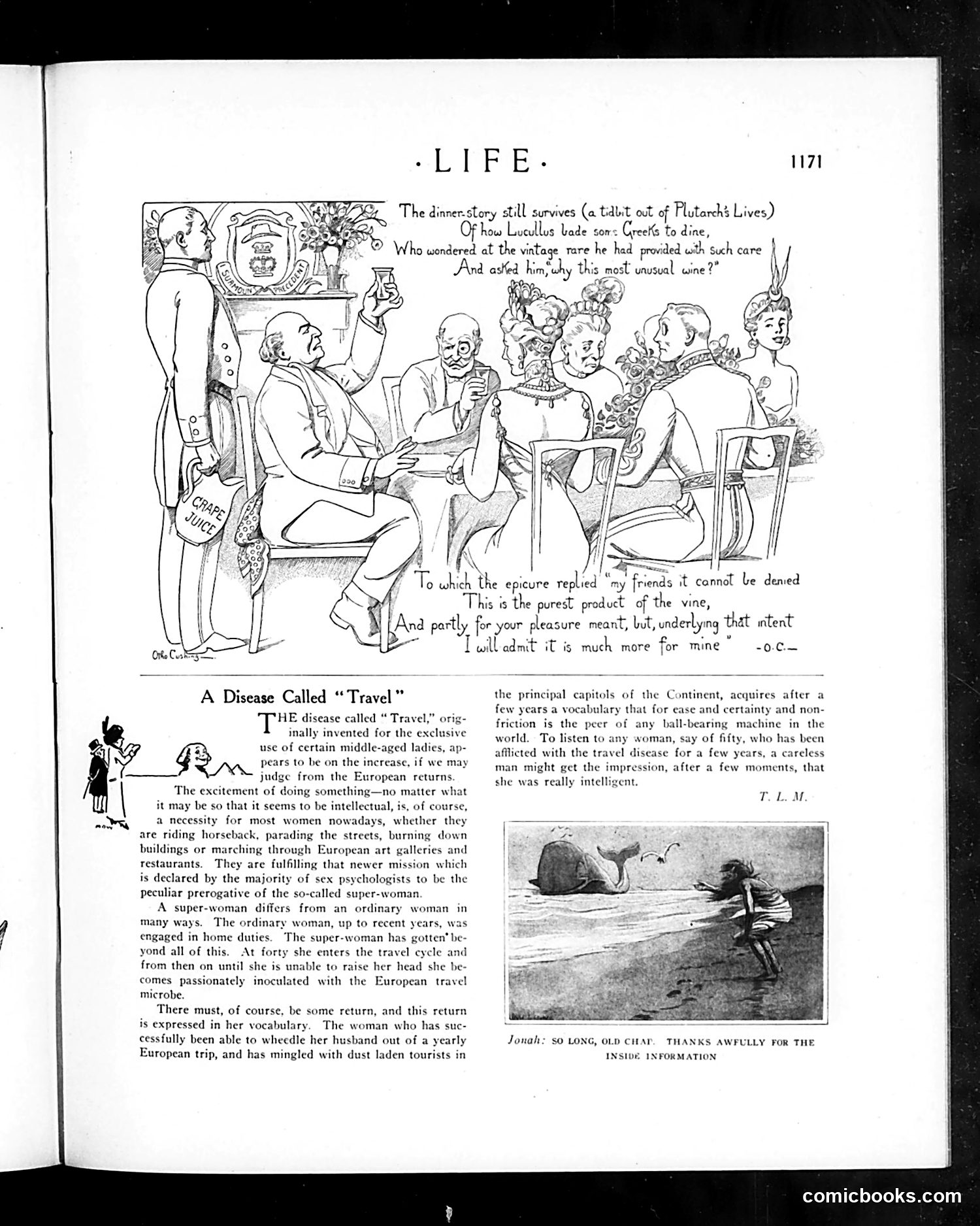
This 1920s *Life* magazine page satirizes emerging social changes regarding women's independence and leisure travel. **Top cartoon**: A dinner scene referencing classical literature (Plutarch's *Lives*), where an epicurean host serves rare wine. The joke plays on excessive refinement and showing off—likely mocking how wealthy diners use elaborate displays to impress. **Main article**: "A Disease Called 'Travel'" mocks middle-aged women who, newly freed from domestic duties, become obsessed with European tourism. The piece ridicules the contemporary concept of the "super-woman"—women entering public life and travel—suggesting they're intellectually shallow despite claiming sophistication. The satire implies these women merely acquire affected vocabulary and pretense from Continental travel, not genuine culture. **Bottom image**: A beach scene with the caption about "inside information," likely a separate humorous piece. The satire reflects anxiety about women's changing roles and expanding freedoms in the post-WWI era, presenting female leisure travel as superficial rather than empowering.
📄 Transcribed text from this page (OCR, searchable)
Machine-transcribed from the original scan — historical spelling and the odd misread are preserved.
-LIFE- The dinner.story still survives (a tidbit out of Plutarch’ Lives) Of how Lucullus bade son: Creetts to dine, Who wondered at the vintage rare he had provided wth such care | And ased himfuhy this most’ unusual wine 2” ae To which the epicure replied “ny friends it cannot be demed This is the purest product of the vine, [Ava partly for your pleasure meant, ut, underlying that wtent Twill admit it is much more for mine A Disease Called “Travel” the principal capitols of the Continent, acquires after a few years a vocabulary that for ease and certainty and non- HE disease called “Travel,” orig- friction is the peer of any ball-bearing machine in the inally invented for the exclusive world, To listen to any woman, say of fifty, who has been 3 use of certain middle-aged ladies, ap-—_aficted with the travel disease for a few years, a careless AA. Beats to be on the inerease, if we may an might get the impression, after a few moments, that - “= judge from the European returns. she was really intelligent. | The excitement of doing something—no matter what ° : Ribot it may be so that it seems to be intellectual, is, of course, ache, A Necessity for most women nowadays, whether they are riding horseback, parading the streets, burning down buildings or marching through European art galleries and restaurants. They are fulfilling that newer mission which is declared by the majority of sex psychologists to be the peculiar prerogative of the so-called super-woman. A super-woman differs from an ordinary woman in many ways. The ordinary woman, up to recent years, ¥ engaged in home duties. The super-woman has gotten’ be yond all of this. At forty she enters the travel cycle and from then on until she is unable to raise her head she be- comes passionately inoculated with the European travel microbe. There must, of course, be some return, and this return is expressed in her vocabulary. The woman who has suc- cessfully been able to wheedle her husband out of a yearly Jonah: SO LONG, OLD CHAP. THANKS AWFULLY FOR THE European trip, and has mingled with dust laden tourists in INSIDE. INFORMATION comicbooks.com