
A complete issue · 44 pages · 1913
Life — May 29, 1913
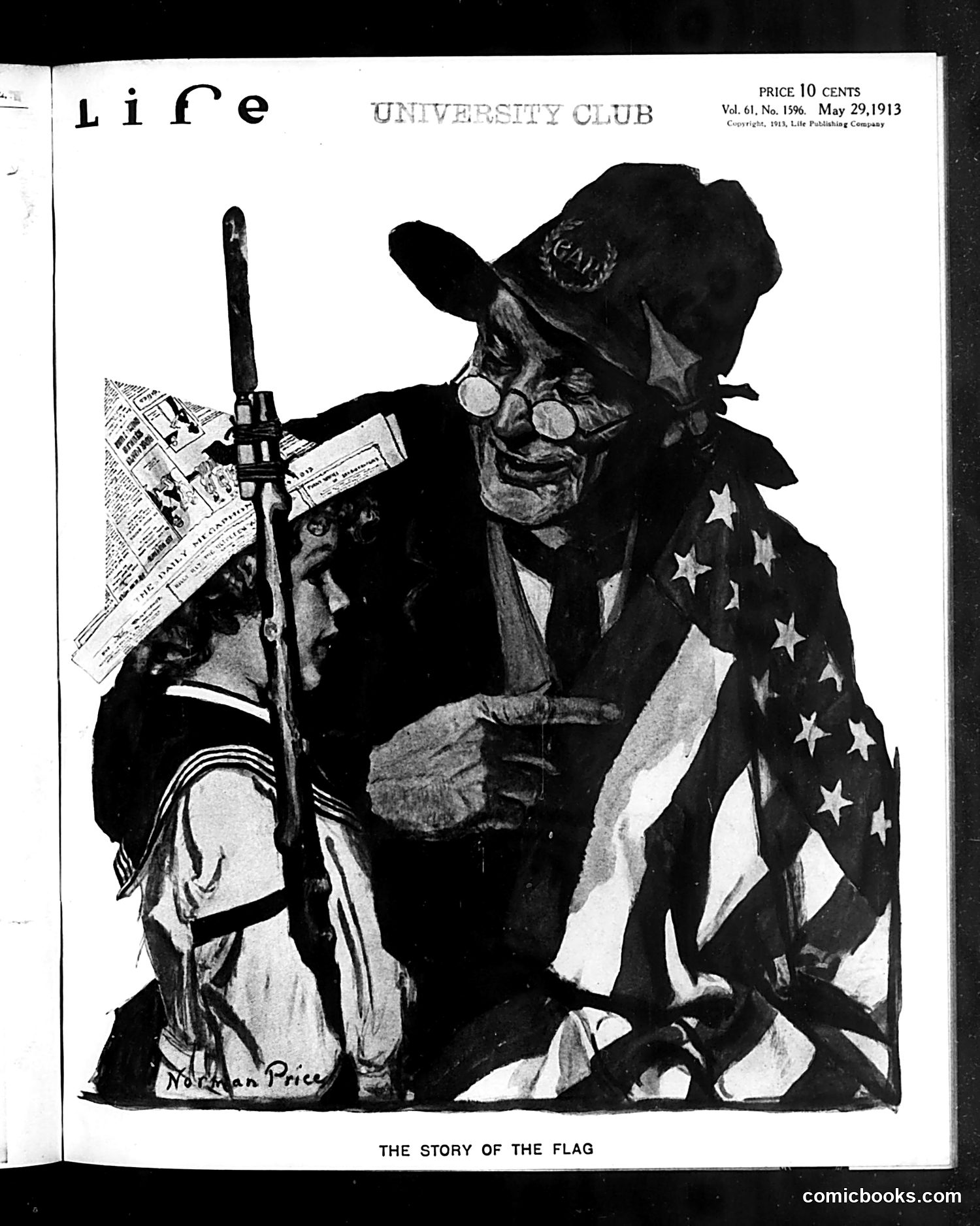
This cartoon by Naldman Price depicts Uncle Sam (the wizened figure in the starred top hat and American flag coat) instructing a younger soldier or citizen about American patriotism. The exaggerated caricature and grotesque features suggest satirical commentary on American nationalism or military policy circa 1913. The newspapers and documents visible in the background likely reference contemporary political issues. The title "The Story of the Flag" and the teaching gesture suggest the cartoon critiques how national mythology is constructed or transmitted—perhaps questioning what version of American history and values is being promoted to younger generations. The specific political context remains unclear without additional information about 1913 events, though this likely relates to pre-World War I American interventionism debates.
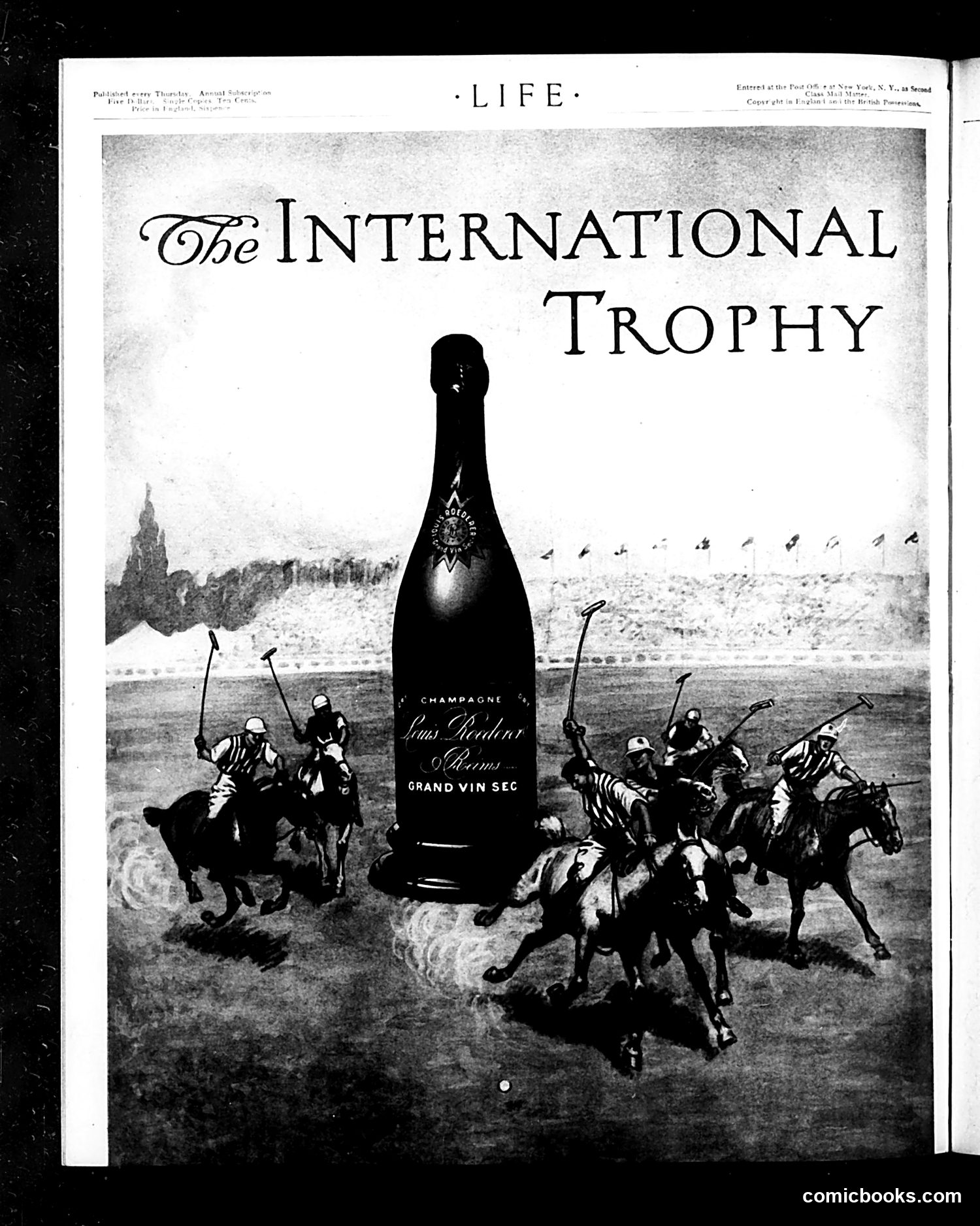
This appears to be a **champagne advertisement** rather than political satire. The image depicts polo players on horseback gathered around an oversized bottle of "Louis Roederer" champagne labeled "Grand Vin Sec," with a landscape and flags in the background. The "International Trophy" likely references a prestigious polo competition. The advertisement associates the champagne brand with elite sporting achievement and international prestige—common luxury marketing strategies. The dramatic composition with mounted players and flags suggests victory celebration and cosmopolitan sophistication. This is primarily **commercial content** using sport imagery for brand positioning rather than satirical commentary on politics or social issues, though it does reflect early 20th-century class associations between champagne, polo, and wealthy international society.
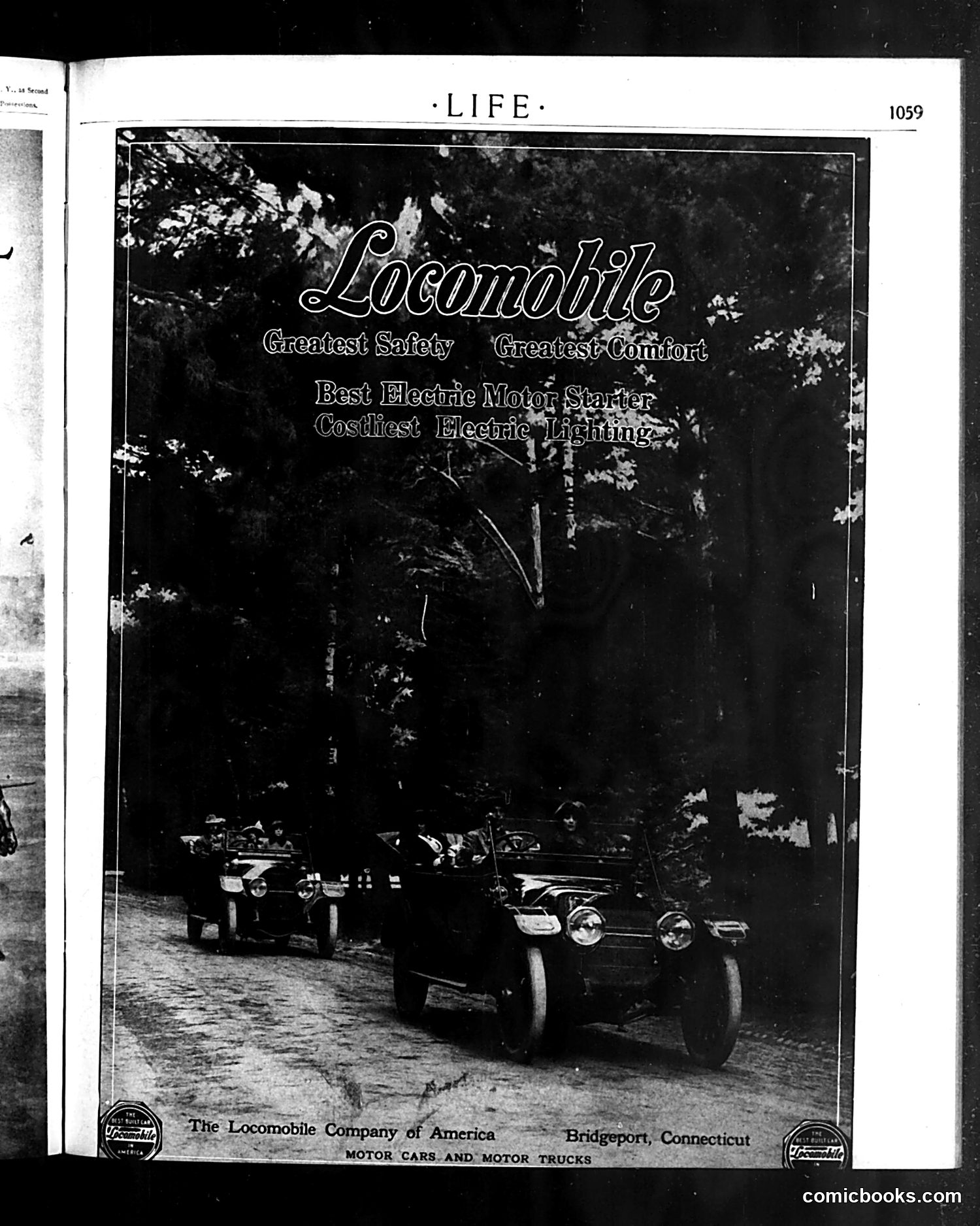
This page is **primarily an advertisement**, not a satirical cartoon. It advertises the Locomotile automobile, manufactured by The Locomotile Company of America in Bridgeport, Connecticut. The ad emphasizes the car's features through text overlays: "Greatest Safety," "Greatest Comfort," "Best Electric Motor Starter," and "Costliest Electric Lighting." The image shows period automobiles parked on a tree-lined road, presenting them as vehicles suitable for leisurely drives. This reflects early 1900s automotive marketing, when electric cars were luxury items and manufacturers competed on comfort and innovation rather than speed or affordability. The emphasis on electric features—a starter and lighting—highlights technological advantages of the era.
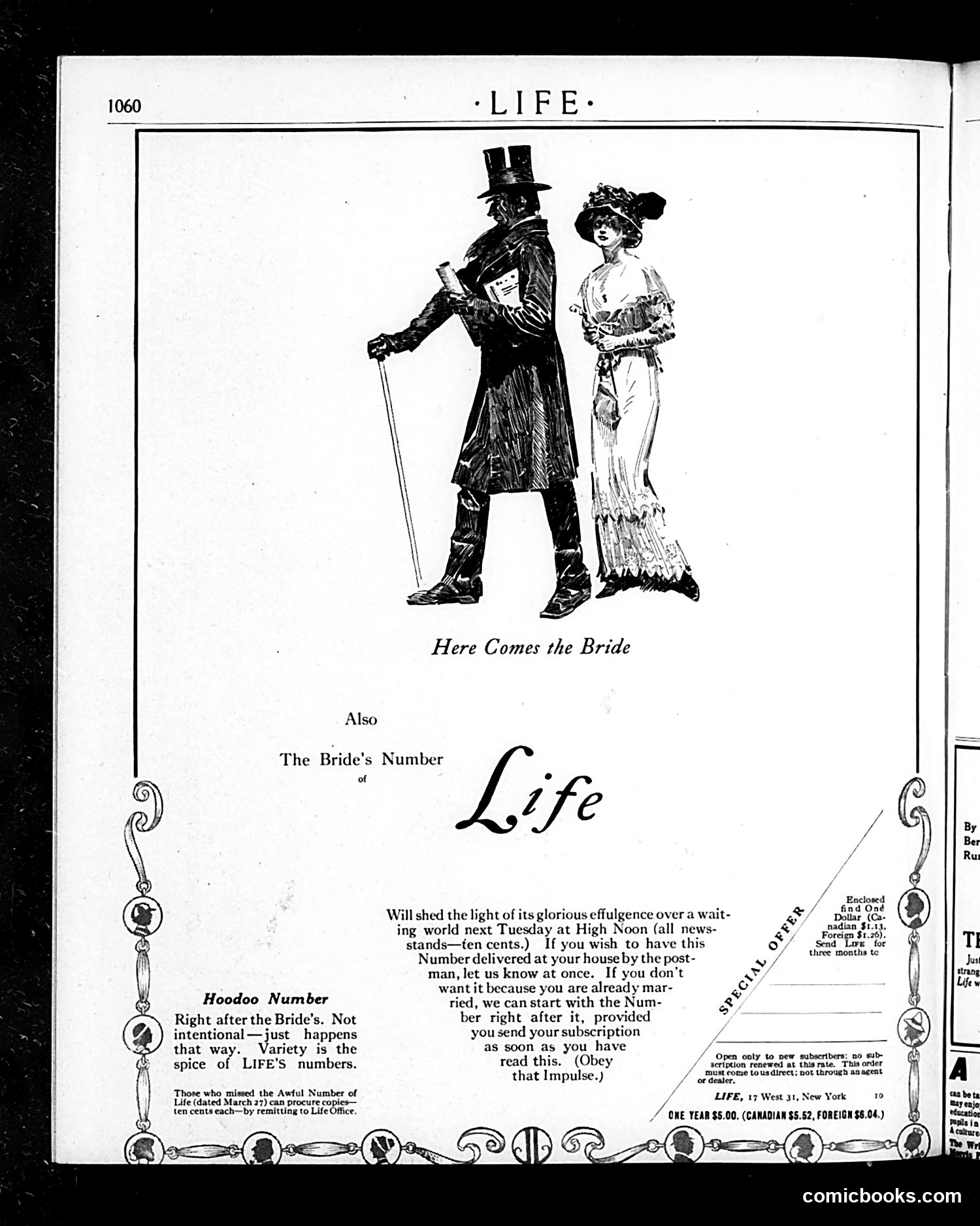
This page from *Life* magazine advertises two upcoming special issues: "Here Comes the Bride" and "The Bride's Number of Life." The illustration shows a formally dressed gentleman in top hat with cane alongside a woman in an elaborate white wedding dress and hat, representing a bride and groom. The text indicates these special issues will be published "next Tuesday at High Noon" and emphasizes the magazine's tradition of numbered special editions—apparently a popular feature for subscribers. The "Hoodoo Number" reference suggests *Life* playfully marketed certain editions as having special significance or luck. The content appears to be straightforward promotion rather than political satire; it capitalizes on wedding season interest to boost circulation and subscriptions.
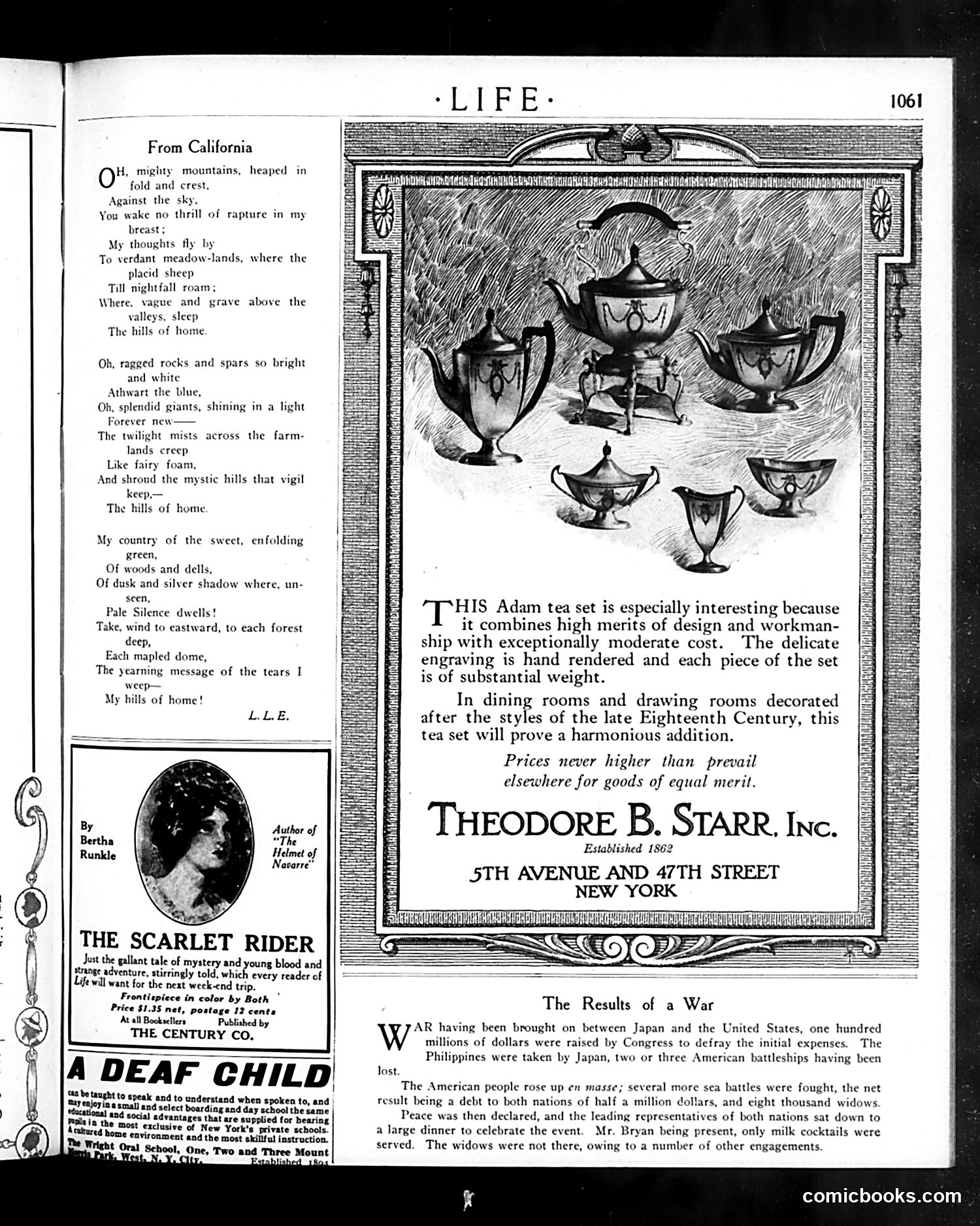
This page contains primarily **advertising and poetry**, not political satire. The left side features a poem "From California" by L.L.E., a nostalgic piece about returning home to California mountains. Below it are advertisements: *The Scarlet Rider* (a mystery novel by Bertha Runkle) and *A Deaf Child* (promoting a New York private school). The main right-side content advertises an **Adam tea set** by Theodore B. Starr, Inc., emphasizing its design quality and affordability for decorating dining and drawing rooms in "late Eighteenth Century" style. Below that is a brief article titled "The Results of a War," discussing financial costs and casualties from a conflict between Japan and the United States, mentioning Congressional spending and widows—likely referencing the Russo-Japanese War's American context, though details remain unclear.
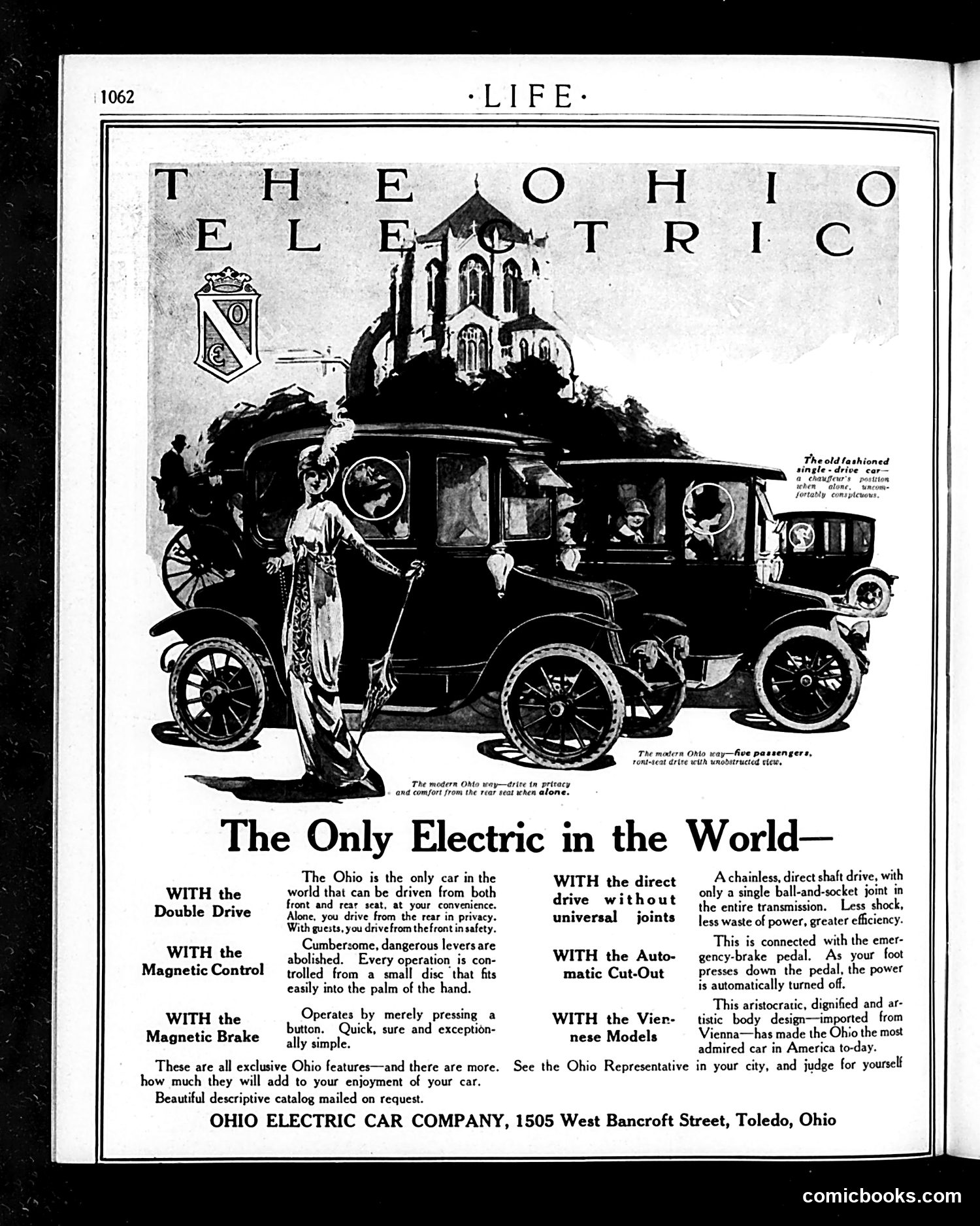
This page is primarily **advertising, not satire or political commentary**. It's a full-page advertisement for the Ohio Electric Car Company of Toledo, Ohio. The headline "The Only Electric in the World" promotes the Ohio brand as uniquely superior. The illustration depicts elegantly dressed figures—a woman in a long dress and men in formal attire—alongside multiple Ohio electric vehicles, suggesting luxury and respectability. The advertisement emphasizes distinctive features: Double Drive, Magnetic Control, Magnetic Brake, direct drive without universal joints, Automatic Cut-Out, and "Viernese Models" (imported from Vienna). The copy appeals to comfort and safety, particularly highlighting the car's suitability for women drivers ("drive in perfect safety"). This reflects the early 1900s electric car market, before gasoline engines dominated.
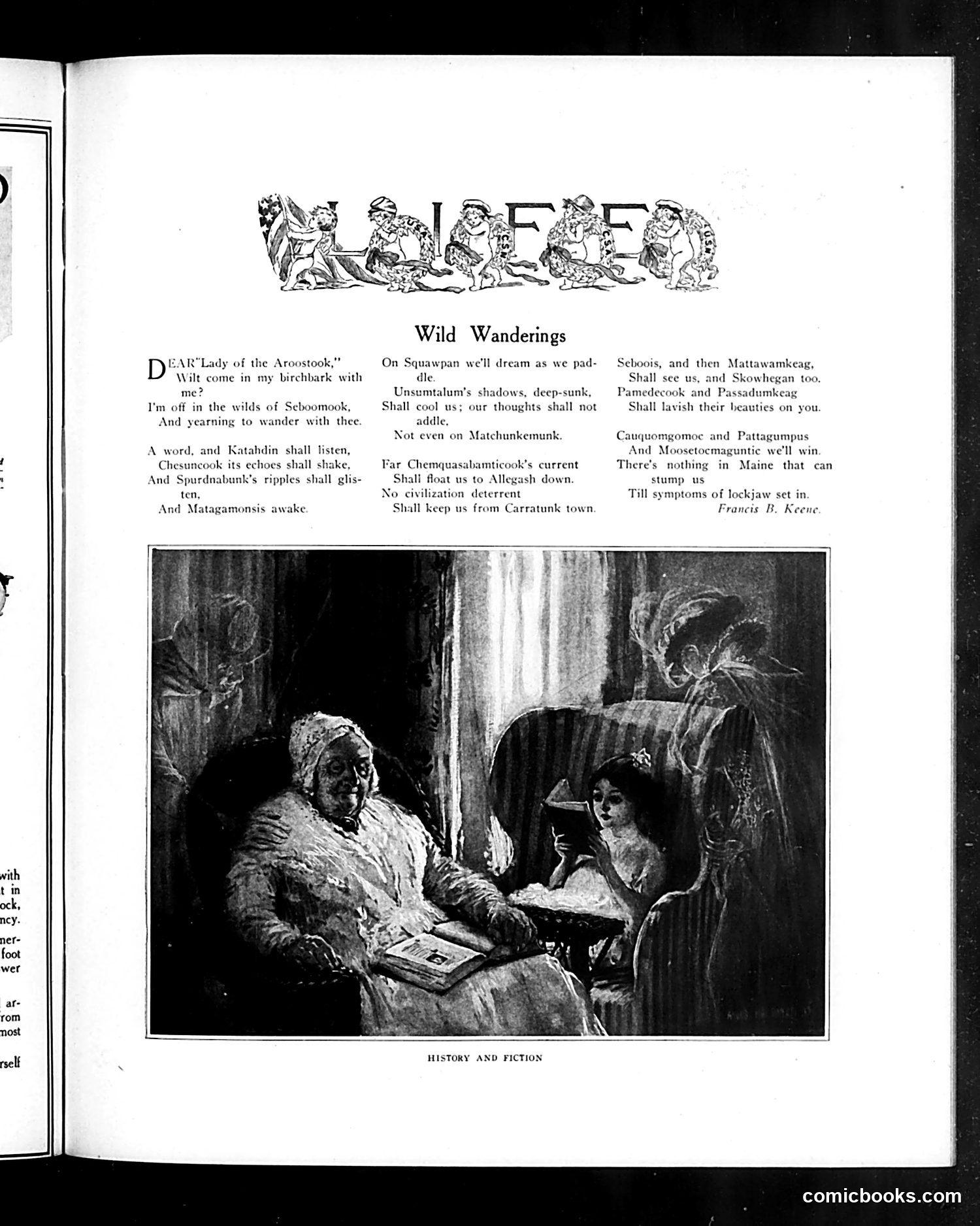
This page features a poem by Francis B. Keene titled "Wild Wanderings" that appears to be **satirical verse about Maine geography and Native American place names**. The poem addresses a "Lady of the Aroostook" and catalogs Maine locations—Squapawpan, Mattawamkeag, Passamekeag, Kennebec—with humorously unpronounceable Indigenous names. The text playfully suggests these names are obstacles to civilization ("No civilization deterrent / Shall keep us from Carratunk town"). The accompanying illustration depicts what appears to be **a fortune teller or soothsayer scene**, likely suggesting the absurdity of trying to navigate or predict outcomes in a landscape with such bewildering place names. The satire mocks both the difficulty of Maine's Native American nomenclature and, implicitly, the challenge of settling or understanding such territories.
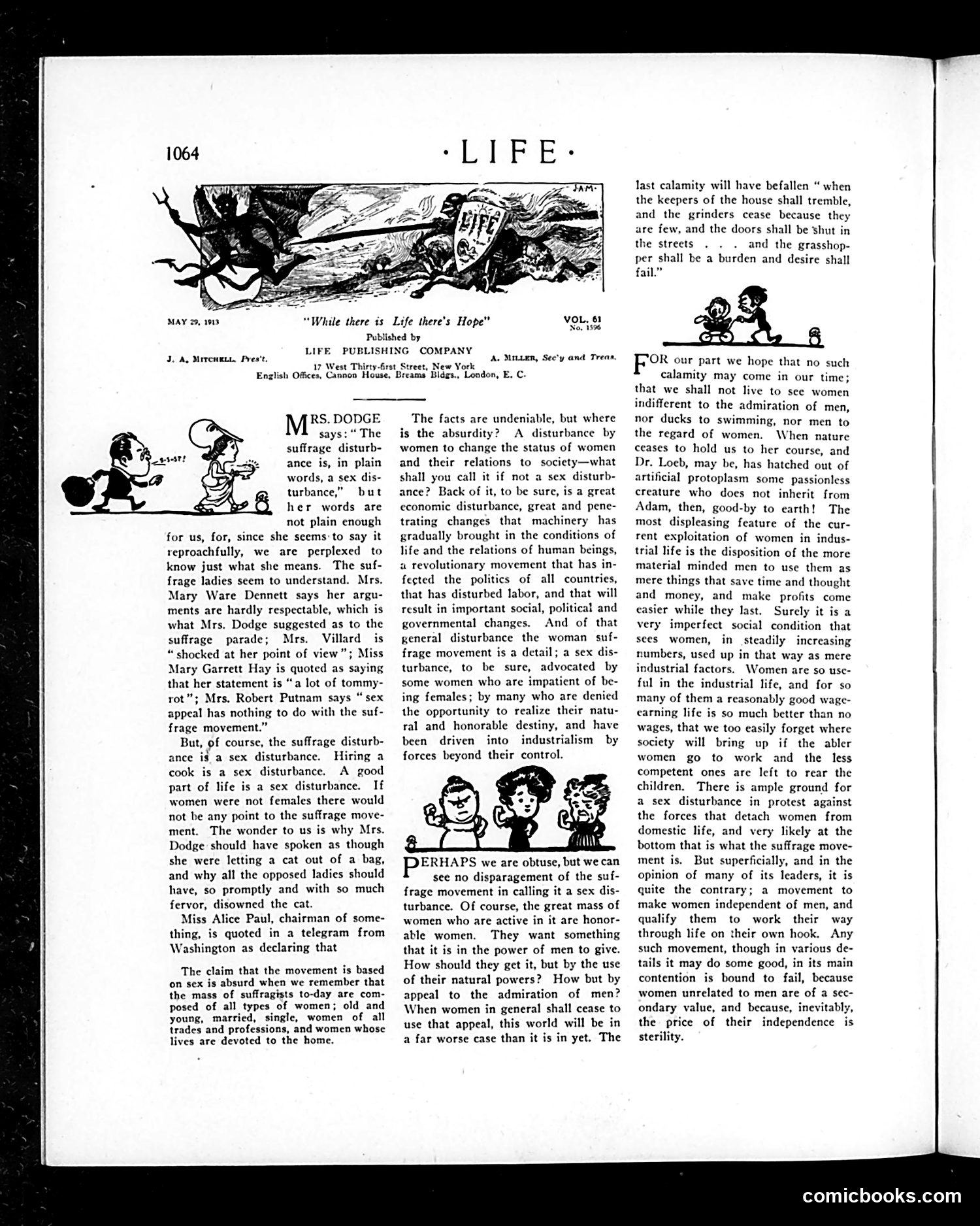
This page contains an editorial debate about women's suffrage disguised as a dialogue between "Mrs. Dodge" and other contributors. The cartoon shows a small figure (likely representing a woman or suffragist) confronting a larger man, illustrating the power imbalance in the suffrage debate. Mrs. Dodge argues that suffrage is a "sex disturbance" causing social upheaval. The magazine's editorial responds by defending the suffrage movement, noting that women's entry into industrial life has already created economic and social change—suffrage simply formalizes women's existing influence. The piece acknowledges women work in factories yet remain politically voiceless, suggesting independence and voting rights are logical extensions of their economic participation.
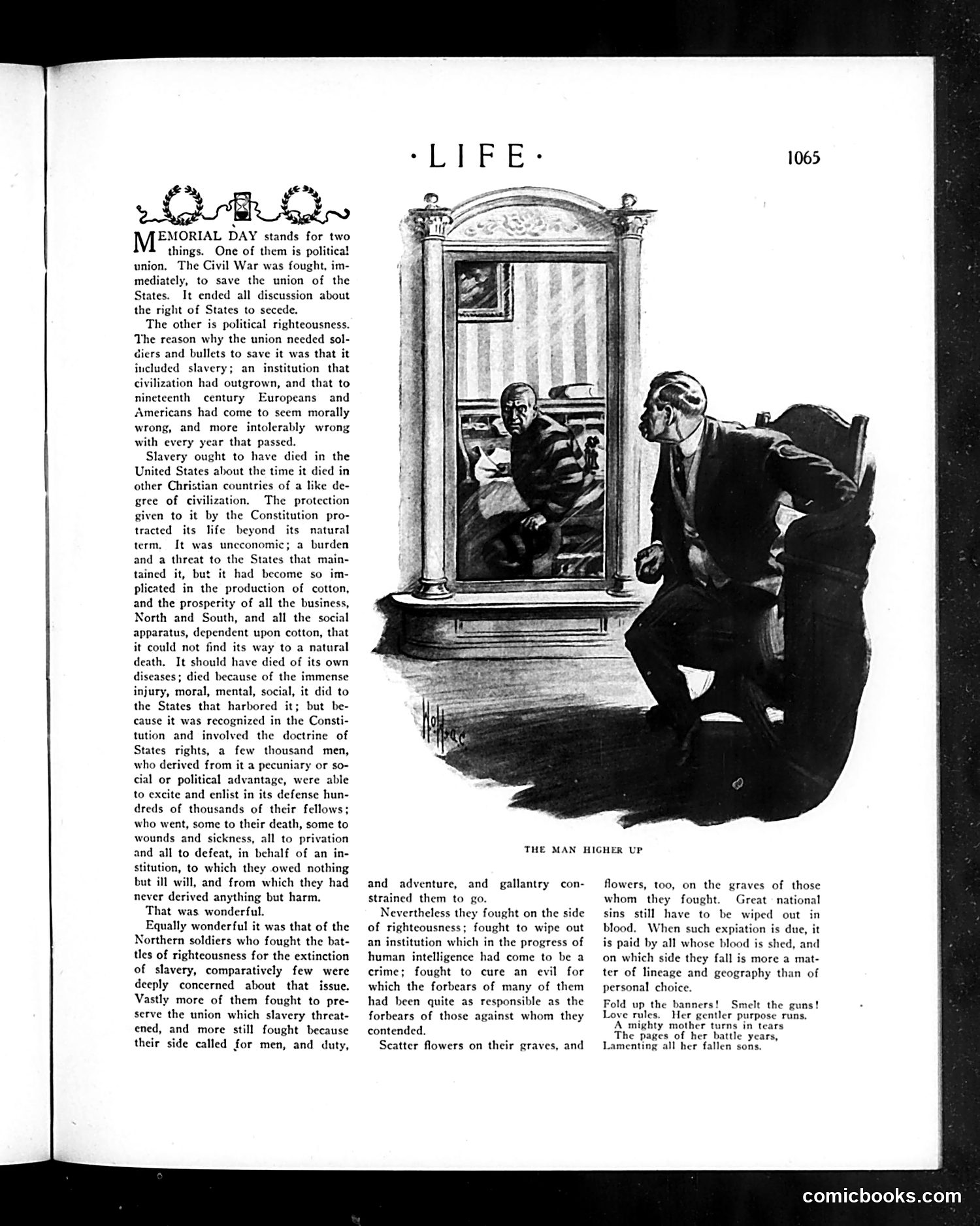
This cartoon satirizes corruption and power dynamics in the post-Civil War era. Two well-dressed men appear to be conducting business at what looks like an official window or counter—one leaning in to speak with the other, who sits in a position of authority. The title "The Man Higher Up" references a common phrase for hidden power brokers who pull strings behind the scenes. The satire suggests that while ordinary soldiers fought and died for causes like preserving the Union and ending slavery, corrupt officials and influential elites profited or wielded power without personal sacrifice. The accompanying text emphasizes this contrast: soldiers risked everything for righteousness, while a privileged few exploited the system for personal gain. The cartoon illustrates public frustration with institutional corruption masquerading as legitimate governance.
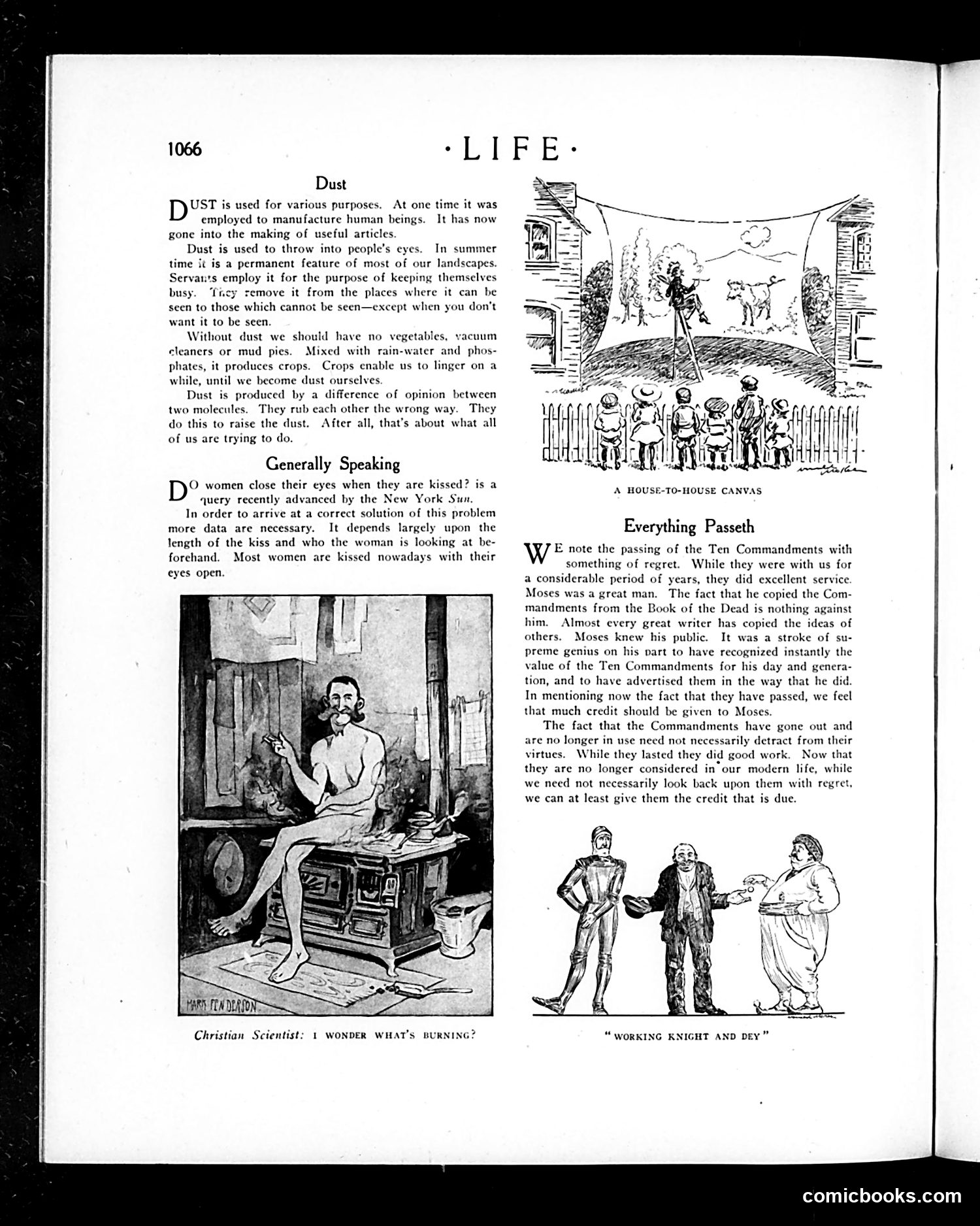
This page contains three distinct pieces: 1. **"Dust"** — A practical essay on dust's usefulness in agriculture and households, noting its necessity for crops and cleaning. 2. **"Generally Speaking"** — A humorous question about whether women close their eyes when kissed, attributed to the *New York Sun*. The accompanying cartoon shows a "Christian Scientist" wondering "what's burning?" — likely satirizing Christian Science's skepticism toward material phenomena and pain. 3. **"Everything Passeth"** — An essay lamenting the decline of the Ten Commandments' relevance in modern life, arguing they deserve historical credit despite obsolescence. The accompanying cartoon titled "Working Knight and Dev" shows three figures, though their specific identities remain unclear from the image alone. The page blends satire, practical humor, and social commentary typical of Life magazine's approach.
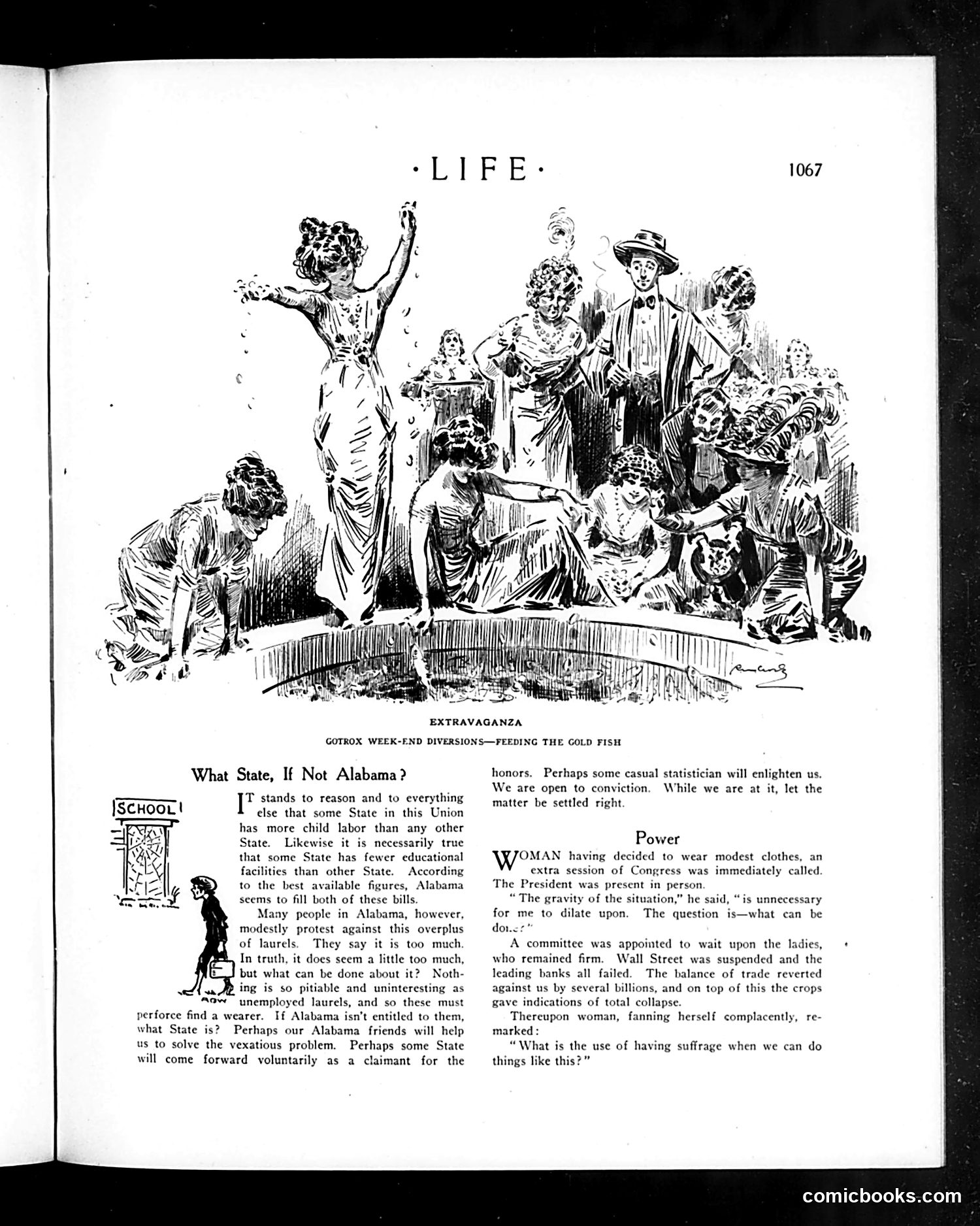
The top illustration titled "EXTRAVAGANZA: GOTROX WEEK-END DIVERSIONS—FEEDING THE GOLD FISH" appears to be a satirical depiction of wealthy leisure activities, showing figures in elaborate dress engaged in frivolous pastimes. Below, "What State, If Not Alabama?" critiques Alabama's child labor practices. The text argues that Alabama has disproportionately high child labor compared to other states and inadequate educational facilities. The satire suggests Alabama should voluntarily address this problem rather than requiring external pressure. The short piece "Power" satirizes women's political influence. After a woman wore modest clothes, Congress convened in crisis. The joke: women's economic power (through fashion choices affecting Wall Street) exceeds their formal political suffrage, making them more influential than their official status suggests. Both pieces mock social/political hypocrisy of the era.
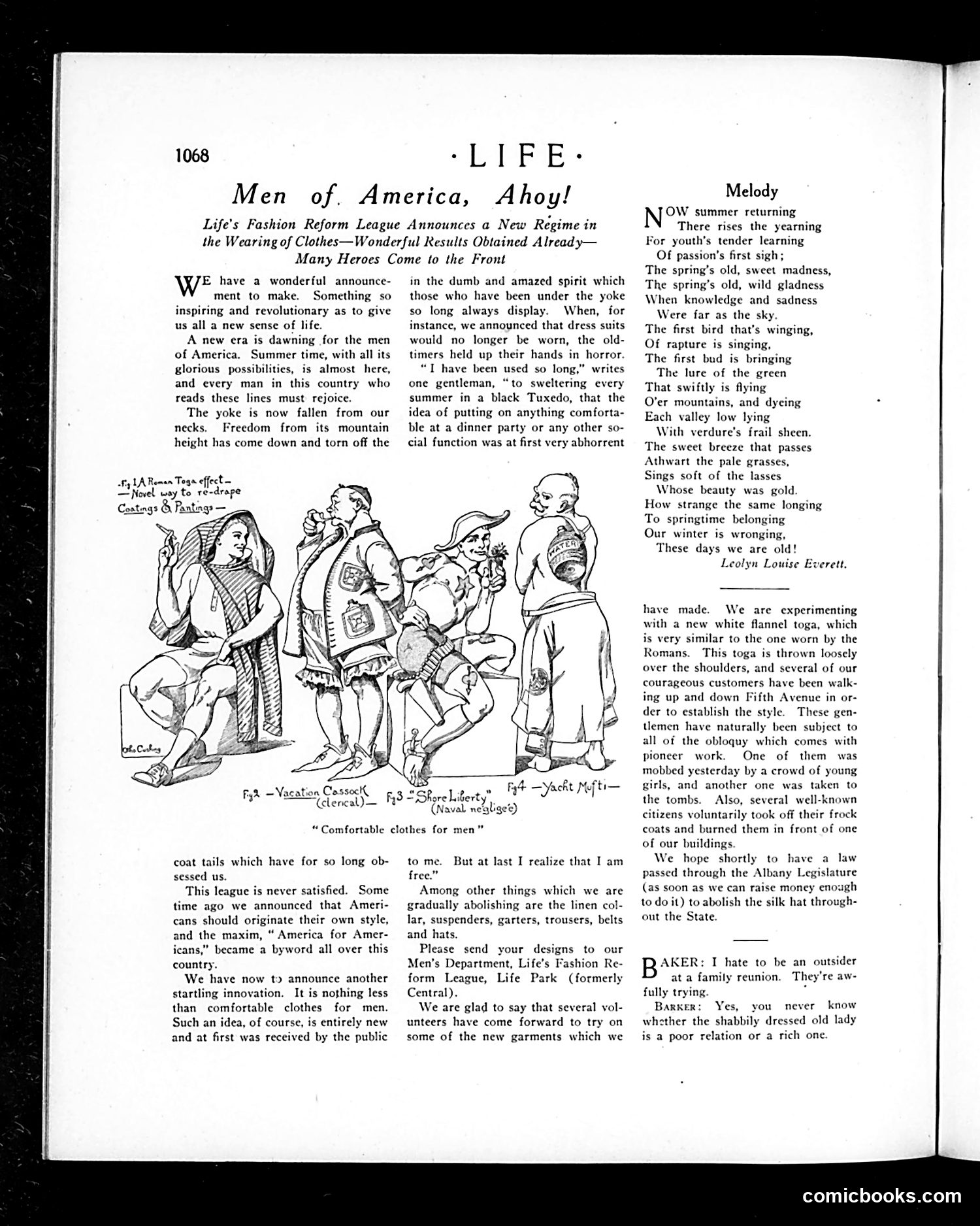
This page satirizes Life's "Fashion Reform League" campaign promoting comfortable men's clothing. The cartoon illustrates the absurdity of this new dress code by depicting men in various states of undress—some in togas, others in minimal garments—labeled "Vacation Cassock," "Shirtsleeves," and "Yacht Motif." The satire mocks the radical nature of the proposed changes: removing formal dress codes (like mandatory coat tails and neckties) was considered shockingly innovative. The exaggerated drawings suggest that liberating men from Victorian fashion constraints feels almost primitive or scandalous to contemporary readers. The accompanying text describes actual public reactions—including one incident where pedestrians were nearly mobbed for wearing the new informal styles on Fifth Avenue, underscoring how genuinely controversial this fashion reform was in 1920s America.
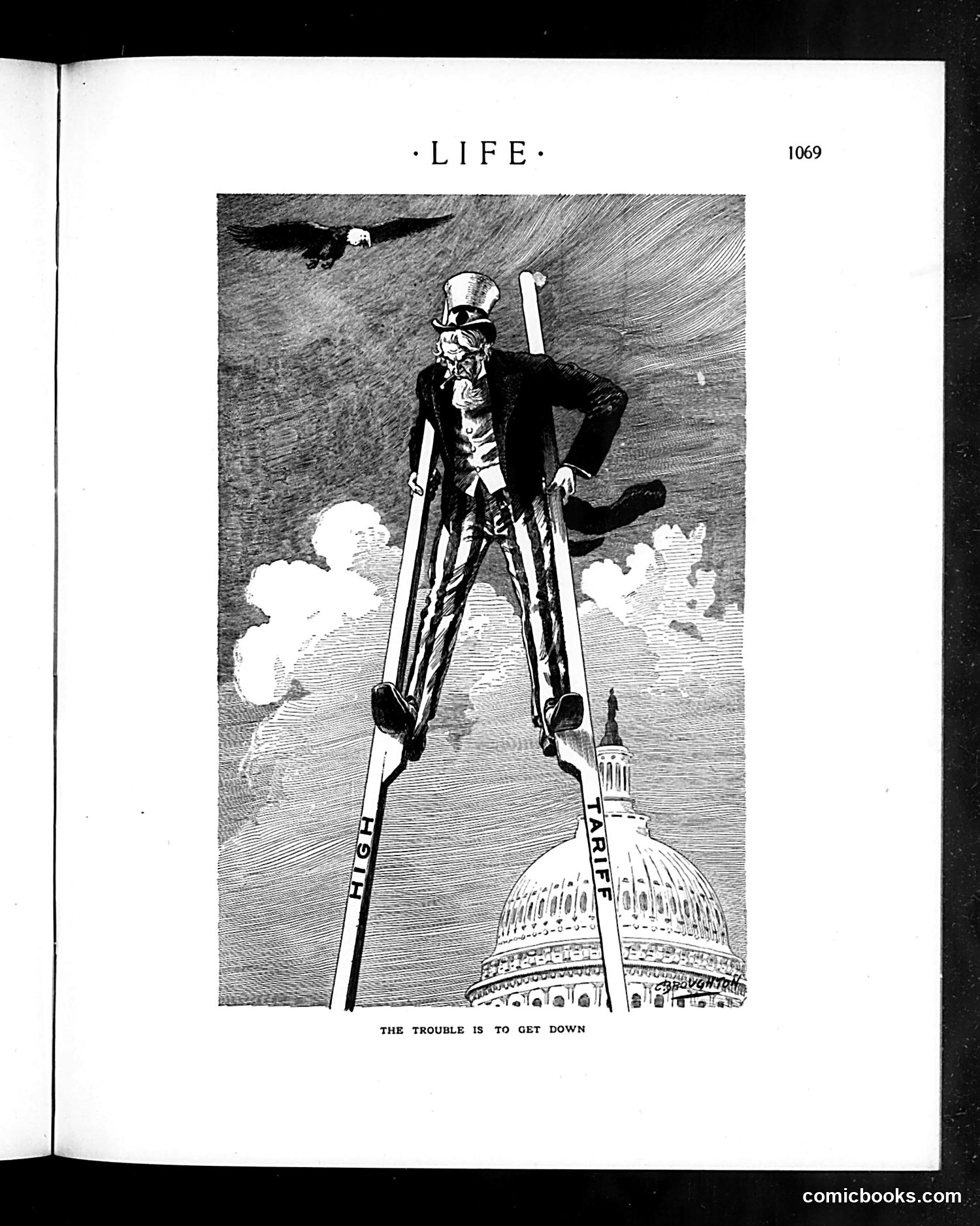
This Life magazine cartoon depicts Uncle Sam—identifiable by his distinctive top hat labeled "HIGH" and patriotic outfit—perched precariously on enormously tall stilts labeled "TARIFF." He stands above the U.S. Capitol building while an eagle flies overhead. The caption reads "THE TROUBLE IS TO GET DOWN." The satire criticizes protectionist tariff policy, suggesting that while tariffs may have initially elevated American prosperity or power (represented by the height), they've become unsustainably high and difficult to reverse without causing economic damage. The precarious balance emphasizes the political difficulty of reducing tariffs once implemented—Uncle Sam is "stuck up there" with no easy way down. This likely reflects early 20th-century debates over American tariff policy and its economic consequences.
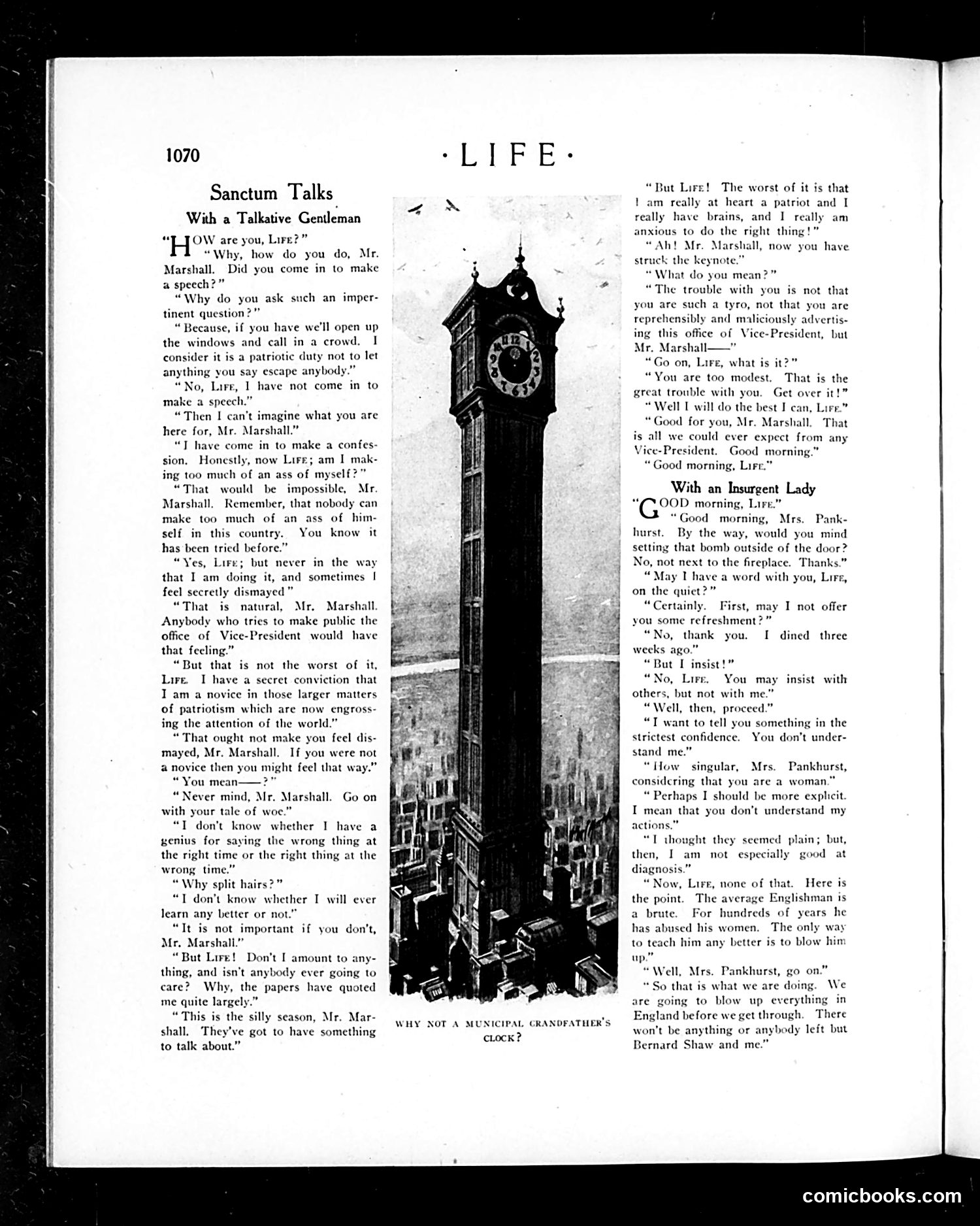
This page contains two satirical dialogues titled "Sanctum Talks": one features a character named Lire conversing with Mr. Marshall about making a patriotic speech, and another titled "With an Insurgent Lady" features Lire and Mrs. Pankhurst discussing bombing and political unrest in England. The central illustration depicts a tall clock tower in an urban setting. The caption reads "WHY NOT A MUNICIPAL GRANDFATHER'S CLOCK?" The satire appears to mock both political rhetoric and the women's suffrage movement (referencing Mrs. Pankhurst, a prominent suffragist). The dialogues criticize patriotic posturing and reference violent protest tactics, reflecting early 20th-century British social tensions around women's rights activism.
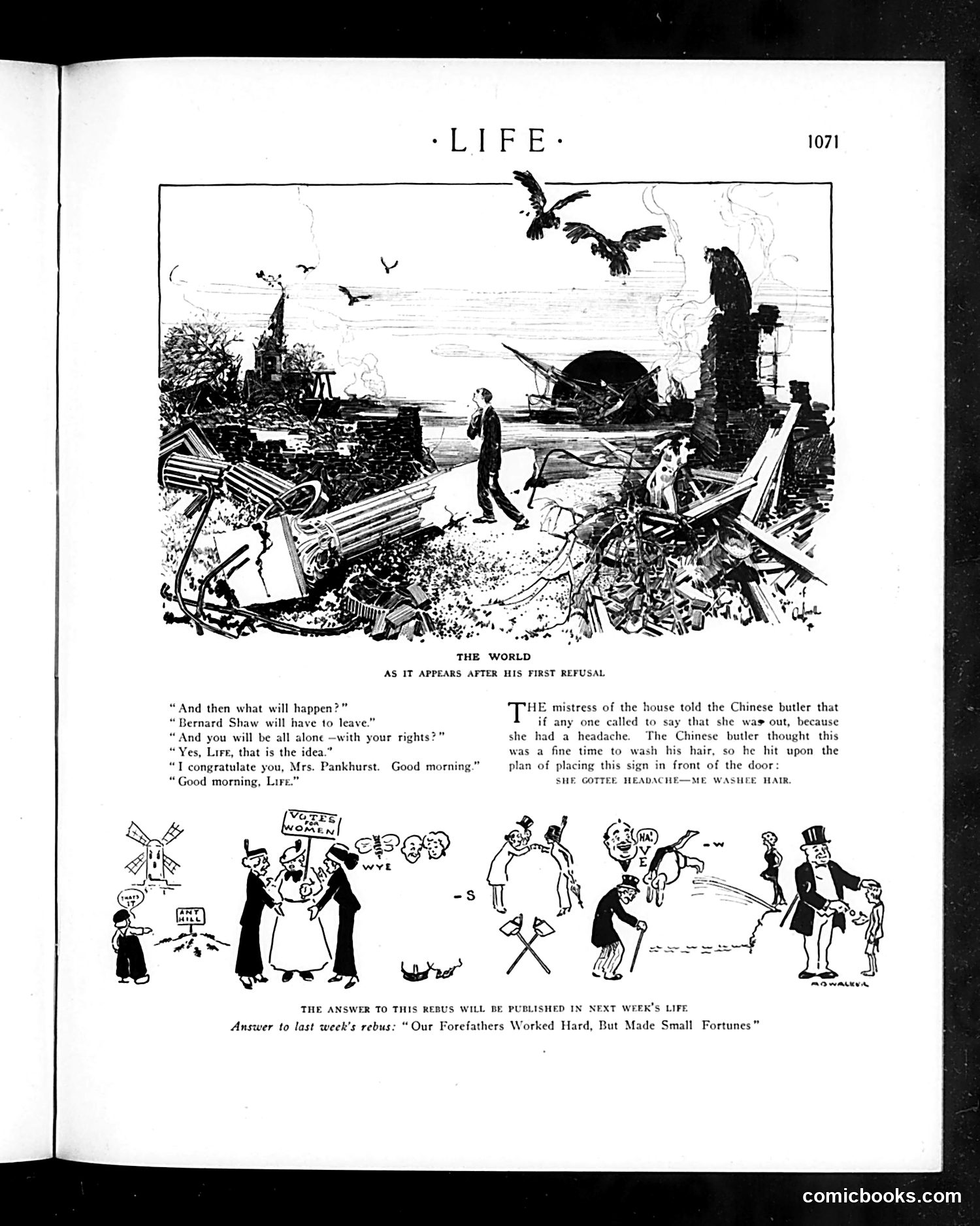
The upper cartoon satirizes **Mrs. Pankhurst** (leader of the British suffragette movement) and her insistence on women's voting rights. The dialogue mocks her absolutism: when asked what happens after a man "refuses" (presumably to grant women's suffrage), she declares she'll be "alone—with your rights," suggesting rigid principles over pragmatism. The "world as it appears after his first refusal" depicts apocalyptic destruction, sarcastically suggesting her uncompromising stance would devastate society. The reference to "Bernard Shaw" (the famous playwright and social critic) leaving England adds satirical weight, implying even intellectuals would abandon such an obstinate position. The lower cartoon is a separate humor piece about a Chinese butler's creative solution to his mistress's headache excuse: a pidgin-English sign ("SHE GOTTEE HEADACHE—ME WASHEE HAIR") placed at the door. It relies on period stereotypes of Chinese immigrants and broken English for comedy. Both pieces reflect early 20th-century attitudes toward suffrage and immigrant labor.
This 1913 satirical piece mocks California's anti-Japanese immigration legislation through a deliberately broken-English "letter" from a fictional Japanese schoolboy. The humor exploits ethnic stereotypes while critiquing American hypocrisy. **Key figures referenced:** - Governor Hiram Johnson (California) - President Woodrow Wilson - William Jennings Bryan - Japanese Ambassador Viscount Chinda **The satire's point:** California passed laws restricting Japanese land ownership while welcoming European immigrants (Irish, Swedish, Jewish). The piece ridicules this selective xenophobia by having the narrator note that only Japanese are branded "foreigners"—while Europeans who haven't even arrived yet somehow aren't. The broken English and naive tone suggest the writer's contempt for Japanese immigrants while simultaneously exposing the legal and diplomatic contradictions in California's discriminatory policies. Bryan's arrival to smooth over international tensions references real diplomatic friction between the U.S. and Japan over California's Alien Land Laws.
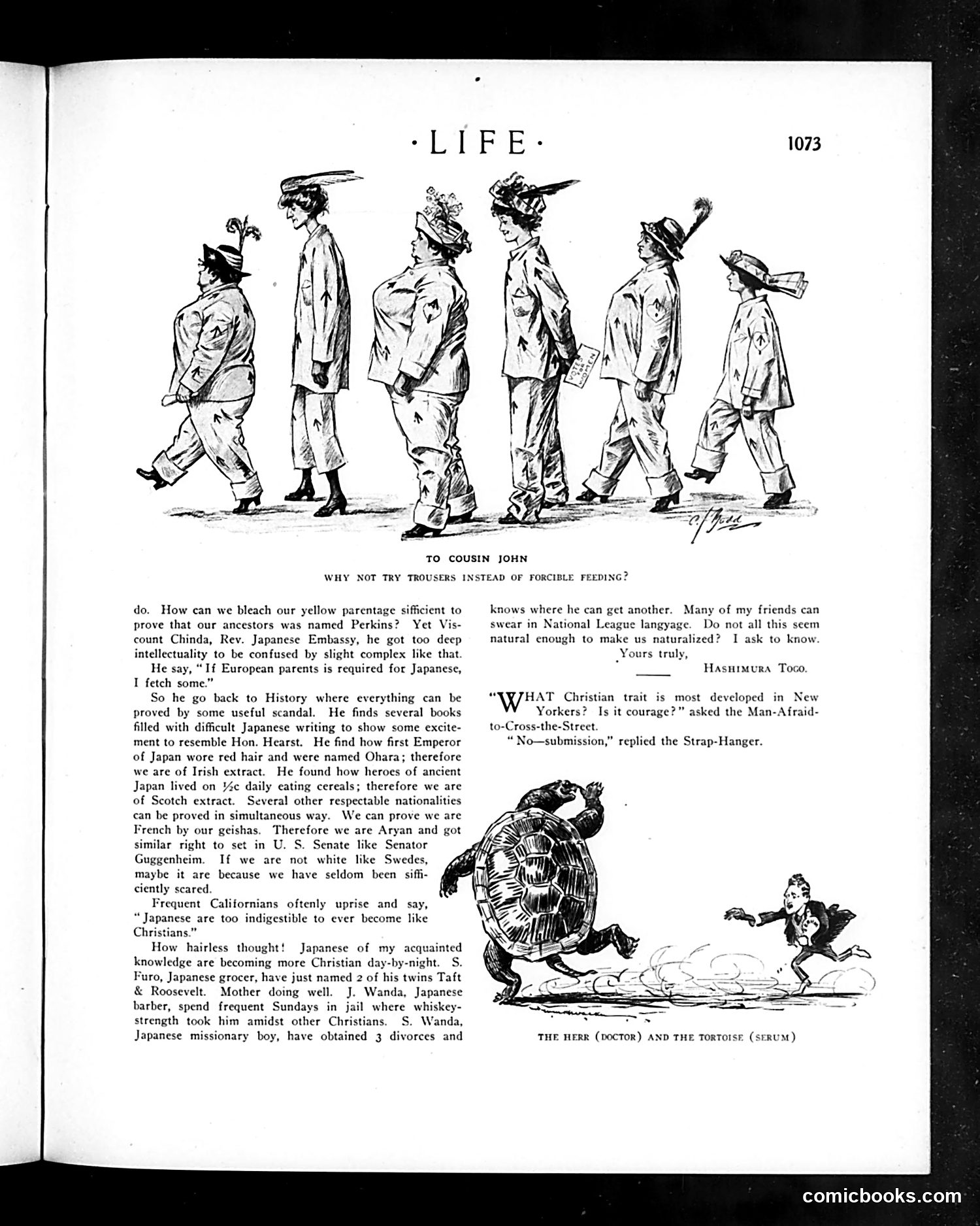
This page contains racist satire mocking Japanese immigrants and Japanese-American identity claims in early 20th-century America. **Top cartoon**: Six figures in suits wearing hats—likely representing Japanese immigrants or Japanese-Americans—are captioned "To Cousin John: Why Not Try Trousers Instead of Forcible Feeding?" The reference to "forcible feeding" alludes to British force-feeding of suffragettes, sarcastically suggesting Japanese adoption of Western clothing is similarly forced assimilation. **Main text**: A fake letter from "Hashimura Togo" (a stereotyped Japanese character) mockingly claims Japanese ancestry from Irish emperors and Scottish cereal-eaters to justify citizenship rights. The satire ridicules both Japanese claims to American belonging and anti-Japanese prejudice simultaneously—presenting supposedly "Christian" Japanese immigrants as morally questionable (jail time, divorces). **Bottom cartoon**: "The Herr (Doctor) and the Tortoise (Serum)" depicts a doctor figure chasing a tortoise—likely a visual pun on slow medical treatment or bureaucratic processes, unclear without additional context. The page exemplifies early-1900s xenophobic humor targeting Japanese assimilation debates.
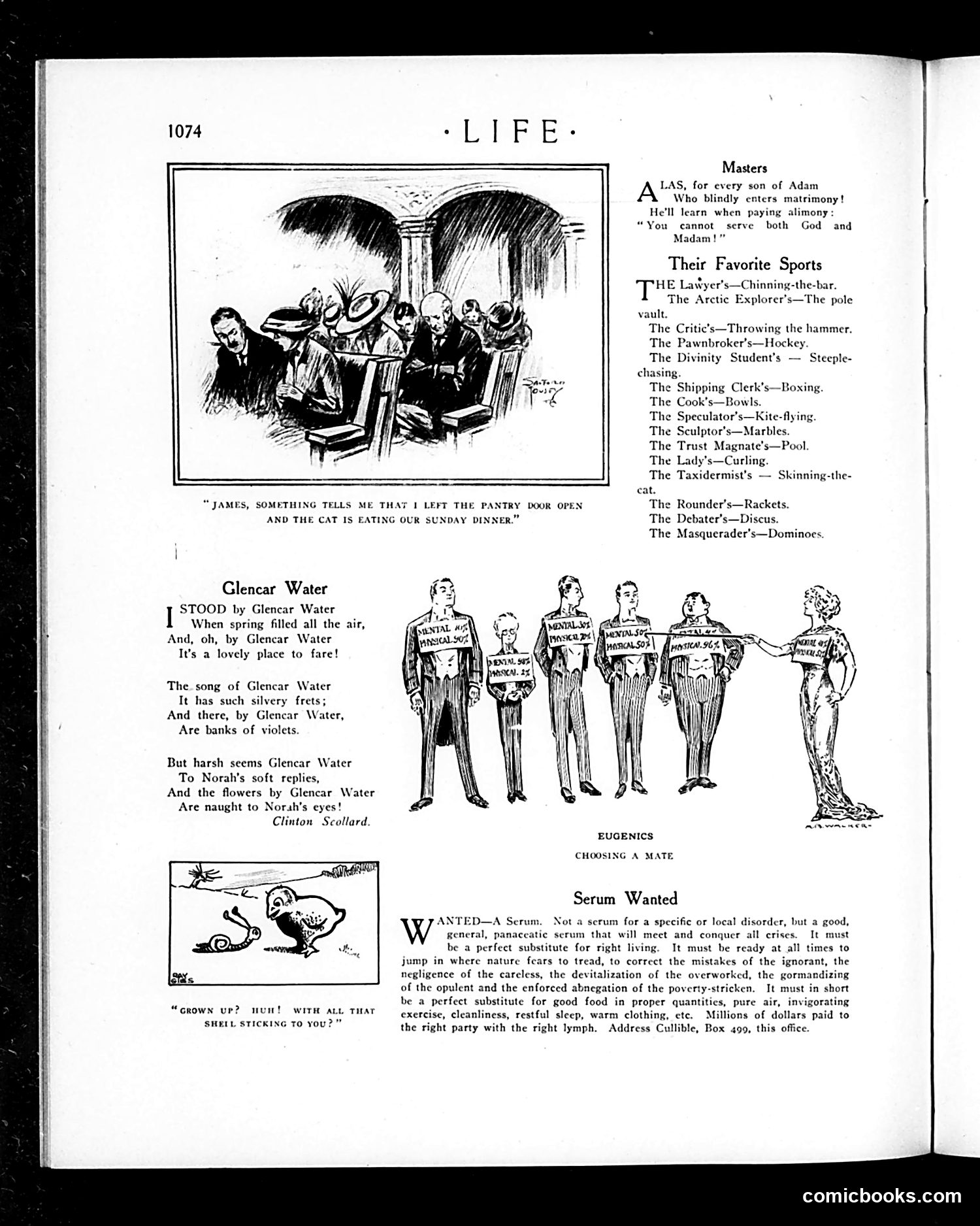
This page contains multiple satirical pieces typical of early 20th-century Life magazine: **Top cartoon:** A domestic scene mocking marriage and alimony payments, with the caption suggesting a husband worried about the cat eating Sunday dinner while he's away—a class-conscious joke about household management and marital anxieties. **"Their Favorite Sports":** A list of puns matching professions to sports activities (lawyers "chinning-the-bar," pawnbrokers playing "hockey," etc.)—wordplay humor exploiting double meanings. **"Serum Wanted":** A satirical advertisement mocking the eugenics movement and pseudo-scientific cure-alls popular in the era. It ridicules the notion that a medical serum could substitute for proper living conditions, nutrition, exercise, and rest—a jab at both scientific overreach and social inequality. **Bottom cartoon:** A small sketch with dialogue mocking a child's messy appearance. The page reflects Progressive-era concerns: marriage/divorce, class differences, and skepticism toward pseudoscientific remedies touted as panaceas for social problems.
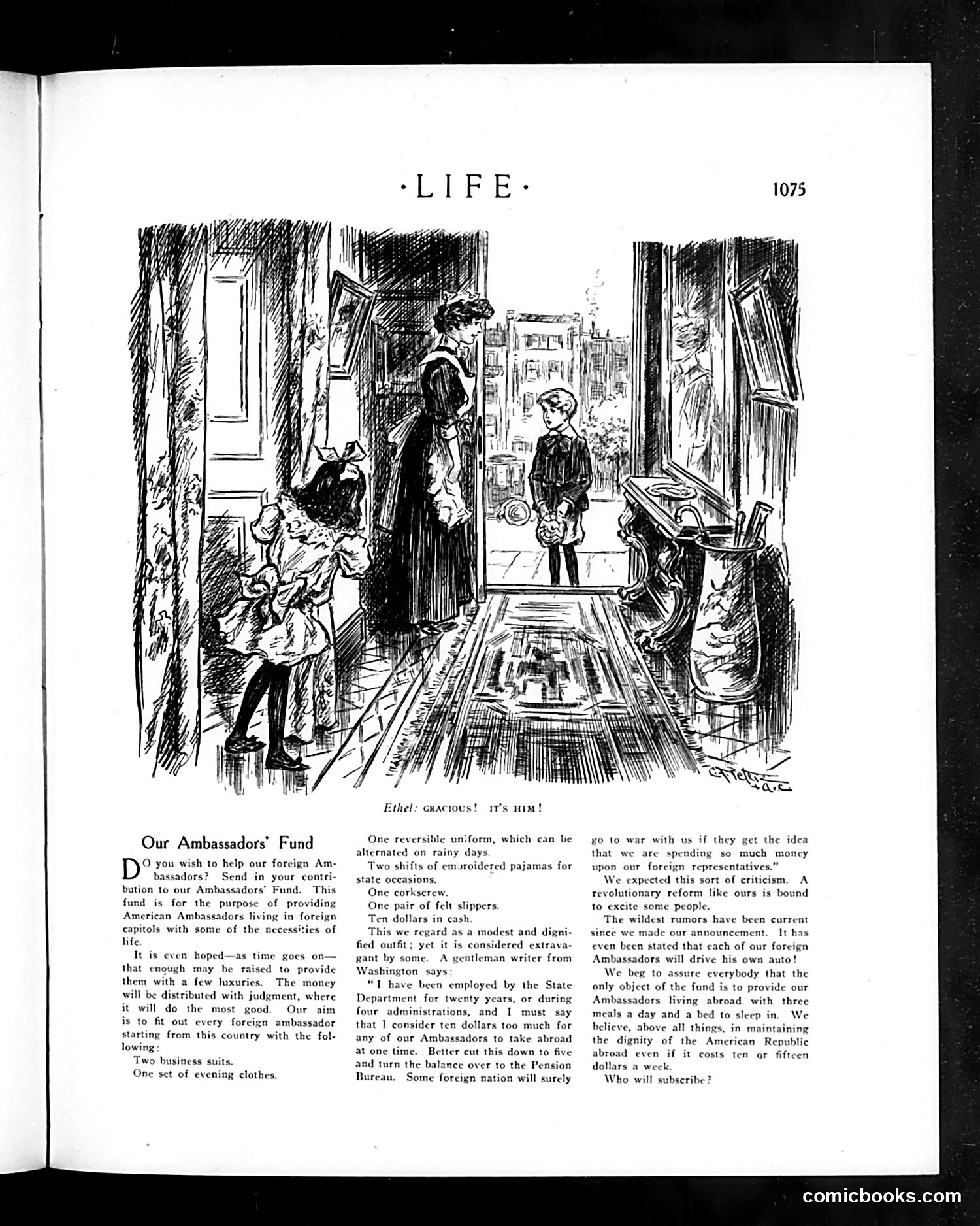
This is political satire mocking the poverty conditions of American diplomats abroad. Life proposes a tongue-in-cheek fundraising campaign to provide U.S. ambassadors with basic necessities—business suits, pajamas, a corkscrew, and ten dollars cash—treating these as luxuries. The joke targets government stinginess: diplomats supposedly represent American dignity internationally while living in shabby conditions. The cartoon illustrates an ambassador arriving at a foreign residence looking unprepared and poorly dressed. A quoted Washington official complains that even ten dollars is excessive, advocating five dollars instead—absurd parsimony that undercuts national prestige. Life sarcastically defends the fund against "revolutionary" criticism and wild rumors (like ambassadors owning cars), while emphasizing that maintaining "the dignity of the American Republic abroad" matters despite costs. The satire critiques both congressional cheapness and the implicit absurdity of expecting representatives to maintain diplomatic authority while impoverished.
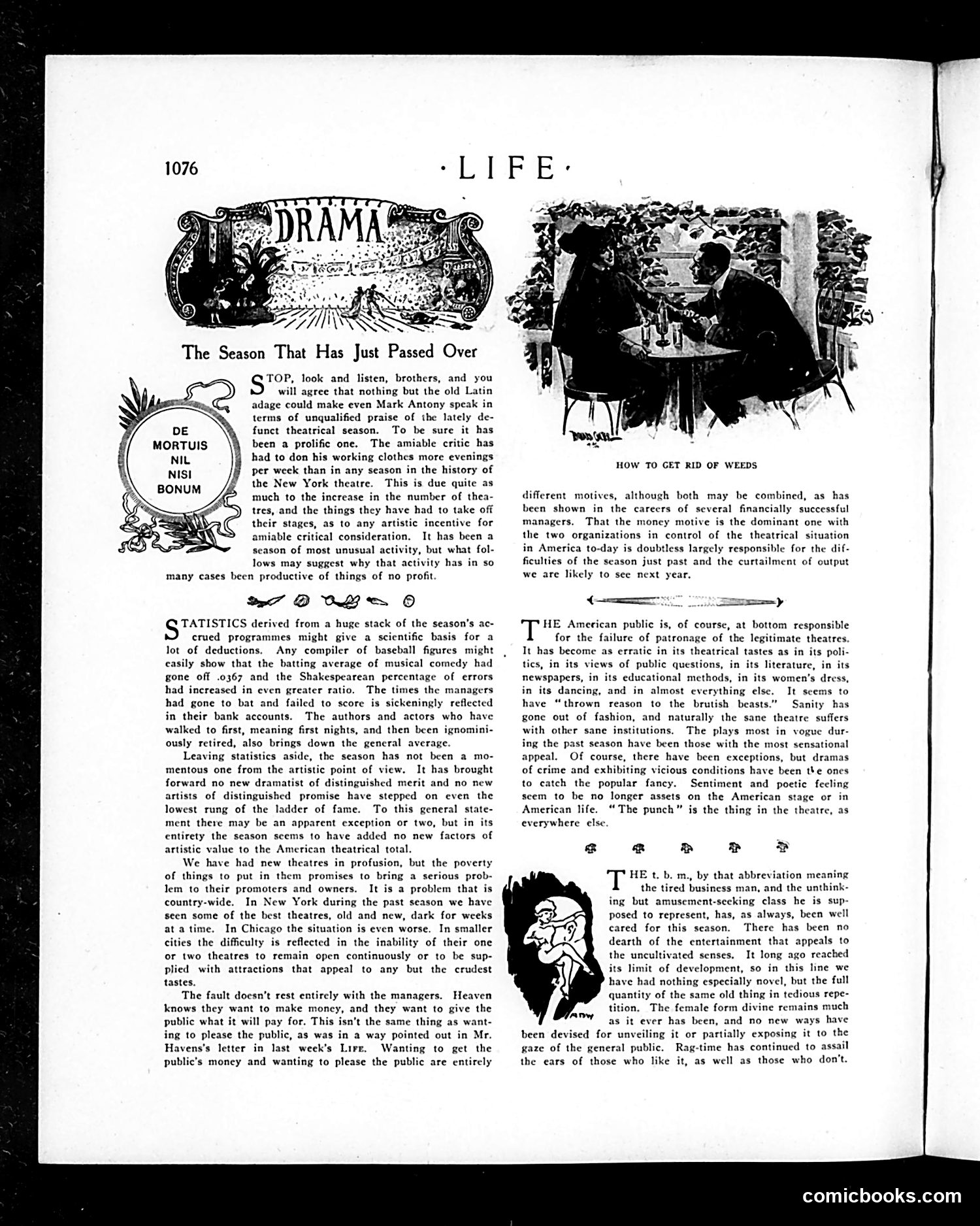
This Life magazine page critiques the recently-concluded Broadway theater season as artistically barren despite unprecedented activity. The Latin epigraph "De Mortuis Nil Nisi Bonum" ("Speak only good of the dead") sets a sardonic tone—the author must praise a dead season out of courtesy. The piece argues that while theaters proliferated and shows opened frequently, **no significant new talent emerged** and financial returns were dismal. Managers' bank accounts "sickeningly reflected" their failures. The author uses baseball statistics as metaphor: low batting averages, increased errors, many strikeouts. The core critique blames both theater management (prioritizing profit over artistic merit) and the fickle American public, whose theatrical tastes have become "as erratic" as their politics and fashion choices. The cartoon appears to illustrate the season's mediocrity, though specific figures are unclear from the image. The piece essentially diagnoses Broadway's malaise: plenty of venues but insufficient quality content to fill them—a problem affecting cities nationwide.
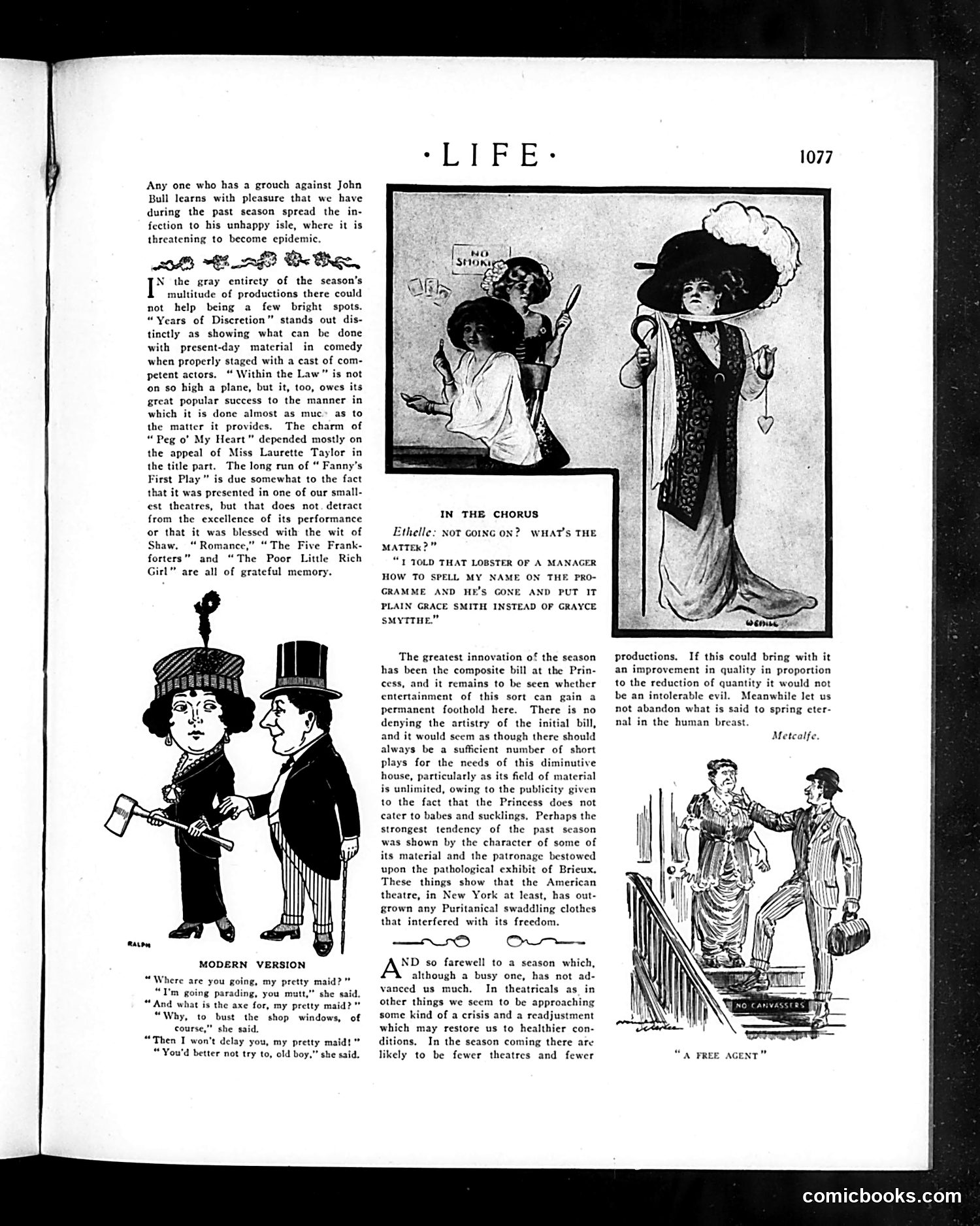
**"Modern Version" Cartoon (Left):** This depicts a suffragette—a woman demanding voting rights—carrying an axe. The dialogue parodies the nursery rhyme "Where Are You Going, My Pretty Maid?" but subverts it: instead of innocent answers, she threatens to "bust the shop windows" and warns a man not to interfere. This satirizes the militant tactics of British suffragettes (window-breaking, property destruction) around 1910-1914. The cartoon's title suggests this "modern" behavior contrasts sharply with Victorian propriety. **"In the Chorus" Dialogue:** A showgirl complains that her manager misspelled her stage name, removing the affected spelling ("Grayce Smytthe" instead of "Grace Smith"). This satirizes theatrical vanity and performers' pretensions. **Theater Reviews:** The text discusses Broadway's theatrical season, praising productions like "Years of Discretion" and criticizing others for relying on stars rather than script quality. The page overall mocks both women's political activism and theatrical pretension through humor.
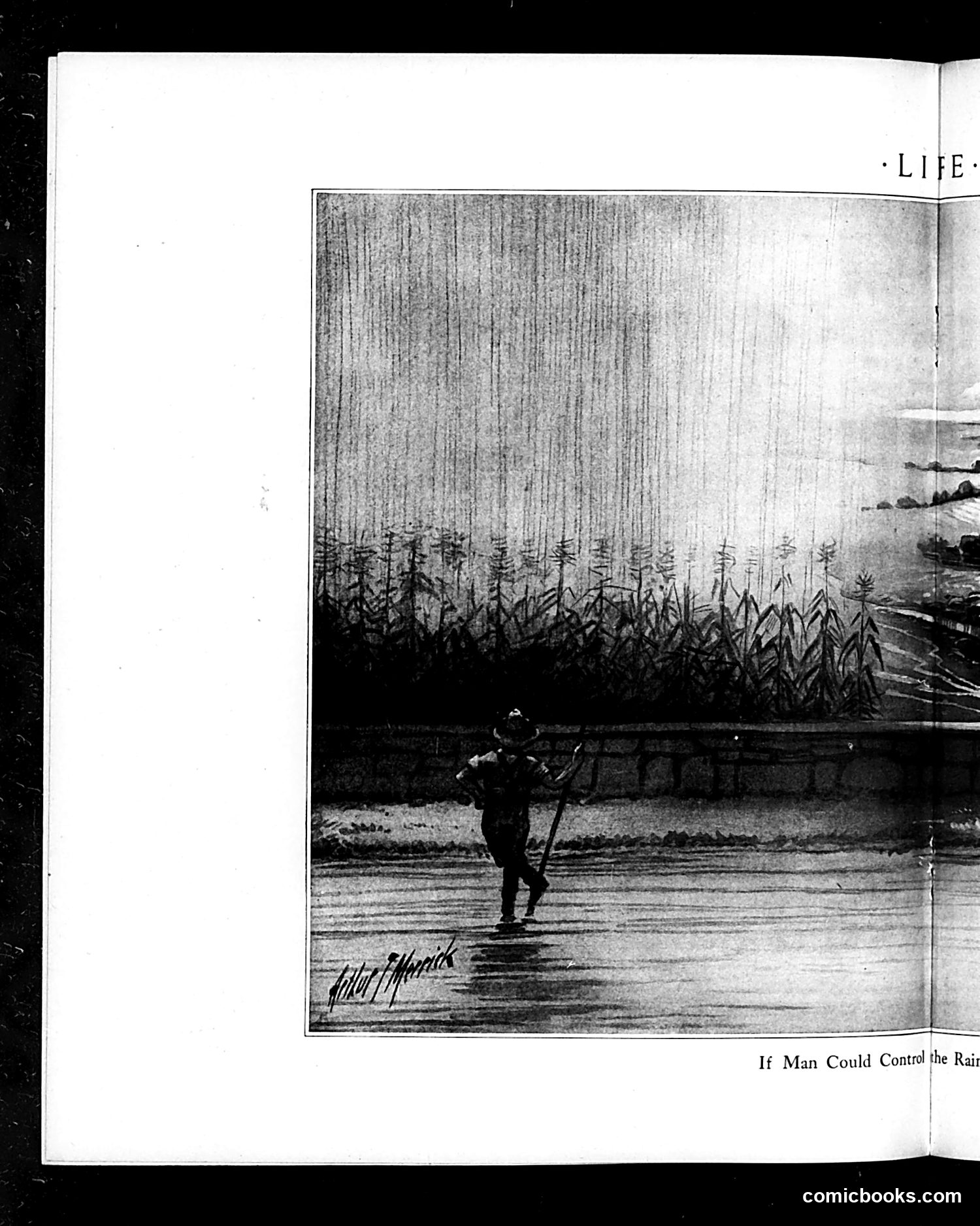
This appears to be a speculative/imaginative cartoon from Life magazine depicting a fantastical scenario. The image shows a lone figure standing in what appears to be a flooded or rain-soaked landscape, with a tall curtain of rain visible in the background and evergreen trees along the horizon. The caption "If Man Could Control the Rain" suggests this is satirizing human ambitions to master nature through technology or engineering. The illustration's style—showing an almost theatrical "curtain" of rain—implies the cartoonist is mocking the idea that rainfall could be controlled like a stage prop, presented as absurdly simple or artificial. The satire likely critiques overconfidence in human technological prowess or the fantasy of complete environmental control, themes relevant to early-to-mid 20th century discussions of progress and human dominion over nature.
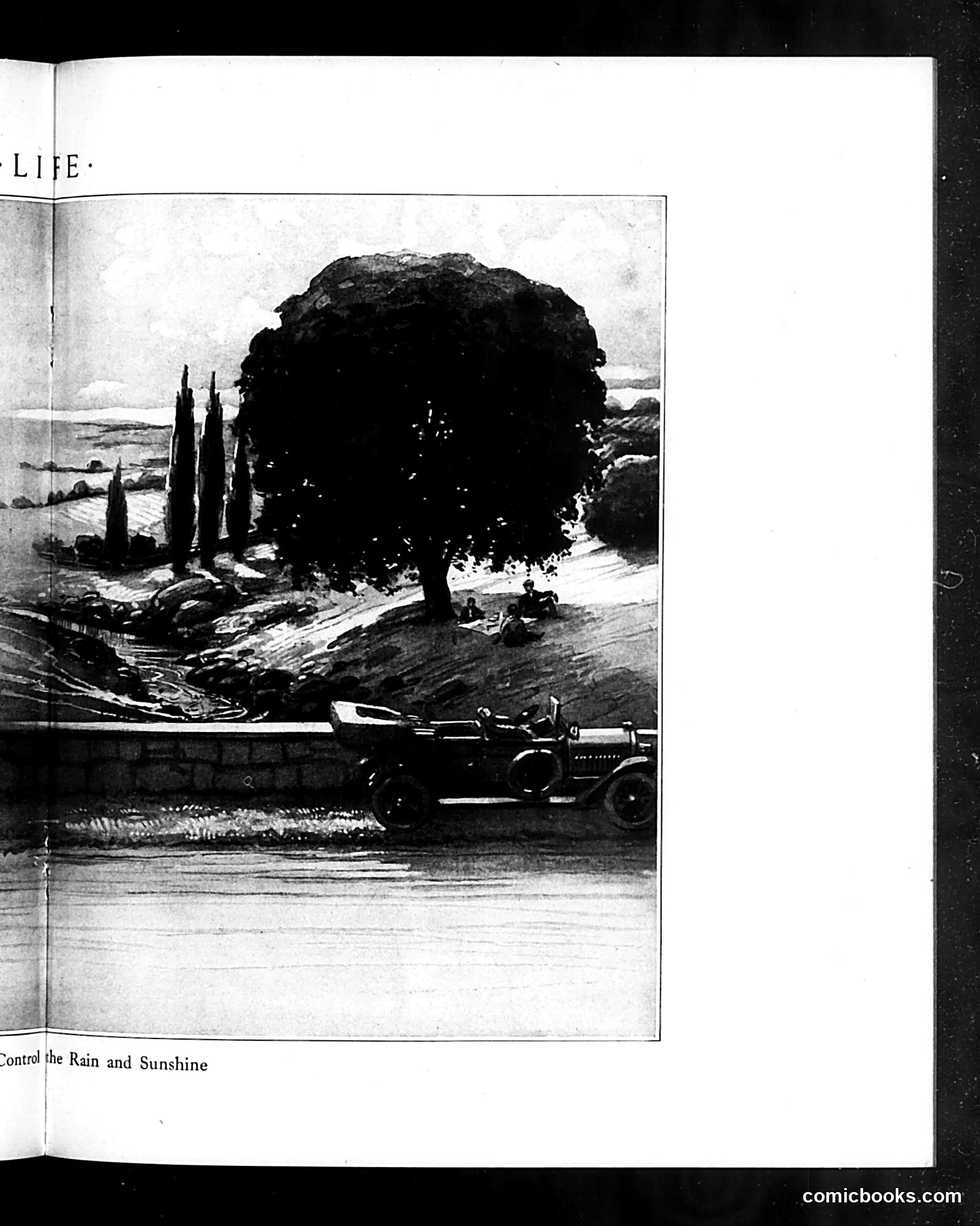
This page from *Life* magazine presents an illustration titled "Control the Rain and Sunshine." The image depicts a vintage automobile beside a pastoral landscape featuring a large tree, cypress trees, water, and rolling terrain. The caption's meaning is unclear from the image alone—it appears to be either aspirational satire about human ambitions to control nature, or possibly commentary on agricultural/irrigation technology of the era. The juxtaposition of modern machinery (the car) against natural landscape elements suggests themes about industrialization's relationship to the natural world. Without additional context or visible text explaining the specific satirical target, the exact political or social commentary remains uncertain. The aesthetic suggests early-to-mid 20th century publication.
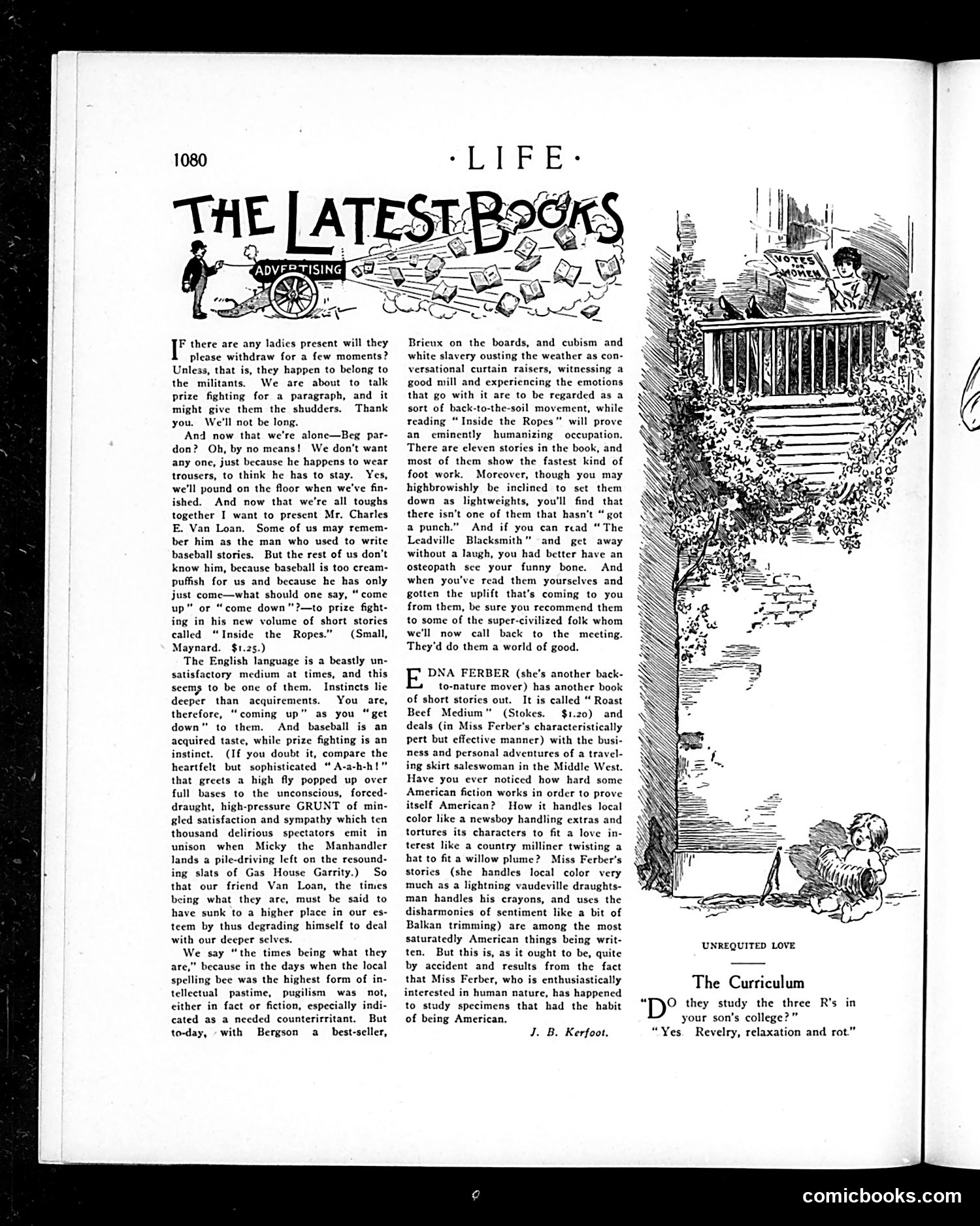
This page reviews recent literature, satirizing early 1900s intellectual trends. The author criticizes how modern "highbrow" culture (referencing philosopher Bergson and playwright Brieux) has made prizefighting literature fashionable as a pseudo-intellectual "back-to-the-soil movement"—a return to primal instincts after over-civilization. The review presents Charles E. Van Loan's boxing story collection "Inside the Ropes" as more authentic than his previous baseball writing, because boxing supposedly appeals to deeper human nature than acquired tastes. The author mocks this pretension: intellectual society now reads boxing stories to appear humanized and authentic. A second review discusses Edna Ferber's "Roast Beef Medium," criticizing how American fiction self-consciously emphasizes "local color" and Americana to prove its credentials, awkwardly forcing characters and romance into predetermined regional types. Both reviews employ sardonic humor about literary fashion and middle-class aspirations toward authenticity and sophistication.
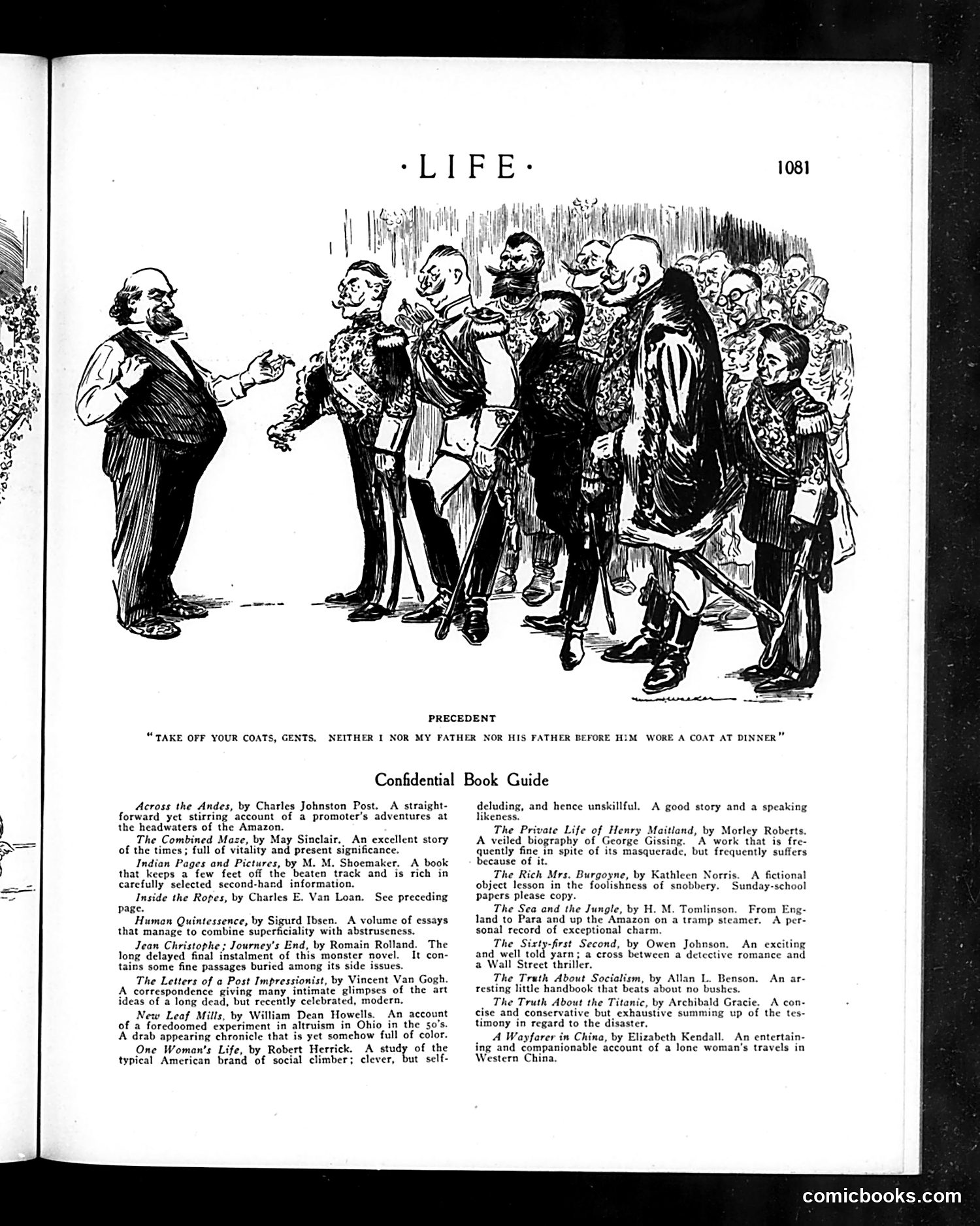
This satirical cartoon, titled "Precedent," mocks upper-class pretension about inherited tradition. A portly gentleman on the left addresses a group of formally dressed men (military officers, nobles, and dignitaries), instructing them to remove their dinner jackets because "neither I nor my father nor his father before him wore a coat at dinner." The joke is the obvious contradiction: the speaker himself is dressed in formal attire, undermining his claim of family tradition. The satire targets how the wealthy invoke spurious "precedent" and invented customs to justify snobbish behavior—essentially making up rules retroactively and presenting them as ancient family practice. The page also includes a "Confidential Book Guide" reviewing contemporary literature, suggesting this is from an early 20th-century *Life* magazine focused on cultural commentary and social satire.
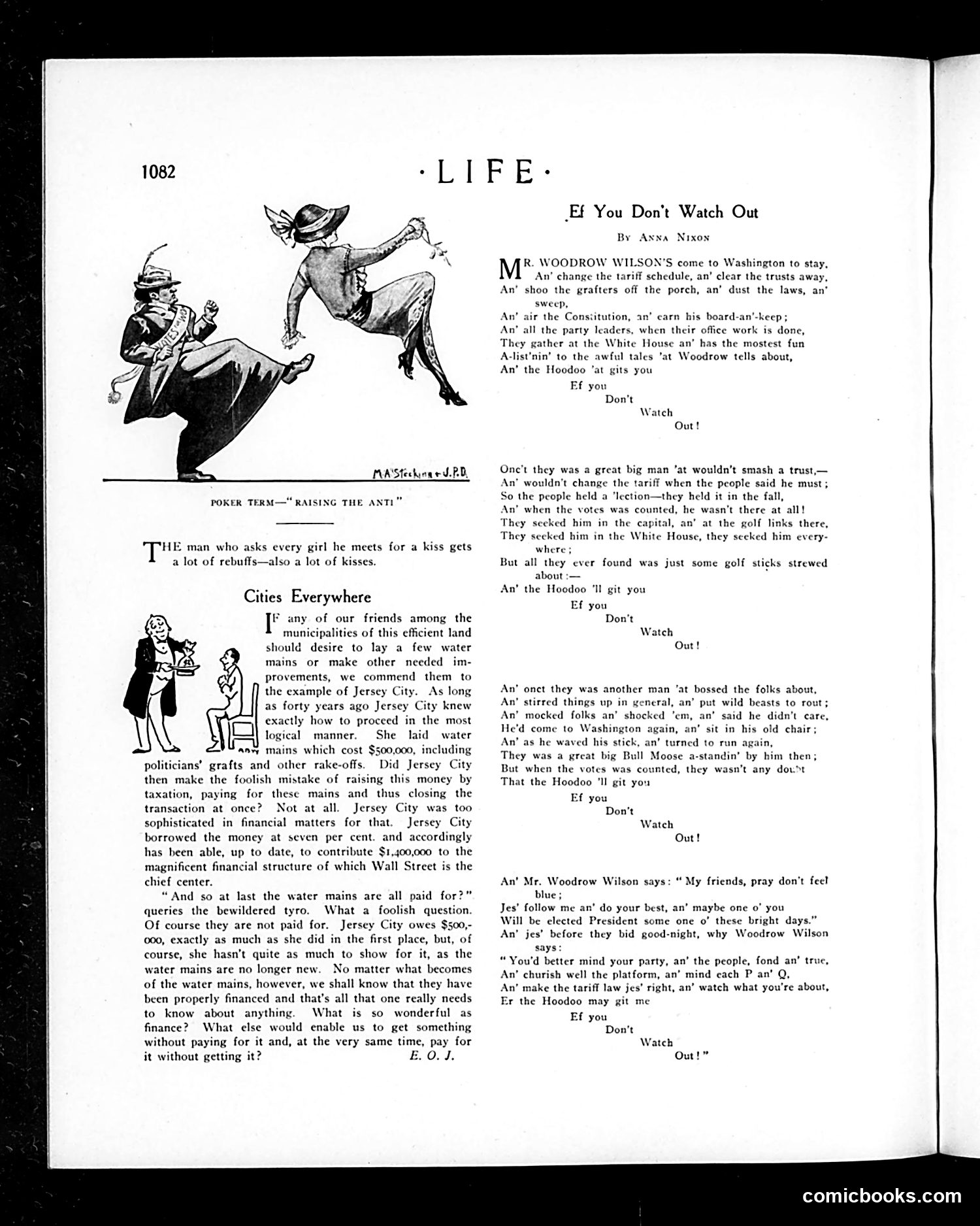
The page contains two distinct satirical pieces from the Wilson era (circa 1913). **"Raising the Anti" cartoon**: A poker-term visual pun showing politicians literally "raising the ante"—kicking up their heels in celebration, likely referencing corrupt financial dealings. **"Cities Everywhere" (by E.O.J.)**: Mocks Jersey City's financial mismanagement. The city borrowed $500,000 for water mains at 7% interest and has now paid $1,400,000 in debt service while still owing the original amount. The satire attacks the absurdity of "finance" itself—paying without getting, getting without paying. **"Ef You Don't Watch Out" (by Anna Nixon)**: A cautionary verse about President Woodrow Wilson's agenda (tariff reform, trust-busting). It references Wilson's defeated predecessor—likely Theodore Roosevelt, who lost the 1912 election (the "Bull Moose" reference). The "Hoodoo" is a folkloric curse that befalls politicians who ignore the people's will. The poem warns party members to follow Wilson carefully or face electoral doom. Both pieces reflect Progressive Era skepticism of political corruption and financial manipulation.
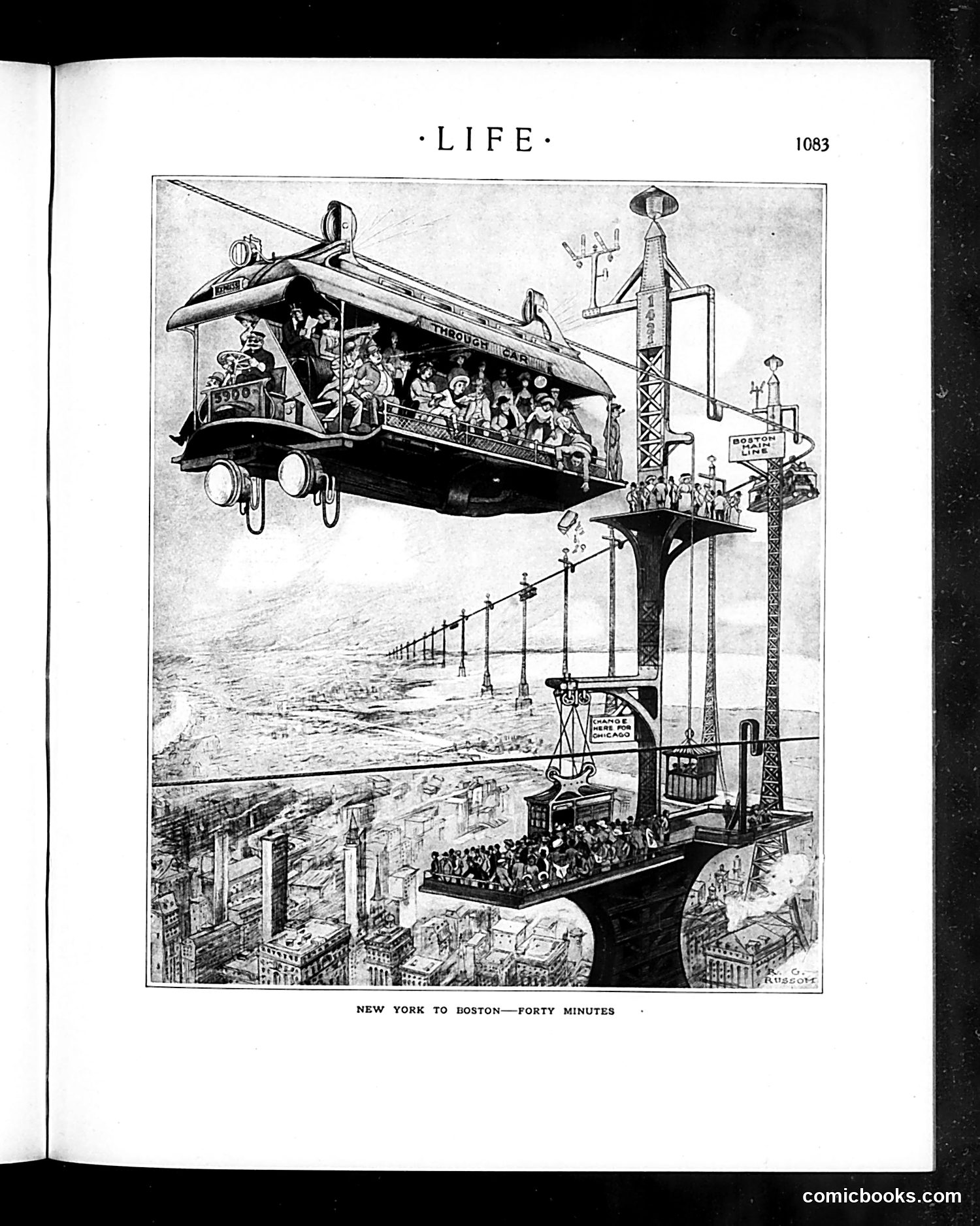
This is a satirical cartoon depicting futuristic rapid transit between New York and Boston. The image shows an enormous aerial vehicle suspended on a cable system, transporting passengers forty minutes between the cities—a dramatic compression of what would have been a multi-hour journey in the early 20th century. The satire targets utopian technological fantasies of the era. The elaborate infrastructure (towers, cables, stations) and crowded vessel suggest both ambitious optimism about progress and skepticism about whether such schemes were practical or necessary. The "Roston Line" marking visible on the tower indicates this is imagined as an established service. This reflects early-1900s debates about transportation innovation, urban connectivity, and whether technological promises would actually materialize in everyday life.
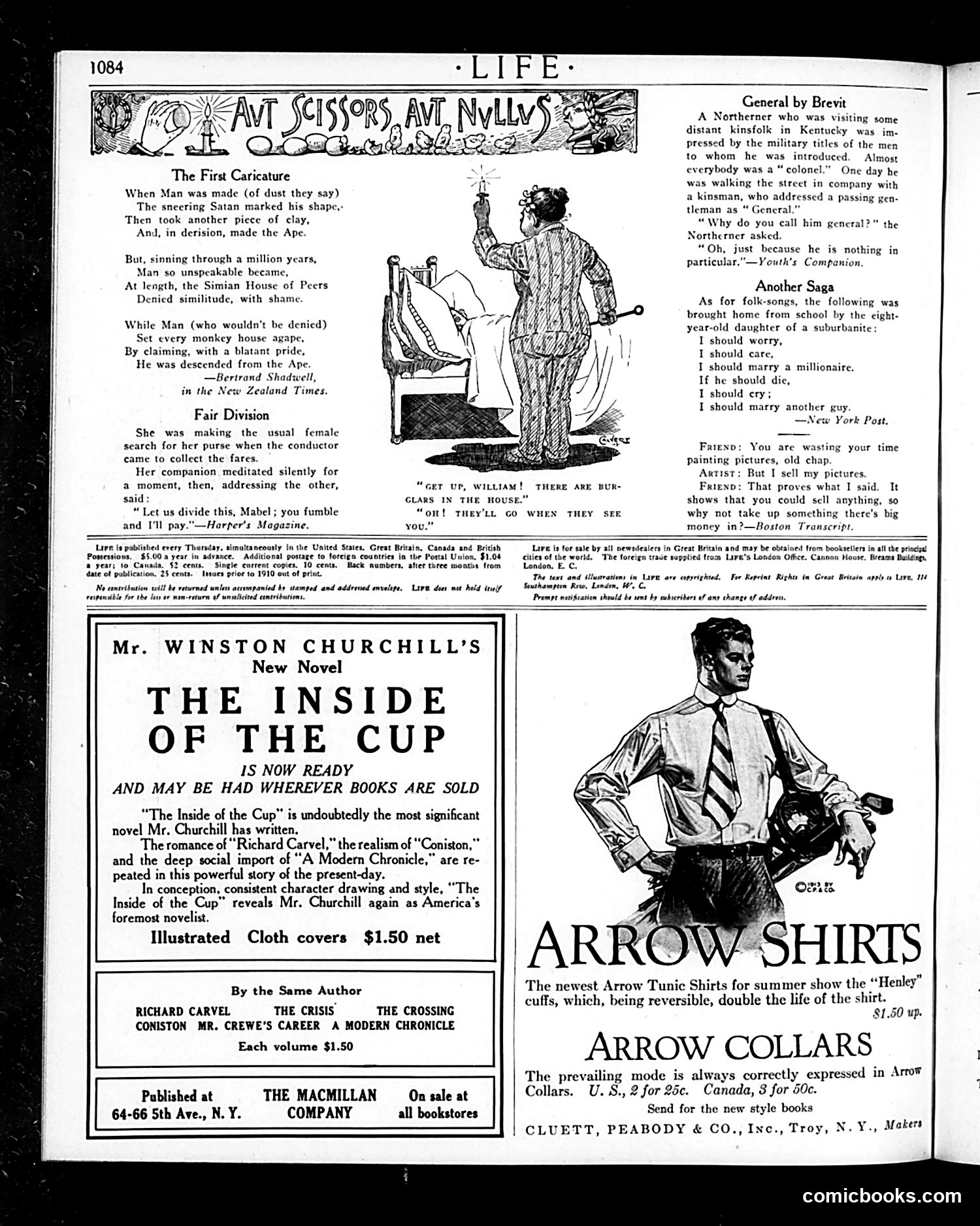
This page contains several satirical cartoons and humorous short pieces typical of *Life* magazine's format. **"The First Caricature"** is a poem mocking evolutionary theory and human vanity—it argues that humans descended into depravity while monkeys remained dignified, yet humans absurdly claim descent from apes. **"Fair Division"** jokes about gender stereotypes: a woman fumbles searching her purse for fare money while her male companion pragmatically suggests they split the burglar problem instead of paying. **"General by Brevit"** satirizes the inflated military titles in the American South—a Northerner notices everyone claims the rank of "colonel," learning that "general" means someone of no particular importance. The remaining pieces are brief humorous anecdotes about suburban aspirations, artist pretension, and period slang ("I should worry"). The page is primarily advertising for Winston Churchill's novel *The Inside of the Cup* and Arrow Shirts/Collars, with satirical content filling the remaining space.
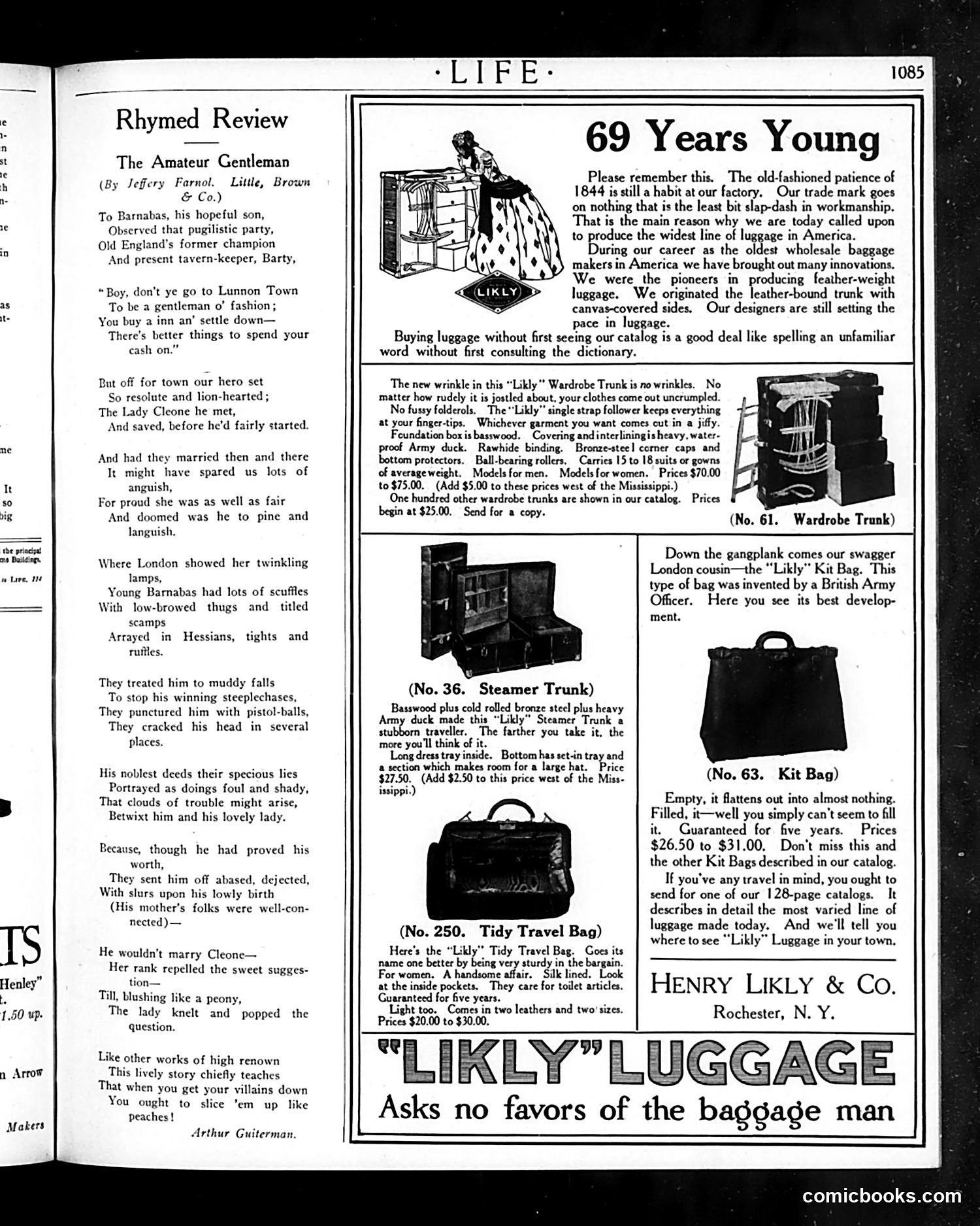
This page contains a **poem and luggage advertisements**, not political cartoons. The left side presents "The Amateur Gentleman," a narrative poem by Jeffery Farnol about a young man (Barnabas) from humble origins attempting to court an aristocratic woman (Cleone) in London. The poem satirizes class distinctions: despite proving his worth through noble deeds, he's rejected because of his lower birth. Society's prejudice—portrayed through lies and slurs—prevents his marriage. The satire critiques how 19th-century British society valued lineage over character. The right side is a **Henry Likly & Co. advertising section** for luggage (wardrobe trunks, steamer trunks, kit bags). The company positions itself as America's oldest wholesale baggage maker, emphasizing durability and innovation. References to "1844" and "old-fashioned patience" appeal to tradition and reliability—a marketing strategy contrasting handcrafted quality against mass-production competitors. No political figures or events are referenced. The page blends literary content with commercial messaging, typical of *Life* magazine's format.
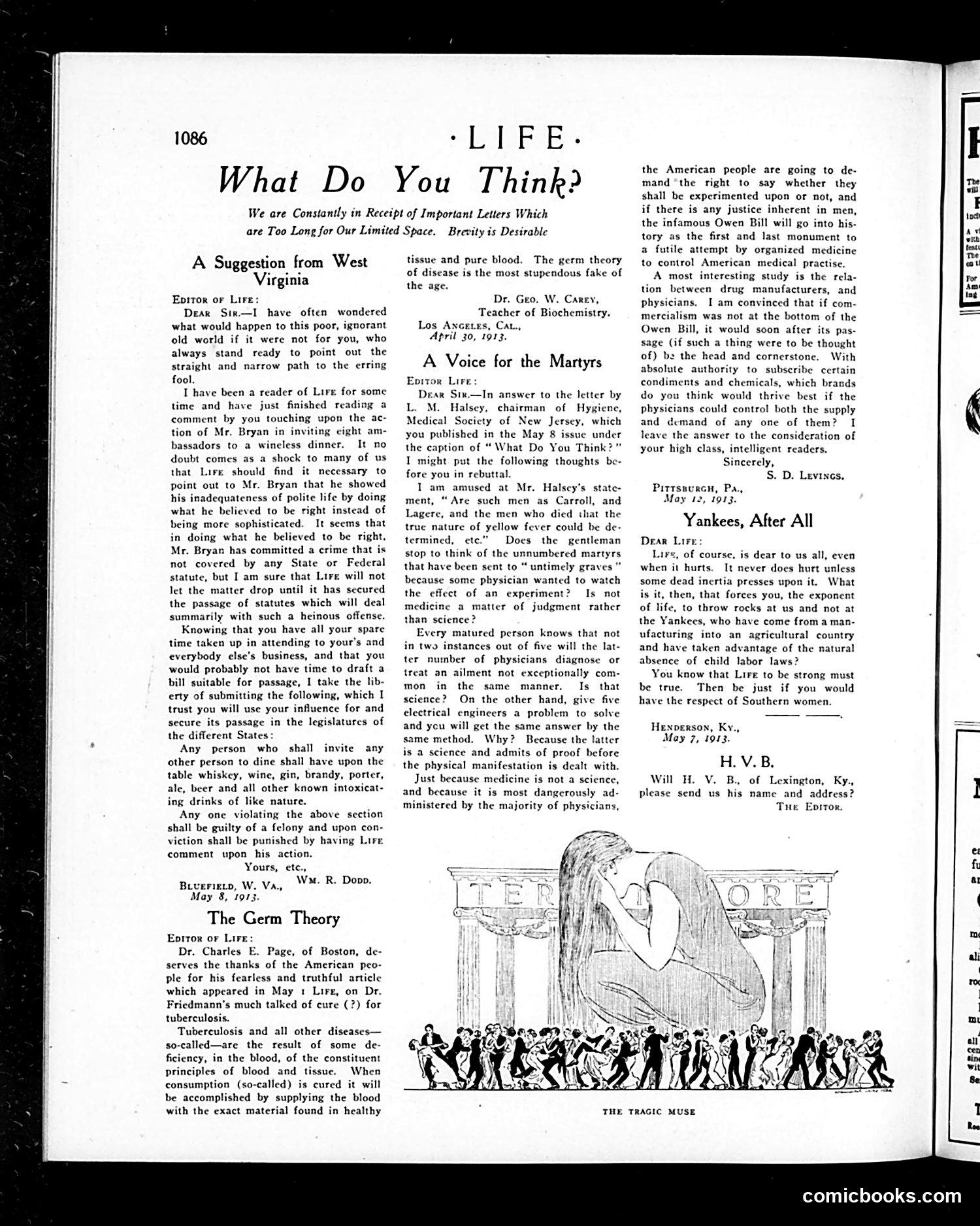
This page features a "What Do You Think?" letters column—Life's reader feedback section. The letters satirize various public debates of the era: 1. **West Virginia letter**: Sarcastically mocks Life's editorial criticism of William Jennings Bryan for hosting a "wineless dinner" with ambassadors. The writer proposes a mock bill requiring alcohol at all dinners, suggesting Life's priorities are misplaced. 2. **Germ Theory letter**: Dr. Geo. W. Carey rejects germ theory as a "stupendous fake," advocating instead for blood deficiency explanations of disease—representing early 20th-century medical pseudoscience still competing with emerging germ theory. 3. **Martyrs letter**: Defends medical experimentation ethics, referencing unnamed doctors (possibly Yellow Fever researchers) who conducted dangerous experiments, questioning whether medicine is science or judgment. The bottom illustration, "The Tragic Muse," depicts suffering figures—likely representing victims or commentary on human tragedy. The satire targets outdated thinking and Life's editorial stances on contemporary issues.
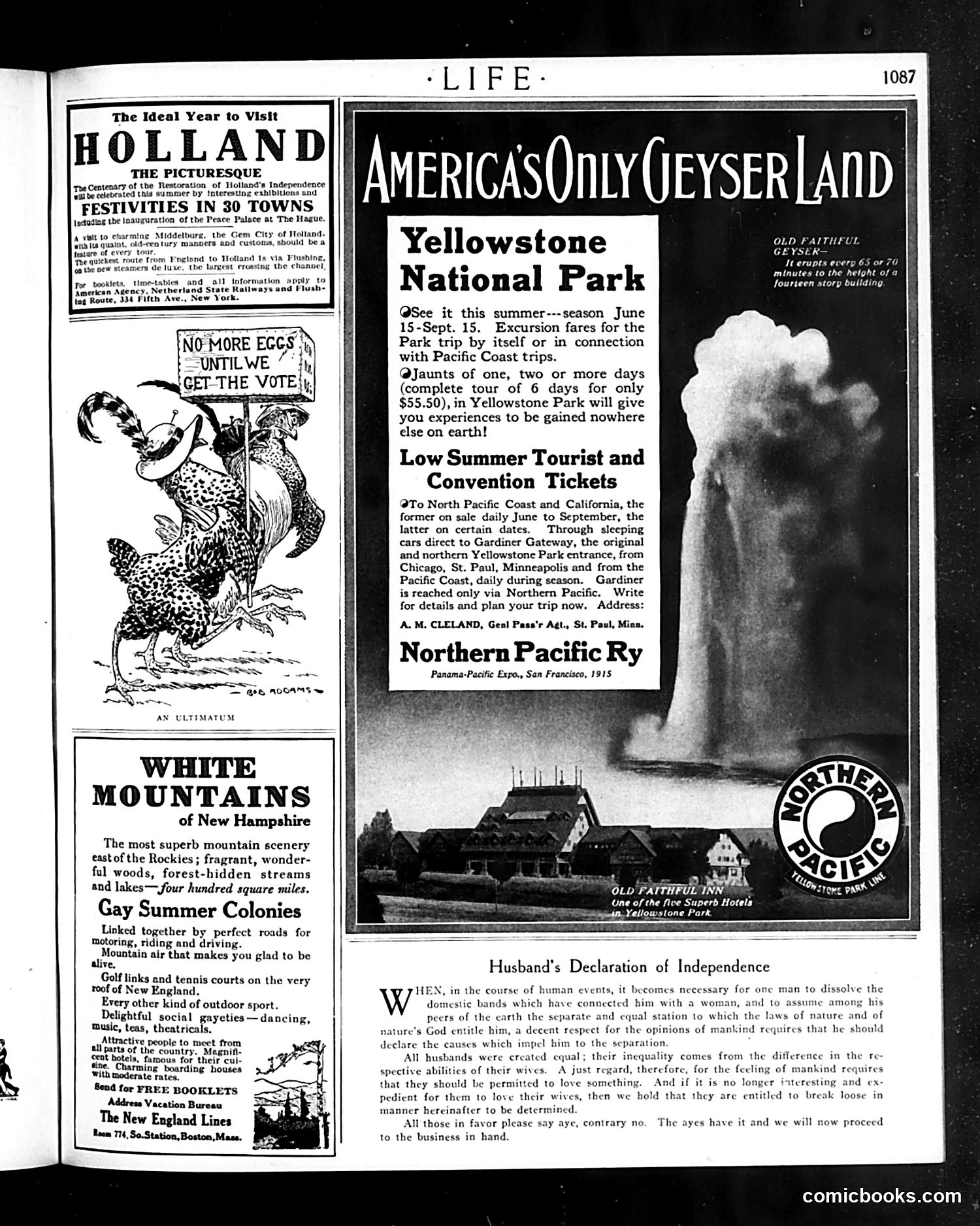
This satirical piece parodies the Declaration of Independence by imagining husbands collectively "divorcing" their wives. The text mimics the formal language of the founding document, replacing political grievances with marital complaints. The joke centers on the claim that "all husbands were created equal; their inequality comes from the difference in the respective abilities of their wives"—inverting typical gender hierarchies by sarcastically blaming wives for husbands' varying success. The piece then grants husbands the "right" to cease loving their wives if love becomes tedious. This appears to be commentary on contemporary gender tensions, likely from an era when women's increasing independence (possibly suffrage-related, given the "NO MORE EGGS UNTIL WE GET THE VOTE" illustration on the facing page) was shifting domestic power dynamics. The satire mocks both marital dissatisfaction and the rhetorical language men might use to justify abandoning their marriages.
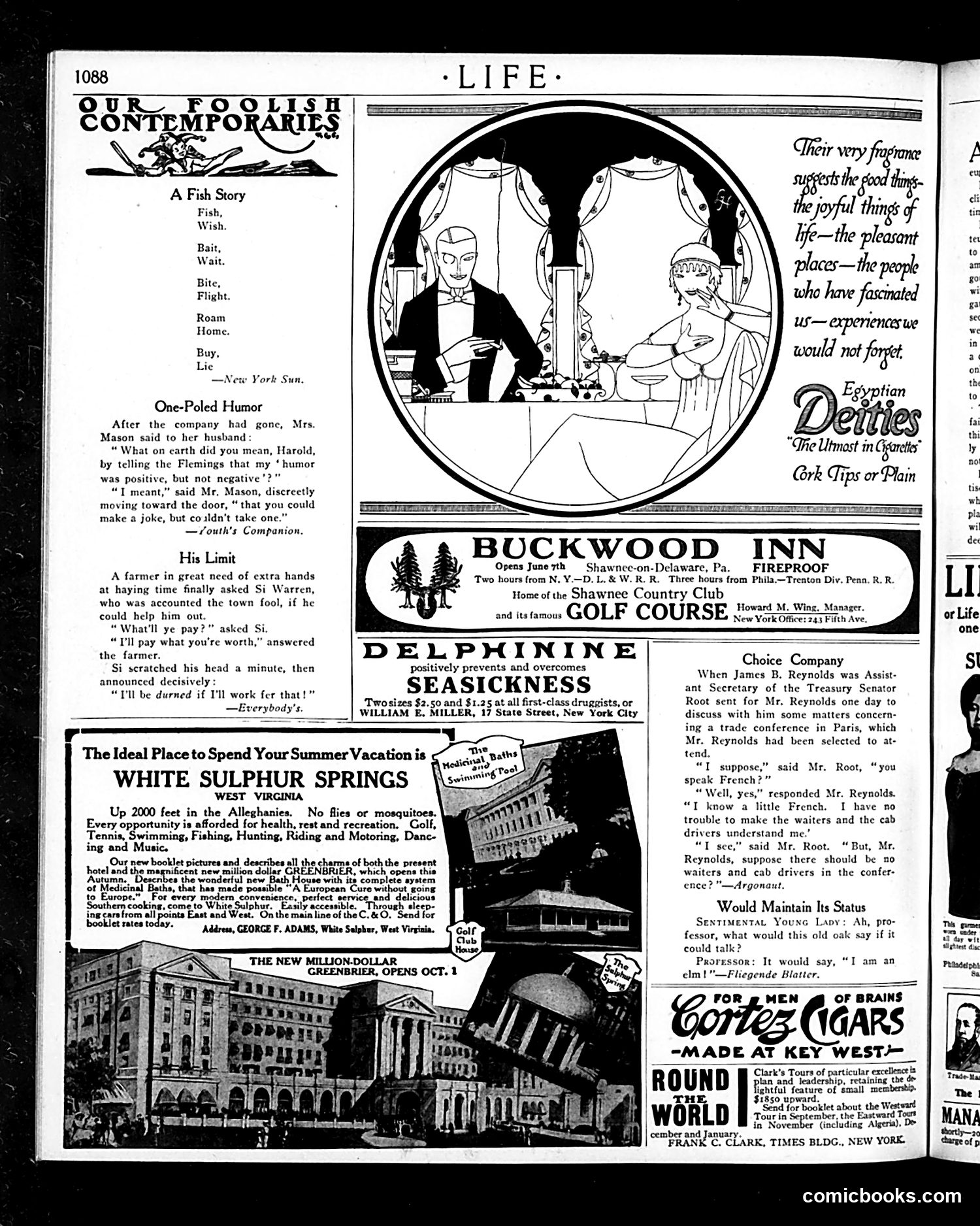
This page contains **humorous anecdotes and advertisements** rather than political cartoons. The three jokes exemplify early 20th-century American humor: 1. **"One-Poled Humor"**: A wife confronts her husband for telling guests she has "positive but not negative" humor—meaning she can make jokes but can't take them. The satire targets marital dynamics and social performance. 2. **"His Limit"**: A farmer asks a town fool to help with haying. When promised "what you're worth," the fool refuses, recognizing the insult in being valued so cheaply. This rural humor exploits class and intelligence stereotypes. 3. **"Choice Company"**: Senator Root discusses a trade conference with Reynolds. Root jokes that if Reynolds speaks only "waiter French" (basic service-industry language), he'll struggle negotiating with diplomats. This satirizes Americans' limited foreign language abilities and diplomatic pretensions. The page is primarily **advertising** (vacation resorts, seasickness medicine, cigars), with light social satire rather than political commentary.
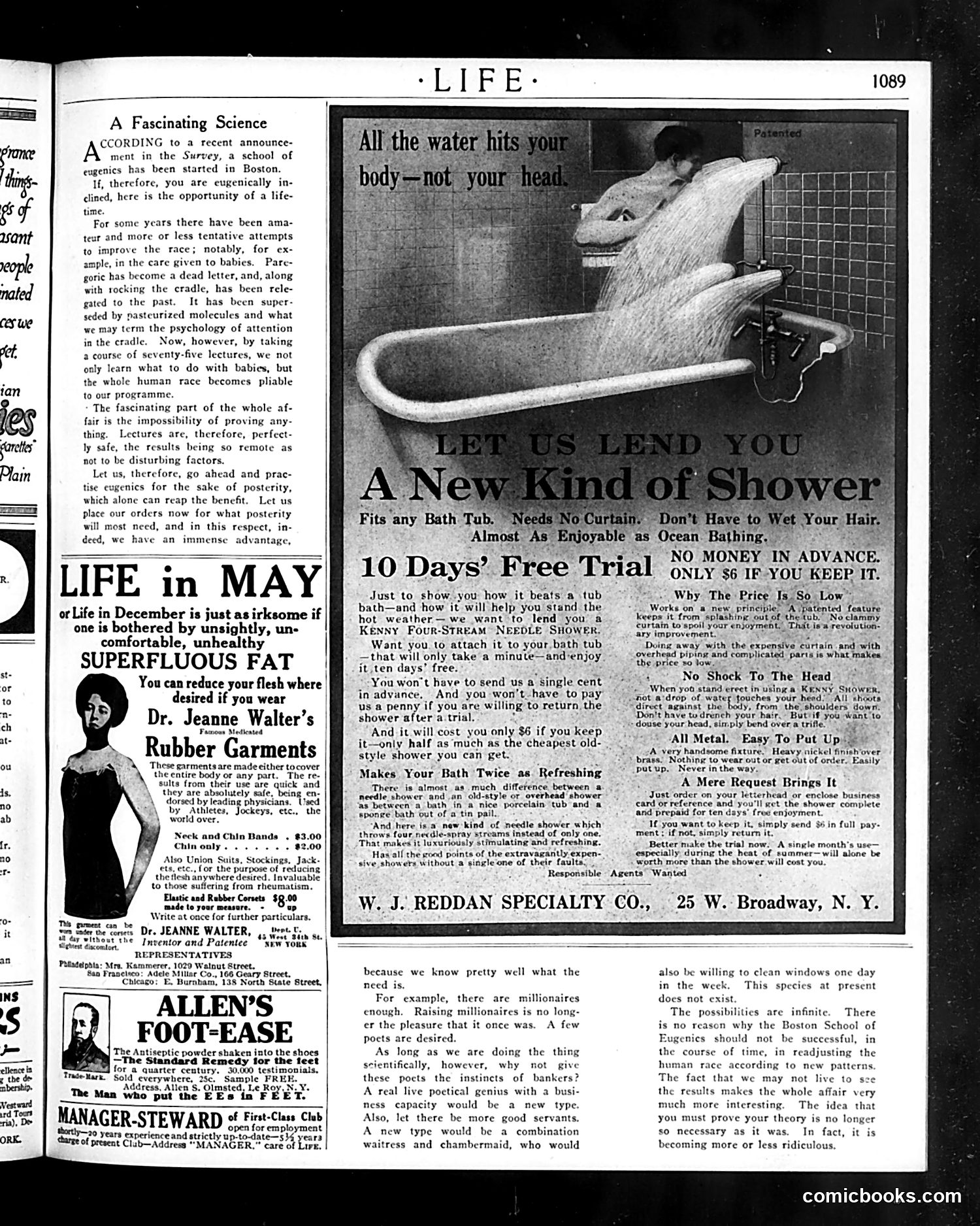
This page primarily contains **advertisements and satirical editorial content** rather than political cartoons. The main satirical piece, "A Fascinating Science," mocks the **eugenics movement**—specifically a new school of eugenics started in Boston. The author sarcastically praises eugenics while pointing out its fundamental absurdity: you cannot prove results because outcomes are so distant in the future. He ironically suggests people should "place our orders now for what posterity will most need," highlighting how eugenics programs make grand claims about improving humanity without accountability. The advertisements surrounding this piece—for reducing garments, foot powder, and a shower apparatus—represent typical early-20th-century consumer products. The juxtaposition is likely intentional satire: while eugenicists promised to scientifically perfect humanity, ordinary Americans were sold various dubious devices to improve their bodies. The page reflects a period when eugenics was still discussed as legitimate science in mainstream American publications, before its association with Nazi ideology discredited it.
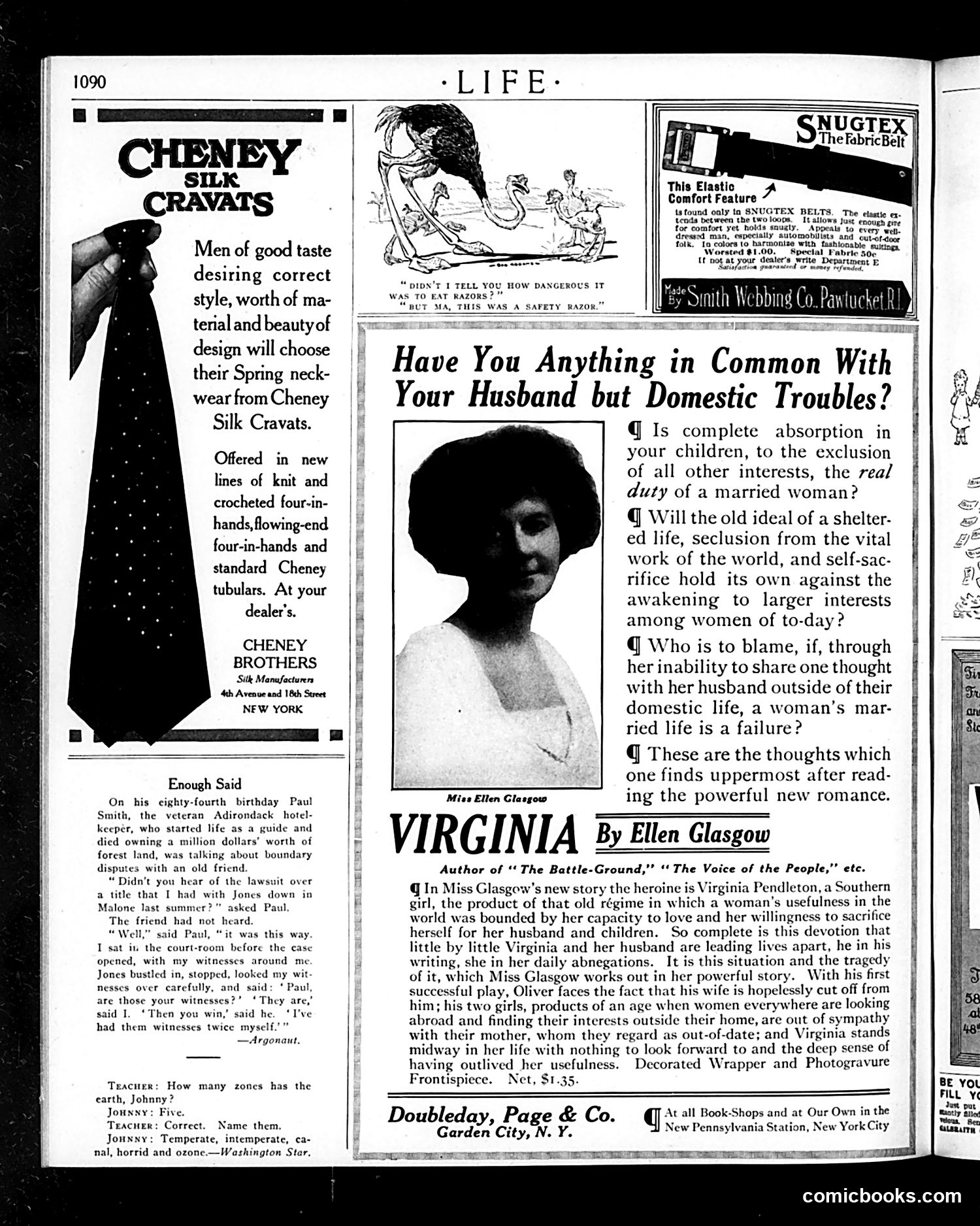
This page mixes advertisements with editorial content addressing early 20th-century gender debates. The central cartoon depicts a woman injured by a razor—likely satirizing domestic danger or foolish behavior, though the exact reference is unclear without fuller context. The major feature is a book advertisement for Ellen Glasgow's novel *Virginia*, which frames the real satire: it critiques the "old régime" confining women to domestic duty. The advertisement poses rhetorical questions challenging whether complete absorption in children and household sacrifice constitutes a married woman's true duty, and whether women's exclusion from intellectual/public life causes marital failure. This reflects Progressive Era anxieties about women's changing roles—as more women sought education and public engagement, traditional domesticity faced ideological challenge. The novel apparently dramatizes this tension through a wife isolated from her husband's intellectual life. The page also includes vintage anecdotes and a Cheney Silk Cravats ad—typical period advertising filler.
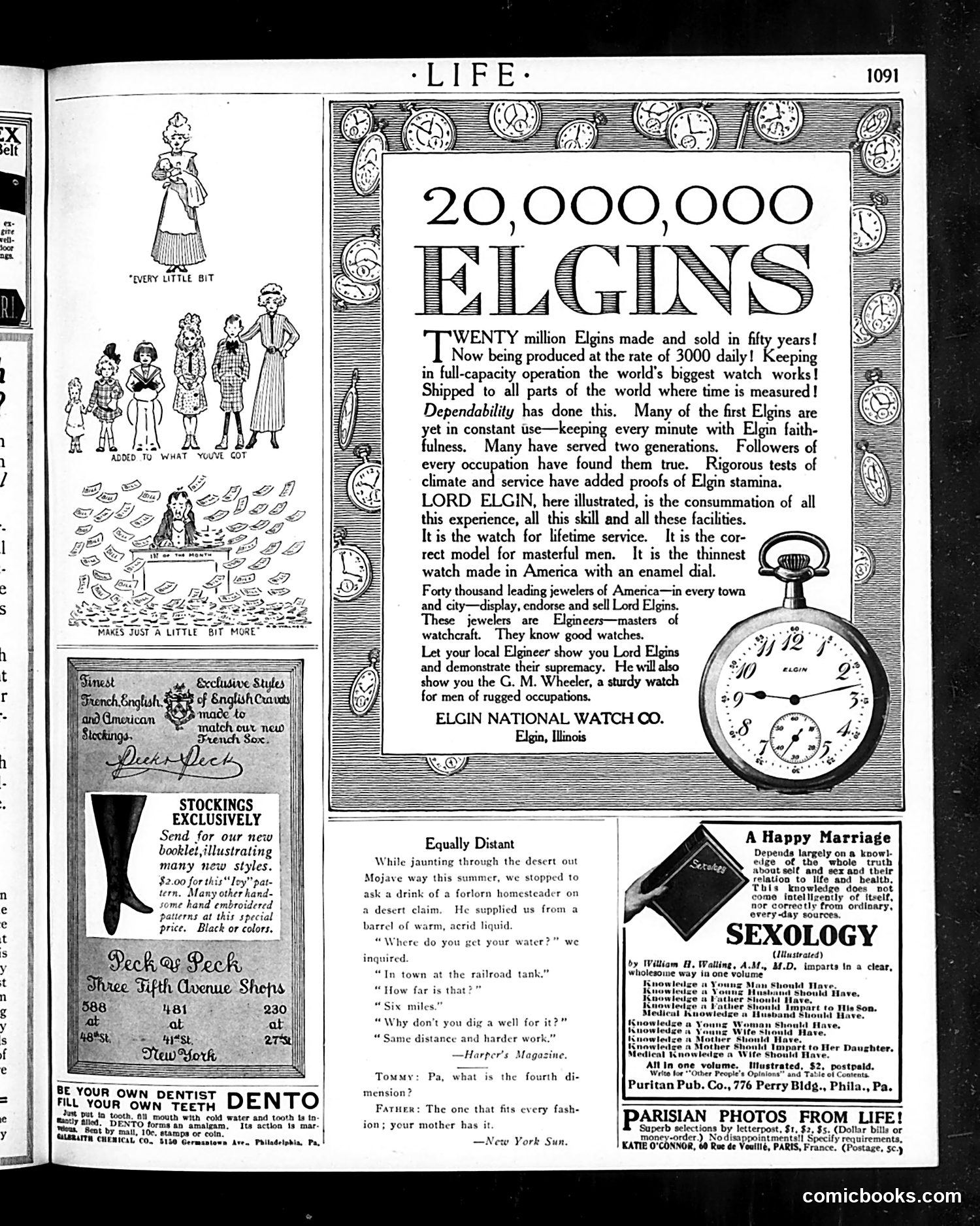
This page is primarily **advertising**, not political satire. The dominant content is a full-page advertisement for Elgin watches, celebrating 20 million units sold over fifty years. The ad emphasizes reliability and durability—watches serving "two generations" and functioning in harsh climates—positioning Elgin as the trustworthy choice for working men. The smaller cartoons on the left appear to be generic humor: one shows a woman surrounded by children labeled "Every Little Bit" (likely about thrift during economically tight times), and another depicts someone drowning in money ("Makes Just a Little Bit More"), suggesting financial struggle. The remaining space contains various product advertisements (stockings, dental cream, a sexology book) and miscellaneous content like a desert anecdote and a riddle. **No clear political message** is present; this reflects typical early-20th-century magazine layout mixing commerce with light entertainment.
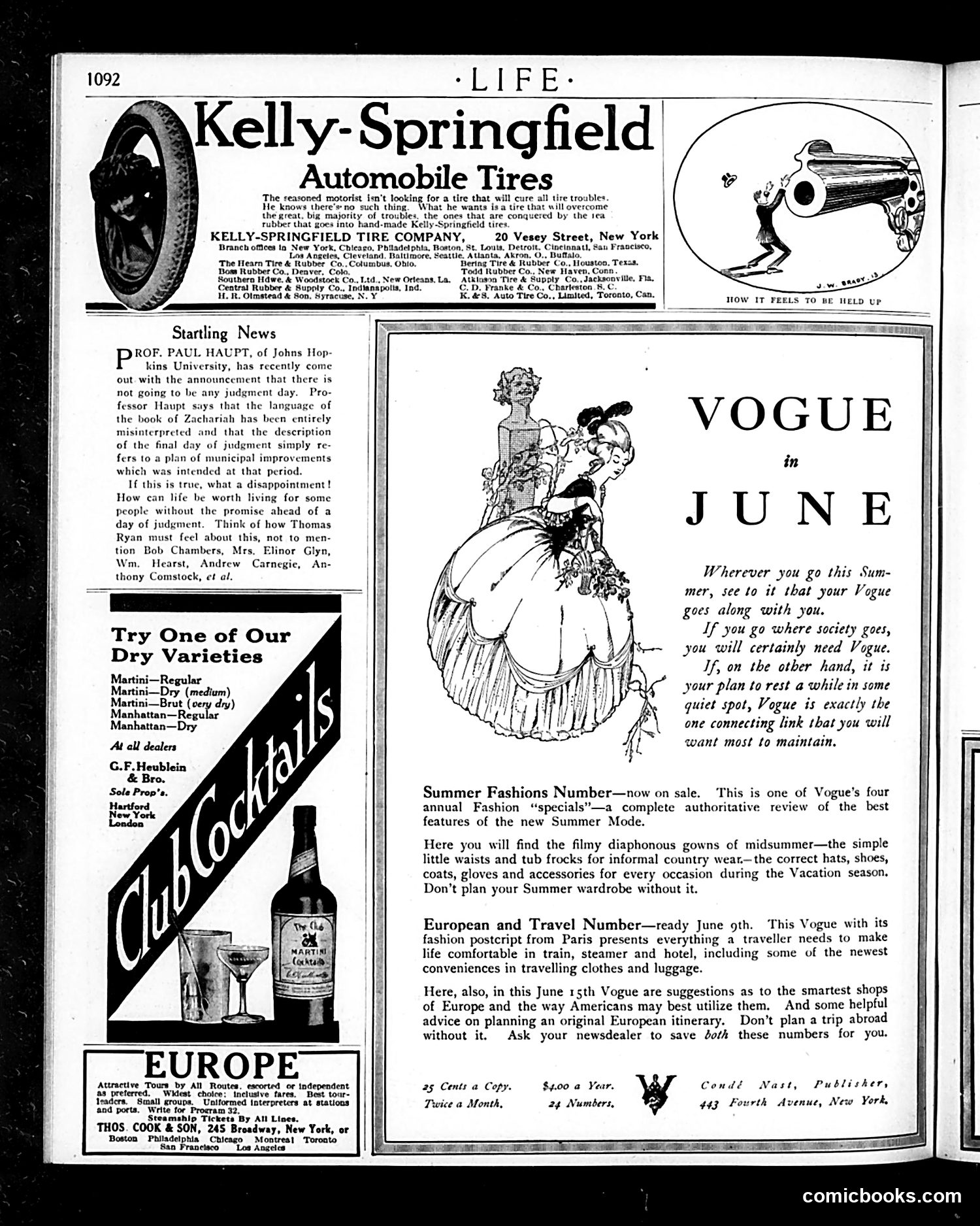
This page is primarily **advertising and fashion content**, not political satire. The main elements are: **"Startling News" section**: A brief satirical piece mocking wealthy industrialists and public figures (Thomas Ryan, Andrew Carnegie, Anthony Comstock, William Hearst, etc.) over a scholarly announcement that the biblical "Day of Judgment" was merely a misinterpretation—actually referring to ancient municipal improvements. The joke: these notoriously corrupt robber barons and moralists would be disappointed to learn there's no final judgment day to fear consequences. **Advertisements**: The page is dominated by ads for Kelly-Springfield automobile tires, Cockdails liquor, and—most prominently—**Vogue magazine's summer fashion issues**, emphasizing travel and European fashions for wealthy readers planning vacations. The overall tone reflects Life magazine's typical audience: affluent Americans interested in fashion, travel, automobiles, and satirical commentary on the wealthy elite.
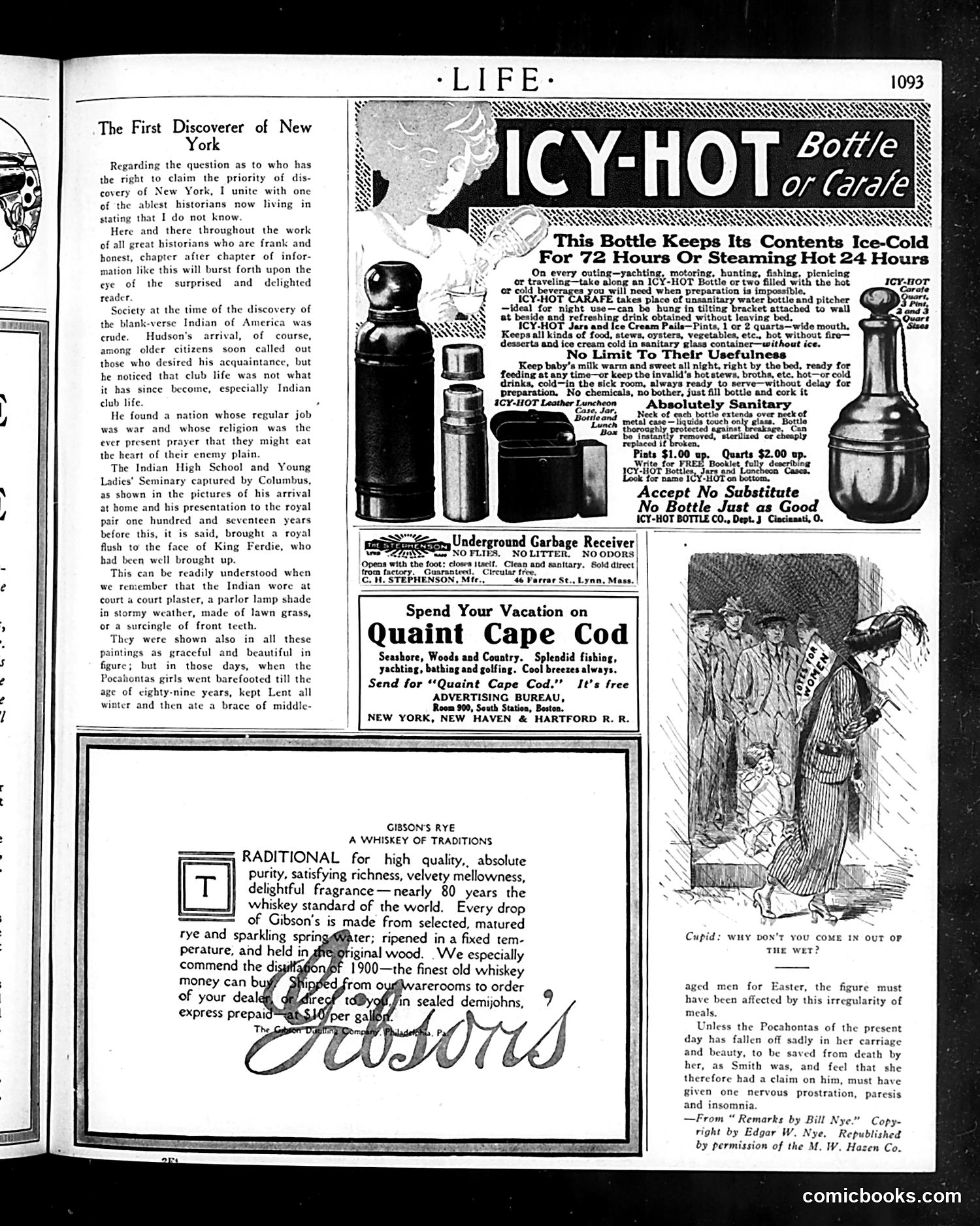
This page is primarily **advertising-heavy** rather than political satire. The main content is a humorous essay titled "The First Discoverer of New York" that mockingly addresses competing historical claims about who discovered New York. The piece satirizes **pretentious historiography**—the author admits not knowing who deserves credit, then provides absurdist "facts" about Native Americans and Columbus. It humorously portrays Indigenous peoples wearing ridiculous court attire (lawn-grass clothing, dental ornaments) and stereotypes them as perpetually warring, in the casual racist style typical of early 20th-century American humor magazines. The sidebar cartoon (right) titled "Cupid: Why Don't You Come In Out of the Wet?" appears unrelated—a romantic scene with unclear specific reference. The page's bulk consists of product advertisements: **ICY-HOT thermal bottles**, garbage receptacles, Cape Cod tourism, and Gibson's Rye whiskey—representative of Life's revenue model during this period (appears to be early 1900s based on design and references).
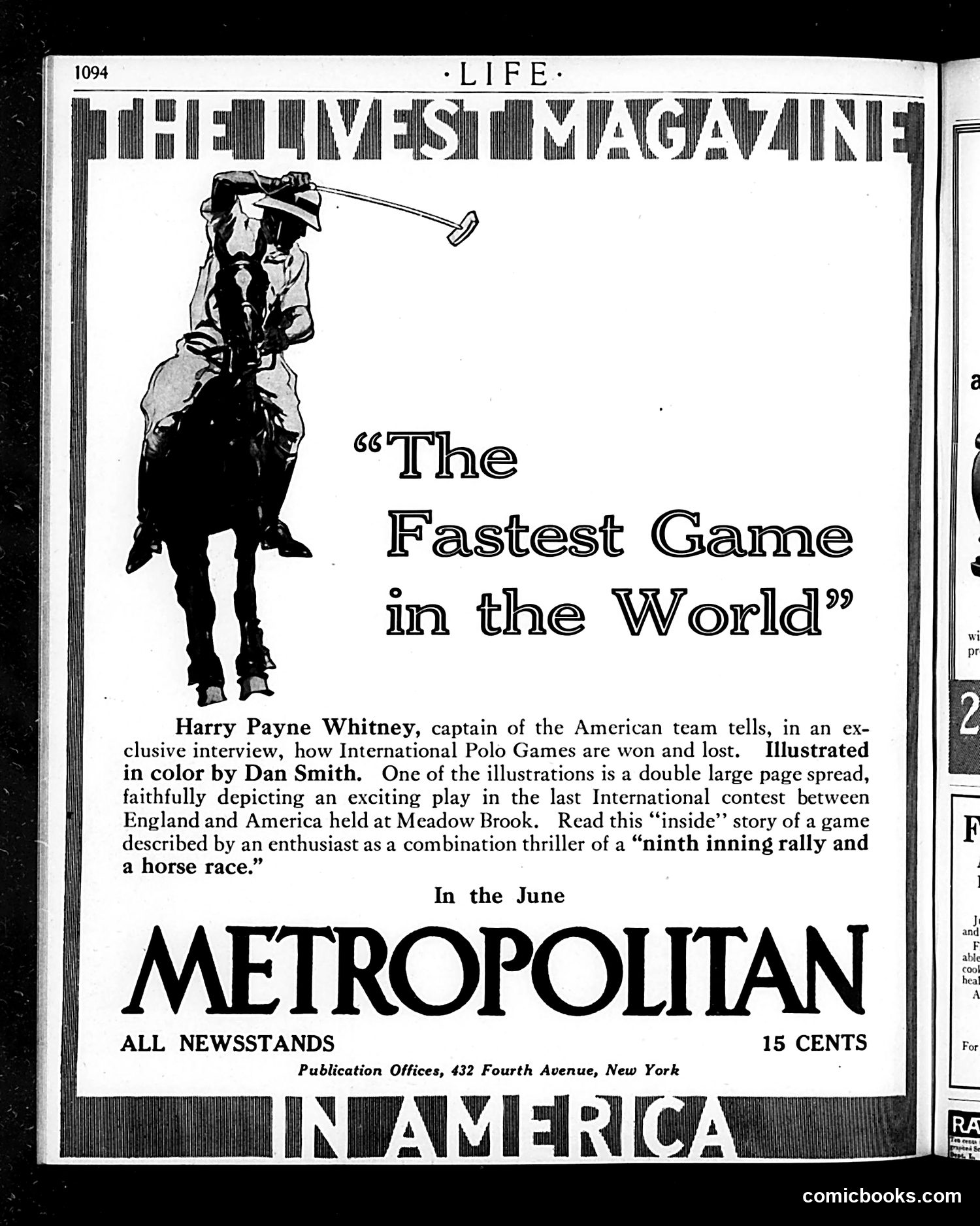
This is primarily an **advertisement for The Metropolitan Magazine's June issue**, not political satire. The illustration shows a polo player on horseback mid-swing—polo being a sport associated with wealthy American elites in this era. The ad promotes an exclusive article by **Harry Payne Whitney**, captain of the American polo team, discussing international polo competition between England and America at Meadow Brook. The language emphasizes dramatic stakes ("ninth inning rally and a horse race"), appealing to readers' interest in elite sporting competition. The content reflects early 20th-century American class attitudes: polo was an exclusive sport of the wealthy, and international matches carried nationalistic significance. The ad targets affluent, educated readers of *Life* magazine (priced at 15 cents when that was substantial). **No political satire is apparent here**—it's straightforward sports promotion emphasizing American competitiveness and upper-class leisure pursuits.
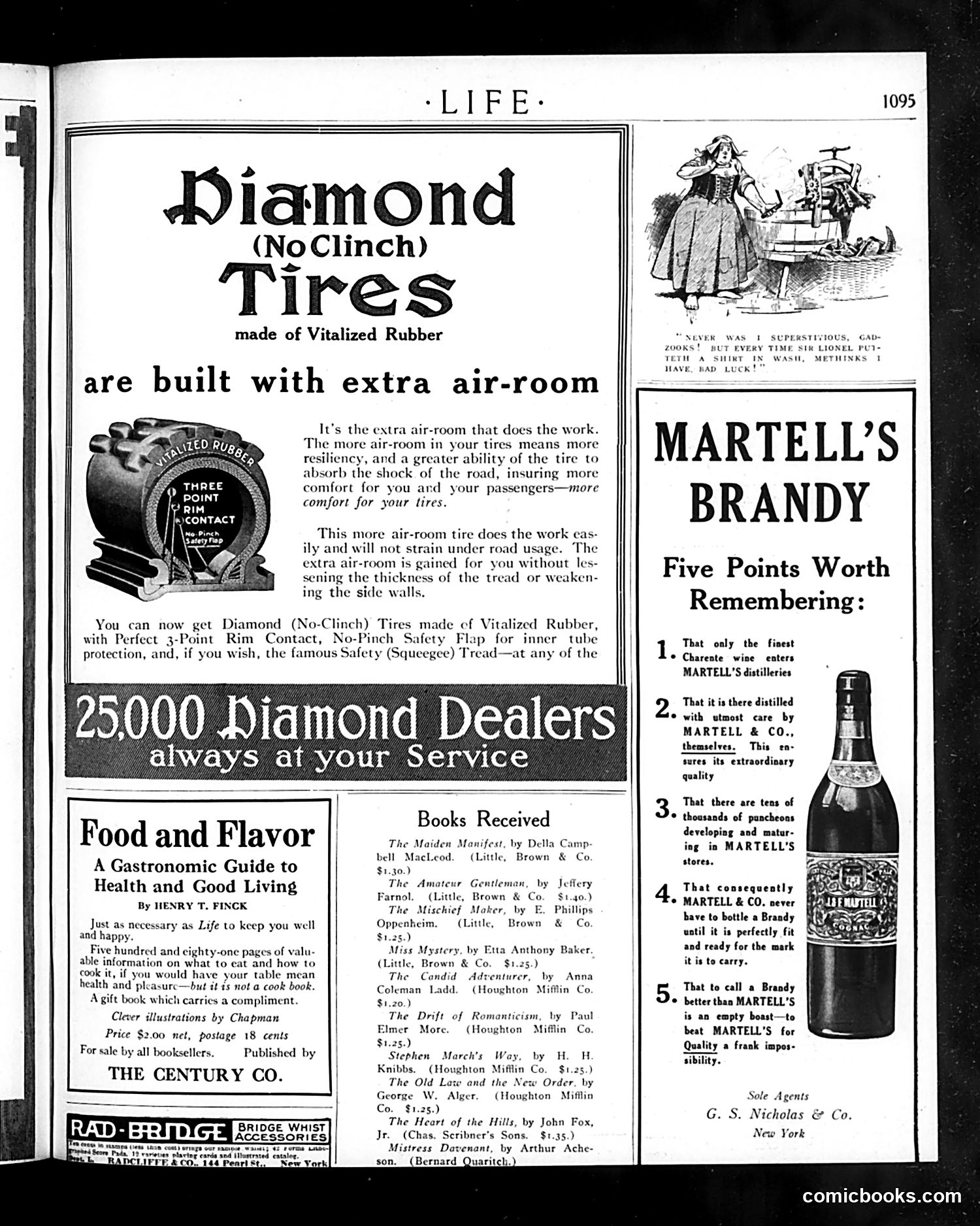
This page is primarily **advertising and book listings**, not political satire. The small cartoon in the upper right is the only comic element—it depicts a superstitious woman in period dress telling a servant that doing laundry brings bad luck, a mild domestic joke unrelated to politics or social commentary. The page's main content advertises **Diamond Tires** (emphasizing air-room technology) and **Martell's Brandy**, along with a "Books Received" section listing contemporary publications. The tire ad uses technical claims about resilience and comfort; the brandy ad emphasizes French distillery credentials and quality control. The lone cartoon makes a simple joke about household superstition—no deeper meaning or historical reference is evident. This appears to be a standard early-20th-century magazine page mixing consumer advertising with light humor and literary notices, rather than political or social satire.
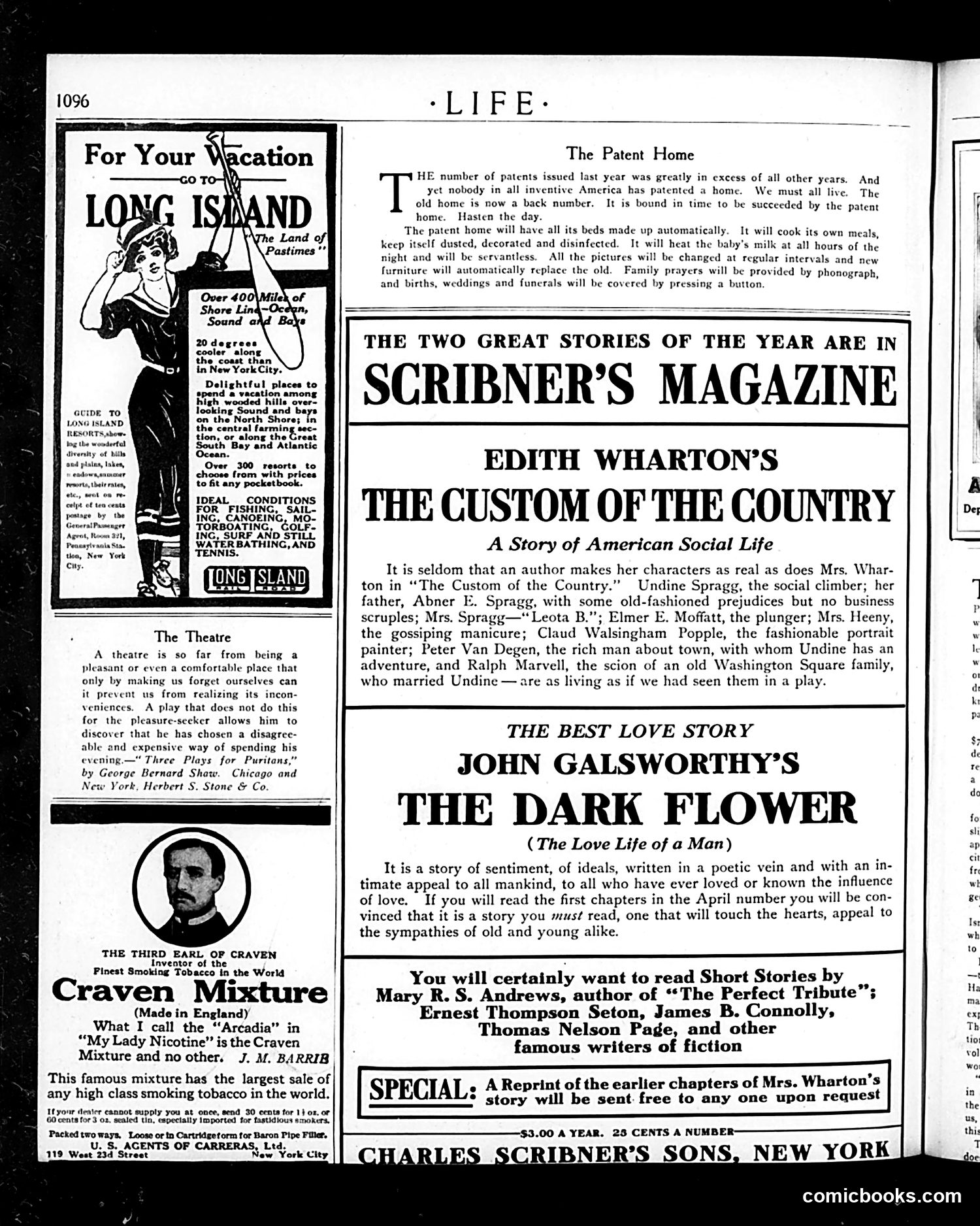
This page mixes advertisements with literary promotion, typical of early 20th-century magazines. The "Patent Home" section is satirical commentary on American technological optimism—it mockingly envisions a fully automated future home where beds make themselves, meals cook automatically, and even "family prayers" play via phonograph while funerals are handled by "pressing a button." The satire targets both utopian faith in invention and anxieties about servants and domestic labor disappearing. The page primarily advertises Scribner's Magazine's current serialized fiction: Edith Wharton's *The Custom of the Country* (about social climbing and American wealth) and John Galsworthy's *The Dark Flower* (a romantic story). Side advertisements promote Long Island vacations and Craven Mixture tobacco. The theatrical quote critiquing theater's discomforts adds a secondary satirical note about entertainment itself being uncomfortable despite its cost.
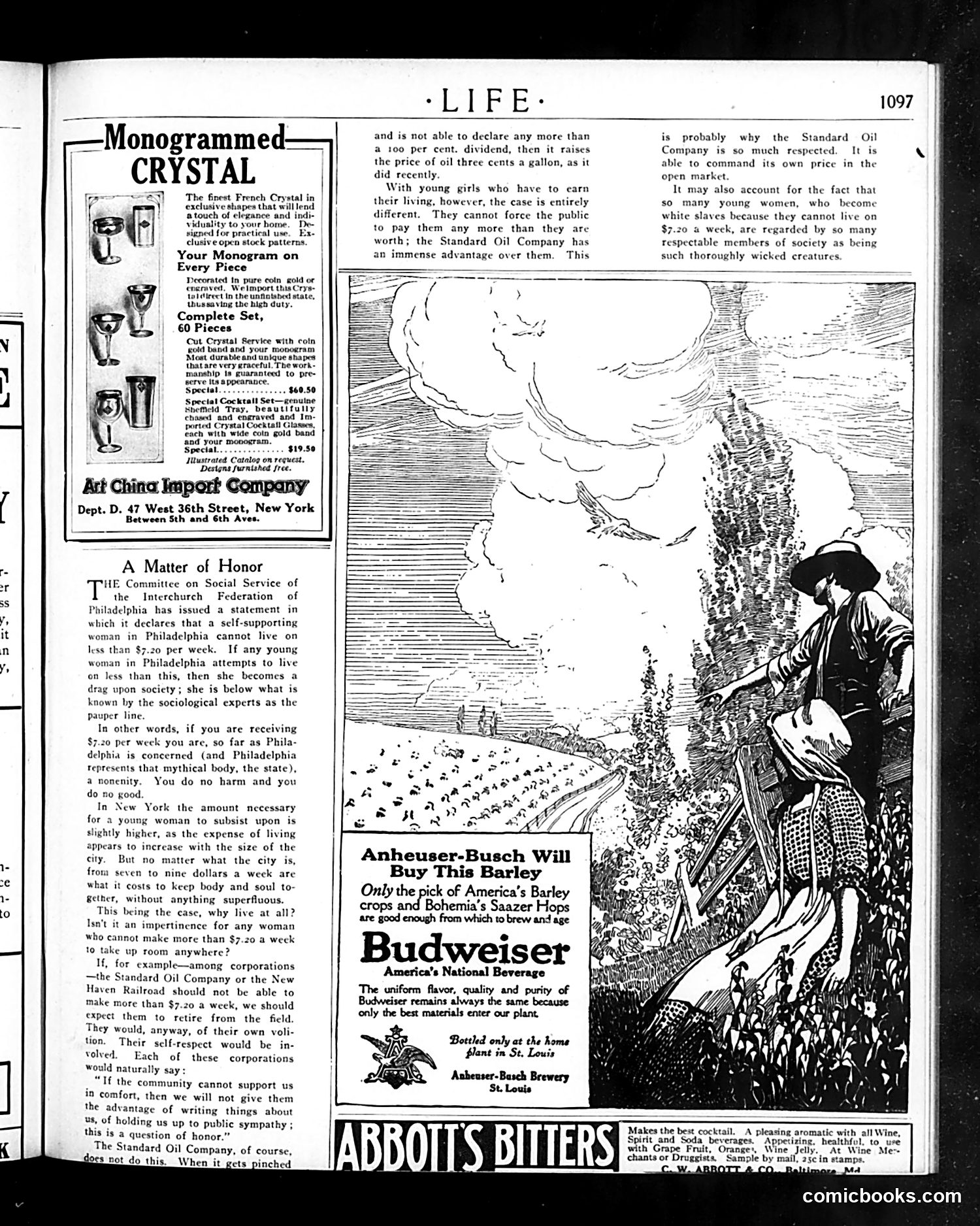
This article satirizes the hypocrisy of corporate America by exposing a double standard regarding minimum wages. Life contrasts how the Standard Oil Company—when unable to maintain high profit margins—raises oil prices to protect its interests, yet society condemns young working women who cannot survive on Philadelphia's declared subsistence wage of $7.20 weekly. The satire's bite: if corporations like Standard Oil or the New Haven Railroad couldn't earn adequate profit, they'd "retire from the field" with dignity. Yet women in identical economic straits are labeled "wicked creatures" and "drags upon society"—social pariahs forced into desperation. The author argues this reflects not morality but power: corporations can dictate prices; poor women cannot. The title "A Matter of Honor" drips with irony—suggesting society's "honor" actually masks indifference to women's suffering while protecting corporate interests.
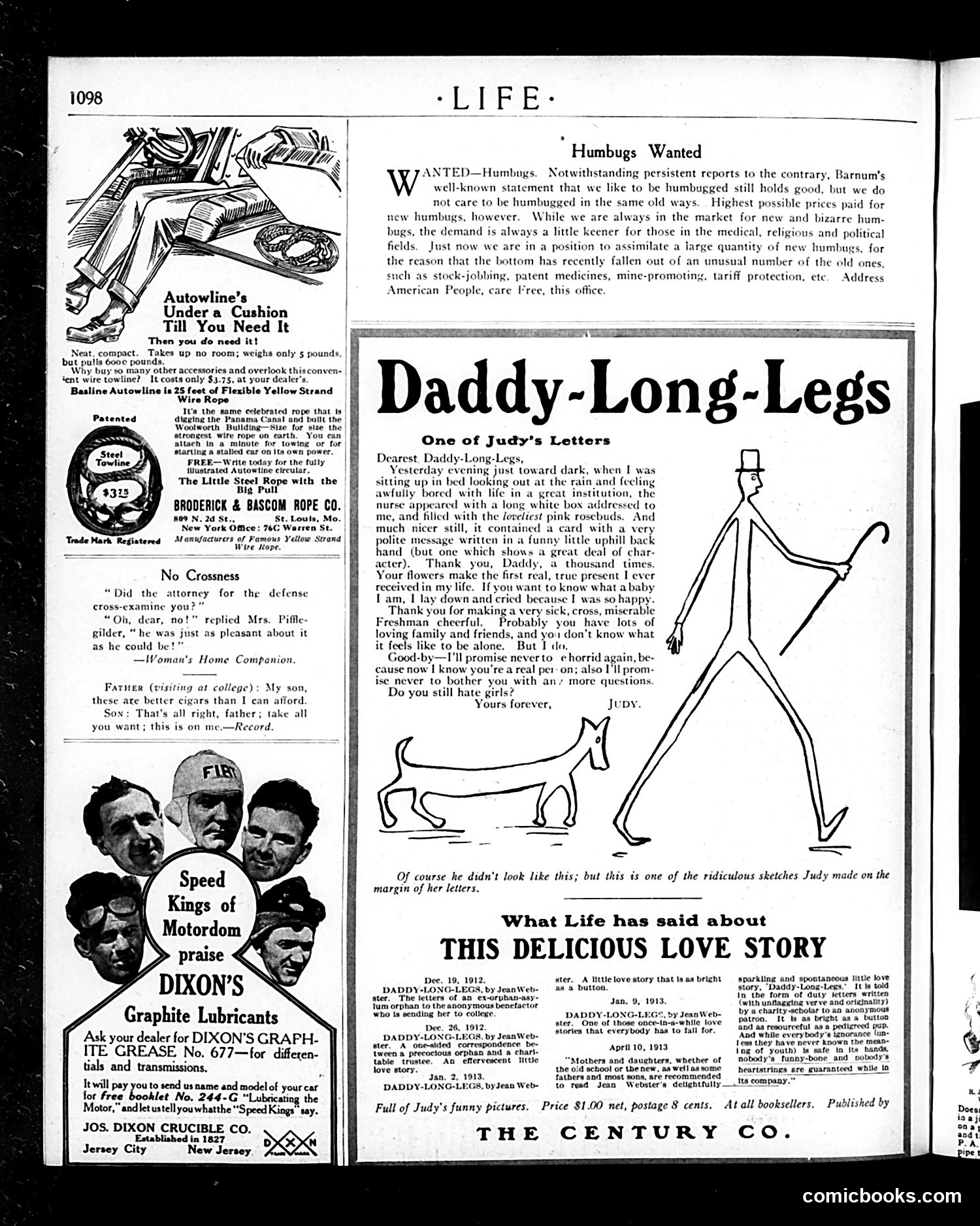
This page mixes advertisements with social commentary. The "Humbugs Wanted" section is satirical, listing old confidence schemes ("stock-jobbing, patent medicines, mine-promoting, tariff protection") whose "bottom has recently fallen out"—mocking how Americans perpetually fall for deceptions despite claiming to enjoy being "humbugged" (P.T. Barnum's famous phrase). It's cynical commentary on American gullibility. The main feature, "Daddy-Long-Legs," excerpts a popular novel serialized in Life. A young woman (Judy) writes gratefully to her mysterious wealthy benefactor about receiving flowers—a sentimental love story presented through her illustrated letters. The crude sketch of the title character with impossibly long legs appears to be Judy's own humorous drawing. The remaining advertisements (Autowline rope, Dixon's lubricants) are standard period marketing, with the "Speed Kings of Motordom" referencing early automobile racing celebrities.
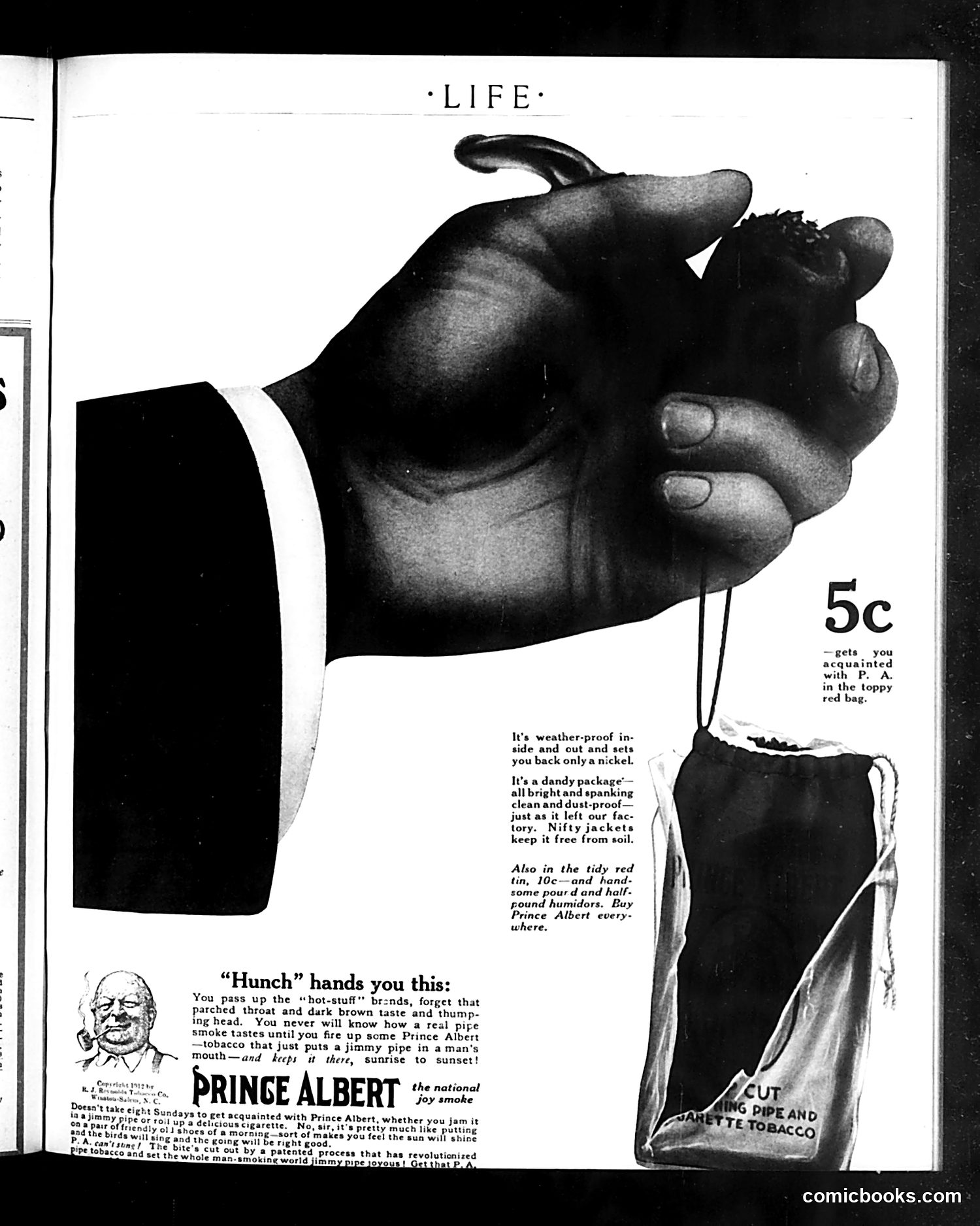
This is a **tobacco advertisement**, not political satire. It promotes Prince Albert pipe tobacco to male smokers, using a large photograph of a hand holding a pipe as the central visual. The ad's pitch emphasizes affordability (5 cents), quality ("weather-proof," "bright and spanking clean"), and the superior smoking experience compared to competing brands ("hot-stuff" alternatives). The copy uses casual, masculine language ("jimmy pipe") and claims the product is revolutionary due to a "patented process." The small illustrated portrait labeled "Hunch" appears to be either a brand mascot or a satisfied customer endorsement, adding a personal testimonial element to the pitch. **For modern readers:** This represents early 20th-century advertising's direct appeal to male consumers and the normalization of tobacco promotion in mainstream magazines—practices now heavily restricted or banned.
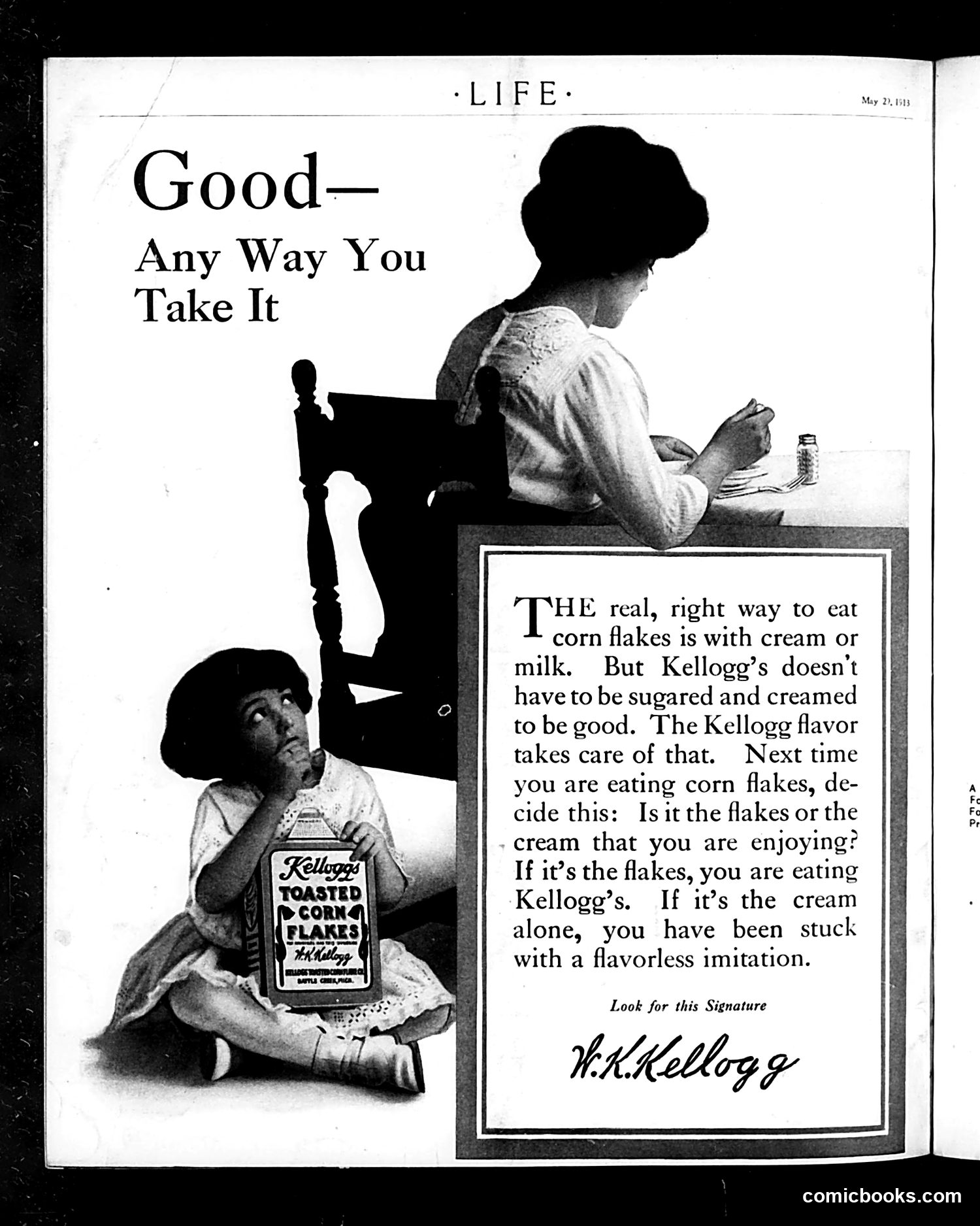
This is a **Kellogg's cereal advertisement**, not political satire. The page shows two figures—a child holding a Kellogg's Toasted Corn Flakes box (lower left) and a woman eating cereal at a table (upper right)—illustrating the product's appeal. The ad's argument is that Kellogg's corn flakes taste good *on their own*, without needing sugar or cream to be palatable. It challenges consumers to distinguish whether they're enjoying the flakes themselves or merely the added cream—implying competitors' cereals are flavorless and need sweetening. This positions Kellogg's as superior through inherent flavor rather than additives. The signature at bottom authenticates the product's quality claim.