
Life, 1913-05-29 · page 21 of 44
Life — May 29, 1913 — page 21: what you’re looking at
What you’re looking at
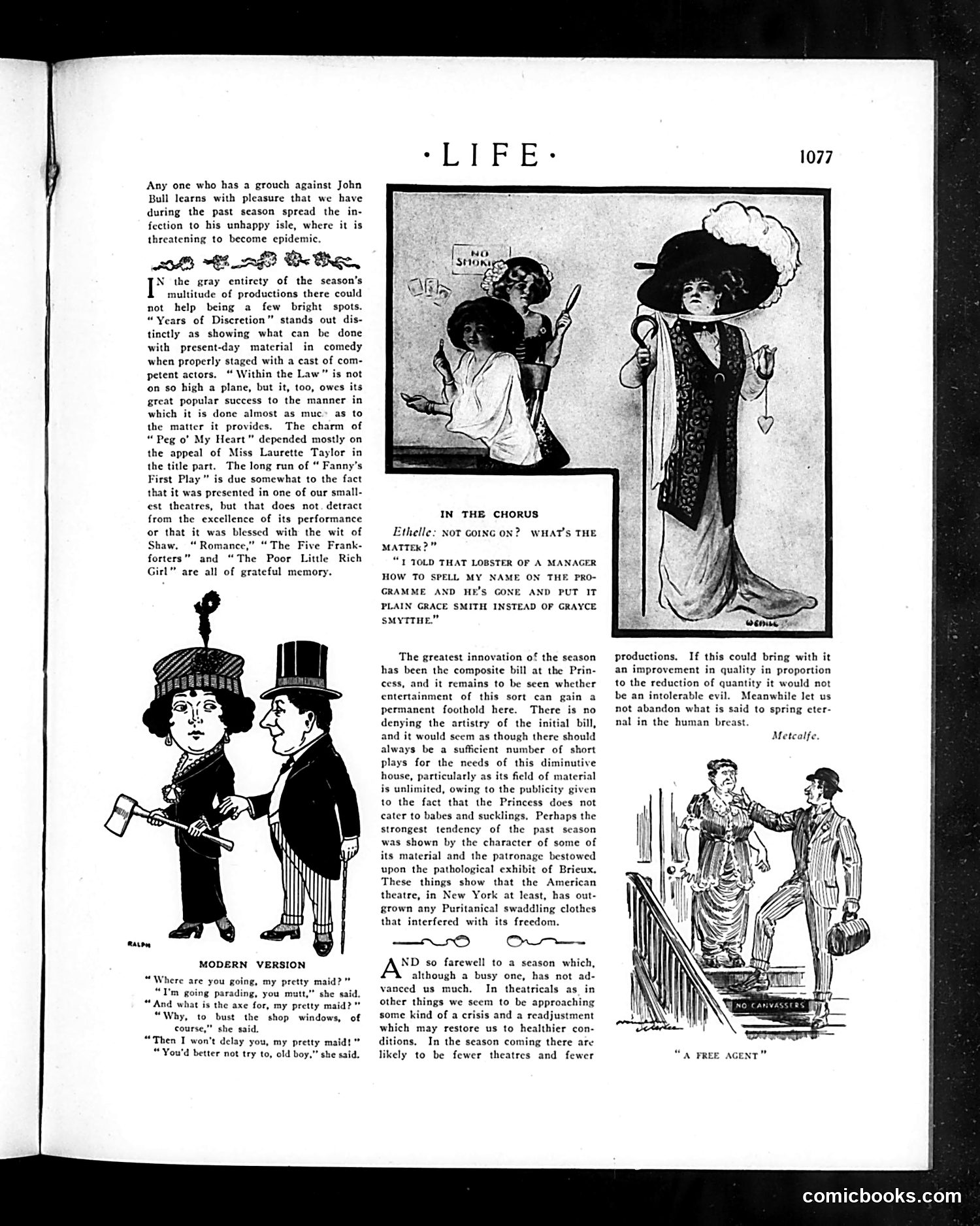
**"Modern Version" Cartoon (Left):** This depicts a suffragette—a woman demanding voting rights—carrying an axe. The dialogue parodies the nursery rhyme "Where Are You Going, My Pretty Maid?" but subverts it: instead of innocent answers, she threatens to "bust the shop windows" and warns a man not to interfere. This satirizes the militant tactics of British suffragettes (window-breaking, property destruction) around 1910-1914. The cartoon's title suggests this "modern" behavior contrasts sharply with Victorian propriety. **"In the Chorus" Dialogue:** A showgirl complains that her manager misspelled her stage name, removing the affected spelling ("Grayce Smytthe" instead of "Grace Smith"). This satirizes theatrical vanity and performers' pretensions. **Theater Reviews:** The text discusses Broadway's theatrical season, praising productions like "Years of Discretion" and criticizing others for relying on stars rather than script quality. The page overall mocks both women's political activism and theatrical pretension through humor.
📄 Transcribed text from this page (OCR, searchable)
Machine-transcribed from the original scan — historical spelling and the odd misread are preserved.
Any one who has a grouch against John Bull learns with pleasure that we have during the past season spread the in- fection to his unhappy isle, where it is threatening to become epidemic. O43 EA Ux Bree, N the gray entirety of the season's I multitude of productions there could not help being a few bright spots. “Years of Discretion” stands out dis- tinctly as showing what can be done with present-day material in comedy when properly staged with a cast of com- petent actors. “ Within the Law” is not on so high a plane, but it, too, owes its great popular success to the manner in which it is done almost as muc» as to the matter it provides. The charm of “ Peg o' My Heart" depended mostly on the appeal of Miss Laurette Taylor in the title part. The long run of “ Fanny's First Play” is due somewhat to the fact that it was presented in one of our small- est theatres, but that does not. detract from the excellence of its performance or that it was blessed with the wit of Shaw. “Romance,” “The Five Frank- forters” and “The Poor Little Rich Girl” are all of grateful memory. MODERN VERSION “Where are you going, my pretty maid?” “I'm going parading, you mutt,” she said. “ And what is the axe for, my pretty maid?" “Why, to bust the shop windows, of course,” she said. “Then I won't delay you, my pretty maid! “You'd better not try to, old boy,” she said. NO. SHOR IN THE CHORUS Ethelle. MATTEK?”” “1 10LD THAT LOBSTER OF A MANAGER HOW TO SPELL MY NAME ON THE PRO- GRAMME AND Hk’S GONE AND PUT IT PLAIN GRACE SMITH INSTEAD OF GRAYCE SMYTTHE.” NOT GOING WHAT'S THE The greatest innovation of the season has been the composite bill at the Prin- cess, and it remains to be seen whether entertainment of this sort can gain a permanent foothold here. There is no denying the artistry of the initial bill, and it would scem as though there should always be a sufficient number of short plays for the needs of this diminutive house, particularly as its field of material is unlimited, owing to the publicity given to the fact that the Princess does not cater to babes and sucklings, Perhaps the strongest tendency of the past season was shown by the character of some of its material and the patronage bestowed upon the pathological exhibit of Brieux. These things show that the American theatre, in New York at least, has out- grown any Puritanical swaddling clothes that interfered with its freedom. —aATOD Onn ND so farewell to a season which, although a busy one, has not ad- vanced us much. In theatricals as in other things we seem to be approaching some kind of a crisis and a readjustment which may restore us to healthier con- ditions. In the season coming there are likely to be fewer theatres and fewer productions, If this could bring with it an improvement in quality in proportion to the reduction of quantity it would not be an intolerable evil. Meanwhile let us not abandon what is said to spring eter- nal in the human breast. Metcalfe. comicbooks.com