
Life, 1913-05-29 · page 20 of 44
Life — May 29, 1913 — page 20: what you’re looking at
What you’re looking at
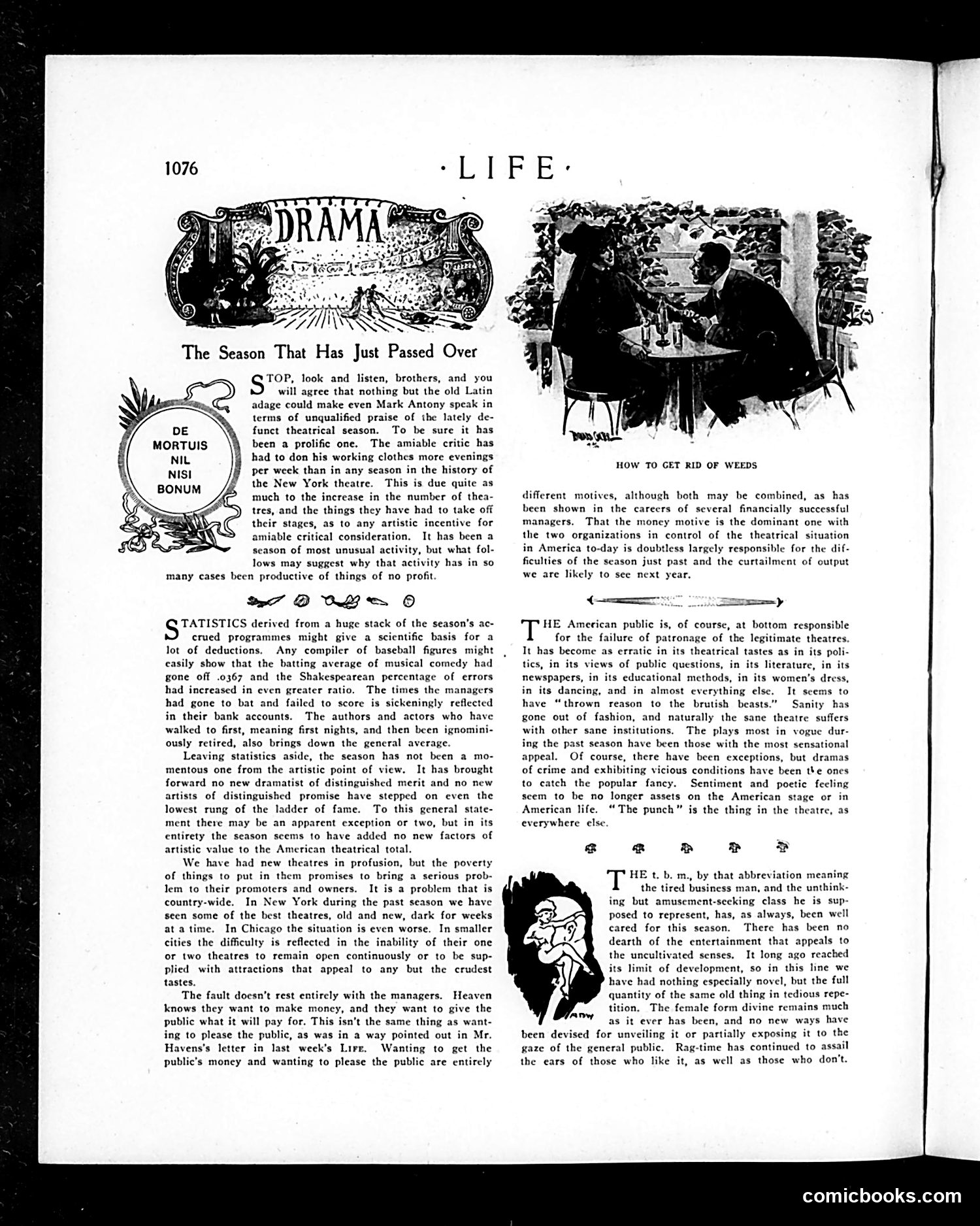
This Life magazine page critiques the recently-concluded Broadway theater season as artistically barren despite unprecedented activity. The Latin epigraph "De Mortuis Nil Nisi Bonum" ("Speak only good of the dead") sets a sardonic tone—the author must praise a dead season out of courtesy. The piece argues that while theaters proliferated and shows opened frequently, **no significant new talent emerged** and financial returns were dismal. Managers' bank accounts "sickeningly reflected" their failures. The author uses baseball statistics as metaphor: low batting averages, increased errors, many strikeouts. The core critique blames both theater management (prioritizing profit over artistic merit) and the fickle American public, whose theatrical tastes have become "as erratic" as their politics and fashion choices. The cartoon appears to illustrate the season's mediocrity, though specific figures are unclear from the image. The piece essentially diagnoses Broadway's malaise: plenty of venues but insufficient quality content to fill them—a problem affecting cities nationwide.
📄 Transcribed text from this page (OCR, searchable)
Machine-transcribed from the original scan — historical spelling and the odd misread are preserved.
SS The Season That Has Just Passed Over TOP, look and listen, brothers, and you will agree that nothing but the old Latin adage could make even Mark Antony speak in terms of unqualified praise of the lately de- DE funct theatrical season. To be sure it has MORTUIS been a prolific one. The amiable critic has had to don his working clothes more evenings per week than in any season in the history of the New York theatre. This is due quite as much to the increase in the number of thea- tres, and the things they have had to take off their stages, as to any artistic incentive for amiable critical consideration. It has been a season of most unusual activity, but what fol- lows may suggest why that activity has in so many cases been productive of things of no profit wa DOL O TATISTICS derived from a huge stack of the season's ac- crued programmes might give a scientific basis for a lot of deductions. Any compiler of baseball figures might casily show that the batting average of musical comedy had gone off .0367 and the Shakespearean percentage of errors had increased in even greater ratio. The times the managers had gone to bat and failed to score is sickeningly reflected in their bank accounts. The authors and actors who have walked to first, meaning first nights, and then been ignomini ously retired, also brings down the general averag Leaving statistics aside, the season has not been a mo- mentous one from the artistic point of view. It has brought forward no new dramatist of distinguished merit and no new artists of distinguished promise have stepped on even the lowest rung of the ladder of fame. To this general state- ment there may be an apparent exception or two, but in its entirety the season scems to have added no new factors of artistic value to the American theatrical total. We have had new theatres in profusion, but the poverty of things to put in them promises to bring a serious prob- lem to their promoters and owners. It is a problem that is country-wide. In New York during the past season we have seen some of the best theatres, old and new, dark for weeks at atime. In Chicago the situation is even worse. In smaller cities the difficulty is reflected in the inability of their one or two theatres to remain open continuously or to be sup- plied with attractions that appeal to any but the crudest tastes. The fault doesn’t rest entirely with the managers. Heaven knows they want to make moncy, and they want to give the public what it will pay for. This isn't the same thing as want- ing to please the public, as was in a way pointed out in Mr. Havens’s letter in last week's Lire. Wanting to get the public's money and wanting to please the public are entirely HOW TO GET RID OF WEEDS different motives, although both may be combined, as has been shown in the carecrs of several financially successful managers. That the money motive is the dominant one with the two organizations in control of the theatrical situation in America to-day is doubtless largely responsible for the dif- ficulties of the season just past and the curtailment of output we are likely to sec next year. —=_= HE American public is, of course, at bottom responsible for the failure of patronage of the legitimate theatres. It has become as erratic in its theatrical tastes as in its poli- tics, in its views of public questions, in its literature, in its newspapers, in its educational methods, in its women’s dress, in its dancing, and in almost everything else. It scems to have “thrown reason to the brutish beasts.” Sanity has gone out of fashion, and naturally the sane theatre suffers with other sane institutions. The plays most in vogue dur- ing the past season have been those with the most sensational appeal. Of course, there have been exceptions, but dramas of crime and exhibiting vicious conditions have been the ones to catch the popular fancy. Sentiment and poetic feeling scem to be no longer assets on the American stage or in American life. “The punch” is the thing in the theatre, as everywhere else g g i) ® 2 HE t. b. m., by that abbreviation meaning the tired business man, and the unthink- ing but amusement-seeking class he is sup- posed to represent, has, as always, been well cared for this season. There has been no dearth of the entertainment that appeals to the uncultivated senses. It long ago reached its limit of development, so in this line we have had nothing especially novel, but the full quantity of the same old thing in tedious repe- tition, The female form divine remains much as it ever has been, and no new ways have been devised for unveiling it or partially exposing it to the gaze of the general public. Rag-time has continued to assail the ears of those who like it, as well as those who don’t. comicbooks.com